INTRODUCTION
Mussels play an important role in coupling the pelagic and benthic food web, by importing a large portion of phytoplankton primary produc- tion and secondary production from the water column into the sediment (Loo and Rosenberg, 1989; Dame et al., 1985; Heath et al., 1995; Jack
and Throp, 2000). Thus, mussels redistribute en- ergy f low in the water column and the sediment through the food web and material cycling (Noordhius et al., 1992; Yamamuro and Koike, 1993; Heath et al., 1995; Gardner et al., 1995;
Dame, 1996).
Recent studies (Holland, 1993; Cotner et al., 1995; Fahnenstiel et al., 1995; Lavrentyev et al., 1995; Hwang, 1996) have demonstrated that
* Corresponding Author: Tel: 02) 450-3748, Fax: 02) 456-5062, E-mail: [email protected]
─
─ 298 ──
Filter- - Feeding Effect of a Freshwater Bivalve (Corbicula leana PRIME) on Phytoplankton
Hwang, Soon--Jin*, Ho--Sub Kim and Jae--Ki Shin
(Department of Biological Systems Engineering, Konkuk University, Hwayang-dong, Kwangjin-gu, Seoul, 143-701, Korea)
The purpose of this study was to evaluate the f iltering--feeding effect of a freshwater mussel (Corbicula leana) on the phytoplankton communities in two lakes with different trophic conditions between June and September, 2000. Manipulation experiments were conducted with two treatments (the control and mussel addition), and each established in duplicate 10 l chambers. Both ambient nutrient (TN, TP) and chlorophyll--a concentrations were significantly (p⁄⁄0.01) higher in Lake Ilgam than Lake Soyang. Cyanophytes (Microcystis, Oscillatoria, Lyngbya and Dactylococcopis) consistently dominated algal community in Lake Ilgam, while flagellated algae (Dinobryon divergence, Mallomonas, Rhodomonas) and cyanophytes (Microcystis) dominated in Lake Soyang. The net exponential death rate (R = day-1) of total phytoplankton in the mussel treatment ranged 1.70~7.39 and 0.38~1.64 in Lakes Soyang and Ilgam, respectively. Mean filtering rate standardized by mussel AFDW (ml mgAFDW-1h-1) was much higher in Lake Soyang (1.70~3.06) than in Lake Ilgam (0.24~0.88). Estimating FR per mussel, 1 mussel f iltered 1.6~7.8 l per day and 1.7~3.0 l per day in Lakes Soyang and Ilgam, respectively. Based on the C--f lux to biomass ratio, Corbicula leana consumed 0.8~4.4 fold of phytoplankton standing stock in Lake Soyang, and 0.4~1.6 fold in Lake Ilgam per day. Mussel feeding resulted in increase of SRP concentration by 30~50%, compared with the control.
The results of this study suggest that f ilter-- feeding activity of Corbicula leana varies depending on the phytoplankton density and community composition. The high seston consumption rate of Corbicula leana even in a eutrophic lake suggests that biomanipulation approach using f ilter--feeding mussels can be used for water quality management in small eutrophic reservoirs.
Key words : Filter feeding, Freshwater bivalve, Phytoplankton, C-- f lux, Nutrient recycling, Water quality management
mussels are eff icient f ilter feeders being able to take up suspended particles, including bacteria, protists, phytoplankton, zooplankton, and abiotic particles. One of the most well studied bivalves, the zebra mussel, has been reported to f ilter a wide range of plankton, from bacterioplankton to zooplankton, at a rate of about 1 l mussel-1day-1, and improve water clarity in aquatic systems (Holland, 1983). Strong filter feeding effects on aquatic sestons also have been observed in other mussel species, especially some solitary-living bivalves (Foster-Smith, 1975; Wright et al., 1982;
Dame, 1996).
From the management perspective, high capa- city of filter-feeding activities using mussels can be applied to water quality control as a biofilter (Reeders et al., 1989; Reeders and Bij de Vaate, 1990; Soto and Mena, 1999), if they were used and managed appropriately. In the Netherlands, the zebra mussels were introduced to control severe algal blooms in small, eutrophicated lakes (Noordhius et al., 1992). The results showed that Secchi transparency in the mussel-introduced lake, increased from 60 cm to 100 cm, and such condition was maintained throughout the entire year of the experiment. They also demonstrated that the simultaneous application of mussels and fish stock within the framework of active biolo- gical management increased the eff iciency.
Similarly, Soto and Mena (1999) showed that a solitary-living freshwater mussel (Diploden chilensis) was able to contribute to biocontrol of eutrophication caused by salmon aquaculture in Lake Llanquihue, Chile.
Mussel effects on phytoplankton biomass in Asian freshwater systems are not much studied.
Populations of Corbicula, Asian introduced spe- cies to North America, increased rapidly in the exotic environments, as zebra mussel did (Gunn- ing and Suttkus, 1966). Its ecology and distribu- tion have been more studied in North America rather than in Asia (Dresler and Cory, 1980; Hill and Knight, 1981; Cohen et al., 1984). The high f iltering rate of Corbicula was applied to waste- water treatment (Haines, 1979). However, the detailed feeding ecology and effects of Corbicula on energy f low and material cycling remain lar- gely to be solved (Yamamuro and Koike, 1993).
The purpose of this study was to evaluate the f ilter-feeding effect of Corbicula leana on phyto- plankton communities, in order further to seek its possible use as a biof ilter in the water quality
management of small eutrophic lakes in Korea.
In this study, we focused on the mussel effect on different phytoplankton communities and den- sities by conducting feeding experiments with lake waters of different trophic status.
MATERIALS AND METHODS
General description of the mussel
Corbicula is found to be very common in many lakes and rivers in Korea, and widely distributed throughout southern regions of the Korean pen- insula. The genus is reported to include 6 species in Korea (Kwon, 1990). Corbicula leana Prime, used in this study, is known to be more tolerant to water pollution than any other species of this genus (Lee and Kim, 1997). Recent molecular systematic study on the genus Corbicula showed that molecular similarity was highest between C.
leana and C. colorata (0.737) along with the se- cond highest similarity between C. leana and C.
fluminea (0.689) (Lee and Kim, 1997).
C. leana was collected using a mussel collector in the upstream of the Han River (the largest river in Korea), where the river water was meso- trophic and the depth was about 2 m. Collected mussels were transported to the laboratory, and acclimated in several aquaria with sand and mud collected from the sampling site. The lake water in the aquaria was replaced every 5~7 day to provide new food sources. Mussels were transferred into a new aquarium, f illed with GF/
C f iltered lake water, one day before the experi- ment. We used healthy-looking mussels in the experiment and their age was approximately 2~3 years old.
Study sites
This study was conducted in two lakes with different trophic states. Lake Soyang, located in the upstream of the Han River, is a large arti- ficial lake made by a dam constructed for the multi-purpose of hydroelectricity and drinking water. The maximum and mean depth of the lake are 100 m and 42 m, respectively. It has a very large drainage area (2,703 km2), which con- sisted mostly of forest and agricultural area (Kim et al., 2000). The primary productivity of Lake Soyang has slowly increased, and the cur- rent trophic status of the lake is mesotrophic
with dominant algae are of diatoms. In contrast, Lake Ilgam, located in the downtown of metero- politan area (Seoul), is small (mean depth: 1.6 m, surface area: 55,661 m2) and is a hypertrophic condition. The dominant algae in Lake Ilgam are colonial and filamentous cyanobacteria.
Sample collections and measurements of water quality parameters
Sampling was conducted at monthly intervals, from June to September 2000, at the deepest site of Lake Ilgam and a site near the dam in Lake Soyang. Water samples were collected from the epilimnion (0.5 m) in both lakes between 10:00 and 12:00 hours, using a 3.2 l Van Dorn water sampler. Water samples were placed in acid- washed 20 l polyethylene carboys, and kept in the shade at nearly ambient temperature during the transportation.
Water samples were f iltered through pre-com- busted GF/F f ilters to determine chlorophyll-a and suspended solids concentrations (APHA, 1995). Chlorophyll-a (chl. a) concentration was determined by the method of Lorenzen (1967).
Water samples for soluble reactive phosphorus (SRP) and nitrate were filtered using 0.2µm polycarbonated membrane f ilters. SRP and nitrate-N were determined with ascorbic acid method and cadmium reduction method (APHA, 1995), respectively. Total phosphorus (TP) and total nitrogen (TN) concentrations were deter- mined by the ascorbic acid method and cadmium reduction method, respectively, after decom- posing with alkalate pursulfate (APHA, 1995).
Water temperature, pH, and specif ic conducti- vity were measured with Hydro-Lab (RS-232/
SDI-12) and water transparency was determin- ed with a black-white (20 cm diameter) Secchi Disk in the f ield. For phytoplankton analysis, duplicated 100 ml aliquots were taken, placed in Whirl-Pak bags, and immediately preserved with Lugol’s solution (2%, f inal conc.).
Mussel feeding experiment
The feeding experiment was conducted on site in 10 l chambers with wide-open mouth in du- plicate, without and with mussels (1 mussel/l). To minimize the effect of large zooplankton, lake water was pre-f iltered through 200µm mesh before added to all chambers, including the con- trol. As soon as mussels were added, duplicated
100 ml aliquots were sampled from each cham- ber, placed in Whirl-Pak bags, and preserved with Lugol’s solution (2%, f inal conc.). Chambers were transported to the laboratory, and incubat- ed for 24 hours at nearly ambient temperature.
After 24 hours, duplicated 100 ml aliquots were carefully removed from the middle of the water column, and preserved as described above. Then, subsamples were taken in order to determine nitrogen and phosphorus changes caused by mussels feeding on phytoplankton in the mussel treatment.
The net death rate (R = day-1) of phytoplankton was calculated using the following equation :
R = (lnNt-lnNo)/t
where No and Nt are initial and f inal cell den- sities, and t is a duration of the experiment.
Ash-free dry weights (AFDW) of mussels were determined by measuring the weight of soft tis- sues of mussels. After feeding experiments done, shells were opened, and tissues were carefully placed into combusted, pre-weighed aluminum planchets, dried 100�C for 72 hours, and com- busted at 500�C for 2 hours. Mussel filtering rate (FR = ml mgAFDW-1 h-1) on phytoplankton was determined for each experiment by the following equation :
FR = V×ln (C/M) / (W×t)
where V is lake water volume (l) in the container;
M and C were the f inal densities of phytoplank- ton in containers with and without mussels, res- pectively; W is the AFDW of mussels; and t is the duration of experiments.
Enumeration and biomass determination of phytoplankton
Phytoplankton were sedimented for 24 hours, and known volume of concentrated sample was placed in 1 ml Sedgewick-Rafter counting cham- ber. At least 300 cells were counted under 200~
400 fold magnification of a microscope. Algal bio- volume was determined on the basis of geometric solid which closely approximated each cell or col- ony shape (Kellar et al., 1980; Wetzel and Likens, 1991). Cell size of each species was measured separately on at least 10 cells in each sample.
Carbon biomass of phytoplankton was calculated using several conversion factors: 10(-0.427±0.784 (log Vµm3))µgC for bacillariophytes (Mullin et al., 1966),
10(-0.460±0.866(log µm3))µgC for cyanophytes and chlo- rophytes (Mullin et al., 1966), and 200 fgC/µm3 for phototrophic flagellates (Strathmann, 1967).
Statistical analysis
One-way analysis of variance (ANOVA) was used to compare environmental parameters be- tween two sites. Student t-test was done to com- pare phytoplankton growth rates and mussel f il- tering rates between two lakes.
RESULTS AND DISCUSSION
Limnological conditions
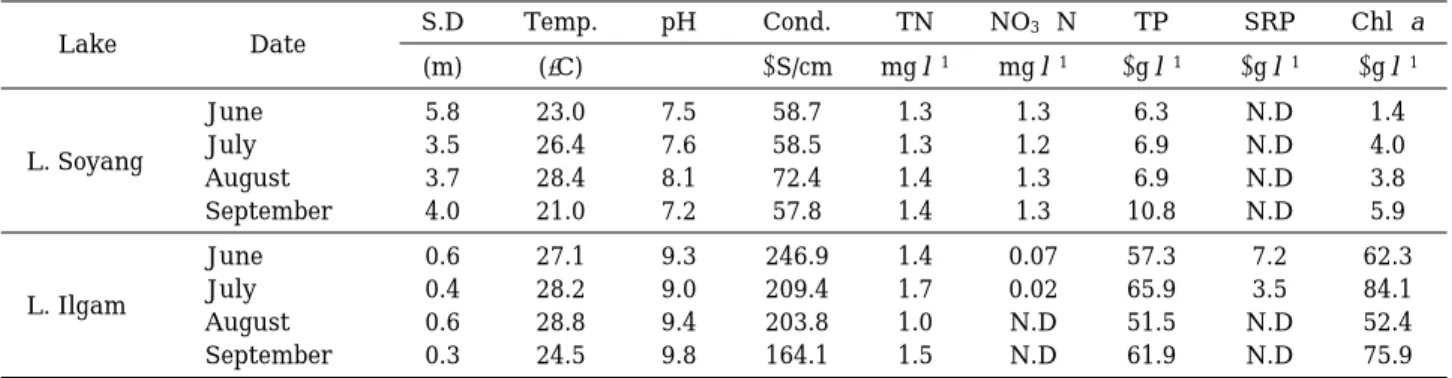
Two lakes showed a distinct contrast in the limnological characteristics. The most parame- ters including secchi depth, pH, specific conduc- tivity, TP and chl-a showed significant (p⁄0.01) differences between the two Lakes (Table 1). The
trophic condition of Lake Ilgam was much higher.
The differences in TN and SRP, however, were minor between two lakes. Considering higher chl-a in Lake Ilgam, inorganic nitrogen may contribute to the nitrogen pool in Lake Soyang.
Interestingly, nitrate concentration in Lake Ilgam was signif icantly (p⁄0.01) lower than Lake Soyang, indicating its active uptake by algae.
Similarly, low concentration of SRP might be due to a rapid uptake by phytoplankton photosyn- thesis in both lakes.
Ambient phytoplankton composition and biomass
Two lakes showed a distinct difference in the phytoplankton compositions during the study period (Table 2). In Lake Soyang, dominant taxa changed from flagellate algae, Dinobryon, Rho- domonas and Mallomonas in June, through Aul- acoseira in July to Microcystis, in September. In
Table 1. Limnological characteristics of Lakes Soyang and Ilgam between June and September 2000. Terms of S.D. and SRP denote Secchi depth transparency and soluble reactive phosphorus, respectively. N.D. denotes the detection limit of NO3-N and SRP (⁄0.02 Nmg/l, ⁄2.2µgP/l).
Lake Date S.D Temp. pH Cond. TN NO3-N TP SRP Chl-a
(m) (�C) µS/cm mg l-1 mg l-1 µg l-1 µg l-1 µg l-1
June 5.8 23.0 7.5 58.7 1.3 1.3 6.3 N.D 1.4
L. Soyang July 3.5 26.4 7.6 58.5 1.3 1.2 6.9 N.D 4.0
August 3.7 28.4 8.1 72.4 1.4 1.3 6.9 N.D 3.8
September 4.0 21.0 7.2 57.8 1.4 1.3 10.8 N.D 5.9
June 0.6 27.1 9.3 246.9 1.4 0.07 57.3 7.2 62.3
L. Ilgam July 0.4 28.2 9.0 209.4 1.7 0.02 65.9 3.5 84.1
August 0.6 28.8 9.4 203.8 1.0 N.D 51.5 N.D 52.4
September 0.3 24.5 9.8 164.1 1.5 N.D 61.9 N.D 75.9
Table 2. List of dominant phytoplankton taxa in Lakes Soyang and Ilgam between June and September 2000. Dominant taxa represent greater than 5% of total cell density (d) or biomass (b) in each lake.
Month \ Lake L. Soyang L. Ilgam
Dianobryon divergence (d)
Oscillatoria spp. (d, b)
June Rhodomonas sp. (d)
Microcystis aeruginosa (b) Mallomonas sp. (b)
Microcystis aeruginosa (d)
July Aulacoseira varians (d) Lyngbya contarata (d)
Ceratium hirundinella (b) Apanocapsa delicatissium (d) Peridinium sp. (b)
August M. aeruginosa (d)
Peridinium sp. (b) Oscillatoria spp. (d) Peridinium sp. (b) Aulacoseira varians (d)
September Microcystis aeruginosa (d) Dactylococcopis acicularis (d, b) Ochromonas mutabilis (b) Peridinium sp. (b)
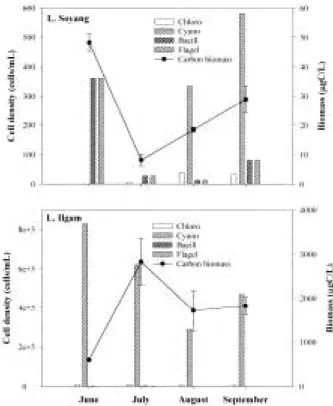
contrast, cyanobacteria were most dominant in Lake Ilgam during June-September, especially Microcystis followed by Oscillatoria, Lyngbya, and Dactylococcopis.
Cell density and biomass of phytoplankton in Lake Ilgam were signif icantly (p⁄0.01) higher than those in Lake Soyang (Fig. 1). Temporal changes in phytoplankton cell density and bio- mass did not always coincide with those in bio- mass. Flagellated algae, including Dinobryon, Chlamydomonas, and Mallomonas, largely ap- peared (55~99% of total biomass) in Lake So- yang. In Lake Ilgam, cyanobacteria were always dominant, in the cell density range of ¤98%.
However, their biomass was highest (54~59%) in July and August when f lagellated algae (especi- ally, Peridinium) occurred.
Feeding effects of Corbicula leana on phytoplankton communities
Effects on phytoplankton abundance and carbon biomass: Feeding effects of the mussel on phyto-
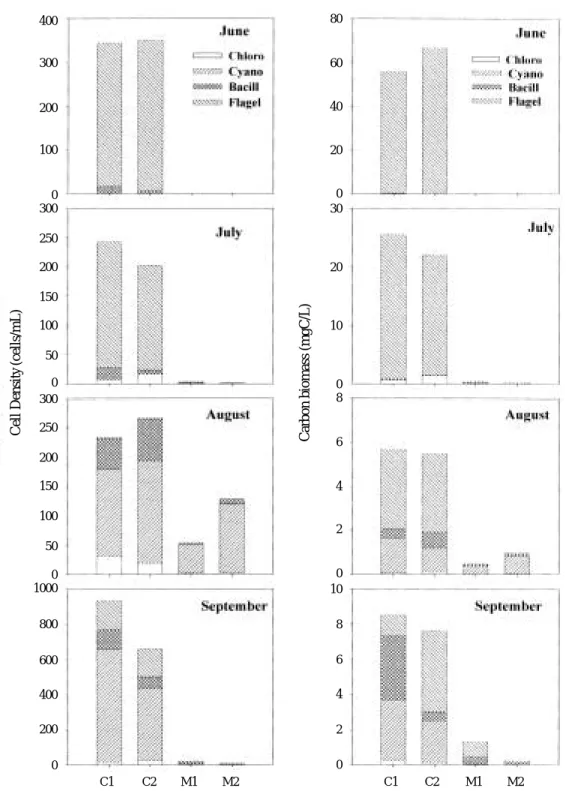
plankton were considerably different in two lakes (Figs. 2, 3). In Lake Soyang, the declining pattern in both cell and carbon biomass was al- most the same, and the proportion of both phyto- plankton cell and carbon in the mussel treat- ment was within 0~36% of the control (Fig. 2).
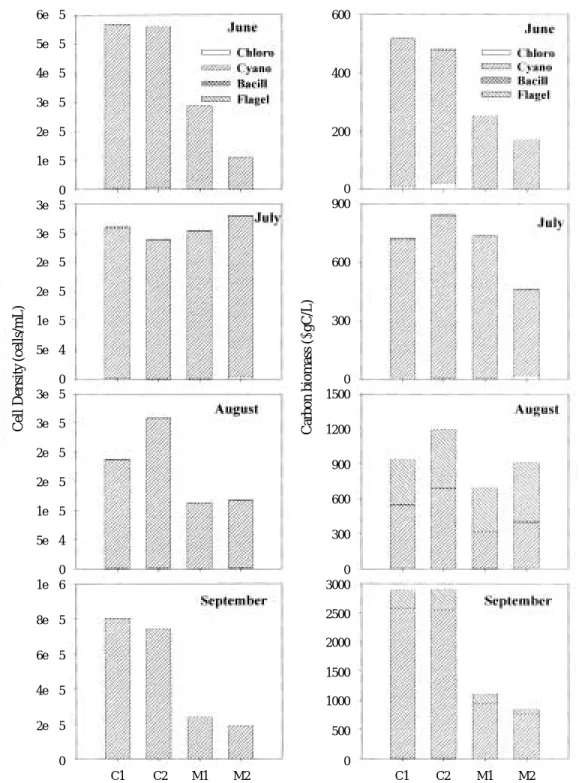
Except for the period of August, when M. aeru- ginosa dominated, almost all phytoplankton was removed in the mussel treatment. These results indicate that phytoplankton in Lake Soyang were nearly grazed, and most phytoplankton was in a favorable size range for mussel f iltering (Winkel and Davids, 1982; Hwang, 1996). In Lake Ilgam, the mussels also signif icantly re- duced phytoplankton density, but the magnitude of grazing effects was small in comparison with that observed in Lake Soyang (Fig. 3). The pro- portion of remaining phytoplankton in the mussel treatment, in comparison with the control, was 27~107% in density and 34~76% in biomass during the study period.
The signif icant difference of feeding effects of the mussel on phytoplankton in two lakes sug- gests that the cell density and species composi- tion of phytoplankton are of important factors in mussel feeding on them. Several previous studies indicated that mussel f iltering rate was positi- vely related to the food density (Winter, 1973;
Sprung and Rose, 1988; Reeders and Bil de Vatte, 1990; Hwang, 1996). However, the ranges of phytoplankton cell density, in which the filter- ing rate of mussel increase, vary depending on the food sources and mussel species (Sprung and Rose, 1988; Dorgelo and Smeenk, 1988; Winter, 1973). Hwang (1996) noted that zebra mussel f iltering rate was 5-fold lower in the eutrophic, cyanobacteria-dominated region of Saginaw Bay than in the oligo-mesotrophic diatom and flagel- late-dominated region. The results agrees with our findings, where the feeding effects of the mussel on phytoplankton was clearly higher in mesotrophic Lake Soyang than in hypertrophic Lake Ilgam (Figs. 2, 3).
Phytoplankton mortality and mussel f iltering rate:
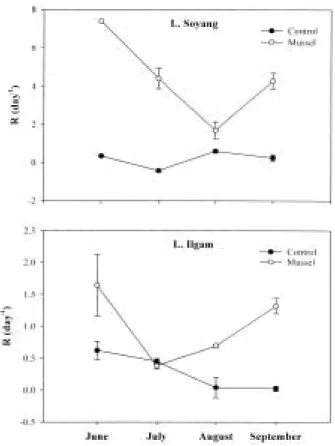
Mussel effect on phytoplankton mortality always was greater in Lake Soyang (1.70~7.39 day-1) than in Lake Ilgam (0.38~1.64 day-1), and its mean difference was 4-fold (Fig. 4), and the dif- ference of mean mortality was signif icant (p⁄
0.05).
Similarly, f iltering rate (ml mgAFDW-1 h-1) was always higher in Lake Soyang (1.70~3.06)
Fig. 1. Ambient phytoplankton density and carbon bio- mass in Lakes Soyang and Ilgam between June and September 2000. Chloro, Cyano, Bacill, and Flagel denote chlorophytes, cyanophytes, bacillar- iophytes, and f lagellates, respectively.
than in Lake Ilgam (0.24~0.88) (Fig. 5), and resulting difference of both f iltering rates were signif icant (p⁄0.05). Filtering rate per mussel (l mussel-1day-1) also was greater in Lake Soyang (1.6~7.8) than in Lake Ilgam (1.7~3.0) (Fig. 5).
This range is comparable to that of the zebra mussel (0.09~2.4) but greater than that of Cor- bicula f luminea (0.38~1.64) (Cohen et al., 1984;
Hwang, 1996; Reeders et al., 1989). The disa- greement of the highest values in both f iltering
Fig. 2. Phytoplankton density and carbon biomass in different treatments (C1: control 1, C2: control 2, M1: mussel addition 1, M2: mussel addition 2) of feeding experiment in Lake Soyang between June and September 2000.
C1 C2 M1 M2 C1 C2 M1 M2
400
300
200
100
0 300 250 200 150 100 50 0 300 250 200 150 100 50 0 1000
800
600 400
200
0
80
60
40
20
0 30
20
10
0 8
6
4
2
0 10
8
6
4
2
0
Cell Density(cells/mL) Carbon biomass (mgC/L)
rates was due to the difference of mussel AFDWs (i.e., size). The mussel AFDW in July was smal- ler by 2-fold and 3-fold in Lakes Soyang and Ilgam, respectively. This result indicates that f iltering activity of Corbicula leana did not pro-
portionately depend on the mussel size, and that smaller mussels seem to more actively f ilter ses- tons.
Phytoplankton carbon f lux: Total mean phyto- plankton carbon f lux to mussel (C. leana) was 3~
Fig. 3. Phytoplankton density and carbon biomass in different treatments (C1: control 1, C2 : control 2, M1 : mussel addition 1, M2 : mussel addition 2) of feeding experiment in Lake Ilgam between June and September 2000.
Cell Density(cells/mL) Carbon biomass (µgC/L)
C1 C2 M1 M2 C1 C2 M1 M2
600
400
200
0 900
600
300
0 1500
1200
900 600
300
0 3000 2500 2000 1500 1000 500 0 6e±5
5e±5 4e±5 3e±5 2e±5 1e±5 0 3e±5 3e±5 2e±5 2e±5 1e±5 5e±4 0 3e±5 3e±5 2e±5 2e±5 1e±5 5e±4 0 1e±6
8e±5
6e±5
4e±5
2e±5
0
40 fold greater in Lake Ilgam than Lake Soyang (Table 3). This is evident that although f iltering rate was higher in Lake Soyang, total phyto- plankton biomass was greater in Lake Ilgam.
Based on the C-f lux to biomass ratios, C. leana consumed 0.8~4.4 fold of phytoplankton stand- ing stock in Lake Soyang, and 0.4~1.6 fold in Lake Ilgam per day (Table 3).
Much higher CF/CB ratios in Lake Soyang sug- gest that grazing effects of the mussel is likely stronger in less trophic condition, where algal density is relatively low. An inverse relationship between seston density and filtering activity of mussels (e.g., zebra mussel, Mytilus edulis) was observed in several studies (Winter, 1973; Dor- gelo and Smeenk, 1988; Sprung and Rose, 1988).
The high density of phytoplankton, along with their large cell size or colonial forms in Lake Ilgam, might have caused more variable or pre- sumably adverse inf luence on mussel filtering on seston (Hwang, 1996). While, mussels might had
to more actively f iltered sestons to compensate relatively small amount of food concentration in Lake Soyang.
Phosphorus and nitrogen change in the mussel treatment
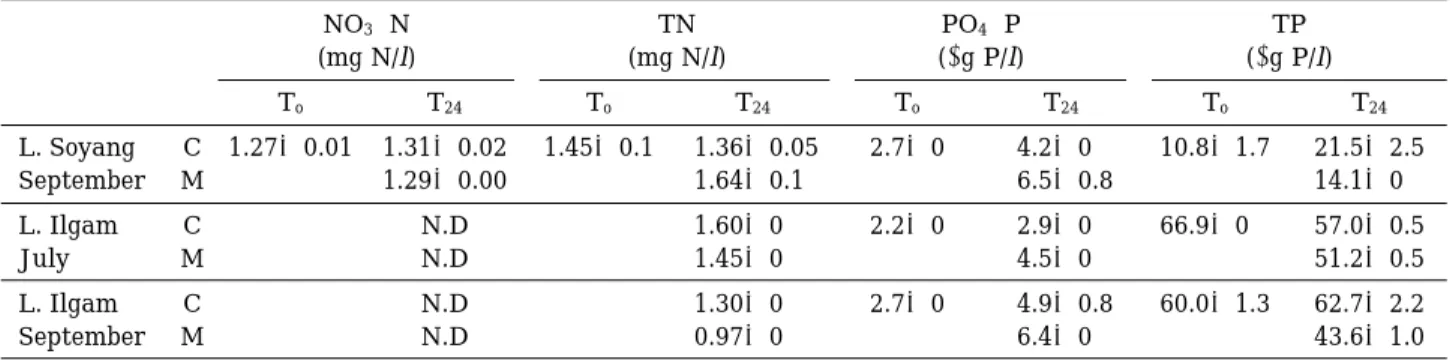
Mussel feeding on phytoplankton affected pho- sphorus and nitrogen concentration in the feed- ing chambers. TP concentration in the mussel treatment decreased by about 5~34%, while SRP concentration increased by 30~50% in com- parison with the control (Table 4). A decrease in TN also occurred, but there was no corresponding reduction of nitrate concentration. The decreases of TP and TN were mainly due to seston grazing by mussels. The degree of change in TP, TN, and SRP was similar between two lakes, and no distinct temporal patterns were observed.
This result suggests that bioavailable phospho- rus and nitrogen is recycled by mussel feeding on phytoplankton. Recycled nutrients also would affect the growth of cells remaining alive in the pseudofeces or phytoplankton cells, which avoid- ed the mussel f iltering (Yamamuro and Koikes,
Fig. 4. Exponential death rate (R: day-1) of phytoplank- ton in each treatment (C: control, M: mussel addi- tion) in Lakes Soyang and Ilgam between June and September 2000.
Fig. 5. Filtering rate (FR: ml mgAFDW-1 h-1) of phyto- plankton in each treatment (C: control, M: mussel addition) in Lakes Soyang and Ilgam between June and September 2000.
1993). Although we exclude this possibility be- cause phytoplankron samples were taken from the middle of water column in the chambers, its availability by various plankton needs to be exa- mined. Yamamuro and Koike (1993) showed that the excretion rate of ammonia by f ilter-feeding Corbicula japonica was greater than the uptake of particulate organic nitrogen in a brackish lake, Japan. Taken together, f ilter-feeding Corbicula appears to be involved in bioturbation or other nonmetabolic processes of the upward f lux of phosphorus and nitrogen.
ACKNOWLEDGEMENT
This study was supported by Agricultural Technology Development Project (Project #:
H0273500, The Ministry of Agriculture and Fore- stry) under the contract with KARICO (Korea Agricuitural Rural Infrastructure Corporation).
REFERENCES
APHA. 1995. Standard Methods for the water and wastewater, 18th ed. American Public Health Association, Washington DC.
Cohen, R.R.H., P.V. Dresler, E.J.P. Phillips and R.L.
Cory. 1984. The effect of the Asiatic clam, Corbi- cula f luminea, on phytoplankton of the Potamiac River, Maryland. Limnol. Oceanogr. 29: 170-180.
Cotner, J.B., W.S. Gardner, J.R. Johnson, R.H. Sada, J.F. Cavaletto and R.T. Heath. 1995. Effects of zebra mussels (Dreissena polymorpha) on bacteri- oplankton: evidence for both size-selective con- sumption and growth stimulation. J. Great Lakes Res. 21: 517-528.
Dame, R.F., R. Zingmark and D. Nelson. 1985. Filter feeding coupling between the estuarine water column and benthic subsystems. pp. 521-526. In : Estuarine Perspectives (V.S. Kennedy ed.). Acade- mic Press, New York.
Dame, R.F. 1996. Ecology of marine bivalves: An eco- system approach. CRC Press, Boca Raton. p. 254.
Table 3. Phytoplankton C-f lux (µgC l-1day-1) and percent C-f lux to biomass (µg C/l) ratio in Lakes Soyang and Ilgam.
C-f lux was calculated by the product of carbon biomass and f iltering rate for the mussel, using the following equation of CF = CB×FR×AFDW×(24 hrs/1 day)×(1 l/1,000 ml). C-f lux to the mussel was estimated from 1 mussel as 1 l according to the feeding experiment.
Lake Soyang Lake Ilgam
Carbon Carbon Percent Carbon Carbon Percent
Biomass Flux CF/CB Biomass Flux CF/CB
(CB) (CF) Ratio (CB) (CF) Ratio
µg C/l µg Cl-1day-1 day-1 µg C/l µg Cl-1 day-1 day-1
June 48.2 363.7±0.4 75±41 596 977±282 164±47
July 7.1 31.6±3.8 444±54 2,825 1,070±136 38±5
August 18.4 31.3±8.1 170±44 1,714 1,179±37 69±2
September 28.9 123.1±12.6 426±43 1,820 2,379±210 131±12
Avg. 25.6 137.4±6.1 279±46 1,739 1,401±166 101±16
Table 4. The variation of nitrogen and phosphorus concentration in the different treatments (C: control, M: mussel addition) of feeding experiment in Lakes Soyang and Ilgam in July and September 2000. N.D. denoted “not detected”.
NO3-N TN PO4-P TP
(mg N/l) (mg N/l) (µg P/l) (µg P/l)
To T24 To T24 To T24 To T24
L. Soyang C 1.27±0.01 1.31±0.02 1.45±0.1 1.36±0.05 2.7±0 4.2±0 10.8±1.7 21.5±2.5
September M 1.29±0.00 1.64±0.1 6.5±0.8 14.1±0
L. Ilgam C N.D 1.60±0 2.2±0 2.9±0 66.9±0 57.0±0.5
July M N.D 1.45±0 4.5±0 51.2±0.5
L. Ilgam C N.D 1.30±0 2.7±0 4.9±0.8 60.0±1.3 62.7±2.2
September M N.D 0.97±0 6.4±0 43.6±1.0
Dermott, R. and D. Kerec. 1977. Changes to the deep -water benthos of estern Lake Erie since the in- vasion of Dreissena: 1979~1993. Can. J. Fish.
Aquat. Sci. 54: 922-930.
Dorgelo, J. and J.W. Smeenk. 1988. Contribution to the ecophysiology of Dreissena polymorpha (Pal- las) (Mollusca: Bivalvia): Growth, f iltration rate and respiration. Verh. Internat. Verein. Limnol.
23: 2202-2208.
Dresler, P.V. and R.L. Cory. 1980. The Asiatic clam, Corbicula f luminea (Muller), in the tidal Potomac River, Maryland. Estuaries 3: 150-151.
Fahnenstiel, G.L., T.B. Bridgeman, G.A. Lang, M.J.
McCormick and T.F. Nalepa. Phytoplankton pro- ductivity I Saginaw Bay, Lake Huron: effects of zebra mussel (Dreissena polymorpha) coloniza- tion. J. Great Lakes Res. 21: 465-475.
Foster-Smith, R.L. 1975. The effect of concentration of suspension on the f iltration rate and pseudo- faecal production for Mytilus edulis, L., Cerasto- derma edule (L.), and Venerupis pullastra. J. Exp.
Mar. Biol. Ecol. 17: 1-22.
Gardner, W.S., J.F. Cavaletto, T.H. Johengen, J.R., Johnson, R.T. Heath and J.B. Cotner. 1995. Eff- ects of the zebra mussel, Dreissena polymorpha, on community nitrogen dynamics in Saginaw Bay, Lake Huron. J. Great Lakes Res. 21: 529-544.
Gunning, G.E. and R.D. Suttkus. 1966. Occurrence and distribution of the Asiatic Clam, Corbicula leana, in the Pearl River, Lousiana. Nautilus 79:
113-116.
Hains, K.C. 1979. The use of Corbicula as a clarifying agent in experimental tertiary sewage treatment process on St. Croix, U.S. Virgin Islands, Proc. 1st Corbicula symp. Texas Christian Univ. Res.
Found. pp. 166-175.
Heath, R.T., G.L. Fahnenstiel, W.S. Gardner, J.F.
Cavaletto and S-J Hwang. 1995. Ecosystem-level effects of zebra mussel (Dreissena polymor-pha):
An enclosure experiment in Saginaw Bay, Lake Huron. J. Great Lakes Res. 21: 501-516.
Hill, W. and A. Knight. 1981. Food preference of the Asian clam (Corbicula f luminea) in the Sacramen- to-San Joaquin delta. Estuaries 4: 245.
Holland, R.E. 1983. Changes in plankton diatoms and water transparency in Hatchery Bay, Bass Island area, western Lake Erie since the establi- shment of the zebra mussel. J. Great Lakes Res.
19: 617-624.
Holland, R.E. 1993. Changes in plankton diatoms and water transparency in Hatchery Bay, Bass Island area, western Lake Erie since the establi- shment of the zebra mussel. J. Great Lakes Res.
19: 617-624.
Hwang, S-J. 1996. Effects of zebra mussel (Dreissena polymorpha Pallas) on phytoplankton and bac- terioplankton: Evidence for size-selective graz- ing. Korean J. Limnol. 29: 363-378.
Jack, J.D. and J.H. Thorp. 2000. Effects of the ben- thos suspension feeder Dreissena polymorpha on zooplankton in a large river. Freshwater Biol. 44:
569-579.
Johannsson, O.E., R. Dermott, D.M. Graham, J.A.
Dahl, E.S. Millard, D.D. Myles and J. LeBlance, 1999. Benthic and pelagic secondary production in Lake Erie after invasion of Dreissena spp. with implication for f ish production. J. Great Lakes Res. 26: 31-54.
Karatayev, A.Y., L.E. Burkalova and D.K. Padilla.
The effect of Dreissena polymorpha (Pallas) inva- sion on aquatic communities in eastern Europe. J.
Shellf ish Res. 16: 187-203.
Kellar, P.E., S.A. Paulson and L.J. Paulson. 1980.
Methods for biological, chemical and physical an- alyses in reservoirs. Tech. Rep. Lake Mead Lim- nological Res. Center, Univ. Nevada, Las Vegas.
p. 234.
Kim, B., K. Choi, C. Kim, U.H. Lee and Y.H. Lim.
2000. Effects of the summer monsoon on the dis- tribution and loading of organic carbon in a deep reservoir, Lake Soyang, Korea. Water Res. 34:
3495-3504.
Kown, O.K. 1990. Illustrated encuclopedia of fauna and f lora. Vol. 32. Mollusca (I). Ministry of Educa- tion, Seoul, Korea.
Lavrentyev, P.J., W.S. Gardner, J.F. Cavaletto and Beaver. 1995. Effect of zebra mussel on protozoa and phytoplankton from Saginaw Bay, Lake Huron. J. Great Lakes Res. 21: 545-557.
Lee, J-S. and J-B. Kim. 1997. Systematic study on the genus Corbicula (Bivalvia: Corbiculidae) in Korea. The Korean J. of Systematic Zoology 13:
233-246. (In Korean)
Lorenzen, C.J. 1967. Determination of chlorophyll and pheo-pigments: spectrophotometric equation.
Limnol. Oceanogr. 12: 343-346.
Loo, L-O. and R. Rosenberg. 1989. Bivalve suspen- sion-feeding dynamics and benthic-pelagic coup- ling in a eutrophicated marine bay. J. Exp. Mar.
Biol. Ecol. 130: 253-276.
Lowe, R.L. and R.P. Pillsbuty. 1995. Shifts in benthic algal community structure abd function following the appearance of zebra mussels (Dreissena poly- morpha) in Saginaw Bay, Lake Huron. J. Great Lakes Res. 21: 558-566.
Mullin, M.M., P.R. Sloan and R.W. Eppley. 1966.
Relationship between carbon content, cell volume and area in phytoplankton. Limnol. Oceanogr. 11:
307-311.
Noordhius, R., H. Reeders and A. Bij De Vaate. 1992.
Filtration rate and pseudofaeces in zebra mussel and their application I water quality manage- ment. pp. 101-114. In : The zebra mussel Deris- sena polymorpha. Ecology, Biological monitoring and f irst application in the water quality manage- ment (Neuman and Jenner eds.). Gustav Fischer,
New York.
Reeders, H.H., A. Bij de Vaate and F.J. Slim. 1989.
The filtration rate of Dreissena polymorpha (Biva- lvia) in three Dutch lakes with reference to bio- logical water quality management. Freshwater Biol. 22: 133-141.
Reeders, H.H. and A. Bij de Vaate. 1990. Zebra mu- ssel (Dreissena polymorpha): a new perspective for water quality management. Hydrobiol. 200/201:
437-450.
Soto, D. and G. Mena. 1999. Filter feeding by the freshwater mussel, Diplodon chilensis, as a bio- control of salmon farming eutrophication. Aqua- culture 171: 65-81.
Sprung, M. and U. Rose. 1988. Inf luence of food size and food quality of the feeding of the mussel Drei- ssena polymorpha. Oecologia 77: 526-532.
Strathmann, R.R. 1967. Estimating the organic car- bon content of phytoplankton from cell volume or plasma volume. Limnol. Oceanogr. 12: 411-418.
Strayer, D.L., L.C. Smith and D.C. Hunter. 1998.
Effects of the zebra mussel (Dreissena polymor- pha) invasion on the macrobenthos of the fresh-
water tidal Hudson River. Can. J. Zool. 76: 419- 425.
Winkel, E.H. and C. Davids. 1982. Food selection by Dreissena polymorpha Pallas (Mollusca: Bivalvia).
Freshwater Biol. 12: 533-558.
Wetzel. R.G. and G.E. Likens. 1991. Limnological analyses (2nd). Springer-Verlag, New York.
Winter, J.E. 1973. The f iltration rate of Mytilus edu- lis and its dependence of on algal concentration, measured by a continuous automatic apparatus.
Marine Biol. 22: 317-328.
Wright, R.T. R.B. Coff in, C.P. Erising and D. Pear- son. 1982. Field and laboratory measurements of bivalve f iltration of natural marine bacterioplank- ton. Limnol. Oceanogr. 27: 91-98.
Yamamuro, M and I. Koike. 1993. Nitrogen metabo- lism of the f ilter-feeding bivalve Corbicula japo- nica and its signif icance in primary production of a brackish lake in Japan. Limnol. Oceanogr. 38:
997-1007.
(Received 19 Oct. 2001, Manuscript accepted 30 Nov. 2001)
⁄ ¤
식물플랑크톤에 대한 담수산 패류(참재첩)의 섭식효과
황 순 진*∙김 호 섭∙신 재 기 (건국대학교 지역생태시스템공학과)
영양상태가 다른 두 호수에서 식물플랑크톤 군집에 대한 담수산 패류의 섭식 효과를 2000년 6월 부터 9월까지 조사하였다. 실험은10 l플라스틱 용기에 패류를 투입하지 않는 것과 투입한 것으로 처리되었고2 반복으로 수행되었다. 수체 내 존재하는 총질소와 총인 그리고 엽록소a농도는 소양 호에 비해 일감호에서 월등히 높았다(p⁄0.01). 일감호에서 우점한 식물플랑크톤 군집은 거의 대부 분 남조류 였던 반면 소양호에서는 편모조류가 우점하였다. 패류가 투입된 용기 내 총 식물플랑크 톤의 감소율은 소양호와 일감호에서 각각1.70~7.39 d-1그리고0.38~1.64 d-1의 범위였다. 시간에 따른 식물플랑크톤의 변화를 바탕으로 한 패류의 유기물함량에 따른 여과율(FR; ml mgAFDW-1 h-1)은 일감호(0.24~0.88)에서 보다 소양호(1.70~3.06)에서 높았다. 조개 개체 당 여과율(l mussel-1day-1)은 소양호에서 1.6~7.8 l, 일감호에서 1.7~3.0 l로 나타났다(p⁄0.05). 생물량에 대 한 C-f lux로 고려할 때, Corbicula leana는 소양호의 경우 식물플랑크톤 현존량의 0.8~4.4배를, 일감호에서는 0.4~1.6배를 섭식하는 것으로 조사되었다. 패류의 섭식 활동으로 인해 인의 농도가 조개가 없는 용기에 비해 30~50% 증가하였다. 본 연구에서 나타난 결과들은 참재첩(Corbicula
leana)의 여과 섭식 활동이 식물플랑크톤의 밀도와 군집구조에 따라 차이가 있음을 제시한다. 또
한, 매우 부영양화된 호수에서도 참재첩은 높은 여과율을 나타냄으로써 국내 소규모의 부영양화된 호수에서 수질관리에 담수패류를 이용할 수 있는 가능성을 제시한다.