서 론
동물은 극단적인 온도에 대해서 어느 정도 순화할 수 있지 만 그 능력에는 한도가 있으며 순화온도를 아무리 서서히 변 화시킨다 하더라도 절대적인 치사 상한과 하한온도(Rajaguru and Ramachandran, 2001)가 있다. 변온동물인 어류는 환경의 수온 변화에 따라 변화한다. 즉 스스로 체온을 조절할 수 있는 능력이 없기 때문에 특정한 수온범위의 환경을 찾게 된다. 자 연생태계에서는 많은 수서생물들이 수온변화에 대처하기 위한 생리적 그리고 행동적인 항상성 기작을 가지며, 적정한 수온범 위의 서식지를 선택할 수 있는 수온조절 반응을 발달시켜왔다 (Prosser and Heath, 1991; Re et al., 2006; González et al., 2010).
어류에게 적정한 수온은 종특이적 반응이며, 이는 연령, 무게, 먹이섭취능력, 계절, 수질, 광도 및 서식밀도에 따라 변화할 수 있다(Wedemeyer et al., 1999; González et al., 2010). 또한 많 은 환경요인 가운데 수온은 양식생물의 생존에 영향을 미치는 가장 주요한 요인 중 하나이다(Beitinger and Bennet, 2000).
환경요인에 의한 양식생물의 생리적 반응은 신경내분비계의 반응, 대사변화, 혈액학적 및 면역학적 반응 그리고 행동반응 (Mazeaud et al., 1977; Barton, 2002)으로 크게 분류되고 있다.
말쥐치의 양식은 2000년대 초에 인공종묘생산의 성공(Lee et al., 2000)으로 시작되어 현재는 남해안의 주요 양식어종으 로 자리잡고 있으나 최근 겨울철 수온 하강으로 인해 빈번하게 폐사가 발생하고 있는 실정이다.
말쥐치에 대한 연구는 1980년대에 주로 어황변동 및 자원생 물학적인 연구(Choi and Park, 1982; Park, 1985; Baik and Park, 1989)가 수행되었으며, 2000년대 이후 인공종묘생산(Lee et
—201 — http://www.fishkorea.or.kr
* Corresponding author: Yun Kyung Shin Tel: 82-55-640-4730, Fax: 82-55-641-2036, E-mail: [email protected]
ISSn: 1225-8598(Print), 2288-3371(online). DoI: https://doi.org/10.35399/ISK.31.4.3
accepted: December 3, 2019
저수온에 노출된 말쥐치 Thamnaconus modestus의 생존율, 혈액학적 및 조직학적 반응
김혜진·이희중·김원진·신윤경
*
국립수산과학원 남동해수산연구소
Survival, Hematologic and Histological Changes of File Fish Thamnaconus modestus Adult Exposed to Different Lower Temperature by Hae Jin Kim, Hee-Jung Lee, Won Jin Kim and Yun Kyung Shin* (South east Sea fisheries research Institute, nIfS, tongyeong 39769, republic of Korea)
ABSTRACT Temperature is one of the most important criteria considered in species preference for aquaculture. Acute drop in temperature during winter is a cause of disease and mass mortality in farmed fish. This study was carried out the low water temperature tolerance, oxygen consumption, hematolog- ic and histological responses to use as basic data for the management of fish farming which frequently cause death due to winter water temperature drop. Low-lethal water temperature for 4 days of file fish Thamnaconus modestus(4day-LT50) was 6.97°C(6.69~7.27°C). Oxygen consumption rate decreased with decreasing water temperature, showing a significant difference between water temperatures. SOD activity increased significantly at 6°C experimental group than control group(10°C)(p<0.05), but CAT did not show any significant difference between experimental temperatures(p>0.05). Cortisol increased with decreasing experimental water temperature compared to control group. Histological changes in the liver include decreased blood vessels in the blood vessels, proliferation of acid cells, condensation of the nucleus, atrophy of pancreatic exocrine gland cells, and enzyme source granules.
Key words: Low water temperature tolerance, file fish, SOD, cortisol, histological changes
al., 2000), 생식주기(Lee et al., 2000), 소화기관 및 소화효소발 달(Gwak and Lee, 2009), 성숙과 산란(Nam et al., 2018) 등이 보고되고 있으나 양식에 필요한 수온 변화에 대한 내성범위를 다룬 연구는 찾아보기 힘들다.
본 연구는 겨울철 수온 하강으로 인해 빈번하게 폐사가 발 생하고 있는 말쥐치, Thamnaconus modestus의 양식현안을 해 소하고 양식관리를 위한 기초자료로 활용하기 위해 말쥐치의 하한수온내성범위, 대사반응, 혈액학적 및 조직학적 반응에 대 한 연구를 수행하였다.
재료 및 방법
실험에 사용된 말쥐치 Thamnaconus modestus는 경남 통영 시 산양읍 소재 해상가두리 양식장에서 2018년 11월에 500마 리를 구입하여 실험실로 옮긴 후 1톤 수조에서 실내사육하면서 한 달 동안 순치시켜 실험에 사용하였다. 순치시킨 후 실험에 사 용한 총 개체는 350마리였다. 순치기간 동안 수온은 10±1°C, 염분은 33.6±0.5psu, 용존산소농도는 9.7±0.5mg/L를 유지하 였으며, 먹이는 수협사료(침강골드 3호)를 1일 2회 공급하였다.
저수온에 대한 하한내성을 분석하기 위하여 실험수온은 10(대 조구), 8, 6, 5±0.5°C였으며, 실험기간 동안 염분은 33.6±0.5
psu였다. 실험수온을 조정하기 위하여 대조구인 수온 10±
0.5°C에 실험생물을 투입 후 매일 0.5°C를 낮추면서 각각의 실 험수온인 8±0.5°C, 6±0.5°C, 5±0.5°C로 조정하였다. 실험에 사용된 개체의 크기는 평균 전장 16.9±1.1cm, 평균 전중량 59.1±7.3g이었다. 실험방법은 실험수온별 450L 수조에 실험 개체 30마리씩 수용하였으며, 유수식으로 4일 동안 수행하였다.
실험수온은 냉각기(대일 DA-1000B)와 온도조절기(대일온도조 절기 DOV-882F)를 이용하여 조정하였다. 생존율은 오전 9시와 오후 9시에 12시간 간격으로 점검하면서 사망개체를 선별하여 생존율로 환산하여 구하였으며, 반수치사 수온은(50% lethal temperature)는 probit법에 의해 분석(Finney, 1971)하였다. 사 망개체는 실험어류가 뒤집혀서 아가미 뚜껑의 운동이 정지되었 을 때 사망으로 판정하였다. 모든 실험은 동시에 3회 반복하여 평균값을 이용하였다.
산소소비율은 각 실험 수온에 노출시킨 후 2일째 산소소비측 정장치(Orbis 3600 made by Switzerland)를 이용하여 실험 전 후 용존산소의 차로서 구하였다. 말쥐치의 스트레스반응을 조사 하기 위하여 각 실험수온에 노출시킨 후 4일째 살아있는 개체를 대상으로 미부에서 1mL 주사기를 이용해 혈액을 채취하여 원 심분리 시킨 후 혈장의 SOD(superoxide dismutase), CAT (catalase) 및 삼투질농도를 분석하였다. SOD와 CAT는 어류
Table 1. Survival rate of adult file fish Thamnaconus modestus exposed to different water temperature for 4 days
Temperature (℃) Water quality
Survival rate(%) *LT50 and 95%
confidence limit(℃)
pH Salinity(psu) DO(mg/L)
10(Control) 8.07
33.6±0.5 9.7±0.5
100 6.97
(6.69~7.27)
8 8.03 100
6 8.05 0
5 8.06 0
*LT50 was calculated by the probit scale
Survival rate(%)
100 80 60 40 20 0
0 1 2 3 4 Elasped time(days)
10℃
8℃
6℃
5℃
Fig. 1. Changes in survival rate of adult file fish Thamnaconus modestus with decreasing of water temperature.
Oxygen consumption(mg O2/kg/hr) 50 40 30 20 10
0 10 8 6 5
Water temperature(℃)
Fig. 2. Changes of oxygen consumption rate of alive adult file fish Thamnaconus modestus after exposure to different water temperature for 2 days.
ELISA kit(Cusabio Biotech, China)를 사용하였고, Versamax SoftMax pro 6(Morecular Devices, USA)를 이용하여 파장 450 nm에서 흡광도를 측정하였다. 삼투질농도는 삼투압 측정기 Osmomat 3000(Gonotec, Germany)을 이용하여 분석하였다.
실험결과에 사용된 유의성 검정은 SPSS 19.0을 이용하여 one- way ANOVA로 통계처리 후 Duncanʼs multiple range test로 사 후 검증하였다.
수온 하강에 따른 말쥐치의 조직학적 변화를 관찰하기 위하여 각 실험수온에 노출시킨 후 4일째 살아있는 개체를 대상으로 간 조직을 절취하여 Bouinʼs solution에 24시간 동안 고정하고, 24∼36시간 동안 흐르는 물에서 수세한 다음 70∼100% 에탄올 을 이용하여 단계적으로 탈수하였다. 이후 paraplast(McCor- mick, USA)을 이용하여 포매하고, microtome(RM2235, Leica, Germany)을 이용하여 두께 4∼6μm의 횡단면과 종단면의 연속 절편을 제작하였다. 이들 조직 절편들은 구조와 세포형태를 관찰 하기 위해 Mayerʼs hematoxylin-eosin(H-E) 비교염색을 실시하 여 광학현미경(BX50, Olympus, Japan)으로 관찰하였다.
결 과
수온 하강에 따라 말쥐치의 생존에 미치는 영향을 알아보기 위하여 수온 10°C에 순치시킨 후 실험 수온 8, 6 및 5°C에 노 출하여 나타난 결과를 Fig. 1과 Table 1에 나타내었다. 수온 5°C 와 6°C에 노출시킨 경우 수온 5°C에서는 노출 3일째, 수온 6°C 에서는 노출 4일째 모두 폐사하였으며, 수온 8°C에서는 실험기 간 동안 폐사 개체는 관찰되지 않았다. 각 실험수온에 노출시 킨 기간 동안 말쥐치의 저수온에 대한 반수치사 수온은(LT50) 6.97°C(6.69∼7.27°C)였다.
실험수온에 노출시킨 후 2일째 수온 하강에 따른 말쥐치의 산소소비율의 변화를 Fig. 2에 나타내었다. 수온 10°C에 순치 시킨 말쥐치의 산소소비율은 수온 8°C에서 5°C까지 점차 수 온이 하강함에 따라 감소하는 경향을 보였으며 이 값은 수온 10°C와 8°C 이하의 수온 간에 유의한 차이를 나타내었으나(p
<0.05), 8∼5°C의 수온 간에 산소소비율의 유의한 차이는 나
SOD(mU/mL) CAT(U/mL)
400 300 200 100 0
50,000 40,000 30,000 20,000 10,000
10 8 6 0
Water temperature(℃)
10 8 6 Water temperature(℃)
Fig. 3. Changes in the enzymatic activities of superoxide dismutase(SOD) and catalase(CAT) in blood of adult file fish Thamnaconus modestus exposed to different water temperature for 4 days.
Osmolality(mOsm/kg)
500 400 300 200 100
0 10 8 6
Water temperature(℃)
Fig. 4. Changes of osmolality in blood of adult file fish Thamnaco
nus modestus exposed to different water temperature for 4 days.
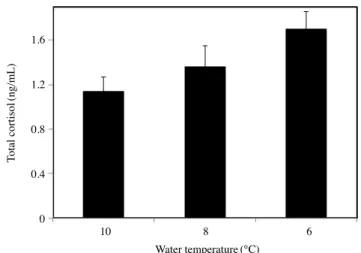
Total cortisol(ng/mL)
1.6 1.2 0.8 0.4
0 10 8 6
Water temperature(℃)
Fig. 5. Changes of total cortisol in blood of adult file fish Thamnaco
nus modestus exposed to different water temperature for 4 days.
타내지 않았다(p>0.05).
Figs. 3∼6은 수온 하강에 따른 스트레스반응을 조사하기 위 하여 실험수온 노출 후 4일째 생존한 개체를 대상으로 말쥐치 의 혈액내 SOD, CAT, Osmolality 및 cortisol의 변화를 분석하 였다. 활성산소 소거효소인 SOD활성도는 대조구 10°C에 비해 8°C와 6°C에서 증가하는 경향을 나타내었으며, 대조구인 10°C 에 비해 수온 6°C에서 유의하게 상승하였다(p<0.05). 반면 CAT는 실험수온 간에 유의한 변화를 나타내지 않았다(Fig. 3).
말쥐치의 혈액내 삼투질농도는(Fig. 4) 수온 6°C 노출구에서 대조구에 비해 다소 높았으나 대조구와 실험수온 간 유의한 차이는 나타나지 않았다(p>0.05). 반면 코티졸은(Fig. 5) 대조 구에 비해 수온 하강에 따라 증가하였으며 수온 간 유의한 차 이를 나타내었다(p<0.05).
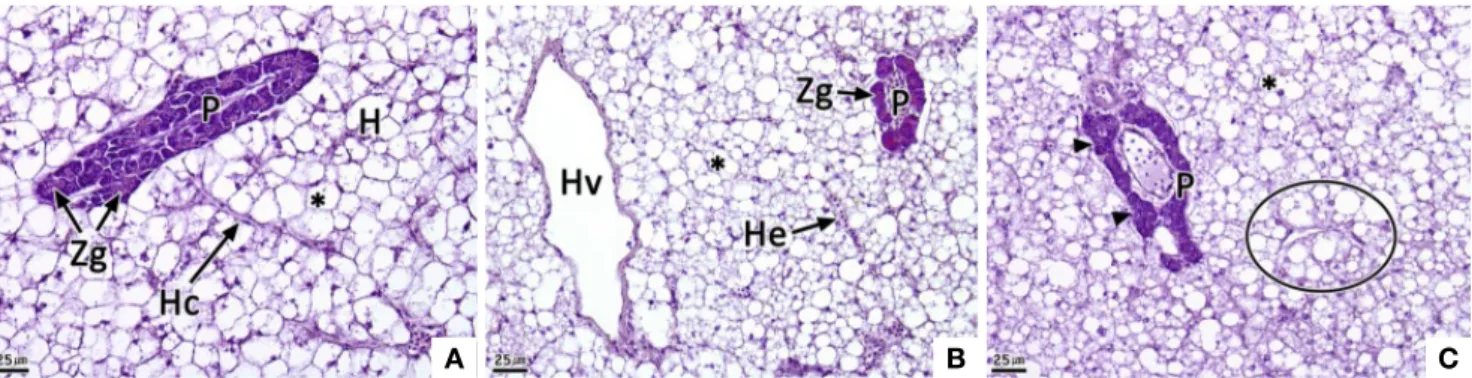
Fig. 6은 수온 10°C, 8°C 및 6°C에 노출시킨 후 4일째 생존 한 개체를 대상으로 수온 하강에 따른 영향을 알아보기 위하 여 말쥐치 간의 조직학적 변화를 분석한 것이다.
간은 간췌장 형태로 간세포, 췌장조직, 간정맥, 모세혈관 및 담관으로 이루어져 있다. 간세포들은 간세포삭의 단위로 모여 있었으며, 세포 중앙에서 호염기성의 핵이 뚜렷하게 관찰되었 다. 췌장조직의 외분비선 세포는 역삼각형의 모양으로 H-E염 색에서 세포질은 전체적으로 강한 호염기성을 나타내었으나, 상단부에는 호산성의 효소원과립이 존재하고 있었다. 저수온 에 노출된 말쥐치의 간은 모든 실험구에 혈관 내 혈구의 감소, 간세포의 공포화와 간세포핵의 응축, 췌장외분비 선세포의 위 축 및 효소원 과립들이 감소된 조직상을 보였다. 이러한 간의 조직상은 수온이 낮을수록 더욱 뚜렷한 반응을 나타내었다.
고 찰
수온은 어류의 생식, 발생, 대사 및 행동 등에 영향을 미치는 중요한 환경요인이며(Beitinger and Bennet, 2000; Donaldson
et al., 2008), 수중에 서식하고 있는 어류는 끊임없이 수온변화 에 대한 스트레스에 노출되어 있다. 말쥐치는 남해안의 통영 지역을 중심으로 해상가두리에서 양식되고 있는 주요 온대성 어종이다. 최근 들어 남해연안의 수온은 여름철에 26∼30°C, 겨울철에는 수온 5∼9°C가 장기간 지속되고 있어 온대성 어 류인 말쥐치는 계절적으로 수온의 영향에 항상 노출되어 있 다. 특히 해상가두리에서 양성중인 어류는 수온 등 환경변화 에 의한 스트레스를 피할 수 없으며, 이로 인해 내성범위를 벗 어난 수온 스트레스가 지속될수록 행동과 대사적 장애가 발생 하며, 결국 폐사에 이를 수 있다(Gallardo et al., 2003; Contessi et al., 2006).
본 연구에서 말쥐치의 저수온에 대한 반수치사수온은 6.97°C (6.69∼7.27°C)로 분석되었으나, 일본의 해양생물환경연구소 (MERI, 2000)보고에 따르면 말쥐치의 치사하한수온은 8.1∼
10.4°C로 본 연구의 결과보다 다소 높다. 이러한 차이는 실험 에 사용되었던 어류의 순치수온, 건강성 및 실험방법에 따라 다소 차이가 있을 것으로 여겨진다. 반면 온대성 어류인 참돔 의 저수온에 대한 치사하한수온은 6.54°C(6.31∼6.76°C)로 (Shin et al., 2018) 말쥐치와 유사하였으며, 쥐치과에 속하는 쥐치 Stephanolepis cirrhifer의 치사수온은 5.8∼8.1°C(MERI, 2000)로 본 연구의 말쥐치와 유사하였다.
수온 하강에 의해 말쥐치를 폐사에 이르게 하는 스트레스반 응을 알아보기 위하여 산소소비율, 혈액내 SOD, CAT, 삼투질 농도 및 총 코티졸 농도 변화를 분석하고 간의 조직학적 변화 를 관찰하였다.
산소소비율은 환경요인의 변화와 관련되는 생리적 반응 중 하나이며, 변온동물에서 산소소비율의 대사반응은 수온과 상 관관계를 나타낸다(Hazel and Prosser, 1974). 이는 생물의 에 너지대사가 항상성 조절과정과 관련되기 때문이며(Salvato et al., 2001), 호기성동물에서 산소가 생존에 필수적 요소이므로 ATP합성과 세포기능을 유지하는 역할을 하기 때문이다 (Dejours, 1981). 말쥐치의 산소소비율은 수온 하강에 따라 감
A B C
Fig. 6. Histological alterations of liver in adult file fish Thamnaconus modestus exposed to different water temperature for 4 days. A: 10℃, B: 8℃, C: 6℃. A-C: vacuolization of hepatocyte(*), B: decrease of zymogen granules(Zg) in exocrine cell in pancreas(P), C: atrophy of exocrine cell in pancreas(arrowhead) and decrease of hemocytes(circle). H-E stain. Hc: hepatic cord, He: hemocyte, Hv: hepatic vein.
소하여 대조구(10°C)에 비해 26∼36% 감소하였으며, 반수치 사수온 6.97°C 이하에서는 33∼36% 감소를 보였다. 이는 산소 소비율이 수온과 상관관계를 나타내는 이전의 보고(Debnath et al., 2006; Dalvi et al., 2009)들과 온대성 어류인 참돔의 반 수치사저수온 6.54°C 이하에서 산소소비율이 감소하는(Shin et al., 2018) 보고와도 유사한 결과를 나타내었다
혈액은 어류의 면역방어와 생리기능에 주요한 역할을 하며 혈액학적 지표 들이 어류의 내·외적 반응에 대한 생리적 스트 레스 지표로서 이용되고 있다(Zarejabad et al., 2010; Qiang et al., 2012). 저수온은 양식에 영향을 미칠 수 있는 주요 제한 요 소로 해상가두리에서 양식하고 있는 어류의 생존은 생존범위 내에서 환경수온의 변화에 적응할 수 있는 생화학적 생리학적 보상기작에 달려있다(Qiang et al., 2012; Sharama et al., 2017).
혈액내 말쥐치의 CAT는 수온 간에 유의한 차이가 없는 반면, SOD 활성도는 대조구 10°C에 비해 6°C에서 유의하게 증가 하여 수조기 Nibea albiflora(Song et al., 2019), 참돔 Pagrus major(Shin et al., 2018) 등의 저수온에 대한 쇼크요인과 유사 하였다. 저수온 쇼크는 비정상적인 상태로 수온의 급강하가 있는 상태를 의미하고 있다(Donaldson et al., 2008). 어류에 미 치는 저수온 쇼크는 활성산소(ROS)를 증가시킬 수 있으며 (Chandra et al., 2000; Meng et al., 2014), 이로 인해 DNA손상 을 야기시킨다(Qi et al., 2013). 또한 젖산의 축적, 이온불균형, 에너지소비 등의 생리적 스트레스를 유발시키며, 행동장애를 발생하고 결국 저수온에 기인한 스트레스로 인해 폐사를 유도 할 수 있다(Donaldson et al., 2008). 본 연구에서 말쥐치의 삼 투질농도는 수온 간 유의한 차이를 나타내지 않았으나, Alosa pseudoharengus(Stanleley and Colby, 1971)과 참돔 Pargus major(Shin et al., 2018) 등에서는 이온불균형과 행동장애 등 이 보고되었다. 또한 본 연구에서 말쥐치의 혈액내 코티졸 농 도는 수온 하강에 따라 유의하게 증가하였으며, 간세포는 공 포화되고 혈구가 감소하고 췌장조직을 이루는 세포의 위축과 효소원과립들이 감소하여 간의 손상이 수온 하강에 따라 더욱 뚜렷이 나타났다. 저수온 노출에 따른 혈액내 코티졸에 대한 반응은 Brycon amazonicus를 18°C에서 8°C에 급성 노출시켰 을 때 코티졸 양이 증가(Inoue et al., 2008)하였으며, Tilapia aurea의 경우에도 저수온 노출시 코티졸이 유의하게 증가 (Chen et al., 2002)하여 본 연구에서 말쥐치의 경우와 유사하 였으며, 이러한 결과를 근거로 급작스런 저수온 노출은 어류의 혈액내 면역반응에 매우 민감한 영향을 미치는 것으로 여겨진 다.
수온은 어류의 생리적 과정을 최적화하고 내적 체온을 조절 하는 직접적인 요인이다(Bellgraph et al., 2010). 변온동물에서 온도조절 행동은 생존을 좌우하는 매우 중요한 생리적 반응이 며(Crawshaw, 1977), 대부분의 어류는 주로 행동으로 체온을 조절한다고 보고되고 있다(Bicego et al., 2007). 특히 저수온
쇼크의 공통적인 반응은 평형이 상실되고 반응이 느리고 유영 력이 감소하는데, 평형상실은 어류가 도망갈 수 없도록 하는 결과를 가져와 결국은 폐사에 이르게 한다(Fuiman and Batty, 1997; Smith and Hubert, 2003).
본 연구에서 수온을 10°C에서 8°C, 6°C 및 5°C로 하강시킴 에 따라 말쥐치의 유영행동은 느려지고 둔화되었으며 한쪽 방 향으로 쏠리는 현상이 관찰되었고 6°C 이하 저수온에서는 유 영하는 방향이 일정하지 않고 몸의 균형을 잃고 유영하다가 뒤 집혀 폐사하는 현상이 관찰되었으며, 꼬리지느러미, 배와 등 주 변의 체표면에 혈관 출혈이 관찰되고 일부에서는 지느러미 괴 사 등의 현상이 관찰되는 등 저수온 쇼크의 공통적인 반응을 나타내었다(Fuiman and Batty, 1997; Smith and Hubert, 2003).
생물의 적정수온과 내성수온은 적정한 양식조건을 결정하는 데 중요하며, 또한 양식생물의 치사수온과 생리적 상태에 대한 정보는 환경변화에서 생존하기 위한 양식생물의 능력을 추정 하는데 매우 중요하다.
최근 불규칙한 환경변화로 인해 양식어류의 사육관리에 많 은 문제점이 야기되고 있으며, 특히 가두리 양식의 경우에는 인위적으로 사육환경을 조절하는데 어려움이 있으며, 여름과 겨울 동안 어류의 생리적 임계수온 범위를 벗어난 수온의 상 승과 하강으로 인해 양식어류의 피해가 빈번하게 발생하고 있 는 실정이다.
따라서 본 연구의 결과를 종합해보면 말쥐치는 온대성 어류 로 효율적인 양성관리를 위해 겨울 수온 6.7∼7.3°C 이상에서 사육관리가 필요하다. 또한 저수온기 말쥐치의 폐사는 수온 외 에 가두리그물의 흔들림, 수온의 일간 변화 및 저수온의 지속 기간 등에 영향을 받게 되므로 겨울철 지속적인 관리가 필요 하다.
요 약
수온은 양식어류의 생존에 영향을 미치는 가장 주요한 환경 요인이며, 겨울철 급작스런 수온 하강은 양식어류의 질병과 집단폐사 발생의 요인이 되기도 한다. 본 연구는 겨울철 수온 하강으로 인해 빈번하게 폐사가 발생하고 있는 말쥐치의 양식 관리를 위한 기초자료로 활용하기 위해 말쥐치의 하한수온내 성범위, 산소소비율, 혈액학적 및 조직학적 반응을 조사하였 다.
수온 5°C에서 노출 3일째, 수온 6°C에서는 노출 4일째 모두 폐사하여 말쥐치의 저수온에 대한 반수치사 하한수온은(LT50) 6.97°C(6.69∼7.27°C)였다. 산소소비율은 수온 하강에 따라 감소하여 수온 간 유의한 차이(p<0.05)를 나타내었다. 혈액내 활성산소 소거효소인 SOD활성도는 대조구 10°C에 비해 수온 6°C에서 유의하게 상승하였다(p<0.05). 반면 CAT는 실험수
온 간에 유의한 변화를 나타내지 않았다(p>0.05), 삼투질농도 는 대조구와 실험수온 간 유의한 차이는 나타나지 않았다(p>
0.05). 코티졸은 대조구에 비해 수온 하강에 따라 증가하였으 며 수온 간 유의한 차이를 나타내었다(p<0.05). 간의 조직학 적 변화는 혈관내 혈구의 감소, 간세포의 공포화와 간세포 핵 의 응축, 췌장 외분비 선세포의 위축 및 효소원과립들이 감소 하였다.
사 사
본 연구는 2019년도 국립수산과학원 수산과학연구사업 (R2019015)의 지원으로 수행되었습니다.
RefeRenCeS
Baik, C.I. and J.H. Park. 1989. Fluctuation of fishing conditions of file fish Navidon modestus(Günther) in relation to oceano- graphic characteristics in Korean eaters. NIFS, 43: 91-104.
(in Korean)
Barton, B.A. 2002. Stress in fishes: a diversity of responses with par- ticular reference to changes in circulating corticosteroids.
Integr. Comp. Biol., 42: 517-525.
Bellgraph, B.J., G.A. McMichael, R.P. Mueller and J.L. Monroe.
2010. Behavioural response of juvenile Chinook salmone Oncorhynchus tshawytscha during sudden temperature in- crease and implications for survivor. J. Therm. Biol., 35: 6- 10.
Beitinger, T.L. and W.A. Bennet. 2000. Quantification of the role of acclimation temperature in temperature tolerance of fishes.
Environ. Biol. Fishes, 58: 277-288.
Bicego, K.C., R.C.H. Barros and L.G.S. Branco. 2007. Physiology of temperature regulation: comparative aspects. Comp. Bio- chem. Physiol., 147A: 616-639.
Chandra, J., A. Samali and S. Orrenius. 2000. Triggering and modu- lation of apoptosis by oxidative stress. Free Radic. Biol.
Med., 3: 323-333.
Chen, W., L. Sun, C. Tsai, Y. Song and C. Chang. 2002. Cold stress induced the modulation of catecholamines, cotrisol, imuno- globulin M. and leukocyte phagocytosis in tilapia. Gen.
Comp. Endocrinol., 126: 90-100.
Choi, S.H. and C.S. Park. 1982. Maturity and spawning of file fish Navidon modestus(Günther) in the southern waters of Korea.
NIFS, 30: 73-80.(in Korean)
Contessi, B., D. Volpatti, L. Gusmani and M. Galeotti. 2006. Evalu- ation of immunological parameters in farmed gilthead sea bream, Sparus aurata L., before and during out breaks of
“winter syndrome”. J. Fish Dis., 29: 683-690.
Crawshaw, L.I. 1977. Physiological and behavioral reactions of fish
to temperature change. J. Fish Res. Board. Can., 34: 730-734.
Dalvi, R.S., A.K. Pal, L.R. Tiwari, T. Das and K. Baruah. 2009. Ther- mal tolerance and oxygen consumption rates of the catfish Horabagrus brachysoma(Günther) acclimated to different temperatures. Aquaculture, 295: 116-119.
Debnath, D., A.K. Pal, N.P. Sahy, K. Baruah, S. Yengkokpam, T. Das and S. Manush. 2006. Thermal tolerance and metabolic activ- ity of yellowtai catfish Pangasius pangasius(Hamilton) ad- vances fingerlings with emphasis on their culture potential.
Aquaculture, 258: 606-610.
Dejours, P. 1981. Factors of energy expenditure. Principles of Com- parative respiratory physiology. Elsevier/North-Holland Bio- medical Press, Amsterdam, The Netherlands, pp. 1-13.
Donaldson, M.R., S.J. Cooke, D.A. Patterson and J.S. MacDonald.
2008. Cold shock and fish. J. Fish Biol., 73: 1491-1530.
Finney, D.J. 1971. Probit Analysis. 3rd. Cambridge University Press, London, 333pp.
Fuiman, L.A. and R.S. Batty. 1997. What a drag is getting cold: Par- titioning the physical and physiological effects of tempera- ture on fish swimming. J. Exp. Biol., 200: 1745-1755.
Gallardo, M.A., M. Sala-Rabanal, A. Ibaez, F. Padros, J. Blasco, J. Fernándz-Borràs and J. Sánchez. 2003. Functional alter- nations associated with “winter syndrome” in gilthead sea bream(Sparus aurata). Aquaculture, 223: 15-27.
González, R.A., D. Fernando, L. Alexei, D.R. Ana, L.N. Sánchez and G.E. Zaul. 2010. Thermal preference, tolerance and oxygen consumption of adult white shrimp Litopenaeus vannamei (Boone) exposed to different acclimation temperatures. J.
Therm. Biol., 35: 218-224.
Gwak, W.S. and S.G. Lee. 2009. Developmental changes in digestive organ and digestive enzyme activity of file fish Thamnaconus modestus. Korean J. Ichthyol., 21: 149-157.(in Korean) Hazel, J.R. and C.L. Prosser. 1974. Molecular mechanisms of tem-
perature compensation on poikilotherms. Ohysiol. Rev., 54:
620-677.
Inoue, L.A., G. Moraes, G.K. Iwana and L.O.B. Afonso. 2008. Phys- iological stress responses in the warm-water fish matrinxa (Brycon amazonicus) subjected to a sudden cold shock. Acta Amazon, 38: 603-610.
Lee, S.J., H.D. Ku, B.C. Lee and J.M. Lee. 2000. Technical develop- ment on seed production of file fish, National Fisheries Re- search and Development Institute, 1999. Technical report of east sea regional fisheries research institute, pp. 292-294.(in Korean)
Mazeaud, M.M., F. Mazeaud and E.M. Donaldson. 1977. Primary and secondary effects of stress in fish: some new data with a general review. Trans. Am. Fish. Soc., 106: 201-212.
Meng, X., P. Liu, J. Li, B. Gao and P. Chen. 2014. Physiological re- sponses of swimming crab Portunus tributerculatus under cold acclimation: Antioxidant defense and heat shock pro- teins. Aquaculture, 434: 11-17.
MERI. 2000. Report of marine ecology research institute. 2: A-17, A-23.
Nam, K.M., J.T. Yoo, J.W. Kim, J.H. Park and G.W. Baeck. 2018.
Maturation and spawning of female black scraper, Thamna
conus modestus in the coastal waters off middle east sea, Korea. J. Korean Soc. Fish Ocean Techanol., 54: 89-95.
Park, B.H. 1985. Studies on the fishery biology of file fish, Navidon modestus(Günther) in the Korean waters. NIFS, 34: 1-64.(in Korean)
Prosser, C.L. and J.E. Heath. 1991. Temperature. In: Prosser, C.L.
(ed.), Environmental and Metabolic Animal Physiology.
Wiley-Liss, New York, pp. 109-165.
Qi, Z., Y. Liu, S. Luo, C. Chen, Y. Liu and W. Wang. 2013. Molecu- lar cloning, characterization and expression analysis of tumor suppressor protein p53 from orange-spotted grouper, Epine
phelus coioides in response to temperature stress. Fish Shell- fish Immun., 35: 1466-1476.
Qiang, J., H. Yang, H. Wang, M.D. Kpundeh and P. Xu. 2012. Growth and IGF-I response of juvenile Nile tilapia(Oreochromis ni
loticus) to changes in water temperature and dietary protein level. J. Therm. Biol., 37: 686-695.
Rajaguru, S. and S. Ramachandran. 2001. Temperature tolerance of some estuarine fishes. J. Thermal Biol., 26: 41-45.
Salvato, B., V. Cuomo, R. Di Muro and M. Beltramini. 2001. Effects of environmental parameters on the oxygen consumption of four marine invertebrates: a comparative factorial study. Mar.
Biol., 138: 659-668.
Sharama, J., S.P. Singh and R. Chakrabarti. 2017. Effect of tempera-
ture on digestive physiology, immune-modulatory parame- ters and expression level of Hsp and LDH genes in Catla catla(Hamilton, 1822). Aquaculture, 479: 134-141.
Shin, Y.K., Y.D. Kim and W.J. Kim. 2018. Survival and physiologi- cal responses of red sea bream Pagrus major with decreas- ing sea water temperature. Korean J. Ichthyol., 30: 131-136.
(in Korean).
Smith, M.A. and W.A. Hubert. 2003. Simulated thermal tempering versus sudden temperature change and short-term survival of fingerling rainbow trout. N. Am. J. Aquacul., 65: 67-69.
Song, H., Xu. Dongdong, L. Tian, R. Chen, L. Wang, P. Tan and Q.
You. 2019. Overwinter mortality in yellow drum(Nibea albi
flora): Insights from growth and immune responses to cold and starvation stress. Fish and Shellfish Immunol., 92: 341- Stanley, J.G. and P.J. Colby. 1971. Effects of temperature on electro-347.
lyte balance and osmoregulation in the alewife(Alosa pseudo
harengus) in fresh and sea water. Trans. Am. Fish Soc., 100:
624-638.
Wedemeyer, G.R., F.P. Meyer and L. Smith. 1999. Environmental Stress and Fish diseases. Narendra Publishing House, Delhi, India, 107pp.
Zarejabad, A.M., M. Sudagar, S. Pouralimotlagh and K.D. Bastami.
2010. Effects of rearing temperature on hematological and biochemical parameters of great sturgeon(Huso huso Lin- naeus, 1758) juvenile. Comp. Clin. Pathol., 19: 367-371.