Kor. J. Mater. Res.
Vol. 24, No. 2 (2014)
111
Effect of Milling Time on Pore Size and Distribution of Ti-Nb-Zr Biomaterials with Space Holder Consolidated by
Spark Plasma Sintering
Dong-Gun Kim, Kee-Do Woo † , Dong-Soo Kang and Tack Lee
Division of Advanced Materials Engineering, Research Center of Advanced Materials Development(RCAMD), Chonbuk National University, Jeonbuk 561-756, Korea
(Received January 14, 2014 : Received in revised form February 20, 2014 : Accepted February 20, 2014)
Abstract
Titanium and its alloys are useful for implant materials. In this study, porous Ti-Nb-Zr biomaterials were successfully synthesized by powder metallurgy using a NH4HCO3 as space holder and TiH2 as foaming agent. Consolidation of powder was accomplished by spark plasma sintering process(SPS) at 850oC under 30 MPa condition. The effect of high energy milling time on pore size and distribution in Ti-Nb-Zr alloys with space holder(NH4HCO3) was investigated by optical microscope(OM), scanning electron microscope(SEM) & energy dispersive spectroscopy(EDS) and X-ray diffraction(XRD).Microstructure observation revealed that, a lot of pores were uniformly distributed in the Ti-Nb-Zr alloys as size of about 30- 100
µm using mixed powder and milled powders. In addition, the pore ratio was found to be about 5-20 % by image analysis,
using an image analyzer(Image Pro Plus). Furthermore, the physical properties of specimens were improved with increasing milling time as results of hardness, relative density, compressive strength and Young’s modulus. Particularly Young’s modulus of the sintered alloy using 4h milled powder reached 52 GPa which is similar to bone elastic modulus.Key words
biomaterial, Ti alloy, space holder, spark plasma sintering, high energy mechanical milling.1. Introduction
Ti and Ti-based alloys are widely used as biomaterials due to the combination of its outstanding characteristics such as high strength, low density(high specific strength), high immunity to corrosion, complete inertness to body environment, enhanced biocompatibility, low modulus and high capacity to join with bone and other tissues.
1,2)Nowadays, pure titanium, Ti-6Al-4V ELI(extra low in- terstitial) alloys have been widely used as dental and orthopedic implants.
3,4)In addition, its elastic modulus is 50 % less than that in Co-Cr implants. So pure titanium, Ti-6Al-4V ELI alloys would help to reduce a stress shielding effect. However Ti-6Al-4V ELI alloys has been considered because of the toxic elements to health, such as Al and V.
5)There are some problems of the solid implant materials in orthopedic surgery, such as lack of osteointegration capacity and inadequate mechanical prop- erties of Young’s modulus. The mismatch of Young’s
modulus between the bone (2-20GPa) and the metallic implants of pure Ti and Ti-6Al-4V ELI alloy (100-120 GPa) is about 100GPa.
6)Therefore, it is important for biometallic materials to have low Young’s modulus. Porous metallic biomaterials are one of the methods to reduce the Young’s modulus.
There is a limit to the addition of alloying elements in a way of reducing the Young’s modulus.
In this study, to solve these problems(toxic elements and high Young’s modulus) was to fabricate a porous Ti- Nb-Zr alloy, which is known as low Young’s modulus alloy due to β-Ti phase and good biocompatibility due to non toxic elements,
7)using space holder method. Space holder method was cost effective process. Also it con- trolled pore size distribution and pore shape. During sintering, space holder was removed after mixing a metal powder and space holder. And then this method fabricated porous material by sintered metal powder to keep pore size and shape. It kind of NaF, NaCl, NH
4HCO
3,etc and
†
Corresponding author
E-Mail : [email protected] (K.-D. Woo, Chonbuk Nat'l Univ.)
© Materials Research Society of Korea, All rights reserved.
This is an Open-Access article distributed under the terms of the Creative Commons Attribution Non-Commercial License (http://creative-
commons.org/licenses/by-nc/3.0) which permits unrestricted non-commercial use, distribution, and reproduction in any medium, provided the
original work is properly cited.
porosity was about 60~80 %.
8)In this study, to make a porous Ti-Nb-Zr alloy were used to Ti powder, Nb powder, Zr powder, NH
4HCO
3as space holder and TiH
2as foaming agent. And then these mixing and milling powders were sintered by SPS.
2. Experimental procedure
The raw powder was added Ti-13wt%Nb-13wt%Zr- 10wt%NH
4HCO
3-2wt%TiH
2, in which of high purity Ti (99.9 %, 100 µm), Nb(99.9 %, 120 µm), Zr(99.8 %, 100 µm), TiH
2(99 %, 10 µm) and pure NH
4HCO
3powder (99.9 % 120~200 µm) were used. Ti-13wt%Nb-13wt%Zr alloy powders were mixed for 24h using a low energy mixing equipment with a ZrO
2ball to powder ratio of 7:1. The powders were milled using high energy mech- anical milling(SPEX 8000 mill/mixer) with ZrO
2balls (weight ratio of ZrO
2ball to powder was 4:1) in hardened steel vial. Isopropyl alcohol was used as process control agent(PCA) during the HEMM. The powders were milled in Ar atmosphere for different times(4h, 8h and 12h).
And then Ti-13wt%Nb-wt%Zr alloy powders added 10 wt%NH
4HCO
3and 2wt%TiH
2were mixed for 1h using mixer. The mixed and milled powders were placed in a 10 mm-diameter cylindrical graphite die of the SPS equip- ment.
9)The chamber was evacuated down to 10
−3torr and a uniaxial pressure of 30MPa was applied. The mixed
and milled powders were sintered at 850
oC and instantly cooled without holding time in chamber at Ar atmosphere due to rapid cooling. Temperature was measured using a thermocouple on the surface of the graphite die.
The phases of the sintered Ti-Nb-Zr-NH
4HCO
3-TiH
2biomaterials and as mixed and as milled powders were investigated using X-ray diffraction(XRD) with Cu-K α radiation within the range of 20-80
o. The pore size and distribution were observed by scanning electron micro- scope(JMS-6400 : SEM) and the pore size and ratio was measured by image analyzer(Image Pro Plus). The density of the sintered Ti-Nb-Zr biomaterials was calculated by Archimedes’ method. The hardness of the sintered bio- materials was measured using Rockwell hardness tester (Load: 60 kg).
3. Results and discussion
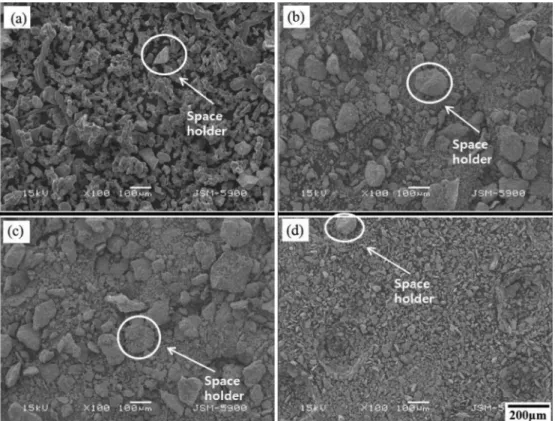
Fig. 1 shows SEM micrographs of the mixed and milled Ti-13wt%Nb-13wt%Zr alloy powders with 10wt%- NH
4HCO
3-2wt%TiH
2powders. The particle sizes of the composite powders decreased from 20~40 µm(Fig. 1b, 1c) to less than 5~20 µm(Fig. 1d). Fine particles are Ti based alloys and big particles are space holder particles. The size of Ti based alloy particles is ultra fine. By XRD analysis, the size of high energy mechanical milled particle for is 4~12h is 200 nm to 5 µm. Particle size of Ti-Nb-Zr
Fig. 1. SEM micrographs of the Ti-13%Nb-13%Zr alloy powders mixed for 24h or milled for 4-12h and followed by mixed with
10%NH
4HCO
3-2%TiH
2for 1h using mixer; (a) 24h mixed, (b) 4h milled, (c) 8h milled and (d) 12h milled Ti-13%Nb-13%Zr powder.
powder, which is mixed with very high melting point elements, is very important to consolidate sound specimen by sintering. And the shape of the high energy milled powders changed from irregular shape to round shape.
Consequently, the morphology and size of Ti-13%Nb- 13%Zr alloy powders was more regularly changed with increasing milling time. The shapes of space holder (NH
4HCO
3) were kept as round shape because the Ti- 13wt%Nb-13wt%Zr powder with 10wt%NH
4HCO
3-2wt%- TiH
2composite powders didn’t milled due to keep size and shape of the space holder.
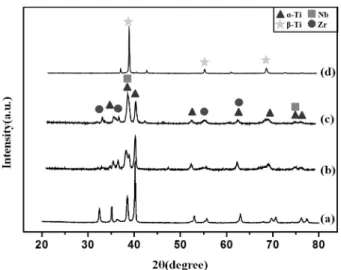
Fig. 2 shows the XRD analysis results of the sintered Ti-13%Nb-13%Zr alloys with 10wt%NH
4HCO
3-2wt%TiH
2using mixed and milled Ti-13wt%Nb-13wt%Zr alloy powders. The XRD results show that α-Ti phase was re- mained in all sintered specimens except the Ti-13wt%Nb-
13wt%Zr alloys sintered by SPS using 12h high energy milled powder, but its diffraction intensity was relatively decreased with increasing milling time. Furthermore, β- Ti phase was formed caused by transformation of α-Ti phase in 12h milled specimen. It might be occurred due to a role of Nb as a β phase stabilizing alloying. And other reasons are increase of defect density such as dislocation and vacancy and increase of grain boundary energy due to high energy mechanical milling. These defects and ultra fine grains increased diffusion rate and decreased activa- tion energy of deformation from α-Ti phase to β-Ti phase.
Other small peaks are due to oxide such as TiO
2formed during milling and sintering.
Ammonium hydrogen carbonate(NH
4HCO
3) evaporates at below 200
oC as an ammonia, carbon dioxide and water by following reaction
7);
NH
4HCO
3= NH
3↑ + CO
2↑ + H
2O ↑ (1) For this reason, it could not find space holder in the sintered specimens.
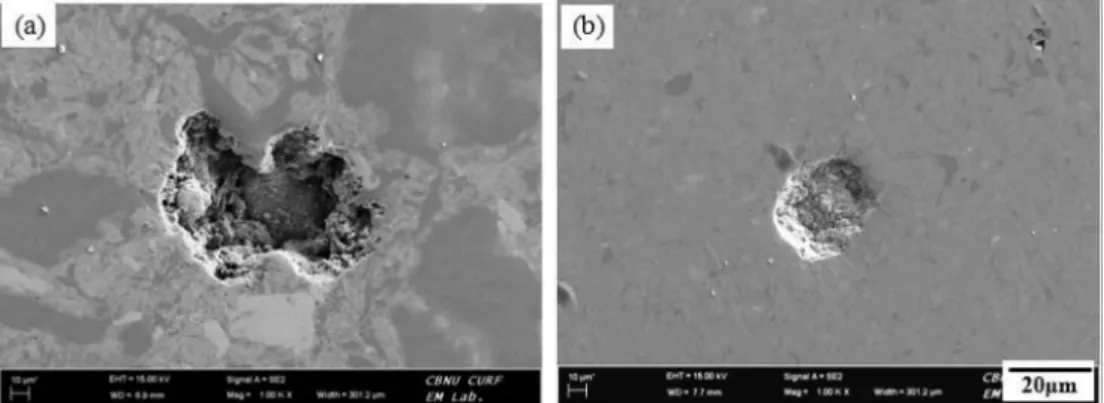
Fig. 3 shows OM micrographs and area percent of pore and Fig. 4 shows SEM micrographs of the sintered Ti- 13%Nb-13%Zr alloys with 10wt%NH
4HCO
3-2wt%TiH
2. From the result of image analysis using image analyzer (Image Pro Plus), the pore ratio of (a), (b), (c) and (d) was 21.74, 10.42, 8.36, 5.6 %, respectively and decrease with increasing milling time. The pore shape is similar to initial shape of space holder appeared in 24h-mixed speci- men (a). But the size of pores decreased up to 20~50 µm in 12h milled specimen (b) using ultra fine Ti-13%Nb- 13%Zr milled powder with a pressure(30MPa) during sintering.
Fig. 5 shows elemental mapping results of the sintered Ti-13wt%Nb-13wt%Zr alloys with 10wt%NH
4HCO
3-2wt%
Fig. 2. XRD patterns of the sintered Ti-13%Nb-13%Zr alloys using mixed powder for 24h or milled powder for 4-12h and followed by mixed with 10%NH
4HCO
3-2%TiH
2for 1h using mixer; (a) 24h mixed, (b) 4h milled, (c) 8h milled and (d) 12h milled.
Fig. 3. OM micrographs and area percent of pores of the sintered Ti-13%Nb-13%Zr alloy using mixed powder for 24h or milled powder
for 4-12h and followed by mixed with 10%NH
4HCO
3-2%TiH
2for 1h using mixer; (a) 24h mixed, (b) 4h milled, (c) 8h milled and (d)
12h milled.
TiH
2. In case of mixing for 24h, Nb and Zr rich phases(white region) were appeared in Ti matrix, and the distribution of each element was uniformly distributed
with increasing milling time. Because Nb and Zr elements were solid soluted in Ti matrix.
Fig. 6 shows the results of relative and measured dens- ity of the sintered Ti-13%Nb-13%Zr-(10wt%NH
4HCO
3- 2wt%TiH
2) composites. With increase milling time, relative density was increased as a value of 79, 81, 83, 88 % re- spectively, and measured density was increased as a value of 4.65, 4.78, 4.89 and 5.15 g/cm
3. This is because density depends on milling time.
Fig. 7 shows the hardness of the sintered Ti-13%Nb- 13%Zr alloys with 10%NH
4HCO
3-2%TiH
2. The hardness was increased with increase milling time from 107.2 to 125.6 for mixed powder and 12h milled powder respect- ively. This is because grain size of sintered alloy using milled powder decreased with milling time.
Fig. 8 shows compressive strength and Young’s modu- lus of the sintered Ti-13%Nb-13%Zr alloy using mixed and milled powder and followed by mixed with 10%
Fig. 4. SEM micrographs of the sintered Ti-13%Nb-13%Zr alloy using mixed powder for 24h or milled powder for 12h and followed by mixed with 10%NH
4HCO
3-2%TiH
2for 1h using mixer. (a) 24h mixed, (b) 12h milled.
Fig. 5. Elemental mapping results of the sintered Ti-13%Nb-13%Zr alloys using mixed powder for 24h or milled powder for 4-12h and followed by mixed with 10%NH
4HCO
3-2%TiH
2for 1h using mixer; (a) 24h mixed, (b) 4h milled, (c) 8h milled and (d) 12h milled.
Fig. 6. The relative and measured density of the sintered Ti-
13%Nb-13%Zr-(10%NH
4HCO
3-2%TiH
2) composites.
NH
4HCO
3-2%TiH
2for 1h using mixer. With increase milling time, compressive strength was increased as value of 923, 1166, 1229, 1540MPa respectively, and Young’s modulus was increased as a value of 51, 52, 58 and 78GPa.
This is because the mechanical property is affected by grain size and density of specimen. The size of 12h milled powder can be obtained nano-size. This paper is intended to obtain an elastic modulus to be similar to bone elastic modulus, but it is obtained a higher elastic modulus than bone. Is a result of using the 10 % space holder. Therefore adjusting the amount of space holder, it is expected that it is possible to obtain elastic modulus similar bone.
4. Conclusions
In this study, it examined the effects on the mechanical
properties and pore characteristics of biomaterials by spark plasma sintering using space holder.
1) Having the low Young’s modulus, porous Ti-Nb-Zr biomaterials with space holder(NH
4HCO
3) and pore foaming agent(TiH
2) were successfully fabricated by SPS using high energy mechanical milled and mixed powders.
2) The sintered Ti-13%Nb-13%Zr alloys using 12h milled powder showed ultrafine grain and addition ele- ments such as Nb and Zr distributed uniformly.
3) β- phase Ti-13%Nb-13%Zr alloy can be fabricated by SPS at 850
oC using 12h milled powder.
4) The pore ratio was decreased with increasing milling time. The size of pore of the sintered specimen using 12h milled powder was decreased up to 20~50 µm during sintering.
5) The density, hardness, compressive strength and Young’s modulus was increased with milling time, because of grain size of sintered alloys were decreased with increasing milling time.
Acknowledgements
This research was conducted with financial support from the National Research Foundation(NRF) (No: 2013- 1301000703) of Korea.
References
1. M. Long and H. J. Rack, Biomater., 19, 1621 (1998).
2. H. S. Kim, W. Y. Kim and S. H. Lim, Scr. Mater., 54, 887 (2006).
3. E. Takahashi, T. Sakurai, S. Watanabe, N. Masahashi, and S, Mater. Trans., 43, 2978 (2002).
4. L. M. Elias, S. G. Schneider, S. Schneider, H. M. Silva and F. Malvisi, Mater. Sci. Eng. A, 432, 108 (2006).
5. H. S. Kim, S. H. Lim, I. D. Yeo, W. Y. Kim, Mater. Sci.
Eng. A, 449, 322 (2007).
6. Geetha M., Singh AK., Asokamani R. and Gogia AK., Progr. Mater. Sci., 54, 397 (2009).
7. L. M. Elias, S. G. Schneider, H. M. Silva and F. Malvisi, Mater. Sci. Eng., A 432, 108 (2006).
8. Nouri, Alireza, Hodgson, Peter D., and Wen, Cui'e, in Biomimetics learning from nature, ed. Mukherjee, Amitava (InTech, Rijek, Croatia, 2010) p.415.
9. K. D. Woo, S. M. Kim, D. G. Kim, D. Y. Kim and D. S.
Kang, Kor. J. Mater. Res., 23, 135 (2013).