INTRODUCTION
Menopause is the cessation of menstruation for more than 1 year, owing to depletion of ovarian function.1 As the life expec- tancy of women has increased, presently, approximately one-
third of a woman’s life is postmenopausal. Women experience several postmenopausal symptoms, and management of these symptoms is crucial for maintaining their quality of life. Vaso- motor symptoms, insomnia, vaginal dryness, and other such symptoms are associated with the postmenopausal period, and they can impair woman’s normal function and well-being.2 Hor- mone therapy (HT) is the most effective treatment for severe postmenopausal symptoms.3,4 However, there are several other non-hormonal treatment options, such as health functional foods, oriental medicine, and relaxation therapy. After the Women’s Health Initiative (WHI) study, there has been some confusion about whether women experiencing menopausal symptoms should utilize HT.5 Many women have opted for non- hormonal treatments, such as health functional foods, relax- ation therapy, exercise, or diet. Nevertheless, the effects of these non-hormonal treatments are not as promising as those of HT.6
Perceptions of Postmenopausal Symptoms and Treatment Options among Middle-Aged
Korean Women
Min Kyoung Kim
1,2, Seok Kyo Seo
1,2, Hee Dong Chae
3, Kyung Joo Hwang
4, Tak Kim
5, Byung-Koo Yoon
6, and Byung Seok Lee
1,21Division of Gynecologic Endocrinology, Department of Obstetrics and Gynecology, Severance Hospital, Yonsei University College of Medicine, Seoul;
2Institute of Women’s Life Medical Science, Yonsei University College of Medicine, Seoul;
3Department of Obstetrics and Gynecology, University of Ulsan College of Medicine, Asan Medical Center, Seoul;
4Department of Obstetrics and Gynecology, Ajou University College of Medicine, Suwon;
5Department of Obstetrics and Gynecology, Korea University College of Medicine, Seoul;
6Department of Obstetrics and Gynecology, Sungkyunkwan University College of Medicine, Samsung Medical Center, Seoul, Korea.
Purpose: To investigate the perceptions of postmenopausal symptoms and treatment options among middle-aged Korean women.
Materials and Methods: This cross-sectional study included 2330 Korean women. The women were administered a structured questionnaire to collect sociodemographic data and information regarding menopause and its treatment.
Results: More than half (65%) of the participants perceived menopause as a disease, and 66.8% knew hormone therapy (HT) is avail- able for menopausal symptom treatment. However, only 19.7% of participants visited clinics for HT. The most common reasons for having negative views about HT were its adverse reactions (47.3%) and concerns about developing cancer (41.1%). For symptom management, 36.5% of the participants tried lifestyle modification instead of HT.
Conclusion: The majority of Korean women regarded menopause as a disease. They were aware of HT for menopausal symptom treatment, but the use of HT was relatively low. Education about the safety and positive effects of HT and the importance of profes- sional healthcare should be provided.
Key Words: Postmenopause, hormone replacement therapy, middle aged
pISSN: 0513-5796 · eISSN: 1976-2437
Received: September 27, 2016 Revised: February 13, 2017 Accepted: February 13, 2017
Corresponding author: Dr. Byung Seok Lee, Division of Gynecologic Endocrinolo- gy, Department of Obstetrics and Gynecology, Institute of Women’s Life Medical Sci- ence, Yonsei University College of Medicine, 50-1 Yonsei-ro, Seodaemun-gu, Seoul 03722, Korea.
Tel: 82-2-2228-2230, Fax: 82-2-313-8357, E-mail: [email protected]
•The authors have no financial conflicts of interest.
© Copyright: Yonsei University College of Medicine 2017
This is an Open Access article distributed under the terms of the Creative Com- mons Attribution Non-Commercial License (http://creativecommons.org/licenses/
by-nc/4.0) which permits unrestricted non-commercial use, distribution, and repro- duction in any medium, provided the original work is properly cited.
Yonsei Med J 2017 May;58(3):533-539 https://doi.org/10.3349/ymj.2017.58.3.533
There have been several trials worldwide in finding out the middle-aged women’s perception of menopause and its treat- ment methods. A Belgian study used an internet survey to ob- tain information from 600 postmenopausal women. Almost all participants (98%) were aware of menopause, and 82% knew the different treatment options. Interestingly, HT was used sig- nificantly more often by French-speaking women (32%) than by Dutch-speaking women (9%).7 On the other hand, a Chinese study has shown that HT awareness among women was only 3.5% and that, although most Chinese women had knowledge of menopause, they thought menopausal symptoms should not be treated.8 A study from Central America reported that women considered HT as a treatment option in 27.2%, but the actual use was rather low (2.7%).9 Different cultures and socio- economic backgrounds are reflected in the different results in these studies. Due to this background, the present study aimed to investigate the perceptions of postmenopausal symptoms and treatment options among Korean middle-aged women.
MATERIALS AND METHODS
This study was done during the “2015 Cool Diva campaign” su- pervised by the Korean Menopause Society. The study enrolled 2330 Korean women aged 45–65 years. ‘Middle-aged’ women are defined as women in their perimenopausal and postmeno- pausal period, and 45–65 years of age is the correlated period.
The participants included menopausal (45.1%) and perimeno- pausal women. After stratified sampling, random quota sam- pling of the participants was performed. Sociodemographic data, such as age, education level, resident city, occupation, and income, were collected. This study used asmartphone sur- vey application (http://ovey.co.kr) with a structured question- naire composed of 21 questions with regard to the following three categories: general perceptions of menopause, treatment options, and postmenopausal symptoms and their treatments.
The survey was conducted for 3 days from June 16 to 19, 2015.
The study subjects randomly participated the mobile survey at their own will and were rewarded with an item they chose after they finished the survey. The survey was automatically finalized once the number of participants reached 2330. The study was performed according to the tenants of the Declara- tion of Helsinki and was approved by the Institutional Review Board of Yonsei University Health System, Severance Hospital (4-2015-0756).
The first questionnaire category (general perceptions of menopause) included questions on whether the study partici- pants perceived menopause as a disease. It also included ques- tions on the source of information about menopause. The sec- ond category (treatment options) had the following three topics:
HT, health functional foods, and visiting gynecology clinics.
The study participants were asked whether they were aware about HT or health functional foods and their opinion on these
treatments. They were also asked whether they had visited gy- necology clinics for postmenopausal symptoms and if they were inclined to visit such clinics in the future. The third catego- ry (postmenopausal symptoms and their treatments) included questions on whether the participants experienced certain postmenopausal symptoms and whether they tried to improve the symptoms. It also included questions on the approaches to handle the symptoms and the effectiveness of the treatment approaches. Finally, the participants were questioned on whether they had discontinued HT previously and on the rea- sons for discontinuing HT. Statistical analysis was done using Pearson’s chi-square test by SPSS ver. 23 (IBM, Armonk, NY, USA).
RESULTS
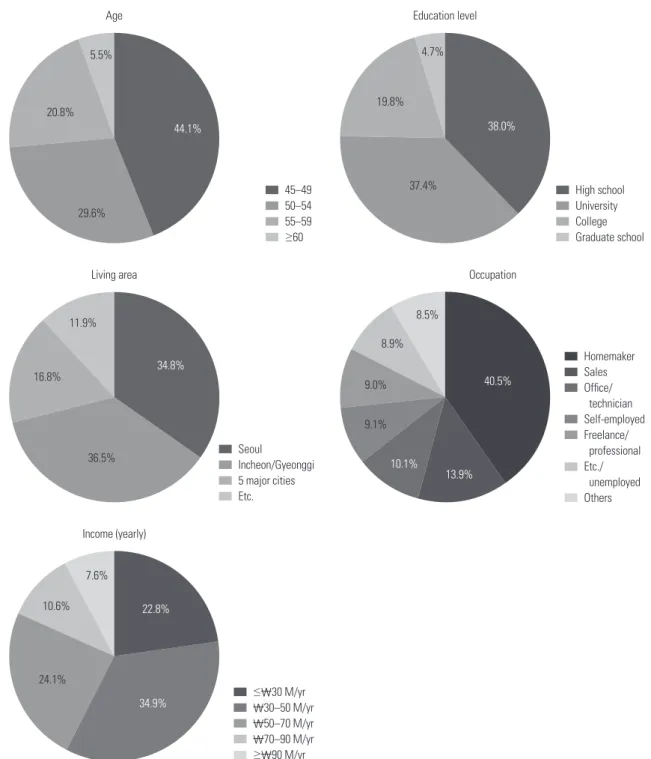
The sociodemographic characteristics of the study partici- pants are presented in Fig. 1. Approximately 70% of the study participants were aged 45–54 years and lived in Seoul (the cap- ital of Korea) or nearby Gyeonggi province. Additionally, ap- proximately 50% were working, 40% were homemakers, and more than 60% had college education.
With regard to the first questionnaire category (general per- ceptions of menopause), 65% of the participants recognized menopause as a disease that needs treatment. The perception of menopause as a disease was greater in younger participants than in older participants (70.5% for participants in their late 40s, and 56.7% for participants in their early 60s). Participants who had high income had a tendency to recognize menopause as an illness (72.5%) (Supplementary Table 1, only online).
For obtaining information about menopause, a majority of participants (64.6%) depended on their friends or family mem- bers, and many relied on mass media, such as TV/radio (50.5%) and the internet/social network services (SNS) (45.0%). High proportions of participants, especially in their late 40s (50.7%) and early 50s (44.3%), obtained information from the internet/
SNS (Supplementary Table 2, only online).
With regard to the second category (treatment options), 66.8% of the participants were aware that HT is available for menopausal symptom treatment. Awareness about HT was greater among participants in their early 60s than among those in their late 40s (81.9% vs. 63.9%) and greater among partici- pants with high income than among those with low income (72.5% vs. 58.0%). Moreover, awareness about HT was higher among participants who considered menopause as a disease than among those who did not consider menopause as a dis- ease (70.7% vs. 59.6%) (Supplementary Table 3, only online).
A low proportion of participants had positive views about HT (30.9%), and most participants had neutral views (61.7%).
A very low proportion of participants had negative views about HT (7.3%). Among participants in their late 40s, 33.0% had posi- tive views, and among participants in their early 60s, 69.4%
had neutral views about HT. Participants who perceived meno- pause as a disease had more positive views about HT (40.7%) than those who did not (Supplementary Table 4, only online).
The most common reasons for having negative views about HT were its adverse reactions (47.3%) and concerns about devel- oping cancer (41.1%) (Supplementary Table 5, only online).
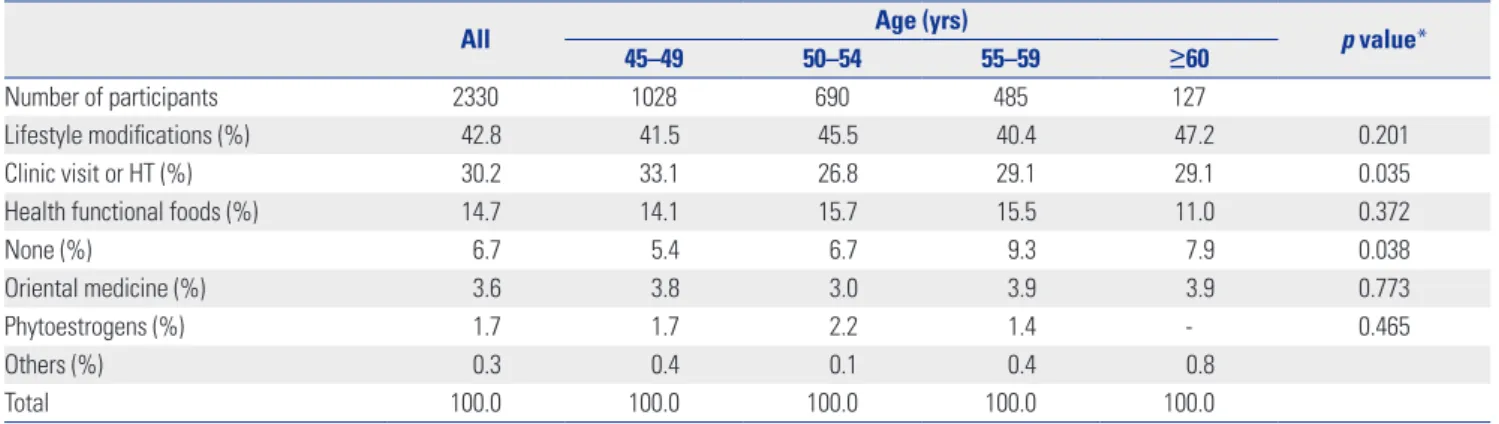
For alleviating menopausal symptoms, 42.8% of the partici- pants believed that simple lifestyle modifications would be ef- fective, while 30.2% and 14.7% believed that HT and health functional foods would be effective, respectively (Table 1) (Sup-
plementary Table 6, only online). Low proportion of partici- pants (29.9%) visited clinics for professional consultation and treatment (Supplementary Table 7, only online). The lowest proportion was noted for participants in their late 40s (19.6%), and with age, the proportion of participants who sought pro- fessional help increased (early 50s, 35.5%; late 50s, 40.4%; ear- ly 60s, 43.3%). Moreover, clinic visits were more common among participants who considered menopause as a disease than among those who did not consider menopause as a dis- ease (35.8% vs. 18.9%). The participants’ willingness to visit
Fig. 1. Sociodemographic data of the study population.
45–49 50–54 55–59
≥60 Age
44.1%
5.5%
20.8%
29.6%
Seoul
Incheon/Gyeonggi 5 major cities Etc.
Living area
34.8%
11.9%
16.8%
36.5%
≤₩30 M/yr
₩30–50 M/yr
₩50–70 M/yr
₩70–90 M/yr
≥₩90 M/yr Income (yearly)
22.8%
7.6%
10.6%
24.1%
34.9%
High school University College Graduate school Education level
38.0%
4.7%
19.8%
37.4%
Homemaker Sales Office/
technician Self-employed Freelance/
professional Etc./
unemployed Others Occupation
40.5%
13.9%
10.1%
9.1%
9.0%
8.9%
8.5%
clinics in the future and the reason for avoiding the clinics are described more in Supplementary Table 8 and 9 (only online).
With regard to the third category (postmenopausal symptoms and their treatments), 70.8% of the menopausal participants ex- perienced menopausal symptoms (Supplementary Table 10 and 11, only online). Among the symptoms experienced, hot flushes were the most common (75.4%), followed by vaginal
dryness (50.9%), fatigue (50.3%), and insomnia (47.6%) (Table 2) (Supplementary Table 12, only online). The menopausal symp- tom that was the most difficult to endure was hot flushes (33.1%), followed by insomnia (15.1%) and arthritic or muscular pain (9.2%) (Supplementary Table 13, only online). Although the most frequently experienced symptoms were vaginal dry- ness and fatigue, they were not considered difficult to endure by Table 1. Treatment Options that are Considered to be Helpful for Alleviating Menopausal Symptoms
All Age (yrs)
p value*
45–49 50–54 55–59 ≥60
Number of participants 2330 1028 690 485 127
Lifestyle modifications (%) 42.8 41.5 45.5 40.4 47.2 0.201
Clinic visit or HT (%) 30.2 33.1 26.8 29.1 29.1 0.035
Health functional foods (%) 14.7 14.1 15.7 15.5 11.0 0.372
None (%) 6.7 5.4 6.7 9.3 7.9 0.038
Oriental medicine (%) 3.6 3.8 3.0 3.9 3.9 0.773
Phytoestrogens (%) 1.7 1.7 2.2 1.4 - 0.465
Others (%) 0.3 0.4 0.1 0.4 0.8
Total 100.0 100.0 100.0 100.0 100.0
HT, hormone therapy.
*Pearson’s chi-square test.
Table 2. Experienced Postmenopausal Symptoms
Multiple choices All Age (yrs)
p value*
45–49 50–54 55–59 ≥60
Number of participants 743 88 294 283 78
Vasomotor symptoms (%) 75.4 79.5 74.5 76.0 71.8 0.767
Vaginal dryness (%) 50.9 47.7 54.8 49.5 44.9 0.288
Fatigue (%) 50.3 55.7 54.4 46.3 43.6 0.115
Insomnia (%) 47.6 46.6 51.4 47.0 37.2 0.162
Palpitation (%) 42.0 47.7 41.2 38.9 50.0 0.258
Depression (%) 40.6 47.7 40.5 38.9 39.7 0.615
Temperament (%) 38.6 43.2 42.5 35.7 29.5 0.106
Arthritic/muscular pain (%) 37.7 39.8 42.2 35.7 25.6 0.028
Perspiration (%) 35.7 36.4 39.1 33.9 28.2 0.224
Dizziness (%) 18.2 22.7 19.0 17.3 12.8 0.352
Headache (%) 16.8 27.3 17.0 13.8 15.4 0.031
*Pearson’s chi-square test.
Table 3. Attempted Treatments by the Participants
All Age (yrs)
p value*
Menopause as
a disease p value*
45–49 50–54 55–59 ≥60 Yes No
Number of participants 743 88 294 283 78 487 256
Diet and exercise (%) 36.5 33.0 35.7 39.2 33.3 0.615 30.8 47.3 <0.001
Clinic visits and HT prescription (%) 19.7 19.3 16.3 20.5 29.5 0.073 26.3 7.0 <0.001
Health functional foods (%) 11.4 13.6 13.6 10.2 5.1 0.155 12.5 9.4 0.2
Clinic visits and non-hormonal treatment prescription (%) 10.5 14.8 12.6 7.8 7.7 0.113 14.4 3.1 <0.001
Etc. (%) 3.0 2.3 3.4 3.2 1.3 2.9 3.1
None (%) 19.0 17.0 18.4 19.1 23.1 0.768 13.1 30.1 <0.001
HT, hormone therapy.
*Pearson’s chi-square test.
many participants (8.3% and 7.5%, respectively).
Table 3 shows the actually attempted treatment options by the survey participants (Supplementary Table 14 and 15, only online). Once again, the highest number of women tried life- style modifications, such as diet and exercise (36.5%), and HT was the second popular choice (19.7%). The comparisons be- tween the groups perceiving menopause as a disease or not show significant differences. People who perceived menopause as a disease visited clinics and used HT or non-hormonal treat- ments more than the counterpart. On the other hand, those who did not think menopause as a disease tended to do noth- ing for treatment.
Among the participants who used HT, a high proportion of participants stopped using HT (78.1%) (Supplementary Table 16, only online). The main reasons for discontinuation of HT were concerns about developing cancer (36.8%) and experi- encing adverse reactions (23.7%) (Supplementary Table 17, only online).
DISCUSSION
This study demonstrated the current state of perceptions of Ko- rean women with regard to postmenopausal symptoms and their management. A relatively large number of participants recognized menopause as a disease that needs treatment and obtained information from friends/family members and the in- ternet or social media rather than from professionals. Many participants preferred lifestyle modifications or health func- tional foods to HT and believed that these approaches could al- leviate menopausal symptoms. Additionally, participants who used HT but discontinued treatment were mostly worried about developing cancer and experiencing adverse reactions.
The results of previous epidemiological studies on the aware- ness of menopause among Korean menopausal women per- formed by the Korean Menopause Society10-12 are comparable to the results of our study. Although the study population dif- fered among the previous studies and our study, with regard to the number of participants and age groups, the finding that more than half of the participants knew about HT was similar.
On the other hand, the percentage of actual users of HT de- creased from 24.3% in the year 200211 to less than 20% in this study. It is quite discouraging to find that HT utilization has not increased among postmenopausal women, although more than a decade has passed since the announcement of the pre- vious studies. However, the HT awareness rate is not so low when compared to studies from other countries. A Pakistan study showed that only 5% of the participants had knowledge about HT even though the study population included highly educated Asian women.13 A recent Belgian study revealed 16%
of 696 postmenopausal women were using HT.7 The Central American women also showed low percentage; 10.2% were currently using HT, whereas 13.8% previously used HT but ab-
andoned it.9 Therefore, compared to these reports from around the world, about 20% of Korean women using HT do not seem to be lagging behind.
The present study differs from previous reports11,12 by the Ko- rean Menopause Society in several aspects: first, this was the largest study, including over 2300 women, whereas previous studies had 1201 participants. Second, it was the first attempt to utilize a mobile application survey, whereas previous studies were done by face-to-face interviews or answering question- naires on paper. Third, the results of a 2002 study showed that 53.6% perceived HT as a treatment option, and the present study showed an increased percentage of women who knew of HT (65.6%). Obviously, people had easier access to information about HT these days than in the past. Additionally, the most common reason for stopping HT in the past was the adverse ef- fects of HT, whereas in the present it was the fear of getting can- cer. This result also demonstrates that women today receive various sources of indiscriminate information about HT and the risk of cancer.
Many Korean women believed that their menopausal symp- toms could be effectively treated with lifestyle modifications, such as diet and exercise. Some women had the false idea that HT is detrimental to the body’s natural system.11,12 Although there was no significant difference among different age groups, it was also evident from this study that the primarily considered treatment option among Korean women was lifestyle modifica- tion. Therefore, health care professionals in Korea should edu- cate women and their family members about the benefits of HT and that it is more effective than lifestyle modification.
Koreans have easy access to the internet and mass media, and this development of information technology in Korea has resulted in greater knowledge about menopause and its treat- ments among Korean women than women from other coun- tries. A previous Chinese study8 reported that HT awareness among Chinese women was only 3.5%, and another study from Central America9 reported it was 27.2%. However, in our study, the proportion of women who were aware of HT was 66.8%. Al- though a high number of Korean women were aware about HT, the actual number of HT users was not as high as that of wom- en perceiving HT, which indicates that information technology has some limitations. Our study found that younger middle- aged women in their late 40s and early 50s were avid users of the internet and mass media and that these were the primary sources for information about menopause. However, regardless of easy access to abundant information about menopausal treatments via the internet or mass media, the most common treatment method chosen by most women was still ‘lifestyle modification’.
After the publication ofthe WHI study,14-17 which was over- stated in mass media, many individuals became concerned about the breast cancer risk associated with HT, and the num- ber of HT users consequently decreased. The current study found that women tend to think negatively about HT because
of the possible risk of breast cancer. However, a follow-up WHI study showed that the incidence of breast cancer was not greatly influenced by HT, and the combined estrogen-proges- terone therapy group was shown to have an increase in the in- cidence rate by only <1.0 per 1000 women per year of use.18-20 This demonstrates that the initial findings were exaggerated by mass media, which considerably affected public judgment.
There are many treatment options in HT and new approach- es, such as tissue-selective estrogen complex, have been in- troduced to reduce the risk of breast cancer.21,22 Many women are not aware that there are definite contraindications and in- dications for appropriate HT usage and that not everyone has the same risks or treatment criteria. The public should be in- formed that consultations with physicians are important to ensure appropriate and effective treatment.
The present study has some strengths. First, this study had a large population that included women from various back- grounds (e.g., different areas of living, occupations, and educa- tion levels). This is the most up-to-date and largest study in a single Asian country. With this representative data, we hope to realize the current status and plan for improvements in any de- ficiencies found. Second, selection bias was reduced owing to the random selection of participants. Third, the study question- naires were systematically categorized, and this facilitated a deeper understanding of the study topic.
On the other hand, this study also had some limitations.
Since this was a mobile survey without much further assistance or guidance by the survey organizer, some questionnaires may have been skipped or not answered properly by the partici- pants. Also, the data were collected by a smartphone applica- tion that only the people who knew this application or were able to use such program participated. Over 60% of the partic- ipants had high education levels, and thus, we may need to be careful in interpreting this as the perception of the general Korean population. However, subanalysis according to educa- tion level also showed similar results to the main results of this study. As previously described, a high percentage of the Kore- an public obtains information about HT through mass media or internet. Also, since medicine is such a professional field, the differences in perception of postmenopausal treatments among various education levels seem to be less likely. Further- more, as this study had a cross-sectional design, the causality of the women’s perspectives of HT and socioeconomic or cul- tural factors could not be determined. Further studies will be needed to assess these aspects.
In conclusion, while high numbers of Korean women were aware about HT, relatively few women selected HT for the treat- ment of menopausal symptoms, possibly because of informa- tion obtained from the internet/mass media and false beliefs about the negative effects of HT. There is a need to improve public awareness of the benefits of HT. Medical professionals will need to educate the public on treatments for menopausal symptoms, and measures should be taken to remove incorrect
information from the internet/mass media.
REFERENCES
1. Cheng MH, Wang SJ, Wang PH, Fuh JL. Attitudes toward meno- pause among middle-aged women: a community survey in an is- land of Taiwan. Maturitas 2005;52:348-55.
2. Gold EB, Colvin A, Avis N, Bromberger J, Greendale GA, Powell L, et al. Longitudinal analysis of the association between vasomotor symptoms and race/ethnicity across the menopausal transition:
study of women’s health across the nation. Am J Public Health 2006;96:1226-35.
3. Panay N, Hamoda H, Arya R, Savvas M; British Menopause Society and Women’s Health Concern. The 2013 British Menopause Soci- ety & Women’s Health Concern recommendations on hormone replacement therapy. Menopause Int 2013;19:59-68.
4. Maclennan AH, Broadbent JL, Lester S, Moore V. Oral oestrogen and combined oestrogen/progestogen therapy versus placebo for hot flushes. Cochrane Database Syst Rev 2004;(4):CD002978.
5. Burger HG, MacLennan AH, Huang KE, Castelo-Branco C. Evi- dence-based assessment of the impact of the WHI on women’s health. Climacteric 2012;15:281-7.
6. Nonhormonal management of menopause-associated vasomo- tor symptoms: 2015 position statement of The North American Menopause Society. Menopause 2015;22:1155-72.
7. Depypere H, Pintiaux A, Desreux J, Hendrickx M, Neven P, Marcho- wicz E, et al. Coping with menopausal symptoms: an internet sur- vey of Belgian postmenopausal women. Maturitas 2016;90:24-30.
8. Jin F, Tao M, Teng Y, Shao H, Li C, Mills E. Knowledge and attitude towards menopause and hormone replacement therapy in Chi- nese women. Gynecol Obstet Invest 2015;79:40-5.
9. Tserotas K, Hernandez L, Morera F, Pineda R, Chedraui P. Treat- ment for the menopause in Central America: use, knowledge, per- ceptions and attitudes among urban living middle-aged women.
Gynecol Endocrinol 2011;27:504-11.
10. Choi H, Lee HK, Park HM. The Korean menopausal women’s atti- tudes and awareness on menopause: results of Korean Gallup ep- idemiologic survey on menopause and HRT. J Korean Soc Meno- pause 2003;9:36-43.
11. Park HM, Choi H, Lee HK. The HRT awareness and acceptance in Korean postmenopausal women: results of Korean Gallup epide- miologic survey on menopause and HRT. J Korean Soc Menopause 2002;8:3-18.
12. Chae HD, Choi SY, Cho EJ, Cho YM, Lee SR, Lee ES, et al. Aware- ness and experience of menopausal symptom and hormone ther- apy in Korean postmenopausal women. J Menopausal Med 2014;
20:7-13.
13. Memon FR, Jonker L, Qazi RA. Knowledge, attitudes and percep- tions towards menopause among highly educated Asian women in their midlife. Post Reprod Health 2014;20:138-42.
14. Yum SK, Kim T. Gaps in menopause knowledge. J Menopausal Med 2014;20:47-51.
15. Kyvernitakis I, Kostev K, Hars O, Albert US, Hadji P. Discontinua- tion rates of menopausal hormone therapy among postmenopaus- al women in the post-WHI study era. Climacteric 2015;18:737-42.
16. Kim JY, Sang JH, Park HM. The change of hormone therapy in post- menopausal women in Korea before and after women’s health ini- tiative study: 2000~2009. Korean J Obstet Gynecol 2010;53:1110-7.
17. Rossouw JE, Anderson GL, Prentice RL, LaCroix AZ, Kooperberg C, Stefanick ML, et al. Risks and benefits of estrogen plus progestin in healthy postmenopausal women: principal results From the Wom- en’s Health Initiative randomized controlled trial. JAMA 2002;288:
321-33.
18. de Villiers TJ, Hall JE, Pinkerton JV, Pérez SC, Rees M, Yang C, et al. Revised global consensus statement on menopausal hormone therapy. Maturitas 2016;91:153-5.
19. Aedo S, Cavada G, Blümel JE, Chedraui P, Fica J, Barriga P, et al.
Women’s Health Initiative estrogen plus progestin clinical trial: a study that does not allow establishing relevant clinical risks. Meno- pause 2015;22:1317-22.
20. Gompel A, Santen RJ. Hormone therapy and breast cancer risk 10
years after the WHI. Climacteric 2012;15:241-9.
21. Song Y, Santen RJ, Wang JP, Yue W. Inhibitory effects of a bazedox- ifene/conjugated equine estrogen combination on human breast cancer cells in vitro. Endocrinology 2013;154:656-65.
22. Song Y, Santen RJ, Wang JP, Yue W. Effects of the conjugated equine estrogen/bazedoxifene tissue-selective estrogen complex (TSEC) on mammary gland and breast cancer in mice. Endocrinology 2012;153:5706-15.