* Corresponding author : Hyowon Lee, Korea National Open University, Seoul 110-791, Korea, Tel: +82-2-2652-2810, Fax: +82-2-3679- 2381, E-mail: [email protected]
Research Article
Mapping Herbage Biomass on a Hill Pasture using a Digital Camera with an Unmanned Aerial Vehicle System
Hyowon Lee
1, Hyo-Jin Lee
2, Jong-Sung Jung
3and Han-Jong Ko
11
Department of Agriculture, Korea National Open University, Seoul 110-791, Korea,
2
Department of Landscape Architecture, Sungkyunkwan University, Suwon 440-746, Korea,
3
National Institute of Animal Science, RDA, Cheonan, 330-801, Korea
ABSTRACT
Improving current pasture productivity by precision management requires practical tools to collect site specific pasture biomass data. Recent developments in unmanned aerial vehicle (UAV) technology provide cost effective and real time applications for site specific data collection. For the mapping of herbage biomass (BM) on a hill pasture, we tested a UAV system with digital cameras (visible and near-infrared (NIR) camera). The field measurements were conducted on the grazing hill pasture at Hanwoo Improvement Office, Seosan City, Chungcheongnam-do Province, Korea on May 17 and June 27, 2014. Plant samples were obtained from 28 sites. A UAV system was used to obtain aerial photos from a height of approximately 50 m (approximately 30 cm spatial resolution). Normalized digital number (DN) values of Red and NIR channels were extracted from the aerial photos and a normalized differential vegetation index using DN (NDVIdn) was calculated. The results show that the correlation coefficient between BM and NDVIdn was 0.88. For the precision management of hilly grazing pastures, UAV monitoring systems can be a quick and cost effective tool to obtain site-specific herbage BM data.
(Key words : Digital camera, Herbage biomass, Hilly pasture, Mapping, Unmanned aerial vehicle)
. INTRODUCTION
In Korea, most pasture is cultivated on a small area and located in mountainous or hill ground, making precision management difficult. For the efficient management of Korean hill pasture, precision farming can be an appropriate pasture management strategy. Precision farming is a site- specific agricultural management system which can reduce costs, optimize of crop yield and protect the environment (Bouma, 1997). It has a role not only in upland crop production but also in forage crop production (Suzuki et al., 2008), and precision grazing can help stock managers adjust stocking rates and determine supplement requirement (Starks et al., 2006; Zhao et al., 2007).
Site-specific pasture quality data are required for precision grassland management because pasture quality plays an important role in animal productivity and farm profitability (White and Hodgson, 1999) and the high-resolution data are required frequently for livestock management in small scale
(1~20 ha) paddocks (Di Bella et al., 2004; Wallace et al., 2004). Therefore, various monitoring and analytical methods have been developed to monitor spatial distributions of pasture quality.
However, the cost and difficulty of collecting site-specific data sets are major barriers for the application of precision grassland management (Betteridge et al., 2008). Traditional ground-based plant sampling methods are neither practical nor cost effective when a large amount of data has to be collected. Prior studies have found several factors influencing herbage biomass (BM) production (Jung, 2003; Sung et al., 2005) in hill pasture. However, most of these studies were based on block-level analysis, and the factors may vary within a field due to micrometeorology, topography and variation in soil factors. Therefore, techniques are required to measure pasture quality quickly and cost-effectively across the field.
Remote sensing is frequently used to collect site-specific
information because it can efficiently assess within-field
Lee et al. ; Estimating Pasture Biomass using UAV
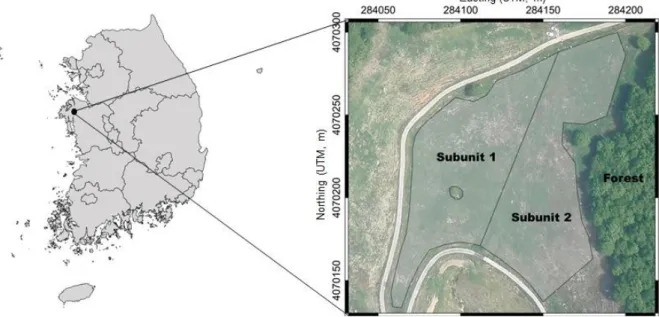
Fig. 1. Location of the study site which consisted of Subunit 1 (0.62 ha) and Subunit 2 (0.67 ha).
variability in large fields (Schanda, 1978). Satellite imagery has been widely used to evaluate long-term change in pasture conditions across large areas, and it can be one of the most effective tools for displaying spatial variation in herbage conditions within fields. However, most satellite imagery has low spatial resolution (e.g. 30 m for Landsat) and the time required to collect repeat images in the same location is relatively long (e.g. every 16 days for Landsat).
Airborne imaging has much greater flexibility than satellite platforms with a higher spatial resolution (Lamb and Brown, 2001). However, it is expensive for practical application, especially when repeated data acquisition is required. To overcome the limitations of satellite and aerial imaging, various low-altitude aerial platforms have been applied to collect high spatial resolution imagery, such as cable- supported helium balloon systems (Kawamura et al., 2011), blimps (Inoue et al., 2000) and remote-control helicopters (Sugiura et al., 2005; Rovira-M´as et al., 2005). These low- altitude aerial platforms can provide fine-scale imagery within 1 m and are cost effective.
For the purpose of generating a spatial distribution map of herbage BM on hill pasture, we developed a simple and cost effective low-altitude aerial platform system with a commercial digital camera on an unmanned aerial vehicle (UAV) system, collected the images and estimated the herbage BM using statistical analyses.
. METHODS 1. Experimental field
The study was conducted at the grazing hill pasture at Hanwoo Improvement Office (36° 45 N, 126° 34 E), Seosan City, Chungcheongnam-do Province, Korea (Fig. 1). This area has a mean annual temperature of 11.9 and mean annual precipitation of 1,285 mm. The pasture consisted of two areas, i.e. Subunit 1 (0.62 ha) and Subunit 2 (0.67 ha) which are located on a west-facing slope (145 to 190 m above sea level) with forest to the north and south of the experimental field, dominated by Quercus spp. and Pinus densiflora Siebold & Zucc., with a canopy height of 20~30 m. Both subunits were established in 1969 sown with tall fescue (Festuca arundinacea S.), orchardgrass (Dactylis glomerata L.), perennial ryegrass (Lolium perenne L.) and Kentucky bluegrass (Poa pratensis L.) at 18 kg, 10 kg, 5 kg and 2 kg per hectare, respectively, in Subunit 1 and 10 kg, 18 kg, 5 kg and 2 kg per hectare, respectively, in Subunit 2 in 2013.
From June 5 to June 9 in 2014, Korean native cows (Bos taurus coreanae) and their calves grazed both pastures.
2. Unmanned aerial vehicle system with digital cameras
To obtain aerial photos, two commercial digital cameras
(Casio, FS-10) were used. A filter in front of CCD (Charge-
Photo 1. Left hand photograph: digital camera for the visible image (right hand side) and near infrared image (left hand side). Right hand photograph: unmanned aerial vehicle for aerial photography.
Coupled Device) on one of the digital cameras was replaced with a near-infrared (NIR) penetration filter (Fujifilm, IR 76) to obtain NIR images. Shutters on each of the cameras were controlled by signals sent by an electronic device to the two cameras at 5 second intervals (Photo 1, left hand side).
The remote control airplane (Photo 1, right hand side) was flown to obtain digital image data from a height of approximately 50 m in the nadir position, giving approximately 30 cm spatial resolution on the ground. The airplane was 1 m long and able to lift about 300 g.
3. Preprocessing aerial images
NIR and RGB images from the two digital cameras were processed using Quantum GIS (QGIS) software ver. 2.6 (http://www.qgis.org/). The images were georeferenced using ground control points that were collected with the differentially corrected global positioning system (DGPS) receiver MobileMapper 120 GPS (Spectra precision Co. Ltd., Westminster, USA), giving an accuracy of less than 30 cm.
Although earlier studies indicated the importance of canopy segmentation on image processing in vision-based remote sensing (Laliberte and Rango, 2011), this was not necessary in the present study as almost 100% of the ground surface was covered by vegetation.
RGB and NIR images were resampled by 30 cm spatial resolution. Then, using the normalized digital number (DN)
value of the red band (Red
dn) of the RGB image and NIR band (NIR
dn) of the NIR image, the normalized differential vegetation index using DN (DNVI
dn) was calculated by following equation :
DNVI
dn= (NIR
dn- Red
dn) / (NIR
dn+ Red
dn)
4. Field data collection
Forage was sampled in 28 plots within the field on May 16 and June 27, 2014. All vegetation was clipped to ground level using a 30 cm × 30 cm quadrat. The forage samples were dried in a forced-air oven at 65 for 72 h to determine the dry matter (DM) of the BM (g DM m
2).
5. Generating spatial distribution map of pasture biomass
Spatial distribution maps of pasture biomass were generated from the NDVI
dnimages. Then, a spatial distribution map of change in pasture biomass was generated from the two spatial distribution maps of pasture biomass using the QGIS software.
. RESULTS AND DISCUSSION 1. Biomass estimation using UAV system
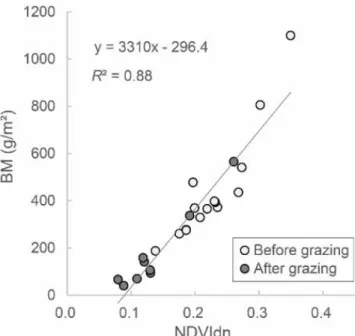
The result of simple linear regression analysis between
BM and NDVI
dnis shown in Fig. 2. The correlation
Lee et al. ; Estimating Pasture Biomass using UAV
Fig. 2. Relationship between normalized differential vegetation index using normalized digital number (NDVI
dn) and herbage biomass (BM). *Samples were collected on 19 days before grazing and 18 days after grazing.
coefficient between BM and NDVI
dnwas 0.88.
In this research, regression models showed relatively high predictive ability and it was similar with previous research using high-resolution satellite image and aerial hyperspectral imagery. Edirisinghe et al. (2011) reported that high-resolution satellite image shows a significant linear relationship (R
2= 0.84) between NDVI and pasture biomass. Another research using aerial hyperspectral imagery also showed a significant linear relationship (R
2= 0.81) between broad band NDVI and rangeland biomass (Beeri et al., 2007).
However, it is generally known that NDVI is sensitive to low chlorophyll concentrations (Yoder and Waring, 1994), but is not sensitive to extremes of green vegetation with higher chlorophyll concentrations (Mutanga and Skidmore, 2004). Therefore, it is not possible to conclusively determine the effectiveness of the NDVI
dnof the UAV system as the investigation was short term. However, this study has shown its potential and has laid the groundwork for the next longer term study.
Spectral vegetation indices were calculated as a ratio or normalized difference between near infrared (NIR) and visible bands, and they have been widely used to retrieve biophysical parameters (Sellers, 1987). NDVI is the most
widely known vegetation index for BM estimation (Tucker, 1979; Wessels et al., 2006) and should be calculated from reflectance. However, the DN value was directly used in this research to calculate NDVI (i.e. NDVI
dn) for the convenient use of UAV system with digital camera. The results showed that NDVI
dnfrom the UAV system with digital cameras can predict herbage biomass with high predictive ability.
2. Generating site-specific BM data
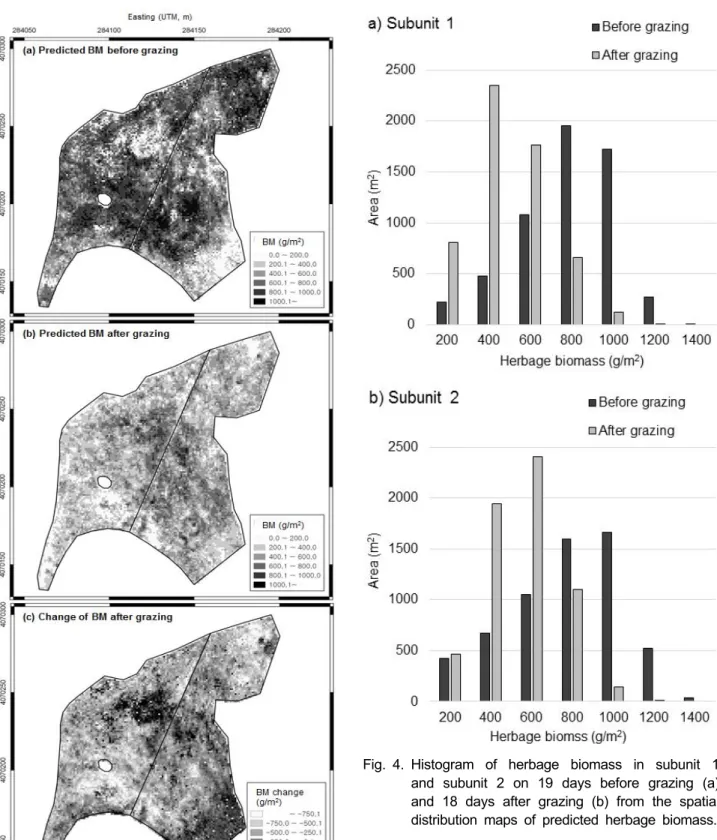
Spatial distribution maps of predicted BM from NDVI
dnimages were generated on 16th May (Fig. 3, a) and 27
thJune (Fig. 3, b), and spatial distribution map of BM change was generated from the generated BM maps (Fig. 3, c).
Then, average BM was calculated from the spatial distribution maps of predicted BM. The average predicted BM on 17
thMay, 2014 and 27
thJune, 2014 was 668.6 g/m
2and 386.5 g/m
2in subsite 1 and 652.4 g/m
2and 447.7 g/m
2in subsite 2, respectively. The change in predicted BM was also well described BM change histogram in Fig. 4.
For the monitoring and mapping of spatial variability, site-specific data can lead to more efficient site-specific grazing management decisions like fertilizer application, irrigation or pasture renovation (Hill et al., 1999), and it should be used to support practical information about current actual condition of Korean hill grazing pastures.
3. Application of UAV monitoring system for monitoring hill pasture
In Korea, hill grazing pasture is an important livestock
farming resource. However, Korean hill grazing pasture is
usually located on steep slope and remote from main roads,
and so it is difficult to monitor pasture quality by traditional
survey methods. In this research, we have confirmed that a
UAV monitoring system can be a quick and cost effective
tool to obtain site-specific herbage BM data presented as a
very fine resolution map. The site-specific pasture herbage
data from UAV monitoring system can be used not only to
estimate herbage biomass and its distribution but also to
apply precision grazing strategy to hill grazing pasture.
Fig. 3. Spatial distribution map of predicted herbage biomass (BM) on 19 days before grazing (a), 18 days after grazing (b) and change of bio- mass (c).
Fig. 4. Histogram of herbage biomass in subunit 1 and subunit 2 on 19 days before grazing (a) and 18 days after grazing (b) from the spatial distribution maps of predicted herbage biomass.
. CONCLUSION
This study investigated the potential of UAV system and
digital camera for estimation of BM in hill pasture in
Korea. The results show that the correlation coefficient
Lee et al. ; Estimating Pasture Biomass using UAV
between BM and NDVI
dnwas 0.88. The UAV system with digital cameras can be an effective tool to estimate hill grazing pasture BM with a high predictive ability and it may thus be a quick and cost-effective methodology.
. ACKNOWLEDGEMENT
This research was supported by a 2014 Grant-in-add from Korea National Open University.
. REFERENCES
Beeri, O., Phillips, R., Hendrickson, J., Frank, A.B. and Kronberg, S.
2007. Estimating forage quantity and quality using aerial hyperspectral imagery for northern mixed-grass prairie. Remote Sensing of Environment. 110:216-225.
Betteridge, K., Schnug, E. and Haneklaus, S. 2008. Will site specific nutrient management live up to expectation?. Agriculture and Forestry Research. 58:283-294.
Bouma, J. 1997. Precision agriculture: introduction to the spatial and temporal variability of environmental quality. Lake, J.V., Bock, G. R. and Goode, J. A. Eds. pp. 5-17. John Wiley and Sons, Wageningen, The Netherlands.
Di Bella, Faivre, C., Ruget, R., Seguin, F., Guérif, M., Combal, B., Weiss, M. and Rebella, C. 2004. Remote sensing capabilities to estimate pasture production in France. International Journal of Remote Sensing. 25:5359-5372.
Edirisinghe, A., Hill, M.J., Donald, G.E. and Hyder, M. 2011.
International Journal of Remote Sensing. 32(10):2699-2724.
Hill, M.J., Donald, G.E., Vickery, P.J., Moore, A.D. and Donnelly, J.R. 1999. Combining satellite data with a simulation model to describe spatial variability in pasture growth at a farm scale.
Australian Journal of Experimental Agriculture. 39:285-300.
Inoue, Y., Morinaga, S. and Tomita, A. 2000. A blimp-based remote sensing system for low altitude monitoring of plant variables: A preliminary experiment for agricultural and ecological applications. International Journal of Remote Sensing. 21:379- 385.
Jung, Y.K. 2003. Effects of the kieserite application on the seedling vigour and yield of grass/clover mixed swards on newly reclaimed hilly soil (in Korean). Journal of the Korean Society of Grassland and Forage Science. 23(1):31-36.
Kawamura, K., Sakuno, Y., Tanaka, Y., Lee, H.J., Lim, J., Kurokawa, Y. and Watanabe, N. 2011. Mapping herbage biomass and nitrogen status in an Italian ryegrass (Lolium multiflorum L.)
field using a digital video camera with balloon system. Journal of Applied Remote Sensing. 5(1):053562-053562.
Laliberte, A. and Rango, A. 2011. Image processing and classification procedures for analysis of sub-decimeter imagery acquired with an unmanned aircraft over arid rangelands. GIScience & Remote Sensing. 48(1):4-23.
Lamb, D.W. and Brown, R.B. 2001. PA precision agriculture:
Remote-sensing and mapping of weeds in crops. Journal of Agricultural Engineering Research. 78:117-125.
Mutanga, O. and Skidmore, A.K. 2004. Narrow band vegetation indices overcome the saturation problem in biomass estimation.
International Journal of Remote Sensing. 25:3999-4014.
Quantum GIS (QGIS). Version 2.6.1. 2014. QGIS Development Team. http://www.qgis.org/.
Rovira-M´as, F., Zhang, Q. and Reid, J.F. 2005. Creation of three-dimensional crop maps based on aerial stereoimages.
Biosystems Engineering. 90:251-259.
Schanda, E. 1978. Remote sensing of the environment. Naturwis- senschaften. 65:169-173.
Sellers, P.J. 1987. Canopy reflectance, photosynthesis, and transpiration, II. The role of biophysics in the linearity of their interdependence. Remote Sensing of Environment. 21:143-183.
Starks. J.P., Zhao, D., Phillips, A.W. and Coleman, S.W. 2006.
Herbage mass, nutritive value and canopy spectral reflectance of bermudagrass pastures. Grass and Forage Science. 61:101-111.
Sugiura, R., Noguchi, N. and Ishii, K. 2005. Remote-sensing technology for vegetation monitoring using an unmanned helicopter. Biosystems Engineering. 90:369-379.
Sung, K.I., Kim, G.S., Lee, J.W., Kim, B.W., Lee, J.K. and Jung, J.W. 2005. Effects of cutting frequency and level of fertilizer application on forage productivity at alpine grassland of 600 m altitude (in Korean). Journal of the Korean Society of Grassland and Forage Science. 25(2):137-142.
Suzuki, Y., Tanaka, K., Kato, W., Okamoto, H., Kataoka, T., Shimada, H., Sugiura, T. and Shima, E. 2008. Field mapping of chemical composition of forage using hyperspectral imaging in a grass meadow. Grassland Science. 54:179-188.
Tucker, J.C. 1979. Red and photographic infrared linear combination for monitoring vegetation. Remote Sensing of Environment.
8:127-150.
Wallace, J.F., Caccetta, P.A. and Kiiveri, H.T. 2004. Recent developments in analysis of spatial and temporal data for landscape qualities and monitoring. Austral Ecology. 29:100-107.
Wessels, K.J., Prince, S.D., Zambatis, N., Macfadyen, S., Frost, P.E.
and Van Zyl, D. 2006. Relationship between herbaceous biomass and 1-km2 Advanced Very High Resolution Radiometer
(AVHRR) NDVI in Kruger National Park, South Africa.
International Journal of Remote Sensing. 27:951-973.
White, J. and Hodgson, J. 1999. New Zealand pasture and crop science. NZ: Oxford University Press, Auckland.
Yoder, B.J. and Waring, R.H. 1994. The normalized difference vegetation index of small Douglas-fir canopies with varying chlorophyll concentrations. Remote Sensing of Environment.
49:81-91.
Zhao, D., Starks, P.J., Brown, M.A., Phillips, W.A. and Coleman, S.W. 2007. Assessment of forage biomass and quality parameters of bermudagrass using proximal sensing of pasture canopy reflectance. Grassland Science. 53:39-49.
(Received August 6, 2015 / Revised September 5, 2015 / Accepted September 6, 2015)