• 검색 결과가 없습니다.

Influence of the Timing of Percutaneous Coronary Intervention on Clinical Outcomes in Non-ST-Elevation Myocardial Infarction

N/A
N/A
Protected

Academic year: 2022

Share "Influence of the Timing of Percutaneous Coronary Intervention on Clinical Outcomes in Non-ST-Elevation Myocardial Infarction"

Copied!
6
0
0

로드 중.... (전체 텍스트 보기)

전체 글

(1)

Korean Circulation Journal

Introduction

Non-ST-elevation myocardial infarction (NSTEMI), which is the most common referral form of acute coronary syndrome (ACS), re- presents the majority of patients that undergo percutaneous coro-

Print ISSN 1738-5520 • On-line ISSN 1738-5555

Influence of the Timing of Percutaneous Coronary Intervention on Clinical Outcomes in Non-ST-Elevation Myocardial Infarction

Kamuran Tekin, MD 1 , Caglar Emre Cagliyan, MD 2 , Ibrahim Halil Tanboga, MD 2 , Mehmet Balli, MD 2 , Onur Kadir Uysal, MD 2 , Bugra Ozkan, MD 2 , Osman Ziya Arik, MD 2 , and Murat Cayli, MD 2

1

Department of Cardiology, Batman State Hospital, Batman, Turkey

2
Department of Cardiology, Adanana Numune Education and Research Hospital, Istanbul, Turkey

Background and Objectives: We have intended to investigate the influence of the timing of invasive procedures on all-cause mortality, recurrent myocardial infarction (MI), re-hospitalization due to cardiac causes and left ventricular function over a 3-month period among patients with Non-ST-elevation myocardial infarction (NSTEMI).

Subjects and Methods: A total of 131 NSTEMI patients with moderate-high Thrombolysis in Myocardial Infarction risk scores, who had been admitted to our department between July 2011-December 2011 were included in our study. They had been randomized into 2 groups according to the timing of the percutaneous coronary intervention (PCI). Patient undergoing PCI in the first 24 hours of hospitalization were named the “Early Invasive Group” and those undergoing PCI between 24-72 hours of hospitalization were named the “Delayed Inva- sive Group”. All patients were followed up for 3 months.

Results: Third month left ventricular ejection fraction (LVEF) values were higher in the early invasive group (59.9±6.0% vs. 54.1±8.7%;

p<0.001). Recurrent MI rates were lower in the early invasive group (2.9% vs. 14.5%; p=0.016). Similarly, hospitalization rates due to car- diac events were lower in the early invasive group (8.7% vs. 30.6%; p=0.001). All cause mortality appeared to be lower in the early inva- sive group, although not to a statistically significant degree (0% vs. 4.8%; p=0.065).

Conclusion: The early invasive strategy appears to be more effective for the reduction of recurrent MI, re-hospitalization due to cardiac events, and the preservation of 3rd month LVEF in patients with moderate-high risk NSTEMI when compared to a delayed invasive strategy.

(Korean Circ J 2013;43:725-730)

KEY WORDS: Percutaneous coronary intervention; Myocardial infarction; Prognosis.

Received: April 15, 2013

Revision Received: August 19, 2013 Accepted: September 10, 2013

Correspondence: Kamuran Tekin, MD, Department of Cardiology, Batman State Hospital, Batman 72010, Turkey

Tel: 90-5533966203, Fax: 90-3223387017 E-mail: [email protected]

• The authors have no financial conflicts of interest.

This is an Open Access article distributed under the terms of the Creative Commons Attribution Non-Commercial License (http://creativecommons.

org/licenses/by-nc/3.0) which permits unrestricted non-commercial use, distribution, and reproduction in any medium, provided the original work is properly cited.

nary intervention (PCI). Among NSTEMI patients, the essential goals

of coronary revascularization are minimizing angina symptoms, ma-

intaining the systolic functions of the ventricles by resolving myo-

cardial ischemia, lessening repetitive myocardial infarction (MI), and

improving the prognosis in the short and mid-term by decreasing

the progression to death. In randomized controlled studies (RCS), it

has been found that invasive procedures in the treatment of moder-

ate to high risk NSTEMI is superior in offering protection against un-

wanted cardiac events compared to conservative treatment op-

tions.

1)2)

There were many RCS performed in order to determine the

optimal timing of coronary angiography and revascularization in

NSTEMI patients. The results of a meta-analysis that include four of

these studies revealed that, although early catheterization per-

formed on the first day of hospitalization is a reliable and superior

method in preventing repetitive myocardial ischemia and decreas-

ing the amount of hospitalization time required, it did not result in

a significant difference in mortality rates.

3)

This issue of optimal in-

(2)

vasive timing remains unresolved through RCSs. Further and more extensive studies are required to determine a strategy to decrease the mortality rates resulting from coronary artery disease. The aim of revascularization is to minimize the symptoms and hospitaliza- tion periods, and improve the short and long-term prognosis of pa- tients. As a result, the therapeutic strategy that will be chosen in NS- TEMI patients in the acute period affects early, mid-term and long- term prognosis in a significant way.

Subjects and Methods

A total of 139 NSTEMI patients with moderate to high Thromboly- sis in Myocardial Infarction (TIMI) risk scores that were being follow- ed up at the Adana Numune Research and Education Hospital Car- diology Department between July 2011 and December 2011 were enrolled in the study. They had been randomized into 2 groups ac- cording to the timing of PCI through computer-generated randomiz- ation. Patients undergoing PCI in the first 24 hours of hospitaliza- tion were named the “Early Invasive Group”, and those undergoing PCI between 24-72 hours of hospitalization were named the “De- layed Invasive Group”. All patients were followed up for 3 months.

Of these 139 patients, eight were excluded due to inadequacy of in-hospital data and the nonexistence of follow up records. The stu- dy was initiated with 131 moderate- to high-risk NSTEMI (85 male, 46 female, and an average age of 56.9±10.2 year-old) patients.

Those patients with a TIMI risk score of <3, a history of coronary ar- tery bypass graft operation, bypass decision following coronary an- giography, severe ventricular arrhythmia, symptoms of heart fail- ure and a left ventricle ejection fraction (LVEF) <35%, hemodynamic instability, conditions such as continuing or recurring ischemia that necessitate emergency PCI, and those patients who refused PCI and refused to sign the consent forms, as well as those who were preg- nant were excluded from this study.

Echocardiographic evaluation

All echocardiographic measurements were taken when patients were at complete rest and at the left lateral decubiti’s position. Al- ong with routine echocardiographic evaluations, left ventricle end systolic volumes and end diastolic volumes and ejection fractions were measured using the “Simpson” method (152). An echocardio- graphic evaluation was performed at discharge and at the 3rd month during a clinic visit by a cardiologist who was unaware of the study purposes.

Clinical follow up and results

Our study group was clinically followed up for a total of a 3-month period. During this time, clinic visits were performed in the 1st, 2nd,

and 3rd months. At the end of our study, the timing and frequency of undesired cardiovascular events were recorded. Repetitive MI, hospitalization due to cardiac reasons, and death due to any reason were regarded as major adverse cardiac events. Repetitive MI was regarded to be present when there was an elevation of cardiac mar- kers during the post hospitalization period, along with chest pain re- levant to ischemia or ischemic electrocardiography (ECG) changes.

Statistical analysis

Statistical analysis was conducted using Statistical Package for the Social Sciences (SPSS) 14.0 software (SPSS Inc., Chicago, IL, USA).

Numerical variables were indicated as mean±standard deviation or median, and categorical variables as percentages or rates. In or- der to test the differences between the groups, a Student t-test was used for numerical variables that had regular distribution, and the Mann-Whitney U test was employed if there was an irregular dis- tribution. Categorical variables were analyzed by the chi-square test and Fisher’s exact test. Kaplan Meier survival analysis was used in the analysis of endpoints that occurred after the follow up period, and a log rank test was performed to test the differences. A p of

<0.05 was regarded as statistically significant.

Results

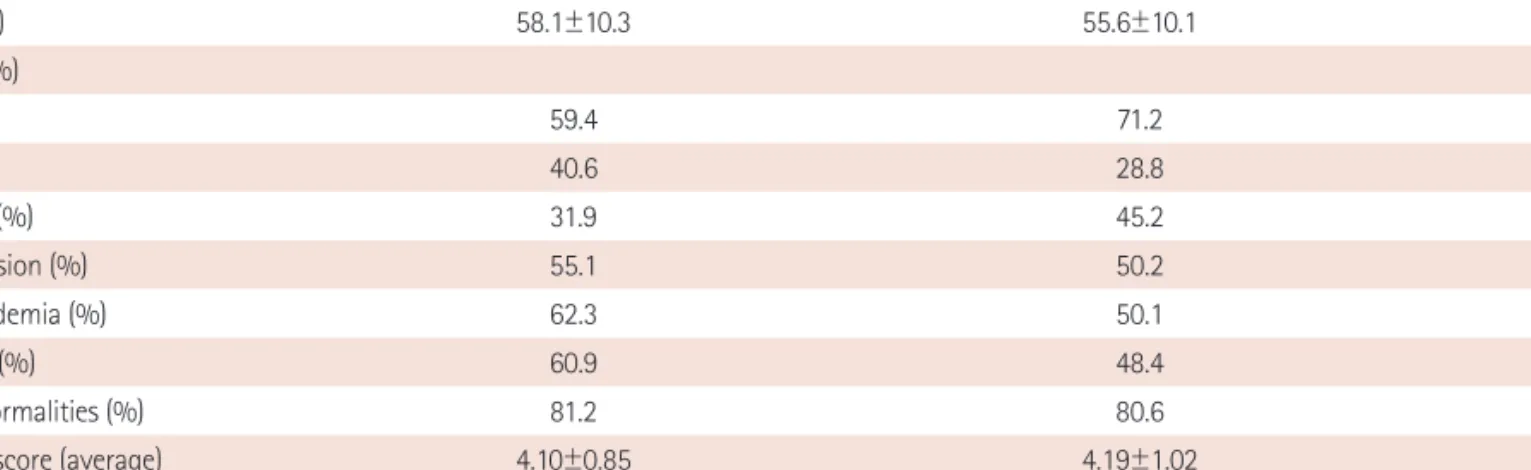
There were 69 patients in the early invasive group and 62 in the delayed invasive group. Basal demographic and clinical features (age, gender and risk factors) of the patients, ECG irregularities, and TIMI risk scores were similar (Table 1). Infarct related artery distribution was similar in both groups. Moreover, there were mostly 3 vessel diseases in both groups. In none of the patients was the left main coronary artery the responsible lesion. The number of stents used was found to be higher in patients in the delayed invasive group (1.42±0.70 vs. 1.71±0.88, p=0.04). Drug eluting stent (DES) use was particularly low in both groups and the DES and bare metal stent distribution was similar (p=0.207). Between the two therapy groups, the rate of obtaining TIMI-III flow tended to be higher in the post- PCI early invasive therapy group (97.1% vs. 88.7%, p=0.059) (Table 2).

As expected, the hospitalization period in the early invasive group was markedly lower than that in the delayed invasive group (33.6±

5.9 hours vs. 81.4±38.3 hours, and p<0.001). Moreover, brain natri-

uretic peptide (BNP) levels were distinctly higher in the delayed in-

vasive therapy group (75.4±124.2 vs. 163.1±249.8, p<0.001). There

were no significant differences between the LVEF and C-reactive

protein (CRP) levels of the two groups, as measured at the time of

discharge (Table 3). In the third month of LVEF measurements, it

was determined that the levels were better preserved in the early in-

vasive therapy group when compared to the delayed invasive thera-

(3)

py group (59.3±6.0% vs. 54.1±8.7%, p<0.001). Repetitive MI be- tween the therapy strategies were found to be significantly lower in the early invasive therapy group when compared to the delayed invasive group (2.9% and 14.5%, respectively, p=0.016). Similarly, cardiac related hospitalization rates were significantly lower in the early invasive group compared to those in the delayed invasive gr-

oup (8.7% vs. 30.6%, respectively, p=0.001). Although there was no death in the early invasive group, there were three deaths in the delayed invasive group. Two of the three deaths were caused by ACS and one was caused by acute decompensated chronic heart failure. Deaths related to any reason were determined to be lower in the early invasive group than in the delayed invasive group (0% vs.

Table 1. Demographic and basal clinical features in early invasive and delayed invasive groups

Variables Early invasive (n=69) Delayed invasive (n=62) p

Age (year) 58.1±10.3 55.6±10.1 0.169

Gender (%) 0.168

Male 59.4 71.2

Female 40.6 28.8

Diabetes (%) 31.9 45.2 0.120

Hypertension (%) 55.1 50.2 0.563

Hyperlipidemia (%) 62.3 50.1 0.157

Smoking (%) 60.9 48.4 0.153

ECG abnormalities (%) 81.2 80.6 0.941

TIMI risk score (average) 4.10±0.85 4.19±1.02 0.577

ECG: electrocardiography, ECG abnormalities: ST-segments changes and T wave abnormalities, TIMI: Thrombolysis in Myocardial Infarction

Table 2. Distributions of the coronary angiography data between the therapy groups of early invasive and delayed invasive

Variables Early invasive (n=69) Delayed invasive (n=62) p

IRA (%) 0.845

LMCA 0 (0.0) 0 (0.0)

LAD 38 (55.1) 34 (54.8)

Cx 20 (29.0) 16 (25.8)

RCA 11 (15.9) 12 (19.4)

Prevalence of CAD (%) 0.739

One vessel 9 (13.0) 11 (17.7)

Two vessels 40 (58.1) 16 (25.8)

Three vessels 40 (58.1) 35 (56.5)

Number of stents used 1.42±0.70 1.71±0.88 0.040

Stent type (%) 0.207

BMS 65 (94.2) 55 (88.7)

DES 4 (5.8) 7 (11.3)

Post-procedure TIMI III flow (%) 97.1 88.7 0.059

IRA: infarct related artery, LMCA: left main coronary artery, LAD: left anterior descending artery, Cx: left circumflex artery, RCA: right coronary artery, CAD:

coronary artery disease, BMS: bare metal stent, DES: drug eluting stent, TIMI: Thrombolysis in Myocardial Infarction

Table 3. Distribution of discharge, laboratory, and echocardiographic data and hospitalization periods between early invasive and delayed invasive ther- apy groups

Variables Early invasive (n=69) Delayed invasive (n=62) p

BNP (pg/dL) 75.4±124.2 163.1±249.8 0.001

CRP (mg/dL) 3.4±3.7 2.7±2.1 0.877

LVEF-discharge (%) 56.5±7.5 55.6±7.3 0.660

Hospitalization period (hour) 33.6±5.9 81.4±38.3 <0.001

CRP: C-reactive protein, BNP: brain natriuretic peptide, LVEF: left ventricular ejection fraction

(4)

4.8%, respectively, p=0.065). Compound endpoints were also sig- nificantly lower in the early invasive therapy group (Table 4, Fig. 1).

Discussion

It was determined in our study that with the early invasive thera- py of NSTEMI patients of moderate- to high-risk, there was much more TIMI-III flow obtained, a lower hospitalization duration, a bet- ter preserved left ventricle function, a decrease in the compound endpoint results, including recurring MI and cardiac related hospi- talization, and a tendency toward a decrease of mortality due to any reason.

ST-elevated myocardial infarction (STEMI), NSTEMI, and unstable angina pectoris (UAP) are similar in their etiologies in the sense that they all have in common a pathological atherosclerotic plaque rup- ture history. Although the pathophysiology of these settings known as ACS is similar, their clinical courses differ. In UAP, in-hospital mortality is low and its 1-year mortality was found to be 1.6%-a

figure close to that of chronic stabile angina.

4)

The highest in-hos- pital mortality rate is 7% among STEMI patients, but their mortality rates are equal with those of NSTEMI patients at the 6th month.

5)6)

In long-term follow-ups, it has been shown that the mortality rate among NSTEMI patients is two times that of STEMI patients in the fourth year.

7)

The actual reason behind this difference in mortality is that NSTEMI patients tended to be older and have a higher rate of comorbid conditions, such as diabetes and chronic renal failure.

The importance of invasive therapy in non-ST-elevation myocardial infarction treatment

With the development of new therapy strategies, multiple treat- ment options are now available for NSTEMI patients. However, mor- tality and morbidity rates in this group remain high. Among these therapy options, there were two therapy strategies that came to the forefront in clinical settings. One of them was the early invasive therapy (in the first 72 hours following referral) or routine coronary angiography and PCI to the proper lesion. The second is conserva- tive or selective invasive therapy option. In the second option, sta- bilization is expected by therapy, and invasive therapy is performed in cases of ongoing or recurrent angina. There are many randomized control studies relating to planning an ideal acute therapy regimen, the timing of interventional procedures, and long-term therapeutic strategies. In a meta-analysis performed of data obtained from FRISC II, RITA 3, and Invasive Versus Conservative Treatment in Unst- able Coronary Syndromes (ICTUS), it was found that patients ben- efited more from interventional therapy when compared to conser- vative therapy.

1)2)

In subgroup analyses performed at the end of the studies conducted independently of the used risk scores, it was sh- own that high-risk group patients benefited more from invasive th- erapy. The aim of revascularization is to minimize the symptoms and hospitalization period, and improve the short- and long-term prog- nosis of patients. As a result, the therapeutic strategy that will be chosen in NSTEMI patients in the acute period affects early, mid- term and long-term prognosis significantly. That is why European Society of Cardiology guidelines recommend an invasive therapy strategy for ACS patients in moderate and high-risk groups.

8)

Table 4. Prevalence of death occurring for any kind of reason, cardiac related hospitalization, recurring myocardial infarction in 3 months, and third month LVEF between the therapeutic strategies

Variables Early invasive (n=69) Delayed invasive (n=62) p

LVEF-3rd month (%) 59.3±6.0 54.1±8.7 <0.001

Recurring infarction (%) 2 (2.9) 9 (14.5) 0.016

Recurring hospitalization (%) 6 (8.7) 19 (30.6) 0.001

Death occurring for any kind of reason (%) - 3 (4.8) 0.065

Compound endpoints* (%) 6 (8.7) 19 (30.6) 0.001

*Recurring infarction, cardiac related hospitalization and death related to any kind of reason have been defined as the compound endpoints. LVEF: left ven- tricular ejection fraction

Fig. 1. Recurring myocardial infarction, cardiac related hospitalization, and death prevalence related to any reason within the first three month period between different treatment strategies.

35 30 25 20 15 10 5

0 Recurring myocardial infarction (%)

2.9 14.5

8.7 30.6

0 4.8

Cardiac related

hospitalization Death related any

kind of reason

Early invasive

Delayed invasive

(5)

Percutaneous coronary intervention timing in Non-ST elevation myocardial infarction

Although an early invasive diagnostic approach is indicated in the diagnosis and planning of sequential therapy, the timing of a routine invasive procedure remains controversial. Despite many RCTs and meta-analysis on the issue, the optimal intervention time in NSTEMI patients remains undefinitive. In the Intracoronary Stenting with Antithrombotic Regimen Cooling-Off (ISAR-COOL) study, in which the optimal intervention timing was assessed among 401 randomized NSTEMI patients, it was found that death and the MI rate were both significantly lower in the patient group in whom the intervention was performed in the first 6 hours.

9)

In a more recent and more expanded study (of 7749 patients) of the Acute Catheter- ization and Urgent Intervention Triage (ACUITY) strategy, patients were divided into three groups according to the intervention time (<8 hours, 8-24 hours, and >24 hours), and they were followed up for a year. Results from the study showed that the <8 hours and 8-24 hour groups had similar death and death or MI and compo- und ischemia rates, whereas all three endpoints in the >24 hour group were significantly higher than those in the other groups.

10)

We have divided the moderate-high-risk NSTEMI patients into two groups depending on the PCI timing-first 24 hours and 24-72 hours.

After a three-month follow up, we have determined that recurring MI and cardiac related hospitalization was significantly less, LVEF was preserved better, and the rate of obtaining a TIMI-III flow fol- lowing PCI was higher in patients on whom the PCI was performed in the first 24 hours.

In our study, when patient groups were compared in regards to cardiac related hospitalizations, the rate was found to be signifi- cantly lower in the early invasive group (8.7% vs. 30.6%). It was seen that the risk of hospitalization due to cardiac causes was higher in patients with a diabetes mellitus history, low LVEF during disch- arge, high levels of BNP and CRP at discharge, low coronary artery TIMI flow following PCI, and those with high TIMI risk scores. Simi- larly, in the ICTUS study in which early interventional therapy was compared with traditional therapy, it was reported that angina re- lated re-hospitalization rates were lower with early invasive therapy.

11)

In our study, when patient groups were compared with regards to recurring MI, the rate was found to be significantly lower in the early invasive group (2.9% vs. 14.5%). In a meta-analysis of three trials-Angioplasty to Blunt the Rise of Troponin in Acute Coronary Syndromes Randomized for an Immediate or Delayed Intervention (ABOARD), Early or Late Intervention in unStable Angina, ISAR-COOL, and TIMACS-early catheterization followed by coronary interven- tion on the first day of hospitalization was shown to be safe and superior in terms of presenting a lower risk of recurrent ischaemia and promising a shorter hospital stay.

3)

In our study, when patient groups were compared with regards to compound endpoints (recurring MI, cardiac related hospitaliza- tion, and death due to any reason), it was observed that the end- points were significantly lower in the early invasive therapy group.

In the OPTIMA, ABOARD, and TIMACS studies, there were no differ- ences in the compound endpoints with different strategies. These results do not correlate with our findings. However, in the ACUITY study, the largest scale study conducted so far, it was determined that compound endpoints were lower in the early invasive therapy group.

10)12-14)

Clinical relevance

It has been shown that it is possible to have a decrease in the mid-term MUCE rate in NSTEMI patients, who represent the most common referral groups of ACS patients and the most PCI per- formed groups, with appropriate invasive therapy timing. Along with this benefit, it can be deduced that, especially in centers where cath- eterization rates are high, early invasive therapy will lead to a de- crease in hospitalization periods for NSTEMI patients and will, therefore, result in more efficient health service delivery. As resource use, such as drugs, nurses, physicians, and accessory personnel de- creases, significant health care cost cutting can occur. However, for the cost effectiveness analysis of this treatment strategy, further analysis focusing on the economic benefits of these findings is re- quired.

Conclusion

Early invasive therapy strategy in moderate- to high-risk NSTEMI patients is more effective in decreasing recurrent myocardium in- farction and cardiac related recurring hospitalization and preserv- ing the left ventricle functions compared to delayed invasive ther- apy strategy.

Limitations

The most important limitation of our study is the low number of patients in the groups randomized for therapy strategies. More- over, the fact that follow up durations were not long enough may af- fect the frequencies of endpoints, thus the results of the study.

References

1. Mehta SR, Cannon CP, Fox KA, et al. Routine vs selective invasive strat- egies in patients with acute coronary syndromes: a collaborative meta- analysis of randomized trials. JAMA 2005;293:2908-17.

2. Patel TN, Bavry AA, Kumbhani DJ, Ellis SG. A meta-analysis of random- ized trials of rescue percutaneous coronary intervention after failed fibrinolysis. Am J Cardiol 2006;97:1685-90.

3. Katritsis DG, Siontis GC, Kastrati A, et al. Optimal timing of coronary

(6)

angiography and potential intervention in non-ST-elevation acute coronary syndromes. Eur Heart J 2011;32:32-40.

4. Bigi R, Cortigiani L, Colombo P, Desideri A, Bax JJ, Parodi O. Prognostic and clinical correlates of angiographically diffuse non-obstructive cor- onary lesions. Heart 2003;89:1009-13.

5. Savonitto S, Ardissino D, Granger CB, et al. Prognostic value of the ad- mission electrocardiogram in acute coronary syndromes. JAMA 1999;

281:707-13.

6. Volmink JA, Newton JN, Hicks NR, Sleight P, Fowler GH, Neil HA. Coro- nary event and case fatality rates in an English population: results of the Oxford myocardial infarction incidence study. The Oxford Myo- cardial Infarction Incidence Study Group. Heart 1998;80:40-4.

7. Terkelsen CJ, Lassen JF, Nørgaard BL, et al. Mortality rates in patients with ST-elevation vs. non-ST-elevation acute myocardial infarction:

observations from an unselected cohort. Eur Heart J 2005;26:18-26.

8. Hamm CW, Bassand JP, Agewall S, et al. ESC Guidelines for the man- agement of acute coronary syndromes in patients presenting without persistent ST-segment elevation: The Task Force for the management of acute coronary syndromes (ACS) in patients presenting without persistent ST-segment elevation of the European Society of Cardiolo- gy (ESC). Eur Heart J 2011;32:2999-3054.

9. Neumann FJ, Kastrati A, Pogatsa-Murray G, et al. Evaluation of pro- longed antithrombotic pretreatment (“cooling-off” strategy) before intervention in patients with unstable coronary syndromes: a random- ized controlled trial. JAMA 2003;290:1593-9.

10. Sorajja P, Gersh BJ, Cox DA, et al. Impact of delay to angioplasty in pa- tients with acute coronary syndromes undergoing invasive manage- ment: analysis from the ACUITY (Acute Catheterization and Urgent In- tervention Triage strategY) trial. J Am Coll Cardiol 2010;55:1416-24.

11. de Winter RJ, Windhausen F, Cornel JH, et al. Early invasive versus se- lectively invasive management for acute coronary syndromes. N Engl J Med 2005;353:1095-104.

12. Mehta SR, Granger CB, Boden WE, et al. Early versus delayed invasive intervention in acute coronary syndromes. N Engl J Med 2009;360:

2165-75.

13. Riezebos RK, Ronner E, Ter Bals E, et al. Immediate versus deferred cor- onary angioplasty in non-ST-segment elevation acute coronary syn- dromes. Heart 2009;95:807-12.

14. Montalescot G, Cayla G, Collet JP, et al. Immediate vs delayed interven-

tion for acute coronary syndromes: a randomized clinical trial. JAMA

2009;302:947-54.

수치

Table 1. Demographic and basal clinical features in early invasive and delayed invasive groups
Fig. 1. Recurring myocardial infarction, cardiac related hospitalization, and  death prevalence related to any reason within the first three month period  between different treatment strategies.

참조

관련 문서

Prasugrel versus ticagrelor in patients with acute myocardial infarction treated with primary percutaneous coronary intervention: Multicenter randomized PRAGUE-18

Therefore, we undertook the present study to analyze the clinical efficacy of the timing of revascularization and to test the hypothesis that an early invasive strategy is superior

Background The aim of this study was to assess the impact of more aggressive pharmacological treatment on short-term clinical outcomes in patients with acute non

patients who underwent a successful primary percutaneous coronary intervention via the distal radial approach (Snuff- box puncture time was defined as time interval from local

It is uncertain that atorvastatin pretreatment can reduce myocardial damage in patients undergoing primary percutaneous coronary intervention (PCI) for ST-segment elevation

moderate-volume operators. However, patients who sustained cardiac arrest were more frequently treated by low-volume operators than by moderate-/high-volume operators. During

► See the article “Effect of Operator Volume on In-Hospital Outcomes Following Primary Percutaneous Coronary Intervention for ST-Elevation Myocardial Infarction: Based on the 2014

The rate of cumulative MACE differed significantly among the gr- oups, mainly driven by the risk of cardiac death. However, after ad- justment for multiple confounders, the risk of