Use of Corpus for Problem-Based Learning in a Korean Graduate English Grammar Course
Youn-Kyoung Lee (Catholic University of Daegu)
Lee, Youn-Kyoung. (2017). Use of corpus for problem-based learning in a Korean graduate English grammar course. The Linguistic Association of Korea Journal 25(4).
83-102. The present study explored the use of corpus for problem-based learning (PBL) in a Korean graduate English grammar course. The study involved 32 English education students in the ‘Advanced English Grammar and Usage Course.’ Data included the students’ corpus research projects, reflection papers about corpus use, a Likert-scale questionnaire, and interview data. The results of the study revealed the following three themes in students’ use of, and reflection about, corpus study: (1) critical understanding about lexicogrammatical and broader language use issues, (2) awareness of the dynamic nature of language, and (3) appreciation of context- and register-appropriate use of lexicogrammar. The study also discussed the challenges involved in incorporating corpus use into English grammar classes and offered suggestions for further research.
Key Words: use of corpus in an EFL grammar course, problem-based learning, advanced English grammar learning
1. Introduction
Despite years of debate, grammar teaching, involving which grammar to teach and how it should be taught, has remained a controversial issue, and there has not been much change in the way grammar is taught in second/foreign language learning classes (Burns & Richards, 2011; Curzan, 2009). While some have argued for and embraced the teaching of usage-based descriptive grammar and a critical examination of grammar, many instructors still use remedial
approach focusing on teaching and enforcing prescriptive grammar rules, such as Don’t begin sentences with and/but (Burns & Richards, 2011; Curzan, 2009; Kolln
& Gray, 2009). According to Micciche (2004), current grammar instruction in second/foreign language classes is in general “not empowering but disempowering, not rhetorical but discontextualized, not progressive, but remedial” (p. 718). Such disempowering and discontextualized grammar teaching not only makes grammar learning passive and uninteresting but also undermines students’ ability to develop clear understanding of context-appropriate use of grammar. For instance, the teaching and the strict enforcement of certain prescriptive grammatical rules, such as “no sentence initial use of and/but“ rule, have caused some students religiously follow these rules regardless of context. According to Kolln and Gray (2009), such teaching practices also make students less willing to allow grammatical choices that are not only available but also necessary for effective communication. Moreover, such a teaching practice discourages and stifles the development of critical understanding of grammar and context appropriate language use in general (Curzan, 2009; Micciche, 2004).
The above discussion about current grammar teaching indicates a clear need for English instructors involved in EFL grammar instruction to strive for more appropriate and effective teaching approaches to help students enhance their critical understanding of context and audience-appropriate use of grammar (Burns & Richards, 2011; Cullen, 2008; Curzan, 2009; Micciche, 2004). Therefore, as a way to search for more effective and empowering grammar teaching, the present study aims to investigate the use of corpora in problem-based learning (PBL) of grammar in a graduate English grammar course. With this regard, the study will provide useful suggestions for teaching English grammar more meaningfully. The study specifically addressed the following research questions.
1) To what extent is corpus use in PBL applicable and effective when used in a Korean graduate English grammar course?
2) What are the students’ perceptions of corpus use in PBL in a Korean graduate English grammar course?
2. Literature Review
2.1. Corpus Use in Language Learning and Teaching
A corpus is a computerized collection of linguistic data, spoken and/or written, compiled primarily for the purpose of research (Sinclair, 1991). In the past decade, corpora have also been used for language learning and teaching, especially foreign/second language learning and teaching. The researcher or teacher has used the concordance lines to examine the immediate linguistic context of the item being queried to gain a better understanding of its meaning and usage patterns. Many applied linguists have also taken advantage of the various unique functions of corpora and produced valuable new understandings about language with some of them challenging existing English language description (Biber et al., 1999; Carter & McCarthy, 2006; Hunston & Table 2000).
A very important contribution of corpus-based language learning research is that it has provided evidence for the theory of lexicogrammar. Lexicogrammar views lexicon and grammar as two inherently connected parts of a single entry (Sinclair, 1991). In this view, lexical items are often grammatical in nature because the use of a lexical item often has grammatical implications (Conrad, 2000; Hunston & Table 2000). Findings of relevant studies also showed that vocabulary learning and grammar learning should often take place simultaneously and the teaching of the two should be conducted together (Aston, 2001; Clear, 2000; Francis et el., 1998; Schmitt, 2004, 2005).
Lexicogrammar, thus, covers not only traditional grammatical topics, such as syntax and morphology but also important lexical issues not considered within the purview of grammar traditionally. These lexical usage issues are important because they deal with one of the most fundamental aspects of language structure and usage: that is, how words are actually used and patterned to convey meaning. It is important to note that the current study adopted the concept of lexicogrammar and, therefore, the topics covered in the grammar course in the study included the aforementioned lexical issues.
In terms of corpus use in language teaching, many studies have shown that corpora can make foreign/second language learning and teaching more interesting and effective (Aijmer, 2009; Aston, 2001; Lee, 2016; O’Keeffe,
McCarthy & Carter, 2007). Many research has indicated that corpus use is especially helpful for learning lexicogrammatical usage rules and patterns (Lee, 2016; O’Keeffe, McCarthy & Carter, 2007). Via concordancing searches, language learners can obtain, observe, and analyze useful language data about the lexicogrammatical items they are interested in and then discover and generalize these items’ usage rules and patterns. Such corpus-based learning is very effective because it engages learners in active “discovery learning” (Aijmer, 2009;
Aston, 2001, p. 19). Moreover, corpora are also very helpful for foreign/second language students to learn register difference in the use of lexicogrammar, such as context-based variations in lexicogrammar use (Aijmer, 2009; Huston, 2002;
Lee, 2016).
Given the aforementioned valuable uses of corpora found in foreign/second langue learning and teaching, it is rather surprising that there has not been much research about corpus use in foreign/second language classes. The researcher found only a few publications on such corpus use and they mainly dealt with elementary and secondary school English classes (McEnery, et al., 1997; Sealey, & Thompson, 2004, 2007; Lee & Lee, 2010; Lee, 2016). Furthermore, of the above mentioned studies, only the following four were empirical.
Sealey and Thompson (2004, 2007) focused on the use of corpora to raise elementary school students’ metalinguistic knowledge, such as the knowledge of the parts of speech. McEnery, et al., (1997) discussed how corpora might be used to enhance mainstream English education in secondary schools. Lee and Lee (2010) showed the beneficial effects of corpus-based vocabulary learning on word forms and use in a Korean high school. Lee (2016) revealed college learners’ perspectives on the corpus-based lexicogrammatical approach in an English grammar class. Thus, it is clear that more research on corpus use in EFL classes, especially at the English education major graduate level, is needed. That is because the potential of corpus use is considerable to help determine what specific context appropriate lexicogrammatical rules are, to promote active and discovery learning, and to make grammar teaching more empowering, contextualized, and progressive not only for themselves, but also for their students. Moreover, the discovery learning potential of corpora is particularly important because active discovery learning has been a key component of many contemporary learning theories and approaches, including PBL, the approach
which helps from the theoretical base for the present study.
2.2. Problem-Based Learning (PBL)
PBL refers to “an instructional and curricular learner-centered approach that empowers learners to conduct research, integrate theory and practice, and apply knowledge and skills to develop a viable solution to a defined problem.”
(Savery, 2006, p. 9). While it can be traced to John Dewey (2007) in theory, PBL was first used thirty years ago as an instructional approach in teaching medical students at McMaster University in Canada (Barrows & Tamblyn, 1980). It has since been employed successfully, however, in teaching various subjects and at all levels of school from elementary to tertiary (Duch, et al., 2001; Hmelo-Silver, 2004; Torp & Sage, 2002). The underlying theory of this approach is that learning is most effectively initiated and facilitated by posing and solving real-life problems that interest the learner because working on such problems makes learning meaningful and motivates learners. The major characteristics of PBL are: (1) the use of complex or “ill-structured” real life problems for students to research, (2) the facilitating role, rather than the traditional instructional role that the instructor plays, (3) the self-directing and self-regulating that the students exercise in their learning, (4) the close collaboration the students do in groups in the problem-solving process (Duch, el al., 2001; Savery, 2006). The unique features of PBL make it especially appropriate for college teaching because, according to Duch, Groh, and Allen (2001, p. 6), the approach
“addresses directly many of the recommended and desirable outcomes of an undergraduate education.” including development of critical thinking and problem-solving skills.
Considering the unique values of corpora in language study discussed above and the characteristics of PBL, it appears that corpora may be ideal for problem-based learning/teaching of grammar. As the above research has shown, corpora can provide learners with many active learning opportunities to explore lexicogrammatical issues. Furthermore, lexicogrammatical problems, in particular, those related to use what constitute context-appropriate lexicogrammatical rules, are often messy or ill-structured and thus excellent for PBL. For instance, where and when to use the passive voice is not a very simple
question. Nor is it an easy question whether and when certain collective nouns, such as team and jury, should be used as singular or plural. For these questions, corpora are arguably the best place for students to find possible answers, not just because corpora contain useful information for answering these questions but also, and more importantly, the process of searching for the answer in corpora is complex and challenging, a condition crucial for PBL. In addition, by having students do corpus research about lexicogrammar, the teacher are involving students in active discovery learning. Thus, English instructors should help students capitalize on this knowledge by making it conscious through active discovery learning (Kolln & Gray, 2009).
3. Methodology
3.1. Research Contexts and Participants
The participants were 32 Korean graduate students of an ‘Advanced English Grammar and Usage Course’ at a large university in the Southeast of Korea. The course was designed to help prospect and practicing English teachers enhance their understanding of English grammar, expand their skills in linguistic analysis, and develop a pedagogical approach to teaching English grammar.
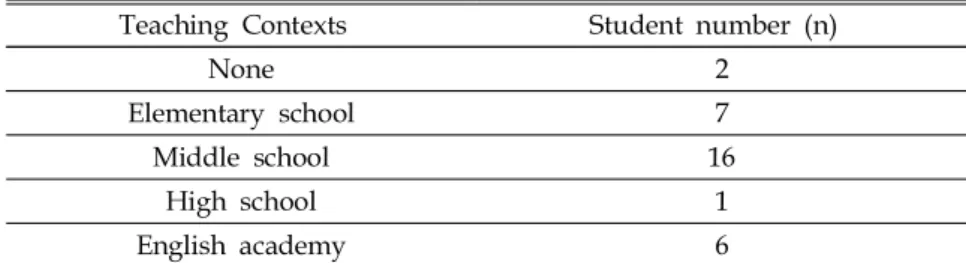
Most students has had teaching experiences at primary and secondary schools or sometimes at English academies from 1 to 7 years (See Table 1). Among the participants, 2 students have not had any teaching experiences (See Table 2). The participants’ English grammar proficiency level based on a mock TOEIC was within the low intermediate to high intermediate range (See Table 3). An English grammar test was conducted on the first day of the course. The test consisted of 40 questions of a mock TOEIC Part 5. The following is detailed description of student profiles.
Table 1. Summary of Students’ Teaching Contexts (n=32)
Teaching Contexts Student number (n)
None 2
Elementary school 7
Middle school 16
High school 1
English academy 6
Table 2. Summary of Students’ Teaching Experiences (n=32)
Teaching experiences Student number (n)
None 2
1-3 years 20
3-6 years 9
More than 6 years 1
Table 3. Summary of Students’ English Grammar Proficiency (n=32)
Mock TOEIC score (40 items total) Student number (n)
Beginner 10-20 0
Low-intermediate 20-25 13
Mid-intermediate 25-30 17
High-intermediate 35-40 2
For this course, the students met three consecutive hours a day for three weeks. The course provided core introduction of English grammatical structure, comprehension and application exercises that enabled students to assess their understanding of the material and practice their ability to apply what was been presented in class. In addition, students were asked to conduct usage studies on the distribution of a particular English structure in authentic discourse and write short papers on some particular topic related to an English grammatical structure.
3.2. Corpus Used
The corpus used in the course was the 400 million-word Corpus of Contemporary American English (COCA). The COCA was used for the study
because it has free online access, and it was mega sized with comprehensive and representative data in a variety of spoken and written genres, such as TV and film scripts, fictions, magazines, newspaper articles, and academic papers.
3.3. Study Design and Procedures
For the study, an exploratory case study approach was used because it investigated distinct phenomena characterized by a lack of detailed preliminary research and it would allow a variety of qualitative data for detailed in-depth analysis on the issue being explored (Cohen, et al., 2011) In terms of the procedures of the study, in the second weeks of the course, the researcher introduced the aforementioned corpus, including how to use it to conduct various queries, and instructed in the use of queries to extract different types of language usage information. Sample corpus research questions, such as to what extent the prescriptive rule that the subject quantifier, “every or every(one)” must be used with a singular verb form (e. g. “Everyone of these athletes runs the mile in four minutes”) was actually followed, were given so the students were able to practice corpus query methods in answering real grammar usage questions.
For the research project in PBL during the rest of the two weeks, the students in a group were asked to work on a lexicogrammatical problem that they had questions about or interested in and to write a report about the project.
For the group project, according to PBL approach, the students selected their own research questions and decided to how search for the answers. The researcher served only as a tutor or facilitator, the typical role in PBL. In particular, the researcher provided technical support and assistance about corpus search. The group project was motivated in the present study because, in PBL theory, collaboration was crucial in students’ learning. Thus, sharing the work among group members made the task more manageable. As a part of the group research project assignment, each group had to write a report about their research including findings and present it to the class.
3.4. Data Collection and Analysis
The data used in the study include the followings: (1) the group corpus research project, (2) a reflection paper about corpus use, and (3) a Likert-scale
questionnaire and students’ interview data (see Appendix for the interview questions). The interview was given on the last day of class and 8 voluntary students participated in the follow-up interview. The number of items collected as data by category was as follows: 16 group projects, 16 reflection papers, 8 students’ interview data, and 30 Likert-scale questionnaires. All data were collected voluntarily and anonymously.
For the Likert-scale questionnaire, the current study used descriptive statistics. EXCEL was used for coding and analyzing the questionnaire data. The questionnaire consisted of five questions. Except for the students’ response to the Likert-scale questions, the other data used were almost exclusively qualitative. For the data analysis, the present study employed a two-step commonly used in qualitative data analysis in social science/education research to identify theme: (1) “pawing” and (2) “cutting and sorting” of the data (Ryan
& Bernard, 2003). In particular, in the pawing stage, the researcher read multiple times through the data, involving the students’ research paper and their responses to the interview and highlighted sections that seemed important and interesting. Then, during the cutting and sorting phrase, the researcher carefully read the texts again focusing on the highlighted sections, identified quotes or expressions that appeared important to the research questions and then arranged the quote thematically.
4. Results and Discussion
This section is organized as follows. It begins with a description of the students’ general responses to the use of corpora in PBL based on the results of the Likert-scale question. Then it is followed by a detailed discussion of the results from the qualitative data.
4.1. Students’ Responses to Use of Corpora in PBL
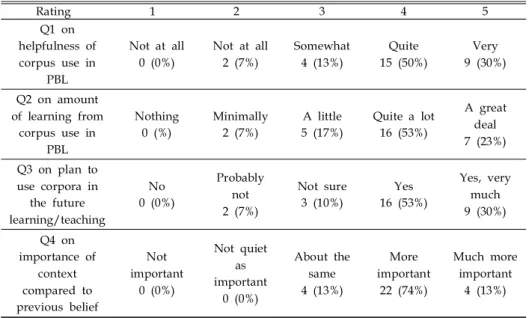
The results of the Likert-scale questions (summarized in Table 4) showed that in what extent corpus in PBL is applicable and effective when it is used in a Korean graduate English grammar course. That is, the majority of the students
responded positively or very positively to the questions. In particular, 80% of the students who returned the survey found the use of corpus in PBL quite helpful or very helpful (Question 1). For Question 2, 76% of the students believed they learned a good amount or a great deal from corpus use in PBL. In addition, 83% of the students planned to use corpora in the future learning and teaching (Question 3), and 87% of the students considered context more or much more important in language use than before the study (Question 4). Of course, it is also important to note that two students found corpus use in PBL to be minimally useful and believe they had learned minimally from corpus use.
Moreover, five students (nearly 20%) expressed some degree of skepticism about future use of corpora in PBL.
Table 4. Summary of Students’ Responses to Use of Corpus in PBL
Rating 1 2 3 4 5
Q1 on helpfulness of corpus use in
PBL
Not at all 0 (0%)
Not at all 2 (7%)
Somewhat 4 (13%)
Quite 15 (50%)
Very 9 (30%)
Q2 on amount of learning from
corpus use in PBL
Nothing 0 (%)
Minimally 2 (7%)
A little 5 (17%)
Quite a lot 16 (53%)
A great deal 7 (23%)
Q3 on plan to use corpora in
the future learning/teaching
No 0 (0%)
Probably not 2 (7%)
Not sure 3 (10%)
Yes 16 (53%)
Yes, very much 9 (30%)
Q4 on importance of
context compared to previous belief
Not important
0 (0%)
Not quiet as important
0 (0%)
About the same 4 (13%)
More important
22 (74%)
Much more important
4 (13%)
Since the Likert-scale question did not ask the students why they answered the way they did, the researcher conducted a follow-up interview. Therefore, the results of the interview demonstrated the reasons for their decision not to use corpus or their uncertainty about the corpus use (See Appendix: Interview Question 5). To avoid repetition, the researcher will explore the reasons below in the section on “challenges.”
4.2. Findings from the Qualitative Data
Like the students’ response to the Likert survey questions, the students’
direct response to corpus use in PBL in the qualitative data were generally positive, even though some students showed difficulty using corpora in PBL.
Analysis of the students’ qualitative assessment of the use of corpora will be provided in the following sub-section. Regarding the topics of the students’
corpus project, they fell into the two major categories: (1) issues involving grammatical rules and usages which are a matter of debate and (2) changes of lexicogrammatical usage and meaning. Some addressed both issues. Of the total of 12 projects the students turned in, 11 were primarily of the first type, covering topics such as the use of sentence-intial conjunctions like “and” and
“but,” the issues of whether the “everyone/everybody” subject should be followed by a singular or plural verb, and the use of comma after a sentence-initial transitional adverb (e.g., therefore). The reason many of the students chose grammatical issues of debate was that typically these issues involved rules that the student had learned in school but were not always followed in actual language use. The three projects that covered language change issues dealt with topics such as the frequency and use patterns of
“whom” over the century and neologism in the 21st century. Analysis of the qualitative data found themes in students’ use of corpus study in these classes:
(1) critical understanding about lexicogrammatical and broader language use issues, (2) awareness of the dynamic nature of language, (3) understanding of the context/register-appropriate use of lexicogrammar, and (4) grasping of the nuances of lexicogrammatical usages.
4.2.1. Critical Understanding about Lexicogrammatical and Broader Language Use Issue
One of examples showing students’ critical examination of lexicogrammatical use issues was found in the prescriptive grammatical rule. That is, “Do not use conjunctions and/but in a sentential initial position.” One group wanted to determine to what extent this rule was actually followed. They searched for sentence initial uses of the two words in COCA and the results revealed that such use was steady from the 1920s through 1960s but showed a noticeable
decline in the late 1960s and the 1970s and then a steady and sharp increase from the 1980s. In order to find out what might have been the reason for the short-lived decline, the students examined various resources and learned that sentence intial use of and/but had actually been common since the 9th century and was not questioned until the 19th century when some prescriptive grammarians such as G. P. Quackenbos decided it was not acceptable (Burchfield, 1996). Despite the new rule, sentence initial use of the two conjunctions has continued to be widespread except for that short-term decline because of a strong push by prescriptive grammarians and school teachers to enforce the prescriptive rule. Based on their research findings, the group members appeared to have recognized the failings of prescriptive grammar and embraced a descriptive approach to grammar. In a conclusion of the group project, they mentioned:
Prescriptive grammarians may be very upset about the fact that conjunctions are being used ‘improperly.’ But, descriptive grammarians can easily recognize the linguistic trends are leading to such a grammar shift in conjunction and/but.
Another example indicating critical understanding of grammar was a comma used after a sentence-initial transitional adverb such as therefore and thus. In a group project, the students mentioned that they had been taught and had become staunch followers of the rule; but, they noticed some of English native speakers and magazines did not follow the rule. They believed they were wrong. However, surprisingly, their research of the “Humanity/Art” section of the Academic Writing Register of COCA yielded a slightly higher number of tokens with no comma after the sentence-initial transitional adverb. As a result, the students concluded, “We discovered that our use of the comma after therefore, thus, and hence is not common. The data proved that more often it was used without the comma even though the issue was debatable. Yet, the surprise was so strong that they wrote in the reflection paper as following: ”Now, our view of no-exceptions grammar rule is slowly changed.“ These comments seemed to suggest that the corpus study made their question long-rigid views about grammar.
One more example on this issue came from the group who conducted a corpus research about whether it was acceptable to say “raise a child/children.”
The reason the group did the study was that in an English grammar book a group member taught to their students, “raise/rear/bring up a child” was all used as synonyms even though he believed that rear was less used than raise/bring up.
The results of their search of COCA revealed that raise has been used more often than rear since 1920s. In fact, rear has been used more in formal writing.
More importantly, according to their search, bring up has been actually the more frequently used verb form in expressing the idea. Based on the findings, the students concluded:
From the data, rear seems to have never been dominantly used in any context or time period...so, the data raised the question of where the axiom that we along with others were taught originally.
These three examples illustrated the potential of corpus research to enhance students’ critical understanding not only of lexicogrammatical usage issues, but also of the difference between prescriptive rules and descriptive grammar rules.
In addition, critical understanding of lexicogrammar figures as an important theme in the students’ interview. For instance, In answering interview question 1 regarding what they learned from their research, all 8 students pointed out that they found some traditional grammatical rules were often not followed in actual language use. In particular, one student mentioned, “Even in written English, I recognized people often choose not to follow prescriptive grammatical rules.” Similarly, in responding to interview question 4 about their views about prescriptive grammar based on their corpus research findings, most of the students (7 out of 8) stated that the findings did not support the traditional rigid view of grammar.
4.2.2. Awareness of the Dynamic Nature of Language Use
One example of awareness of the dynamic nature of language came from a group who conducted a corpus research about the use of “neat” to mean
‘interesting/fun/good,’ but often found the group members confused as they
were not familiar with the use of the word. The problem led the group to study the word in COCA. The group was able to trace the development of the word’s new meaning from its original meaning of “clean/organized” and to diagram the development of the new meaning. Interestingly, their research also demonstrated a decline of the new use of the word in recent years, promoting them to conclude: “Finally, the use of ‘neat’ has begun to decrease so that it may one day become out-dated word. For the future, it might be predicted that
‘neat’ will revert back to its original formal uses...”
Similarly, another group who traced the development of the different usages and meanings of “like” in COCA pointed out:
We did not expect to form so many opinions on the word ‘like’; I mean this word has so many diversities, it’s amazing. By diversity, I mean it is able to form so many expressions and different meaning.
It seems that these students’ corpus search enabled them to see how lexicogrammatical usages and meanings are not fixed but dynamic, changing over time and even from individual to individual. In fact, 6 out of 8 students in their responses to interview questions 1 and 2 revealed how corpus analysis helped them understand diachronic and synchronic variations in lexicogrammar.
One student mentioned: “I also learned that language evolves and changes in spite grammar rules.” Similarly, another student pointed out, “corpus search gives historic and cultural insight into language use.”
4.2.3. Understanding of Context/Register-Appropriate Use of Lexicogrammar
The results of the study showed that students’ understanding of the context/register-appropriate use of lexicogrammar came from a student who examined the issue of verb agreement with the “none of [plural noun/pronoun]
subject.” The prescriptive grammatical rule was that the verb should be in the singular form because “none” indicated singular. The students’ query of COCA showed demonstrated that, in the spoken register, 77.3% of the relevant tokens used the plural verb form and only 21.4% used the singular form; in contrast, the opposite pattern was found in academic writing with 73.8% using the
singular verb form and 27.2% the plural for. The findings led the students to conclude that “in written English, people tended to follow the prescriptive grammatical rules whereas in spoken English people would not do most of the time.” In fact, most of the students’ projects examined cross-register differences regarding the lexicogrammatical issue they investigated, and many commented on register variations. For instance, one group investigated the usage patterns of type of vs. sort of in COCA and found that the context in which the two were used differed noticeable, therefore concluding: “type of seemed like the better choice in a business or economic discourse, and sort of was more often applied to relationships, behaviors, and people.”
The students’ understanding of the context/register-appropriate use of lexicogrammar may also be seen in the students’ answers to the interview questions. For instance, in responding to the interview question 1 about what they had learned, 7 out of 8 students stated that they had learned noticeable difference in lexicogrammatical usage across registers and varieties of English.
Moreover, 6 out of 8 students mentioned they found violation of traditional grammatical rules, and such violation was often necessary for effective communication in spoken contexts.
More noticeably, on question 3 concerning the role of context in language use, all students’ responses were centered around the crucial role of context in determining the lexicogrammatical choices people made. Most of the students used special expressions to emphasize the importance of context. One student specifically mentioned that the use of corpus had helped him better appreciate the role of context: “I know that context was important to lexicogrammatical choices, but corpus work has helped me gain a better understanding of the way context probabilistically affects choice.”
4.3. Challenges
The discussion in this section is based primarily on the students’ response to the interview question 5 that asked them specifically about the challenges they faced. The students responses to question 5 appeared to converge on two major issues: The first concerned the difficulty involved in data analysis, including determining what query tokens were relevant and knowing how to interpret the
results and identify usage rules. As one student pointed out, the greatest challenge for him was “filtering through the concordance lines and finding meaningful data.” A total of 8 students made comments on this challenge.
Six of these students also mentioned that the enormous amount of information that corpus queries often generated added further to their difficulty in data screening and analysis. Another difficulty 5 students mentioned was that they did not know which query methods were most useful and appropriate for finding answers to their research questions. These challenges in corpus use might have been the major reasons for the negative response to some of the Likert questions mentioned earlier. Students who experienced great difficulty in their corpus research were perhaps likely to feel that corpus use was not helpful and/or they learned little in corpus research.
The other challenge to the students in the interview was that there were too many different query methods to learn that it would take a great amount of time to become familiar with them. While some students’ description highlighted the difficulties they experienced in corpus research, their final solution after time-consuming exploration also demonstrated that if they devoted the time and were persistent, they could devise workable solutions. This fact may further indicate the potential of corpus use mixed with PBL-based learning.
5. Conclusion
The present study examined to what extent the corpus use in PBL is applicable and effective in a Korean graduate English grammar course. The results of the study revealed that corpus use in PBL may be helpful for grammar teaching/learning in advanced English grammar classes. As illustrated by the three themes of the findings, corpus use when combined with PBL may be able to help students develop critical understanding about lexicogrammatical and broader language use issues. According to Curzan (2009), teaching critical understanding of grammar should be an important goal of grammar teaching in general because critical thinking is empowering. Due to the diachronic (across historic periods) and synchronic (cross-register) data available in corpus, corpus use may also be able to help students increase their appreciation for the
context/register-appropriate use of lexicogrammar. In short, corpus use in PBL may help make grammar teaching/learning more empowering, contextualized, and progressive.
Based on the challenges of using corpus identified in the present study, it is important for the instructors to provide students with adequate training on the use of corpus, especially the use of various query methods and the knowledge of which methods to use for the different types of problems being investigated.
It is also paramount for the instructors to be proficiency corpus users and effective facilitators to create a classroom environment and other conditions conductive to corpus study.
As this was an exploratory case study, the generalization of these findings are uncertain. Given that this study included only English education majored graduate students in an advanced grammar course, it would be interesting and useful in future research to conduct studies on corpus use in PBL in other types of English courses, such as writing courses to conduct studies that would make use of other research designs, such as quasi-experimental studies with larger sample sizes. Finally, it is the author’s hope that the present study will generate more interest and research into the use of corpora that will make grammar teaching more effective and more empowering to the students.
References
Aston, G. (2001). Learning with corpora: An overview. In G. Aston (Ed.), Learning with corpora (pp. 6-45). Houston, TX: Athelstan.
Aijmer, K. (2009). Corpora and language teaching. Amsterdam: Benjamins.
Barrows, H. S., & Tamblyn, R. (1980). Problem-based learning: An approach to medical education. Springer: New York.
Biber, D., Johansson, S., Leech, G., Conrad, S., & Finegan, E. (1999). Longman grammar of spoken and written English. New York, NY: Longman.
Burchfield, R. W. (1996). The new Fowler’s modern English usage. Oxford, UK:
Clarendon Press.
Burns, A., & Richards, J. C. (2011). Pedagogy and practice in second language teaching. New York, NY: Cambridge University Press.
Carter, R., & McCathy, M. (2006). Cambridge grammar of English: A comprehensive guide-spoken and written English grammar use and usage.
The Korea TESOL Journal, 9(1), 179-192.
Clear, J. (2000). Do you believe in grammar? In L. Bernard & T. McEnery (Eds.), Rethinking language pedagogy from a corpus-based perspective (pp. 19-30).
Frankfurt: Peter Lang.
Cohen, L., Manion, L., & Morrison, K. (2011). Research method in education. New York, NY: Routledge.
Conrad, S. (2000). Will corpus linguistics revolutionize grammar teaching in the 21st century? TESOL Quarterly, 34(3), 548-599.
Cullen, R. (2008). Teaching grammar as a liberating force. ELT Journal, 62(3), 221-230.
Curzan, A. (2009). Says who? Teaching and questioning the rules of grammar.
PMLA, 124(4), 870-879.
Duch, B. J., Groh, S. E., & Allen, D. E. (2001). The power of problem-based learning:
A practical “how to” for teaching undergraduate courses in any discipline.
Sterling, VA: Stylus.
Table G., Hunston, S., & Manning, E. (1998). Cobuild grammar patterns 2: Nouns.
London: Harper Collins.
Hmelo-Silver, C. E. (2004). Problem-based learning: What and how do students learn? Educational Psychology Review, 16(2), 235-266.
Hunston, S., & Table, G. (2000). Pattern grammar: A corpus-driven approach to the lexical grammar of English. Amsterdam: Benjamins.
Hunston, S. (2002). Corpora in applied linguistics. Cambridge: Cambridge University Press.
John, D. (2007). Experience and education. New York, NY: Touchstone.
Kolln, M. J., & Gray, L. S. (2009). Rhetorical grammar: Grammatical effects, rhetorical effects. New York, NY: Pearson Longman.
Lee, H.-J., & Lee, E.-J. (2010). The effects of corpus-based vocabulary tasks on high school students’ English vocabulary learning and attitude. The English Teachers Association in Korea, 16(4), 239-265.
Lee, Y.-K. (2016). Corpus-based English grammar instruction in a Korean college context. The Linguistic Association of Korea Journal, 24(1), 39-60.
McEnery, T., Wilson, A., & Baker, P. (1997). Teaching grammar again after
twenty years: Corpus-based help for teaching grammar. Recall 9(2), 8-16.
Micciche, L. R. (2004). Making a case for rhetorical grammar. College Composition and Communication, 55(4), 716-767.
O’Keeffe, A., McCarthy, M., & Carter, R. (2007). From corpus to classroom: Language use and language teaching. Cambridge: Cambridge University Press.
Ryan, G. W., & Bernard, H. R. (2003). Techniques to identify themes. Field Methods, 15(1), 85-109.
Savery, J, R. (2006). Overview of problem-based learning: Definitions and distinctions. The Interdisciplinary Journal of Problem-based Learning, 1(1), 9-20.
Schmitt, N. (2004). Formulaic sequences. Amsterdam: Benjamins.
Schmitt, N. (2005). Current research perspectives and grammar teaching. Paper presented at the 39th TESOL Convention, San Antonio, Texas.
Sealey, A., & Thompson, P. (2004). ‘What do you call the dull words?’ Primary school children using corpus-based approaches to learn about language.
English in Education, 38(1), 80-91.
Sealey, A., & Thompson, P. (2007). Through children’s eyes?: Corpus evidence of the features of children’s literature. International Journal of Corpus Linguistics, 12(1), 1-23.
Sinclair, J. M. (1991). Corpus, concordance, and collocation. Oxford: Oxford University Press.
Torp, L., & Sage, S. (2002). Problems and possibilities: Problem-based learning for K-16 education (2nd ed.). Alexandra, VA: Association of Supervision and Curriculum Development.
Appendix
w 설문지
다음의 내용을 읽고 각 문항에 맞는 답변을 선택하여 주세요. 본 설문지는 학생의 자유의사를 바탕으로 익명으로 처리되며 본인의 성적에 어떤 영향도 미치지 않습니다.
1. 문제중심학습(PBL)에 바탕을 둔 코퍼스 사용은 당신의 영어 학습에 얼마만큼 도움이 되었나요?
1) 전혀 도움이 되지 않음 2) 약간 도움이 됨 3) 어느 정도 도움이 됨 4) 꽤 도움이 됨 5) 매우 도움이 됨 2. PBL에 바탕을 둔 코퍼스 사용을 통해 얼마나 많이 배웠나요?
1) 전혀 배우지 못함 2) 매우 약간 배움 3) 어느 정도 배움 4) 꽤 많이 배움 5) 매우 많이 배움
3. PBL에 바탕을 둔 코퍼스 사용 경험을 바탕으로 코퍼스를 앞으로 영어 학습/교수 시 활용하고자 합니까?
1) 전혀 아니다 2) 아마도 아니다 3) 잘 모르겠다 4) 그렇다 5) 매우 그렇다.
4. 코퍼스를 통한 영어 학습 이전과 비교해, 영어단어나 문법적 구조 사용을 선택/결정하는 데 있어 문맥의 중요성에 관한 지금의 당신의 생각은 어떠합니까?
1) 전혀 중요하지 않다 2) 별로 중요하지 않다 3) 예전과 동일하다 4) 더 중요하다 5) 훨씬 더 중요하다
w 인터뷰 문항
1. 본 수업의 코퍼스 리서치를 통해 배운 것 중 가장 유용한 것은 무엇입니까?
2. 본 수업의 코퍼스 사용/경험을 통해, 언어의 어떤 양상(aspects of language)을 학습하는데 코퍼스가 가장 많은 도움이 되었나요? (예: 문맥의 중요성, 어휘 및 문법적 패턴의 중요성 등등)
3. 본 수업을 통해, 영어사용 시 어휘 및 문법적 패턴을 선택하는데 있어 문맥의 역할은 무엇이라고 생각하나요?
4. 전통영문법(Prescriptive grammar)은 영어원어민이 실제 사용하는 규칙보다 엄한 문법규칙을 적용하고 있다고 보고 있습니다.
당신의 코퍼스 리서치 프로젝트의 결과(findings)물들은 이 견해를 뒷받침 하나요? 마찬가지로, 당신의 코퍼스 리서치 프로젝트의 결과물들이 당신의 지금까지의 영문법에 관한 견해를 바꾸었나요? 만약 그렇다면 어떻게 바꾸었나요?
5. 본 수업의 코퍼스를 활용한 영어학습 및 리서치 프로젝트에 있어 어려웠던 점은 무엇입니까?
Youn-Kyoung Lee Department of English
College of Humanities, Catholic University of Daegu Phone: +82-53-850-3186
Email: [email protected]
Received on September 25, 2017
Revised version received on December 12, 2017 Accepted on December 31, 2017