1. Introduction
Many changes in the educational field are required in
order to adapt to the Fourth Industrial Revolution, which has recently emerged. Thus, research on appropriate teaching activities has been actively
Study of English Teaching Method by Convergence of Project-based Learning and Problem-based Learning for English Communication
Myeong-Hee Shin
Professor, Talmage Liberal Arts College, Hannam University
프로젝트 기반과 문제해결 기반 융합 학습을 통한 영어 의사소통 교수법에 관한 연구
신명희
한남대학교 탈메이지 교양교육대학 교수
Abstract This study examines the effects of student-centered project-based learning for the development of creative problem-solving skills, communication skills, critical thinking skills, and cooperation. A college students’ creative personality test was used and pre-and post-test were performed. and TOEIC Speaking practice test by Educational Testing Service were selected to measure the English communication skills. The SPSS 18.0 was used and validated at a significance level of 5%. The result of this study shows that in the case of 'independence', the post-test average of the experimental group was statistically significant at the significant level (p<.01), which also showed statistically significant difference. There was statistically significant difference between the control group (M=127±08.2) and in the experimental group (M=132±18.7) applying project-based and problem-based convergent learning to English class were positively changed.
Key Words :Project-based and problem-based convergent learning, Creative personality, Student-centered learning, English communication skills, Independence, Openness.
요 약 본 연구는 창의적 문제 해결 기술, 커뮤니케이션 기술, 비판적 사고 기술 및 협력의 개발을 위한 학생 중심 프로젝트 기반 학습의 효과를 알아보고자 창의적 성격 테스트를 실시하였다. 프로젝트와 문제해결 기반 학습 이후 영어 커뮤니케이 션 향상 측정을 위해 ETS(교육 테스트 서비스)가 발행한 토익 말하기 평가 항목을 선정하였고 측정의 신뢰성은 be α=.84으 로 나타났다. 독립 표본 t-검사 및 유의 수준 5%에서 SPSS 18.0이 사용 및 검증되었다. 이 연구의 결과는 '독립성'의 경우 실험 그룹의 시험 후 평균이 유의 수준(p <.01)에서 통계적으로 유의했고, '개방성'(실험군 M = 3.24, 통제군 M = 2.73)의 경우 통계적으로 유의한 차이를 보였다. 토익시험 결과, 실험군 평균은 200명 중 132±18.7명, 대조군 평균은 127±08.2명이었 다. 영어 수업에 프로젝트, 문제해결 기반 융합 학습을 적용하는 실험군과 통제군 사이에는 통계적으로 유의한 차이가 있었 다. 이 연구의 결과로, 대학 강의실에서 프로젝트, 문제해결 기반 융합 학습을 적용하는 것은 창의적 성격 하위 차원들 사이 의 독립성과 개방성에 긍정적인 영향을 미쳤다.
주제어 : 프로젝트와 문제해결 기반 융합 학습, 창의적 성격, 학생 중심 수업, 영어 의사소통 능력, 독립성, 개방성.
*Corresponding Author : Myeong-Hee Shin ([email protected]) Received December 31, 2018
Accepted February 20, 2019
Revised February 2, 2019 Published February 28, 2019
pursued. This study examines the effects of student-centered project-based and problem-based convergent learning for the development of creative problem-solving skills, communication skills, critical thinking skills, and team cooperation in the era of the Fourth Industrial Revolution. The purpose of this study is to investigate the effect of project-based and problem-based convergent learning on the creative personality of EFL (English as a foreign language) students and their English language communication skills.
There are studies that suggest language, language environment, and language ability are factors affecting creativity [1,2]. Some of the common characteristics of creative people suggest that their language skills outperform ordinary people [3]. Human beings have the creative ability to produce new expressions and sentences by using language skills when new situations appear or when there is a need to describe new things. Thus, language and creativity seem to be closely related [4]. After all, since language is a tool that reflects cognition and thinking, language and creativity have a mutual influence and the effects of language can be further promoted through creative convergence education [5].
Today, Korean universities are actively engaged in various types of pedagogical research studies and applications to develop competitive methods. Especially in college general English courses, there has been a major change in teaching methods which now focus on student-centered problem-solving rather than past knowledge transfer. For example, Content and Language Integrated Learning has the advantage of using English as a means of delivering lectures and acquiring English at the same time as delivering content [6]. In other words, it allows students to increase their diffuse thinking through lectures and discussions conducted in English, and they can reconstruct their problems to expand their imagination.
However, studies have shown that there has been little evidence of the effectiveness of teaching English as a
tool in the integration of talent in higher education.
Therefore, it is necessary to carry out empirical research in addition to theoretical discussion on this.
Nowadays, there have been many new teaching methods and strategies for students to develop skills in creative problem-solving, communication, critical thinking, and cooperation. Project-based learning is one of these methods. Project-based learning is based on experience education and John Dewey's philosophy that learning is a social activity and students need to think about new information as well as participate [7]. In project-based learning, students must cooperate within group activities. Students should become
"self-administrators" themselves, using problem- olving skills and assuming accountability for learning and task completion [8]. This study suggests that a creative personality is closely related to project-based learning performance, which ultimately has a positive impact on English communication skills.
It was noted that creativity is a personality factor such as openness to change, creativity in judgment, commitment to one's work, sensitivity, acceptance of objects as natural, optimistic attitudes, and adventure [9]. It was added that creative human beings are intelligent, original, and independent, open, intuitive, and active, energetic, persistent, and self-centered [10].
The purpose of this study is to investigate the effect of project-based and problem-based learning in an EFL (English as a foreign language) classroom on students' creative personalities and how they change their English communication skills. Research questions for this study are as follows:
1) Which nature of creative personality factors has the most impact on project-based learning performance?
2) Will project-based and problem-based convergent learning activities have a positive effect on English communication skills?
2. Materials and Method
The subjects of this study were 48 university students. They are non English majored and students who had experience living abroad were excluded from the questionnaires. The sample size of the study subjects was calculated using the G-power sample size calculation program. In the t-test, the significance level was .05, and the number of samples to maintain the power of .8 at the effect size .8 was 20 for each group.
However, considering the dropout rate of 10%, 48 subjects were assigned to each group.
2.1 Procedure
This study focuses on cultivating creative problem-solving ability and communication ability while carrying out a given project in teams (small group) within an instructional English class through the convergence of project-based and problem-based learning curriculum. Unlike previous theoretical classes, students are taught to solve problems in a variety of ways to approach, think, create, express, and apply skills.
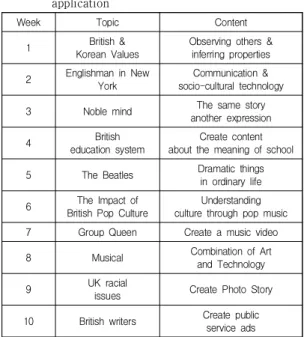
The experimental period consisted of a total of 10 weeks of weekly activities. Each session was conducted in the classroom with the steps of 'presenting the task, finding the problem, collecting the thought, exploring, solving the project, and presentation. Classes were 75 minutes in length. The project-based and problem-based convergent learning application program is a process of teaming students into small groups and focusing on creative curriculum such as self-expression, self-discovery, story-telling, using video production based on Action, Communication, and Teamwork. It was developed by Choi Min-ji and Kim Jae-kyung [11] for the purpose of fostering convergent talent in students through acting and communicating with each other and improving their ability to empathize through creativity and teamwork. The main themes of the project-based and problem-based convergent learning application program are as follows (Table 1).
Table 1. The main themes of the project-based and problem-based convergent learning application
Week Topic Content
1 British &
Korean Values
Observing others &
inferring properties
2 Englishman in New York
Communication &
socio-cultural technology
3 Noble mind The same story
another expression
4 British
education system
Create content about the meaning of school
5 The Beatles Dramatic things
in ordinary life
6 The Impact of
British Pop Culture
Understanding culture through pop music
7 Group Queen Create a music video
8 Musical Combination of Art
and Technology
9 UK racial
issues Create Photo Story
10 British writers Create public
service ads
2.2 Instrument
In order to measure creativity personality traits, the 'creativity positive tendency test' developed by Lee [12] was used. This creative personality test for college students classifies the personality traits into six categories (openness, emotional instability, propulsion, independence, nonconformity, self-confidence). In the previous study, the reliability of the test tool was found to be α=.84 as shown in Table 2.
To measure the English communication skills of college students according to the application of project-based and problem-based convergent learning, TOEIC Speaking practice test evaluation items issued by ETS (Educational Testing Service) were selected.
Pre- and post-tests were conducted and the questionnaire items included students’ perceptions of communication improvement.
Cronbach's alpha coefficient was calculated through the item internal reliability test to verify the reliability of the measurement tool. The SPSS 18.0 program was used for the above-mentioned empirical analysis and it was verified at the significance level of 5%.
Table 2. Reliability coefficient by sub-factors of creative personality test
Sub-factor Cronbach's alpha
openness .89
anxiety .72
non-sociality .55
propulsion .78
Independence .74
self-confidence .58
total .84
3. Results and Discussion
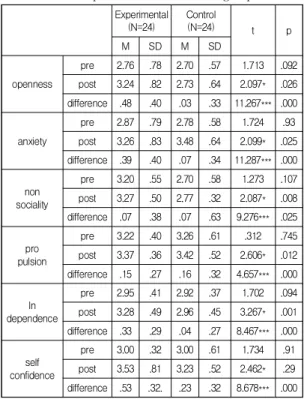
The effect on creative personality by project-based and problem-based convergent learning sub-dimensional was statistically measured by pre- and post-testing (Table 3). The group homogeneity was verified by independent sample t-test using pre-test scores. As a result, there was no significant difference between the experimental group and the comparative group in the six sub-factors of creativity such as openness, anxiety, non-sociality, propulsion, independence, and self-confidence.
First, in the openness category, the posttest mean of the experimental group was M=3.24, the mean of posttest in the control group was M=2.73 (T=2.097, p<.05), and the difference was statistically significant (p<.05). In addition, as a result of comparing the difference between before and after, the value of the experimental group was significantly higher than that of the control group (p<.001).
Second, in the factor of anxiety, the posttest mean of the experimental group was M=3.26, the posttest mean of the control group was M=3.48 (T=2.099, p<.05), and the difference was statistically significant (p<.05). In addition, as a result of comparing the difference between before and after, the value of the control group was significantly higher than that of the experimental group (p<.001). Third, in terms of non-sociality, the posttest mean of the experimental group was M=3.27, the posttest mean of the control group was M=2.77
(T=2.087, p<.05), and the difference was statistically significant (p<.05). In addition, as a result of comparing the difference between before and after, the value of the experimental group was significantly higher than that of the control group (p <.001).
Table 3. The result of pre and post-test between the experimental and control group
Experimental (N=24)
Control
(N=24) t p
M SD M SD
openness
pre 2.76 .78 2.70 .57 1.713 .092 post 3.24 .82 2.73 .64 2.097* .026 difference .48 .40 .03 .33 11.267*** .000
anxiety
pre 2.87 .79 2.78 .58 1.724 .93
post 3.26 .83 3.48 .64 2.099* .025 difference .39 .40 .07 .34 11.287*** .000
non sociality
pre 3.20 .55 2.70 .58 1.273 .107 post 3.27 .50 2.77 .32 2.087* .008 difference .07 .38 .07 .63 9.276*** .025
pro pulsion
pre 3.22 .40 3.26 .61 .312 .745
post 3.37 .36 3.42 .52 2.606* .012 difference .15 .27 .16 .32 4.657*** .000
In dependence
pre 2.95 .41 2.92 .37 1.702 .094 post 3.28 .49 2.96 .45 3.267* .001 difference .33 .29 .04 .27 8.467*** .000
self confidence
pre 3.00 .32 3.00 .61 1.734 .91
post 3.53 .81 3.23 .52 2.462* .29 difference .53 .32. .23 .32 8.678*** .000
Fourth, with regards to propulsion, the posttest mean of the experimental group was M=3.37, the mean of the posttest in the control group was M=3.42 (T=2.606, p<.05), and the difference was statistically significant (p<.05). In addition, as a result of comparing the difference between before and after, the value of the control group was little bit higher than that of the experimental group (p<.05).
Fifth, when measuring the independence category, the mean of the posttest in the experimental group was 3.28 and the mean of the posttest in the control group was 2.96 (t=3.267, p<.01). Also, the value of the experimental group was significantly higher than that of the control group (p<.001) as a result of comparing
the difference before and after.
Sixth, in the area self-confidence, the mean of the posttest in the experimental group was M=3.53, the mean of the posttest in the control group was M=3.23 (T=2.462, p<.05), and the difference was statistically significant (p<.05). In addition, as a result of comparing the difference between before and after, the value of the experimental group was significantly higher than that of the control group (p <.001).
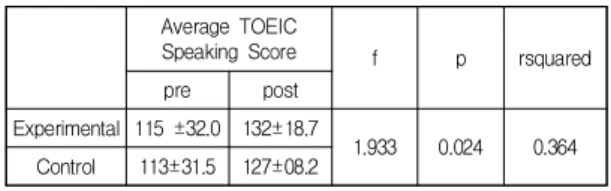
Table 4. Average TOEC Speaking Score (Pre & Post -test)
Average TOEIC
Speaking Score f p rsquared
pre post
Experimental 115 ±32.0 132±18.7
1.933 0.024 0.364 Control 113±31.5 127±08.2
In the experimental group of project-based and problem-based convergent learning, openness, anxiety, non-sociality, independence, self-confidence of sun-factors can be seen as being positively affected.
4. Conclusion
The results of this study showed that there was improvement in the areas of openness, non-sociality, independence, and self-confidence among the sub-dimensions of creative personality in project-based learning applied general English class. This was also statistically significant. On the other hand, in terms of anxiety and propulsion, the control group showed a larger effect than the experimental group. The TOEIC speaking score for measuring communication ability also showed a somewhat higher improvement in the experimental group in the posttest.
These results can be interpreted in a variety of ways depending on each effect variable, but generally speaking, project-based and problem-based convergent learning applied to EFL (English as a foreign language) lessons can provide the environment that promotes
communication and learner's activeness in the development of a creative personality [13]. The effect of the control group on propulsion seems to be more related to the expressive function than the comprehension function of language in the case of Korean students.
Students learned the tasks given by using their limited English proficiency, assessed the problem solving situation and the relationship among their group members, and actively created meanings by using appropriate communication strategies in order to increase their effectiveness within a project-based context. The creative personality can be further stimulated by expressing in a creative way the problem solving plan in the general English class [14]. In conclusion, project-based and problem-based [15]
convergent learning applied to general English classes was not only discussed in terms of improvement of English communication ability, but there is also a suggestion that it promotes students’ creativity.
This study was meaningful as an empirical study to verify the effectiveness of project-based and problem-based convergent learning in a general English class. Data was obtained with regards to the relevance of language to creativity. The samples of this study are from university students, so the number of students participating in the study was relatively limited and the differences in effectiveness due to regional, university, major, environmental and educational experience should also be taken into consideration.
A further study would be meaningful if the scope of the study were extended to determine whether environmental and experience factors were of significance, and perhaps further research can be done to verify each effect.
REFERENCES
[1] R. G. Harrington. (1984). Effects of verbal self-instruction on creative play in preschool-aged
children. The Journal of Creative Behavior, 18(2), 143-151.
DOI: 10.1002/j.2162-6057.1984.tb00376.x
[2] S. Monika. (2016). Creativity in foreign language teaching Journal of Education Culture, 16, 141-168.
DOI : 10.15503/jecs20162.180.188
[3] M. Robyn (2015). The relationship between creativity, social play, and children's language abilities. Journal of Early Child Development and Care, 185(7).
DOI: 10.1080/03004430.2014.983916
[4] M. Y. Lee & D. Y. Lee. (2004). Language and Linguistics. Seoul: Yeoklack.
[5] J. S. Lee. (2017). A Study on the Premise and Contents Layout of Language - based Convergence Education.
Korean language literature, 101, 175-199.
[6] D. Coyle, P. Hood, & D. Marsh. (2010). Content and Language Integrated Learning. New York: Cambridge University Press.
DOI: 10.1017/S0261444813000256.
[7] C. Adams. (2018). Buck Institute for Education http://www.bie.org/index.php/site/PBL/pbl_handbook_in troduction/#history.
[8] J. Mergendoller. & J. Thomas. (2018). Managing project based learning: Principles from the field.
http://www.bie.org/index.php/site/RE/pbl_research/29.
[9] E. P. Torrance. (1996). The Torrance Test of Creative Thinking. Massachusetts, Personal Press. 53-58.
DOI: 10.1016/j.tsc.2008.03.003
[10] E. Sagone (2013). The Influence of Creative Personality Factors on Interpersonal Adjustment in Adolescents:
What's the Relationship?, Procedia - Social and Behavioral Sciences, 82(3), 131-136
DOI: 10.1016/j.sbspro.2013.06.236
[11] M. J. Choi & J .K. Kim (2016). Correlation of Art-centered Projects with Teamwork and Credibility, Learner-centered curriculum education research, 16(10).
DOI : 10.22251/jlcci.2016.16.10.403
[12] S. D. Lee. (2002). Development and Validation of Creative Personality Test for University Students.
Journal of Educational Psychology, 16(2), 43-61 [13] D. E. Murray (2013). Case for Online English Language
Teacher Education, .The International Research Foundation for English Language Education 4(1).
[14] A. J. Starko (2013). Creativity in the classroom.
https://doi.org/10.4324/9780203115176
[15] E. Cindy (2004) Problem-based learning; What and How do students learn?, Educational Psychology Review, 16(3), 235-266.
신 명 희(Myeong-Hee Shin) [정회원]
․2000년 2월 : Vancouver College (TESOL)
․2008년 8월 : 한국외국어대학교 영 어과(문학박사)
․2006년 3월 ~ 2010년 8월 : 건양 대학교 조교수
․2010년 9월 ~ 현재 : 한남대학교 부교수
․관심분야 : Sociolinguistics, TESOL. Discourse analysis, English Language Teaching
․E-Mail : [email protected]