Application of convergence thinking in Problem-based learning on paramedic education
Se-Young Lim 1 , Soo-Tae Kim 1,2* , Tae Young Moon 3
1
Ph.D. Candidate, Graduate School of Health Sciences, Kangwon National University,
2
Professor, Department of Emergency Medical Technology, Dongnam Health University
3
Professor, Department of Emergency Medical Services, Kangwon National Universi ty
융합적 사고를 적용한 응급구조학의 문제중심학습
임세영 1 , 김수태 1,2* , 문태영 3
1
강원대학교 일반대학원 박사수료,
2동남보건대학교 응급구조과 교수,
3강원대학교 응급구조학과 교수
Abstract The purpose of this study is to implement the convergence thinking in problem-based learning (PBL) on paramedic education. PBL scenario course was conducted for 78 students in the third year of emergency medical technology during the first semester of 15 weeks in 2017. After 15 weeks, data of 73 students were analyzed. Among questions about learning interest in PBL, ‘neutral’ was the most frequent response with 38% for “PBL scenario classes were more effective in learning and acquiring knowledge than lecture class”. For “The lessons learned in the class helped to improve the ability to come up with appropriate solutions for problem solving”, 57.5% responded ‘agree’, and for “The lessons learned in the class helped with confidence in the emergency scene”, 50.7% responded ‘agree’. PBL will be an effective and efficient way of teaching as a learning curriculum for understanding the field situation.
Key Words : Problem-based learning, Scenario, Paramedic education, Convergence thinking
요 약 본 연구의 목적은 융합적 사고를 적용하여 응급구조학과 학생들의 현장문제해결에 도움되고자 하는데 있다.
응급구조과 3학년에 재학 중인 학생 78명을 대상으로 15주간 동안 문제중심학습 시나리오 수업을 20시간 진행하였으 며, 수업 진행 후 미응답자 5명을 제외한 73명 학생의 자료를 분석하였다. 학습관심도에 대한 질문 중 조사대상자의
“문제중심학습 시나리오 수업방식이 강의식 수업보다 학습과 지식습득에 효과적이었다‘라는 질문에 각각 보통이라고 하였고, 38%로 가장 높았다. 수업에서 학습한 내용들이 문제해결에 있어 적절한 해결방안을 생각해 내는 능력 향상에 도움이 되었다“라는 질문에 57.5% ‘그렇다’라고 하였고, 수업에서 학습한 내용들이 응급 현장에서 자신감을 갖는 데에 도움이 되었다“에 50.7%가 그렇다고 답하였다. 문제중심학습은 어느 한 학년에 국한되지 않고 단계별, 지속적으로 현 장상황을 이해할 수 있는 학습교과과정으로 적용된다면 효과적이고, 효율적인 교육방법이 될 것이다.
주제어 : 문제중심학습, 시나리오, 응급구조학 교육, 융합적 사고
*Corresponding Author : Soo tae Kim([email protected]) Received August 21, 2019
Accepted November 20, 2019
Revised October 2, 2019
Published November 28, 2019
Ⅰ. Introduction
1.1 Background and Objectives
With the improvement of the quality of life, the changed modern lifestyle provides a new change of diversity in uniformity and simplification, and it is expanding to a leisure culture escaping the basic desire for the pursuit of food and shelter.
This age of change, demands rapid response and improved awareness from emergency medical technicians. Until the early 1990s, the emergency site had no emergency medical technician to perform the patient treatment at the accident site, so that only the simple transfer was made to the hospital without preventing the secondary damage of the patient[1]. However, since the mid 90's, field specialists called emergency medical technicians have been deployed (Level 1-15,371, Level 2–14,058) to deal with situations on the field. Nowadays, there is a recognition that there is a limit to cultivate problem solving ability suitable for a new social environment as an existing teaching method that delivers regularized and clarified knowledge to teachers with respect to individuality and diversity rather than uniformity and universality[2]. In addition to reflecting the education area on the spot, it is necessary to have flexibility to cope with the situation on the spot, and it is different from other health care occupations where it is most important to save people in the golden hour in the special situation of the field. One of the educational methods to improve the ability to cope flexibly in this social environment is problem-based learning (PBL). Among the various ways we learn, the problem of inflective education is that the learners themselves accept the given knowledge passively rather than recognize and solve the problem themselves.
Problem-solving learning stimulates the learner's interest and aims at the holistic development of knowledge, value, and attitude, and was systematized into a life-centered classroom
course[3]. Problem-based learning has been proposed as a new alternative to develop the necessary reasoning and self-directed learning functions because medical students who have acquired much information through traditional medical education methods can not cope with analyzing and prescribing problems faced after graduation[3]. Problem-based learning is the process of presenting situation-based problems to students in class and helping them to become active participants. The teacher's role is to simply facilitate learning and to help students actively participate in class[4]. It is a method to find out the knowledge by oneself by letting students experience the process of diagnosing the patients themselves and preparing the treatment plan by systematically making the virtual scenarios systematically as if meeting the actual patient[5]. This method is completely reversed from the conventional teaching principle and it is more effective for the students who do not have the theoretical foundation to get the clinical case rightly to acquire the theoretical knowledge of basic medicine and clinical medicine[6].
This learning method, which was started by
Professor Barrow at College of Medicine in
Canada in the 1960s, was adopted by some
universities in such countries as Canada, UK and
Australia for more than 15 years in nursing
education and PBL was conducted mainly in
medical schools and nursing universities in Korea
as example cases[7,8]. As a result of comparing
the PBL learning group with the lecture group,
the PBL learning process was positively effective
in students' participation in class, cooperation
and discussion ability, problem solving process,
and learning satisfaction[9]. In recent years,
evidence-based medicine has become important
in clinical education and practice, and medical
simulation education based on virtual scenarios
has further developed in medical education with
the most value in patient safety[10]. Therefore, it
is necessary to periodically reeducate to cope with sudden emergencies, and a learning environment is needed to create a hypothetical scenario based on a clinical case so that students can be motivated to apply relevant knowledge.
However, the education of emergency medical technicians is still focused on injecting education or problem solving for qualification rather than problem-based learning (PBL) which can cope with causes and incidents due to diversity[11].
Thus, the purpose of this study is to understand what learning methods are needed in the field through the feedback of students applying problem-based learning (PBL) and to provide basic data according to this.
2. Methods and Materials
2.1 Study subjects
A problem-based learning (PBL) scenario course (20 hours) was conducted for 78 students who were in the third year of emergency medical technology department of D university in Suwon during the first semester of 15 weeks in 2017, and most students were those who had not experienced problem-based learning scenario classes in the first and second year curriculum.
After 15 weeks of study, 73 students were analyzed from the data of 78 students except 5 non-responses.
2.2 Study instruments
Based on problem-based learning (PBL), the course was taught using self-directed learning and a question-and-answer method with 9 scenarios including musculoskeletal injury, multiple severe injuries (traffic accident), traumatic consciousness disorder (head injury), burns, bleeding, and shock. For the evaluation, the learning attitude measurement tool developed by Hwang[12] was modified to fit this study. The
questionnaire consisted of 3 parts and 16 items including 8 items of interest in problem-based learning, 3 items of learning preparation, and 5 items of learning participation, and it was in a 5 point Likert scale from "1 point = Strongly disagree", to "5 points = Strongly agree".
2.3 Statistical method
The results of the Statistical method are shown in Table 1.
Frequency analysis was performed using general descriptive statistics, and SPSS Win 18.0 was used. Reliability showed Cronbach's α of .917.
Reliability test
Item Number of items Cronbach alpha
Learning interest 8 .857
Learning preparation 3 .762
Learning participation 5 .767
Overall reliability 16 .929
Table 1. Reliability test
2.4 Setting Learning Objectives (Example)
1. Identify and describe multiple severe injuries treatment (TA) according to a given situation.
2. Describe the symptoms and signs of a traumatic consciousness disorder, head injury patient (fall) and describe the method for treatment.
3. Understand musculoskeletal injuries (fractures, dislocations, sprains) and describe methods for proper equipment application.
4. Understand the algorithm of the trauma patient, and analyze severe trauma patients and patients focusing on chief complaints appropriately.
5. Identify the life-threatening problems of the burn patient and provide appropriate treatment according to the burn range.
Scenario 1. Construction of scenario
2.5 Scenario Case
On April 18, 2017, at around 2 pm on a new shopping arcade construction site, three workers fell while they were moving things with a crane and field dispatch was made. The witness said the patient was moving glass for the building exterior construction. With a loud sound, it was said that the workers had crashed. The place where the patient crashed was a public road and there was no additional damage to the patient. One patient was groaning at the time of arrival, but two patients had no response. Protective equipment such as a helmet was worn.
Scenario 2. Falling down from a crane
You are a first year emergency medical technician working at Gyeonggi Fire Station 119 Paramedics. You are on standby today at the 119 Security Center for work on April 18th.
Situation room : “4 am, a car crash occurred in the vicinity of the entrance to the Yeongdong Expressway. Requesting dispatch”
Field : Police and fire rescue teams were already on the scene, and the front of the vehicle was severely damaged.
Police in control : The accident is an accident in which a driver who was not able to secure visibility due to fog collided with a guardrail.
The patient was a driver, was wearing a seat belt, and the air bag was blown.
Paramedic : Where is it the most uncomfortable?
Patient : “My head and neck are in most pain”
Observations showed no severe bleeding, but the forehead was swollen.
Patient consciousness was normal.
Scenario 3. Car crash accident
4 am, there was notice of a collision with a car in the vicinity of the entrance road of Suin line road Yeongdong Expressway. Police and fire rescue teams were already on the scene, and there was a guard rail collision due to lack of visibility due to fog. The police were on-site control and informed that there was one driver in the accident vehicle. When approaching the driver's seat, the patient was very surprised, complaining of severe headache and neck pain.
While driving, the car collided without control, the driver hit the head on the windshield, there was no loss of consciousness, and the forehead was severely swollen. The front of the vehicle was pushed to the driver's seat, the seat belt was worn, the airbag was blown, and the windshield was broken.
Scenario 4. Vehicle collision
At the scene of dispatch, a 70-year-old man had fallen down in front of the bathroom door, complaining of severe pain in his hips and right leg. The guardian went out in surprise due to a loud noise and found the patient who fell in front of the bathroom. The patient's consciousness was normal and there was some abrasion on the forehead.
Scenario 5. Falling down accident
6. Approaching method to problem solution
- Inspect the most important parts of the scenario situations above.
- Identify, judge and record the comprehensive situation of the site.
- Describe the appropriate first aid required for the patient.
- What types of history taking of the patient should be done by a paramedic?
- How do you explain the patient's condition to the medical staff when handing over to
the hospital?
- If you are receiving medical guidance, what are you considering when directed by a doctor as a paramedic?
- Did you identify the appropriate hospital to transport this patient to? Describe the reasons for the selection.
3. Results
Item
Stron gly disagr ee (%)
Disag ree (%)
Neutr al (%)
Agree (%)
Stron gly agree (%) 1. Problem-based learning scenario
teaching methods were more effective than lecture-based learning.
2 (2.7)
2 (2.7)
38 (52.1)
20 (27.4)
11 (15.1) 2. Problem-based learning scenario
classes were more effective in acquiring knowledge as experts than in lecture class.
2 (2.7)
7 (9.6)
38 (52.1)
15 (20.5)
11 (15.1)
3. The lessons learned in the class helped to improve the ability to come up with appropriate solutions for problem solving
0 3
(4.1) 28 (38.4)
25 (34.2)
17 (23.3)
4. The lessons learned in the class helped with confidence in the emergency scene
0 7
(9.6) 29 (39.7)
23 (31.5)
14 (19.2) 5. The content of scenario classes
improved the motivation to learn more than theory class
2 (2.7)
6 (8.2)
37 (50.7)
14 (19.2)
14 (19.2) 6. Problem-based learning scenario
classes were more interesting than theoretical lessons.
0 4
(5.5) 38 (52.1)
23 (31.5)
8 (11) 7. There was something that stimulated
curiosity and interest in the contents of the class.
0 6
(8.2) 32 (43.8)
25 (34.2)
10 (13.7) 8. Since most of the contents of this class
were previously learned, the class was not related to my needs.
11 (15.1)
18 (24.7)
29 (39.7)
10 (13.7)
5 (6.8)
Total 3 7 33 19 11
Table 2. Learning interest (N=73)
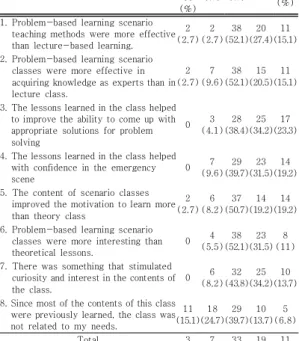
The results of the survey on learning interest are shown in Table 2. Among questions about learning interest in problem-based learning,
‘Neutral’ was the most frequent response with 38% for “Problem-based learning scenario classes were more effective in learning and acquiring knowledge than lecture class”. This is because the students have already learned the lecture class, so the scenario-based lecture is not familiar and the lecture class is mostly used for
The level of consciousness was P, and there was a sign of vomiting
in the mouth. The vital signs were measured as blood pressure 150
/ 100mmhg, pulse 107 times / min, respiration 22 times / min, body
temperature 36.5 ℃, and oxygen saturation 87%. There was scalp
bleeding in the left temporal lobe.
acquiring knowledge information, resulting in many neutral responses.
For “The lessons learned in the class helped to improve the ability to come up with appropriate solutions for problem solving”, 57.5% responded
‘Agree’, and for “The lessons learned in the class helped with confidence in the emergency scene”, 50.7% responded ‘Agree’.
In the interest of learning and interest in class, Neutral was 50.7%, but at the beginning, the level of learning tended to be lower and gradually improved over time. PBL induces self-interest in learning subjects and is maintained by stimulating self-regulated learning (metacongnition). Most curricula focus on knowledge-based delivery learning, and problem-based learning requires familiarity with long-term progress rather than short-term learning curricula. For “There was something that stimulated curiosity and interest in the contents of the lesson” there was frequent response of 47.9% for ‘Agree’. Based on the scenario based on the situation or field practice of the patients in the lecture, indirect experience or cases stimulated curiosity and interest. 39.8%
of respondents answered that there was a need for problem-based learning. This is because they are learned based on the connection with the theoretical knowledge before applying the problem-based learning subject.
Item
Stron gly disag ree (%)
Disa gree (%)
Neut ral (%)
Agre e (%)
Stron gly agre e (%) 1. The contents of the class helped to
induce self-directed learning. 0 7 (9.6)
32 (43.8)
18 (24.7)
16 (21.9) 2. It could be clearly seen whether the
contents learned in the class were related to the learning.
1 (1.4)
3 (4.1)
30 (41.1)
24 (32.9)
15 (20.5) 3. After class, I organized what was learned
in class.
7 (9.6)
12 (16.4)
32 (43.8)
14 (19.2)
8 (11)
Total 2 8 31 19 13
Table 3. Learning readiness (N=73)
Learning readiness results are shown in Table 3. For “The contents of the class helped to induce self-directed learning”, 46.6% responded
‘Agree’. Self confidence and self control ability, which are sub-factors of problem solving ability was enhanced, and as a result of analyzing the learner's reflection log, it can be seen that they experienced the improvement of the overall understanding in the task performance process, such as motivation for task performance and task performance method. For “It could be clearly seen whether the contents learned in the class were related to the learning”, 53.4% responded
‘Agree’. For “After class, I organized what was learned in class”, 43.8% responded ‘Neutral’. This is because the students are familiar with the existing lecture class and can not organize what they learned after problem-based learning.
Item
Stron gly disag ree (%)
Disag ree (%)
Neutr al (%)
Agre e (%)
Stron gly agre e (%) 1. The lessons learned in class helped with
team work 0 10
(13.7) 29 (39.7)
22 (30.1)
12 (16.4) 2. Question-answer format discussion class
method helped to participate in the class. 0 4 (5.5)
34 (46.6)
23 (31.5)
12 (16.4) 3. I actively participated in this class 1
(1.4) 4 (5.5)
26 (35.6)
29 (39.7)
13 (17.8) 4. Even if there is something I do not know
in class, I go over without asking.
7 (9.6)
15 (20.5)
35 (47.9)
10 (13.7)
6 (8.2) 5. This lesson helped to express opinion
based on different situations. 0 4 (5.5)
36 (49.3)
20 (27.4)
13 (17.8)
Total 2 7 32 21 11
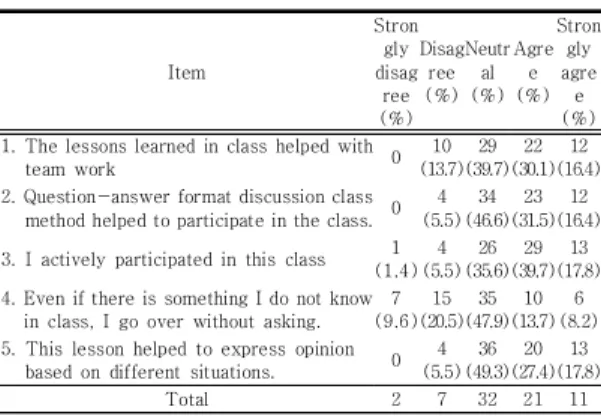
Table 4. Learning participation (N=73)
The results related to learning participation are shown in Table 4. For “The lessons learned in class helped with team work”, 46.5% responded
‘Agree’. PBL refers to the learning method and environment in which learning is conducted in the process of presenting practical problems to learners, discussing problem solving methods jointly in order to solve the problems, and preparing a common solution through individual learning and cooperative learning.
4. Discussion
PBL is said to improve learner motivation,
improve self-directed learning ability, and integrate knowledge to improve problem solving ability[13]. The main characteristic of the PBL is that it provides step-by-step analysis of the actual situation of the clinical field prepared in a scenario form[14]. The learners reflect the existing knowledge and experience to cope with the present situation, find out the learning needs, and learn independently through small group discussion and autonomous learning. In the PBL[2], students are presented with learning materials composed of scenarios that will be encountered in actual clinical situations, and learners will learn how to identify and solve problems by analyzing given data and establishing hypotheses. This is because, through simulated scenarios in the field situations that occur with diversity, they learn the thoughts of the emergency situations in the way of self-directed learning and fears about the field and the first aid to the patient becomes easy by finding the answer[15].
As a result of evaluating PBL and lecture learning for students who experienced PBL, and it was relatively higher than lecture learning in terms of teaching process, opinion exchange, self-directed learning. In terms of learning effect, it was high in development of medical thinking and judgment ability and intellectual ability development for problem solving[16,17]. The problem-based learning method is a way to find the best way in the present situation, not just solving the problem and getting the correct answer, so it is suitable for the emergency medical technician working in the field.
In some cases, the awareness that lecture-based learning is faster and more effective communicates the knowledge that the PBL learning process is
"ineffective". However, if students lack the ability to apply and judge knowledge in clinical situations, then the results do not convey knowledge[18]. PBL has the advantage of building useful knowledge in clinical situations,
developing clinical reasoning processes, and developing self-learning abilities and attitudes.
Self-directed learning is a “process whereby individual students diagnose their own learning needs without the help of others and select the resources needed to set and achieve goals”[19].
For an emergency medical technician, it is very important to focus on the team on site.
47.9% of the respondents participated in the class through the question-answer method with the professor, and 57.5% of them participated in the class actively. For more active questions and expressions in class, learners who are familiar with injection education should not feel burdened with other types of lessons. Continuous efforts are needed to improve field understanding and appropriate response through problem-based learning.
5. Conclusion
An emergency field golden time is only possible with the understanding of the site by the emergency medical technician and appropriate treatment of the patient. Although limited, 73 emergency medical technology department students who applied problem-based learning had more positive effects and more self-directed learning than previous methods.
Problem-based learning should not be limited to a single school year, and it will be an effective and efficient way of teaching if it is applied as a learning curriculum for understanding the field situation step by step.
REFERENCES
[1] J. G. Lee J. S. Kim & S. G. Roh. (2018). Comparison of
chest compression and ventilation volume using
LUCAS and manual in virtual reality-based ambulance
simulation -A manikin study-. Korean J Emerg Med
Ser, 22(3), 67-76.
DOI : 10.14408/KJEMS.2018.22.3.067
[2] Y. A. Lee & H. S. Kim. (2016). Effect of flipped learning on self-directed learning and academic achievement in emergency medical technology students. Korean J Emerg Med Ser, 20(2), 99-111.
DOI : 10.14408/KJEMS.2016.20.2.099
[3] Y. S. Lee. (2017). The effects of CPR education on CPR knowledge and self-efficacy for dental hygiene students from different regions. J Korean Soc Dental Hygiene, 17(6), 1003-1012.
DOI : 10.13065/jksdh.2017.17.06.1003
[4] J. S. Choi, S. R. Jeong & Y. K. Choi. (2018). A case study on the difference of communication competency for dental hygiene process of care in the students of a dental hygiene department by the evaluator. J Korean Soc Dental Hygiene, 18(1), 139-151.
DOI : 10.13065/jksdh.2018.18.01.139
[5] E. K. Jung, S. S. Choi & J. Y. Jung. (2018). Comparison of educational interest, satisfaction, and achievements of educational virtual reality and videos education before simulation training. Korean J Emerg Med Ser, 22(2), 93-102.
DOI : 10.14408/KJEMS.2018.22.2.093
[6] J. S. Kim & U. J. Choi. (2016). Memory retention of education regarding endotracheal and laryngeal tube intubation -A manikin study-. Korean J Emerg Med Ser, 20(3), 85-93.
DOI : 10.14408/KJEMS.2016.20.3.085
[7] H. S. Barrows & R. M. Tamblyn. (1980). Problem-based learning: An approach to medical education. New York: Springer Publishing Company Inc.
[8] S. B. Lee, Y. W. Lee, Y. S. Yoon & J. B. Bang. (2013).
Can a computer-based simulation apply to test for medical students?, J of Healthcare Simulation, 2(1), 1-5.
[9] H. Y. Pi. (2013). Effects and adequacy of simulation-based training in department of emergency medical technician ACLS lecture. J of Healthcare Simulation, 2(1), 20-28.
[10] K. Y. Song & M. J. Choi. (2013). Clinical performance evaluation of one to one interaction simulation program using standardized patient simulation for nursing students. J of Healthcare Simulation, 2(1), 37-42.
[11] D. C. Uhm & B. Y. Ko. (2017). Effectiveness of education regarding cuff pressure after endotracheal intubation. Korean J Emerg Med Ser. 21(2), 7-15.
DOI : 10.14408/KJEMS.2017.21.2.007
[12] S. Y. Hwang. (2013). Effects of Problem-based Learning on the Knowledge Achievement, Critical Thinking Ability, Attitude and Motivation toward Learning of Nursing Students . Unpublished doctoral dissertation, Chonnam National University, Gwangju.
[13] I. S. Seo, T. H. Kim, S. W. Hahn & M. S. Kim. (2019).
The effects of creative teaching technique applied to
nursing major curriculum on critical thinking disposition, problem solving process, and self leadership. Journal of the Korea Convergence Society, 10(3), 272-382.
DOI : 10.15207/JKCS.2019.10.3.373
[14] M. H. Shin & D. S. Choi. (2019). Project-based learning and learner interaction by web convergence communication types. Journal of the Korea Convergence Society, 10(2), 35-49.
DOI : 10.15207/JKCS.2019.10.2.035
[15] M. Y. Shin. (2019). Study of English teaching method by convergence of project-based learning and problem-based learning for English communication.
Journal of the Korea Convergence Society, 10(2), 83-88.
DOI : 10.15207/JKCS.2019.10.2.083
[16] Y. J. Ha, S. J. Woo & N. S. Seo. (2018). A convergence study on the effects of blended learning on the self-directed learning ability and learning satisfaction of nursing students. Journal of the Korea Convergence Society. 9(11), 509-517.
DOI : 10.15207/JKCS.2018.9.11.509
[17] H. J. Kim & I. H. Chun. (2018). The effect of problem-based learning and simulation practice convergence education for nursing students. Journal of the Korea Convergence Society, 9(7), 355-364.
DOI : 10.15207/JKCS.2018.9.7.355
[18] D. R. Kim. (2018). Study on flipped learning and flipped PBL effectiveness of college general mathematics. Journal of the Korea Convergence Society, 9(6), 209-215.
DOI : 10.15207/JKCS.2018.9.6.209
[19] K. Huh & J. Lee. (2018). The learning strategy use in a convergence flipped class. Journal of the Korea Convergence Society, 9(3), 173-179.
DOI : 10.15207/JKCS.2018.9.3.173
임 세 영(Se-Young Lim) [정회원]
․ 2016년 2월 : 강원대학교 응급구 조학과 (응급구조학 석사)
․ 2018년 8월 : 강원대학교 대학원 응 급구조학과 박사과정수료
․ 2013년 7월 ~ 현재: 강릉아산병원 응 급실 응급구조사
․ 관심분야 : 응급구조학, 심폐소생술
․ E-Mail : [email protected]
김 수 태(Soo-Tae Kim) [정회원]
․ 2013년 8월 : 한국교통대학교 응급 구조학과(응급구조학 석사)
․ 2018년 8월 : 강원대학교 대학원 응급 의료재활학과 박사과정수료
․ 2014년 3월 ~ 현재: 동남보건대 응급 구조과 교수
․ 관심분야 : PBL. 민간구급차, 응급처 치, 캡스톤디자인
․ E-Mail : [email protected]
문 태 영(Tae Young Moon) [정회원]