Veterinary Science
http://dx.doi.org/10.4142/jvs.2012.13.2.153
Received: 6 May 2011, Revised: 19 Aug. 2011, Accepted: 17 Mar. 2012
Original Article
*Corresponding author: Tel: +002-01095698763; Fax: +002-048603213; E-mail: [email protected]
ⓒ 2012 The Korean Society of Veterinary Science.
This is an Open Access article distributed under the terms of the Creative Commons Attribution Non-Commercial License (http://creativecommons.org/licenses/by-nc/3.0) which permits
unrestricted non-commercial use, distribution, and reproduction in any medium, provided the original work is properly cited.
In vitro susceptibility of Staphylococcus aureus strains isolated from cows with subclinical mastitis to different antimicrobial agents
Ayman El Behiry
1,*, Gerd Schlenker
2, Istvan Szabo
2, Uwe Roesler
2
Institutes of
1Animal Hygiene, and
2Environmental Health, Faculty of Veterinary Medicine, Free University of Berlin, 10115 Berlin, Germany
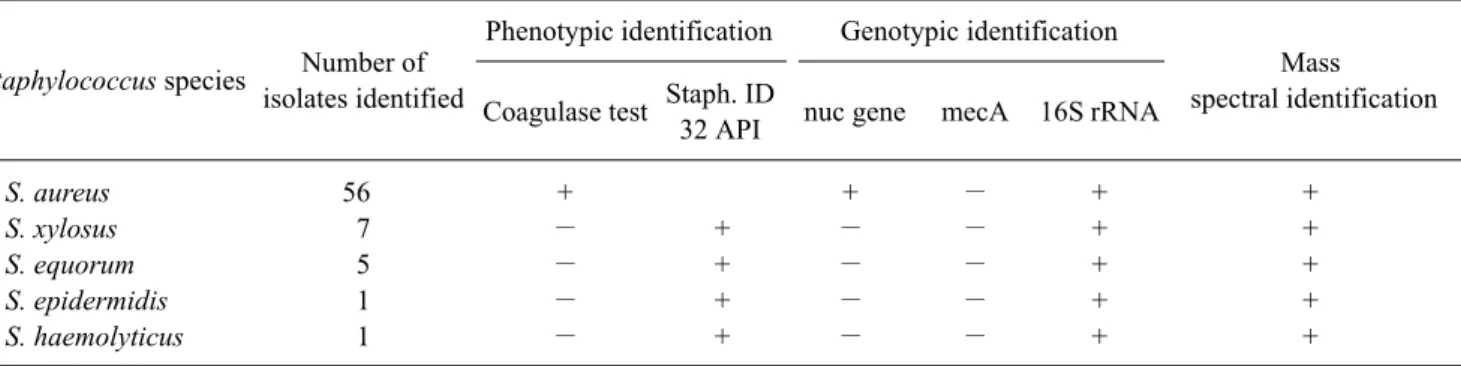
Sensitivity to commercial teat dips (nonoxinol-9 iodine complex and chlorhexidine digluconate) of 56 Staphylococcus (S.) aureus strains isolated from quarter milk samples of various German dairy herds treated with different teat dipping schemes was investigated in this study. The minimum inhibitory concentration was determined using a broth macrodilution method according to the German Veterinary Association guidelines. The main objective of the current study was to induce in vitro resistance induction of S. aureus to chemical disinfectants. Ten different strains were repeatedly passed ten times in growth media with sub-lethal concentrations of disinfectants. Nine strains showed a significant reduction in susceptibility to the nonoxinol-9 iodine complex but only one strain developed resistance to chlorhexidine digluconate.
Stability of the acquired resistance was observed in all S. aureus strains adapted to the nonoxinol-9 iodine complex and chlorhexidine digluconate. In contrast, simultaneous resistance to different antibiotics was not observed in any of the ten investigated S. aureus strains. However, the isolates exhibited a high degree of resistance to penicillin G. Based on these results, resistance of S. aureus to chemical disinfectants may be more likely to develop if the chemicals are used at concentrations lower than that required for an optimal biocidal effect.
Keywords: antibiotics, bovine mastitis, resistance induction, Staphylococcus aureus, teat dips
Introduction
Bovine mastitis is an inflammatory reaction primarily caused by different pathogens that gain entry into the teat canal and mammary gland [3]. This represents one of the most costly diseases in the dairy industry worldwide with estimated losses of about 2 billion dollars per year in the
United States alone [12]. These substantial economic losses are incurred by several factors such as rejected milk, reduced milk quality, drug costs, veterinary expenses, early culling, and increased laboratory costs [12]. Most cases of bovine mastitis are due to various types of bacteria. Bacteria of the genus Staphylococcus are one of the most common pathogens that cause mastitis worldwide. The genus Staphylococcus is divided according to the coagulase test into coagulase-negative (CNS) and coagulase-positive (CPS) species. Historically, CNS has often been considered to be minor important pathogens that cause intramammary infections (IMI). In contrast, recent studies on mastitis prevalence have found that CNS may be of major importance in some countries [3,26].
Staphylococcus (S.) aureus is among the CPS isolated from cases of bovine mastitis. This pathogen is considered to be one of the most common causes of bovine mastitis in different areas of the world and responsible for 25 ~ 30% of all IMI in the United States [35]. Mastitis caused by S.
aureus is most frequently subclinical; however, major rates of clinical mastitis incidence are associated with this microorganism. S. aureus is regarded as a contagious mastitis pathogen because it is commonly spread from infected to non-infected cows during milking [33].
Although S. aureus is not difficult to cultivate and easily identified, there is still need for a rapid and sensitive DNA-based assay specific for detecting S. aureus [30].
Most recent studies used polymerase chain reaction (PCR) techniques to identify S. aureus and, in some cases, for genotyping [10,18]. In general, more rapid identification of bacteria using matrix-assisted laser desorption/ionization- time of flight-mass spectrometry (MALDI-TOF-MS) can be an important method for diagnosing infections [31].
Bovine S. aureus mastitis can be prevented and
controlled by the use of effective post-milking teat
Table 3. Percentages of in vitro susceptibility to six selected antimicrobial agents for 70 Staphylococcus species obtained from subclinical cases of bovine mastitis
Antibiotic Disc
concentration
Susceptibility (%) of S. aureus (56 isolates)
Susceptibility (%) of CNS (14 isolates)
Susceptibility (%) of all isolates (70 isolates)
S I R S I R S I R
Penicillin G Tetracycline Gentamycin Oxacillin Erythromycin Chloramphinicol
10 units 30 μg 10 μg 5 μg 15 μg 30 μg
14.29 89.28 85.72 100.00 100.00 96.44
0.00 3.57 3.57 0.00 0.00 1.78
85.71 7.14 10.71 0.00 0.00 1.78
71.43 92.86 92.86 100.00 100.00 92.86
0.00 0.00 0.00 0.00 0.00 0.00
28.57 7.14 7.14 0.00 0.00 7.14
25.72 90.00 87.14 100.00 100.00 95.71
0.00 2.86 2.85 0.00 0.00 1.42
74.28 7.14 10.00 0.00 0.00 2.85
CNS: coagulae-negative Staphylococcus, S: susceptible, I: intermediate, R: resistant.
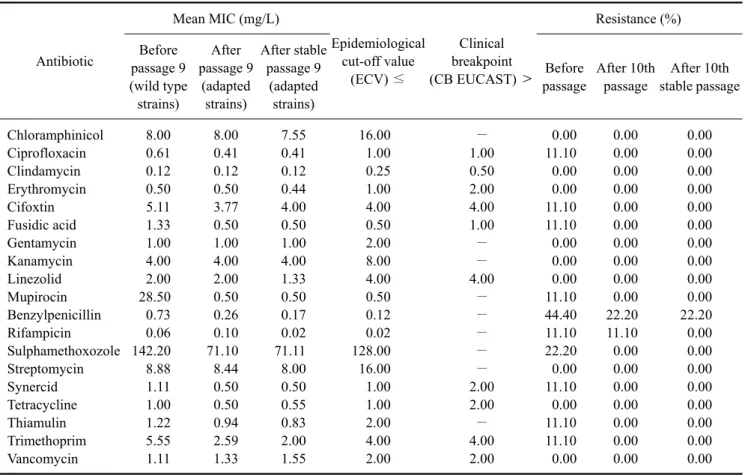
Table 4. Mean MIC values (mg/L) of 19 commercial antimicrobial agents used to treat bovine mastitis for the wild type and Ujosan dip-resistant S. aureus strains
Antibiotic
Mean MIC (mg/L)
Epidemiological cut-off value
(ECV) ≤
Clinical breakpoint (CB EUCAST) >
Resistance (%) Before
passage 9 (wild type strains)
After passage 9
(adapted strains)
After stable passage 9
(adapted strains)
Before passage
After 10th passage
After 10th stable passage
Chloramphinicol Ciprofloxacin Clindamycin Erythromycin Cifoxtin Fusidic acid Gentamycin Kanamycin Linezolid Mupirocin Benzylpenicillin Rifampicin Sulphamethoxozole Streptomycin Synercid Tetracycline Thiamulin Trimethoprim Vancomycin
8.00 0.61 0.12 0.50 5.11 1.33 1.00 4.00 2.00 28.50 0.73 0.06 142.20 8.88 1.11 1.00 1.22 5.55 1.11
8.00 0.41 0.12 0.50 3.77 0.50 1.00 4.00 2.00 0.50 0.26 0.10 71.10 8.44 0.50 0.50 0.94 2.59 1.33
7.55 0.41 0.12 0.44 4.00 0.50 1.00 4.00 1.33 0.50 0.17 0.02 71.11 8.00 0.50 0.55 0.83 2.00 1.55
16.00 1.00 0.25 1.00 4.00 0.50 2.00 8.00 4.00 0.50 0.12 0.02 128.00 16.00 1.00 1.00 2.00 4.00 2.00
− 1.00 0.50 2.00 4.00 1.00
−
− 4.00
−
−
−
−
− 2.00 2.00
− 4.00 2.00
0.00 11.10 0.00 0.00 11.10 11.10 0.00 0.00 0.00 11.10 44.40 11.10 22.20 0.00 11.10 0.00 11.10 11.10 0.00
0.00 0.00 0.00 0.00 0.00 0.00 0.00 0.00 0.00 0.00 22.20 11.10 0.00 0.00 0.00 0.00 0.00 0.00 0.00
0.00 0.00 0.00 0.00 0.00 0.00 0.00 0.00 0.00 0.00 22.20 0.00 0.00 0.00 0.00 0.00 0.00 0.00 0.00
EUCAST: European Committee on Antimicrobial Susceptibility.
conclusion was that S. aureus did not exhibit enhanced tolerance of chlorhexidine digluconate similar to that observed with the nonoxinol-9 iodine complex.
Antimicrobial drug resistance of S. aureus strains and CNS
As shown in Table 3, the S. aureus isolates showed the
highest level of in vitro resistance to penicillin G (85.72%)
while that of CNS was lower (28.57%), In addition 7.14%