Veterinary Science
Effect of mastitis on raw milk compositional quality
Henry Ogola, Anakalo Shitandi*, Jackin Nanua
Guildford Institute, Egerton University, P. O. Box 536, Egerton, 20115, Kenya
In this study, we investigated the impact of mastitis infection on the quality of milk composition in small-scale dairy bovine herds. The purpose of this study was to find a milk quality somatic cell count (SCC) standard that could be used as an integral component of a control program. In all, 396 quarter milk samples from lactating cross-bred cows (Holstein & Zebu) were analyzed; 56% of these quarters were experiencing intramammary infection, with an overall mean SCC of 5.46 × 10
5± 2.30 × 10
4cells/
ml. Infected quarters had significantly ( p < 0.05) higher mean SCC levels (6.19 × 10
5± 4.40 × 10
4cells/ml) compared to healthy quarters (2.65 × 10
5± 2.40 × 10
4cells/ml). In high SCC milk and infected quarters, the concentrations of non-casein fractions, sodium, chloride, and free fatty acid were higher ( p < 0.05), while the casein content, lactose, casein-to-total protein, potassium, and calcium were lower (p < 0.05) compared to normal quarters. These findings suggest a mean SCC threshold limit of 5.46 × 10
5cells/ml for the region. It was concluded that the results could be used to propose a milk quality SCC standard that can be used as an integral component of a control program.
Key words: compositional quality, raw milk, small scale farms, somatic cell count, subclinical mastitis
Introduction
The dairy cattle population in Kenya is estimated to exceed three million, and consists of indigenous breeds, i.e.,
Bos indicus and crosses between these species with exotic breeds, i.e., Bos taurus (e.g., Friesian, Ayrshire, Guernsey, and Jersey). The dairy industry is dominated by small-scale dairy farmers, who are estimated to contribute approximately 80% of total milk production [18]. Although increasing opportunities for income generation exist, small-scale dairy farms sometimes show sub-optimal animal performance, which could be attributed to poor management and disease [23].
Mastitis, particularly the subclinical type, is one of the most persistent and widely spread disease conditions of importance to milk hygiene and quality among dairy cattle worldwide [5]. Mastitis influences the total milk output and modifies milk composition and technological usability. In cows, the somatic cell count (SCC) is a useful predictor of subclinical mastitis, and therefore, it is an important component of milk in terms of quality, hygiene, and mastitis control [7]. Elevated milk SCC is associated with altered protein quality, change in fatty acid composition, lactose, ion and mineral concentration, increased enzymatic activity, and a higher pH of raw milk [1,5].
Various studies have demonstrated that subclinical mastitis is a prevalent disease in smallholder dairy herds in Kenya [19,22] and elsewhere. This study evaluated the effect of subclinical mastitis infection on raw milk compositional quality in small-scale dairy herds. We sought to determine a milk quality SCC standard that could be used as an integral component of a control program within the region. The ultimate aim was to propose a milk quality improvement model as a management tool designed for use as part of a control program.
Materials and Methods
Study animal selection and sampling
A cross-sectional study was conducted between August 2004 and March 2006 in the Rift Valley province, a major milk production region of Kenya. In the study, farm selection was based on herd size, availability of crosses of Holstein Friesian and Zebu ( Bos indicus ) cattle, and willingness of farmers to participate. The grazing system was a cut-and-carry stall-feeding system where Napier grass and crop residues are the main feeds, with concentrate supplementation restricted to milking cows. The study herds were initially screened for mastitis using the California mastitis test, udder palpation, and visual examination of milk. From 311 cows of 54 herds meeting the breed selection criteria and available for sampling, 396 quarter milk samples from 99 lactating cows were obtained by stratified random sampling.
While the cows were restrained in a standing position,
*Corresponding author
Tel: +254 51 62039; Fax: +254 51 622527
E-mail: [email protected]
quarter milk samples were collected after discarding the first few milliliters of milk. Udders and teats were cleaned with warm water and left to dry, and were then wiped with cotton buds soaked in 70% alcohol, after which a 5 ml milk sample for bacteriological culturing was aseptically collected in sterile tubes. Another aliquot was collected in 100 ml sample bottles and kept refrigerated at 4
oC for SCC and chemical analysis. The Delvo test SP, a commercial screening test (GistBrocades, Netherlands), was used to screen the milk to ensure that no antibiotic residues were present in the milk. This test was performed as described by the manufacturer. It was necessary to confirm that the samples were free of antibiotics, for if antibiotics had already been prescribed and used prior to milking, some of the bacteria may have been inhibited. The samples were transported on ice to the Guildford Institute Laboratories of Egerton University, and were tested within 6 h of collection.
Bacteriological analysis
Bacteriological isolation and identification followed the procedures of the National Mastitis Council [16]. Using a sterile disposable culturing loop, 0.01 ml of milk was streaked onto half a plate of blood agar (Becton Dickinson, USA) supplemented with 5% ovine blood and incubated aerobically at 37
oC. Plates were examined for bacterial growth at 24 and 48 h. Pure cultures were examined further for morphology, staining, and cultural characteristics, and for biochemical reactions. In cases where no growth was detected, plates were re-incubated at 37
oC for an additional 24 h.
Bacteria were identified using standardized procedures [17].
In brief, catalase-positive cocci were identified according to colonial morphology, hemolysis production, Gram staining, growth in Baird Parker agar, fermentation of glucose, and mannitol and coagulase tube tests against a positive control of Staphylococcus aureus ( S. aureus ) subsp. aureus ATCC 12600 (Culture Collection of the University of Gothenburg, Sweden). Quarters were classified as non-infected (NI) if no organisms were isolated, and were determined to be infected if mastitis pathogens were isolated. Cultural identity results for other non-Staphylococci mastitis pathogens were not available in this study. Thus, non-identified pathogens were grouped in the other mastitis pathogen category.
Milk chemical analysis
For each of the quarter milk samples, all of the analytical assessments were carried out in duplicate; these assessments included pH (potentiometric method, Contort C830), SCC [10], lactose, and chloride [11]. The free fatty acid (FFA) content [9] was expressed as the acid degree value (ADV) (meqFFA/100 g fat). The total nitrogen (TN), non-protein nitrogen (NPN), and non-casein nitrogen (NCN) contents were determined using a Kjeldahl block digester apparatus (FossElectric, Denmark) and calculated as: TN = N × 6.38,
NPN = N × 6.38, total protein (TP) = TN-NPN, NCN = N
× 6.34 [19]. The Na and K content were measured by flame photometry, while the Ca content was measured by atomic absorption spectrophotometry [17].
Statistical analysis
SCC values were transformed to log
10prior to statistical analysis. Pearson correlation coefficients and linear regression were used to investigate the relationship between SCC levels and various milk components. The effects of SCC levels, infectious status, lactation stage, and lactation number on milk components were evaluated with ordinary least square means analysis of variance using the PROC GLM procedure in SAS statistical software [21].
Results
Bacteriological analyses
From the 396 quarter milk samples examined, 56% (n = 222) of the quarters were experiencing intramammary infection. Threshold limits of 3.50 × 10
5SCC/ml have been fixed for milk quality control and udder health monitoring in the tropics [8]. Using this threshold limit, 76.27% of the quarters could be classified as infected.
The mean log
10SCC in the individual milk samples was calculated based on locality, mastitic status, parity, stage of lactation, and previous history of mastitis. The study yielded an overall mean SCC of 5.46 × 10
4± 2.30 × 10
4cells/ml and a standard deviation of 3.15 × 10
4, with 6.50 × 10
4cells/ml and 2.20 × 10
6cells/ml as the minimum and maximum SCC levels recorded, respectively. There were no significant differences ( p < 0.05) between the mean SCC values for animals with different parities and at different stages of lactation. However, the locality significantly affected the mean log
10SCC levels.
The SCC levels were significantly influenced by quarter health status. There was a significant rise ( p < 0.05) in the mean SCC levels in the infected quarters, whereby healthy quarters had a mean log
10SCC of 5.423 ± 0.02 (2.65 × 10
4± 2.30 × 10
4) cells/ml compared to infected quarters, which had a mean log
10SCC of 5.792 ± 0.03 (6.19 × 10
4± 4.40 × 10
4) cells/ml. This was also reflected in quarters that had a previous history of mastitic infection exhibiting a significantly higher ( p < 0.05) mean log
10SCC than those with no previous mastitis history. In the infected quarters, the SCC responses also depended on the mastitic pathogen isolated. Quarters from which S. aureus was isolated had a higher ( p < 0.05) mean log
10SCC compared to other pathogens. The quarters from which coagulase negative staphylococci , and other mastitic pathogens were isolated had mean log
10SCC values of 5.84±0.03, 5.65±0.04, and 5.79±0.03 cells/ml, respectively.
SCC and milk composition
The qualitative parameters were analyzed according to the
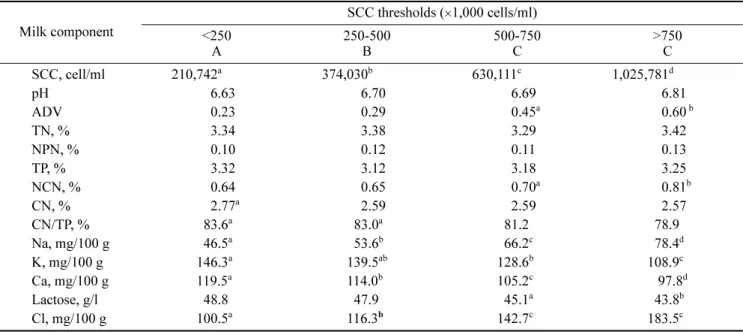
SCC threshold classifications of the herd to test the effect of SCC on pH, FFA, milk protein fractions, and mineral content. The results relate to the mean values of the milk components at several SCC threshold levels are reported in Table 1.
The results show the SCC to have had no significant effect on the pH values of quarter milk samples, with the mean pH values falling within the normal milk pH range. However, the FFA content rose significantly ( p < 0.05) along with the SCC level. The lower SCC threshold groups were not significantly different from each other, although milk with higher SCC levels showed a significant difference.
The acid degree value (ADV) was increased by 0.16-0.37 meq FFA per 100 g in higher SCC quarters (>5.0 × 10
5cell/
ml). Furthermore, the FFA content had a high correlation (r = 0.75, p < 0.05) with SCC values in quarter milk (Fig. 1).
The protein fraction concentrations of the TN, TP, and NPN fractions were not significantly affected by SCC responses in the quarters. The Kjeldahl values for TP percentage according to SCC group were 3.32, 3.12, 3.18, and 3.25 for group A, B, C, and D, respectively. However, the percentage of the NCN fraction increased significantly ( p < 0.05) with increasing SCC levels in quarters, while CN content was lower in SCC groups B, C, and D respectively. The elevation of the NCN fraction with a corresponding decrease in CN content resulted in an 1.8-4.5% decrease in CN/TP ratio in high SCC quarters (>5.0 × 10
5cell/ml). The CN/TP ratio (proteolysis index) was significantly affected ( p < 0.05) by the SCC levels of quarters. Fig. 2 presents the correlations between SCC levels and TP, NCN, and CN/TP content ratios. Negative correlation was observed between the SCC level and the CN/TP ratio (r = − 0.83) and NCN content (r =
0.70), respectively, at p < 0.05. The CN/TP (proteolysis index) was positively correlated with CN (r = 0.35, p < 0.05) and negatively correlated with NCN (r = − 0.81, p < 0.05).
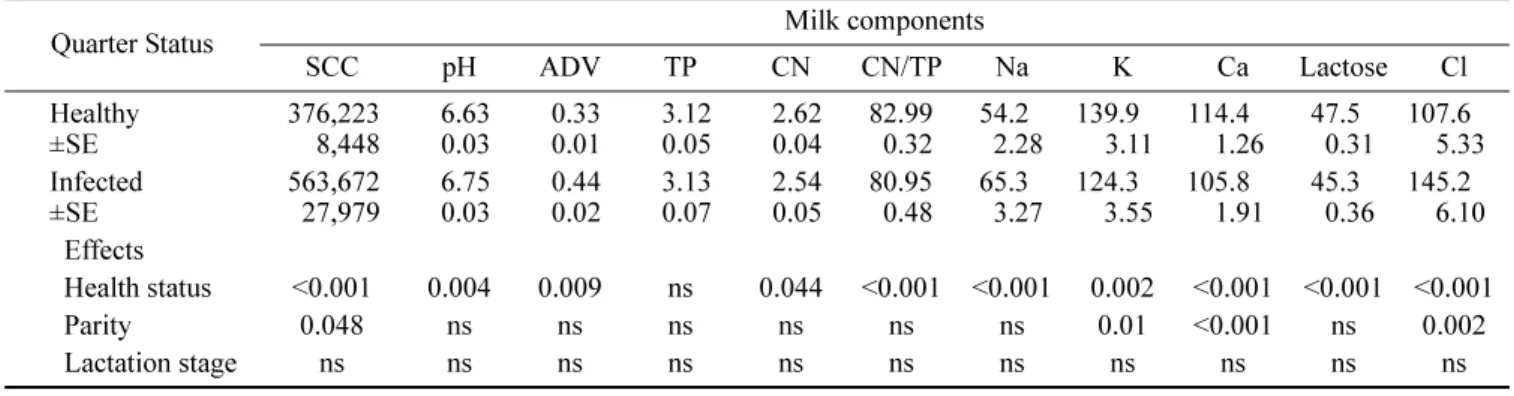
Mineral compositions (Na, K, Ca, and Cl) varied in the study herd, and were significantly affected by the SCC responses in quarters (Table 2). Pearson correlation coefficients calculated between log
10SCC and various mineral components indicated a positive correlation with Na (r = 0.87) and Cl (r = 0.85), and a negative correlation with K (r = − 0.64) and Ca (r = − 0.87) at p < 0.05. Fig. 2 and Fig. 3 illustrate the correlation between SCC values and Na content, whereby approximately 75% variation in Na content in the quarter samples could be associated with the change in SCC content. Na content was positively correlated with Cl content (r = 0.77, p < 0.05), but negatively correlated with K content (r = − 0.61, p < 0.05). The SCC and total protein components were positively correlated, though not as markedly as SCC and NCN content.
Table 1. Mean variation of quarter milk components according to SCC threshold levels
Milk component SCC thresholds ( × 1,000 cells/ml)
<250
A 250-500
B 500-750
C >750
SCC, cell/ml 210,742
a374,030
b630,111
c1,025,781 C
dpH 00000,6.63 00000,6.70 00000,6.69 00000,6.81
ADV 00000,0.23 00000,0.29 00000,0.45
a00000,0.60
bTN, % 00000,3.34 00000,3.38 00000,3.29 00000,3.42
NPN, % 00000,0.10 00000,0.12 00000,0.11 00000,0.13
TP, % 00000,3.32 00000,3.12 00000,3.18 00000,3.25
NCN, % 00000,0.64 00000,0.65 00000,0.70
a00000,0.81
bCN, % 00000,2.77
a00000,2.59 00000,2.59 00000,2.57
CN/TP, % 0000,83.6
a0000,83.0
a0000,81.2 0000,78.9
Na, mg/100 g 0000,46.5
a0000,53.6
b0000,66.2
c0000,78.4
dK, mg/100 g 000,146.3
a000,139.5
ab000,128.6
b000,108.9
cCa, mg/100 g 000,119.5
a000,114.0
b000,105.2
c0000, 97.8
dLactose, g/l 0000,48.8 0000,47.9 0000,45.1
a0000,43.8
bCl, mg/100 g 000,100.5
a000,116.3
b000,142.7
c000,183.5
ca,b,c