Magnetic resonance imaging (MRI) is the most important radiographic tool in the diagnosis of a spinal neurenteric cyst (NEC) and to differentiate it from other spinal cord tumors.1) However, imaging findings of NEC could vary based on the cyst’s contents. Such inconsistent imaging find- ings make it difficult to diagnose NEC preoperatively. Here, we present a case of an adult male with acute, progressive paraplegia due to an intradural NEC in the cervicothoracic region with atypical findings on MRI. We also discuss the unique similarity among other cases that reported atypical imaging findings in patients diagnosed with NEC from a review of the pertinent literature.
CASE REPORT
A 50-year-old man with no history of trauma presented to the outpatient clinic with weakness in the left leg, and
decreased temperature and pain sensation on the right side. His neurologic status was compatible with Brown- Sequard syndrome. MRI demonstrated a well-defined
Unique Imaging Features of Spinal Neurenteric Cyst
Hyoung-Seok Jung, MD, Sang-Min Park, MD, Gang-Un Kim, MD, Mi Kyung Kim, MD*, Kwang-Sup Song, MD
Departments of Orthopaedic Surgery and *Pathology, Chung-Ang University College of Medicine, Seoul, Korea
A 50-year-old male presented with acutely progressed paraplegia. His magnetic resonance imaging demonstrated two well- demarcated components with opposite signals in one cystic lesion between the T1- and T2-weighted images at the T1 spine level.
The patient showed immediately improved neurological symptoms after surgical intervention and the histopathological exam was compatible with a neurenteric cyst. On operation, two different viscous drainages from the cyst were confirmed. A unique similar- ity of image findings was found from a review of the pertinent literature. The common findings of spinal neurenteric cyst include an isointense or mildly hyperintense signal relative to cerebrospinal fluid for both T1- and T2-weighted images. However, albeit rarer, the signals of some part of the cyst could change into brightly hyperintensity on T1-weighted images and hypointensity on T2-weighted images due to the differing sedimentation of the more viscous contents in the cyst.
Keywords: Spinal cord, Neoplasm, Neuroenteric cyst, Magnetic resonance imaging
Copyright © 2015 by The Korean Orthopaedic Association
This is an Open Access article distributed under the terms of the Creative Commons Attribution Non-Commercial License (http://creativecommons.org/licenses/by-nc/4.0) which permits unrestricted non-commercial use, distribution, and reproduction in any medium, provided the original work is properly cited.
Clinics in Orthopedic Surgery • pISSN 2005-291X eISSN 2005-4408 Received May 9, 2014; Accepted June 11, 2014
Correspondence to: Kwang-Sup Song, MD
Department of Orthopaedic Surgery, Chung-Ang University College of Medicine, 102 Heukseok-ro, Dongjak-gu, Seoul 06973, Korea
Tel: +82-2-6299-1589, Fax: +82-2-822-1710 E-mail: [email protected]
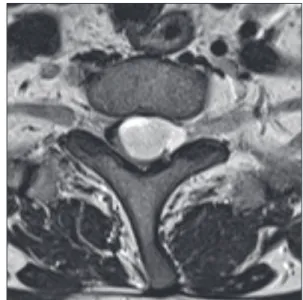
Fig. 1. Axial T2-weighted magnetic resonance imaging scan at the T1 spinal level showing a hypointense mass surrounded by an isointense signal severely compressing the spinal cord on the left side.
Case Report
Clinics in Orthopedic Surgery 2015;7:515-518 • http://dx.doi.org/10.4055/cios.2015.7.4.515516
Jung et al. Atypical Imaging Features of Spinal Neurenteric Cyst Clinics in Orthopedic Surgery • Vol. 7, No. 4, 2015 • www.ecios.org
intradural extramedullary mass located on the left antero- lateral aspect of the spinal cord, severely compressing the cord at the T1 spinal level (Fig. 1). The lesion consisted of two well-demarcated components with opposite signals on MRI between the T1- and T2-weighted images without enhancement. The supernatant component showed a mild hyperintensity on T1-weighted images and isointensity on T2-weighted images relative to cerebrospinal fluid, which are common imaging features of a cyst. The infranatant component demonstrated a bright hyperintensity on T1- weighted images and hypointensity T2-weighted images (Fig. 2). The radiologist suggested that the lesion could be a benign tumor, such as a fat-containing epidermoid cyst or schwannoma with a melanocytic component. The patient’s neurologic status rapidly worsened and he devel- oped paraplegia, including loss of bladder function, some
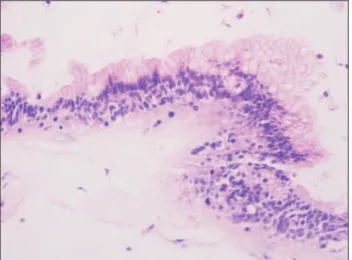
hours after admission. The patient underwent an emer- gency surgery. After the dura and arachnoidal space were opened following a total laminectomy of T1, a thin trans- lucent cystic membrane was found. During the dissection of the cyst from the proximal side, clear fluid was drained from the supernatant cyst wall, after which yellow-green mucinous fluid was drained (Fig. 3). A histopathologi- cal examination showed a cystic lesion lined by a simple columnar or cuboidal epithelium with mucin resembling that of the gastrointestinal tract (Fig. 4). The final diagno- sis was NEC. The patient’s motor weakness and sensory deficit improved completely after the emergent surgery.
Fig. 2. Sagittal T1-weighted (A), T2- weighted (B), and T1-weighted enhan- cement (C) images demonstrating a well demarcated heterogeneous mass (about 2 × 1.2 × 2.1 cm) containing two components with opposite signals between the T1- and T2-weighted images without enhancement. The supernatant lesion showed a mild hyperintensity on T1- weighted and isointensity on T2-weighted images. The infranatant lesion showed a bright hyperintensity on T1-weighted and hypointensity on T2-weighted images.
T1 T1 T1
A B C
Fig. 3. Intraoperative photograph after the first drainage of clear fluid.
Note the yellow-green color and higher viscosity of the fluid.
Fig. 4. The histopathological examination of the neurenteric cystic wall composed of columnar epithelium with goblet cells (H&E, ×200).
517
Jung et al. Atypical Imaging Features of Spinal Neurenteric Cyst Clinics in Orthopedic Surgery • Vol. 7, No. 4, 2015 • www.ecios.org
DISCUSSION
The common MRI findings of spinal NEC for both T1- and T2-weighted images include isointense or mildly hy- perintense images relative to cerebrospinal fluid without enhancement.2-4) However, our case showed two heteroge- neous components with opposing signals between T1- and T2-weighted images in one cyst. The reason for the two different signals in a cyst could be differing viscosities of the cyst’s contents as noted in the operative findings. Some atypical imaging findings1,5-7) in spinal NEC have been reported, including an enhanced NEC mimicking a spinal cord abscess6) and an intra-cystic calcification.1) Two re- ports5,6) showed similar MRI findings to those seen in our patient (Table 1). Paolini et al.7) reported atypical imaging findings of a spinal NEC that consisted of two compo- nents. Their operative findings showed two different vis- cous drainages from the cyst: a milky fluid followed by a denser, whitish, and jellylike substance. Jhawar et al.5) also reported a spinal NEC with two different fluid levels on MRI. Such a fluid-fluid level was presumed to be a result of contents with different viscosities, such as blood and protein, in the NEC. Althogh the NEC, especially in case of a homogenous cyst, shows cystic T1- and T2-weighted sinals,8) the dense viscous contents, which would be pro- duced by the cystic wall, hemorrage, and/or other necrotic cell debris,7,9) could contribute to differing sedimentation
levels and cause the opposite signal; a hyperintense signal on T1-weighted and hypointense signal on T2-weighted images compared to the signal of less viscous contents in a cyst.
NEC usually has an insidious onset and a chronic course with progressive worsening over months.5) How- ever, some atypical cases presenting with acute neuro- logical deterioration similar to our case have also been reported.5,8) The main reason may be a sudden increase in different viscous contents caused by spontaneous hem- orrhage, trauma, inflammation, or retention of mucous secretions.3,8) In the present case, the increased thick muci- nous secretion could be one cause of the acute neurologi- cal deterioration.
The spinal NEC can show heterogeneous signals within a cyst, such as brightly hyperintense signals on T1- weighted images and hypointense signals on T2-weighted images, due to more viscous contents that are produced by the cystic wall, as noted in our case. A finding of opposite signals between the T1- and T2-weighted images within a cystic mass should no longer be an atypical MRI finding in spinal NEC.
CONFLICT OF INTEREST
No potential conflict of interest relevant to this article was reported.
REFERENCES
1. Ziu M, Vibhute P, Vecil GG, Henry J. Isolated spinal neuren- teric cyst presenting as intramedullary calcified cystic mass on imaging studies: case report and review of literature.
Neuroradiology. 2010;52(2):119-23.
2. Agrawal D, Suri A, Mahapatra AK, Sharma MC. Intramed- ullary neurenteric cyst presenting as infantile paraplegia: a case and review. Pediatr Neurosurg. 2002;37(2):93-6.
3. Chang IC. Thoracic neurenteric cyst in a middle aged adult Table 1. The Unique Imaging Findings of Reported Spinal Neurenteric Cysts with Atypical Heterogeneous Signals on Magnetic Resonance Imaging
Source Age (yr)/
sex Clinical
progression Magnetic resonance imaging finding* Described intraoperative finding Jhawar et al.5)
(2012) 3/Male Acute onset Non-enhancing cyst, heterogeneous
Superior: mild hyperintense on T1 and isointense on T2 Inferior: bright hyperintense on T1 and hypointense on T2
Dirty greenish color
Paolini et al.7)
(2003) 28/Female Chronic onset Non-enhancing cyst, heterogeneous
Cystic: hyperintense on T1 and isointense on T2 Dependent: hyperintense on T1 and hypointense on T2
Heterogeneous, milky + whitish jellylike
Present case 50/Male Acute onset Non-enhancing cyst, heterogeneous
Supernatant: mild hyperintense on T1 and isointense on T2 Infranatant: bright hyperintense on T1 and hypointense on T2
Heterogeneous, clear + yellow-greenish color
*Signal intensity compared to cerebrospinal fluid.
518
Jung et al. Atypical Imaging Features of Spinal Neurenteric Cyst Clinics in Orthopedic Surgery • Vol. 7, No. 4, 2015 • www.ecios.org presenting with Brown-Sequard syndrome. Spine (Phila Pa
1976). 2003;28(24):E515-8.
4. de Oliveira RS, Cinalli G, Roujeau T, Sainte-Rose C, Pierre- Kahn A, Zerah M. Neurenteric cysts in children: 16 consec- utive cases and review of the literature. J Neurosurg. 2005;
103(6 Suppl):512-23.
5. Jhawar SS, Mahore A, Goel A. Intramedullary spinal neur- enteric cyst with fluid-fluid level. J Neurosurg Pediatr. 2012;
9(5):542-5.
6. Muzumdar D, Bhatt Y, Sheth J. Intramedullary cervical
neurenteric cyst mimicking an abscess. Pediatr Neurosurg.
2008;44(1):55-61.
7. Paolini S, Ciappetta P, Domenicucci M, Guiducci A. Intra- medullary neurenteric cyst with a false mural nodule: case report. Neurosurgery. 2003;52(1):243-5.
8. Hicdonmez T, Steinbok P. Spontaneous hemorrhage into spinal neurenteric cyst. Childs Nerv Syst. 2004;20(6):438-42.
9. Alyas F, Lee J, Ahmed M, Connell D, Saifuddin A. Preva- lence and diagnostic significance of fluid-fluid levels in soft- tissue neoplasms. Clin Radiol. 2007;62(8):769-74.