This is an Open Access article distributed under the terms of the Creative Commons At- tribution Non-Commercial License (http://creativecommons.org/licenses/by-nc/3.0/) which permits unrestricted non-commercial use, distribution, and reproduction in any medium, provided the original work is properly cited.
Ubiquitous Diabetes Management System via
Interactive Communication Based on Information Technologies: Clinical Effects and Perspectives
Jae-Hyoung Cho1,2, Hun-Sung Kim1,2, Jae-Hoon Han2, Jin-Hee Lee2, Jeong-Ah Oh2, Yoon-Hee Choi1,2, Kun-Ho Yoon1,2
1Department of Endocrinology, Seoul St. Mary’s Hospital, The Catholic University of Korea College of Medicine,
2The Catholic Institute of Ubiquitous Health Care, The Catholic University of Korea, Seoul, Korea
New diabetes management systems based on interactive communication have been introduced recently, accompanying rapid advances in information technology; these systems are referred to as “ubiquitous diabetes management systems.” In such ubiqui- tous systems, patients and medical teams can communicate via Internet or telecommunications, with patients uploading their glucose data and personal information, and medical teams sending optimal feedback. Clinical evidence from both long-term and short-term trials has been reported by some researchers. Such systems appear to be effective not only in reducing the levels of HbA1c but also in stabilizing glucose control. However, most notably, evidence for the cost-effectiveness of such a system should be demonstrated before it can be propagated out to the general population in actual clinical practice. To establish a cost-effective model, various types of clinical decision supporting software designed to reduce the labor time of physicians must first be devel- oped. A number of sensors and devices for monitoring patients’ data are expected to be available in the near future; thus, meth- ods for automatic interconnections between devices and web charts were also developed. Further investigations to demonstrate the clinical outcomes of such a system should be conducted, hopefully leading to a new paradigm of diabetes management.
Keywords: Delivery of healthcare; Diabetes mellitus; Internet
Corresponding author: Kun-Ho Yoon
Department of Endocrinology, Seoul St. Mary’s Hospital, The Catholic University of Korea College of Medicine, 505 Banpo-dong, Seocho-gu, Seoul 137-701, Korea
INTRODUCTION
Currently, the number of subjects with diabetes mellitus, as well as other chronic diseases, is increasing sharply [1,2]. For- tunately, it has been determined that diabetic complications could be prevented via effective glucose control in long-term large-scale prospective trials [3-5]. However, glucose control status with conventional outpatient management remains in- sufficient to prevent completely all of the related complica- tions. Actually, the proportion of subjects with the target HbA1c level (< 7%) was approximately 36% in the USA [6], 31% in Europe (target HbA1c < 6.5%) [7] and 21% in Asia
(target HbA1c < 7%) [8]. Additionally, the economic burden resulting from diabetic complications is expected to be enor- mous, with both the rapid increase in the numbers of diabetic patients and the failure of the glucose control status to reach the target range. We currently require a new type of diabetes management with both effective glucose control and cost-ef- fectiveness. Information technology (IT) is a rapidly growing field with the capacity to substantially strengthen the model of care for diabetes, by providing a framework for the monitor- ing of patient data in real time and providing frequent optimal feedback to patients. Some of the ways in which IT can improve the model for diabetes care include periodic advice and feed- pISSN 1976-9180 · eISSN 2093-2650
back, continuous motivation for glucose control, frequent en- couragement, problem assessment, and individualized diet and exercise education, and drug modification [9]. Such IT-based communication systems have generated clinical evidence re- garding glucose control over long-term [9] as well as short-term periods [10]. Moreover, more advanced technologies with re- al-time image and audio contact via equipment such as digital cameras, video phones, and computers can allow for closer in- teractions between health workers and individual patients. Thus, many people expect such a system may perform a function in improving records in diabetes management for the general pop- ulation, and eventually may even constitute a wholly new field of industry. However, for actual application to the general popu- lation in real practice worldwide, some significant barriers re- main to be surmounted. It is crucially important to demonstrate not only evidence of the clinical effectiveness of such manage- ment systems, but also their economic impacts. Such systems should be conveniently and readily accessible to the majority of patients, although they are not familiar with Internet usage.
Various types of sensors and devices can be developed and ap- plied to management systems for the status monitoring of a va- riety of patient types. Most importantly, we must build trust with patients regarding both the efficacy and safety of these systems.
Here, we classify the ubiquitous diabetes management sys- tems and summarize their clinical efficacies. We will demon- strate the economic impact of an Internet-based diabetes man- agement system and introduce some advanced clinical deci- sion supporting systems and patients’ data monitoring sensors.
Finally, we will discuss some various perspectives on ubiqui- tous diabetes management systems.
EFFECT OF INTERACTIVE COMMUNICATION SYSTEM
Direct communication between patient and medical team Internet-based communication system
In past iterations of diabetes management systems, medical teams communicated with patients via direct telephone calls.
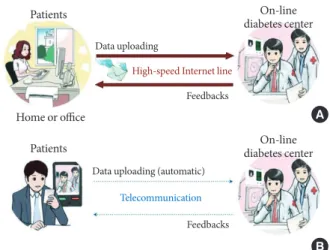
However, this was inappropriate for large populations, owing to prohibitive economic costs. Frequent and close monitoring of patients’ glucose data proved impossible to effect simply by telephone. Recently, the Internet has become a communica- tion tool propagated throughout the world. Internet-based in- teractive communication systems make possible two-way com- munication between patients and their physicians via the In-
ternet (Fig. 1A). Options range from utilizing e-mail to inde- pendently developing a private homepage to share patients’
clinical information [11]. In 2004, we reported a short-term reduction in HbA1c through the effects of an Internet-based glucose monitoring system (IBGMS), in which patients and doctors shared a web-chart online (Fig. 2) [10]. Patients upload- ed their glucose data as well as their personal histories, hypo- glycemic events, and questions to the remote web server, and their doctors provided advice after interpreting the data [10].
However, because this was effective for HbA1c reduction only for a short-term period of 3 months, we wondered whether it could also provide for effective glucose control over a long-term period. Thus, in 2006, we reported the longest prospective study
Fig. 1. (A) A scheme of the Internet-based glucose monitor- ing system. Patients logged on to the website from their homes or offices at a time and uploaded their glucose data, together with additional information such as current drug information (the type and dosage of oral hypoglycaemic medications or in- sulin), lifestyle modifications and hypoglycaemic events. In addition, patients recorded any changes in their blood pres- sure or weight, and any questions or detailed information that they wished to discuss, such as changes in diet, exercise, hypo- glycaemic events, and other factors that might influence their blood glucose level. Medical team of on-line diabetes center reviewed the uploaded information and sent optimal feed- backs to the patients periodically. (B) A scheme of the tele- communication based glucose control system in which mobile devices such as a mobile phone with the capacity to measure blood glucose were adopted. Patients could upload their self- monitoring of blood glucose data through telecommunication automatically and the medical team responded to patients af- ter reviewing the uploaded data. The patient–doctor commu- nication could be achieved practically in real time by the short message service.
Patients
Patients
Feedbacks
Feedbacks Data uploading
Data uploading (automatic) High-speed Internet line
Telecommunication
On-line diabetes center
On-line diabetes center
Home or office A
B
thus far conducted (30 months) regarding the IBGMS on dia- betes, where it was effective in reducing HbA1c and maintain- ing glucose stability (Fig. 3) [9]. We surmised that such a sys- tem was unique in its ability not only to provide periodic ad- vice and feedback, but also to provide continuous motivation for glucose control, frequent encouragement, problem assess- ment, and individualized education regarding diet, exercise, and drug modification, thereby providing a thorough system for the care of diabetic patients. In 2005, McMahon et al. [12]
introduced a web-based care management system and report- ed its effects on patients with poorly controlled diabetes. The
web-based management system was effective for HbA1c re- duction over 12 months when compared with education and routine care. The two studies mentioned above [9,12] showed similar results, namely that HbA1c levels were reduced in the majority of participants early in the study; however, the levels of HbA1c rebounded in the patients with poor compliance, whereas the patients with good compliance maintained reduced HbA1c levels. This means that compliance for system use may represent an additional important factor for diabetes manage- ment. In addition, such Internet-based interactive systems have been applied to lifestyle modification as well as diabetes con- trol. For example, the Internet has been previously employed as a medium for a weight loss program, to prevent diabetes [13], and as part of a walking program for the treatment of type 2 diabetes patients. The latter had a more significant effect on patients’ physical activity and reduction of depressive symp- toms than did the conventional method of sharing physical activity information [14]. Additionally, an Internet and mobile phone intervention was found to improve cardiovascular risk factors for both type 1 and type 2 diabetes groups [15]. Recently, some commercialized glucose monitoring systems have already been introduced, with clinical evidence of the system in several countries with good IT-infrastructure. For example, MyCare- Team is a diabetes management facilitating solution that uses web-based software, which allows for interactive communica- Fig. 2. The screen viewed by patients and physicians on the
website for diabetes management. Basic profile, past history, family history, and laboratory data are shown on the top. Self- monitored blood glucose levels are shown (middle), which are recorded as fasting or postprandial (breakfast, lunch, and din- ner). Drug information, notes from the patients, and recom- mendations from the physicians are shown at the bottom.
Weight and blood pressure also can be shown.
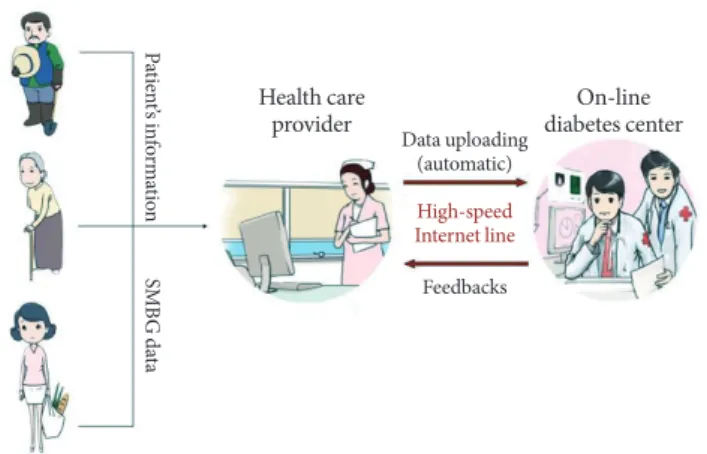
Fig. 3. Scheme of the Internet-based diabetes management system using a PDA-type blood glucometer. First, a nurse checked the self-monitoring of blood glucose (SMBG) data of patients with PDA-type glucometer and sent the patients’ data, including SMBG data, to the medical team of the on-line dia- betes center. The medical team reviewed the patients’ upload- ed information and sent optimal messages to the nurse. The nurse educated and managed the patients according to the recommendations sent by medical team.
Feedbacks
On-line diabetes center Health care
provider
High-speed Internet line Data uploading
(automatic)
Patient’s informationSMBG data
tion between patients and their physicians or family members (www.mycareteam.com; MyCareTeam Inc., Chelmsford, MA, USA). A similar web-based service system, in which patients could communicate with a diabetes-specialist care team con- sisting of a nurse, nutritionist, and exercise therapist, was in- troduced to improve the glycemic control of patients with ges- tational diabetes mellitus and pregnancy-associated diabetes (www.cared.co.kr; Pyeonghwa Uhealth Co., Seoul, Korea).
Growing numbers of healthcare companies are currently em- ploying IT tools for their care solutions rather than traditional telephone-based services in USA. Alere, for example, has de- veloped a diabetes management program that focuses princi- pally on education and ensuring that patients adhere to the physician’s directions and clinical guidelines via web-based tools and telephone interactions (www.alere.com; Alere Health, Atlanta, GA, USA). We expect that the IT-based healthcare mar- ket can be increased in size in the near future, by establishing evidence of improvements in the quality of disease care, even- tual medical cost reductions, and improvements in patient satisfaction.
Cell phone-based communication system
A real-time telemedicine transmission system has also been previously developed and tested. Farmer et al. [16] demonstrat- ed that real-time telemedicine was both feasible and realistic in a randomized controlled trial. Further, the notion of mea- suring the blood glucose level directly via a mobile phone has also been conceived of and introduced (Fig. 1B). In the Repub- lic of Korea, a mobile phone with a glucometer, called a “diabe- tes phone” has been developed, with which patients could mea- sure glucose levels and send the data directly to the web server of an online diabetes center. We conducted a randomized con- trolled trial to compare a new telecommunication-based inter- active system using the “diabetes phone” coupled with the pre- vious Internet-based glucose monitoring system. In 2009, we reported that the effect of the mobile communication system using the “diabetes phone” was not inferior to that of the Inter- net-based glucose monitoring system in terms of patient’s su- pervision, care, and patient’s satisfaction [17]. In the same year, Yoo et al. [18] reported a ubiquitous chronic disease care sys- tem using cellular phones and the Internet for overweight pa- tients with both type 2 diabetes and hypertension. Using this system, they could induce significant improvements in HbA1c and blood pressure. Total cholesterol, low density lipoprotein cholesterol, and triglyceride levels were also improved. Interest
in telecommunication-based interactive systems has increased, especially because mobile phones, among all the currently available patient-directed technologies, are likely to have the greatest potential use even in countries with low IT-resource settings as well as in countries with good IT-resource settings, such as the Internet. Additionally, a mobile diabetes education and care system for a rural area exerted beneficial effects in children and young people suffering from type 1 diabetes [19].
However, when employing mobile phones and text messages, the potential length of the messages is quite limited, for exam- ple within 80 bytes. The fact that text messaging on mobile phones is a very limited means of communication represents a possible disadvantage for utilizing real-time telemedicine in providing various kinds of information with regard to patients’
blood glucose status. Thus, we will require other types of real- time mobile communication devices, such as smartphones, which could provide both convenience and a sufficient quantity of information. Additionally, we anticipate that various medi- cal apparatus integrated with such mobile communications devices will be developed within the not-too-distant future.
Indirect communication system mediated by health care provider
Above, we described the clinical effects of the direct interac- tive communication system on diabetes. However, we must consider that there are more patients, for example, people liv- ing in rural areas, who cannot readily access diabetes centers or meet nurses or doctors who specialize in diabetes. For these individuals, such interactive communications might prove an effective tool for diabetes management. Thus, we have attempt- ed to develop a new healthcare delivery system, which could link endocrinologists at diabetes centers in urban areas and people living in rural areas via ITs. We allowed nurses working in public healthcare posts in rural areas to send information regarding specific patients’ glucose readings to an endocrinol- ogist using PDA-type glucometers. The specialist could review the uploaded data and could send advice regarding patient management to the nurses. The nurses then educated the pa- tients in accordance with the advice sent from the specialist (Fig. 3) [20]. This indirect communication system might even- tually be applied to health workers living in low-resource set- tings, thereby contributing to the improvement of universal IT-based diabetes management systems and improvements in diabetes management.
JOURNEY TO IMPROVING COST EFFECTIVENESS
In above, we have introduced clinical evidence of an interac- tive communication system using IT. However, increases in medical costs are also certain to facilitate the maintenance of interactive services. Therefore, efforts must be made to dem- onstrate the economic impacts of such services and to reduce the costs associated with maintenance of the service. We re- ported a simulation study in which it was shown that the Inter- net-based glucose monitoring system could significantly reduce the development of most diabetic complications relative to con- ventional out-patient management systems [21]. Additionally, the willingness-to-pay threshold might save $27,666 of costs per person for 35 years compared to conventional face-to-face interview systems in outpatient clinics [22]. Johnson et al. [23]
reported previously that individuals were willing to pay $1,500 over 3 years to participate in a lifestyle intervention program similar to the Diabetes Prevention program. This means that individuals at high risk of diabetes are willing to pay more than individuals with lower levels of perceived risk. An IT-based patient care system could be more effective and seems rather tempting; once again, though, the key to the feasibility of such a system lies in the cost-effectiveness of such IT-based interac- tive systems [24] even in high-resource settings, and the amount that an individual is willing to pay may well depend on their perception of risk.
Data analysis system and clinical decision-supporting system
In order to develop a more cost-efficient system, the labor time required of healthcare providers should be minimized, while preserving some communication between patients and medi- cal team and not affecting their influences on diabetes. Recently, we piloted a system, referred to as a semi-automatic response system (SARS), which responds automatically to patients when the glucose levels are acceptable, but which will report to the medical team for further evaluation when the results are ab- normal or difficult to determine. We also reported the effects of the SARS for glucose control on labor savings. This system, which featured an algorithm-based glucose decision tree, re- duced physicians’ labor time by nearly 50% without affecting glucose control while preserving interactive communications when necessary [25]. Simple algorithm-based programs might prove inadequate to meet the complexity of clinical decision-
making however, and in the future artificial intelligence-based programs may be developed to handle complex patient data, detect the relevant patterns, and suggest a new treatment strate- gy. Various types of clinical decision supporting systems (CDSS) have been developed, which can provide diagnostic services and therapeutic services to both clinicians and patients by us- ing electronically-recorded health data. In 2010, Rossi et al. [26], introduced a new telemedicine system based on an interactive diabetes diary, which helped patients to follow a flexible diet and insulin therapy using a carbohydrate program. The inter- active diabetes diary was at least as effective as traditional car- bohydrate counting education, allowing dietary freedom for patients with type 1 diabetes. This reduced the time required for education and was associated with lower levels of weight gain. Most of all, “Diabetes Interactive Diary” significantly im- proved treatment satisfaction and quality-of-life dimensions.
In the future, more types of CDSS should be developed and we anticipate that such CDSS could improve the accuracy of diag- nosis and the efficacy of treatment.
SENSORS, DEVICES, AND INTERCONNECTION
Many people expect various types of sensors or devices for pa- tients’ data monitoring to be developed in the near future.
Nowadays, some new sensors or devices have already been in- troduced. For example, a physical activity monitor (Lifecoder, Suzuken, Japan; Actical, Philips, Andover, MA, USA) is cur- rently in use for the monitoring of actual home physical activi- ty. Then, measured patient data needs to be sent automatically to improve convenience. Recently, we introduced an automat- ic data uploading system for this purpose. This system allows for self-monitored glucose data measured with a home glu- cometer (OneTouch Ultra; Lifescan, Milipitas, CA, USA) to be sent to a patient’s web chart via the Internet, simply by connect- ing it to a personal computer. Physicians can view the automati- cally uploaded glucose data on the web chart and send messages to the patients, along with suggestions. Other patient data, in- cluding data regarding physical activity in the home, also needs to be fed into a communication system. Moreover, the idea of integrating web-based communication with the hospital’s own electronic medical record charting system was previously in- troduced [27]. Electronic Health Records (EHR) will be gen- erated according to patient demographics, progress notes, prob- lems, medications, vital signs, past medical history, immuniza-
tion, laboratory data, and radiology reports, and data were monitored by different sensors or devices. The EHR data auto- mates the clinician’s workflow, generating a complete record of a clinical patient encounter.
CONCLUSION
In this study, interactive communication systems using ITs such as the Internet or telecommunications devices were shown to be effective in diabetes management. Thus, it is generally believed that the dramatic development of IT and its applica- tion to health management systems will play a crucial role in medicine. Simple IT management models for the control of blood glucose levels for diabetic patients will definitely evolve into far more complex models, in which various types of com- munication technologies or patients’ data sensing technologies are integrated in order to effect the complex management functions required. Thus, a data analysis system or a clinical decision supporting system that can meet the complex patients’
data efficiently should be developed in the future. Most of all, cost effectiveness must be demonstrated, and efforts to mini- mize the labor time of medical team should be followed. As the numbers of patients with diabetes is increasing sharply in re- cent years, the novel system introduced herein can be expand- ed to achieve more effective diabetes management in the near future. However, there is little evidence thus far regarding the clinical outcomes of the system. We require further investiga- tions to demonstrate the clinical outcomes of the system, in- cluding the incidence of diabetic complications and mortality rates. In addition, various types of ubiquitous management models for other chronic diseases aside from diabetes should be developed according to advances in bio-technology and IT.
REFERENCES
1. Yoon KH, Lee JH, Kim JW, Cho JH, Choi YH, Ko SH, Zimmet P, Son HY. Epidemic obesity and type 2 diabetes in Asia. Lan- cet 2006;368:1681-8.
2. Chan JC, Malik V, Jia W, Kadowaki T, Yajnik CS, Yoon KH, Hu FB. Diabetes in Asia: epidemiology, risk factors, and patho- physiology. JAMA 2009;301:2129-40.
3. UK Prospective Diabetes Study (UKPDS) Group. Intensive blood-glucose control with sulphonylureas or insulin compared with conventional treatment and risk of complications in pa- tients with type 2 diabetes (UKPDS 33). Lancet 1998;352:837-
53.
4. The Diabetes Control and Complications Trial Research Group.
The effect of intensive treatment of diabetes on the develop- ment and progression of long-term complications in insulin- dependent diabetes mellitus. N Engl J Med 1993;329:977-86.
5. Ohkubo Y, Kishikawa H, Araki E, Miyata T, Isami S, Motoyo- shi S, Kojima Y, Furuyoshi N, Shichiri M. Intensive insulin therapy prevents the progression of diabetic microvascular complications in Japanese patients with non-insulin-depen- dent diabetes mellitus: a randomized prospective 6-year study.
Diabetes Res Clin Pract 1995;28:103-17.
6. Koro CE, Bowlin SJ, Bourgeois N, Fedder DO. Glycemic con- trol from 1988 to 2000 among U.S. adults diagnosed with type 2 diabetes: a preliminary report. Diabetes Care 2004;27:17-20.
7. Liebl A, Mata M, Eschwege E; ODE-2 Advisory Board. Evalua- tion of risk factors for development of complications in type II diabetes in Europe. Diabetologia 2002;45:S23-8.
8. Chuang LM, Tsai ST, Huang BY, Tai TY; Diabcare-Asia 1998 Study Group. The status of diabetes control in Asia: a cross- sectional survey of 24 317 patients with diabetes mellitus in 1998. Diabet Med 2002;19:978-85.
9. Cho JH, Chang SA, Kwon HS, Choi YH, Ko SH, Moon SD, Yoo SJ, Song KH, Son HS, Kim HS, Lee WC, Cha BY, Son HY, Yoon KH. Long-term effect of the Internet-based glucose monitoring system on HbA1c reduction and glucose stability: a 30-month follow-up study for diabetes management with a ubiquitous medical care system. Diabetes Care 2006;29:2625-31.
10. Kwon HS, Cho JH, Kim HS, Song BR, Ko SH, Lee JM, Kim SR, Chang SA, Kim HS, Cha BY, Lee KW, Son HY, Lee JH, Lee WC, Yoon KH. Establishment of blood glucose monitoring system using the internet. Diabetes Care 2004;27:478-83.
11. Smith KE, Levine BA, Clement SC, Hu MJ, Alaoui A, Mun SK.
Impact of MyCareTeam for poorly controlled diabetes melli- tus. Diabetes Technol Ther 2004;6:828-35.
12. McMahon GT, Gomes HE, Hickson Hohne S, Hu TM, Levine BA, Conlin PR. Web-based care management in patients with poorly controlled diabetes. Diabetes Care 2005;28:1624-9.
13. McCoy MR, Couch D, Duncan ND, Lynch GS. Evaluating an internet weight loss program for diabetes prevention. Health Promot Int 2005;20:221-8.
14. McKay HG, King D, Eakin EG, Seeley JR, Glasgow RE. The di- abetes network internet-based physical activity intervention: a randomized pilot study. Diabetes Care 2001;24:1328-34.
15. Harno K, Kauppinen-Makelin R, Syrjalainen J. Managing dia- betes care using an integrated regional e-health approach. J
Telemed Telecare 2006;12 Suppl 1:13-5.
16. Farmer AJ, Gibson OJ, Dudley C, Bryden K, Hayton PM, Tarassenko L, Neil A. A randomized controlled trial of the ef- fect of real-time telemedicine support on glycemic control in young adults with type 1 diabetes (ISRCTN 46889446). Diabe- tes Care 2005;28:2697-702.
17. Cho JH, Lee HC, Lim DJ, Kwon HS, Yoon KH. Mobile com- munication using a mobile phone with a glucometer for glu- cose control in type 2 patients with diabetes: as effective as an Internet-based glucose monitoring system. J Telemed Telecare 2009;15:77-82.
18. Yoo HJ, Park MS, Kim TN, Yang SJ, Cho GJ, Hwang TG, Baik SH, Choi DS, Park GH, Choi KM. A Ubiquitous Chronic Dis- ease Care system using cellular phones and the internet. Dia- bet Med 2009;26:628-35.
19. von Sengbusch S, Muller-Godeffroy E, Hager S, Reintjes R, Hiort O, Wagner V. Mobile diabetes education and care: inter- vention for children and young people with type 1 diabetes in rural areas of northern Germany. Diabet Med 2006;23:122-7.
20. Yoon KH, Cho JH, Kwon HS, Lee JH, Park YM, Lee WC, Cha BY, Son HY. Effect of the Internet-based glucose monitoring system (IBGMS) connected with personal digital assistance (PDA) in rural health subcenter. Paper presented at: 6th An- nual Diabetes Technology Society Meeting; 2006 Nov 2-4; At- lanta, GA, USA.
21. Cho JH, Lee JH, Oh JA, Kang MJ, Choi YH, Kwon HS, Chang SA, Cha BY, Son HY, Yoon KH. Complication reducing effect of the information technology-based diabetes management system on subjects with type 2 diabetes. J Diabetes Sci Technol
2008;2:76-81.
22. Cho JH, Yoon KH. Economic impact of the information tech- nology-based diabetes management system on type 2 diabetes:
a key for solving world’s big problem. Paper presented at:
American Diabetes Association 67th Scientific Sessions; 2007 Jun 22-26; Chicago, IL, USA.
23. Johnson FR, Manjunath R, Mansfield CA, Clayton LJ, Hoerger TJ, Zhang P. High-risk individuals’ willingness to pay for dia- betes risk-reduction programs. Diabetes Care 2006;29:1351-6.
24. Jackson CL, Bolen S, Brancati FL, Batts-Turner ML, Gary TL.
A systematic review of interactive computer-assisted technol- ogy in diabetes care. Interactive information technology in di- abetes care. J Gen Intern Med 2006;21:105-10.
25. Cho JH, Yoon KH. Labor saving effect of the semi-automatic response system for diabetes management (SARS-DM) based on the internet. Poster session presented at: American Diabe- tes Association 68th Scientific Sessions; 2008 Jun 6-10; San Francisco, CA, USA.
26. Rossi MC, Nicolucci A, Di Bartolo P, Bruttomesso D, Girelli A, Ampudia FJ, Kerr D, Ceriello A, Mayor Cde L, Pellegrini F, Horwitz D, Vespasiani G. Diabetes Interactive Diary: a new telemedicine system enabling flexible diet and insulin therapy while improving quality of life: an open-label, international, multicenter, randomized study. Diabetes Care 2010;33:109-15.
27. Ralston JD, Revere D, Robins LS, Goldberg HI. Patients’ expe- rience with a diabetes support programme based on an inter- active electronic medical record: qualitative study. BMJ 2004;
328:1159.