I. Introduction
The Internet of Things (IoT), which is continuously growing owing to advances in communication technology, ubiquitous identification, sensing technology, and connectivity, is be- ing used to implement various services in diverse industries [1-5]. The healthcare industry is a potential area for the application of IoT. The adoption of IoT interconnection in healthcare could enable a wide variety of functions in many medical applications, such as diagnostics through the inter- net, patient and environmental monitoring, remote surger- ies, and remote health monitoring [3,6-12].
The Department of Laboratory Medicine in a hospital stores and analyses a large number of various reagents and specimens, such as blood, urine, and genetic samples. These reagents and specimens, which are required for diagnosis or
Laboratory Environment Monitoring:
Implementation Experience and Field Study in a Tertiary General Hospital
Seungjin Kang, MS1*, Hyunyoung Baek, RN, MPH1*, Sunhee Jun, MS2, Soonhee Choi, BS2, Hee Hwang, MD3,4, Sooyoung Yoo, PhD1
1Healthcare ICT Research Centre, Office of eHealth Research and Businesses, Seoul National University Bundang Hospital, Seongnam, Korea; 2Department of Laboratory Medicine, Seoul National University Bundang Hospital, Seongnam, Korea; 3Office of eHealth Research and Businesses, Seoul National University Bundang Hospital, Seongnam, Korea; 4Department of Pediatrics, Seoul National University Bundang Hospital, Seongnam, Korea
Objectives: To successfully introduce an Internet of Things (IoT) system in the hospital environment, this study aimed to identify issues that should be considered while implementing an IoT based on a user demand survey and practical experi- ences in implementing IoT environment monitoring systems. Methods: In a field test, two types of IoT monitoring systems (on-premises and cloud) were used in Department of Laboratory Medicine and tested for approximately 10 months from June 16, 2016 to April 30, 2017. Information was collected regarding the issues that arose during the implementation process.
Results: A total of five issues were identified: sensing and measuring, transmission method, power supply, sensor module shape, and accessibility. Conclusions: It is expected that, with sufficient consideration of the various issues derived from this study, IoT monitoring systems can be applied to other areas, such as device interconnection, remote patient monitoring, and equipment/environmental monitoring.
Keywords: Internet of Things, Laboratory, Temperature, Environmental Monitoring
Healthc Inform Res. 2018 October;24(4):371-375.
https://doi.org/10.4258/hir.2018.24.4.371 pISSN 2093-3681 • eISSN 2093-369X
Submitted: March 15, 2018
Revised: 1st, August 16, 2018; 2nd, October 17, 2018;
3rd, October 22, 2018 Accepted: October 22, 2018 Corresponding Author Sooyoung Yoo, PhD
Healthcare ICT Research Centre, Office of eHealth Research and Businesses, Seoul National University Bundang Hospital, 82 Gumi- ro 173beon-gil, Bundang-gu, Seongnam 13620, Korea. Tel: +82- 31-787-8980, E-mail: [email protected] (https://orcid.org/0000- 0001-8620-4925)
*These two authors contributed equally to this work.
This is an Open Access article distributed under the terms of the Creative Com- mons Attribution Non-Commercial License (http://creativecommons.org/licenses/by- nc/4.0/) which permits unrestricted non-commercial use, distribution, and reproduc- tion in any medium, provided the original work is properly cited.
ⓒ 2018 The Korean Society of Medical Informatics
laboratory testing, should be stored in a controlled environ- ment to preserve their quality [13]. As the storage conditions are directly related to the clinical results, precise control is required to support accurate clinical decisions. To address such needs, IoT technology can be used to integrate the pro- cess of maintaining the required temperature and humidity, periodically track temperature and humidity to prevent ac- cidents, and record data.
The purpose of this paper is to discuss the implementation and adoption of hospital IoT monitoring systems in a labo- ratory.
II. Case Description
1. Survey of User Needs
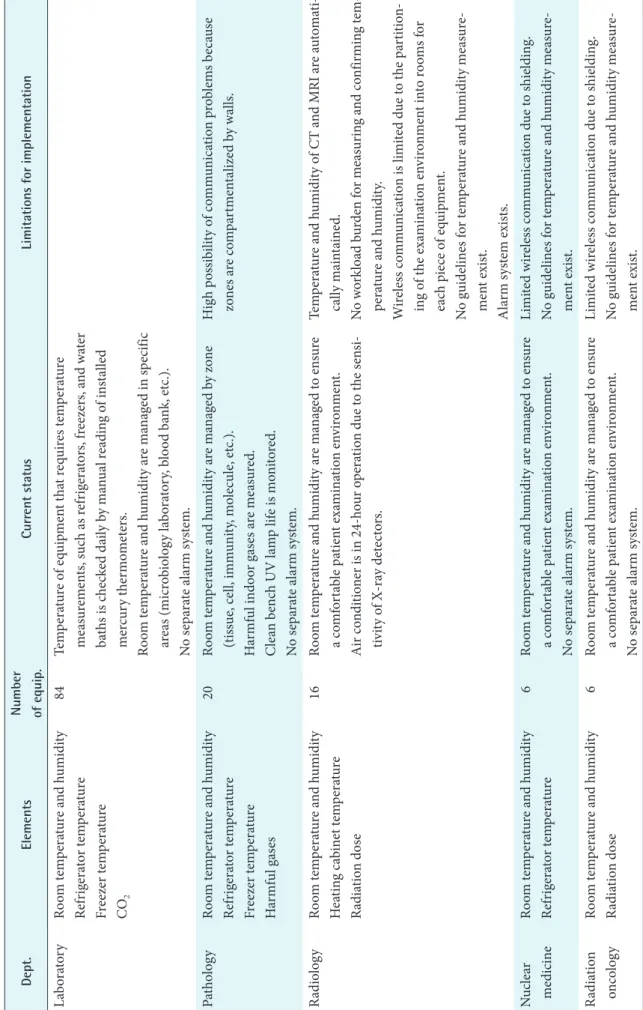
The study was conducted at a tertiary university hospital located in South Korea. A survey and focus group interview were conducted to determine the need for IoT monitoring systems in five supportive care departments requiring envi- ronmental monitoring. The current quality-control methods and specific needs of each department were understood (Table 1).
Based on the results presented in Table 1, the Department of Laboratory Medicine was selected as the field study site.
The equipment to be monitored consisted of refrigerators and freezers where important specimens, reagents, and blood were stored (Table 2).
2. Implementation of IoT Monitoring Systems
The IoT monitoring systems were installed on site and tested for approximately 10 months from June 16, 2016 to April 30, 2017. Two types of environmental monitoring systems were constructed: on-premises and cloud IoT systems. These were commercially available and were customized for the hospi- tal’s user requirements and environment. Figure 1 presents the architecture of each system.
For the on-premises monitoring system, all of the system components (e.g., the server, database, and web service) were installed in the hospital. The system was connected to the hospital’s internal network, and the collected sensor data were transmitted to the monitoring server through a wired network. The temperature and humidity module used in the on-premises monitoring system in this study was developed in-house based on a Beagleboard (Texas Instruments, Dallas, TX, USA) using a temperature sensor. It was a rod-shaped sensor that was easy to place anywhere in the refrigerator.
The ZigBee communication protocol was selected because the refrigerators and freezers were spread throughout the
department instead of being arranged in one place.
The cloud IoT monitoring system used a dedicated long- term evolution network. The temperature and humidity modules were developed in-house using SMARTMIEW cloud (Mbuzzer Co., Seoul, Korea). The Bluetooth low-ener- gy (BLE) 4.1 communication protocol was used to transmit the sensor data from each sensor to the gateway.
Data collected from each sensor in both systems were transmitted every minute to the gateway. When the tempera- ture fell outside of the preset tolerance limit, an alert was sent through a dedicated web page or smartphone applica- tion.
The IoT monitoring system consists of four core functions:
sensor management, temperature and humidity monitoring, alerting and reporting, and indoor mapping.
III. Discussion
The study focused on the various issues that could arise in the implementation process. From the pilot test, a total of five issues were identified.
1. Sensing and Measuring
There are two issues related to measurement. First, tem- perature variations depend on several factors. While the refrigerator temperature was measured over the test period, temperature variations were caused by the internal location of the measurement or the fullness of the refrigerator [14].
Second, there is a problem with the standard temperature measurement method. According to guidelines [15], the temperature of a liquid should be measured by immersing a mercury thermometer in a glycerol solution in blood refrig- erators. However, IoT temperature sensors are produced in a form that cannot be immersed in a liquid.
2. Transmission Method
The protocol used in the on-premises system switched to sleep mode when the data were not being unidirectionally transmitted and woke up once a minute to send the sen- sor data to the gateway. The protocol used in the cloud IoT system also unidirectionally transmitted data once a min- ute. However, it waited for the data to be received from the sensor for one minute and then transmitted the data to the gateway, thereafter going into sleep mode. This difference in protocol led to a high data-loss rate in the on-premises sys- tem. It woke up once a minute and transmitted data, but if it failed to transmit the data because of some environmental factors while awake, the final values on the display were null.
Table 1. Current status of and demand for quality control by department Dept.ElementsNumber of equip.Current statusLimitations for implementation LaboratoryRoom temperature and humidity Refrigerator temperature Freezer temperature CO2
84Temperature of equipment that requires temperature measurements, such as refrigerators, freezers, and water baths is checked daily by manual reading of installed mercury thermometers. Room temperature and humidity are managed in specific areas (microbiology laboratory, blood bank, etc.). No separate alarm system. PathologyRoom temperature and humidity Refrigerator temperature Freezer temperature Harmful gases 20Room temperature and humidity are managed by zone (tissue, cell, immunity, molecule, etc.). Harmful indoor gases are measured. Clean bench UV lamp life is monitored. No separate alarm system.
High possibility of communication problems because zones are compartmentalized by walls. RadiologyRoom temperature and humidity Heating cabinet temperature Radiation dose
16Room temperature and humidity are managed to ensure a comfortable patient examination environment. Air conditioner is in 24-hour operation due to the sensi- tivity of X-ray detectors.
Temperature and humidity of CT and MRI are automati- cally maintained. No workload burden for measuring and confirming tem- perature and humidity. Wireless communication is limited due to the partition- ing of the examination environment into rooms for each piece of equipment. No guidelines for temperature and humidity measure- ment exist. Alarm system exists. Nuclear medicineRoom temperature and humidity Refrigerator temperature6Room temperature and humidity are managed to ensure a comfortable patient examination environment. No separate alarm system.
Limited wireless communication due to shielding. No guidelines for temperature and humidity measure- ment exist. Radiation oncologyRoom temperature and humidity Radiation dose6Room temperature and humidity are managed to ensure a comfortable patient examination environment. No separate alarm system.
Limited wireless communication due to shielding. No guidelines for temperature and humidity measure- ment exist.
The cloud system also followed a unidirectional protocol, but it had a low data-loss rate because it waited until data were received. The data loss disappeared once the protocol of the on-premises system was changed from unidirectional to bidirectional.
3. Power Supply
We employed batteries to preserve the concept of IoT wire- less monitoring. The average lifespan of the batteries was approximately 1.5 years; however, the users’ perspective in- dicated that batteries were not preferred owing to the incon- venience of having to periodically replace them.
4. Sensor Module Shape
A separate module that could collect and process sensor data was needed for the on-premises system. Because it used a wire sensor, the user could position the wire at the desired position, but it was difficult to repair the sensor, and this could cause problems if the number of sensors increased. A chip sensor was used for the cloud system. It was an all-in-
one module with a sensing and communicating function.
The lack of cables was an advantage, and it could be easily fixed anywhere because of its small size. However, because it was an all-in-one sensor with an integrated processor chip, the refrigerators in which it could be installed were limited.
5. Accessibility
The accessibility of the on-premises monitoring system was low. Even though the system tracked the temperature in real time, users had to connect to the monitoring page of the server through the web portal on a hospital PC to check it.
The cloud IoT monitoring system, in contrast, had relatively better accessibility because it used the existing internet net- work.
The present study implemented a temperature and humid- ity monitoring system in the department of laboratory medi- cine at a general university hospital. Considerable demand for and interest in IoT monitoring systems was confirmed.
It is expected that if the various issues identified during this study are addressed, IoT monitoring systems can be applied to other areas, such as device interconnection, remote pa- tient monitoring, and equipment/environmental monitor- ing.
Conflict of Interest
No potential conflict of interest relevant to this article was reported.
Acknowledgments
This work was partly supported by the IT R&D program of Seoul National University Bundang Hospital and SK Tele- Table 2. Monitoring equipment
Sensor location Control element Tolerance limit Indoor laboratory Temperature (°C) 23–27
Humidity (%) 20–80 Reagent freezer Temperature (°C) 2–8 Deep freezer Temperature (°C) ≤−50 General refrigerator Temperature (°C) 2–8 Walk-in freezer Temperature (°C) 2–8 Blood freezer Temperature (°C) 2–8
Sensors
ZigBee
Gateway
IoT server
Monitoring Event recording
Intranet
Web portal
SMSalarm
Apppushalarm Eventrecording LAN
LTE BLE 4.1
Sensors
On-premise monitoring system
A.
B.Cloud monitoring system
Web portal Mobile
Monitoring Event recording IoT Cloud server
Gateway
Figure 1. Architecture of both envi- ronmental monitoring sys- tem types. (A) On-premise monitoring system. (B) Cloud monitoring system.
com, and was partly supported by the Creative Industrial Technology Development Program (No. 10053249, Devel- opment of Personalized Healthcare System exploiting User Life-Log and Open Government Data for Business Service Model Proof on Whole Life Cycle Care) funded by the Min- istry of Trade, Industry & Energy (MOTIE, Korea).
References
1. Da Xu L, He W, Li S. Internet of things in industries: a survey. IEEE Trans Industr Inform 2014;10(4):2233-43.
2. Zhang Y, Zhang G, Wang J, Sun S, Si S, Yang T. Real- time information capturing and integration framework of the internet of manufacturing things. Int J Comput Integr Manuf 2015;28(8):811-22.
3. Hossain MS, Muhammad G. Cloud-assisted industrial internet of things (IIOT): enabled framework for health monitoring. Comput Netw 2016;101:192-202.
4. Zanella A, Bui N, Castellani A, Vangelista L, Zorzi M.
Internet of things for smart cities. IEEE Internet Things J 2014;1(1):22-32.
5. Ferrandez-Pastor FJ, Garcia-Chamizo JM, Nieto- Hidalgo M, Mora-Pascual J, Mora-Martinez J. Develop- ing ubiquitous sensor network platform using Internet of Things: application in precision agriculture. Sensors (Basel) 2016;16(7):E1141.
6. Tarouco LM, Bertholdo LM, Granville LZ, Arbiza LM, Carbone F, Marotta M, et al. Internet of Things in healthcare: interoperatibility and security issues.
Proceedings of 2012 IEEE International Conference on Communications (ICC); 2012 Jun 10-15; Ottawa, Canada. p. 6121-5.
7. Islam SR, Kwak D, Kabir MH, Hossain M, Kwak KS.
The Internet of Things for health care: a comprehensive survey. IEEE Access 2015;3:678-708.
8. Ahmed MU, Bjorkman M, Causevic A, Fotouhi H, Linden M. An overview on the Internet of Things for
health monitoring systems. In: Mandler B, et al., editors.
Internet of Things: IoT infrastructures. Cham, Swizer- land: Springer; 2016.
9. Rohokale VM, Prasad NR, Prasad R. A cooperative Internet of Things (IoT) for rural healthcare monitor- ing and control. Proceedings of 2011 2nd International Conference on Wireless Communication, Vehicular Technology, Information Theory and Aerospace & Elec- tronic Systems Technology (Wireless VITAE); 2011 Feb 28-Mar 3; Chennai, India. p. 1-6.
10. Balaguera HU, Wise D, Ng CY, Tso HW, Chiang WL, Hutchinson AM, et al. Using a medical Intranet of Things system to prevent bed falls in an acute care hos- pital: a pilot study. J Med Internet Res 2017;19(5):e150.
11. Alyami A, Campion R, Atkins A. Performance improve- ment in hospital management using RFID and Zigbee technologies for tracking and monitoring patients and assets in Saudi Arabia. Proceedings of the IIER 64th International Conference on Science, Innovation and Management (ICSIM); 2015 Jun 5; Kuala Lumpur, Ma- laysia.
12. Cannistraro G, Cannistraro M. Hypothermia risk, mon- itoring and environment control in operating rooms.
Intl J Heat Technol 2016;34(2):165-71.
13. Ezzelle J, Rodriguez-Chavez IR, Darden JM, Stirewalt M, Kunwar N, Hitchcock R, et al. Guidelines on good clini- cal laboratory practice: bridging operations between research and clinical research laboratories. J Pharm Biomed Anal 2008;46(1):18-29.
14. Chojnacky M, Miller W, Ripple D, Strouse G. Thermal analysis of refrigeration systems used for vaccine stor- age. Gaithersburg (MD): National Institute of Standards and Technology; 2009.
15. World Health Organization. WHO Expert Commit- tee on specifications for pharmaceutical preparations:
thirty-ninth report. Geneva, Switzerland: World Health Organization; 2005.