Chemotherapy
Infect Chemother 2013;45(4):394-405 pISSN 2093-2340 · eISSN 2092-6448
Received: April 17, 2013 Revised: September 29, 2013 Accepted: October 2, 2013 Corresponding Author : Shin-Woo Kim, MD
Department of Internal Medicine, Kyungpook National University Hospital, 130 Dongdeok-ro, Jung-gu, Daegu 700-721, Korea
Tel: +82-53-420-6525, Fax: +82-53-426-2046 E-mail: [email protected]
This is an Open Access article distributed under the terms of the Creative Commons Attribution Non-Commercial License (http://creativecommons.org/licenses/by-nc/3.0) which permits unrestricted non-commercial use, distribution, and repro- duction in any medium, provided the original work is properly cited.
Copyrights © 2013 by The Korean Society of Infectious Diseases | Korean Society for Chemotherapy
www.icjournal.org
A 2011-2012 Survey of Doctors’ Perceptions of Korean Guidelines and Empirical Treatment of Community-Acquired Pneumonia
Hye-In Kim
1, Shin-Woo Kim
1, Hyun-Ha Chang
1, Jong-Myung Lee
1, and Kyong Ran Peck
21Department of Internal Medicine, Kyungpook National University School of Medicine, Daegu; 2Department of Internal Medicine, Sam- sung Medical Center, Seoul, Korea
Background: The causative pathogens of and prevalence of antibiotic resistance in community-acquired pneumonia (CAP) varies across countries. We evaluated the patterns of antibiotic prescriptions for adult CAP patients, and physician satisfaction with the form and content of the 2009 Korean CAP treatment guidelines.
Materials and Methods: We designed an online survey for clinical physicians who treat CAP (infectious disease specialists, pulmo- nologists, and other physicians). We e-mailed the online survey to physicians and gathered results from December 2011 to January 2012, and then analyzed their responses.
Results: A total of 157 physicians responded to our survey: 61 (38.9%) infectious disease specialists, 33 (21.0%) pulmonologists, and 63 (40.1%) other physicians. Two-thirds (96/157, 61.2%) had positions in tertiary and secondary hospitals; the others (61, 38.8%) worked in primary clinics (hospitals and private clinics). One hundred and eight (68.8%) were aware of the Korean CAP clinical guidelines; of these, 98 (62.4%) applied the guidelines to their practice. Among physicians using them, 86.7% (85/98) reported the guidelines to be most useful for empirical selection of antibiotics, and 75.2% (118/157) said the guidelines were useful and satisfac- tory. Sixty-eight (43.3%) respondents indicated that they had not used aminoglycosides as an initial empirical CAP treatment, while 51 (32.5%) had combined aminoglycosides with other antibiotics to treat patients with CAP. Seventy-three (46.5%) physicians often combined macrolides with β-lactam antibiotics for empirical treatment of CAP, and 21 (13.4%) reported using macrolide monothera- py (which is not recommended in the 2009 Korean CAP treatment guidelines) for CAP patients. The most commonly used β-lactams were third-generation cephalosporins (72, 45.9%) and ampicillin/sulbactam or amoxicillin/clavulanate (28, 17.8%).
Conclusions: Some physicians remain unaware of the 2009 Korean treatment guidelines for CAP and do not use them in clini- cal practice. In addition, aminoglycoside combination therapy is frequently and inappropriately used in practice. In some cases, CAP is treated with macrolide monotherapy. Thus, the Korean CAP clinical guidelines must be more aggressively and continu- ously publicized.
Key Words: Pneumonia, Guidelines, Antibiotics
Introduction
Community-acquired pneumonia (CAP) is a common in- fectious disease. Despite advances in diagnostic and treat- ment methods, CAP infections can still lead to death. Less than 1–5% of deaths among ambulatory patients are report- edly caused by CAP, but an average of 12% of CAP patients re- quire hospitalization, especially the elderly or patients with underlying diseases [1]. According to the statistical yearbook released by the National Bureau of Statistics, a CAP mortality rate in Korea was 9.4 people per 100,000 in 2007, ranking first among causes of death from infections in Korea [2]. Because it may be difficult to identify CAP pathogens, the choice of anti- biotic treatment is usually empirical [3]. Pathogen distribution and antibiotic resistance differ between countries, so it may be not appropriate to use the foreign guidelines for CAP ther-
apy in Korea.
Despite availability of appropriate antibiotic therapy for CAP, mortality rates are still high; the causative pathogens and antibiotic resistance vary across countries. Thus, at the end of 2009, the Joint Committee of the Korean Society for Chemo- therapy, the Korean Society of Infectious Diseases, and the Korean Academy of Tuberculosis and Respiratory Diseases published the Korean treatment guidelines for CAP [4]. These guidelines are based on CAP treatment guidelines that had been established on the basis of research data obtained from the Infectious Diseases Society of America (IDSA)/American Thoracic Society (ATS) [5] over the last 10 years, as well as data on causative pathogens of and antibiotic resistance in domestic CAP.
We investigated physicians’ awareness and practical appli- cation of and satisfaction with the Korean guidelines. We also
Table 1. Demographics of survey participants
Question Frequency (%)
Sex Male 119 (75.8)
Female 38 (24.2)
Total 157 (100)
Specialty Pulmonology 33 (21.0)
Infectious disease 61 (38.9)
Internal medicine except pulmonology or infectious disease 62 (39.5)
Family medicine 1 (0.6)
Total 57 (100)
Workplace Tertiary hospital 64 (40.8)
Secondary hospital 32 (20.4)
Hospital 6 (3.8)
Private clinic 55 (35.0)
Total 157 (100)
Average number (monthly) of CAP outpatients this year
None 8 (5.1)
1–2 patients 51 (32.5)
3–4 patients 40 (25.5)
5–6 patients 19 (12.1)
7–8 patients 12 (7.6)
More than 9 patients 27 (17.2)
Total 157 (100)
Average number of CAP inpatients this year
None 46 (29.3)
1–2 patients 35 (22.3)
3–4 patients 27 (17.2)
5–6 patients 13 (8.3)
7–8 patients 5 (3.2)
More than 9 patients 31 (19.7)
Total 157 (100)
evaluated patterns of empirical antibiotic use for CAP treat- ment.
Materials and Methods
1. Study population and period
An Internet survey was conducted for 2 weeks in December 2011 to January 2012.
Respondents included doctors from tertiary and secondary hospitals, hospitals, and private clinics.
2. Survey content
The survey included physician age, sex, and specialty (respi- ratory disease, infectious disease, internal medicine, family medicine, or general medicine) of physician. The survey fo- cused on awareness of the CAP treatment guidelines pub- lished at the end of 2009, with questions to determine if the respondent knew the guidelines and how the guidelines were applied in clinical practice, as well as to identify the most use- ful guideline sections and reasons that survey respondents did not use the guidelines. The survey collected doctor opin- ions on CAP treatment patterns and factors leading to the de- cision to hospitalize CAP patients. Satisfaction with the guide- lines’ format and contents and reasons for dissatisfaction were also investigated. To determine treatment patterns, the factors influencing selection of empirical antibiotics for CAP treat- ment, the combination with aminoglycosides, the empirical use of macrolides, and the preferred β-lactam drugs were in- vestigated.
3. Statistical analysis
The data were analyzed using SPSS Version 18.0 (SPSS Ko- rea Data Solution Inc., Seoul, Korea). A frequency analysis and a multiple response analysis were performed on all partici- pant responses. Chi-square tests were conducted and odds ratios calculated between respondent specializations and workplaces. All P-values were 2-tailed and P < 0.05 was con- sidered statistically significant.
Results
1. General respondent characteristics
The total response rate was 157/1,388 (11.3%); 61/149 (40.9%) were infectious disease specialists, 33/72 (45.8%) were pulmonologists, and 63/1,167 (5.4%) were other physi- cians. Among the 157 physicians, sixty-one (38.9%) were infec- tious disease specialists, 33 (21.0%) were pulmonologists, and 62 (39.5%) were internists (non-major in respiratory diseases or infectious diseases). One-hundred nineteen (75.8%) were men and 38 (24.2%), women; their mean (SD) age was 45.2 (9.5) years. Sixty-four doctors worked in tertiary hospitals (40.8%) and 32 (20.4%) in secondary hospitals. The respondents’ de- mographic characteristics are summarized in Table 1.
2. Compliance and satisfaction with the Korean CAP treatment guidelines
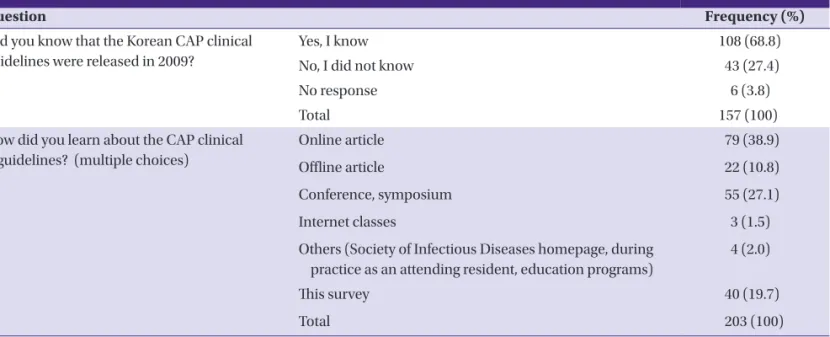
To the question, “Did you know that the Korean CAP clinical guidelines were released in 2009?” 108 (68.8%) answered “I know” and 43 (27.4%) “I did not know” (Table 2). To “Do you
Table 2. Awareness of the Korean guidelines for community-acquired pneumonia
Question Frequency (%)
Did you know that the Korean CAP clinical guidelines were released in 2009?
Yes, I know 108 (68.8)
No, I did not know 43 (27.4)
No response 6 (3.8)
Total 157 (100)
How did you learn about the CAP clinical guidelines? (multiple choices)
Online article 79 (38.9)
Offline article 22 (10.8)
Conference, symposium 55 (27.1)
Internet classes 3 (1.5)
Others (Society of Infectious Diseases homepage, during practice as an attending resident, education programs)
4 (2.0)
This survey 40 (19.7)
Total 203 (100)
CAP, community-acquired pneumonia.
use the 2009 Korean CAP treatment guidelines in practice?,”
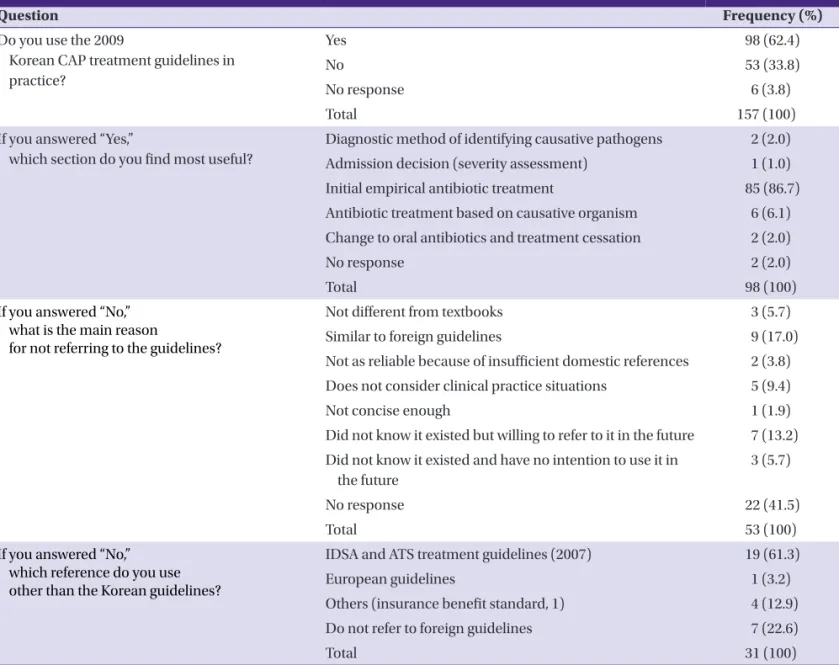
98 (62.4%) said “Yes” and 53 (33.8%) said “No” (Table 3).
Among those who answered “Yes,” to “Which section is most useful?,” the most common answer was “Initial empirical anti- biotic treatment” (85/98, 86.7%) (Table 3). To “Are the contents of the guidelines satisfactory?,” 66 (42.0%) answered “Yes,” 48 (30.6%) answered “Not good but not bad”, and 4 (2.5%) an- swered “Not satisfied” (Table 4). Among the respondents who said “No” to “Why are you dissatisfied? (multiple choices)?,”
5/14 (35.7%) answered that they “do not agree with the empir- ical antibiotic treatment choice.” Compliance and satisfaction with the CAP guidelines are summarized in Tables 2, 3, and 4.
3. Status of and opinions on CAP treatment patterns To the question “What influences your choice of empirical antibiotics for CAP patients?” (multiple choices), 92/357
(25.8%) answered “Korean CAP clinical guidelines for adults,”
74 (20.7%) answered “IDSA/ATS guidelines,” 66 (18.5%) an- swered “Health insurance review standards for CAP,” and 61 (17.1%) answered “Antibiotic-related complications and handiness” (Table 5). To the question “Do you use aminogly- cosides for empirical treatment of CAP?,” 68/157 (43.3%) an- swered “No,” 23 (14.6%) answered “Yes, when gram-negative bacilli, including Pseudomonas, is likely to cause pneumonia,”
and 16 (10.2%) answered “Yes, when severe infection is likely”
(Table 5). To “Do you use macrolides for empirical treatment of CAP?,” 73/157 (46.5%) answered “Yes, concomitantly in combination with β-lactams (penicillins and cephalospo- rins),” 15 (9.6%) answered “Yes, macrolides only for mild pneumonia,” 10 (6.4%) answered “Yes, concomitantly in com- vination with other antibiotics for severe CAP,” and 6 (3.8%) answered “Yes, I prefer the Macrolide monotherapy” (Table 6).
Table 3. Compliance with the Korean guidelines for community-acquired pneumonia
Question Frequency (%)
Do you use the 2009
Korean CAP treatment guidelines in practice?
Yes 98 (62.4)
No 53 (33.8)
No response 6 (3.8)
Total 157 (100)
If you answered “Yes,”
which section do you find most useful?
Diagnostic method of identifying causative pathogens 2 (2.0) Admission decision (severity assessment) 1 (1.0)
Initial empirical antibiotic treatment 85 (86.7)
Antibiotic treatment based on causative organism 6 (6.1) Change to oral antibiotics and treatment cessation 2 (2.0)
No response 2 (2.0)
Total 98 (100)
If you answered “No,”
what is the main reason
for not referring to the guidelines?
Not different from textbooks 3 (5.7)
Similar to foreign guidelines 9 (17.0)
Not as reliable because of insufficient domestic references 2 (3.8) Does not consider clinical practice situations 5 (9.4)
Not concise enough 1 (1.9)
Did not know it existed but willing to refer to it in the future 7 (13.2) Did not know it existed and have no intention to use it in
the future
3 (5.7)
No response 22 (41.5)
Total 53 (100)
If you answered “No,”
which reference do you use other than the Korean guidelines?
IDSA and ATS treatment guidelines (2007) 19 (61.3)
European guidelines 1 (3.2)
Others (insurance benefit standard, 1) 4 (12.9)
Do not refer to foreign guidelines 7 (22.6)
Total 31 (100)
CAP, community-acquired pneumonia; IDSA, Infectious Diseases Society of America; ATS, American Thoracic Society.
To “What β-lactam drugs do you select for empirical treatment of CAP?,” 72/157 (45.9%) responded “Third-generation cepha- losporins,” 28 (17.8%) responded “Ampicillin/sulbactam or amoxicillin/clavulanate,” 6 (3.8%) responded “Not at all,” an- other 6 (3.8%) responded “Second-generation cephalosporins,”
and 4 (2.5%) responded “First-generation cephalosporin” (Ta- ble 6). The status of and opinions on the treatment of CAP are summarized in Table 5 and Table 6.
4. Opinions on the determination of the need to hospitalize CAP patients
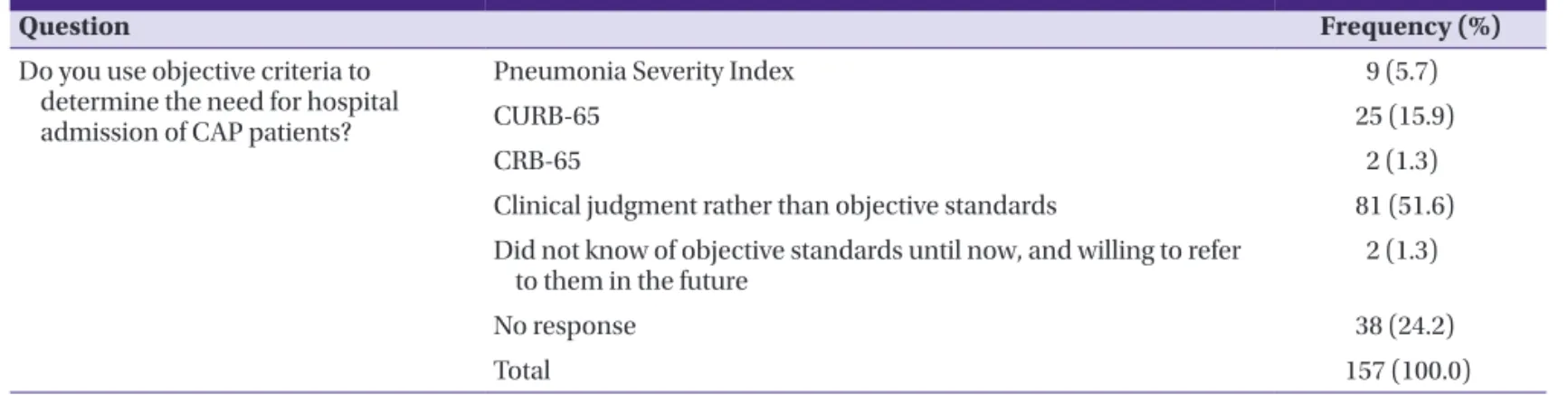
To “Do you use objective criteria to determine the need for hospital admission of CAP patients?,” 81/157 (51.6%) replied “I use clinical judgment rather than objective standards,” 25
(15.9%) replied “I use CURB-65,” and 9 replied (5.7%) “I use the Pneumonia Severity Index” (Table 7). These results are summarized in Table 7.
5. Responses to the CAP treatment guidelines according to specialty
To the question “Did you know that the Korean CAP guide- lines were released in 2009?,” 85/90 (94.4%) of the pulmonolo- gists and infectious disease specialists answered “I know” and 5 (5.6%) answered “I do not know”; among other physicians, 23/61 (37.7%) answered “I know” and 38 (62.3%) “I do not know.” The awareness of the CAP treatment guidelines among pulmonologists and infectious disease specialists was higher than in other physicians (odds ratio [OR]: 28.1, 95% confi- Table 4. Satisfaction with Korean guidelines for community-acquired pneumonia
Question Frequency (%)
Are you satisfied with the format of the guidelines?
No 3 (1.9)
They are not good but not bad 54 (34.4)
Satisfied 59 (37.6)
Very satisfied 6 (3.8)
No response 35 (22.3)
Total 157 (100.0)
If you are dissatisfied with the format of the guidelines, why? (multiple choices)
The reference is too long 5 (35.7)
Too short 2 (14.3)
There are too many tables 3 (21.4)
Not enough tables 1 (7.1)
Other 3 (21.4)
Total 14 (100)
Are you satisfied with the contents of the guidelines?
No 4 (2.5)
They are not good but not bad 48 (30.6)
Yes 66 (42.0)
Very satisfied 4 (2.5)
No response 35 (22.3)
Total 157 (100)
If you are dissatisfied with the contents of the guidelines, why? (multiple choices)
Do not agree with the diagnosis method 1 (7.1) Do not agree with the admission indication
(severity assessment)
3 (21.4)
Do not agree with the oral antibiotic change, discharge timing, and follow-up guidelines
3 (21.4)
Do not agree with the causative pathogen (atypical pneumonia, causative pathogen distribution and antibiotic resistance included)
1 (7.1)
Do not agree with the empirical antibiotic choice 5 (35.7)
Others 1 (7.1)
Total 14 (100.0)
Table 5. Status of and opinions on the treatment of community-acquired pneumonia (I)
Question Frequency (%)
What influences your choice of empirical antibiotics for CAP patients? (multiple choices)
Do not refer to any guidelines 5 (1.4)
Korean CAP clinical guidelines for adults 92 (25.8)
IDSA/ATS guidelines 74 (20.7)
Textbook recommendation 43 (12.0)
Antibiotic-related complication and handiness 61 (17.1)
Health insurance review standards for CAP 66 (18.5)
Cost 16 (4.5)
Total 357 (100.0)
Do you use aminoglycosides for empirical treatment of CAP? (for inpatients or outpatients)
Never 68 (43.3)
When infection with GNB, including Pseudomonas infection, is likely 23 (14.6) When GNB, including Pseudomonas, is cultured in the sputum or blood 9 (5.7) Empirically combined when severe infection is likely 16 (10.2) For almost all cases, since it is known to have some benefits
from experience
3 (1.9)
No response 38 (24.2)
Total 157 (100.0)
CAP, community-acquired pneumonia; IDSA, Infectious Diseases Society of America; ATS, American Thoracic Society; GNB, gram-negative bacilli.
Table 6. Status of and opinions on the treatment of community-acquired pneumonia (II)
Question Frequency (%)
Do you use macrolides for empirical treatment of CAP? (for inpatients or outpatients)
Not at all 6 (3.8)
Macrolides only 6 (3.8)
Macrolides only for mild pneumonia 15 (9.6)
Combined with β-lactams (penicillins and cephalosporins) 73 (46.5) β-lactams (penicillins and cephalosporins) (not combined with
macrolides)
7 (4.5)
Combined empirically if severe CAP is likely 10 (6.4)
Others (combined with β-lactams, 1; when mycoplasma pneumonia is likely, 1)
2 (1.3)
No response 38 (24.2)
Total 157 (100.0)
How do you select β-lactam drugs in the empirical treatment of CAP?
(Intravenous or oral)
Not at all 6 (3.8)
First-generation cephalosporin 4 (2.5)
Second-generation cephalosporin 6 (3.8)
Third-generation cephalosporin 72 (45.9)
Third-generation cephalosporin which have effect on Pseudomonas 2 (1.3)
Ampicillin or amoxicillin 1 (0.6)
Ampicillin/sulbactam or amoxicillin/clavulanate 28 (17.8) Pseudomonas effective penicillins (e.g., piperacillin/tazobactam, etc.) 0 (0)
Carbapenem (imipenem, meropenem, etc.) 0 (0)
No response 38 (24.2)
Total 157 (100.0)
CAP, community-acquired pneumonia.
dence interval [CI]: 9.9 to 79.5, P-value < 0.001). To “Do you use the 2009 Korean CAP treatment guidelines in practice?,”
67/90 (74.4%) pulmonologists and infectious disease special- ists answered “Yes” and 23 (25.6%) answered “No”; among other physicians, 31/61 (50.8%) answered “Yes” and 30 (49.2%) “No.” The frequency CAP treatment guideline use in clinical practice was also higher among pulmonologists and infectious disease specialists than among other physicians (OR: 2.8, 95% CI: 1.4 to 5.6, P-value = 0.003). Six of 76 (7.9%)
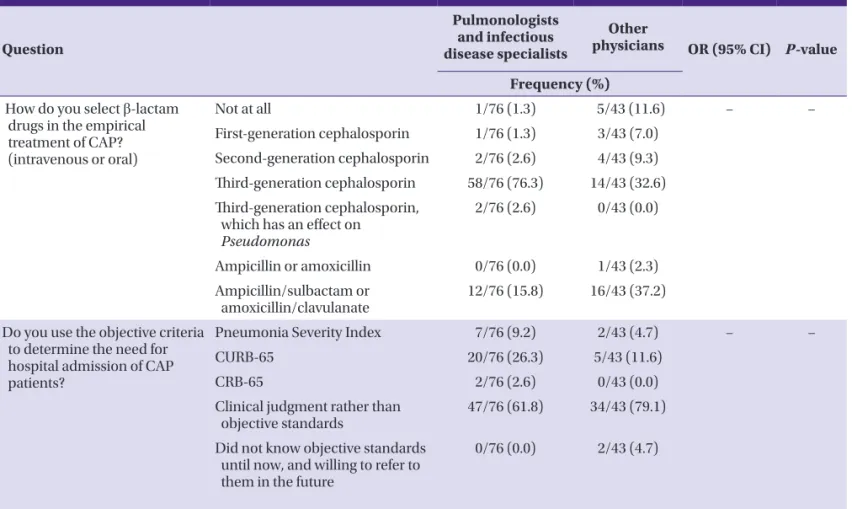
pulmonologists and infectious disease specialists, and 15 of 43 (34.9%) other physicians reported using macrolide mono- therapy for CAP treatment. To “What β-lactam drugs do you use to empirically treat CAP?,” “Third-generation cephalospo- rins” was the most common answer (58/76, 76.3%) in pulmo- nologists and infectious disease specialists; “Ampicillin/sul- bactam or amoxicillin/clavulanate” was the most common answer (16/43, 37.2%) in the other physicians. To ”Do you use objective criteria to determine the need for hospital admis- Table 7. Use of admission criteria for community-acquired pneumonia
Question Frequency (%)
Do you use objective criteria to determine the need for hospital admission of CAP patients?
Pneumonia Severity Index 9 (5.7)
CURB-65 25 (15.9)
CRB-65 2 (1.3)
Clinical judgment rather than objective standards 81 (51.6) Did not know of objective standards until now, and willing to refer
to them in the future 2 (1.3)
No response 38 (24.2)
Total 157 (100.0)
CAP, community-acquired pneumonia; CURB-65, Confusion, Urea > 7 mmol/L, Respiratory rate > 30/min, low Blood pressure(diastolic blood pressure (DBP) < 60 mmHg or systolic blood pressure (SBP) < 90 mmHg and age ≥ 65 years; CRB-65, does not include urea.
Table 8. Responses to the CAP treatment guidelines according to specialty (I)
Question
Pulmonologists and infectious
disease specialists
Other
physicians OR (95% CI) P-value Frequency (%)
Did you know that the Korean CAP clinical guidelines were released in 2009?
Yes, I know 85/90 (94.4) 23/61 (37.7) 28.1 (9.9 to 79.5) < 0.001
No, I did not know 5/90 (5.6) 38/61 (62.3)
Do you use the 2009 Korean CAP treatment guidelines in practice?
Yes 67/90 (74.4) 31/61 (50.8) 2.8 (1.4 to 5.6) 0.003
No 23/90 (25.6) 30/61 (49.2)
Do you use macrolides for empirical treatment of CAP?
(for inpatients or outpatients)
Not at all 1/76 (1.3) 5/43 (11.6) − −
Macrolides only 2/76 (2.6) 4/43 (9.3)
Macrolides only for mild pneu
monia 4/76 (5.3) 11/43 (25.6)
Combined with β-lactams
(penicillins and cephalosporins) 59/76 (77.6) 14/43 (32.6) β-lactams (penicillins and
cephalosporins) (not combined with macrolides)
2/76 (2.6) 5/43 (11.6)
Combined empirically if severe
CAP is likely 7/76 (9.2) 3/43 (7.0)
Others 1/76 (1.3)
(combined with β-lactams)
1/43 (2.3) (when myco- plasma pneu- monia is likely) CAP, community-acquired pneumonia; OR, odds ratio; CI, confidence interval.
sion of CAP patients?,” “I use clinical judgment rather than objective standards” was the most common response (47/76, 61.8%) among pulmonologists and infectious disease special- ists, as well as in other physicians (34/43, 79.1%). The respons- es to the CAP treatment guidelines according to specialty are summarized in Table 8 and Table 9.
6. Responses to the CAP treatment guidelines according to workplace
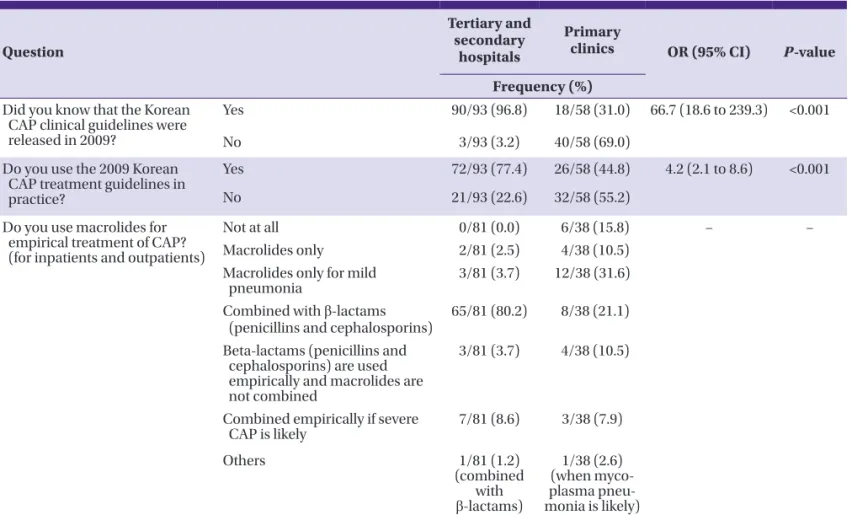
To the question “Do you know that the Korean CAP clinical guidelines were released in 2009?,” 90/93 (96.8%)of tertiary and secondary hospital doctors answered “I know,” 3 (3.2%) answered “I do not know,” while 18/58 (31.0%) of primary clinic doctors (hospitals and private clinics) answered “I know” and 40/58 (69.0%) answered “I do not know.” Aware- ness of the CAP treatment guidelines by tertiary and second- ary hospital doctors was higher than that of the primary clinic doctors (OR: 66.7, 95% CI: 18.6 to 239.3, P-value < 0.001). To
“Do you use the 2009 Korean CAP treatment guidelines in practice?,” the majority of tertiary and secondary hospital doc- tors answered “Yes” (72/93, 77.4%); only 21 (22.6%) said “No.”
Among primary clinic doctors, 26/58 (44.8%) answered “Yes”
and 32 (55.2%) “No.” Clinical use of CAP treatment guidelines was higher among tertiary and secondary hospital doctors than among primary clinic doctors (OR: 4.2, 95% CI: 2.1 to 8.6, P-value < 0.001). To “Do you use macrolides to empirically treat CAP?,” “I use macrolides only for mild pneumonia” was the most common response of primary clinic doctors (12/38, 31.6%). To “What β-lactam drugs do you use to empirically treat CAP?,” “Third-generation cephalosporins” was the most common answer among doctors of tertiary and secondary hospital doctors (66/81, 81.5%), while “ampicillin/sulbactam or amoxicillin/clavulanate” was the most common answer among doctors of primary clinic doctors (17/38, 44.7%). To
“Do you use objective criteria to determine the need for hos- pital admission of CAP patients?,” “I use clinical judgment rather than objective standards” was the most common an- swer among both doctors of tertiary and secondary hospital doctors and primary clinic doctors (51/81, 63.0%; 30/38, 78.9%; respectively). The responses to the CAP treatment guidelines according to specialty are summarized in Table 10 and Table 11.
Table 9. Responses to the CAP treatment guidelines according to specialty (II)
Question
Pulmonologists and infectious disease specialists
Other
physicians OR (95% CI) P-value Frequency (%)
How do you select β-lactam drugs in the empirical treatment of CAP?
(intravenous or oral)
Not at all 1/76 (1.3) 5/43 (11.6) − −
First-generation cephalosporin 1/76 (1.3) 3/43 (7.0) Second-generation cephalosporin 2/76 (2.6) 4/43 (9.3) Third-generation cephalosporin 58/76 (76.3) 14/43 (32.6) Third-generation cephalosporin,
which has an effect on Pseudomonas
2/76 (2.6) 0/43 (0.0)
Ampicillin or amoxicillin 0/76 (0.0) 1/43 (2.3)
Ampicillin/sulbactam or
amoxicillin/clavulanate 12/76 (15.8) 16/43 (37.2) Do you use the objective criteria
to determine the need for hospital admission of CAP patients?
Pneumonia Severity Index 7/76 (9.2) 2/43 (4.7) − −
CURB-65 20/76 (26.3) 5/43 (11.6)
CRB-65 2/76 (2.6) 0/43 (0.0)
Clinical judgment rather than
objective standards 47/76 (61.8) 34/43 (79.1)
Did not know objective standards until now, and willing to refer to them in the future
0/76 (0.0) 2/43 (4.7)
CAP, community-acquired pneumonia; OR, odds ratio; CI, confidence interval.
CURB-65, Confusion, Urea > 7 mmol/L, Respiratory rate > 30/min, low Blood pressure (diastolic blood pressure [DBP] < 60 mmHg or systolic blood pressure [SBP] < 90 mmHg and age ≥ 65 years); CRB-65, does not include urea.
Table 10. Responses to the CAP treatment guidelines according to workplace (I)
Question
Tertiary and secondary
hospitals
Primary
clinics OR (95% CI) P-value Frequency (%)
Did you know that the Korean CAP clinical guidelines were released in 2009?
Yes 90/93 (96.8) 18/58 (31.0) 66.7 (18.6 to 239.3) <0.001
No 3/93 (3.2) 40/58 (69.0)
Do you use the 2009 Korean CAP treatment guidelines in practice?
Yes 72/93 (77.4) 26/58 (44.8) 4.2 (2.1 to 8.6) <0.001
No 21/93 (22.6) 32/58 (55.2)
Do you use macrolides for empirical treatment of CAP?
(for inpatients and outpatients)
Not at all 0/81 (0.0) 6/38 (15.8) − −
Macrolides only 2/81 (2.5) 4/38 (10.5)
Macrolides only for mild
pneumonia 3/81 (3.7) 12/38 (31.6)
Combined with β-lactams
(penicillins and cephalosporins) 65/81 (80.2) 8/38 (21.1) Beta-lactams (penicillins and
cephalosporins) are used empirically and macrolides are not combined
3/81 (3.7) 4/38 (10.5)
Combined empirically if severe
CAP is likely 7/81 (8.6) 3/38 (7.9)
Others 1/81 (1.2)
(combined with β-lactams)
1/38 (2.6) (when myco- plasma pneu- monia is likely) CAP, community-acquired pneumonia; OR, odds ratio; CI, confidence interval.
Table 11. Responses to the CAP treatment guidelines according to workplace (II)
Question
Tertiary and secondary
hospitals
Primary
clinics OR (95% CI) P-value Frequency (%)
How do you select β-lactam drugs in the empirical treatment of CAP?
(intravenous or oral)
Not at all 0/81 (0.0) 6/38 (15.8) − −
First-generation cephalosporin 1/81 (1.2) 3/38 (7.9) Second-generation cephalosporin 1/81 (1.2) 5/38 (13.2) Third-generation cephalosporin 66/81 (81.5) 6/38 (15.8) Third-generation cephalosporin,
which has an effect on Pseudomonas 2/81 (2.5) 0/38 (0.0)
Ampicillin or amoxicillin 0/81 (0.0) 1/38 (2.6)
Ampicillin/sulbactam or amoxicillin/
clavulanate 11/81 (13.6) 17/38 (44.7)
Do you use objective criteria to determine the need for hospital admission of CAP patients?
Pneumonia Severity Index 7/81 (8.6) 2/38 (5.3) − −
CURB-65 21/81 (25.9) 4/38 (10.5)
CRB-65 2/81 (2.5) 0/38 (0.0)
Clinical judgment rather than objective
standards 51/81 (63.0) 30/38 (78.9)
Did not know of objective standards until now, but willing to refer to them in the future
0/81 (0.0) 2/38 (5.3)
CAP, community-acquired pneumonia; OR, odds ratio; CI, confidence interval.
CURB-65, Confusion, Urea > 7 mmol/L, Respiratory rate > 30/min, low Blood pressure (diastolic blood pressure [DBP] < 60 mmHg or systolic blood pressure [SBP] <
90 mmHg and age ≥ 65 years); CRB-65, does not include urea.
Discussion
In the United States and Korea, CAP has the sixth highest mortality rate [6]. However, the distribution and resistance patterns of CAP pathogens differ among regions and coun- tries; therefore, antimicrobial treatment of CAP also differs.
The Korean CAP treatment guidelines were released at the end of 2009. They reflect the current domestic and interna- tional status of CAP causative pathogens and resistance pat- terns. The Korean CAP guidelines may be accepted to varying degrees by practitioners treating CAP.
Yoon et al. [7] researched antibiotic choices for patients who were hospitalized for CAP in 2004, and showed that cephalo- sporin was administered to 6.0% of patients, quinolone in 3.5%, β-lactam/β-lactamase inhibitors in 2.3%, and macrolides in 2.2% of patients. Empirical antibiotics for CAP treatment may have changed since this report and after the release of the new CAP treatment guidelines. We conducted our survey not only for the entire study patients’ population but also accord- ing to doctor specialization and workplace. Although the Ko- rean CAP treatment guidelines were released a full 3 years ago, many doctors (27.4%) are still unaware of their existence.
The number of other physicians and primary clinic doctors who are unaware of these guidelines was higher than that of doctors from any other specialty or workplace. In addition, fewer other physicians and primary clinic doctors use the guidelines in clinical practice. This suggests that the guidelines must be more aggressively promoted. Because online papers and official symposiums are common paths for learning about the guidelines, we should consider promoting them in more accessible and economical ways such as through the Internet or social media.
Many physicians thought that “The guidelines do not reflect the actual situation, especially on the choice of initial empiri- cal antibiotics.” This finding is not unexpected, because the choice of antibiotics is affected by various factors such as pathogen, severity of patient disease, the doctor’s preferred antibiotics, and drug availability.
The use of β-lactam alone, combined β-lactam and macro- lide, or respiratory quinolones, are recommended as empiri- cal antibiotics for patients who do not require hospitalization.
Because of their high resistance rates, tetracycline and macro- lide monotherapy are not recommended treatments [4]. A secondary retrospective study was performed using the Com- munity-acquired Pneumonia Organization CASE database (CAPO database) that was registered in Phase III clinical trials around the world. The study found that, on the basis of mor-
tality and clinical outcomes, antibiotics that were effective for atypical pneumonia showed better results [8]. The most com- mon response to survey questions on the content of the guidelines was dissatisfaction with the selection of initial em- pirical antibiotic therapy.
These responses indicate that a randomized controlled clini- cal trial comparing β-lactam monotherapy with combination therapy (β-lactams plus macrolides or β-lactams plus quino- lone) is needed. Aminoglycosides are easily administered in- tramuscularly to outpatients, and anaphylaxis is rare. Some physicians still use a combination of aminoglycosides and other antibiotics as CAP therapy [9]. However, empirical ami- noglycoside combination therapy should be limited to CAP cases with suspected Pseudomonas infections, and is not rec- ommended under typical circumstances [10]. However, ami- noglycoside combination therapy was often mentioned in our survey. The use of aminoglycosides as an option in treatment of pneumonia has insufficient evidence on the effectiveness and adverse events such as nephrotoxicity or ototoxicty [11, 12].
Better education and consensus on the minimization of ami- noglycosides use for CAP treatment are needed for antimicro- bial stewardship, patient safety, and reduction of medical costs.
This survey showed that pulmonologists, other physicians, and primary clinic doctors use macrolide therapy alone only for mild cases. Macrolide monotherapy is currently recom- mended for mild outpatient CAP patients by the IDSA/ATS CAP guidelines. We believe that these recommendations like- ly affect the high number of responses indicating monothera- py use for CAP treatment. Reported macrolide resistance rates to Streptococcus pneumoniae have reached 62.0-87.6% [4, 13-19]
and resistance rates to Mycoplasma pneumoniae were simi- larly high; therefore, macrolide monotherapy is not recom- mended in the Korean CAP guidelines [20]. We need more data on the clinical significance of in vitro macrolide resis- tance to Mycoplasma. However, physicians should know the reasons that macrolide monotherapy is omitted from the em- pirical therapy recommendations in the Korean CAP guide- lines.
Third-generation cephalosporins or ampicillin/sulbactam, and amoxicillin/clavulanate such as β-lactams, usually have been used for treatment of patients hospitalized with CAP [21- 25]. According to our survey, very similar trends were ob- served in our study, yet first- or second-generation cephalo- sporins were often used. However, empirical antibiotic treatment of CAP with first- or second-generation cephalo- sporins is considered inappropriate, because pneumococcal
antibiotic resistance to cefuroxime, a typical second-genera- tion cephalosporin [17], is 61.3%. Haemophilus influenzae re- sistance to cefuroxime and cefaclor has been reported to be 9.2%
and 41.0%, respectively [26]. A large number of doctors decided to hospitalize patients on the basis of clinical judgment rather than objective criteria. This is owing to the difficulty of uni- formly applying CURB-65 (Confusion, Urea > 7 mmol/L, Re- spiratory rate > 30/min, low Blood pressure (diastolic blood pressure [DBP] < 60 mmHg or systolic blood pressure [SBP] <
90 mmHg and age ≥ 65 years) and the Pneumonia Severity In- dex (PSI), severity scoring systems that are traditionally used to determine if hospitalization is required. In many circum- stances, the patient’s condition, underlying diseases, and so- cioeconomic conditions should be considered to determine the need for hospitalization. The physician’s experience and clinical judgment are also important for making this decision.
CURB-65 and CRB-65 (CRB-65 does not include urea) scores are simpler and easier to use than PSI as a CAP severity as- sessment tool [27], and doctors should consider its use in clin- ical practice to determine the need for hospitalization. The higher mortality rate of hospitalized patients compared to outpatients among low-risk patients suggests the importance of clinical judgment in addition to objective criteria [28].
As a conclusion, a large number of doctors still don’t know that the Korean CAP treatment guidelines exist even though they were released at the end of 2009. Therefore, the guide- lines must be more aggressively promoted in medical society and hospitals. For some clinicians who still inappropriately use aminoglycoside as a combination therapy and macrolide monotherapy, inappropriately, we should make a strong and consistent effort to educate them and make changes in clini- cal practice.
References
1. Niederman MS, Mandell LA, Anzueto A, Bass JB, Brough- ton WA, Campbell GD, Dean N, File T, Fine MJ, Gross PA, Martinez F, Marrie TJ, Plouffe JF, Ramirez J, Sarosi GA, Tor- res A, Wilson R, Yu VL; American Thoracic Society. Guide- lines for the management of adults with community-ac- quired pneumonia. Diagnosis, assessment of severity, antimicrobial therapy, and prevention. Am J Respir Crit Care Med 2001;163:1730-54.
2. Statistics Korea. Annual report on the cause of death sta- tistics 2007: Nation Wide. Daejeon: Statistics Korea; 2007.
3. Apisarnthanarak A, Mundy LM. Etiology of community-
acquired pneumonia. Clin Chest Med 2005;26:47-55.
4. Song JH, Jung KS, Kang MW, Kim DJ, Pai H, Suh GY, Shim TS, Ahn JH, Ahn CM, Woo JH, Lee NY, Lee DG, Lee MS, Lee SM, Lee YS, Lee H, Chung DR. Treatment guidelines for community-acquired pneumonia in Korea: an evi- dence-based approach to appropriate antimicrobial ther- apy. Infect Chemother 2009;41:133-53.
5. Mandell LA, Wunderink RG, Anzueto A, Bartlett JG, Campbell GD, Dean NC, Dowell SF, File TM, Jr., Musher DM, Niederman MS, Torres A, Whitney CG; Infectious Diseases Society of America; American Thoracic Society.
Infectious Diseases Society of America/American Thorac- ic Society consensus guidelines on the management of community-acquired pneumonia in adults. Clin Infect Dis 2007;44 (Suppl 2):S27-72.
6. Pinner RW, Teutsch SM, Simonsen L, Klug LA, Graber JM, Clarke MJ, Berkelman RL. Trends in infectious diseases mortality in the United States. JAMA 1996;275:189-93.
7. Yoon YK, Kim EJ, Chun BC, Eom JS, Park DW, Sohn JW, Kim MJ. Prescription of antibiotics for adults hospitalized with community-acquired pneumonia in Korea in 2004: a population-based descriptive study. Respirology 2012;17:
172-9.
8. Arnold FW, Summersgill JT, Lajoie AS, Peyrani P, Marrie TJ, Rossi P, Blasi F, Fernandez P, File TM Jr, Rello J, Menen- dez R, Marzoratti L, Luna CM, Ramirez JA; Community- Acquired Pneumonia Organization (CAPO) Investigators.
A worldwide perspective of atypical pathogens in com- munity-acquired pneumonia. Am J Respir Crit Care Med 2007;175:1086-93.
9. Kumana CR, Yuen KY. Parenteral aminoglycoside therapy.
Selection, administration and monitoring. Drugs 1994;47:
902-13.
10. Arancibia F, Bauer TT, Ewig S, Mensa J, Gonzalez J, Nieder- man MS, Torres A. Community-acquired pneumonia due to gram-negative bacteria and pseudomonas aeruginosa:
incidence, risk, and prognosis. Arch Intern Med 2002;162:
1849-58.
11. Dobie RA, Black FO, Pezsnecker SC, Stallings VL. Hearing loss in patients with vestibulotoxic reactions to gentami- cin therapy. Arch Otolaryngol Head Neck Surg 2006;132:
253-7.
12. Humes HD. Aminoglycoside nephrotoxicity. Kidney Int 1988;33:900-11.
13. Kim BN, Bae LG, Kim MN, Park SJ, Woo JH, Ryu J, Kim YS.
Risk factors for penicillin resistance and mortality in Kore- an adults with Streptococcus pneumoniae bacteremia. Eur
J Clin Microbiol Infect Dis 2002;21:35-42.
14. Lee NY, Song JH, Kim S, Peck KR, Ahn KM, Lee SI, Yang Y, Li J, Chongthaleong A, Tiengrim S, Aswapokee N, Lin TY, Wu JL, Chiu CH, Lalitha MK, Thomas K, Cherian T, Perera J, Yee TT, Jamal F, Warsa UC, Van PH, Carlos CC, Shibl AM, Jacobs MR, Appelbaum PC. Carriage of antibiotic-resis- tant pneumococci among Asian children: a multinational surveillance by the Asian Network for Surveillance of Re- sistant Pathogens (ANSORP). Clin Infect Dis 2001;32:
1463-9.
15. Farrell DJ, Morrissey I, Bakker S, Felmingham D. Molecu- lar characterization of macrolide resistance mechanisms among Streptococcus pneumoniae and Streptococcus pyogenes isolated from the PROTEKT 1999-2000 study. J Antimicrob Chemother 2002;50 (Suppl S1):39-47.
16. Schito GC, Felmingham D. Susceptibility of Streptococcus pneumoniae to penicillin, azithromycin and telithromycin (PROTEKT 1999-2003). Int J Antimicrob Agents 2005;26:
479-85.
17. Song JH, Jung SI, Ko KS, Kim NY, Son JS, Chang HH, Ki HK, Oh WS, Suh JY, Peck KR, Lee NY, Yang Y, Lu Q, Chongtha- leong A, Chiu CH, Lalitha MK, Perera J, Yee TT, Kumaras- inghe G, Jamal F, Kamarulzaman A, Parasakthi N, Van PH, Carlos C, So T, Ng TK, Shibl A. High prevalence of antimi- crobial resistance among clinical Streptococcus pneu- moniae isolates in Asia (an ANSORP study). Antimicrob Agents Chemother 2004;48:2101-7.
18. Lee K, Lim CH, Cho JH, Lee WG, Uh Y, Kim HJ, Yong D, Chong Y; KONSAR Group. High prevalence of ceftazi- dime-resistant Klebsiella pneumoniae and increase of imipenem-resistant Pseudomonas aeruginosa and Aci- netobacter spp. in Korea: a KONSAR program in 2004.
Yonsei Med J 2006;47:634-45.
19. Shin JH, Jung HJ, Kim HR, Jeong J, Jeong SH, Kim S, Lee EY, Lee JN, Chang CL. Prevalence, characteristics, and molecular epidemiology of macrolide and fluoroquino- lone resistance in clinical isolates of Streptococcus pneu- moniae at five tertiary-care hospitals in Korea. Antimicrob Agents Chemother 2007;51:2625-7.
20. Morozumi M, Iwata S, Hasegawa K, Chiba N, Takayanagi R, Matsubara K, Nakayama E, Sunakawa K, Ubukata K ; Acute Respiratory Diseases Study Group. Increased mac- rolide resistance of Mycoplasma pneumoniae in pediatric patients with community-acquired pneumonia. Antimi- crob Agents Chemother 2008;52:348-50.
21. Mufson MA, Chan G, Stanek RJ. Penicillin resistance not a factor in outcome from invasive Streptococcus pneumoni- ae community-acquired pneumonia in adults when ap- propriate empiric therapy is started. Am J Med Sci 2007;333:161-7.
22. Cardoso MR, Nascimento-Carvalho CM, Ferrero F, Ber- ezin EN, Ruvinsky R, Camargos PA, Sant’anna CC, Brand- ileone MC, de Fátima P March M, Feris-Iglesias J, Maggi RS, Benguigui Y; CARIBE Group. Penicillin-resistant pneu- mococcus and risk of treatment failure in pneumonia.
Arch Dis Child 2008;93:221-5.
23. Song JH, Jung SI, Ki HK, Shin MH, Ko KS, Son JS, Chang HH, Kim SW, Lee H, Kim YS, Oh WS, Peck KR, Chongtha- leong A, Lalitha MK, Perera J, Yee TT, Jamal F, Kamarulza- man A, Carlos CC, So T; Asian Network for Surveillance of Resistant Pathogens Study Group. Clinical outcomes of pneumococcal pneumonia caused by antibiotic-resistant strains in asian countries: a study by the Asian Network for Surveillance of Resistant Pathogens. Clin Infect Dis 2004;38:1570-8.
24. Hong JH, Lee HS, Jung SH, Kim GW, Eom KS, Lee JM, Jang SH, Kim DG, Hyoen IG, Lee MK, Park YB, Jung KS, Lee YK.
Prevalence and clinical outcome of penicillin-resistant p n e u m o c o c c a l p n e u m o n i a . Tu b e rc R e s p i r D i s 2003;54:295-303.
25. Hwangbo B, Yoon HI, Lee SM, Choi SH, Yoo CG, Lee CT, Kim YW, Han SK, Min KU, Kim YY, Shim YS. Clinical char- acteristics of pneumococcal bacteremia in adults: the ef- fect of penicillin resistance on the mortality of patients with pneumococcal bacteremia. Tuberc Respir Dis 1999;47:184-94.
26. Kim IS, Ki CS, Kim S, Oh WS, Peck KR, Song JH, Lee K, Lee NY. Diversity of ampicillin resistance genes and antimi- crobial susceptibility patterns in Haemophilus influenzae strains isolated in Korea. Antimicrob Agents Chemother 2007;51:453-60.
27. Neill AM, Martin IR, Weir R, Anderson R, Chereshsky A, Epton MJ, Jackson R, Schousboe M, Frampton C, Hutton S, Chambers ST, Town GI. Community acquired pneumo- nia: aetiology and usefulness of severity criteria on admis- sion. Thorax 1996;51:1010-6.
28. Labarere J, Stone RA, Obrosky DS, Yealy DM, Meehan TP, Fine JM, Graff LG, Fine MJ. Comparison of outcomes for low-risk outpatients and inpatients with pneumonia: A propensity-adjusted analysis. Chest 2007;131:480-8.