Research Article Open Access
Effect of Gym-ball Exercise Program to Pelvis and Spine of the 20’s Woman
Seung-Hyean Oh, PT⋅Kyung-Tae Yoo, PT, PhD
†Department of Physical Therapy, Namseoul University
1)Received: August 15, 2014 / Revised: August 19, 2014 / Accepted: September 5, 2014
ⓒ 2014 J Korean Soc Phys Med
| Abstract |
PURPOSE: This study is to investigate the effect of 4 weeks of gym ball exercise on the pelvis and spine of women in 20s.
METHODS: Randomly selected 10 of 20 subjects are allocated to experimental group who will practice gym-ball exercise while the rest 10 subjects are allocated to control group. Values for pelvic obliquity DL-DR, pelvic torsion DL-DR, pelvic rotation, kyphotic angle ICT-ITL (max), and lordotic angle ITL-ILS (max) were measured through recording using 3-dimensional image analyzer as a preliminary inspection. Gym-ball exercise was implemented 3 sessions a week for 4 weeks. Each session consisted of 10 minutes of warm up exercise, 30 minutes of main exercise, and 10 minutes of cool down exercise totaling 50 minutes. Post inspections were measured after exercise.
RESULTS: Experimental group showed statistically significant difference in pelvic obliquity DL-DR, pelvic torsion DL-DR, and kyphotic angle ICT-ITL (max) (p<.05) and values of pelvic obliquity DL-DR showed statistically significant difference between two groups (p<.05). However
†Corresponding Author : [email protected]
This is an Open Access article distributed under the terms of the Creative Commons Attribution Non-Commercial License (http://creativecommons.org/licenses/by-nc/3.0) which permits unrestricted non-commercial use, distribution, and reproduction in any medium, provided the original work is properly cited.
pelvic rotation, lordotic angle ITL-ILS (max) did not show a significant difference.
CONCLUSION: These results showed that gym-ball exercise has positive effect in the pelvic obliquity, torsion and spine kyphotic angle and expected to have positive effect on the body balance, body lineup, and coordination.
Key Words: Gym-ball exercise, Spine, Pelvis
Ⅰ. Introduction
High heel shoes are parts of fashion and trend and have been developed in various forms. Various precedent studies were conducted to identify the effect on gait such as motor mechanical analysis of gait posture depending on the height of shoes heel. Repeatedly wearing high heel shoes lays a burden on the feet, changes body line up as the center of body weight changes, and has negative effects on leg and gait. Motor mechanical characteristics and kinematic characteristics are changed to compensate this (Ko et al., 2008; Lee & Hong, 2005).
Increase in the muscle activity of flexor due to wearing
high heels reduces the stability by creating instability on
feet and ankle muscles, leading to general muscular
skeleton problem (Gefen et al., 2002). The result of analysis
on the changes in overall physical functions due to use
of heightening insole reported that use of these insoles
affects balancing ability, sense, and range of motion (Jung et al., 2009).
The use of high heels arouse weakening of front side of anterior tibialis and weakens the strength of lower leg along with the dynamic changes of foot to cause imbalance in the lineup of lower limbs, leading to the restrictions on the motion range of leg joints.
Used that brings various effects on muscular skeleton system such as weakening of strength in the foot joints, damage in ligament, ankylosis, and imbalanced body lineup and becomes the cause of instability of ankle (Garn &
Newton, 1988).
The high heel shoes affect the soft-tissues in the vicinity of leg by increasing the amount of perpendicular impact during the static and dynamic movement, and may arouse damages in ligament and joint, and weakening of strength in leg and ankle. High heel shoes are considered as causes of overall muscular skeleton lesions because it may lead to weakening of body lineup and may result in chronic instability in ankle (Konradsen, 2002). Likewise, high heel shoes may be the cause of imbalanced lineup of lower limbs, and damages on ankle, balance, and ligament where most of these are considered to influence not only damages on the ankle but also the damages on pelvis or spines.
Gym ball is a low-intensity aerobic exercise where subjects can easily perform the dynamic training of maintaining balance (Hwang & Lee, 2004).
Gym ball exercise relaxes pelvis muscles which are stressed or hardened due to lumbar pains, broadens the motor range of joints in lumbar vertebrae, reduces the pressure exerted on the disk, and serves a role of balancing the spines because subjects have to utilize weight and balance sense in order to maintain same posture on the ball. Also, gym ball exercise improves muscle strength, stamina, flexibility, and coordination (Sung et al., 2005).
Gym ball exercise has been used as an exercise treatment tool for stroke, spinal cord, posture correction, and treatment for pains in spines and neck. Ball exercise
demands overall developments on reflexes, perception ability, and balancing sense in order to maintain balance in a dynamic motion of leaning one’s body to the ball using the stimulation - response interaction (Lee et al., 2003).
Exercise using swiss ball can be used for program preventing injuries from falls as it stabilizes the body (Choi et al., 2012) and is effective in improving balance (Han et al., 2008).
Gym ball exercise showed effect of reducing lower limbs lengths and improving balance, and significant decreasing effect on body disturbance area (Ju & Park, 2007).
pelvis stabilizing exercise using gym ball maintained and increased the lumbar extensor muscle strength, lumbar balancing ability, and lumbar flexibility which were declined due to chronic pelvis pains; this exercise was shown to be effective in improvement of pelvis pains and stamina as well (Lee, 2011).
Various studies on the effect of high heel shoes on the strength and muscle activity of feet, ankle, and gait were conducted but limited number of studies focused on the effect of high heel shoes on the pelvis and spines of human body.
Therefore, this study aims to investigate the effect of gym ball exercise on the pelvis and spine angles with women who wear high heel shoes often as study subjects.
Ⅱ. Method
1. Subject
This study selected 20 women in 20s who wear high heel shoes more than 5 times a week from the students of N University in Chungcheongnam-do. The selected students were then randomly allocated to control group (n=10) and experimental group (n=10).
The purpose and methods of this study were
well-explained to the subjects and study subjects voluntarily
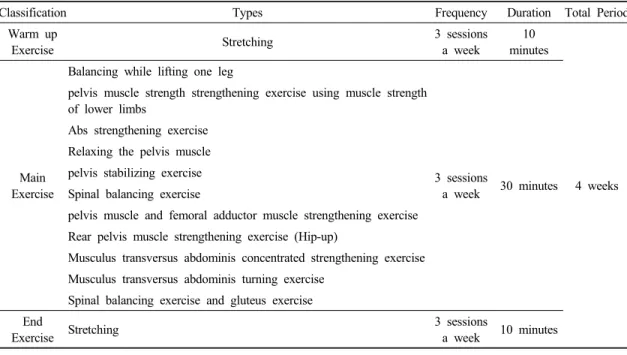
Table 1. Gym-Ball Excercise Program
Classification Types Frequency Duration Total Period
Warm up
Exercise Stretching 3 sessions
a week
10 minutes
4 weeks Main
Exercise
Balancing while lifting one leg
3 sessions
a week 30 minutes pelvis muscle strength strengthening exercise using muscle strength
of lower limbs
Abs strengthening exercise Relaxing the pelvis muscle pelvis stabilizing exercise Spinal balancing exercise
pelvis muscle and femoral adductor muscle strengthening exercise Rear pelvis muscle strengthening exercise (Hip-up)
Musculus transversus abdominis concentrated strengthening exercise Musculus transversus abdominis turning exercise
Spinal balancing exercise and gluteus exercise End
Exercise Stretching 3 sessions
a week 10 minutes signed on the experiment participation agreement. This
study selected those women with no experience of similar experiments or test. The subjects of this study were not allowed to know the specific purpose of this experiment.
Those volunteers with spinal tumor, transposition, and osteoporosis were excluded and study subjects who received other treatment during the period of the exercise were excluded as well.
2. Experiment Method
1) Measuring Equipment
This study used 3 dimensional image analyzer (Formetric II 4D, Germany) in order to measure the angle of gradient and twist of pelvis, lumbar lordosis, and thoracic kyphosis.
Characteristics of this equipment are fast and accurate measurement time (0.04∼6 seconds), no risk of radiation exposure by using halogen ramp, and expectation of treatment effect through simulation platform function.
2) Experiment Procedure
The subjects of this study agreed to participate to the experiment where they film spine and pelvis using 3 dimensional picture analyzer and perform gym ball exercise. Experimental group Gym ball exercise is taken 50 minutes a session, 3 sessions a week for 4 weeks. The post inspection was measured after the exercise. but control group did not exercise (Table 1).
3) Collection of Data
The subjects stripped the top, face the back toward the camera of the measurement device, and lowered bottoms until the point tailbone is shown. The subjects stood 2 meters away from the Formetric device and the measurement posture is to relax, lower both arms naturally, and face front direction. The legs are horizontally fixed on the foothold with knees straight up.
The anatomical terms and measurement factors used in this study are as follows:
(1) VP (vertebra prominence) 7th cervical vertebral, SP
(sacrum point) sacral cornu: VP-SP refers to the
Table 3. A change of pelvis angle between pre-test and post-test (Unit : °)
Variable Group Pre-test Post-test t p
PO DL-DR Control(N=10) 0.63±3.53 0.48±3.10 1.56 .15
Experimental(N=10) 12.70±9.76 3.30±1.82 3.05 .01
*PT DL-DR Control(N=10) 0.65±3.40 -0.10±3.00 1.40 .19
Experimental(N=10) 3.80±2.57 1.60±0.699 2.79 .02
*PR Control(N=10) -0.15±3.78 0.29±4.01 -0.64 .55
Experimental(N=10) 1.50±0.527 1.60±0.69 -2.87 .78
*
p<.05 Mean±SD
PO : pelvis_Obliquity, PT : pelvis_Torsion, PR : pelvis_rotation
distance between 7th cervical vertebral and sacral cornu.
(2) DL (left lumbar dimple) and DR (right lumbar dimple): Refer to the cavernous place on the left pelvis and DM is the middle of DL and DR.
(3) pelvic tilt angle DL-DR[°]: Refers to the difference in the height of DL and DR.
(4) pelvic torsion angle DL-DR[°]: Refers to the pelvis which is twisted to anterior and posterior direction.
(5) pelvic rotation angle[°]: Refers to the pelvis which is twisted to left or right direction
(6) kyphotic of thoracic vertebra (kyphotic angle ICT-ITL (max)[°]): Refers to the maximum value of kyphotic in the thoracic vertebra.
(7) lumbar lordotic (lordotic angle ITL-ILS (max)[°]):
Refers to the maximum value of lumbar lordotic angle.
3. Data Analysis
For data analysis, SPSS 18.0 for windows was used.
Kolmogorov-Smirnov Test was used to verify the standard distribution of the characteristics of data. To verify the difference between experiment group (gym-ball group) with control groups Independent t-test was used while paired t-test was used to compare the measurements before and after exercise. The level of statistical significance was set at α=.05.
Ⅲ. Results
1. General Characteristics of the Study Subjects This study selected 20 women in 20s who wear high heel shoes more than 5 times a week. The study randomly allocated 10 subjects into experimental group and the rest 10 were allocated to control group. The general characteristics of study subjects are as follows (Table 2).
Table 2. General Characteristics of subjects (n=20) Characteristic Experimental(N=10) Control(N=10)
Weight(kg) 57.90±9.28 60.71±6.97 Hight(cm) 159.10±5.61 161.17±4.81 Age(years) 20.00±1.89 20.40±0.70
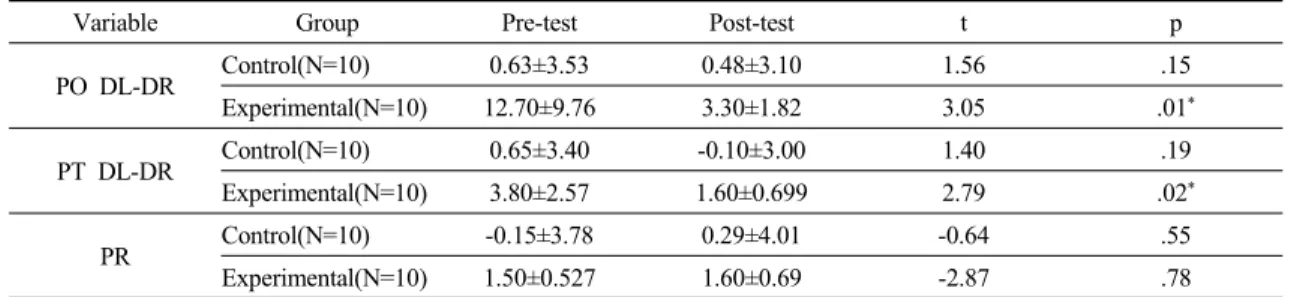
2. Comparison of the Average pelvis Angle PO DL-DR, PT DL-DR, PR were measured as a means of identifying the changes of pelvis angle before and after exercise (Table 3).
Measurement of PO DL-DR in experimental group showed statistically significant change from 12.70±9.76 to 3.30±1.82 while measurements of PT DL-DR in experimental group showed statistically significant change from 3.80±2.57 to 1.60±0.69.
But measurements of PR before and after exercise in
both control group and experimental group did not have
statistically significant difference.
Table 4. A change of spine angle between pre-test and post-test (Unit : °)
Variable Group Pre-test Post-test t p
KA ICT-ITL (max)
Control(N=10) 44.70±7.78 41.30±9.11 .73 .48
Experimental(N=10) 47.70±8.39 45.66±12.87 2.16 .05
*LA ITL-ILS (max)
Control(N=10) 36.00±9.78 34.40±9.40 .61 .55
Experimental(N=10) 37.97±8.16 37.46±8.86 1.19 .26
*
p<.05 Mean±SD
KA : Kyphotic angle, LA : Lordoticangle
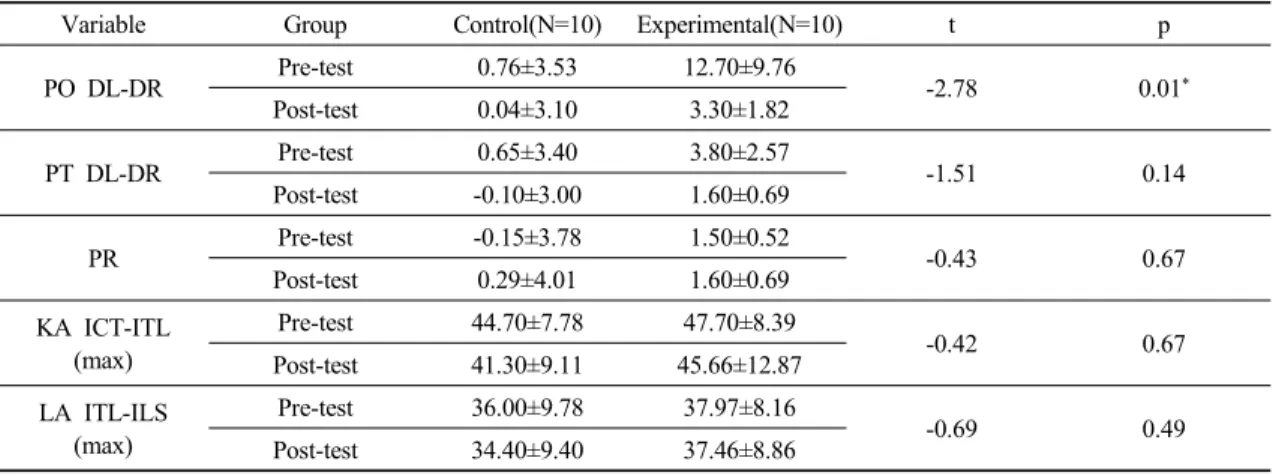
Table 5. Comparison of changes between experimental group and control group (Unit : °)
Variable Group Control(N=10) Experimental(N=10) t p
PO DL-DR Pre-test 0.76±3.53 12.70±9.76
-2.78 0.01
*Post-test 0.04±3.10 3.30±1.82
PT DL-DR Pre-test 0.65±3.40 3.80±2.57
-1.51 0.14
Post-test -0.10±3.00 1.60±0.69
PR Pre-test -0.15±3.78 1.50±0.52
-0.43 0.67
Post-test 0.29±4.01 1.60±0.69
KA ICT-ITL (max)
Pre-test 44.70±7.78 47.70±8.39
-0.42 0.67
Post-test 41.30±9.11 45.66±12.87 LA ITL-ILS
(max)
Pre-test 36.00±9.78 37.97±8.16
-0.69 0.49
Post-test 34.40±9.40 37.46±8.86
*