INTRODUCTION
Despite a steady decrease in the number of suicides in ad- olescents since a peak in 2009, it is still the most frequent cause of death in this age group.
1)Suicide in adolescents puts severe psychological stress on their families thereby having a great impact on their lives.
2)Moreover, thoughts and at- tempts of suicide at an adolescent age can repeatedly appear in adulthood. Therefore, active nationwide countermeasures to intervene and prevent suicide in adolescents are necessary.
There have been several domestic and international stud- ies to identify the risk factors for suicide in adolescents. For example, depression is known to be the key sole risk factor for suicide.
3)Nevertheless, considering that development at
the adolescent stage involves a dynamic interaction of dif- ferent systems, the issue of adolescent suicide must be ap- proached and understood from a more comprehensive view, including the peer group and school.
4)For instance, the loss of a family member, more specifically, family dissolution, is reported to be associated with suicide.
5-7)In addition, behav- ioral issues increase the risk of suicide in adolescents by 3–6- fold, while associations with alcohol consumption and drugs have also been suggested.
8,9)Furthermore, stressful events are often reported to precede adolescent suicides,
5)and ex- periencing separation and rejection in social relationships are thought to increase the risk of suicide as well.
10)Bullying at school is reported as another key factor associated with sui- cide, and a report in Korea has demonstrated that experienc- es of being bullied or harassed at school were significantly associated with suicidal ideation.
11)Interestingly, not only does exhibit a significant association with suicidal ideation, but
This is an Open Access article distributed under the terms of the Creative Commons Attribution Non-Commercial License (http://creativecommons.org/licenses/by-nc/4.0) which permits unrestricted non-commercial use, distribution, and reproduction in any medium, provided the original work is properly cited.
Risk Factors for Suicidal Ideation and Attempts in Adolescents
Hoin Kwon
1, Jong-Sun Lee
2, Ah Reum Kim
3, Hyun Ju Hong
3,4, and Yong-Sil Kweon
3,51Department of Counseling Psychology, Jeonju University, Jeonju, Korea
2Department of Psychology, Kangwon National University, Chuncheon, Korea
3Suicide and School Mental Health Institute, Hallym University, Chuncheon, Korea
4Department of Psychiatry, Hallym University Sacred Hospital, Hallym University, Chuncheon, Korea
5Department of Psychiatry, The Catholic University of Korea College of Medicine, Uijongbu, Korea
Objective: Although suicide is a serious public health concern for adolescents, there is a lack of studies that explore its risk factors in the Republic of Korea. The present study aims to investigate risk factors associated with suicidal behaviors in Korean adolescents.
Methods: Participants consisted of 2258 middle and high school students who completed a series of questionnaires regarding suicide ideation or attempts, non-suicidal self-injuries, depression, impulsivity, drinking behaviors, and negative life events, including peer bul- lying.
Results: Among the participants, 8.3% of students reported suicide ideation, while 3.2% reported a history of a suicide attempt in the past 12 months. Depression, peer-victimization, internet-related delinquency, and positive attitudes toward suicide were associated with suicidal ideations and attempts. Adverse life events were also associated with suicide ideation, but not attempts, while not living with both parents and poor family relationships were associated with suicide attempts, but not ideations. Non-suicidal self-injuries were associated with both suicide ideations and attempts. Students with suicidal ideations and attempts can be differentiated depending on the presence of self-injury.
Conclusion: In addition to depression or behavioral problems, non-suicidal self-injuries and lack of support from family may also play significant roles in suicide attempts in adolescents. To facilitate the prevention of suicide in adolescents, longitudinal studies should be followed to confirm the risk factors identified in this study.
Key Words: Adolescent; Suicidal attempts; Suicide; Risk factors; Non-suicidal self-injury.
Received: March 3, 2017 / Revision: July 3, 2017 / Accepted: February 22, 2018
Address for correspondence: Yong-Sil Kweon, Department of Psychiatry, The Catholic University of Korea College of Medicine, 271 Cheonbo-ro, Uijeong- bu 11765, Korea
Tel: +82-31-820-3055, Fax: +82-31-847-3630, E-mail: [email protected]
the perpetrator does as well.
12)With numerous empirical studies on suicide in adolescents, researchers have been attempting to identify factors contrib- uting to the development of suicidal ideation and attempts.
In other words, the aim was to differentially explore the fac- tors that contribute to the development of suicidal ideation and the factors that turn the ideation into reality. For exam- ple, impulsivity and self-harm are being highlighted as fac- tors that lead to suicidal action.
5)Identification of the factors closely associated with suicidal attempts is crucial since it allows for the identification of individuals who need more di- rect intervention. Previous studies on suicide in adolescents in Korea have focused on suicidal ideation. Furthermore, very few adolescents who attempt suicide seek help at medical centers,
5)suggesting the necessity of future studies assessing suicidal actions in a community sample. This study aims to identify the risk factors of suicide through screening of a large-scale community sample, in order to contribute to the prevention of suicides in adolescents in Korea. In addition, by including subjects who had suicidal ideation only and the subjects who actually had suicidal attempts, we aim to dis- tinguish the factors closely associated with suicidal action.
METhODs
Subjects and data collection
Two middle and two secondary schools in the city of Seoul and surrounding Gyeonggi province (4 schools in total) were randomly selected for assessment from September to November 2015. With the approval from the school princi- pal to conduct “the survey on emotional behaviors and sui- cide in students,” the investigators visited the schools and explained the background and purpose of the study to the students and teachers. Students who gave voluntary written consent to participate in the study were asked to complete the survey. There were 3085 students in the 4 selected schools, and 2290 students (74%) participated in the survey. After ex- cluding incomplete responses, responses from 2258 students were used as the final data set for the analysis. The mean age of the subjects was 15.63 years, and 55.1% were male and 44.9%
were female subjects. This study was performed with the ap- proval from the Institutional Review Board of Catholic University of Korea (IRB No. UC15QISI0073).
Assessment tools
The survey form used in this study included questions based on a traditional rating scale for psychological characteristics of adolescents. Selection of the questions in the survey was based on a literature review of domestic and international studies on the risk factors of suicide in adolescents, and the
selected questions were screened and agreed upon by 3 pedi- atric psychiatrists and 1 clinical psychologist with consider- ation for the importance and validity of the questions.
Demographic factors
The basic questionnaire assessed demographic factors, in- cluding the subject’s gender, age, year in school, and family relationship. Moreover, the subjects were asked to make a subjective assessment of the socioeconomic status of their family and their academic achievement level at school as high, intermediate, or low. The current family relationship was assessed with a question about which family members are currently residing together. Subjects who do not live with both parents (father and mother) were included in the group of single-parent family.
Questionnaire on the Parenting Behavior Inventory and child trauma
The assessment of family-related factors was based on 4 se- lected questions regarding the expectations and interven- tions from the parents perceived by the adolescent subjects (from Parenting Behavior Inventory Questionnaire
13)) and 4 selected questions regarding physical or emotional harass- ment from the family (from the Korean Child Trauma Ques- tionnaire
14)). Each question was on a 4-point Likert scale, with a higher score indicating more severe, negative experiences from the parents and the family. The calculated Cronbach’s α for these questions was 0.76.
Student Social Support Scale
Nine questions selected from the Korean Student Social Sup- port Scale
15)were used to assess the supportive system from the parents, teachers, and friends. Each question was on a 4-point Likert scale, with a higher score indicating a greater level of support perceived by the subject. Cronbach’s α for 3 questions regarding the support from parents was 0.80, while Cronbach’s α values for each of the 3 questions regarding the support from teachers and friends were both 0.86.
Barratt Impulsiveness Scale and Lifestyle Factor Scale
Impulsivity was assessed using 3 questions selected from
the Korean version of the Barratt Impulsiveness Scale
16)that
originally contains 11 questions, including “In the past 12
months, I tend to start acting without thinking deeply.” Each
question was on a 4-point Liker scale, with a higher score
indicating a greater level of impulsivity. The calculated Cron-
bach’s α for these questions was 0.73. Deviant behaviors were
assessed using the questions from the Lifestyle Factor Scale
17)developed by the National Youth Policy Institute of Korea. The
following questions were included in the assessment: 2 ques-
tions on alcohol consumption and drug abuse, 3 questions on experience with being bullied and harassed (including on-line harassment), 3 questions on experience with bullying or harassment, and 2 questions regarding problematic be- haviors associated with internet and video games. Each ques- tion was on a 5-point Likert scale, with a higher score indi- cating more frequent problematic behaviors. The calculated Cronbach’s α for these questions was 0.79.
Stress Scale
The Stress Scale
17)developed by the National Youth Policy Institute of Korea was used for this assessment. The assess- ment included 11 questions (4-point Likert scale) asking stu- dents about the effects of stress-related factors, including the relationship with parents, physical appearances, and socio- economic status of the household. A higher score indicated a greater level of stress. The calculated Cronbach’s α for these questions was 0.84.
Rosenberg Self-Esteem Scale
Five questions from the Korean version of the Rosenberg Self-Esteem Scale
18)were used. The calculated Cronbach’s α for these questions was 0.84.
Korean version of Attitudes Toward Suicide
Four questions (on a 5-point Likert scale) from the Korean version of Attitudes Toward Suicide
19)were included. Among them, only 2 questions with internal consistency–“Humans have the right to commit suicide” and “Suicide may be the only option in certain situations”–were included in the final analysis. A higher score indicated a more permissive attitude toward suicide. The calculated Cronbach’s α for these two questions was 0.64.
Self-harm, suicidal ideation, and suicide attempts
Self-harm was assessed using 3 questions asking if the sub- ject had cut him or herself with a sharp object, bashed him or herself against a wall, or burnt him or herself in the past 12 months. The subjects were divided into a no self-harm or self- harm group, and if the subject answered yes to any of the 3 questions, he or she was included in the self-harm group. Sui- cidal ideation was assessed by the question “Have you seri- ously thought of committing suicide in the past 12 months?”
and suicide attempt was assessed by the question of “Have you attempted to commit suicide in the past 12 months?”
Statistical analysis
The subjects were divided into three groups: a control group that exhibits no tendency toward suicide; the suicidal ideation group that had a serious consideration of committing suicide
but did not attempt it in the past 12 months; and the suicid- al attempt group that tried to commit suicide in the past 12 months. To establish comparisons among the groups, sub- jects who responded yes to both suicidal ideation and the sui- cidal attempt were included in the suicidal attempt group.
To identify any differences in demographic factors and psy- chosocial factors (including perceived stress, social support, and attitude towards suicide) among the groups, a chi-squared test and one-way analysis of variance (ANOVA) were per- formed. Moreover, factors that exhibited a significant differ- ence in the frequency from the chi-squared test were assessed using the Pearson’s residual to analyze the residual structure and examine which subgroups exhibited the difference. Fac- tors showing significant differences from the ANOVA were assessed with the Scheffe test for post-hoc analysis. Lastly, a multivariate logistic regression was performed to predict the suicidal ideation group and the suicidal attempt group with the control group as a reference. In addition, the comparison between the subjects with suicidal ideation and the subjects with suicidal attempts was thought to be crucial in this study.
Therefore, another multivariate logistic regression was per- formed to predict the suicidal attempt group with the suicid- al ideation group as a reference. Statistical significance was defined as p<0.05, and all statistical analyses were performed using SPSS version 22.0 (IBM Corp., Armonk, NY, USA).
REsULTs
Differences in demographic characteristics among the three groups
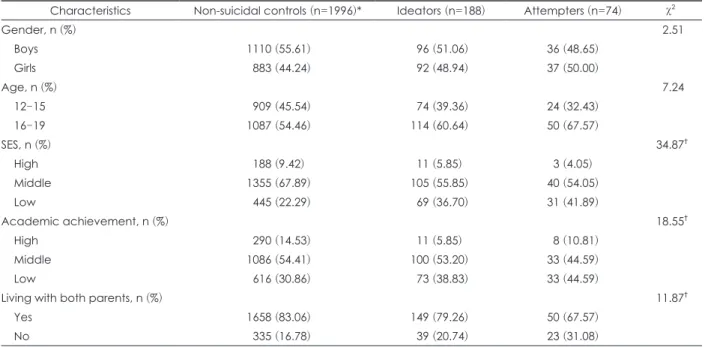
From 2258 subjects in the study, 188 subjects (8.3%) had se- riously considered committing suicide and 74 subjects (3.2%) had attempted to commit suicide in the past 12 months. Dif- ferences in demographic characteristics between the three groups, the control group with no tendency toward suicide, the suicidal ideation group, and the suicidal attempt group, are outlined in Table 1.
There was no significant difference in the gender ratio be- tween the three groups, however, the number of secondary school students was significantly higher in both the suicidal ideation group and the suicidal attempt group compared to the control group. Furthermore, there were significant differ- ences between the three groups in terms of socioeconomic status, academic achievement, and family relationship (whether the subject was living with both parents together).
Residual structure analysis showed that the suicidal ideation
group and the suicidal attempt group had more subjects that
reported a perceived low socioeconomic status. For the aca-
demic achievement, the control group had more reports of a
high level of achievement compared to the other two groups,
while the suicidal ideation group had few subjects reporting a high level of achievement. The suicidal attempt group exhib- ited the highest frequency of a low level of academic achieve- ment among the three groups. Moreover, there were signif- icant differences among the groups regarding the family relationship (whether the subject lived with both parents to- gether). The control group had a significantly lower number of single-parent families compared to the other two groups, while the suicidal attempt group had a significantly higher frequency of single-parent families compared to the other two groups.
Differences in psychosocial factors among the three groups
The assessment outcome of differences in psychosocial fac- tors among the three groups is outlined in Table 2. There were significant differences among the groups for every fac- tor assessed, while there was no significant difference be- tween the characteristics of the suicidal ideation and the sui- cidal attempt group. Both the suicidal ideation and attempt groups exhibited a higher frequency of depression and im- pulsivity, negative feedback on the family relationship, a low level of perceived social support from teachers, a higher level of perceived stress, and a more permissive attitude toward suicide compared to the control group. Meanwhile, social support from the parents was observed at its highest fre- quency in the control group, followed by the suicidal ideation and the suicidal attempt group. Support from friends was at an equal level for the control group and the suicidal ideation
group, but the suicidal attempt group exhibited the lowest level of perceived support from friends. Furthermore, school violence was observed at similar frequency in both the con- trol group and the suicidal ideation group, while the fre- quency was highest in the suicidal attempt group. Differenc- es between the three groups were observed in the following factors: self-esteem, self-harm, sexual harassment, school violence, and alcohol consumption or drug abuse. Self-esteem was highest in the control group, followed by the suicidal ide- ation group and the suicidal attempt group. Self-harm, sexu- al abuse, victim of school violence, drug abuse, and internet- related problematic behaviors were observed at the lowest frequency in the control group, followed by the suicidal ide- ation group and highest in the suicidal attempt group.
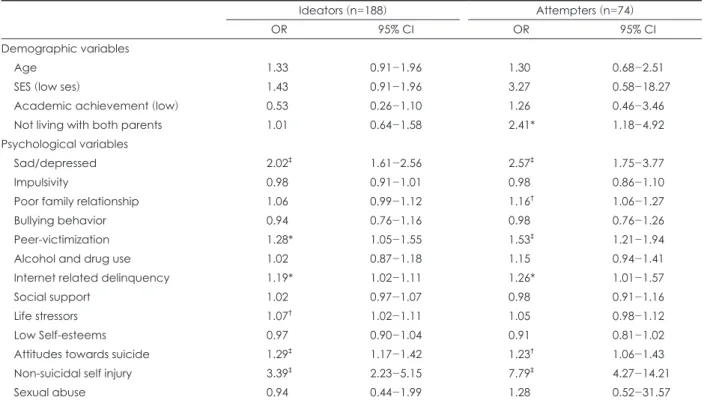
Multivariate logistic regression outcome
Table 3 shows the outcome of the multivariate logistic re- gression analysis with all factors to explore the factors that predict the suicidal ideation group and the suicidal attempt group with the control group as a reference. Compared to controls, the following factors showed a significant associa- tion with the suicidal ideation group: depression, stress from daily life, permissive attitude towards suicide, victim of school violence, internet-related problematic behaviors, and self- harm. Meanwhile, factors such as perpetrators of school vio- lence, impulsivity, family dispute, alcohol and drug abuse, socioeconomic status, academic achievement, single-parent family, and sexual assault did not show a significant associ- ation with the suicidal ideation group as an independent fac-
Table 1. Sociodemographic data of ideators, attempters, and non-suicidal controls
Characteristics Non-suicidal controls (n=1996)* Ideators (n=188) Attempters (n=74) χ2
Gender, n (%) 2.51
Boys 1110 (55.61) 96 (51.06) 36 (48.65)
Girls 883 (44.24) 92 (48.94) 37 (50.00)
Age, n (%) 7.24
12-15 909 (45.54) 74 (39.36) 24 (32.43)
16-19 1087 (54.46) 114 (60.64) 50 (67.57)
SES, n (%) 34.87†
High 188 (9.42) 11 (5.85) 3 (4.05)
Middle 1355 (67.89) 105 (55.85) 40 (54.05)
Low 445 (22.29) 69 (36.70) 31 (41.89)
Academic achievement, n (%) 18.55†
High 290 (14.53) 11 (5.85) 8 (10.81)
Middle 1086 (54.41) 100 (53.20) 33 (44.59)
Low 616 (30.86) 73 (38.83) 33 (44.59)
Living with both parents, n (%) 11.87†
Yes 1658 (83.06) 149 (79.26) 50 (67.57)
No 335 (16.78) 39 (20.74) 23 (31.08)
*missing values are within the 0.001-0.004% range, †p<0.01. SES: socioeconomic status
tor from the regression analysis.
Similarly, there was no significant difference between the suicidal ideation and the suicidal attempt group. Compared to the control group, factors showing a significant association were depression, permissive attitude towards suicide, self- harm, victim of school violence, and internet-related prob-
lematic behaviors. Stress from daily life showed a significant association with the suicidal ideation group compared to the control group, but did not show a significant association with the suicidal attempt group. Moreover, the suicidal attempt group had a higher frequency of single-parent families and family disputes.
Table 2. Psychosocial characteristics of three groups 1. Non-suicidal controls
(n=1996)
2. Ideators (n=188)
3. Attempters
(n=74) F/χ2 Post-hoc
Mean (SD) Mean (SD) Mean (SD)
Depressive symptoms 0.33 (0.59) 0.94 (0.80) 1.26 (0.79) 154.99* 1<2,3
Impulsivity 6.63 (2.46) 7.61 (2.40) 8.18 (2.56) 27.42* 1<2,3
Poor Family relationship 14.44 (3.30) 16.53 (3.61) 17.84 (4.08) 66.01* 1<2,3
Social support_parents 9.69 (1.65) 9.05 (1.67) 8.43 (2.01) 31.52* 1>2>3
Social support_teachers 8.70 (1.90) 7.93 (1.93) 8.32 (2.17) 14.93* 1>2,3
Social support_peers 9.21 (1.67) 8.85 (1.78) 8.25 (2.35) 14.43* 1,2>3
Bullying behavior 3.20 (0.74) 3.40 (0.98) 4.11 (2.38) 43.25* 1,2<3
Peer-victimization 3.13 (0.66) 3.45 (0.99) 4.19 (2.12) 76.03* 1<2<3
Alcohol/drug use 2.50 (1.09) 2.80 (1.26) 3.57 (1.98) 35.04* 1<2<3
Internet related delinquency 2.39 (0.82) 2.80 (1.20) 3.34 (1.88) 54.62* 1,2<3
Life stressors 20.63 (5.28) 25.50 (5.17) 27.18 (5.80) 120.49* 1<2,3
Self-esteems 15.34 (2.70) 13.51 (2.92) 12.34 (3.19) 76.80* 1>2>3
Attitudes towards suicide 9.63 (2.66) 11.71 (2.78) 11.83 (2.28) 73.28* 1<2,3
Non-suicidal self injury (%) 128 (6.4) 57 (30.3) 41 (55.4) 284.07* 1<2<3
Sexual abuse (%) 38 (1.9) 14 (7.4) 13 (17.6) 77.58* 1<2<3
*p<0.001. SD: standard deniation
Table 3. Multinomial analysis of ideators and attempters compared with non-suicidal controls
Ideators (n=188) Attempters (n=74)
OR 95% CI OR 95% CI
Demographic variables
Age 1.33 0.91-1.96 1.30 0.68-2.51
SES (low ses) 1.43 0.91-1.96 3.27 0.58-18.27
Academic achievement (low) 0.53 0.26-1.10 1.26 0.46-3.46
Not living with both parents 1.01 0.64-1.58 2.41* 1.18-4.92
Psychological variables
Sad/depressed 2.02‡ 1.61-2.56 2.57‡ 1.75-3.77
Impulsivity 0.98 0.91-1.01 0.98 0.86-1.10
Poor family relationship 1.06 0.99-1.12 1.16† 1.06-1.27
Bullying behavior 0.94 0.76-1.16 0.98 0.76-1.26
Peer-victimization 1.28* 1.05-1.55 1.53‡ 1.21-1.94
Alcohol and drug use 1.02 0.87-1.18 1.15 0.94-1.41
Internet related delinquency 1.19* 1.02-1.11 1.26* 1.01-1.57
Social support 1.02 0.97-1.07 0.98 0.91-1.16
Life stressors 1.07† 1.02-1.11 1.05 0.98-1.12
Low Self-esteems 0.97 0.90-1.04 0.91 0.81-1.02
Attitudes towards suicide 1.29‡ 1.17-1.42 1.23† 1.06-1.43
Non-suicidal self injury 3.39‡ 2.23-5.15 7.79‡ 4.27-14.21
Sexual abuse 0.94 0.44-1.99 1.28 0.52-31.57
*p<0.05, †p<0.01, ‡p<0.001. CI: confidence interval, OR: odds ratios, SES: socioeconomic status
Multivariate logistic regression analysis using the suicidal ideation group as a reference group showed that the suicidal attempt group had a higher frequency of single-parent fami- lies, family disputes, and self-harm compared to the suicidal ideation group.
DIsCUssION
This study aimed to identify the factors associated with sui- cidal ideation and attempt using a community-level adoles- cent student sample. From the cohort, 8.3% of the subjects had seriously considered committing suicide in the past 12 months, and 3.2% of the subjects attempted suicide. A pre- vious study on Korean adolescents had reported that 12.2%
had seriously considered committing suicide and 2.4% had attempted suicide in the past 12 months.
20)Depression was highly associated with both suicidal ideation and attempt, in agreement with the previous study on adolescent suicide.
5)These results emphasize that an accurate assessment of de- pression and interventions to relieve depression are priorities in preventing adolescent suicide in general. Furthermore, both victims of school violence and excessive internet usage were significantly associated with both suicidal ideation and attempt, once again supporting the findings in previous studies.
11,21,22)On the other hand, alcohol consumption and smoking, which were identified as important factors in pre- vious studies, were not independently associated with suicidal ideation or attempt.
9)This indicates differences in the risk fac- tors of suicide for adolescents from Western countries and from Korea. These outcomes reflect recently highlighted is- sues with internet or smartphone usage affecting the quality of life in Korean adolescents,
23)and further studies on the negative effects of not only alcohol abuse or smoking, but also internet addiction, are crucial to understanding the associa- tion with suicide in adolescents.
In this study, a permissive attitude toward suicide was in- dependently associated with both suicidal ideation and at- tempt, in agreement with a previous study in adults.
24)More- over, another study reported that Korean university students had a more permissive attitude toward suicide than Ameri- can students.
18)Despite a media guide for suicide reporting which must be followed as a nationwide suicide prevention strategy to prevent copycat suicide and negative influences, Korean public media is still showing detailed reports of sui- cide cases. Websites for suicide have also been identified as a social issue.
25)Considering that adolescents are more sen- sitive to the effects of suicidal reporting in the media, a per- missive message or beautification of suicide must be prevent- ed. In addition, preventive measures including an educational program at the school level, a strict media guide for suicidal
reporting, and a public campaign must be taken to treat ad- olescents in danger of suicidal ideation or attempts.
As previously shown in the study by Muehlenkamp and Gutierrez
26)self-harm was significantly associated with both suicidal ideation and attempts. Furthermore, in this study, the degree of self-harm aided in differentiating the adolescents with suicidal ideation from the adolescents with suicidal at- tempts. The Interpersonal Theory of Suicide
27)suggests that when an individual is repeatedly exposed to physical suffer- ing and fear, he or she obtains suicide potential eventually leading to suicidal attempts. A previous longitudinal study on Taiwanese adolescents showed that predictive factors of self-harm and suicidal attempts are similar, and depression is the key common factor.
28)Considering these findings, a comprehensive analysis of self-harm and suicidal action as well as active interventions against self-harm in adolescents must be performed in order to prevent adolescent suicide.
From the findings of this study, factors that differentiate the subjects with suicidal ideation from the subjects with ac- tual suicide attempts were family relationships and family disputes, in addition to self-harm. Several previous studies have shown that divorced parents and disputes with parents are predictive factors of suicidal attempts in their children.
29-31)Family relationships not only have continuous effects on cognitive and emotional development of adolescents,
32)but are also associated with the recurrence of depressive symp- toms.
33)On the other hand, stressful events or impulsivity were not sufficient to distinguish the subjects with suicidal ideation from those with actual suicide attempts. These re- sults suggest that for an adolescent subject to reach the level of suicidal attempt, stable and continuous family-related factors are more important than stressful events or individ- ual characteristics. In addition, the importance of a stable family relationship in the prevention of suicidal ideation de- veloping into a suicidal attempt is highlighted. Therefore, ad- olescents with a negative family background must be care- fully attended to, and preventive interventions, including therapies to reduce the psychological stress from family re- lationships and to improve family relationships, should be considered as a comprehensive factor of suicide prevention.
There are a few limitations in this study that must be over- come in future studies. First, suicide-related factors in this study were assessed using a single question for both suicidal ideation and attempt, and therefore there were difficulties in the identification of a suicidal action. In addition, the at- tempt for a comprehensive analysis of various factors allowed only a few questions from each scale to be used for the survey.
Second, although we have used a logistic regression to iden-
tify the risk factors of suicide in adolescents, the study is lim-
ited by its cross-sectional nature. Future studies should focus
on a long-term follow-up to identify a causal relationship be- tween the risk factors and suicidal ideation and attempts.
Third, although several factors associated with suicide were identified, their complex interactions could not be explored.
Nevertheless, this study included an adolescent sample co- hort of a large community and explored risk factors of suicid- al ideation and attempt in a comprehensive manner. In addi- tion, family-related factors and self-harm were identified as novel risk factors of suicidal attempts among various factors.
CONCLUsION
In summary, individual factors, such as depression, stress, high-risk behaviors, internet addiction, and self-harm, and complex psychosocial factors, such as a permissive attitude toward suicide, work together to develop suicidal ideation in adolescents. Furthermore, factors such as the absence of parents, family disputes, and self-harm lead to the progres- sion from suicidal ideation to suicidal attempt. Considering these findings, the assessment of suicidal risk in adolescents should focus on family-related factors, while early-stage in- tervention against self-harm is crucial for the prevention of suicide. In the future, parents and teachers should recognize and pay attention to these risk factors of suicide, while the establishment and enforcement of preventive measures tar- geting the key risk factors are required to reduce the suicide rate in Korean adolescents.
Conflicts of Interest
The authors have no financial conflicts of interest.
REFERENCEs
1) Korean National Statistical Office. Annual report on the cause of death statistics; 2006-2017 [online] [cited 2017 Sep 22]. Available from URL:http://kostat.go.kr/wnsearch/search.jsp.
2) Crosby AE, Sacks JJ. Exposure to suicide: incidence and association with suicidal ideation and behavior: United States, 1994. Suicide Life Threat Behav 2002;32:321-328.
3) Cavanagh JT, Carson AJ, Sharpe M, Lawrie SM. Psychological au- topsy studies of suicide: a systematic review. Psychol Med 2003;33:
395-405.
4) King CA, Merchant CR. Social and interpersonal factors relating to adolescent suicidality: a review of the literature. Arch Suicide Res 2008;12:181-196.
5) Hawton K, Saunders KE, O’Connor RC. Self-harm and suicide in adolescents. Lancet 2012;379:2373-2382.
6) Johnson JG, Cohen P, Gould MS, Kasen S, Brown J, Brook JS.
Childhood adversities, interpersonal difficulties, and risk for sui- cide attempts during late adolescence and early adulthood. Arch Gen Psychiatry 2002;59:741-749.
7) Allberg WR, Chu L. Understanding adolescent suicide: correlates in a developmental perspective. School Counselor 1990;37:343-350.
8) Allebeck P, Allgulander C. Suicide among young men: psychiatric illness, deviant behaviour and substance abuse. Acta Psychiatr Scand 1990;81:565-570.
9) Brent DA, Perper JA, Moritz G, Allman C, Friend A, Roth C, et al.
Psychiatric risk factors for adolescent suicide: a case-control study.
J Am Acad Child Adolesc Psychiatry 1993;32:521-529.
10) Rich CL, Young D, Fowler RC. San Diego suicide study: I. young vs.
old subjects. Arch Gen Psychiatry 1986;43:577-582.
11) Kim JY, Lee KY. A study on the influence of school violence on the adolescent’s suicidal ideation. Korean J Youth Stud 2010;17:121- 12) Kim JR, Kim HS. The influence of family violence and school vio-149.
lence on suicidal implses in adolescents. Health and Social Welfare Review 2014;34:310-333.
13) Hu MY. A study for the development and validation of an inven- tory for parenting behavior perceived by adolescents. Korean J Youth Counsel 2004;12:170-189.
14) Yu J, Seo MJ, Park J. The relationship between childhood trauma experience and parent-adolescent reports of problem behavior: com- parison of delinquent and general adolescent. J Korean Acad Child Adolesc Psychiatry 2013;24:36-43.
15) Kim DY, Oh OS, Kim SB. Mediating effect of self-efficacy between social support and career maturity among high school students.
Korean J Youth Stud 2012;19:71-91.
16) Lee SR, Lee WH, Park JS, Kim SM, Kim JW, Shim JH. The study on reliability and validity of Korean version of the Barratt Impul- siveness scale-11-revised in nonclinical adult subjects. J Korean Neuropsychiatr Assoc 2012;51:378-386.
17) Chi EJ, Kim MS, Kim JE, Park JY. A study on mental health im- provement policy for children and adolescents: current state of men- tal health enhancement policy and future plan. Seoul: National Youth Policy Institute;2011. p.3-8.
18) Jeon BJ. Self-esteem: a test of its measurability. Yonsei Nonchong 1974;11:107-130.
19) Park JI, Kim YJ. Factor structure of Korean version of attitudes toward suicide (ATTS-20). Ment Health Soc Work 2014;42:91-113.
20) Korea Centers for Disease Control and Prevention. National ado- lescent health behavior survey. Chungbuk: KCDC;2016 [cited 2016 Dec 30]. Available from URL: Available from URL: http://
www.cdc.go.kr/CDC/contents/CdcKrContentView.jsp?cid=77749
&menuIds=HOME001-MNU1130-MNU2393-MNU2749.
21) Ryu EJ, Choi KS, Seo JS, Nam BW. The relationships of internet addiction, depression, and suicidal ideation in adolescents. Taehan Kanho Hakhoe Chi 2004;34:102-110.
22) Kim K, Ryu E, Chon MY, Yeun EJ, Choi SY, Seo JS, et al. Internet addiction in Korean adolescents and its relation to depression and suicidal ideation: a questionnaire survey. Int J Nurs Stud 2006;43:
185-192.
23) So SS, Myung JS, Kim CS. A study of predicting variables for in- ternet addiction in adolescence. Korean J Health Psychol 2011;16:
521-535.
24) Limbacher M, Domino G. Attitudes toward suicide among attempt- ers, contemplators and non-attempters. Omega (Westport) 1986;16:
325-334.
25) Lee HJ. Youth harmful site, provide suicide method #1. Medical today Post 2010 Aug 9.
26) Muehlenkamp JJ, Gutierrez PM. Risk for suicide attempts among adolescents who engage in non-suicidal self-injury. Arch Suicide Res 2007;11:69-82.
27) Joiner TE, Van Orden KA. The interpersonal-psychological theory of suicidal behavior indicates specific and crucial psychotherapeu- tic targets. Int J Cogn Ther 2008;1:80-89.
28) Huang YH, Liu HC, Sun FJ, Tsai FJ, Huang KY, Chen TC, et al. Re- lationship between predictors of incident deliberate self-harm and suicide attempts among adolescents. J Adolesc Health 2017;60:
612-618.
29) Alonzo D, Thompson RG, Stohl M, Hasin D. The influence of pa- rental divorce and alcohol abuse on adult offspring risk of lifetime suicide attempt in the United States. Am J Orthopsychiatry 2014;84:
316-320.
30) Bridge JA, Goldstein TR, Brent DA. Adolescent suicide and suicid- al behavior. J Child Psychol Psychiatry 2006;47:372-394.
31) Keller PS, Cummings EM, Davies PT. The role of marital discord and parenting in relations between parental problem drinking and child adjustment. J Child Psychol Psychiatry 2005;46:943-951.
32) Dunn VJ, Abbott RA, Croudace TJ, Wilkinson P, Jones PB, Herbert
J, et al. Profiles of family-focused adverse experiences through childhood and early adolescence: The ROOTS project a communi- ty investigation of adolescent mental health. BMC Psychiatry 2011;
11:109.
33) Birmaher B, Arbelaez C, Brent D. Course and outcome of child and adolescent major depressive disorder. Child Adolesc Psychiatr Clin N Am 2002;11:619-637.