DOI : 10.3341/jkos.2008.49.6.1013
백내장수술 전 구후마취 직후 발생한 망막중심동맥과 중심정맥의 폐쇄 1예
임한웅․고병우․송유미․박영숙․이병로 한양대학교 의과대학 안과학교실
목적 : 백내장수술 전 구후마취 주사 직후 발생한 망막중심동맥과 중심정맥폐쇄에 대하여 보고하고자 한다.
증례 요약 : 4일 전 좌안의 초음파수정체유화술 및 인공수정체 삽입술을 받은 62세 여자 환자가 전원되었다. 시력은 좌안 안전수지였고 구심성동공장애가 관찰되었으며 안저 검사상 후극부에 불규칙한 형태의 점상 및 원형출혈과 부분적 으로 선형의 다양한 망막출혈이 산재되어 있었다. 형광안저촬영상 비측 및 이측의 분지동맥들은 형광이 전혀 충만되지 않았고, 정맥도 충만이 매우 지연되어 있었다. 2주 후 좌안 시력은 안전수동이고, 안압은 좌안 10 mmHg이었다. 안 저검사상 후극부 망막출혈은 크기와 양이 좀 더 증가하였고 황반의 창백한 부종은 지속되었다. 형광안저촬영에서 비측 및 이측의 분지동맥과 정맥들은 여전히 형광이 충만되지 않았고, 안저 전체의 모세혈관비관류가 더욱 뚜렷해졌다. 2개 월 후 시력은 좌안 안전수동이고, 안압은 좌안 35 mmHg, 신생혈관녹내장이 합병되었다.
결론 : 본 환자를 통해 수술 전 구후마취 시 심각한 망막중심혈관의 폐쇄가 일어날 수 있음을 알 수 있으며 좀 더 안전
한 구후마취 주사방법이 연구되어야 할 것으로 사료된다.
<한안지 49(6):1013-1017, 2008>
<접수일 : 2007년 4월 17일, 심사통과일 : 2008년 5월 22일>
통신저자 : 이 병 로
서울시 성동구 행당1동 한양대학교병원 안과
Tel: 02-2290-8570, Fax: 02-2291-8517 E-mil: [email protected]
* 본 논문의 요지는 2005년 대한안과학회 제94회 추계학술대회 에서 포스터로 발표되었음.
구후마취 주사법은 안내 수술 시에 흔하게 사용되는 마취 방법으로 대개 효과적이고 안전하지만, 구후출혈 이나 시신경손상, 안구천공, 망막혈관폐쇄, 심정지, 호 흡억제, 중추신경계억제, 발작과 같은 심각한 합병증이 일어날 수 있는 가능성이 있다.1-4 특히 그 중에서 구후 마취 주사 후 망막중심동맥과 중심정맥의 폐쇄가 일어 난 예는 1983년 Sullivan et al5에 의해 3예가 보고 되었고, 그 후 1990년 Mieler et al6이 1예, 1995년 Giuffere et al7이 1예, 2005년 Torres et al8이 2 예를 보고하였으며, 국내에서는 아직 보고된 바가 없다.
저자들은 백내장수술 전 구후마취 주사 직후 발생한 망 막중심동맥과 중심정맥폐쇄를 경험하여 보고하고자 한다.
증례보고
62세 여자 환자가 2004년 5월 타병원에서 좌안의 초음파수정체유화술 및 인공수정체 삽입술을 받고, 수 술 4일째 본원에 전원되었다. 환자는 수술 직후부터 좌 안의 심한 시력저하가 있었다고 하였다. 내원당시 시력 은 우안 0.7, 좌안 안전수지였으며 교정되지 않았고, 안압은 우안 15 mmHg, 좌안 8 mmHg이었다. 우안 의 경우 수개월전 초음파수정체유화술 및 인공수정체 삽입술을 받았고, 전안부 및 후안부 모두 특이 소견 없 었다. 좌안에서는 하안검 주위에 피하출혈이 관찰되었 고, 결막하출혈이 있었으며, 구심성동공장애가 관찰되 었다.
좌안의 각막은 정상소견이었고, 전방에는 염증세포 가 trace로 관찰되었다. 인공수정체는 수정체낭 내에 잘 위치해 있었고, 후낭파열 등의 이상소견은 없었다.
좌안의 안저 검사상 후극부에는 불규칙한 형태의 점상 및 원형출혈과 부분적으로 선형의 다양한 망막출혈이 산재되어 있었다. 이측 상하혈관궁 안쪽으로 황반부는 창백하게 혼탁, 심한 부종이 있었고, 앵두반점이 관찰 되었다. 망막혈관은 뒤틀림은 없었지만, 전반적으로 동 맥을 포함하여 좁아져 있었다. 형광안저촬영상 비측 및 이측의 분지동맥들은 형광이 전혀 충만되지 않았고, 정
= 증례보고 =
7
Figure 1. Fundus photography and fluorescein angiography were performed 4 days after the cataract operation; (A) Fundus photograph reveals retinal whitening, large dot blot hemorrhages, macular edema, and cherry red spot; (B, C, D) Fluorescein angiographs reveal markedly delayed filling of the retinal artery and vein (B, early phase), multiple second‐order arteriolar occlusion, extensive retinal nonperfusion, dense hypofluorescent dots related to retinal hemorrhage and late staining of the optic disc. (C, mid phase; D, late phase)
맥도 충만이 매우 지연되어 있었다. 시신경유두를 중심 으로 전반적으로 망막모세혈관의 비관류가 관찰되었다. 후 기에는 시신경유두부에서 과형광이 나타났다(Fig. 1).
MRI 검사상 좌안의 구후출혈은 없었고, 시신경 주 위에 특이소견 관찰되지 않았다(Fig. 2). 환자 고혈압 있어 현재 혈압약 복용 중이었고, 혈액응고검사는 정상 범위였고, 지질검사 상 TG 312 mg/dl, LDL 126 mg/dl으로 증가되어 있었다.
2주 후 우안시력은 동일했지만, 좌안시력은 안전수 동으로 좀 더 악화되었고, 안압은 좌안 10 mmHg이었 다. 안저 검사상 우안은 변화가 없었으나 좌안의 후극
부 망막출혈은 크기와 양이 좀 더 증가하였고 황반의 창백한 부종은 지속되었다. 형광안저촬영에서 비측 및 이측의 분지동맥과 정맥들은 여전히 형광이 충만되지 않았고, 안저 전체의 모세혈관비관류가 더욱 뚜렷해졌 다. 후기의 시신경유두부 과형광은 약간 감소한 상태였 다(Fig. 3).
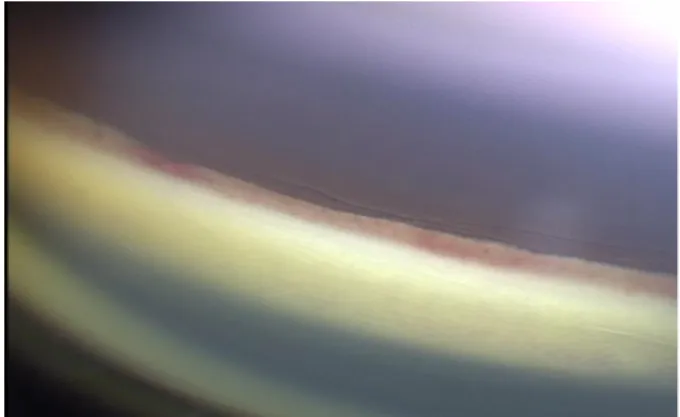
2 개월 후 시력은 좌안 안전수동으로 개선되지 않았 고, 안압은 우안이 15 mmHg, 좌안은 35 mmHg으 로 매우 증가되어 있었다. 좌안의 홍채와 우각에는 신 생혈관이 생성되어 있었으며, 신생혈관녹내장이 합병되 어 있었다(Fig. 4).
Figure 4. The anterior angle of the left eye on postoperative 11 weeks. Note the neovascularization of the angle.
Figure 2. T1-weighted axial spin-echo nuclear MRI was performed 4 days after the cataract operation. It doesn’t show asymmetry of the optic nerve sheaths.
7
Figure 3. Fundus photography and fluorescein angiography were performed 18 days after the cataract operation; (A) Fundus photographs reveal persistent retinal whitening, increased preretinal hemorrhages and macular edema; (B, C, D) Fluorescein angiographs reveal increased extensive retinal nonperfusion and increased dense hypofluorescent dots related to retinal hemorrhage.
고 찰
안내 수술시에 많이 사용되는 구후마취 주사법은 드 물지만 여러 심각한 합병증을 일으켜 망막과 시신경에 손상을 입힐 수 있다.1-4 특히 구후마취 주사 후에 발생한 망막중심동맥과 중심정맥의 폐쇄는 1983년 Sullivan et al5에 의해 보고된 이후 여러 차례 보고되었다.
망막중심동맥과 망막중심정맥의 폐쇄는 임상적으로 산재된 망막내출혈, 경한 크림 색깔의 후극부, 좁고 불 규칙적인 망막소동맥, 확장되고 구불거리는 망막정맥의 특징을 보인다.9 이러한 특징은 망막중심동맥과 중심정 맥을 클램프하여 인위적으로 폐쇄시킨 실험에서도 비슷 한 결과를 볼 수 있다.10,11
구후마취 주사 후 망막중심동맥과 중심정맥이 폐쇄 되는 기전을 살피면 첫번째로 구후마취 주사로 시신경 의 연막혈관이 뚫려 시신경초 내로의 출혈이 발생하는 것이다. 이러한 시신경초 내로의 출혈은 자기공명영상 과 B-scan으로 시신경의 구후부의 확대가 관찰되는 것으로 확인할 수 있다. 신경초 내로의 출혈로 인한 압 력상승으로 정맥유출이 막히게 되고 이러한 기계적인 압박은 중심망막정맥을 폐쇄하여 출혈성망막병증을 일 으키는데 술전 저안압상태를 만들기 위한 안구 압박은 정맥혈저류를 더욱 야기시킨다. 후기의 갑작스런 시력 상실은 혈관종의 계속적인 크기 증가로 시신경초 내의 압력이 상승하여 망막중심동맥이 폐쇄로 인한 것이며 전신고혈압이 있을 시에 관류압의 하강으로 더욱 악화 될 수 있다.7 두번째 기전으로 구후마취 주사 시에 마취 제의 시신경 내로의 주입이 있다. 이러한 주입으로 시 신경과 안구에 국소적인 영향이 미쳐지는데 망막중심동 맥과 중심정맥의 폐쇄, 시신경유두부종, 망막하공간으 로의 공기, 액체 유입, 망막동맥의 색전증 등이 나타날 수 있다.2,5,12,13 시신경을 따라 마취제가 국소적인 압박 효과를 나타내 망막중심동맥과 정맥이 폐쇄되게 되는데 이러한 국소 압박 효과는 초음파나 컴퓨터단층촬영에서 시신경의 확장 등의 소견이 나타나지 않는데 이는 마취 제가 빠르게 흡수되거나 시신경초에 남아있기 때문이 다.6 망막중심동맥과 중심정맥은 정수압 차이로 인하여 기계적인 압박으로 먼저 정맥이 막히고 동맥이 다음으 로 막히게 되는데 이 때문에 광범위한 출혈 소견이 나 타나게 된다. 만약 망막중심동맥폐쇄가 먼저 일어난다 면 망막혈관계의 혈류 부족으로 망막중심정맥의 광범위 한 출혈 소견이 나타나지 않게 된다.7
본 증례의 환자는 구후마취 주사 직후 망막중심동맥 과 중심정맥이 함께 폐쇄된 소견으로, MRI 소견상 시 신경 주위에 혈종 등의 이상 소견은 발견되지 않았으며 시력소실이 심하고 영구적이며, 시신경 부종이 관찰되
는 것으로 보아 여러 발생기전 중에서, 마취제의 시신 경초 내로의 주사에 의해 망막중심혈관 폐쇄가 발생한 것으로 추정된다. 망막의 백색반점, 망막출혈 및 유두 부종과 함께 갑작스런 시력 상실을 보이는 푸르처망막 병증과의 감별을 요하나, 광범위한 비관류, 영구적인 시력 소실, 신생혈관녹내장의 발생으로 인하여 감별 가 능하다.
망막중심정맥폐쇄의 특징적 소견인 광범위하게 산재 된 망막출혈이 관찰되어 아마도, 정맥폐쇄가 먼저 발생 하고, 직후에 동맥폐쇄가 생긴 것으로 추정되며, 이는 망막중심동맥폐쇄가 먼저, 혹은 동시에 생겼다면 공급 혈액의 부족으로 출혈성 망막증 소견은 관찰 되지 않았 을 것이기 때문이다.
본 증례를 통하여 수술 전 구후마취 시 합병증으로 망막중심혈관의 폐쇄가 올 수 있음을 알 수 있으며 따 라서 구후마취 시 정확한 술기와 세밀한 주의가 필요함 은 물론 좀 더 안전한 구후마취 주사방법이 연구되어야 할 것으로 생각된다.
참고문헌
1) Feibel RM. Current concepts in retrobulbar anesthesia. Surv Ophthalmol 1985;35:102-10.
2) Morgan CM, Schartz H, Vine AK, et al. Ocular complications associated with retrobulbar injections. Ophthalmology 1988;95:
660-5.
3) Rosenblatt RM, May DR, Barsoumian K. Cardiopulmonary arrest after retrobulbar block. Am J Ophthalmol 1980;90:425-7.
4) Nicoll JM, Acharya PA, Ahlen K, et al. Central nervous system complications after 6,000 retrobulbar block. Anesth Analg 1987;66:1298-1302.
5) Sullivan KL, Brown GC, Forman AR, et al. Retrobulbar anesthesia and retinal vascular obstruction. Ophthalmology 1983;90:373-7.
6) Mieler WF, Bennett SR, Platt LW, et al. Localized retinal detachment with combined central retinal artery and vein occlusion after retrobulbar anesthesia. Retina 1990;10:278-83.
7) Giuffre G, Vadala M, Manfre L. Retrobulbar anesthesia complicated by combined central retinal vein and artery occlusion and massive vitreoretinal fibrosis. Retina 1995;15:
439-41.
8) Torres RJ, Luchini A, Weis W, et al. Combined central retinal vein and artery occlusion after retrobulbar anesthesia. Arq Bras Oftalmol 2005;68:257-61.
9) Jorizzo AO, Klein ML, Shutts WT, Linn ML. Visual recovery in combined central retinal artery and central retinal vein occlusion. Am J Ophthalmol 1987;104:358-63.
10) Hayerh SS. Occlusion of the central retinal vessels. Br J Ophthalmol 1965;49:626-45.
11) Hayerh SS. Pathogenesis of occlusion of the central retinal
vessels. Am J Ophthalmol 1971;72:998-1011.
12) Pautler SE, Grizzard WS, Thompson LN, et al. Blindness from retrobulbar injection into the optic nerve. Ophthalmic Surg 1986;17:334-7.
13) Klein ML, Jampol LM, Condon PI, et al. Central retinal artery occlusion without retrobulbar hemorrhage after retrobulbar anesthesia. Am J Ophthalmol 1982;93:573-7.
=ABSTRACT=
Combined Central Retinal Vein and Artery Occlusion After Retrobulbar Anesthesia: A Case Report
Han Woong Lim, M.D., Byung Woo Ko, M.D., Yumi Song, M.D., Young Sook Park, M.D., Byung Ro Lee, M.D.
Department of Ophthalmology, College of Medicine, Hanyang University, Seoul, Korea
Purpose: To report central retinal vein and artery occlusion after retrobulbar anesthesia for a cataract operation.
Case summary: A 65-year-old woman was transferred to our facility 4 days after she had undergone cataract extraction with IOL implantation. She could count fingers and had a relative afferent papillary defect in her left eye. As seen upon fundus examination, dot-shaped, circular-shaped irregular, and partially linear-shaped retinal hemorrhages were evident. Fluorescein angiography revealed that branch arteries around the nasal and temporal areas were not filled, and that the filling of veins was delayed. After two weeks, the patient was only able to recognize hand motion, and her intraocular pressure was 10 mmHg. According to a fundus examination, the size and quantity of retinal hemorrhages increased, and a pale, macular edema was observed.
Following fluorescein angiography, the filling defect of branch vessels on the nasal and temporal areas was still evident, and the blocked fluorescence of capillaries on the fundus was prominent. After two months, she could still only recognize hand motion, and her intraocular pressure had increased to 35 mmHg; we therefore diagnosed a neovascular glaucoma.
Conclusions: A patient experienced a serious central retinal vessel occlusion after retrobulbar anesthesia for cataract extraction. Retrobulbar injections should therefore be administered with great caution to prevent this outcome.
J Korean Ophthalmol Soc 49(6):1013-1017, 2008
Key Words: Combined Central Retinal Vein and Artery Occlusion, Retrobulbar anesthesia
Address reprint requests to Byung Ro Lee, M.D.
Department of Ophthalmology, College of Medicine, Hanyang University Hospital
#Haengdang 1-dong, Seongdong-gu, Seoul 133-792, Korea
Tel: 82-2-2290-8570, Fax: 82-2-2291-8517, E-mil: [email protected]