Fabrication of Multi-Layered Graphenes/P(S- co-BA) Nanocomposite via Sudden Heating Heterocoagulation Process
JinKyu Choi, Eun-Kyoung Lee * , and Sang Eun Shim †
Department of Chemistry & Chemical Engineering, Inha University, 100 Inha-ro, Namgu, Incheon 22212, Republic of Korea
*
Department of Biomedical Science, Cheongju University, Chungju 28503, Republic of Korea (Received November 3, 2017, Revised November 21, 2017, Accepted November 24, 2017)
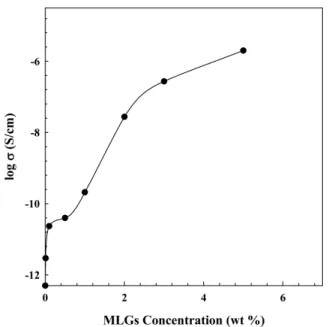
Abstract: The heterocoagulation of latex is a simple and useful method to fabricate various polymer nanocomposites in which a precise control of the colloid stability is essential. In this work, a multi-layered graphenes (MLGs)/poly(styrene- co-butyl acrylate) (P(S- co-BA)) nanocomposite having an excellent dispersion of MLGs was prepared via the sudden heat- ing heterocoagulation process. The P(S- co-BA) component was obtained by emulsion polymerization. This process can effectively shorten the process and particles growth steps. The colloid stability of these dispersions was controlled by factors such as ionic charge, temperature, and reaction times. The influence of these factors on heterocoagulation was evaluated and the properties of the nanocomposites were investigated. The conductivity of the MLGs/P(S- co-BA) nanocomposites increased from −11.53 to −5.70 S/cm for an increase in MLG content from 0.01 to 5 wt%. Moreover, percolation threshold was observed in the case of 0.01 wt% MLGs.
Keywords: multi-layered graphene, latex, sudden heating heterocoagulation process, percolation threshold, electrical con- ductivity
Introduction
Agglomeration of latex is the fundamental method used in various processes such as pigment formulation, water puri- fication, and drug delivery system, etc. These processes are indispensable to have a precise control over the colloid sta- bility and they are of technical as well as scientific impor- tance. The colloid stability of these dispersions is controlled by factors such as particle diameter, ionic charge, and the concentration of stabilizers.
1Colloidal particle properties, agglomeration action, mutual interaction, and charging effects have been studied well among spherical particles, rods, and spheres. However, they still have challenging problems.
2-6Aqueous dispersions of charged colloids have been the goal of strong investigations recently. Different composites have been prepared by heterocoagulation on the surfaces between small latex particles having a low T
gand large poly- mer particles having a high T
g. But their charges are opposite each other.
7,8Heterocoagulation generate a stable composite particle that is driven by electrostatic interactions of oppo- sitely charged materials. Composite particles with well-defined
morphologies can be made via heterogoagulation process either by engulfment or complete encapsulation.
9,10Various carbonaceous materials including graphene, car- bon nanotube, diamond, graphite, and buckyball have been researched in diverse regions of nanomaterial.
11So far, car- bon-based materials have been applied to nanocomposites, field effect transistors, quantum devices, chemical-bio sen- sors, and so on.
12-14But most of all, graphene is a remarkable material for a zero-bandgap semiconductor giving electric field effect.
15Electric characters of graphene were investi- gated about the transport of relativistic Dirac fermions, spin transports, bipolar supercurrents, and quantum Hall effects at room temperature for a few years.
16-18It has been applied to other fields as in ambipolar field effect transistor, ultrasen- sitive gas sensor, gate controlled p-n junction, nanoribbon, and building block for carbon-based integrated nanoelec- tronics, etc.
19-21It is difficult to niformly disperse MLGs in host matrices as a filler in polymers because MLGs tend to easily self- agglomerate by strong van der Waals force.
22The adhesion and wettability with matrix must be maximized to solve this self-agglomeration problem which can be accomplished by
†