1
치과위생사의 감염 예방 실태 조사
남영신†·류정숙1·박명숙1
†아주대학교병원
1극동정보대학 치위생과
A Study on Actual Conditions for Prevention of Infections by Dental Hygienists Young-Shin Nam†, Jung-Sook Yoo1 and Myung-Suk Park1
†Ajou university Hospital, suwon city, kyungki-do, 443-749, korea Ajou
1Department of Dental Hygiene, Keukdong College, Chungbuk 369-850, Korea
ABSTRACT This study aimed to provide basic information on dental hygienists' practicing the prevention of infections by figuring out their actual conditions in dental clinics. The subjects of the study were the dental hygienists who participated in the continuing medical education of Incheon & Gyeonggi-do association and Seoul city association in October and November 2005 and the self-administered surveys were used for the prevention of infections. The results were as below.
1. In terms of education experiences of infection prevention, those who answered
“there were
”were 72 persons (42.9%) and those who followed the educational route for infection prevention were
“through the in-house education from the hospital
”and they were 42 persons (58%), which were highest. 2. In terms of the injury experiences, those who answered
“
there were
”were 147 persons (87.5%) and the number of annual injury out of 147 persons with injury experiences was 7.7 time. For the tools that were damaged, 125 persons (75%) damaged the
“explorer,
”which was highest. 3. For the experiences of being infected with contagious diseases, those who answered
“there were
”were 6 persons (3.6%) and there were four persons for
“hepatitis B
”, one person for
“rubella
”and one person for
“TB.
”4. The questions with high practice scores were as in the following:
“2. I wash my hands after conducting medical examinations (1.86 points),
”“7. I always close the lid of a shot of Novocain after doing local anesthesia (1.86 points)
”and
“20. I separate and collect the wastes and give them to those who treat accumulated materials (1.85 points)
”. Meanwhile, the questions with low practice scores were as below:
“16. I change my medical gowns (doctor wears) once a day (0.24 point)
”and
“I wash my medical gowns every time after examining patients with contagious diseases (0.52 points).
”5. The question with high knowledge was as below:
“1. The contagion during the dental treatment is determined by source of infection, infection methods, infection routes and the host that is prone to infection (0.95 point)
”and the question with the lowest knowledge was
“5.
HBV(hepatitis B) is destroyed after adding 95
oC of heat for more than 5 minutes (0.27 points).
”6. The question with the highest organization-related factors was
“I am always ready to use a mask, gloves, etc. if necessary
”(0.89 points)
”and the question with the lowest score was
“There is a guideline that I can refer when I am exposed to dangerous situations related to the contagion in my workplace (0.33 point).
”7. In terms of the equipment conditions of protectors in medical environments, 168 persons for (disposable) mask (100%), 167 persons for disposable gloves (Latex) (99.4%), which meant that most of them were equipped with them. On the contrary, 108 persons (64.3%) are equipped with the protectors for frontal faces, which is the lowest and 165 persons (98.2%) said that they had autoclave in their disinfecting and sterilizing devices.
Key words Dental clinic, Pathogenic microorganism, Protection against infection
서 론
치과진료실은광범위한종류의병원성미생물에항상노출 되어있으며1)
, J. Hardie
2)은치과 진료의특성상환자의혈액 과타액안에있는매우다양한종류의세균이나바이러스등 에노출될 수있으며,
특히날카로운진료기구또는주사바늘에 찔리거나
,
노출된신체의상처를통하거나,
에어로졸 형 태의 여러 경로를통해 감염이가능하며,
또한 환자의여러 가지 분비물로인해 실내가오염될경우감염의매개장소가 될 수 있다고 보고하였다.
감염성 질환이 전파될 수있는 몇 가지 주된 경로를 살펴 보면
,
혈액또는구강분비물등의 직접적인접촉,
오염이된 기구들진료실장비와그주위표면등을통한간접적인접촉,
진료과정중구강에서발생하여액체방울이튀거나에어로졸 로 인해공기중을 떠다니는것을 포함하고있는 오염물질에 접촉하는경우들이 있다3)
.
따라서치과진료실에서감염예방†
Corresponding author Tel: 031-219-4289 Fax: 031-219-5868
E-mail: [email protected]
을위해서는치과에내원하는환자의병력을조사하거나 확인 하여환자의 전반적인건강 상태를관찰하고
,
전염성질환이 발견되었을때는즉시예방조치를취해야하며4),
장갑,
마스크,
보안경등의보호장구를 반드시착용하고
,
모든기구를 철저 히멸균하는 등 교차감염을예방하기 위해적극적으로노력 해야 한다5,6).
국내에서는
1983
년보사부에서병원감염에대한관심이높 아지면서 전염병예방지침을마련하여병원내 전염병환자의 격리치료및세균오염방지 설치등을규정화시키고있으며, 1996
년11
월병원감염관리학회에서는감염관리지침서를발간 하였다.
하지만감염예방에대한연구는아직부족한실정이다.
따라서감염예방에대한 의무와책임을가져야할의료종사 자와병원의역할이제대로이루어지고 있지않으며선행연 구를보면
,
의료종사자중에서도간호사의감염예방에대한 연구7)8)는활발히이루어지고있으나치과진료실에서환자관리,
기구및 장비의소독멸균 관리
,
진료 등 전반적인업무를수 행하는치과위생사를대상으로 한 연구는미흡한 실정이다.
이에본 연구자는치과 진료실에서치과위생사의 감염예방 지식도
,
교육경험,
조직관련요인,
진료환경,
실천도및감 염사고실태를 파악하여치과위생사가감염예방을실천하는데 기초 자료로 제공하고자 한다.
연구대상 및 방법
1. 연구 대상 및 기간
이연구는
2005
년10
월과11
월에인천경기도회와서울시회보수교육에 참여한 치과위생사를 대상으로 하였다
.
2. 연구 방법
이 연구는설문조사로하였으며
,
연구에사용된설문지는선 행연구(
조윤정외9), 2003;
유맹순10), 2002;
김수경11), 1996;
양내 원외12), 1995)
와 치과계에서의 교차 감염 방지(
오세광13),
2003)
를 참조하여연구목적에맞게작성하였으며 사전조사를실시하여설문지를수정
,
보완하였다.
자료수집방법은치과위생사를대상으로설문지
200
부를배부하여181
부를회수하 였다.
설문지는자기기입방식으로실시하였고 회수된181
부중 에누락된 설문지13
부는자료 분석에서제외하고총168
부를 사용하였다.
3. 분석 방법
이연구의자료분석은
SPSS WIN 13.0 program
을 사용하 여 빈도분석과 기술통계분석을 하였다.
결 과
1. 연구대상자의 일반적 특성
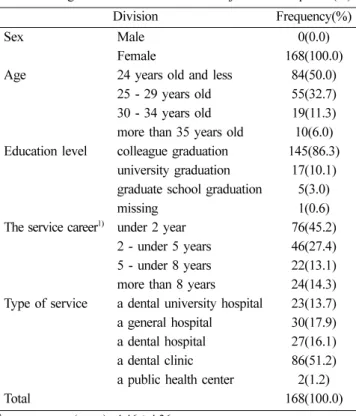
연구대상자의 일반적 특성은
Table 1
과 같다.
연령은
24
세 이하가84
명(50%)
으로 가장 많았으며, 25
세- 29
세 이하가55
명(32.7%), 30
세-34
세 이하가19
명(11.3%), 35
세이상이10
명(6.0%)
이었다.
교육수준은전문대졸이145
명(86.3%)
으로 대부분을차지하였으며대학 졸이17
명(10.1%),
대학원졸이
5
명(3.0%)
이었다.
근무경력은2
년 미만이76
명(45.2%)
으로응답자수가 가장 많았으며, 2
년-5
년 미만46
명(27.4%), 5
년-8
년미만22
명(13.1%), 8
년이상이24
명(14.3%)
이었다
.
평균근무 년수는4.5
년이었다.
근무처는치과 의원 이86
명(51.2%)
으로응답자수가가장많았으며,
종합병원30
명(17.9%),
치과병원27
명(16.1%),
대학병원23
명(13.7%),
보건 소2
명(1.2%)
순이었다.
2. 감염예방 교육경험
감염예방 교육경험은
Table 2
와 같다.
감염예방교육경험은 “있다”로응답한자가
72
명(42.9%)
이 었고,
“없다”고 응답한 자가96
명(57.1%)
이었다.
감염예방 교육경로는
Table 3
과 같다.
교육경험자에서의감염예방교육경로는 “근무병원자체교 육을 통해서”가
42
명(58%)
으로 가장많았으며,
졸업후 보수 교육28
명(39%),
졸업 전 학교 교육12
명(17%),
기타6
명(8%)
순 이었다.
Table 1.
The general characteristics of the subjects Unit: person(%)Division Frequency(%)
Sex Male 0(0.0)
Female 168(100.0)
Age 24 years old and less 84(50.0)
25 - 29 years old 55(32.7) 30 - 34 years old 19(11.3) more than 35 years old 10(6.0) Education level colleague graduation 145(86.3)
university graduation 17(10.1) graduate school graduation 5(3.0)
missing 1(0.6)
The service career1) under 2 year 76(45.2) 2 - under 5 years 46(27.4) 5 - under 8 years 22(13.1) more than 8 years 24(14.3) Type of service a dental university hospital 23(13.7) a general hospital 30(17.9) a dental hospital 27(16.1)
a dental clinic 86(51.2)
a public health center 2(1.2)
Total 168(100.0)
1)
average career(years) : 4.46 ± 4.36
Table 2.
Education experiences of infection prevention Unit: person(%) Education experiences Frequency(%)Yes 72(42.9)
No 96(57.1)
Total 168(100.0)
Table 3.
Educational route for infection prevention Unit: person(%) Educational route* Frequency(%) Through the school education before graduation 12(17) Through the supplement education after graduation 28(39) Through the in-house education from the hospital 42(58)The others 6(8)
* plural answer
3. 감염 사고 실태
감염 사고 실태는
Table 4
와 같다.
손상경험은 “있다”로응답한자가
147
명(87.5%)
이었고 “없 다”로 응답한자가21
명(12.5%)
이었다.
대상자의연 평균손 상횟수는1
회에서5
회사이가전체응답자의50%
를 차지하였으며
,
손상경험이있는대상자147
명의전체연평균손상 횟수는7.7
회였다.
감염성 질환에 감염된 경험은 “있다”로 응답한 자가
6
명(3.6%)
이었고 “없다”로응답한자가162
명(96.4%)
이였다.
감염 된경험이 있는경우의그질환으로는 “B
형 간염”이4
명으로가장 많았고
,
“풍진”1
명,
“결핵”1
명이었다.
손상시기는 “진료 후 정리할때”가 응답자수
126
명(75%)
으로 가장 많았으며 “기구 세척할 때”
73
명(43.5%),
“진료 전 준비할 때”60
명(35.7%),
“진료 중”48
명(28.6%)
의 순 이었다.
손상을 입힌 기구명은 ‘explorer
’가125(75%)
명으로가장 많았으며
,
‘bur
’79
명(47.0%),
‘needle
’73
명(43.5%),
‘file
’71
명(42.3%),
‘scaler tip
’62
명(36.9%),
‘curette
’16
명(9.5%),
‘blade
’15
명(8.9%),
‘기타’6
명(3.6%)
이었다.
손상 이유는 “부주의로 인해서”가95
명(56.5%)
으로가장많았으며,
“시간부족으로(
바 빠서)
”71
명(42.3%),
“보호장구(
장갑)
를 착용하지않아서”40
명
(23.8%),
“기타”3
명(1.8%),
“기구의 위험성인식이부족해 서”1
명(0.6%)
순 이었다.
4. 감염예방 실천도
감염예방 실천도는
Table 5
와 같다.
실천 점수가높은문항은 “
2.
나는진료 후에손을 씻는다(1.86
점)
”,
“7.
나는국소마취후 마취주사바늘뚜껑을덮는다(1.86
점)
”,
“20.
나는폐기물을 분리수거하여적출물처리업자 에게 위탁한다(1.85
점)
” 이었으며,
실천 점수가낮은 문항은“
16.
나는 진료복을하루에 한번 갈아입는다(0.24
점)
”와 “감염성 환자진료후에는진료복을 매번세탁한다
(0.52
점)
” 이었다
.
감염예방 실천을 하지 않는 이유는
Table 6
과 같다.
감염예방실천을 하지않는이유는 “번거로워서”가
108
명(64.3%),
“진료시간이연장되기때문에”가82
명(48.8%)
으로많 았고 “기타”31
명(18.5%),
“비용이많이들기 때문에”가29
명(17.3%),
“관심이 없어서”가4
명(2.4%)
이였다.
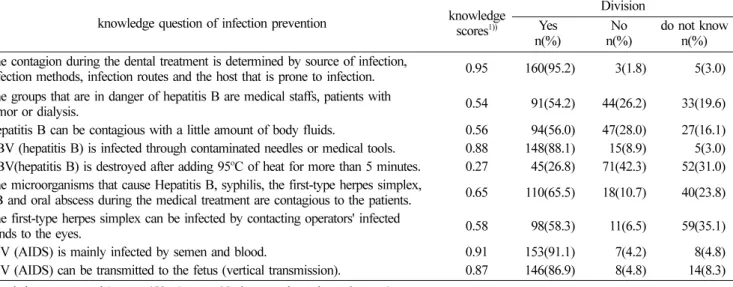
5. 감염예방 지식도
감염예방 지식도는
Table 7
과 같다.
지식도가 가장 높은 문항은 “
1.
치과 진료를하는 동안에 전염은 감염원,
전염방법,
전염경로,
감염되기쉬운숙주에 의해 좌우 된다
(0.95
점)
”이었으며 지식도가 가장 낮은 문항은“
5. HBV(B
형간염)
는95
oC
에서5
분이상가열해야 파괴된다(0.27
점)
” 이였다.
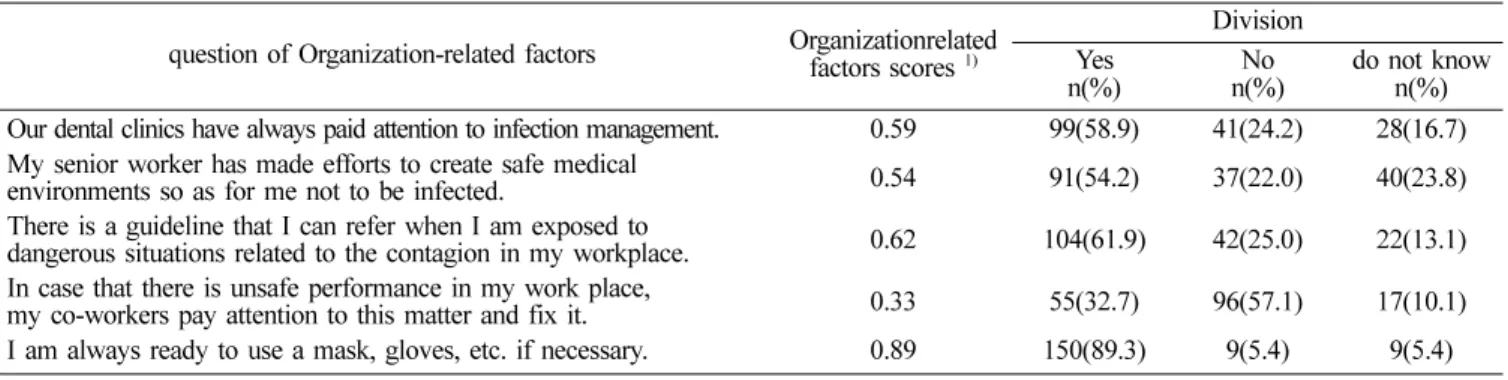
6. 조직 관련 요인
조직 관련 요인은
Table 8
과 같다.
점수가 가장높은 문항은 “나는 필요한경우 마스크
,
장갑등의보호장구가항상이용가능하다
(0.89
점)
” 이었으며조직관련 요인중에서가장점수가낮은 문항은 “내가 일하는곳 에는 감염과관련된위험한상황에노출되었을때 참고할수 있는 지침서가 있다
(0.33
점)
”이었다.
7. 진료 환경
진료 환경은
Table 9
와 같다.
세면대와 진료실의거리는 “
1
미터미만”이116
명(69.0%)
으 로 가장많았으며,
“1
미터이상-2
미터미만”47
명(28.0%),
“2
미터 이상”
5
명(3.0%)
순 이었다.
소독실과 진료실의 거리는“
2
미터미만”이77
명(45.8%),
“2
미터이상- 3
미터미만”52
명(31.0%),
“3
미터이상”39
명(23.2%)
이었다.
보호장구중에서마스크
(
일회용)
는 응답자수가168
명(100%)
으로 전체 병원에 구비되어 있고,
일회용 장갑(
라텍스)
역시 응답자수가167
명(99.4%)
으로대부분의병원에 구비되어있었다.
반면안면 보호대는 응답자수가
108(64.3%)
명으로가장적게구비하고 있 었다.
소독,
멸균기에서는autoclave
가있다고응답한자가165
명
(98.2%)
으로거의모든병원에구비되어있었고,
초음파세척기와 자외선소독기는각각
145
명(86.3%), 109
명(64.9)
이었다. chemiclave
와유리구슬멸균기는26
명(15.5%), 28
명(16.7%)
으로Table 4.
Actual Conditions for incident of Infections Unit: person(%)Division Frequency(%)
Injury experiences Yes 147(87.5)
No 21(12.5)
Experiences of
Being infected Yes1) 6(3.6)
No 162(96.4)
Number of injury
(years)2) 0 21(12.5)
1-5 84(50.0)
6-10 37(22.0)
11-15 8(4.8)
16-20 11(6.5)
More than 21 7(4.2)
Injury time* During the preparatory
Before medical treatment 60(35.7) During the medical
Treatment 48(28.6)
During the arrange after
Medical treatment 126(75.0) During the instrument Washing 73(43.5)
Injury tools* Explorer 125(74.4)
Needle 73(43.5)
File 71(42.3)
Bur 79(47.0)
Curette 16(9.5)
Scaler tip 62(36.9)
Blade 15(8.9)
The others 6(3.6)
Injury reasons* By lack of time 71(42.3) No wearing conditions of
protectors(glove) 40(23.8)
A careless 95(56.5)
By recognize lack of
Danger instrument the others 1(0.6) 3(1.8)
*plural answer
1)
hepatitis B :four person, rubella: one person, tuberculosis: one person
2)
number of annual injury : 7.74 ± 7.98(n = 147)
응답자수가적었다
.
일일환자수는 “19
명이하”75
명(44.6%),
“
30
명 이상”55
명(32.7%),
“20-29
명”38
명(22.6%)
순 이었다.
담당하는업무는 “진료업무”
68
명(40.5%),
“환자진료보조업 무”52
명(31.0%),
“환자관리업무”48
명(28.6%)
이었다.
고 찰
의료종사자들은일하는동안에혈액으로접촉되는
B
형간염바이러스
(HBV), C
형간염바이러스(HCV), HIV
와같은혈액전염바이러스
(BBVs)
의 감염위험에노출될수 있으며,
직업적으로 혈액전염바이러스
(BBVs)
에감염될 수있는대부분의노출경로는주사기에찔린손상이다14)
.
그리고전세계적으로3
천5
백만 명의의료종사자들에서혈액전염병원균이발생하Table 5.
Practice of infection prevention Unit: person(%) practice question of infection prevention practicescores1)
Division always
n(%) sometimes
n(%) never
Wash my hands before conducting medical examinations. 1.64 108(64.03) 59(35.1) n(%)1(0.6)
Wash my hands after conducting medical examinations. 1.86 147(87.5) 21(12.5) 0(0.0)
Chemical disinfections for hands are used when washing hands. 0.68 33(19.6) 48(28.6) 87(51.8) Be sure to use paper towel when drying hands after washing them. 1.39 106(63.1) 21(12.5) 41(24.4) Wear the disposable gloves (Latex) during the medical treatment. 1.26 54(32.1) 103(61.3) 11(6.5) Wear thick rubber gloves for home use when washing tools. 1.74 133(79.2) 26(15.5) 9(5.4) Always close the lid of a shot of Novocain after doing local anesthesia. 1.86 149(88.7) 15(8.9) 4(2.4) Wear the (disposable) mask during the medical treatment. 1.65 113(67.3) 51(30.4) 4(2.4) Be sure to change the mask whenever the patients change. 0.50 8(4.8) 68(40.5) 92(54.8) Wear the protection equipment during the medical treatment. 0.79 21(12.5) 90(53.6) 57(33.9) Use the rubber dam when possible during the treatment for patients. 0.63 18(10.7) 69(41.1) 81(48.2) Ask each patient about the presence of bodily diseases (contagious diseases). 1.46 99(58.9) 47(28.0) 22(13.1)
Receive medical examination regularly for health. 1.13 69(41.1) 52(31.0) 47(28.0)
Have a preventive shot for contagious diseases. 1.08 58(34.5) 66(39.3) 44(26.2)
Wash my medical gowns every time after examining patients with contagious diseases. 0.52 11(6.5) 66(39.3) 91(54.2)
Change my medical gowns (doctor wears) once a day. 0.24 3(1.8) 34(20.2) 131(78.0)
Disinfect and sterilize each tool and hand pieces. 1.78 137(81.5) 25(14.9) 6(3.6)
Disinfect and sterilize each tool and hand pieces. 1.09 49(29.2) 85(50.6) 34(20.2)
Disinfect the shelves and the surface of medical board in the clinics. 1.28 61(36.3) 93(55.4) 14(8.3) Separate and collect the wastes and give them to those who treat accumulated materials. 1.85 151(89.9) 8(4.8) 9(5.4)
1)
practice scores : total 2 scores ( always 2 scores, sometimes 1 scores, never 0 scores)
Table 6.
The reasons that they do not practice infection prevention Unit: person(%) The reasons that they do not practice infectionprevention* Frequency(%)
because of the expenses 29(17.3)
the postponement of examination period 82(48.8)
because it is troublesome 108(64.3)
they do not have an interest 4(2.4)
the others 31(18.5)
*plural answer
Table 7.
knowledge of infection prevention Unit: person(%) knowledge question of infection prevention knowledgescores1))
Division n(%)Yes No
n(%) do not know The contagion during the dental treatment is determined by source of infection, n(%)
infection methods, infection routes and the host that is prone to infection. 0.95 160(95.2) 3(1.8) 5(3.0) The groups that are in danger of hepatitis B are medical staffs, patients with
tumor or dialysis. 0.54 91(54.2) 44(26.2) 33(19.6)
Hepatitis B can be contagious with a little amount of body fluids. 0.56 94(56.0) 47(28.0) 27(16.1) HBV (hepatitis B) is infected through contaminated needles or medical tools. 0.88 148(88.1) 15(8.9) 5(3.0) HBV(hepatitis B) is destroyed after adding 95oC of heat for more than 5 minutes. 0.27 45(26.8) 71(42.3) 52(31.0) The microorganisms that cause Hepatitis B, syphilis, the first-type herpes simplex,
TB and oral abscess during the medical treatment are contagious to the patients. 0.65 110(65.5) 18(10.7) 40(23.8) The first-type herpes simplex can be infected by contacting operators' infected
hands to the eyes. 0.58 98(58.3) 11(6.5) 59(35.1)
HIV (AIDS) is mainly infected by semen and blood. 0.91 153(91.1) 7(4.2) 8(4.8)
HIV (AIDS) can be transmitted to the fetus (vertical transmission). 0.87 146(86.9) 8(4.8) 14(8.3)
1)
knowledge scores : total 1 scores ( Yes 1 scores, No 0 scores, do not know 0 scores)
는데 약
3
백 만 명은 피부를 통한 노출을경험한다.
이러한 손상은16,000
명이C
형 간염, 66,000
명이B
형 간염,
그리고200
명에서5000
명이HIV
에감염된다는 결과를추정 한다15).
본연구에서의 손상경험은
168
명중147
명(87.5%)
이었는데이는
2003
년 조윤정9)의 연구 결과88.7%
와 비슷하였고,
2000
년 김수경11)의 연구 결과92.1%, 1996
년 윤미숙16)의 결과
95.7%
의 손상경험보다는낮았다.
그리고손상을입힌기구 명으로는 “
explorer
”가125(75%)
명으로 가장 많았다.
치과진료실에서감염성질환에감염된경험을보면
,
윤미숙16)의 연구에서
210
명중10
명(4.8%)
이 감염된 경험이있었고감염을일으킨질환명을보면
1.9%
가B
형 간염이었으며본연구 결과에서도 감염된 경험이 있는 사람이
168
명중6
명(3.6%)
이었고 그중에서 “B
형간염”이4
명(2.4%)
이었다.
위와같은결과는 치과에서
B
형 간염이치과진료실내에서 위험한 감염성질환이고,
치료시의주사침이나여러가지기구에의한손상 등으로인해
B
형간염유병률이증가한다는직접적인 증 거는 없으나감염의 기회가능성이 충분한것으로 사료된다.
또한 손상 시기가 “진료 후 정리할 때”라고 응답자한 자가
168
명중126
명으로진료후의감염된기구로부터의손상이많 다는 것은위험성이 더높다고생각되며 각별한주의가필요 하겠다.
이와 같이 일상의치과 진료과정중 잠재되어있는 교차감염을예방하고보다안전하고과학적인치료를 위해서 는 치과위생사의 손세척과 관리,
보호장구 사용,
건강관리,
문진
,
진료복 교체시기,
기구및 기재 관리,
치과폐기물관리 등에 대한 감염예방 실천이 중요하다고 할 수 있다.
감염예방실천점수가 낮은문항은진료복교체시기에관한 것으로 “진료복을하루에 한번갈아입는다 ”와 “감염성환자 진료후에는진료복을매번세탁한다”로본연구에서 “감염성 질환을가진 환자를진료한뒤에진료복을매번세탁한다”의 문항에서 “항상한다”가
11
명(6.5),
“가끔한다”가66
명(39.3%)
이Table 8.
Organization-related factors Unit: person(%)question of Organization-related factors Organizationrelated factors scores 1)
Division
n(%)Yes No
n(%) do not know Our dental clinics have always paid attention to infection management. 0.59 99(58.9) 41(24.2) 28(16.7)n(%) My senior worker has made efforts to create safe medical
environments so as for me not to be infected. 0.54 91(54.2) 37(22.0) 40(23.8)
There is a guideline that I can refer when I am exposed to
dangerous situations related to the contagion in my workplace. 0.62 104(61.9) 42(25.0) 22(13.1) In case that there is unsafe performance in my work place,
my co-workers pay attention to this matter and fix it. 0.33 55(32.7) 96(57.1) 17(10.1) I am always ready to use a mask, gloves, etc. if necessary. 0.89 150(89.3) 9(5.4) 9(5.4)
1)
Organization-related factors scores : total 1 scores ( Yes 1 scores, No 0 scores, do not know 0 scores)
Table 9.
Medical environments Unit: person(%) Division Frequency(%)Interval of washstand and medical office Under 1 meter 116(69.0)
1 meter - under 2 meter 47(28.0)
More than 2 meter 5(3.0)
Interval of disinfecting room and medical office Under 2 meter 77(45.8)
2meter - under 3 meter 52(31.0)
More than 3 meter 39(23.2)
The equipment conditions of protectors * A disposable gloves (Latex) 167(99.4)
Mask(disposable) 168(100.0)
Glasses 142(84.5)
The protectors for frontal faces 108(64.3)
Rubber gloves for home 162(96.4)
High volume evacuator 125(74.4)
The equipment conditions of disinfecting and sterilizing devices* Autoclave 165(98.2)
Chemiclave 26(15.5)
Ultrasonic cleansing machine 145(86.3)
Dry heat sterilizer 42(25)
Ultraviolet rays sterilizer 109(64.9)
Glass beads sterilizer 28(16.7)
Number of patient(day) 19 person and less 75(44.6)
20-29 person 38(22.6)
More than 30 person 55(32.7)
The business under charge Medical examination and treatment 68(40.5)
Patient management 48(28.6)
Assistance 52(31.0)