INTRODUCTION
The deterioration of cognitive functioning is a crucial fea- ture of schizophrenia patients, and many of the meta-analy- ses have suggested a wide-range of cognitive impairments in schizophrenia patients (1).
However, there are inconsistent results regarding the cogni- tive architecture in schizophrenia. One of the reasons is that the human cognitive system is very complex. Although the- oretical considerations, studies of brain localization, and devel- opments in neuroscience are continuously made, the distinc- tive components of the cognitive system and their relations with one another are difficult to confirm. Second, it is not guarantee that neurocognitive tests assess only the specific cognitive domains or brain regions that they were designed to test. Since the performances of individual tests are influ- enced by a number of cognitive abilities, it is not uncommon that a test used in assessing a specific cognitive domain in one study is assigned to a different domain in another study (2). Lastly, the most important reason is that it is difficult to
compare the results of previous studies because of the differ- ences in their materials and methods. Specially, wide varia- tions in the type of tests and the total number of tests admin- istered constitute an important potential obstacle in making parallel comparisons, because the results of the factor analy- sis may have substantial differences due to the composition of variables (3). Recent factor analysis studies have yielded inconsistent factor solutions, in which the number of factors identified range from 2 to 14 (4).
Despite these limitations, identifying the cognitive domains is a crucial step in the research of schizophrenia. These domains have been applied in making a diagnosis, evaluating a course of illness and used as an endophenotype in genetic studies.
Therefore, various neurocognitive batteries, including diverse domains, have been developed (5, 6).
One of the promising neurocognitive batteries is the MCCB (MATRICS Consensus Cognitive Battery). The National Insti- tute of Mental Health (NIMH) of the United States devel- oped the Measurement and Treatment Research to Improve Cognition in Schizophrenia (MATRICS) initiative in order
276
Jihae Noh1, Ji-Hae Kim2, Kyung Sue Hong2, Nara Kim3, Hee Jung Nam4, Dongsoo Lee2, and Se Chang Yoon2
Samsung Biomedical Research Institute1, Seoul;
Department of Psychiatry2, Samsung Medical Center, Sungkyunkwan University School of Medicine, Seoul;
Department of Psychology3, Korea University School, Seoul; Seoul Metropolitan Eunpyoung Hospital4, Seoul, Korea
Address for Correspondence Se Chang Yoon, M.D.
Department of Psychiatry, Samsung Medical Center, Sungkyunkwan University of Medicine, 50 Irwon-dong, Gangnam-gu, Seoul 135-710, Korea
Tel : +82.2-3410-6565, Fax : +82.2-3410-0050 E-mail : [email protected]
This work was supported by a grant (CRS105-09-1) from the Clinical Research Development Program (CRDP) funded by Samsung Medical Center.
Factor Structure of the Neurocognitive Tests: An Application of the Confirmative Factor Analysis in Stabilized Schizophrenia Patients
The purpose of the present study was to identify the factor structure of neurocogni- tive tests used on schizophrenia patients by using the confirmative factor analysis, and to assess the factor score differences of schizophrenia patients and healthy con- trols. Comprehensive neurocognitive tests were administered to stabilized schizophre- nia patients (N=114) and healthy controls (N=120). In the results of factor analyses on patients, the multifactorial-6-factor model, which included the speed of process- ing, working memory, verbal learning and memory, visual learning and memory, atten- tion/vigilance, and reasoning/problem solving as suggested by the Measurement and Treatment Research to Improve Cognition in Schizophrenia (MATRICS), showed the better goodness of fit than any of the other models tested. And assessing the group differences of factor scores, we found the patients performed worse than the controls in all factors, but the result showed meaningful variations of impairments across the cognitive factors. Our study identifies the six major domains with multi- factorial structure of cognitive abilities in schizophrenia patients and confirms the distinctive impairment patterns of each cognitive domain. These results may have utility in better understanding the pathology of schizophrenia as well as in genetic studies.
Key Words : Confirmative Factor Analysis; Neurocognitive Test; Schizophrenia; Cognition
Received : 21 July 2009 Accepted : 11 November 2009
ⓒ 2010 The Korean Academy of Medical Sciences.
This is an Open Access article distributed under the terms of the Creative Commons Attribution Non-Commercial License (http://creativecommons.org/licenses/by-nc/3.0) which permits unrestricted non-commercial use, distribution, and reproduction in any medium, provided the original work is properly cited.
to provide a consensus of the crucial cognitive domains of schizophrenia (7). Based on the extensive empirical evidence, literature, and discussions by experts, the MATRICS Neu- rocognition Committee suggests seven cognitive factors of schizophrenia and the tests that are required in order to mea- sure each of these domains (8).
However, another controversy exists regarding the structure of cognition in schizophrenia. Most factor analyses research treat cognitive factors in schizophrenia as ‘separable’ and ‘dis- crete’. However, some studies emphasized that the general cognitive ability is defined as the ‘g’ factor or have suggest- ed that some of the sub-domains do not need to be divided (2, 9). Dickinson et al. (9) has found that cognitive ability appears to be more unitary in schizophrenia than in healthy subjects. They suggested that the hierarchical model (has a higher order latent factor, representing general cognitive abili- ty) is more appropriate than the multifactorial model (each of the latent factors cause performance on the individual tests) to test the cognitive structure of schizophrenia.
The goal of the present study was to examine the factor structure of neurocognitive tests in schizophrenia patient using confirmative factor analysis (CFA). First, we composed the neurocognitive battery including factors suggested by MA- TRICS and conducted to examine that MATRICS model fits to the empirical data. Second, we analyzed which of the multifactorial model or the hierarchical model is better appro- priate for understanding schizophrenia cognitive structure.
Additionally, we administered the same battery to healthy control subjects and assessed the factor scores differences bet- ween the groups to validate the distinctive impairments pat- terns and discuss the utility of factor scores.
MATERIALS AND METHODS Participants
The study participants were comprised of 114 schizophrenia patients and 120 healthy controls. The patients were recruit- ed from the outpatient clinics of the Samsung Medical Cen- ter and the Yong-In Mental Hospital. Diagnosis of patients was confirmed by the consensus among the researchers of this study using the Diagnostic and Statistical Manual of Men- tal Disorder-Fourth edition (DSM-IV) criteria based on obser- vation, case notes, and the Korean Version of the Diagnostic Interview for Genetic Studies (DIGS-K) (10). Only clinical stabilized patients were included in this research in order to reduce confounding factors such as the severity of symptoms.
All patients had a 1) current Clinical Global Impression (CGI) score below 3, 2) no psychotic symptom exacerbation, and 3) no changes in medication for at least three months prior to the time of the assessment. We excluded patients with a concurrent axis I diagnosis of DSM-IV, which is a current or past medical disease that is likely to have a significant effect
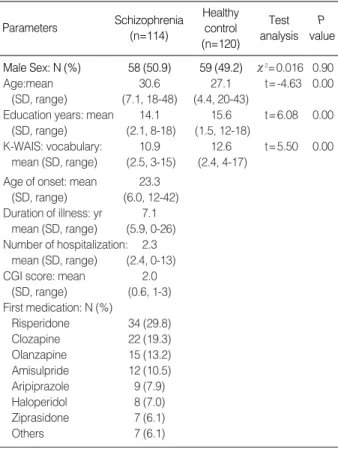
on the central nervous system. Controls were free of all Axis I psychiatric disorders and familiar loading to second-degree relatives, and did not have a medical disorder that may alter cognitive functioning. Written informed consent was obtain- ed from all of the subjects after a complete explanation of the study was provided. The study was approved by the institu- tional review boards of the Samsung Medical Center and the Yong-In Mental Hospital. Demographic and clinical charac- teristics of the participants are shown in Table 1. Differences in age, education, and the premorbid intellectual functioning, which was estimated from the Korean version of the Wech- sler Adult Intelligence Scale (K-WAIS) vocabulary score, were considered in the group comparison analyses. This study was approved by the Institutional Review Board (2004-09-36).
Neurocognitive assessment
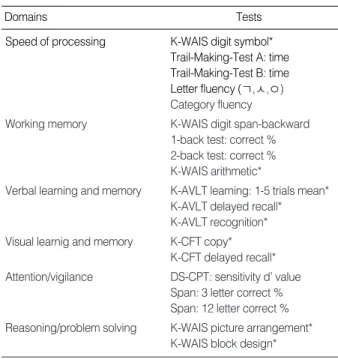
The neurocognitive battery was composed of comprehen- sive tests that correspond to the six cognitive domains of the MATRICS, which were the speed of processing, working mem- ory, verbal learning and memory, visual learning and mem- ory, attention/vigilance, and reasoning/problem solving. Social cognition, which is the 7th domain of the MATRICS, was not included since the appropriate tools were not validated
Parameters Schizophrenia (n=114)
Healthy control (n=120)
Test analysis
P value
Male Sex: N (%) 58 (50.9) 59 (49.2) c2=0.016 0.90
Age:mean 30.6 27.1 t=-4.63 0.00
(SD, range) (7.1, 18-48) (4.4, 20-43)
Education years: mean 14.1 15.6 t=6.08 0.00 (SD, range) (2.1, 8-18) (1.5, 12-18)
K-WAIS: vocabulary: 10.9 12.6 t=5.50 0.00
mean (SD, range) (2.5, 3-15) (2.4, 4-17) Age of onset: mean 23.3
(SD, range) (6.0, 12-42) Duration of illness: yr 7.1
mean (SD, range) (5.9, 0-26) Number of hospitalization: 2.3
mean (SD, range) (2.4, 0-13) CGI score: mean 2.0
(SD, range) (0.6, 1-3) First medication: N (%)
Risperidone 34 (29.8)
Clozapine 22 (19.3)
Olanzapine 15 (13.2)
Amisulpride 12 (10.5) Aripiprazole 9 (7.9) Haloperidol 8 (7.0) Ziprasidone 7 (6.1)
Others 7 (6.1)
Table 1. Demographic and clinical characteristics of the partic- ipants
K-WAIS, Korean version of the Wechsler Adult Intelligence Scale; CGI, Clinical Global Impression.
in Koreans. According to the psychometric characteristic cri- teria suggested by the MATRICS (8) and previous analysis of multicollinearity (11), a total of 19 variables were employed for the statistical analyses (Table 2).
Competing models
Fig. 1 shows the 6-factor model and the five nested mod- els. The 1-factor model evaluated the general cognitive abil- ity of all the tests (12). The 2-factor model included both the verbal and the visual ability based on Wechsler’s origi- nal concepts (13). The 3-factor model was composed of the verbal ability, visual processing, and the speed of processing that is consistent with the factor analyses from recent ver- sions of the Wechsler intelligence scales (14, 15). The 4-fac- tor model does not have exactly the same prior theories, but is based on the studies that have separated the attention/
working memory from the verbal ability in the intelligence tests of both adults and children (16, 17). The 5-factor model was predicted by the CFA study of Gladsjo et al. (18) with the exception of the ‘verbal crystallized’ factor. Finally, the 6-factor model is our hypothetical model that was recom- mended by MATRICS.
The 4-factor, 5-factor, and 6-factor models were also divid- ed into two competing models that have either a multifacto-
Domains Tests
Speed of processing K-WAIS digit symbol*
Trail-Making-Test A: time Trail-Making-Test B: time Letter fluency (ㄱ,ㅅ,ㅇ) Category fluency
Working memory K-WAIS digit span-backward 1-back test: correct % 2-back test: correct % K-WAIS arithmetic*
Verbal learning and memory K-AVLT learning: 1-5 trials mean*
K-AVLT delayed recall*
K-AVLT recognition*
Visual learnig and memory K-CFT copy*
K-CFT delayed recall*
Attention/vigilance DS-CPT: sensitivity d’ value Span: 3 letter correct % Span: 12 letter correct % Reasoning/problem solving K-WAIS picture arrangement*
K-WAIS block design*
Table 2. Tests grouped by cognitive domain
*using scaled scores in analyses.
K-WAIS, Korean version of the Wechsler Adult Intelligence Scale; K- AVLT, Korean version of Auditory Verbal Learning Test; K-CFT, Korean version of Complex Figure Test; DS-CPT, Degraded Stimulus-Continu- ous Performance Test.
6-factor model Working memory
Attention/
vigilance
Verbal learning
& memory
Visual learning
& memory Reasoning /problem
solving
Attention/
working memory
Attention/
working memory
Verbal learning
& memory
Verbal learning
& memory
Visual processing
Visual processing
Verbal ability Verbal ability
Visual ability Visual learning
& memory Reasoning /problem
solving
General cognitive ability
Speed of processing
Speed of processing
Speed of processing
Speed of processing 5-factor
model
4-factor model
3-factor model
2-factor model
1-factor model
Fig. 1. 6-factor models recommend by MATRICS and alternative models.
Fig. 2. Representation of the hierarchical and multifactorial models.
Hierarchical model Multifactorial model
rial structure or a hierarchical structure (Fig. 2). The multi- factorial model has separate latent cognitive factors that cause performance on the individual tests, and these latent factors can be intercorrelated. The hierarchical model has a single second order latent factor which causes performance in dif- ferent cognitive domains (9).
Statistical analyses
The structure of the neurocognitive tests was determined via the CFA. Only data from the patients were included in the CFA. Prior to analyses, the data was evaluated for multi- variate nonnormality (19). The multivariate kurtosis was sig- nificantly high (12.918), and because of this the Maximum likelihood Estimation (MLE) extraction with Bollen-Stine bootstrapping (20) was used in order to meet the multivari- ate normality assumption of MLE. Error variables that shared a common method effect were allowed to correlate to improve the fitting of the model (18).
According to the CFA-derived best fit model structure, the factor scores of the patients and the healthy controls were compared using the MANCOVA analysis while controlling for age, education and premorbid intellectual functioning.
Factor scores were determined by averaging the standardized Z scores by using the means and standard deviations of the healthy control group (21, 22). The analyses in this study were conducted using the SPSS 15.0 and the AMOS 7.0 software.
RESULTS
Confirmatory factor analyses of the schizophrenia patients We examined the goodness of fit and the parameters by
adding four pairs of correlated errors (Tail-Making-Test A and Tail-Making-Test B, letter fluency and category fluency, 1-back test and 2-back test, and 3 letter Span and 12 letter Span) based on prior studies and the modification index used to control for the method effect. The fit indices for the test- ed models are shown in Table 3. The multifactorial-6-factor model had the best fit compared to any of the other competing models. The c2/df and the Root Mean Square Error of Approx- imation (RMSEA) for the multifactorial-6-factor model met the established guideline (23) for adequate fit (c2/df=1.57, RMSEA=0.071). Other fit statistics of all models failed to meet the criteria standards, but the multifactorial-6-factor model was relatively appropriate (CFI=0.889, GFI=0.843, NFI=0.755, TLI=0.857).
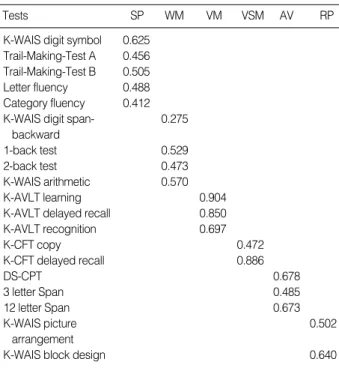
Table 4 shows the factor loadings of the multifactorial-6- factor model. The factor loading of K-WAIS digit span-back- ward on ‘Working memory’ is relative low, but the loadings of all the observed variances of the multifactorial-6-factor model are significant (standardized regression weight=0.274- 0.986).
Differences of factor scores between schizophrenia patients and control subjects
In Table 5, the mean z-scores and the standard deviations
Tests SP WM VM VSM AV RP
K-WAIS digit symbol 0.625 Trail-Making-Test A 0.456 Trail-Making-Test B 0.505 Letter fluency 0.488 Category fluency 0.412 K-WAIS digit span- 0.275
backward
1-back test 0.529
2-back test 0.473
K-WAIS arithmetic 0.570
K-AVLT learning 0.904
K-AVLT delayed recall 0.850
K-AVLT recognition 0.697
K-CFT copy 0.472
K-CFT delayed recall 0.886
DS-CPT 0.678
3 letter Span 0.485
12 letter Span 0.673
K-WAIS picture 0.502
arrangement
K-WAIS block design 0.640
Table 4. Factor loading for the multifactorial-6-factor model
SP, speed of processing; WM, working memory; VM, verbal learning
&memory; VSM, visual learning&memory; AV, attention/vigilance; RP, reasoning/problem solving; K-WAIS, Korean version of the Wechsler Adult Intelligence Scale; K-AVLT, Korean version of Auditory Verbal Learning Test; K-CFT, Korean version of Complex Figure Test; DS-CPT, Degraded Stimulus-Continuous Performance Test.
Model c2 Df c2/df CFI GFI NFI TLI RMSEA
1 factor 386.74 148 2.61 0.649 0.709 0.546 0.594 0.119 2 factor 366.35 147 2.50 0.677 0.708 0.570 0.625 0.115 3 factor 352.75 145 2.43 0.695 0.719 0.586 0.640 0.113 4 factor
Multifactorial 240.68 142 1.70 0.855 0.823 0.717 0.825 0.078 Hierarchical 249.38 144 1.73 0.845 0.809 0.707 0.816 0.080 5 factor
multifactorial 220.58 138 1.60 0.879 0.835 0.741 0.850 0.073 hierarchical 234.69 143 1.64 0.865 0.822 0.724 0.839 0.075 6 factor
multifactorial 208.78 133 1.57 0.889 0.843 0.755 0.857 0.071 hierarchical 226.11 142 1.59 0.876 0.828 0.734 0.851 0.072 Table 3. Goodness-of-fit indices of overall models
An acceptable model fit was defined by the following criteria: c2/df (1-2), GFI (≥0.90), NFI (≥0.90 ), CFI (≥0.90), TLI (≥0.90), RMSEA (≥0.08).
CFI, comparative fit index; GFI, goodness of fit index; NFI, normed fit index; TLI, Tucker-Lewis index; RMSEA, root mean square error of ap- proximation.
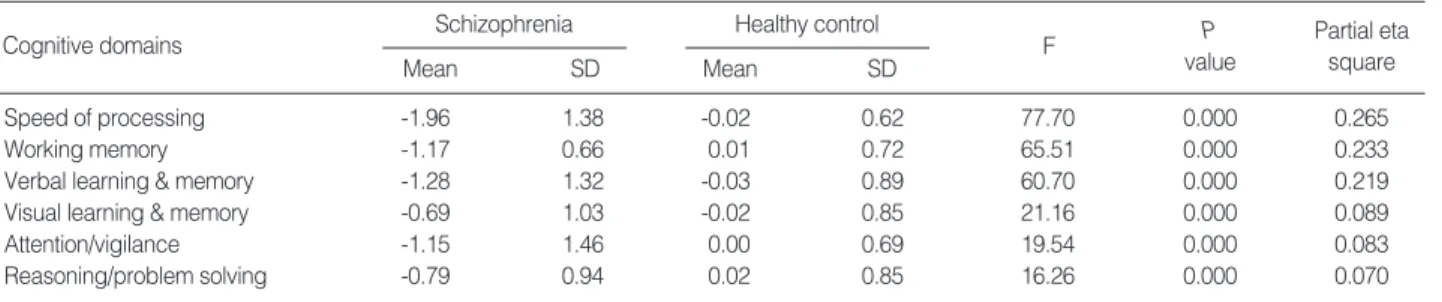
for the cognitive domains were compared. All of the factor scores were significantly lower in the patient group (F [6,211]= 23.698, P<0.001, Wilk’s Lamda=0.597; partial eta square=
0.403). More pronouncing deficits were observed in ‘Process- ing of information’ (mean Z score=-1.96) and ‘Verbal learning and memory’ (mean Z score=-1.28). Patients showed moder- ate impairments in ‘Working memory’ (mean Z score=-1.17) and ‘Attention/Vigilance’ (mean Z score=-1.15). ‘Visual learn- ing and memory’ (mean Z score=-0.69) and ‘Reasoning and problem solving’ (mean Z score=-0.79) were relatively mild- ly impaired.
DISCUSSION
The purpose of the present study was to assess the factor structure of neurocognitive tests used on schizophrenia pati- ents by using the confirmatory factor analysis. And we com- pared the differences of the factor scores between schizophrenic patients and control subjects.
First, our results confirmed that the 6-factor model that was proposed by MATRICS is more appropriate than any of the competing models that were tested. Although this result is difficult to compare to the results of previous factor analytic studies directly, all six domains of this model have been repli- cated as major cognitive functions of schizophrenia. ‘Speed of processing’ was composed of tests that were shown to dis- tinguish impairments in schizophrenia patients and their fami- ly. The construction validity and neurological mechanism of this is difficult to explain, but all of the tests that involve both perceptual and motor components and the many factor anal- ysis studies support that this is one of the most basic domains (24). ‘Working memory’ was defined as the capacity to simul- taneously store, process and manipulate information, and de- ficits of this in schizophrenia patients are consistently demon- strated across a diverse range of tasks. In our results, the fac- tor loading of K-WAIS digit span-backward on this dimen- sion was low. It is a reason that this task also thought of as a measure of ‘Attention/Vigilance’ in other studies, that is, the validity of this task on ‘Working memory’ is relative lower, so less loads on this dimension. ‘Reasoning and problem solv-
ing’ are the skills in planning and decision making, and mean- ingfully relate to the real world functioning of schizophre- nia patients. ‘Reasoning and problem solving’ and ‘Working memory’ can be referred together as ‘executive functioning’.
However, using ‘executive functioning’ as a unitary cognitive operation has been criticized, because it may require a higher ability level to connect and control the information between subsystems (2). This is why MATRICS tried to divide ‘exec- utive functioning’ into two domains and our study supports this idea. An abundant number of studies have revealed both stable and wide memory deficits in schizophrenia patients.
Memory functioning can be divided in to a lot of sub domains, most especially as ‘Verbal memory’ and ‘Visual memory’, which has been conceptualized as separable areas and replicated to have a respective course of impairments. The ‘Attention/Vigi- lance’ is described in the early clinical accounts of schizophre- nia, and is one of the most frequently studied cognitive deficits and show relationships to everyday functioning (3).
Second, we found that the multifactorial model provided a better fit than the hierarchical model. Our research con- firmed the assumption that cognitive dimensions are ‘inde- pendent’. Recent studies that used novel data-mining meth- ods with no prior assumptions also supported ‘separable’ fac- tors (25). The multifactorial structure was verified by the dis- tinct relationships between the factors and the clinical or func- tional capacity variables. Longitudinal studies have indenti- fied that the response to the course and type of anti-psychotic treatment for each type of cognitive domain are diverse (26).
Additionally, we can also validate the multifactorial model by identifying the differences in impairments between the cognitive factors. Schizophrenia patients performed worse than the controls in all of the domains tested, but the result showed meaningful variations of deficits. Similar to a num- ber of previous studies, our results showed that the most severe impairments were found in the ‘Speed of processing’ and the
‘Verbal memory’. These impairments are either stable or pro- gressively deteriorating (27, 28). Deficits of the ‘Working memory’ and the ‘Attention/Vigilance’ were moderate since the early stages of the illness, and the ‘Visual memory’ is rela- tively preserved (29). In our results, the impairments of the
‘Reasoning/problem solving’ are relatively mild, and this find-
Age, education, premorbid intellectuan functioning as covariate.
P<0.008 to set the critical alpha level after Bonferroni correction divied by the number of domains (0.05/6).
Schizophrenia Cognitive domains
Mean SD
Healthy control
Mean SD
F P
value
Partial eta square
Speed of processing -1.96 1.38 -0.02 0.62 77.70 0.000 0.265
Working memory -1.17 0.66 0.01 0.72 65.51 0.000 0.233
Verbal learning & memory -1.28 1.32 -0.03 0.89 60.70 0.000 0.219
Visual learning & memory -0.69 1.03 -0.02 0.85 21.16 0.000 0.089
Attention/vigilance -1.15 1.46 0.00 0.69 19.54 0.000 0.083
Reasoning/problem solving -0.79 0.94 0.02 0.85 16.26 0.000 0.070
Table 5. Comparison of z-scores on cognitive domains between patients and healthy controls
ing is inconsistent with the results of some previous studies.
It may be a reason that some previous studies put ‘reasoning/
problem solving’ and ‘executive functioning’ in the same cate- gory, so used more complex level tests diverse and high order cognitive abilities needed.
Reducing the variables in a large cognitive battery to major cognitive abilities may reflect latent traits and may result in having better psychometric properties (4). Clarifying the fea- tures of cognition by the progress of illness may have utility in reducing the type 1 or 2 error in making a diagnosis and would result in a better understanding of the pathology of schizophrenia. This also has more implications on genetic studies since specific cognitive deficits can be associated with specific genes, brain function or pharmacological mechanism more definitively.
Our study has several limitations. First, the multifactori- al-6-factor model did not fulfill all of the goodness-of-fit cri- teria. This may have been attributed to an insufficient sam- ple size to case per variable ratio for the factor analysis. Anoth- er reason may be due to the differences in the tests and group- ing measures that were used in our batteries than what was recommended by the MATRICS. This limitation is not un- common in factor analysis when using a large number of vari- ables that are derived from the multiplicity tests. Second, the social cognition was not included even though it was men- tioned as the most recent domain of interest by the MAT- RICS. The validation and development of tests to measure social cognition in Korean needs to be completed before it can be studied in a Korean population. Actually, other new cognitive domains and their interactions need to also be stud- ied. Recently, the CNTRICS (Cognitive Neuroscience Treat- ment Research to Improve Cognition in Schizophrenia) pro- ject was initiated to identify a set of cognitive systems and to develop optimized measurements based on the cognitive neuroscience approach (30). It is important to recognize that the results of our study are tentative conclusions of the cog- nitive architecture of schizophrenia in order to design and interpret cognitive test batteries. Defining new cognitive domains, elaborating tests, and identifying the multi-level and dynamic interactions of all known domains must be fur- ther researched.
In summary, using the confirmatory factor analysis of neu- rocognitive tests on schizophrenia patients, our study iden- tifies that the multifactorial-6-model suggested by MATRICS based on the prior studies and theoretical considerations is best fit the data. Also we confirm the distinctive deficits pat- terns across the cognitive domains by assessing the differences of factor scores between schizophrenia patients and healthy controls.
REFERENCES
1. Buchanan RW, Davis M, Goff D, Green MF, Keefe RS, Leon AC,
Nuechterlein KH, Laughren T, Levin R, Stover E, Fenton W, Marder SR. A summary of the FDA-NIMH-MATRICS workshop on clinical trial design for neurocognitive drugs for schizophrenia. Schizophr Bull 2005; 31: 5-19.
2. Jaeger J, Czobor P, Berns SM. Basic neuropsychological dimensions in schizophrenia. Schizophr Res 2003; 65: 105-16.
3. Nuechterlein KH, Barch DM, Gold JM, Goldberg TE, Green MF, Heaton RK. Identification of separable cognitive factors in schizophre- nia. Schizophr Res 2004; 72: 29-39.
4. Genderson MR, Dickinson D, Diaz-Asper CM, Egan MF, Weinberg- er DR, Goldberg TE. Factor analysis of neurocognitive tests in a large sample of schizophrenic probands, their siblings, and healthy controls. Schizophr Res 2007; 94: 231-9.
5. Nam HJ, Kim N, Park T, Oh S, Jeon HO, Yoon SC, Lee YS, Lee WK, Ha K, Kim JH, Hong KS. Cognitive profiles of healthy siblings of schizophrenia patients: application of the cognitive domains of the MATRICS consensus battery. World J Biol Psychiatry 2009; 10:
452-60.
6. Lee KJ, Wee W, Yoo SY, Lee AR, Song JY, Ha TH, Hong KS, Kim MS, Kwon JS. Cognition, emotion and social function: are vulnera- bility markers for developing schizophrenia? J Korean Neuropsy- chiatr Assoc 2006; 45: 3-10.
7. Green MF, Nuechterlein KH. The MATRICS initiative: developing a consensus cognitive battery for clinical trials. Schizophr Res 2004;
72: 1-3.
8. Nuechterlein KH, Green MF, Kern RS, Baade LE, Barch DM, Cohen JD, Essock S, Fenton WS, Frese FJ 3rd, Gold JM, Goldberg T, Heaton RK, Keefe RS, Kraemer H, Mesholam-Gately R, Seidman LJ, Stover E, Weinberger DR, Young AS, Zalcman S, Marder SR. The MATRICS Consensus Cognitive Battery, part 1: test selection, reliability, and validity. Am J Psychiatry 2008; 165: 203-13.
9. Dickinson D, Ragland JD, Calkins ME, Gold JM, Gur RC. A com- parison of cognitive structure in schizophrenia patients and healthy controls using confirmatory factor analysis. Schizophr Res 2006;
85: 20-9.
10. Joo EJ, Joo YH, Hong JP, Hwang S, Maeng SJ, Han JH, Yang BH, Lee YS, Kim YS. Korean version of the diagnostic interview for genetic studies: validity and reliability. Comprehensive Psychiatry 2004; 45: 225-9.
11. Tabachnick BG, Fidell LS. Using Multivariate Statistics. New York:
HarperCollins; 2001.
12. Spearman C. The Abilities of Man: Their Nature and Measurement.
New York: Macmillan; 1927.
13. Wechsler D. Measurement of Adult Intelligence. Baltimore: Williams
& Wilkins; 1939.
14. Wechsler D. Wechsler Adult Intelligence Scale-Third Edition (WAIS- III). San Antonio: Psychological Corporation; 1997.
15. Wechsler D. Wechsler Intelligence Scale for Children (WISC-IV)- Fourth Edition. San Antonio: Psychological Corporation; 2003.
16. Kaufman AS, Lichtenberger EO. Essentials of WAIS-III Assessment.
New York: John Wiley & Sons; 1999.
17. McGrew KS. Analysis of the major intelligence batteries according to a proposed comprehensive Gf-Gc framework. In: Flanagan DP, Genshaft JL, Harrison PL, eds, Contemporary Intellectual Assess-
ment: Theories, Tests, and Issues. New York: Guilford Press; 1997;
151-79.
18. Gladsjo JA, McAdams LA, Palmer BW, Moore DJ, Jeste DV, Heaton RK. A six-factor model of cognition in schizophrenia and related psychotic disorders: relationships with clinical symptoms and func- tional capacity. Schizophr Bull 2004; 30: 739-54.
19. Cole DA. Utility of confirmatory factor analysis in test validation research. J Consult Clin Psychol 1987; 55: 584-94.
20. Bollen KA, Stine RA. Bootstrapping goodness-of-fit measures in struc- tural equation models. Sociologic Methods Res 1992; 21: 205-29.
21. Saykin AJ, Gur RC, Gur RE, Mozley PD, Mozley LH, Resnick SM, Kester DB, Stafiniak P. Neuropsychological function in schizophre- nia. Selective impairment in memory and learning. Arch Gen Psy- chiatry 1991; 48: 618-24.
22. Wainer H. Estimating coefficients in linear models: It don’t make no nevermind. Psychological Bulletin 1976; 83: 213-7.
23. Byrne BM. A primer of LISREL: basic applications and program- ming for confirmatory factor analytic model. New York: Springer- Verla 1989; 55.
24. Carter CS, Barch DM, Buchanan RW, Bullmore E, Krystal JH, Cohen J, Geyer M, Green M, Nuechterlein KH, Robbins T, Silverstein S, Smith EE, Strauss M, Wykes T, Heinssen R. Identifying cognitive mechanisms targeted for treatment development in schizophrenia:
an overview of the first meeting of the Cognitive Neuroscience Treat- ment Research to Improve Cognition in Schizophrenia Initiative. Biol Psychiatry 2008; 64: 4-10.
25. Silver H, Shmoish M. Analysis of cognitive performance in schizophre- nia patients and healthy individuals with unsupervised clustering models. Psychiatr Res 2008; 159: 167-79.
26. Klingberg S, Wittorf A, Sickinger S, Buchkremer G, Wiedemann G. Course of cognitive functioning during the stabilization phase of schizophrenia. J Psychiatr Res 2008; 42: 259-67.
27. Aleman A, Hijman R, de Haan EH, Kahn RS. Memory impairment in schizophrenia: a meta-analysis. Am J Psychiatry 1999; 156: 1358- 66.
28. Sanchez P, Ojeda N, Pena J, Elizagarate E, Yoller AB, Gutierrez M, Ezcurra J. Predictors of longitudinal changes in schizophrenia: the role of processing speed. J Clin Psychiatry 2009; 70: 888-96.
29. Albus M, Hubmann W, Mohr F, Hecht S, Hinterberger-Weber P, Seitz NN, Kuchenhoff H. Neurocognitive functioning in patients with first-episode schizophrenia: results of a prospective 5-year follow- up study. Eur Arch Psychiatry Clin Neurosci 2006; 256: 442-51.
30. Barch DM, Carter CS. Measurement issues in the use of cognitive neuroscience tasks in drug development for impaired cognition in schizophrenia: a report of the second consensus building conference of the CNTRICS initiative. Schizophr Bull 2008; 34: 613-8.