INTRODUCTION
Human papillomavirus (HPV) has been detected in vari- ous benign or malignant epidermal tumors (1-5). Seborrhe- ic keratoses (SK), which are benign epidermal tumors, are similar and often confused with warts in their clinical and/
or histological appearance. These similarities have led inves- tigators to study the role of HPV in the pathogenesis of seborrheic keratoses (6-10).
Zhao et al. (6) detected, by electron microscopy, HPV- like particles in 4 of 89 nongenital SK. In cases of seborrheic keratoses of cases of the genital area, HPV has been report- edly found in 42% (n=57) using polymerase chain reaction (PCR) from tissue extracts (7). However, the same group reported lack of HPV-DNA in nongenital SK (8), demon- strated by PCR from tissue extracts (n=27). Soler et al. (9) showed HPV type 5 DNA by in situ hybridization in a nongenital SK obtained from a renal transplant recipient.
Recently, Tsambaos et al. (10) detected HPV-DNA in 20%
(34/173) of nongenital SK specimens using in situ hybridi- zation.
We believe that it is necessary to clarify the discrepancies of HPV-DNA detection in nongenital SK using accurate and sensitive methods. To demonstrate the presence of HPV in
nongenital SK, we analyzed 40 biopsy specimens taken from patients with nongenital SK using in situ PCR and PCR from tissue extracts.
MATERIALS AND METHODS
To investigate the possibility that HPV might be a causa- tive factor for SK, 40 nongenital SK tissue sections were exam- ined for the presence of HPV 6/11, 31 or 33 DNA by PCR and in situ PCR.
Tissue samples
A series of 40 formalin-fixed and paraffin-embedded biop- sy specimens were collected as tissue samples. Paraffin-embed- ded tissue samples were retrieved from archival diagnostic specimens. The specimens were taken from 40 patients, 22 men and 18 women, who had visited the Dermatology De- partment of Ajou University Hospital from October 1997 to October 1999. Biopsy sites included the face (n=15), trunk (n=8), scalp (n=7), leg (n=3), neck (n=2), arm (n=2), hand (n=1), back (n=1), and buttock (n=1). All specimens used in this study showed the typical histological features of SK.
Eun-So Lee, Mi Ran Whang, Won Hyoung Kang
Department of Dermatology, Ajou University School of Medicine, Suwon, Korea
Received : 9 April 2001 Accepted : 23 May 2001
Address for correspondence Won Hyoung Kang, M.D.
Department of Dermatology Ajou University School of Medicine, 5 Wonchon-dong, Paldal-ku, Suwon 442-721, Korea
Tel : +82.31-219-5190, Fax : +82.31-219-5189 E-mail : [email protected]
619 J Korean Med Sci 2001; 16: 619-22
ISSN 1011-8934
Copyright � The Korean Academy of Medical Sciences
Absence of Human Papillomavirus DNA in Nongenital Seborrheic Keratosis
Seborrheic keratosis (SK) is a benign epidermal tumor of unknown etiology.
Because of its wart-like morphology, human papillomavirus (HPV) has been sug- gested as a possible causative agent. Viral involvement, however, has not been confirmed yet despite extensive research. The aim of this study was to evaluate the presence of HPV 6/11, 31, 33 DNA in nongenital SK. We analyzed 40 biopsy specimens taken from patients with nongenital SK using in situ polymerase chain reaction (PCR) and PCR with tissue extracts. The SK specimens (n=40), analyzed by in situ PCR, were negative for all HPV probes tested (types 6/11, 31, 33).
Control slides (condyloma acuminatum, n=3) were positive for type 6/11, 31, and 33 HPV probes tested. Melasma samples (n=4), the negative controls, were consistently negative. No HPV DNA band was detected by PCR with the tissue extracts from paraffin-embedded SK samples, while condyloma acuminatum, the positive controls, showed DNA bands of the correct molecular weights. Our results show that HPV type 6/11, 31, and 33 cannot be recognized as causative agents for nongenital SK, which is in contrast to the previous studies. Further studies are required to reveal the presence of other types (more than 90) of HPV DNA.
Key Words :Keratosis, Seborrheic; Polymerase Chain Reaction; In Situ PCR; Papillomavirus, Human
620 E.-S. Lee, M.R. Whang, W.H. Kang
Samples included 8 hyperkeratotic types and 32 acanthotic types of SK. The diagnosis was confirmed again after reex- amination of clinical photos and histological slides by two dermatologists (WHK and ESL). We used 3 specimens of condyloma acuminatum as the positive controls and 5 spec- imens of melasma as the negative controls.
In situ PCR
In our study, in situ PCR was modified from Nuovo’s method (11). Four m tissue sections were prepared and dewaxed with xylene for 30 min and 100% ethanol for 5 min. The samples were gradually rehydrated using a graded series of alcohols and digested with 20 g/mL proteinase K (Behringer Manheim Co., Indianapolis, IN, U.S.A.), in PBS for 10 min at 37℃. The samples were washed extensively in phosphate-buffered saline (PBS) to inactivate the enzyme.
The slides were dehydrated in a graded series of alcohols and their PCR amplification was performed using the in situ thermal cyclers (M J Research, Waltham, MA, U.S.A.).
PCR reaction was performed using type-specific primers.
We synthesized the primers for HPV 6/11, 31, 33 as fol- lows: HPV 6/11 (F) 5′-AAGGGCGTAACCGAAATCGGT- 3′, (R) 5′-TGTCACAAACCGCTGTGTGA-3′; HPV 31 (F) 5′-TGTCAAAGACCGTTGTGTCC-3′, (R) 5′-GAG CTGTCGGGTAATTGCTC-3′; HPV 33 (F) 5′-AAGG- GCGTAACCGAAATCGGT-3′, (R) 5′-GTCTCCAAT- GCTTGGCACA-3′. Twenty-five L PCR reaction mix- tures contained Taq polymerase 0.8 L, 10×PCR buffer 2.5 L, 2.5 mM dNTPs 4 L, 1 mM digoxigenin-11-dUTP 1 L (Boehringer Mannheim Biochemicals, Indianapolis, IN), 20 pmol/ L HPVpF 1 L, and 20 pmol/ L HPVpR 1 L. The slides were warmed to 82℃for 7 min in order to perform hot start PCR and then at 55℃, 25 L PCR reac- tion mixture was placed directly on the tissue section and covered with slide seal (TaKaRa Biomedicals, Japan) and cycled as follows: 94℃for 3 min (1 cycle), followed by 55℃ for 2 min and 94℃for 1 min (15 cycles). Slide seals were removed and the tissue was washed in PBS for 5 min.
The samples were then incubated for 30 min with anti- digoxigenin-alkaline phosphatase-conjugated Fab antibody fragments (1:2,000 dilution; Boehringer Mannheim Bio- chemicals, Indianapolis, IN) prepared in blocking buffer.
The slides were washed 3 times in tris buffer solution (pH 7.6). Freshly prepared BCIP/NBT (5′-bromo-4-chloro-3- indolyl-phosphate/nitroblue tetrazolium; Sigma Chemical Co., St. Louis, MO, U.S.A.) was used as the chromogenic substrate. Slides were covered with the substrate and moni- tored for color development. The sections were then coun- terstained with Mayer hematoxylin.
PCR analysis of tissue extracts
DNA amplification by PCR was carried out as previously
described (12) on the tissue samples. Briefly, 8 m thick sections were deparaffinized in 1.5 mL microfuge tubes with 500 L xylene, followed by dehydration with 100% ethanol.
The samples were dried in a vacuum centrifuge, which were digested overnight at 55℃with proteinase K (Sigma Chem- ical Co., St. Louis, MO). Then, it was boiled in 95℃heat block to stop the reaction. Amplification of HPV DNA was performed using the supernatant. We used PCR core kit (Boehringer Mannheim Biochemicals, Indianapolis, IN, U.S.A.) and GeneAmp PCR System 9600 (Perkin Elmer Cetus, Norwalk, CT, U.S.A.). The PCR was implemented using 30 cycles with the primers; 30 sec at 94℃, 2 min at 55℃, and 2 min at 72℃. PCR products were electrophoresed on 1.5% agarose gel, stained with ethidium bromide, and photographed under UV light. Positive and negative con- trol reactions were included with all amplifications.
RESULTS In situ PCR
The 40 tissue samples, analyzed by in situ PCR, were neg- ative for all HPV probes tested (6/11, 31, 33) (Fig. 1A).
Control slides (condyloma acuminatum, n=3) were consis- tently positive for type 6/11, 31, and 33 HPV probes tested (Fig. 1B, C). Dark brown colored positive staining was ob- served on the nuclei of keratinocytes in the upper stratum malpighii and stratum corneum. Melasma samples (n=4), the negative controls, were consistently negative.
PCR analysis of tissue extracts
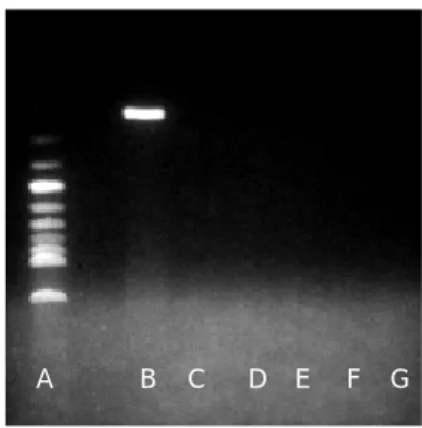
No HPV DNA band was detected by PCR with the tis- sue extracts from paraffin-embedded SK samples (n=40).
However, condyloma acuminatum (n=3), which served as the positive controls, showed DNA bands of the correct molecular weights (Fig. 2).
DISCUSSION
The present study, in situ PCR or PCR with SK tissue extracts, could not demonstrate HPV genomes type 6/11, 31, or 33 in the nongenital SK tissue samples (n=40). This result is contrary to the result by Tsambaos et al. (10), which reported the presence of HPV genomes (6/11, 8.7%; 31/33/
35, 8%; other types, 2.9%; n=173). At present, we cannot explain the discrepancy between the two studies.
We used very sensitive and specific methods to detect the tissue HPV (type 6/11, 31, and 33). We believe that our negative results are not technical errors for the following reasons: 1) in situ PCR method used in this study is more sensitive than in situ hybridization due to the advantages of
Human Papillomavirus DNA in Nongenital Seborrheic Keratosis 621
both PCR and in situ hybridization and enabled us to visu- alize the cellular localization of HPV DNA; 2) to confirm the negative results of in situ PCR for the HPV DNA, we performed PCR using SK tissue extracts, which revealed no HPV DNA (type 6/11, 31, and 33); 3) the positive controls (condyloma acuminatum, n=3) run simultaneously showed definite dark brown colored staining of the nuclei (Fig. 1B, C), while the negative controls (melasma, n=4) did not show the staining pattern.
One possible explanation might be that the venereal HPV transmission would increase the risk of exposure of both sites (genital and periungual) to HPV infection (13). Therefore, despite the same disease entity, the affected site could be the source of such differences in virus detection. For example,
Mitsuishi et al. (14) detected HPV DNA in Bowen’s dis- ease of the hands, while Lu et al. (4 hand from total 91) (13) failed to demonstrate the presence of HPV DNA in Bowen’
s disease of the skin. Similar results have also been reported with squamous cell carcinoma (15, 16). In our study, only one specimen was taken from the finger, which might part- ly explain our negative results.
In conclusion, we believe that HPV type 6/11, 31, and 33 can not be recognized as causative agents for nongenital SK in contrast to the previous study (10). The present study has checked 4 types (6/11, 31, and 33) of HPV DNA among more than 90 types. Further studies are required to reveal the pres- ence of other types of HPV DNA, which would help to clarify the role of HPV in the pathogenesis of nongenital SK.
C
A B
Fig. 1.(A) No HPV 6/11 DNA was detected with in situ PCR in nongenital seborrheic keratosis (digoxigenin alkaline phos- phatase; hematoxylin counterstain; ×200). (B) Demonstration of HPV 6/11 DNA in nuclei of keratinocytes in the upper epider- mal layers of a condyloma acuminatum (digoxigenin alkaline phosphatase; hematoxylin counterstain; ×100). (C) A magnifi- cation clearly shows well-stained (brown colored) keratinocyte nuclei in the upper epidermal layers of a condyloma acumina- tum (digoxigenin alkaline phosphatase; hematoxylin counter- stain; ×400).
622 E.-S. Lee, M.R. Whang, W.H. Kang
ACKNOWLEDGMENTS
The technical assistance of Mr. Young-Bae Kim for histo- pathologic preparations is gratefully acknowledged.
REFERENCES
1. de Villiers EM. Human papillomavirus infections in skin cancers.
Biomed Pharmacother 1998; 52: 26-33.
2. Dianzani C, Calvieri S, Pierangeli A, Imperi M, Bucci M, Degener AM. The detection of human papillomavirus DNA in skin tags. Br J Dermatol 1998; 138: 649-51.
3. Assadoullina A, Bialasiewicz AA, de Villiers EM, Richard G. Detec- tion of HPV-20, HPV-23, and HPV-DL332 in a solitary eyelid syringoma. Am J Ophthalmol 2000; 129: 99-101.
4. Carlson JA, Rohwedder A, Daulat S, Schwartz J, Schaller J. Detec- tion of human papillomavirus type 10 DNA in eccrine syringofi- broadenomatosis occurring in Clouston’s syndrome. J Am Acad Dermatol 1999; 40: 259-62.
5. Rohwedder A, Keminer O, Hendricks C, Schaller J. Detection of HPV DNA in trichilemmomas by polymerase chain reaction. J Med Virol 1997; 51: 119-25.
6. Zhao YK, Lin YX, Luo RY, Huang XY, Liu MZ, Xia M, Jin H.
Human papillomavirus (HPV) infection in seborrheic keratosis. Am J Dermatopathol 1989; 11: 209-12.
7. Leonardi CL, Zhu WY, Kinsey WH, Penneys NS. Seborrheic ker- atoses from the genital region may contain human papillomavirus DNA. Arch Dermatol 1991; 127: 1203-6.
8. Zhu WY, Leonardi C, Kinsey W, Penneys NS. Irritated seborrheic keratoses and benign verrucous acanthomas do not contain papillo- mavirus DNA. J Cutan Pathol 1991; 18: 449-52.
9. Soler C, Chardonnet Y, Euvrard S, Chignol MC, Thivolet J. Evalu- ation of human papillomavirus type 5 on frozen sections of multiple lesions from transplant recipients with in situ hybridization and non- isotopic probes. Dermatology 1992; 184: 248-53.
10. Tsambaos D, Monastirli A, Kapranos N, Georgiou S, Pasmatzi E, Stratigos A, Koutselini H, Berger H. Detection of human papillo- mavirus DNA in nongenital seborrheic keratoses. Arch Dermatol Res 1995; 287: 612-5.
11. Nuovo GJ. PCR in situ hybridization: protocols and applications.
3rd edn., Philadelphia: Lippincott-Raven Publishers, 1997; 245-70.
12. Kallio P, Syrjaenen S, Tervahauta A, Syrjaenen K. A simple method for isolation of DNA from formalin-fixed, paraffin embedded sam- ples for PCR. J Virol Methods 1991; 35: 39-47.
13. Lu S, Syrjanen K, Havu VK, Syrjanen S. Failure to demonstrate human papillomavirus (HPV) involvement in Bowen’s disease of the skin. Arch Dermatol Res 1996; 289: 40-5.
14. Mitsuishi T, Sata T, Matsukura T, Iwasaki T, Kawashima M. The presence of mucosal human papillomavirus in Bowen’s disease of the hands. Cancer 1997; 79(10): 1911-7.
15. Moy RL, Eliezri YD, Nuovo GJ, Zitelli JA, Bennett RG, Silverstein S. Human papillomavirus type 16 DNA in periungual squamous cell carcinomas. JAMA 1989; 261(18): 2669-73.
16. Eliezri YD, Silverstein SJ, Nuovo GJ. Occurrence of human papil- lomavirus type 16 DNA in cutaneous squamous and basal cell neo- plasms. J Am Acad Dermatol 1990; 23: 836-42.
A B C D E F G
Fig. 2. Ethidium-stained 1.5% agarose gel demonstrating HPV 6/11 DNA amplimers. Lane A indicates molecular weight markers;
lane B, condyloma acuminatum, Lane C through G, SKs. Lane B is positive for HPV 6/11 DNA. Lane C through G are negative.