1)
: 2009 9 23 , : 2009 10 17
: ,
Tel : 053)420-5704, 5717, Fax : 053)425-6683, E-Mail: [email protected]
서 론
한국인 소아 청소년에서 가역성 후두부 백질 뇌증․ 증후군의 임상적 특성에 대한 다기관 공동연구
, *
†, ‡
§
이은주 남상욱 김선준․ *․ †․김원섭‡․서혜은§․황수경§․권순학§
= Abstract =
Clinical evaluation of Reversible Posterior Leukoencephalopathy Syndrome in Korean Children: Multicenter Study
Eun-Joo Lee, M.D., Sang-Ook Nam, M.D.*, Sun Jun Kim, M.D.†, Won Seop Kim, M.D.‡ Hye-Eun Seo, M.D.§, Su Kyeong Hwang, M.D.§and Soonhak Kwon, M.D.§
Department of Pediatrics, Daegu Fatima Hospital
Department of Pediatrics*, Pusan National University Children's Hospital Department of Pediatrics†, Chonbuk National University School of Medicine Department of Pediatrics‡, Chungbuk National University School of Medicine Department of Pediatrics§, Kyungpook National University School of Medicine Purpose : Reversible posterior leukoencephalopathy syndrome(RPLS) is a complex con- dition affecting gray/white matter of parieto-occipital lobes from multiple and different etiologies. This study was aimed to analyze clinical characteristics of this condition in Korean children.
Methods : A total of 36 patients from tertiary care medical centers were involved in the study. They were diagnosed as RPLS mainly by clinical and radiological manifestations.
Their medical records and radiological features of brain MRI were retrospectively analyzed.
Results : Thirty six patients were involved in the study(21 males and 15 females, mean age: 9.8±4.1 years of age). Main underlying causes included drug induced(47%), renal diseases(28%), neurogenic tumors(8%) and so on. Initial manifestations were seizures, headache, visual disturbance, mental change, and nausea/vomiting. 13 patients(36%) had two or more symptoms. The brain MRI showed typical pattern of fairly symmetric, high T2 signal intensity in both parieto-occipital regions in 23 patients(64%) and various, aty- pical pattern in 13 patients(36%). 26 patients had the lesions affecting predominantly white matter, but 10 patients had the lesions affecting predominantly gray matter. 34 patients(94
%) had bilateral lesions, but 2 patients(6%) had unilateral lesion. This complex syndrome was associated with acute rise of blood pressure from a variety of conditions. A patient ended up a visual deficit despite the good prognosis.
Conclusion : RPLS in Korean children seems to be complex, but a better understanding of this complex syndrome will lead to better clinical outcome by avoiding unnecessary investigations and appropriate management.
Key Words : Leukoencephalopathy, Seizure
(Reversible Pos- terior Leukoencephalopathy Syndrome Pos- terior Reversible Encephalopathy Syndrome)
, ,
. 1996
Hinchey
1),
, , ,
2-10)
. -
1, 11-13)
.
.
8, 9, 14-17)
.
․
.
대상 및 방법1998 1 2008 12
4 ,
36 .
, .
Diffusion- weighted image T1-weighted image, T2-weighted image, fluid-attenuated inversion-
recovery(FLAIR) image, gadolinium en-
hanced image .
, 36 7
. .
결 과
36 21 , 15
1-20 ( 9.8 )
. 26 (72%),
12 (33%), 9 (25%), 4 (11
%), 4 (11%) , 13 (36%)
.
18-110%
( 54%)
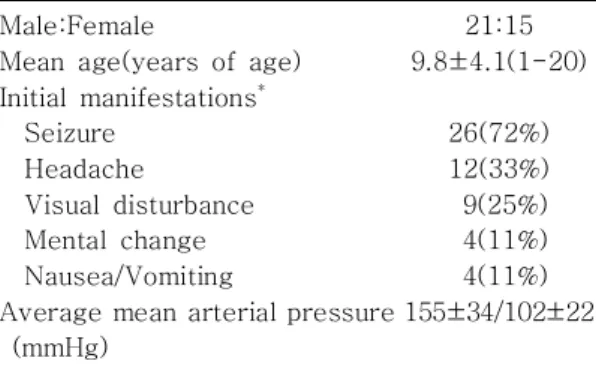
155±34/102±22 mmHg (Table 1).
, 17
(47%) ,
, ,
10 (28%),
3 (8%), , ,
Table 1. Demographic and Clinical Characteristics of the Subjects(n=36)
Male:Female
Mean age(years of age) Initial manifestations*
Seizure Headache
Visual disturbance Mental change Nausea/Vomiting
Average mean arterial pressure (mmHg)
21:15 9.8±4.1(1-20)
26(72%) 12(33%) 9(25%) 4(11%) 4(11%) 155±34/102±22
*13 patients(36%) had two or more symptoms
(Table 2).
T2-weighted FLAIR
-
(Fig. 1A).
23 (64%), 5
(14%), 4 (11%), 2 (6%),
1 , 1
(Table 3).
26 (72%) 10 (28%)
, 34 (94%)
2 (6%)
(Table 4).
(Fig. 1B), 1
. 7
, 5 (Fig. 2A), 2 lactate peak 1.33 ppm
peak (Fig.
Table 2. Underlying Causes of RPLS in the
2B).
Subjects(n=36)
Drug induced(cyclosporine, steroid, etc) Renal diseases(AGN, ARF, HUS, etc.) Neurogenic tumors
Others
17(47%) 10(28%) 3( 8%) 6(17%) Abbreviations : AGN, acute glomerulonephritis;
ARF, acute renal failure; HUS, hemolytic uremic syndrome
Fig. 1. Axial T2-weighted images in a patient with RPLS. Initial MRI shows high signal intensity in both parieto-occipital and right frontal regions(A). Follow-up MRI shows complete resolution of the lesion(B).
Table 3. Patterns and Affected Areas of RPLS in the Subjects by Lobes(n=36)
Typical pattern* Atypical pattern
Temporal Cerebellar Basal ganglia Parietal Frontal
23(64%) 3(36%)
5 4 2 1 1
*Occipital or parieto-occipital lobes
고 찰
,
.
.
, ․
.
36
.
, ,
18)
. RPLS
2-10, 19-25)
,
, ,
,
, ,
,
. RPLS
18-
110% ( 54%)
155±34/102±22 mmHg
. RPLS
- .
Fig. 2. Proton Magnetic Resonance Spectroscopy from the lesions. MRS reveals inverted lactate peak(Lac) at 1.33 ppm with normal N-acetyl aspartate(NAA), creatine(Ccr), and choline(Cho) peaks(A). MRS reveals normal pattern of major components(B).
Table 4. Pathoanatomical Patterns of RPLS in the Subjects(n=36)
Predominantly white matter Predominantly gray matter Bilateral
Unilateral
26(72%) 10(28%) 34(94%) 2( 6%)
(aty-
pical RPLS) 36
23 (64%) 13 (36%)
18, 26, 27)
. 26 (72%)
10 (28%) RPLS
, 2 (6%) RPLS
. RPLS
. RPLS
. RPLS
28, 29)
, 7
, 5 , 2
(lactate peak) 1.33 ppm
. RPLS
.
.
RPLS
.
요 약
목 적 :
-
.
․
.
방 법 : 1998 1 2008 12 4
,
36 .
,
.
결 과 : 36 ( : 21 , : 15 ) 1-20 ( 9.8 ) .
,
17 (47%) ,
, ,
10 (28%), 3 (8%),
, ,
. 26
(72%), 12 (33%), 9 (25%),
4 (11%), 4 (11%)
, 13 (36%) .
- T2-weighted
( 23
, 64%),
.
10 (28%) ,
2 .
(18-110%, 54%)
1
.
결 론 : ․
, .
.
References
1) Hinchey J, Chaves C, Appignani B, Breen J, Pao L, Wang A, et al. A reversible posterior leukoencephalopathy syndrome. N Engl J Med 1996;334:494-500.
2) Lee SY, Dinesh SK, Thomas J. Hypertension- induced reversible posterior leukoencephalopa- thy syndrome causing obstructive hydroceph- alus. J Clin Neurosci 2008;15:457-9.
3) Phal P, Molan M, Clare I. Hypertensive ence- phalopathy. Australas Radiol 2002;46:319-24.
4) Shimada J, Takeda N, Yamauchi S, Urushibara T, Kawaguchi H. [Reversible posterior leuko- encephalopathy syndrome: experience in 3 cases]. No To Shinkei 2004;56:1036-41.
5) Tam CS, Galanos J, Seymour JF, Pitman AG, Stark RJ, Prince HM. Reversible posterior leu- koencephalopathy syndrome complicating cyto- toxic chemotherapy for hematologic malignan- cies. Am J Hematol 2004;77:72-6.
6) Uwatoko T, Toyoda K, Hirai Y, Shimada T, Yasumori K, Ibayashi S, et al. Reversible pos- terior leukoencephalopathy syndrome in a post- partum woman without eclampsia. Intern Med 2003;42:1139-43.
7) Vaughn C, Zhang L, Schiff D. Reversible pos-
terior leukoencephalopathy syndrome in cancer.
Curr Oncol Rep 2008;10:86-91.
8) Lim HR, Seo HE, Kwon SH. Clinical and Ra- diological Analysis of Reversible Posterior Leukoencephalopathy Syndrome in Children.
Korean J Pediatr 2007;50:901-4.
9) Kwon SH, Koo JH, Lee SK. Clinical spectrum of reversible posterior leukoencephalopathy syn- drome. Pediatr Neurol 2001;24:361-4.
10) Ozcakar ZB, Ekim M, Fitoz S, Teber S, Hizel S, Acar B, et al. Hypertension induced rever- sible posterior leukoencephalopathy syndrome:
a report of two cases. Eur J Pediatr 2004;163:
728-30.
11) Mukherjee P, McKinstry RC. Reversible pos- terior leukoencephalopathy syndrome: evalua- tion with diffusion-tensor MR imaging. Radio- logy 2001;219:756-65.
12) Teive HA, Brandi IV, Camargo CH, Bitten- court MA, Bonfim CM, Friedrich ML, et al.
Reversible posterior leucoencephalopathy syn- drome associated with bone marrow transplan- tation. Arq Neuropsiquiatr 2001;59:784-9.
13) Yoshida K, Yamamoto T, Mori K, Maeda M.
Reversible posterior leukoencephalopathy syn- drome in a patient with hypertensive encep- halopathy--case report. Neurol Med Chir (Tokyo) 2001;41:364-9.
14) Kim JS, Lee KS, Lim SC, Ahn JY, Song IU, Kim YI, et al. Reversible posterior leukoence- phalopathy syndrome in a patient with multiple system atrophy: a possible association with oral midodrine treatment. Mov Disord 2007;22:
1043-6.
15) Lim MH, Kim DW, Cho HS, Lee HJ, Kim HJ, Park KJ, et al. Isolated cerebellar reversible leukoencephalopathy syndrome in a patient with end stage renal disease. Intern Med 2008;47:
43-5.
16) Moon JM, Chun BJ. Reversible Posterior Leu- koencephalopathy Syndrome. J Emerg Med 2007;33:349-54.
17) Shin KC, Choi HJ, Bae YD, Lee JC, Lee EB, Song YW. Reversible posterior leukoencepha- lopathy syndrome in systemic lupus erythe- matosus with thrombocytopenia treated with cyclosporine. J Clin Rheumatol 2005;11:164-6.
18) Lee VH, Wijdicks EF, Manno EM, Rabinstein AA. Clinical spectrum of reversible posterior
leukoencephalopathy syndrome. Arch Neurol 2008;65:205-10.
19) Lavigne CM, Shrier DA, Ketkar M, Powers JM. Tacrolimus leukoencephalopathy: a neuro- pathologic confirmation. Neurology 2004;63:1132- 3.
20) Peter S, Hausmann N, Schuster A, Boehm HF. Reversible posterior leukoencephalopathy syndrome and intravenous bevacizumab. Clin Experiment Ophthalmol 2008;36:94-6.
21) Rajasekhar A, George TJ, Jr. Gemcitabine- induced reversible posterior leukoencephalopa- thy syndrome: a case report and review of the literature. Oncologist 2007;12:1332-5.
22) Sasayama D, Shimojima Y, Gono T, Kaneko K, Matsuda M, Ikeda S. Henoch-Schonlein purpura nephritis complicated by reversible posterior leukoencephalopathy syndrome. Clin Rheumatol 2007;26:1761-3.
23) Tajima Y, Matsumoto A. Reversible posterior leukoencephalopathy syndrome in p-ANCA- associated vasculitis. Intern Med 2006;45:1169- 71.
24) Nishio M, Yoshioka K, Yamagami K, Morika- wa T, Konishi Y, Hayashi N, et al. Reversible posterior leukoencephalopathy syndrome: a possible manifestation of Wegener's granulo- matosis-mediated endothelial injury. Mod Rheumatol 2008;18:309-14.
25) Sheth KN, Wu GF, Messe SR, Wolf RL, Kas- ner SE. Dialysis disequilibrium: another rever- sible posterior leukoencephalopathy syndrome?
Clin Neurol Neurosurg 2003;105:249-52.
26) Ahn KJ, You WJ, Jeong SL, Lee JW, Kim BS, Lee JH, et al. Atypical manifestations of reversible posterior leukoencephalopathy syn- drome: findings on diffusion imaging and ADC mapping. Neuroradiology 2004;46:978-83.
27) Horioka K, Kinoshita I, Ohtsubo M, Wakiyama H. [A brainstem variant of reversible posterior leukoencephalopathy syndrome (RPLS) presen- ting with visual disturbance]. Rinsho Shinkei- gaku 2007;47:526-9.
28) Eichler FS, Wang P, Wityk RJ, Beauchamp NJ, Jr., Barker PB. Diffuse metabolic abnor- malities in reversible posterior leukoencephalo- pathy syndrome. AJNR Am J Neuroradiol 2002;23:833-7.
29) Oishi C, Okano H, Uegama K, Kobayashi K, Nagane M, Chiba A, et al. [Brainstem variant of reversible posterior leukoencephalopathy syndrome with a prolonged clinical course: a case report]. Rinsho Shinkeigaku 2008;48:737- 41.