analyzers have been designed to improve the quality and speed of analysis, as well as to meet the various demands of different laboratory environments [2]. These efforts have led to several im- provements in the automated clinical chemistry analyzers, such as better analytical measurable range (AMR), throughput, and better time-cost efficiency. The JEOL BioMajesty JCA-BM6010/C (JCA-BM6010/C, JEOL Ltd., Tokyo, Japan) is a recently developed compact clinical chemistry analyzer that is reliable and sufficient for small laboratories, especially those with a small staff. To our knowledge, no report on the performance of JCA-BM6010 has been published to date. Therefore, we present the first evaluation of the analytical performance of JCA-BM6010 in the clinical labo- ratory environment.
INTRODUCTION
Automation in the clinical laboratory is inevitable in the mod- ern age of medicine [1]. Several new automated clinical chemistry
JEOL BioMajesty JCA/BM6010-C 자동화학분석기의 성능 평가
Performance Evaluation of the JEOL BioMajesty JCA-BM6010/C Automated Clinical Chemistry Analyzer
김형년1·지미숙2·문희원1·허미나1·윤여민1
Hyeong Nyeon Kim, M.D.
1, Misuk Ji, M.D.
2, Hee-Won Moon, M.D.
1, Mina Hur, M.D.
1, Yeo-Min Yun, M.D.
1건국대학교 의학전문대학원 진단검사의학교실1, 중앙보훈병원 진단검사의학과2
Department of Laboratory Medicine
1, Konkuk University School of Medicine, Seoul; Department of Laboratory Medicine
2, VHS Medical Center, Seoul, Korea
Vol. 7, No. 3: 111-119, July 2017
https://doi.org/10.3343/lmo.2017.7.3.111 임상화학
Corresponding author: Yeo-Min Yun
Department of Laboratory Medicine, Konkuk University School of Medicine Konkuk University Hospital, 120-1 Neungdong-ro, Gwangjin-gu, Seoul 05030, Korea
Tel: +82-2-2030-5582, Fax: +82-2-2030-5587, E-mail: [email protected] Received: July 5, 2016
Revision received: September 17, 2016 Accepted: September 26, 2016
This article is available from http://www.labmedonline.org 2017, Laboratory Medicine Online
This is an Open Access article distributed under the terms of the Creative Commons Attribution Non-Commercial License (http://creativecommons.org/licenses/by-nc/4.0/) which permits unrestricted non-commercial use, distribution, and reproduction in any medium, provided the original work is properly cited.
Background: JEOL BioMajesty JCA-BM6010/C (JCA-BM6010/C, JEOL Ltd., Japan) is a recently developed ultra-compact automated clinical chemistry analyzer with a throughput of 1,200 tests per hour. Here, we present the first performance evaluation of JCA-BM6010/C.
Methods: We evaluated the precision, linearity, correlation, accuracy, and carryover of 11 analytes (ALP, ALT, AST, calcium, creatinine, GGT, glu- cose, LDH, total bilirubin, total protein, and uric acid) using the JEOL closed reagent (JEOL Ltd.) according to the guidelines of the Clinical Labora- tory Standards Institute. Linearity was further evaluated for ALT, AST, and GGT using open reagents by Sekisui (Japan). The performance of JCA- BM6010/C was compared to that of the Roche-Hitachi Cobas 8000 c702 chemistry autoanalyzer (Cobas 8000, Roche Diagnostics, Switzerland). Its performance using open reagents from Denka Seiken (Japan), Roche, and Sekisui was also evaluated.
Results: The total coefficients of variation (CV) for all analytes were 1.0–2.7%. Linearity was observed for all analytes over the entire tested an- alytical range (R
2≥0.99). The results of JCA-BM6010/C strongly correlated (r
≥0.988) with those of Cobas 8000 for all evaluated analytes except LDH (r
=0.963), as well as for all open reagents. Recovery rates for creatinine, glucose, calcium, and uric acid were 96.6–101.5% and 98.7–
109.3% with the JEOL exclusive and open reagents, respectively. Sample carryover was less than 0.34%.
Conclusions: JCA-BM6010/C showed acceptable performance in the precision, linearity, correlation, accuracy, and sample carryover analyses and in the method comparison. Therefore, it could be a useful routine laboratory medical analyzer.
Key Words: Analytical performance, JEOL BioMajesty JCA-BM6010/C, Evaluation
2017-03-16 https://crossmark-cdn.crossref.org/widget/v2.0/logos/CROSSMARK_Color_square.svg
MATERIALS AND METHODS
1. Test analyzer and reagents
JCA-BM6010/C is an automated analytical platform for measure- ment of general chemistry parameters and specific serologic pro- teins by colorimetry, turbidimetric immunoassay, and ion-selec- tive electrode assay. It is an ultra-compact analyzer with a throughput of 1,200 tests per hour. There are 84 sample positions for routine and priority samples and 43 refrigerated reagent posi- tions with 4 weeks of on-board stability. In this study, we evalu- ated 11 analytes, which are available in reagents provided with the instrument (JEOL Ltd., Tokyo, Japan). The analytes evaluated were as follows: alkaline phosphatase (ALP), alanine aminotrans- aminase (ALT), aspartate aminotransferase (AST), calcium, creati- nine, gamma-glutamyl transpeptidase (GGT), glucose, lactate de- hydrogenase (LDH), total bilirubin, total protein, and uric acid.
Apart from these analytes, JCA-BM6010/C can also analyze other analytes, such as electrolytes (Na, K, Cl, and bicarbonate), albu- min, blood urea nitrogen (BUN), and cholesterol. This study was approved by the institutional review board of the Konkuk Univer- sity Medical Center (Seoul, Korea).
2. Precision
For evaluation of precision, we tested all the analytes in Liquid Assayed Multiqual (human serum based) chemistry control Level 1 and Level 2 (Bio-Rad Laboratories Inc., Hercules, CA, USA) ac- cording to the Clinical and Laboratory Standards Institute (CLSI) guideline EP5-A2 [3]. After preliminary evaluation for five consec- utive days, the two levels were tested in duplicate, with two runs per day over 20 days. Repeatability, between-run, between-day, and total precision were evaluated for all available analytes. Desir- able analytical precision criteria were obtained from the biologi- cal variation database specification on the Westgard website (http://www.westgard.com/biodatabase1.htm) [4]. We also com- pared the total precision of JCA-BM6010/C to the values for two other instruments (Roche-Hitachi Cobas 8000 c702 and Beckman Coulter AU5822), which were previously published [5, 6].
3. Linearity
Experiments were performed using the Validate GC Linearity Test Set (Marine Standard Company, Windham, ME, USA) accord- ing to the CLSI guideline EP6-A [7]. In the first study, all available
analytes were evaluated using JCA-BM6010/C with JEOL closed reagents. In the second study, three analytes (ALT, AST, and GGT) were evaluated with three Sekisui open reagents. We measured five or six levels with four replicates at each level based on the AMR specified by the manufacturer. Polynomial regression analy- sis was performed and the deviation from linearity was calcu- lated. Allowable nonlinearity was set as 50% of the total allowable error provided by CLIA [8].
4. Method comparison
Method comparison was performed following CLSI guideline EP9-A2-IR [9]. Specimens with variable measurement ranges were collected using leftover serum samples. In the first comparison of the 11 analytes, a set of 50 serum samples was tested using JCA- BM6010/C and the Roche-Hitachi Cobas 8000 c702 chemistry au- toanalyzer (Cobas 8000, Roche diagnostics, Basel, Switzerland) in duplicate, using the reagents provided by the respective manufac- turers (JEOL vs. Roche). In the second comparison, a set of 50 se- rum samples was tested for nine analytes (ALP, ALT, AST, cal- cium, creatinine, GGT, glucose, LDH, and uric acid) in duplicate using the JCA-BM6010/C analyzer with JEOL closed reagents and other open reagents. The manufacturers of the open reagents were Sekisui (AST, ALT, GGT, calcium, and uric acid), Denka Seiken (Glucose, LDH), and Roche (ALP, creatinine). Within- method outliers were excluded from the analysis using EP9-A2-IR [9]. Each value was compared using Deming regression analysis and Bland-Altman plots.
5. Accuracy
We evaluated accuracy using medium- and high-concentration
specimens. The measurements were repeated multiple times at
each level following CLSI guideline EP15-A2 for calcium, creati-
nine, glucose, and uric acid [10]. For the four analytes, the recov-
ery rates were compared based on the reference values measured
by certified standard materials (JCCRM 521 and JCCRM 321). The
manufacturers of the evaluated reagents were Roche (creatinine),
Denka Seiken (glucose), and Sekisui (calcium and uric acid). De-
sirable bias criteria from the biological variation database specifi-
cation on the Westgard web site (http://www.westgard.com/bio-
database1.htm) were used [4].
6. Sample carryover
Carryover was determined using low- and high- concentration specimens with four replicates at each level following CLSI guide- line EP10-A2 [11]. The equation used for calculation of carryover was as follows: % carryover
=[L1−(L3+L4)/2
×100/[(H2+H3)/2−
(L3+L4)/2]. The acceptability limit was set to 1.0% [12].
7. Statistical analysis
For precision studies, both standard deviation (SD) and the co- efficient of variation (CV) were calculated. Linearity was evaluated by performing polynomial regression for first-, second-, and third- order polynomials using EP Evaluator Release 9 (David G. Rhoads Assoc., Kennett Square, PA, USA). All statistical analyses were per- formed using Analyse-it (Analyse-it Software Ltd., Leeds, UK).
RESULTS
1. Precision
A statistical summary of precision evaluated using low- and
high-concentration samples is shown in Table 1. JCA-BM6010/C yielded total CV ranging from 1.0% to 2.7% and within-run CV ranging from 0.5% to 2.1% for all analytes. The between-run CV ranged from 0.0% to 1.6% and the between-day CV ranged from 0.6% to 1.8%. In the comparison analysis of total CV using Roche- Hitachi Cobas 8000 c702 and Beckman Coulter AU5822, JCA- BM6010/C yielded a lower total CV in both low- and high-concen- tration samples for AST, creatinine, and total protein. The values for the rest of the analytes were consistent with the maximum re- ported 1.2% difference [5, 6].
2. Linearity
The results of the linearity evaluation for eleven analytes are shown in Table 2. A coefficient of determination (R
2)
≥0.99 for all analytes evaluated was observed. In the second study of addi- tional linearity evaluation in three analytes (ALT, AST, and GGT) manufactured by Sekisui, JCA-BM6010/C yielded an acceptable linearity range for all parameters. The JEOL closed reagents and Sekisui open reagents showed linearity for all tested analytes Table 1. Precision profiles of JEOL BioMajesty JCA-BM6010/C for the 11 analytes using two levels of control material*
Analytes Level Mean
concentration
CV (%) Desirable
precision criteria (%)
†Roche total
CV
‡(%) Beckman
total CV
§(%) CVw
†(%) Repeatability Between-run Between-day Total
ALP (IU/L) Low 95.1 0.7 0.7 1.2 1.5 3.2 3.0 2.0 6.5
High 603.7 0.9 0.3 2.2 2.4 2.5 1.8
ALT (IU/L) Low 25.0 2.1 1.6 0.6 2.7 9.7 3.6 2.7 19.4
High 190.6 0.8 0.0 1.7 1.9 1.6 1.8
AST (IU/L) Low 42.5 0.7 0.5 1.1 1.4 6.2 1.5 1.9 12.3
High 250.9 0.7 0.3 0.8 1.1 3.5 1.4
Calcium (mg/dL) Low 6.1 1.1 0.6 0.8 1.5 1.1 1.5 1.2 2.1
High 13.6 0.8 0.0 0.9 1.2 1.4 1.2
Creatinine (mg/dL) Low 0.7 0.9 0.5 1.1 1.5 3.0 3.0 3.0 6.0
High 7.0 0.8 0.4 0.6 1.1 2.4 1.9
GGT (IU/L) Low 30.1 1.6 1.2 0.8 2.1 6.7 2.1 1.3 13.4
High 141.3 0.6 0.3 0.7 1.0 1.1 0.8
Glucose (mg/dL) Low 62.4 0.9 0.7 0.8 1.4 2.8 1.3 1.4 5.6
High 360.2 0.9 0.5 1.0 1.4 1.3 1.4
LDH (IU/L) Low 111.2 0.7 0.3 1.8 2.0 4.3 1.5 1.9 8.6
High 374.6 0.7 0.3 1.4 1.6 1.6 1.5
Total bilirubin (mg/dL) Low 0.6 1.7 1.0 1.2 2.3 10.9 3.3 1.1 21.8
High 6.4 0.8 0.5 1.6 1.8 1.8 1.0
Total protein (g/dL) Low 3.9 0.6 0.3 0.8 1.0 1.4 1.2 1.1 2.8
High 6.8 0.5 0.7 0.9 1.3 1.6 1.1
Uric acid (mg/dL) Low 3.4 0.8 1.0 1.5 1.7 4.3 1.2 1.6 8.6
High 9.7 0.8 0.3 0.9 1.2 1.2 1.5
*Liquid Assayed Multiqual (human serum based) Level 1 and Level 2 (Bio-Rad Laboratories Inc., Hercules, CA, USA);
†Within-subject biological variation and desirable analyti- cal precision criteria are referred from the biological variation database specification on the Westgard web site (http://www.westgard.com/biodatabase1.htm) [4];
‡Total CV of Roche-Hitachi Cobas 8000 c702 chemistry autoanalyzer [5];
§Total CV of Beckman Coulter AU5822 automated clinical chemistry analyzer [6].
Abbreviations: ALP, alkaline phosphatase; ALT, alanine transaminase; AST, aspartate aminotransferase; CV, coefficient of variation; CVw, within-subject biologic variation; GGT,
gamma-glutamyl transferase; LDH, lactate dehydrogenase.
within the test range.
3. Method Comparison
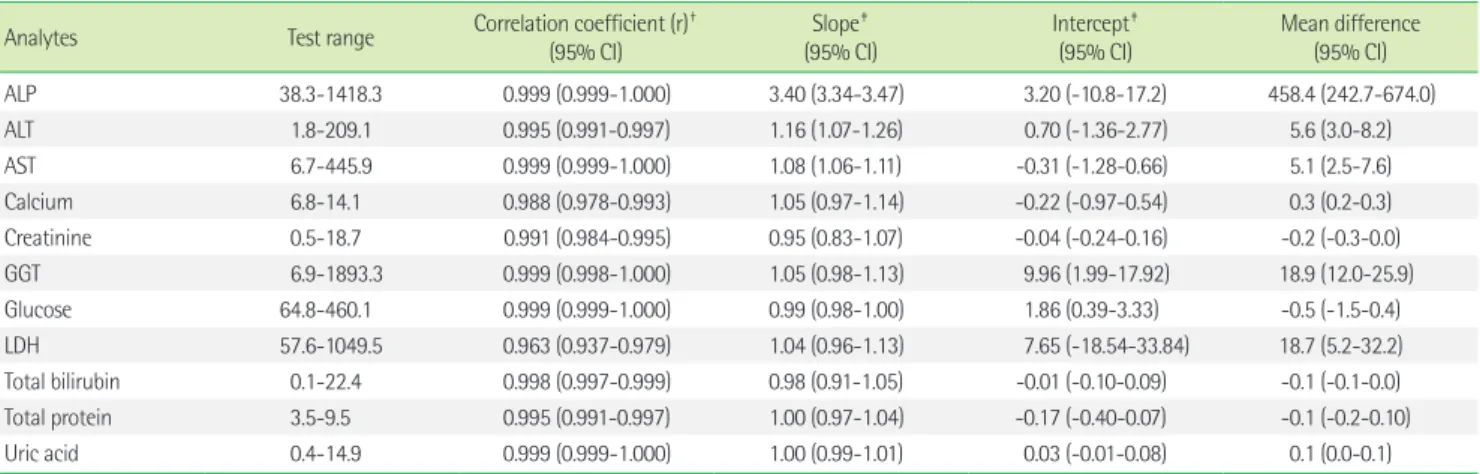
In the first comparison, 11 analytes were tested using the JCA- BM6010/C and Cobas 8000 analyzers (Table 3). The results ob- tained by JCA-BM6010/C strongly correlated (r
≥0.988) with those of Cobas 8000 for all analytes, except LDH (r
=0.963), based on the Deming regression plot. Most analytes showed comparable differences within the allowable difference (total error) range [4];
however, three analytes (ALP, calcium, creatinine) showed nota- ble differences which were shown by Bland-Altman plot (Fig. 1).
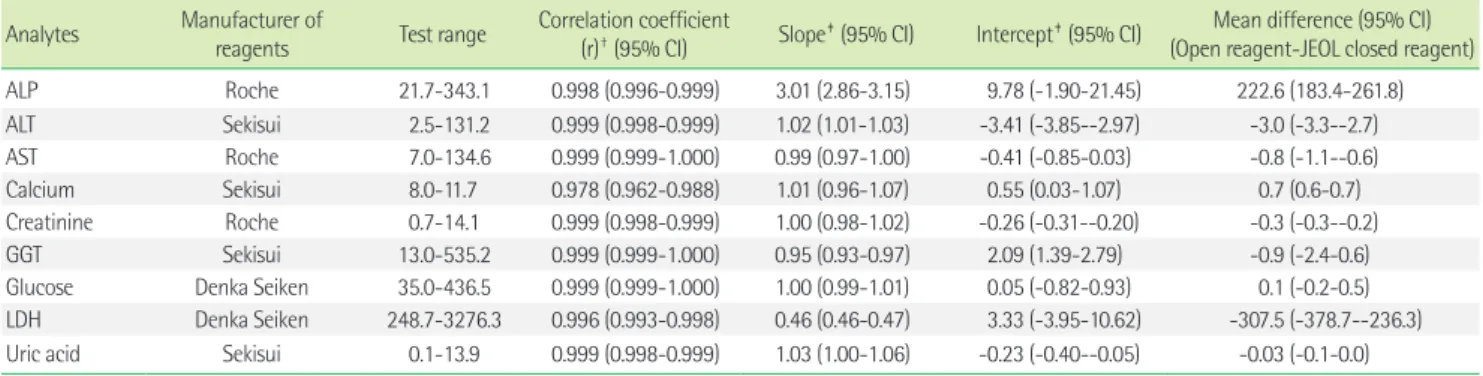
In the second comparison, nine analytes were tested using the
same JCA-BM6010/C instrument with multiple open reagents and JEOL closed reagents (Table 4). The results obtained with the JEOL closed reagents strongly correlated (r
≥0.978) with the other open reagents based on the Deming regression plot. Most ana- lytes showed acceptable results within the allowable difference (total error) range [4]; however, the four analytes (ALP, calcium, creatinine, LDH) showed notable differences which were shown by Bland-Altman plot (Fig. 2).
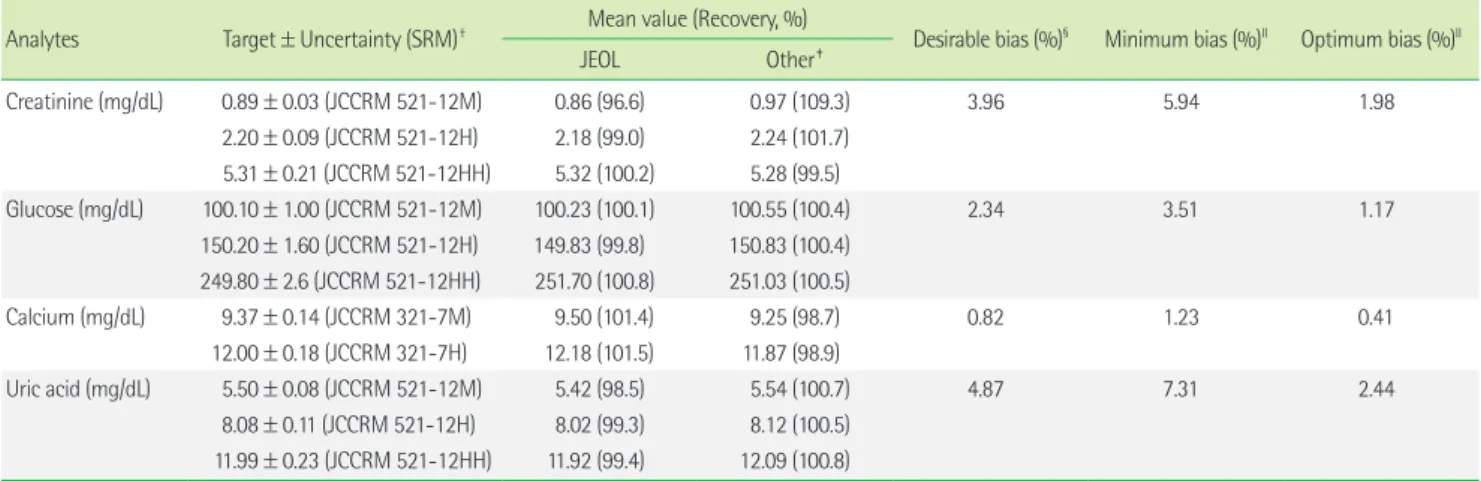
4. Accuracy
In the accuracy evaluation, recovery rates for calcium were out- side of the desirable bias criteria, specifically 1.4 and 1.5% in low-
Table 3. Comparison results between the Cobas 8000 analyzer and JCA-BM6010/C (n=50)*
Analytes Test range Correlation coefficient (r)
†(95% CI)
Slope
‡(95% CI)
Intercept
‡(95% CI)
Mean difference (95% CI)
ALP 38.3-1418.3 0.999 (0.999-1.000) 3.40 (3.34-3.47) 3.20 (-10.8-17.2) 458.4 (242.7-674.0)
ALT 1.8-209.1 0.995 (0.991-0.997) 1.16 (1.07-1.26) 0.70 (-1.36-2.77) 5.6 (3.0-8.2)
AST 6.7-445.9 0.999 (0.999-1.000) 1.08 (1.06-1.11) -0.31 (-1.28-0.66) 5.1 (2.5-7.6)
Calcium 6.8-14.1 0.988 (0.978-0.993) 1.05 (0.97-1.14) -0.22 (-0.97-0.54) 0.3 (0.2-0.3)
Creatinine 0.5-18.7 0.991 (0.984-0.995) 0.95 (0.83-1.07) -0.04 (-0.24-0.16) -0.2 (-0.3-0.0)
GGT 6.9-1893.3 0.999 (0.998-1.000) 1.05 (0.98-1.13) 9.96 (1.99-17.92) 18.9 (12.0-25.9)
Glucose 64.8-460.1 0.999 (0.999-1.000) 0.99 (0.98-1.00) 1.86 (0.39-3.33) -0.5 (-1.5-0.4)
LDH 57.6-1049.5 0.963 (0.937-0.979) 1.04 (0.96-1.13) 7.65 (-18.54-33.84) 18.7 (5.2-32.2)
Total bilirubin 0.1-22.4 0.998 (0.997-0.999) 0.98 (0.91-1.05) -0.01 (-0.10-0.09) -0.1 (-0.1-0.0)
Total protein 3.5-9.5 0.995 (0.991-0.997) 1.00 (0.97-1.04) -0.17 (-0.40-0.07) -0.1 (-0.2-0.10)
Uric acid 0.4-14.9 0.999 (0.999-1.000) 1.00 (0.99-1.01) 0.03 (-0.01-0.08) 0.1 (0.0-0.1)
*The comparison was performed according to the CLSI EP9-A2-IR;
†Figures using the Pearson’s correlation coefficient;
‡Figures using Deming regression plot analysis.
“Mean difference” is defined as measured figures of each JCA-BM6010/C minus Cobas 8000.
Abbreviations: ALP, alkaline phosphatase; ALT, alanine transaminase; AST, aspartate aminotransferase; GGT, gamma-glutamyl transferase; LDH, lactate dehydrogenase.
Table 2. Linearity* of the 11 analytes by using JCA-BM6010/C with JEOL closed reagents
Analytes Linear range specified by
the serum specimen
manufacturer Test range Observed linear
range Slope Intercept R
2Recovery (%)
ALP (IU/L) 10-6,500 0.0-8,868.5 0.0-8,868.5 0.94 26.11 0.999 93-100
ALT (IU/L)
†8-2,200 0.1-2,306.0 0.1-2,306.0 0.94 19.01 0.999 100-104
AST (IU/L)
†6-1,500 0.7-1,463.3 0.7-1,463.3 0.94 18.73 0.999 93-100
Calcium (mg/dL) 2.0-25.0 0.1-26.0 0.1-26.0 1.00 0.02 0.999 99-101
Creatinine (mg/dL) 0.5-45.0 0.2-35.9 0.2-35.9 1.00 0.03 1.000 100-109
GGT (IU/L)
†8-4,000 1.1 -3,684.0 1.1 -3,684.0 0.91 20.30 0.999 90-100
Glucose (mg/dL) 15-850 6.9-690.0 6.9-690.0 0.96 7.11 0.998 77-101
Lactate dehydrogenase (IU/L) 12-3,000 0.0-3,966.5 0.0-3,966.5 0.93 23.44 0.999 93-100
Total bilirubin (mg/dL) 0.2 -27.0 0.1-29.1 0.1-29.1 1.04 -0.10 0.999 96-104
Total protein (g/dL) up to 14 g/dL 0.6-14.7 0.6-14.7 0.96 0.14 0.999 96-100
Uric acid (mg/dL) 1.0-75.0 1.9-29.6 1.9-29.6 1.01 -0.08 0.999 100-101
*The linearity was performed according to the CLSI EP6-A;
†ALT, AST, and GGT were also evaluated using the Sekisui open reagent. Specified linear ranges by the Sekisui were as follows: ALT (0.0–1,500.0, IU/L), AST (0.0–1,500.0, IU/L), GGT (0.0–2,000.0, IU/L). Test ranges and observed linear ranges were as follows: ALT (0.0–1,816.8, 0.0–1,816.8, IU/L), AST (0.6–1,697.9, 0.6–1,697.9, IU/L), GGT (0.0–1,628.0, 0.0–1,628.0, IU/L).
Abbreviations: ALP, alkaline phosphatase; ALT, alanine transaminase; AST, aspartate aminotransferase; GGT, gamma-glutamyl transferase.
Fig. 1. Comparison of the results of 50 ALP, calcium, and creatinine tested using the JCA-BM6010/C and Cobas 8000. (A) Correlation between JCA-
BM6010/C and Cobas 8000. Red bold line, ordinary Deming regression; red dotted line, 95% confidence interval; gray line, identity line. (B) Differ- ence between JCA-BM6010/C and Cobas 8000. Blue bold line, mean difference between values; gray dotted lines, desirable specification for allow- able total error.Abbreviation: ALP, alkaline phosphatase.
5,000
4,000
3,000
2,000
1,000
0
JCA-BM60 10/C (IU/L)
Cobas 8000 (IU/L) ALP
1,000 2,000 3,000 4,000 5,000 y=3.40x+3.20 r=0.995
14
12
10
8
6
JCA-BM60 10/C (mg/dL)
Cobas 8000 (mg/dL) Calcium
6 8 10 12 14
y=1.05x-0.22 r=0.988
20 18 16 14 12 10 8 6 4 2 0
JCA-BM60 10/C (mg/dL)
Cobas 8000 (mg/dL) Creatinine
0 2 4 6 8 10 12 14 16 18 20 y=0.95x-0.04 r=0.988
Differ ence (JEOL-Cobas) (IU/L)
Mean of ALP (IU/L) ALP
0 200 400 600 800 1,000 1,200 1,400 1,600
Allowable difference (Total error)=12.04%
Mean=458.37 (240.45%) 3,500
2,500 1,500 500 -500 -1,500 -2,500 -3,500
1.0
0.5
0
-0.5
-1.0 Differ ence (JEOL-Cobas) (mg/dL)
Mean of Calcium (mg/dL) Calcium
6 7 8 9 10 11 12 13 14 15
Allowable difference (Total error)=2.55%
Mean=0.29 (3.04%)
4.0 3.0 2.0 1.0 0 -1.0 -2.0 -3.0 -4.0 Differ ence (JEOL-Cobas) (mg/dL)
Mean of Calcium (mg/dL) Creatinine
0 2 4 6 8 10 12 14 16 18 20
Allowable difference (Total error)=8.87%
Mean=-0.18 (-8.19%)
A B
Table 4. Comparison results between other open reagents and JEOL closed reagents in the same JCA-BM6010/C instrument (n=50)*
Analytes Manufacturer of
reagents Test range Correlation coefficient
(r)
†(95% CI) Slope
‡(95% CI) Intercept
‡(95% CI) Mean difference (95% CI) (Open reagent-JEOL closed reagent)
ALP Roche 21.7-343.1 0.998 (0.996-0.999) 3.01 (2.86-3.15) 9.78 (-1.90-21.45) 222.6 (183.4-261.8)
ALT Sekisui 2.5-131.2 0.999 (0.998-0.999) 1.02 (1.01-1.03) -3.41 (-3.85--2.97) -3.0 (-3.3--2.7)
AST Roche 7.0-134.6 0.999 (0.999-1.000) 0.99 (0.97-1.00) -0.41 (-0.85-0.03) -0.8 (-1.1--0.6)
Calcium Sekisui 8.0-11.7 0.978 (0.962-0.988) 1.01 (0.96-1.07) 0.55 (0.03-1.07) 0.7 (0.6-0.7)
Creatinine Roche 0.7-14.1 0.999 (0.998-0.999) 1.00 (0.98-1.02) -0.26 (-0.31--0.20) -0.3 (-0.3--0.2)
GGT Sekisui 13.0-535.2 0.999 (0.999-1.000) 0.95 (0.93-0.97) 2.09 (1.39-2.79) -0.9 (-2.4-0.6)
Glucose Denka Seiken 35.0-436.5 0.999 (0.999-1.000) 1.00 (0.99-1.01) 0.05 (-0.82-0.93) 0.1 (-0.2-0.5) LDH Denka Seiken 248.7-3276.3 0.996 (0.993-0.998) 0.46 (0.46-0.47) 3.33 (-3.95-10.62) -307.5 (-378.7--236.3) Uric acid Sekisui 0.1-13.9 0.999 (0.998-0.999) 1.03 (1.00-1.06) -0.23 (-0.40--0.05) -0.03 (-0.1-0.0)
*The comparison was performed according to the CLSI EP9-A2-IR;
†Figures using Pearson’s correlation coefficient;
‡Figures using Deming regression plot analysis.
“Mean difference” is defined as measured figures of each JCA-BM6010/C minus Cobas 8000.
Abbreviations: ALP, alkaline phosphatase; ALT, alanine transaminase; AST, aspartate aminotransferase; GGT, gamma-glutamyl transferase; LDH, lactate dehydrogenase.
and high-concentration samples, respectively, when using JEOL closed reagents. Otherwise, the recovery rates for creatinine, glu-
cose, and uric acid were within the desirable bias criteria [4]. For the other reagents, recovery rates were outside of the desirable bias Fig. 2. Comparison of the results of 50 ALP, Calcium, Creatinine, and LDH using open reagents and the JEOL closed reagent on the same JCA-
BM6010/C instrument. (A) Correlation between the open reagents and JEOL closed reagents. Red bold line, ordinary Deming regression; red dotted line, 95% confidence interval; gray line, identity line. (B) Difference between the open reagents and JEOL closed reagents. Blue bold line, mean dif- ference between values; gray dotted lines, desirable specification for allowable total error.Abbreviations: ALP, alkaline phosphatase; LDH, lactate dehydrogenase
A 1,500
1,000 800 600 400 200 0
JEOL Closed (IU/L)
Roche (IU/L) ALP
0 200 400 600 800 1,000 1,200 y=3.01x+9.78 r=0.998
13 12 11 10 9 8 7
JEOL Closed (mg/dL)
Sekisui (mg/dL) Calcium
7 8 9 10 11 12 13 y=1.01x+0.55 r=0.978
3,000
2,000
1,000
0
JEOL Closed (mg/dL)
Denka Seiken (IU/L) LDH
0 1,000 2,000 3,000 y=0.46x+3.33 r=0.996
1,000
500
0
-500
-1,000 Differ ence (JEOL-Roche) (IU/L)
Mean of ALP (IU/L) ALP
0 50 100 150 200 250 300 350 Allowable difference (Total error)=12.04%
Mean=222.62 (211.78%)
2.0 1.5 1.0 0.5 0 -0.5 -1.0 -1.5 -2.0 Differ ence (JEOL-Sekisui) (mg/dL)
Mean of Calcium (mg/dL) Calcium
7 8 9 10 11 12
Allowable difference (Total error)=2.55%
Mean=0.68 (7.14%)
3.0 2.0 1.0 0 -1.0 -2.0 -3.0 Differ ence (JEOL-Roche) (mg/dL)
Mean of Calcium (mg/dL) Creatinine
0 2 4 6 8 10 12 14 16
Allowable difference (Total error)=8.87%
Mean=-0.25 (-12.83%)
2,000 1,000 0
-1,000 -2,000 Differ ence (JEOL-Denka Seiken) (IU/L)
Mean of LDH (IU/L) LDH
0 1,000 2,000 3,000
Allowable difference (Total error)=11.40%
Mean=-307.48 (-52.91%) 16
14 12 10 8 6 4 2 0
JCA-BM60 10/C (mg/dL)
Roche (mg/dL) Creatinine
0 2 4 6 8 10 12 14 16 y=1.00x-0.26 r=0.999
B
Table 5. Accuracy* of the 4 analytes using JCA-BM6010/C with JEOL closed reagents and other
‡reagentsAnalytes Target ± Uncertainty (SRM)
†Mean value (Recovery, %)
Desirable bias (%)
§Minimum bias (%)
IIOptimum bias (%)
IIJEOL Other
‡Creatinine (mg/dL) 0.89 ± 0.03 (JCCRM 521-12M) 0.86 (96.6) 0.97 (109.3) 3.96 5.94 1.98
2.20 ± 0.09 (JCCRM 521-12H) 2.18 (99.0) 2.24 (101.7) 5.31 ± 0.21 (JCCRM 521-12HH) 5.32 (100.2) 5.28 (99.5)
Glucose (mg/dL) 100.10 ± 1.00 (JCCRM 521-12M) 100.23 (100.1) 100.55 (100.4) 2.34 3.51 1.17
150.20 ± 1.60 (JCCRM 521-12H) 149.83 (99.8) 150.83 (100.4) 249.80 ± 2.6 (JCCRM 521-12HH) 251.70 (100.8) 251.03 (100.5)
Calcium (mg/dL) 9.37 ± 0.14 (JCCRM 321-7M) 9.50 (101.4) 9.25 (98.7) 0.82 1.23 0.41
12.00 ± 0.18 (JCCRM 321-7H) 12.18 (101.5) 11.87 (98.9)
Uric acid (mg/dL) 5.50 ± 0.08 (JCCRM 521-12M) 5.42 (98.5) 5.54 (100.7) 4.87 7.31 2.44
8.08 ± 0.11 (JCCRM 521-12H) 8.02 (99.3) 8.12 (100.5) 11.99 ± 0.23 (JCCRM 521-12HH) 11.92 (99.4) 12.09 (100.8)
*The accuracy was performed with certified standard materials* for each of the three levels according to the CLSI EP15-A2;
†All standard materials are certified (JCCRM 521 and JCCRM 321);
‡Other tested reagents are manufactured by Roche for creatinine, Denka Seiken for glucose, and Sekisui for calcium and uric acid;
§Desirable bias are from the biological variation database specification on the Westgard website (http://www.westgard.com/biodatabase1.htm) [4];
IIMinimum bias and optimum bias are calculated using a previously reported equation by Ricós et al. and Biswas et al. [4, 13].
criteria, 9.3, 1.3, and 1.1% for the low level of creatinine, low level of calcium, and high level of calcium, respectively (Table 5) [4].
5. Sample carryover
The percent carryover for all 11 analytes were as follows: ALP, 0.020%; ALT, 0.115%; AST, 0.035%; calcium, 0.120%; creatinine, 0.38%; GGT, 0.157%; glucose, 0.028%; LDH, 0.004%; total biliru- bin, 0.111%; total protein, 0.339%; uric acid, 0.105%. All the ana- lytes showed carryover rates lower than 1.0%.
DISCUSSION
Routine chemistry analysis is one of the major procedures con- ducted in any routine clinical laboratory. Therefore, the utility of a routine clinical chemistry analyzer should be carefully deter- mined by evaluating its performance on the basis of the corre- sponding guidelines. In this study, the performance of JCA- BM6010/C was evaluated in terms of precision, linearity, and ac- curacy based on CLSI guidelines. In addition, its precision was compared to that of Roche-Hitachi Cobas 8000 c702 and Beck- man Coulter AU5822, which were recently evaluated [5, 6].
JCA-BM6010/C yielded acceptable precision in within-run, be- tween-run, between-day evaluation, and total CV was less than 2.7%. For all tested analytes, the CV obtained by JCA-BM6010/C was comparable to those obtained by the other two chemistry auto-analyzers [5, 6]. It is also notable that JCA-BM6010/C demon- strated optimal specification for imprecision in most analytes ex-
cept high level of ALP, calcium, and total protein [4, 13]. Higher precision in calcium and total protein (
≤1.1% and
≤1.4%, respec- tively) than in other analytes is required [4]. However, JCA- BM6010/C yielded fair performances (
≤1.5% and
≤1.3%, respec- tively) for these analytes compared to the other two chemistry auto-analyzers [5, 6]. In addition, their total CV values were within the minimum specification for imprecision [4, 13].
JCA-BM6010/C yielded excellent linearity for all analytes evalu- ated. Furthermore, the linear range for the maximum concentra- tion of the test material was below that specified in the manufac- turer’s guide for some analytes (AST, creatinine, GGT, glucose, and uric acid). However, the difference would not be meaningful clinically. Moreover, for ALP, ALT, calcium, LDH, total bilirubin, and total protein, linearity was observed at a higher concentration than that mentioned in the manufacturer’s guide. It is noteworthy that JCA-BM6010/C showed linearity in the entire tested range for ALT, AST, and GGT in the case of using open reagents manufac- tured by Sekisui.
When the analysis was conducted using JEOL closed reagents, the results of JCA-BM6010/C strongly correlated with those of the Cobas 8000 as well as with those obtained using other open re- agents (Table 3 and Fig. 1). In addition, JCA-BM6010/C showed ac- ceptable mean difference by excluding analytes showing notable differences. It is suspected that the reason for this discrepancy was the difference in the analytical method used for each reagent by the Roche and JEOL systems (ALP, IFCC/JSCC; calcium, OCPC/
Phosphonazo III; creatinine, Jaffe/Enzymatic). JCA-BM6010/C yielded
slightly higher values than the Cobas 8000 for GGT. In the second comparison using the open reagents, JCA-BM6010/C demonstrated an acceptable mean difference by excluding analytes showing no- table differences; these could be attributed to the difference in the analytical method applied for each open reagent (ALP, Roche, IFCC;
calcium, Sekisui, Arsenazo III; creatinine, Roche, Jaffe; LDH, Denka Seiken, P-L) (Table 4 and Fig. 2).
In the accuracy evaluation, JCA-BM6010/C showed excellent ac- curacy for all evaluated analytes except calcium, when operated using the JEOL closed reagents, although some of the values ob- tained using other reagents were outside the desirable bias crite- ria at the medium level. For creatinine, JCA-BM6010/C showed better accuracy using JEOL closed reagent than with the Roche reagent. For glucose, comparison of the desirable bias criteria demonstrated that JCA-BM6010/C showed high accuracy at low bias ranging from 0.1% to 0.8%. However, the recovery rates were higher than the desirable bias criteria for calcium. JCA-BM6010/C showed worse recovery rates than minimum bias although the Sekisui reagent also showed similar results [4, 13]. Based on these findings, it can be concluded that JCA-BM6010/C would be useful in the clinical setting for routine measurement of creatinine, glu- cose, and uric acid.
For all 11 analytes, JCA-BM6010/C showed acceptable carryover rates of less than 0.34%, which was within the 1.0% cutoff limit [12].
One of the limitations of the present study is that the results of some analytes were not fully evaluated in terms of the differences attributable to the analytical methods applied for each reagent in the method comparison. In addition, all the tested analytes were not evaluated in the accuracy evaluation. Moreover, we did not evaluate other possible analytes such as electrolytes, albumin, BUN, and cholesterol.
In conclusion, JCA-BM6010/C showed excellent performance in terms of precision, linearity, correlation, accuracy, and sample carryover according to the CLSI guidelines. JCA-BM6010/C is an ultra-compact analyzer with a wide AMR and shows comparable performance with that of other instruments. Therefore, JCA- BM6010/C is suitable for small laboratories, especially those with a small staff. We conclude that JCA-BM6010/C would be a useful routine chemistry analyzer in medical laboratories.
요 약
배경: 임상검사실에서의 자동화는 현대의학에서 필연적인,이면서 도 필수적인 부분이다. 이에 따라, 다양한 연구실 환경에 따라서 질적인 면, 속도 및 다양한 요구에 맞추어 수 많은 장비가 개발되 어왔고, 더 나은 분석측정범위(analytical measurable range), 작업 량 및 시간-비용 효율이 개선되는 방향으로 발전되어 왔다. 우리는 이에 본 연구에서는 최근 개발된 소형 자동화학분석기인 JEOL BioMajesty JCA-BM6010/C의 성능을 Clinical and Laboratory Stan- dards Institute (CLSI) 지침에 따라 평가하였다.
방법: 정밀도, 직선성, 상관성, 정확도 및 검체간 교차오염률을 각 CLSI 지침에 따라 시행하였고, Westgard의 desirable bias criteria 를 참고하여 평가하였다. 정밀도 면에서 11개의 항목에 대하여, 최 근 발표된 논문의 Roche-Hitachi Cobas 8000 c702 chemistry auto- analyzer 및 Beckman Coulter AU5822 장비와 비교하였으며, 직선 성 분석에서는 위의 항목 중 세 항목에 대하여 추가로 Sekisui open 시약과 비교하였다. 상관성 측면에서는 1차로 11개 항목에 대하여 Roche-Hitachi Cobas 8000 c702 chemistry autoanalyzer와 비교하였으며, 2차로 9개 항목에 대하여 같은 JCA-BM6010/C 장비 에서 JEOL 자체 전용시약과 타 제조사 시약 간의 비교를 하였다.
결과: 모든 검사항목에서 총 변이계수는 1.0–2.7% 범위의 결과를 보였고, 직선성 평가에서는 모두 임상적으로 의미 있는 범위 내에 서 결정계수가 0.99 이상으로 우수한 직선성을 보였다. 1차로 장비 간 비교에서 상관계수는 모두 0.963 이상의 값을 보였으며, JEOL 전용 시약을 사용하였을 때 타사 시약과 비교하여 0.978 이상으로 우수한 상관성을 보였다. 정확도 측면에서는 creatinine, glucose와 uric acid 항목에서 우수한 정확도를 보이며, 평가한 항목 전반적으 로 우수한 회수율을 보였다. 검체간 교차오염률은 모든 항목에서 0.34% 이하로 교차오염 영향은 매우 낮을 것으로 생각된다.
결론: JCA-BM6010/C는 정밀도, 직선성, 상관성, 정확도 및 검체간 교 체오염률 측면에서 훌륭한 성능을 보여주었고, 작은 검사실 및 소수 의 인력 환경에서 매우 효과적으로 사용될 수 있을 것으로 생각된다.
Authors’ Disclosures of Potential Conflicts of Interest
No potential conflicts of interest relevant to this article were re- ported.
REFERENCES
1. Alpert NL. Automated instruments for clinical chemistry: review and
preview. Clin Chem 1969;15:1198-209.
2. Lee DH and Yoon KJ. Evaluation of the Dimension Vista 1500 chemi- cal autoanalyzer. J Lab Med Qual Assur 2012;34:77-86.
3. Clinical and Laboratory Standards Institute. Evaluation of precision performance of quantitative measurement methods; approved guide- line. 2nd ed. EP5-A2. Wayne, PA: Clinical and Laboratory Standards Institute, 2004.
4. Ricós C, Alvarez V, Cava F, García-Lario JV, Hernández A, Jiménez CV, et al. Desirable specification for total error, imprecision, and bias, de- rived from intra- and inter-individual biologic variation. http://www.
westgard.com/biodatabase1.htm (updated for 2014).
5. Kim SY, Jeong TD, Lee W, Chun S, Min WK. Performance evaluation of the Roche-Hitachi cobas 8000 c702 chemistry autoanalyzer. Lab Med Online 2014;4:132-9.
6. Kim SK, Jeong TD, Lee W, Chun S, Min WK. Performance evaluation of Beckman Coulter AU5822 automated clinical chemistry analyzer.
Lab Med Online 2014;4:77-84.
7. Clinical and Laboratory Standards Institute. Evaluation of the linearity of quantitative measurement procedures: A statistical approach; ap- proved guideline. EP6-A. Wayne, PA: Clinical and Laboratory Stan-
dards Institute, 2003.
8. Medicare, Medicaid and CLIA programs; regulations implementing the Clinical Laboratory Improvement Amendments of 1988 (CLIA)—
HCFA. Final rule with comment period. Fed Regist 1992;57:7002-186.
9. Clinical and Laboratory Standards Institute. Method comparison and bias estimation using patient samples; approved guideline. 2nd ed.
EP9-A2. Wayne, PA: Clinical and Laboratory Standards Institute, 2002.
10. Clinical and Laboratory Standards Institute. Assessment of the diag- nostic accuracy of laboratory tests using receiver operating character- istic curves; approved guideline. 2nd ed. EP15-A2. Wayne, PA: Clinical and Laboratory Standards Institute, 2011.
11. Clinical and Laboratory Standards Institute. Preliminary evaluation of quantitative clinical laboratory methods; approved guideline. 2nd ed.
EP10-A2. Wayne, PA: Clinical and Laboratory Standards Institute, 2002.
12. Broughton PM. Carry-over in automatic analysers. J Automat Chem 1984;6:94-5.
13. Biswas SS, Bindra M, Jain V, Gokhale P. Evaluation of imprecision, bias and total error of clinical chemistry analysers. Ind J Clin Biochem 2015;30:104-8.