pISSN 1229-5418 eISSN 2671-6623
Implantology 2020; 24(3): 148-181 https://doi.org/10.32542/implantology.202015
Received: June 9, 2020 Revised: July 25, 2020 Accepted: July 29, 2020 ORCID
Dae-Young Kang
https://orcid.org/0000-0002-4311-4118 Hieu Pham Duong
https://orcid.org/0000-0001-5409-0361 Jung-Chul Park
https://orcid.org/0000-0002-2041-8047 Copyright © 2020. The Korean Academy of Oral &
Maxillofacial Implantology
This is an Open Access article distributed under the terms of the Creative Commons Attribution Non-Commercial License (http://creativecommons.
org/licenses/by-nc/4.0/) which permits unrestricted non-commercial use, distribution, and reproduction in any medium, provided the original work is properly cited.
OPEN ACCESS
Artificial intelligence and deep learning algorithms are infiltrating various fields of medicine and dentistry. The purpose of the current study was to review literatures applying deep learning algorithms to the dentistry and implantology. Electronic literature search through MEDLINE and IEEE Xplore library database was performed at 2019 October by combining free-text terms and entry terms associated with ‘dentistry’ and ‘deep learning’. The searched literature was screened by title/abstract level and full text level. Following data were extracted from the included studies:
information of author, publication year, the aim of the study, architecture of deep learning, input data, output data, and performance of the deep learning algorithm in the study. 340 studies were retrieved from the databases and 62 studies were included in the study. Deep learning algorithms were applied to tooth localization and numbering, detection of dental caries/periodontal disease/
periapical disease/oral cancerous lesion, localization of cephalometric landmarks, image quality enhancement, prediction and compensation of deformation error in additive manufacturing of prosthesis. Convolutional neural network was used for periapical radiograph, panoramic radiograph, or computed tomography in most of included studies. Deep learning algorithms are expected to help clinicians diagnose and make decisions by extracting dental data, detecting diseases and abnormal lesions, and improving image quality.
Keywords: Deep learning; Dentistry; Dental implants; Machine learning; Neural networks;
Radiography, Dental
Ⅰ. Introduction
The Go competition between the artificial intelligence (AI) AlphaGo of Google DeepMind and the legendary Go player Lee Sedol-in which AlphaGo won 4:1- straightforwardly shows the development of AI. At present, AI is being widely used in
Abstract
* Corresponding author: Jung-Chul Park, Professor, Department of Periodontology, Dankook University College of Dentistry, 119 Dandae-ro, Dongnam-gu, Cheonan 31116, Korea.
Tel: +82-41-550-1931. Fax: +82-303-3442-7364. E-mail: [email protected]
Implantology
Dae-Young Kang, DDS, MSD
1, Hieu Pham Duong, DDS, MSD, PhD
2, Jung-Chul Park, DDS, MSD, PhD
3*1 Clinical Assistant Professor, Department of Periodontology, Dankook University College of Dentistry, Cheonan, Korea
2 Associate Dean, Department of Maxillo-Stomatology, Vietnam National University School of Medicine and Pharmacy, Hanoi, Vietnam
3Associate Professor, Department of Periodontology, Dankook University College of Dentistry, Cheonan, Korea
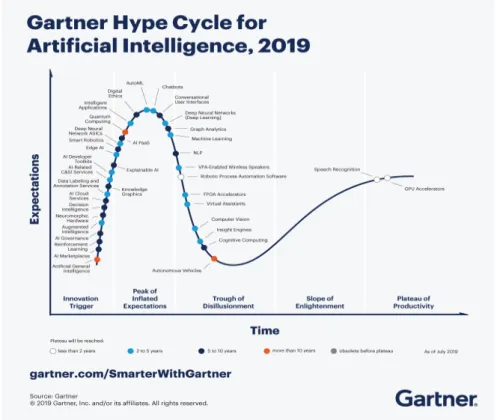
various fields including SPAM mail filters, search algorithms and ranking system of web search engines, facial recognition algorithms of social networking services, and personalized curation algorithms of contents or products (Fig. 1).
1Alibaba achieved daily sales $38 billion during the Singles Day in 2019, 26% higher than the previous year, by launching an AI fashion assistant which has been trained about hundreds of millions of clothes. Amazon is automating most of their logistics except packing and is managing “Amazon Go” checkout-free convenience store chain in the US. In the Amazon Go, the payment is automatically processed when customers exit with their products based on real-time location tracking of them using multiple cameras, weight measuring sensors, and deep learning algorithms.
AI is expected to have huge impact on the healthcare industry. Currently, more than 40 and 10 deep learning algorithms have been approved as medical devices by the US Food and Drug Administration (FDA) and Ministry of Food and Drug Safety (MFDS) in South Korea, respectively. For example, fourth-generation Apple Watch and AliveCor KardiaMobile with deep learning algorithm have been approved by the US FDA as over-the-counter medical devices for detecting atrial fibrillation. These algorithms show an accuracy for detecting abnormal findings comparable to that of humans by training hundreds of thousands of data.
Fig. 1. Hype cycle for artificial intelligence 2019. Reprinted from “Gartner Hype Cycle for Artificial
Intelligence 2019” by Kenneth Brant, Jim Hare, Svetlana Sicular, Copyright 2019 by Gartner, Inc. and/or
its affiliates. https://www.gartner.com/smarterwithgartner/top-trends-on-the-gartner-hype-cycle-for-
artificial-intelligence-2019/
Dentistry is a field of study that requires a high level of accuracy; it is expected that AI and deep learning algorithms will be introduced in the near future and provide great assistance to clinical practices.
In South Korea, an algorithm that estimates bone age from a hand-wrist radiograph has been approved by the MFDS; however, not many other cases have been reported yet. Therefore, this study aims to examine the global trends of deep learning technologies applied to dentistry and to forecast the future of dentistry.
Ⅱ. Materials and Methods
1. Literature Search
To select literature on the application of deep learning algorithms in dentistry, we searched the MEDLINE and IEEE Xplore databases for papers in all languages that were published before October 24, 2019. The search formula was set up by combining free-text term and entry term about the deep learning, neural network, and dentistry (Table 1).
2. Selection of Papers
Papers were selected in two steps: first, papers were selected based on their title and abstract; second, their full text was evaluated. The criteria for selecting papers were as follows: (1) papers for clinical
MEDLINE
1. “Deep learning” [tiab] OR “Neural network” [tiab] OR “Neural networks” [tiab] OR “Neural Net” [tiab] OR
“Neural Nets” [tiab]
2. “Neural Networks (computer)” [Mesh]
3. 1 OR 2
4. “Dental” [tiab] OR “Dentistry” [tiab]
5. “Dentistry” [mesh] OR “Radiography, Dental” [mesh] OR “Dental implants” [mesh] OR “Stomatognathic Diseases” [mesh] NOT “Pharyngeal Diseases” [mesh]
6. 4 OR 5 7. 3 AND 6 IEEE Xplore database
1. “All Metadata” : Deep learning OR “All Metadata” : Neural Network OR “All Metadata” : Neural Networks OR
“All Metadata” : Neural Net OR “All Metadata” : Neural Nets 2. “Mesh_Terms” : Neural networks (computer)
3. 1 OR 2
4. “All Metadata” : Dental OR “All Metadata” : Dentistry
5. “Mesh_Terms” : Dentistry OR “Mesh_Terms” : Radiography, dental OR “Mesh_Terms” : Dental implants OR
“Mesh_Terms” : Stomatognathic Diseases NOT “Mesh_Terms” : Pharyngeal Diseases 6. 4 OR 5
7. 3 AND 6
Table 1. Search strategy
purpose rather than data mining or statistical analysis and (2) papers based on studies using deep neural networks such as convolution neural networks (CNNs), recurrent neural networks (RNNs), or generative adversarial networks (GANs), rather than machine learning among the AI fields.
3. Data Extraction
From the selected studies, we extracted information of the authors, publication years, deep learning architectures that were used, input data, output data, and performance metrics of the algorithm. We examine these data in detail below.
1) Deep learning architectures (1) CNNs
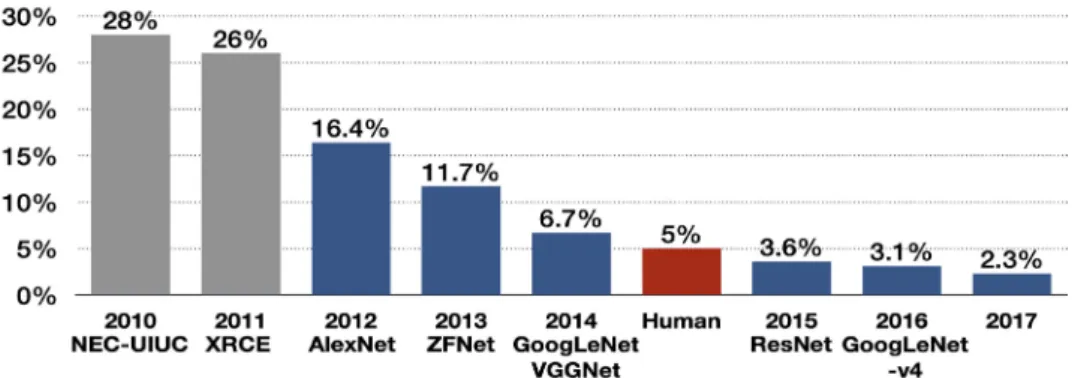
CNNs attracted attention after they won the ImageNet Challenge from 2012–2017, which is a large- scale image recognition contest for classifying 50,000 high-resolution color images into 1,000 categories after training 1.2 million images, held every year since 2010 (Fig. 2). In 2012, AlexNet
2decreased the top-5 error rate by 10% to 16.4%, and SENet achieved 2.3% in 2017.
The origin of the CNN is the Neocognitron Model,
3which applied a neurophysiological theory to an artificial neural network based on the principle that only certain neurons in the visual cortex are activated according to the shape of target object.
4CNNs largely comprise three layers: convolutional layer, pooling layer, and fully connected layer. The convolutional layer creates a feature map by arranging the outputs of convolution operation at each position of square filter while the filter is sliding over the input
Fig. 2. Algorithms that won the ImageNet Large Scale Visual Recognition Challenge (ILSVRC) in 2010–
2017. The top-5 error refers to the probability that all top-5 classifications proposed by the algorithm
for the image are wrong. The algorithms with blue graph are convolutional neural network. Although
VGGNet took second place in 2014, it is widely used in studies as its concise structure. Adapted from “A
fully-automated deep learning pipeline for cervical cancer classification” by Alyafeai Z., Ghouti L., Expert
Systems with Applications Proceedings of the IEEE 2019;141;112951. Copyright 2019 by Elsevier Ltd.
data. It has the advantage of preserving horizontal and vertical information among pixels compared to the fully connected neural network, which converts images to one-dimensional vector. The pooling layer downsamples size of the feature map and summarizes important information in the feature map; the classification value is then output through the fully connected layer. For example, LeNet, which was the first CNN that classified hand-written numbers with an error rate of 0.95%, comprises three convolutional layers, three pooling layers, and one fully connected layer (Fig. 3).
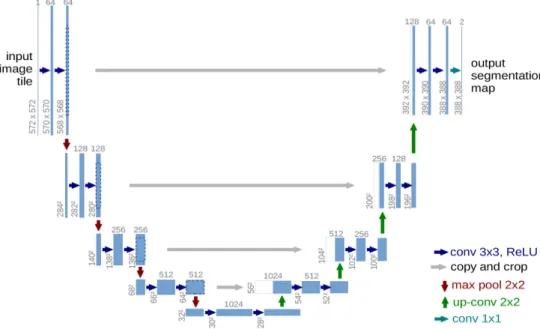
5Meanwhile, U-Net, which is used for region segmentation of medical images, does not have a fully connected layer. It comprises an encoder part, which extracts a feature map by convolution and pooling, and a decoder part, which restores the segmented images from the feature map by “up-convolution”
(Fig. 4).
6Fig. 4. Architecture of U-net. Reprinted from “U-net: Convolutional networks for biomedical image segmentation” by Ronneberger O., Fischer P., Bottou L, Brox T., Lecture Notes in Computer Science 2015;9351:234-241. Copyright 2015 by Elsevier Ltd.
Fig. 3. Architecture of LeNet-5. Reprinted from “Gradient-based learning applied to document recognition” by LeCun Y., Bottou L, Bengio Y. et al., Proceedings of the IEEE 1998;86;2278–2323.
Copyright 1998 by IEEE.
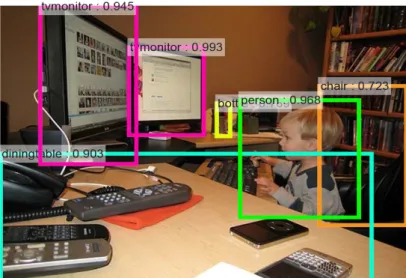
When detecting multiple objects in a single image, a region-based CNN (R-CNN) is used, which includes a region proposal network for the recognition of objects and their positions (Fig. 5).
7The region proposal network suggests anchor boxes of various ratios and sizes for the input image, and those that have a high intersection-over-union (IOU) with the previously trained images are selected.
(2) RNNs
RNNs can analyze time-series data that are arranged in chronological sequence such as voice signals.
Therefore, they are utilized to predict indices such as stocks, for voice recognition, text translation, adding image captions, and image or music generation. A video of former US president Barack Obama appearing to give a speech has been published, in which the algorithm synthesize lip motion synchronized with his original voice.
8This neural network receives the input values from not only the previous layer ( X
t) but also the recurrent neurons of the previous time step, transforms, and delivers them to the next layer and recurrent neurons of the next time step, unlike the feed-forward neural network that only delivers signals from the input layer to the output layer (Fig. 6).
Fig. 5. Multiple object recognition in region-based convolutional neural network. Reprinted from
“Faster R-CNN: Towards Real-Time Object Detection with Region Proposal Networks” by Ren S., He, K., Girshick, R., Sun, J., IEEE Transactions on Pattern Analysis and Machine intelligence 2017;39(6):1137–
1149.
Fig. 6. Structure of recurrent neural network. Right illustrates unfold structure from left to right over
time. Reprinted from http://colah.github.io/posts/2015-08-Understanding-LSTMs/
When an RNN—in a pure sense (also referred to as a “vanilla RNN”)—with the above characteristics is configured with deep layers, there are problems such as gradient vanishing/exploding and the long- term dependency. To solve these problems, changes in connections among cells (the units of neural networks) including skip connection or leaky units, long short-term memory cells,
9and gated recurrent unit cells
10using gates inside the cells have been proposed.
(3) GANs
GANs are unsupervised learning algorithms,
11which have a neural network generating an answer inside a neural network (the generator) competes with a neural network that evaluates it (the discriminator).
The fake answers proposed by the generator are gradually similar to the ground truth with the aid of the feedback from the discriminator.
2) Output data of deep learning
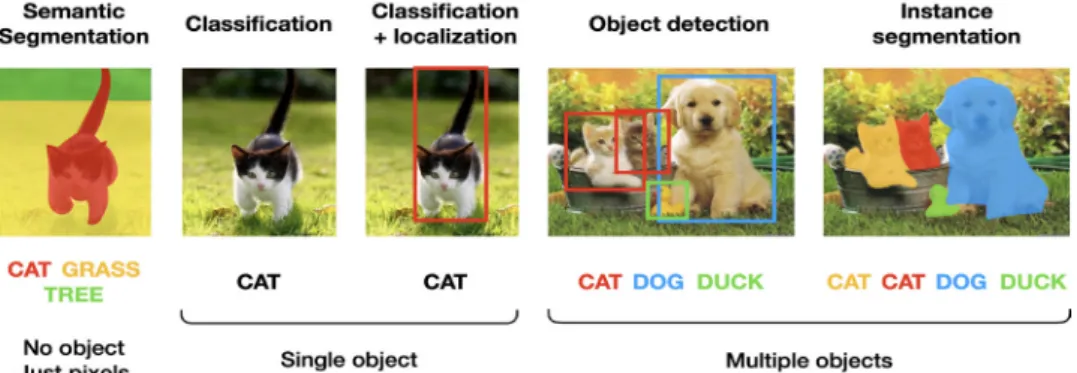
The results of deep learning image analysis can be largely divided into five types as follows (Fig. 7).
(1) Classification: The objects in image are classified as the most likely option to be ground truth among predetermined options. One example is LeNet-5, which classified hand-written numbers into 10 types, from 0 to 9. (2) Object localization: This is to indicate the locations of objects in image by bounding boxes. When object localization and classification are performed simultaneously, it is called object detection. (3) Semantic segmentation: This means to segment whole image according to the pixel-based classification without object recognition. (4) Instance segmentation: This recognizes each object and delineates its outline in an image. (5) Image reconstruction: Examples include image quality enhancement by super-resolution or artifact reduction, and class activation maps overlap heat map, which changes the color depending on the contribution of the classification, to the input image. This allows visual confirmation based on which areas of the image are classified using the deep learning algorithm.
Fig. 7. Computer vision tasks. Adapted from “https://www.slideshare.net/darian_f/introduction-to-the-
artificial-intelligence-and-computer-vision-revolution.”
3) Performance metrics of deep learning algorithms
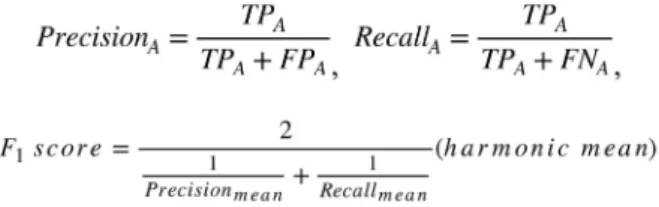
The representative performance metrics for classification algorithms are accuracy, precision, recall, F1 score, and the area under the receiver operating characteristic curve (AUC). Other metrics except AUC can be calculated using the confusion matrix illustrating whether the predicted classification matches the ground truth (Fig. 8).
For example, when we evaluate the accuracy of a deep learning model that classifies images into three types, we can calculate the accuracy simply by dividing the number of cases which classify A as A, B as B, or C as C by the total number of cases.
( TP=True Positive, FP=False Positive, TN=True Negative, FN=False Negative )
Furthermore, the F
1score can be calculated by determining the precisions ( Precision
A, Precision
B, and Precision
C) and recalls ( Recall
A, Recall
B, and Recall
C) for classifying A, B, and C, and calculating the mean precision ( Precision
mean) and mean recall ( Recall
mean), and then calculating the harmonic mean of these two.
The evaluation indices for object localization and segmentation include the IOU and the dice similarity coefficient, in addition to the above-mentioned indices (Fig. 9). IOU is also called Jaccard index and is calculated by dividing the overlapping area between the ground truth and the predicted areas by the union area. The dice similarity coefficient is calculated by dividing the double of the overlapping area by the sum of each area.
Fig. 8. Confusion matrix to calculate accuracy (A) and to calculate precision recall, and F
1score (B).
Ⅲ. Results
1. Literature Search and Selection of Studies
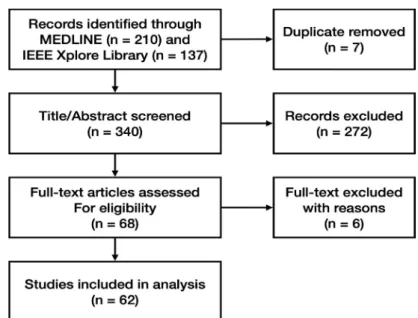
We found 340 papers by searching MEDLINE and the IEEE Xplore Library, excluding 7 duplicates.
After evaluating the titles and abstracts, we excluded 272 papers and evaluated the full texts of 68 papers.
A total of 62 papers were included in the study (Fig. 10). The excluded papers and the reasons for their exclusion are outlined in Suppl. 1.
Fig. 9. Evaluation of object localization (A) and object segmentation (B).
Fig. 10. Flow chart showing literature search and selection.
2. Data Extraction
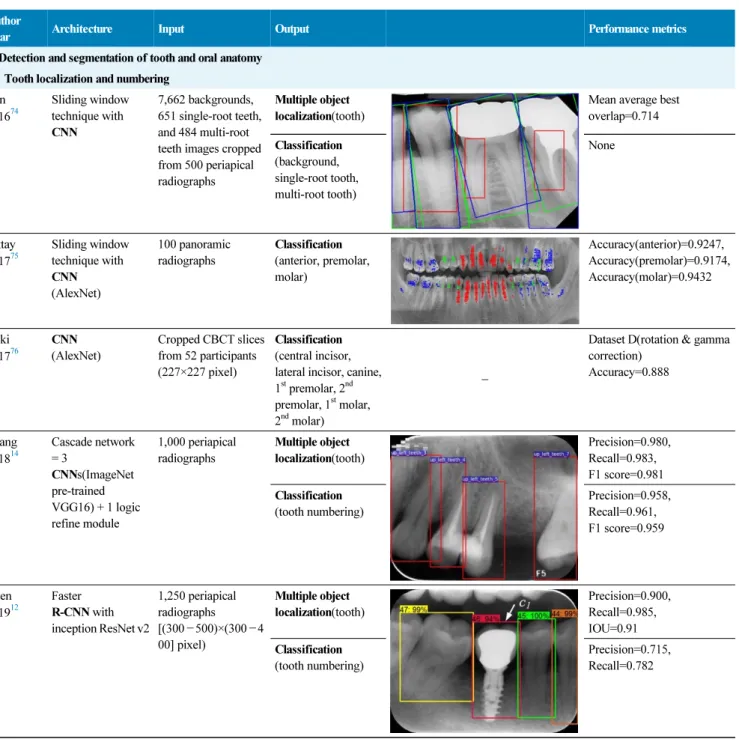
The characteristics of the selected studies and the extracted data are listed in Table 2.
Table 2. Characteristics of included studies.
Author Year
Architecture Input Output Performance metrics
1. Detection and segmentation of tooth and oral anatomy 1.1 Tooth localization and numbering
Eun 2016
74
Sliding window technique with CNN
7,662 backgrounds, 651 single-root teeth, and 484 multi-root teeth images cropped from 500 periapical radiographs
Multiple object localization(tooth)
Mean average best overlap=0.714 Classification
(background, single-root tooth, multi-root tooth)
None
Oktay 2017
75
Sliding window technique with CNN (AlexNet)
100 panoramic radiographs
Classification (anterior, premolar, molar)
Accuracy(anterior)=0.9247, Accuracy(premolar)=0.9174, Accuracy(molar)=0.9432
Miki 2017
76
CNN (AlexNet)
Cropped CBCT slices from 52 participants (227×227 pixel)
Classification (central incisor, lateral incisor, canine, 1
stpremolar, 2
ndpremolar, 1
st
molar, 2
nd
molar)
–
Dataset D(rotation & gamma correction)
Accuracy=0.888
Zhang 2018
14
Cascade network
= 3
CNNs(ImageNet pre-trained VGG16) + 1 logic refine module
1,000 periapical radiographs
Multiple object localization(tooth)
Precision=0.980, Recall=0.983, F1 score=0.981 Classification
(tooth numbering)
Precision=0.958, Recall=0.961, F1 score=0.959
Chen 2019
12
Faster R-CNN with inception ResNet v2
1,250 periapical radiographs [(300–500)×(300–4 00] pixel)
Multiple object localization(tooth)
Precision=0.900, Recall=0.985, IOU=0.91 Classification
(tooth numbering)
Precision=0.715, Recall=0.782
Table 2. Characteristics of included studies
Tuzoff 2019
13
Faster R-CNN with VGG16
1,574 panoramic radiographs
Multiple object localization(tooth)
Precision=0.9945, Recall
†
=0.9941 Classification
(tooth numbering)
Specificity=0.9994, Recall
†
=0.9800
Expert Multiple object
localization(tooth)
Precision=0.9998, Recall
†
=0.9980 Classification
(tooth numbering)
Specificity=0.9997, Recall
†
=0.9893 Koch
2019
77
6 modifications of U-Net
1,500 panoramic radiographs
Classification(1–4:
32, teeth with/without restoration and with/without orthodontic appliance, 5: implant, 6: >32 teeth , 7–10:
<32 teeth with/without restoration and with/without orthodontic appliance)
Ensemble of U-Net modification 1 and 4 Accuracy=0.952, Precision=0.933, Recall
†
=0.944, Specificity=0.961, DSC=0.936
Mask R-CNN Accuracy=0.98,
Precision=0.94, Recall
†
=0.84,
Specificity=0.99, DSC=0.88 Hiraiwa
2019
78
CNN(AlexNet) 760 cropped images of mandibular 1
st
molar from 400 panoramic radiographs CBCT images from 400 participants (ground truth)
Prediction(number of distal root of mandibular 1
st
molar)
Accuracy=0.874, Recall
†
=0.773, Specificity=0.971, Precision
†=0.963, NPV=0.818, AUC=0.87, Training time=51 minutes, Testing time=9 seconds
CNN(GoogleNet) Accuracy=0.853,
Recall
†
=0.742, Specificity=0.959, Precision
†=0.947, NPV=0.800, AUC=0.85, Training time=3 hours, Testing time=11 seconds
Expert radiologist Accuracy=0.812,
Recall
†
=0.802, Specificity=0.820 Precision
†
=0.787, NPV=0.834, AUC=0.74 1.2. Tooth segmentation
Jader 2018
15
Mask R-CNN with ResNet101
1,500 panoramic radiographs
Instance segmentation
None
Classification(1–4:
32, teeth with/without restoration and with/without orthodontic appliance, 5: implant, 6: >32 teeth , 7–10:
<32 teeth with/without restoration and with/without orthodontic appliance)
Accuracy=0.98,
Precision=0.94,
Recall=0.84,
F1 score=0.88,
Specificity=0.99
Vinaya- halingam 2019
79
CNN(U-Net) 81 panoramic radiographs
Instance segmentation (3
rd
molar)
DSC=0.936, IOU=0.881, Recall
†
=0.947, Specificity=0.999 Segmentation
(mandibular canal)
DSC=0.805, IOU=0.687, Recall
†=0.847, Specificity=0.967 De Tobel
2017
21
CNN(ImageNet pre-trained AlexNet)
20 cropped images of lower left 3
rd
molar (240×390 pixel) from 20 panoramic radiographs
Classification (modified Demirjian’s staging, 0–9)
Mean accuracy=0.51, Mean absolute difference=0.6 stages
Merdietio 2019
16
CNN(AlexNet) 400 panoramic radiographs
Segmentation (lower left 3
rd
molar)
Accuracy=0.61
Classification (Modified Demirjian’s staging, 0–9)
Accuracy=0.61 Mean absolute difference=0.53 stages Cohen’s
linear=0.84
Tian 2019
17
CNN(sparse octree structure, voxel-based)
3D scanned images of 600 dental models
Classification (tooth numbering)
Recall
†
=0.9800, Specificity=0.9994 Instance
segmentation(tooth)
Accuracy=0.8981
Expert Classification
(tooth numbering)
Recall
†
=0.9893, Specificity=0.9997
Xu 2019
18
CNN 3D scanned mesh
images from 1,200 dental models
Instance segmentation (tooth–gingiva, tooth–tooth)
Accuracy(maxilla)=0.9906 Accuracy(mandible)=0.9879
1.3. Bone segmentation Duong
2019
20
CNN(U-Net) 50 intraoral ultrasonic images on 8 lower incisors from piglets (128×128 pixel)
Segmentation (alveolar bone)
DSC=75.0±12.7%,
Recall
†=77.8±13.2%,
Specificity=99.4±0.8%
Minnema 2019
19
CNN(MS-D Net) CBCT from 20 patients
Segmentation(bone) DSC=0.87±0.06,
Mean absolute deviation=0.44 mm
CNN(U-Net) DSC=0.87±0.07,
Mean absolute deviation=0.43 mm
CNN(ResNet) DSC=0.86±0.05,
Mean absolute deviation=0.40 mm Snake evolution
algorithm
DSC=0.78±0.07, Mean absolute deviation=0.57 mm 2. Image quality enhancement
Du 2018
22
CNN Center-cropped
images from 5,166 panoramic radiographs
(256×256 or 384×384 pixel)
Image reconstruction (compensating blurring from the positioning error)
Model 1
Mean standard error=0.339, Mean absolute error=0.749, Maximum absolute error=1.499
Liang 2018
23
Hanning + filtered back projection
CBCT from 3,872 patients
Image reconstruction (noise and artifact reduction)
Root mean square error=0.1180, SSI=0.9670
Non-local mean weighted least square iterative reconstruction
Root mean square error
=0.0862, SSI=0.9839
Network reconstruction
Root mean square error
=0.1015, SSI=0.9800
Hu 2019
24
GAN Low-dose CBCT
images from 44 patients
Image reconstruction (noise and artifact reduction)
PSNR(360°)=32.657, SSI(360°)=0.925,
Noise suppression=5.52±0.25, Artifact correction=6.98±0.35, Detail restoration=5.56±0.31, Comprehensive
quality=6.52±0.34, Training time per batch=0.691,
Testing time per batch=0.183
CNN (180 180°scanned
images, 120 360°
scanned images)
PSNR(360°)=34.402, SSI(360°)=0.934,
Noise suppression=8.95±0.36, Artifact correction=7.20±0.23, Detail restoration=5.35±0.28, Comprehensive
quality=7.54±0.32, Training time per batch=0.726,
Testing time per batch=0.183
m-WGAN Normal dose CBCT
images (ground truth)
PSNR(360°)=33.824, SSI(360°)=0.975,
Noise suppression=8.20±0.35, Artifact correction=7.46±0.27, Detail restoration=8.98±0.20, Comprehensive
quality=8.25±0.21, Training time per batch=0.798,
Testing time per batch=0.184 Hegazy
2019
25
CNN(U-Net) 1,000 projection images (0–180°) from 5 patients who had different kinds of metal implants and dental fillings at different tooth positions
Segmentation (metal)
Mean IOU=0.94 Mean DSC=0.96
Image reconstruction (metal artifact reduction)
Mean relative error=94.25%
Mean normalized absolute difference=93.25%
Mean sum of square difference=91.83%
Conventional segmentation method
Original CBCT images
Segmentation (metal)
Mean IOU=0.75 Mean DSC=0.86
Image reconstruction (metal artifact reduction)
Mean relative error=91.71%
Mean normalized absolute difference=95.06%
Mean sum of square
difference=93.64%
Dinkla 2019
26
CNN(U-Net) 3D patch (48×48×48 voxel) from 34 head and neck T2-weighted MRI
CT(ground truth)
Image reconstruction (synthetic computed tomography)
Comparing synthetic CT and conventional CT, Mean DSC=0.98±0.01, Mean absolute error=75±9 HU
Mean error=9±11 HU, Mean voxel-wise dose differences=–0.07±0.22%, Mean gamma pass rate=95.6±2.9%.
Mean dose
difference=0.0±0.6%(body volume),
–0.36±2.3%(high-dose volume)
Hatvani 2019
27
CBCT(original) CBCT of 13 teeth (linewidth resolution=500µm, voxel size
=80×80×80µm
3
), Micro-CT of 13 teeth (linewidth
resolution=50µm, voxel
size=40×40×40µm
3
) (ground truth)
Image reconstruction (super-resolution) DSC=0.88
Mean of difference - Feret=176, Mean of difference - Area=0.1139
LRTV DSC=0.89, Time=6988
(maxillary anterior teeth), 9059(mandibular premolar), 10301 seconds(mandibular molar), Mean of difference - Feret=113, Mean of difference - Area =0.1395
TF-SISR DSC=0.90,
Time=71(maxillary anterior teeth), 92(mandibular premolar), 104 seconds (mandibular molar), Mean of difference - Feret=95, Mean of difference - Area=0.0987 Hatvani
2019
28
CBCT(original) 5,680 CBCT slices of 13 teeth
5,680 micro-CT slices of 13 teeth
(ground truth)
Image reconstruction (super-resolution) DSC=0.8891,
Difference of the endodontic volumes
(CBCT– µCT)=12.39%
SRR:l
2DSC=0.8852
Difference of the endodontic volumes
(SRR:l
2– µCT)=12.25%
SRR:TV DSC=0.8913
Difference of the endodontic volumes
(SRR:l
2– µCT)=12.40%
CNN (U-Net)
DSC=0.8998
Difference of the endodontic volumes
(U-net– µCT)=10.12%
CNN
(Subpixel network)
DSC=0.9101
Difference of the endodontic volumes(Subpixel network–
µCT)=6.07%
3. Disease detection 3.1. Detection of dental caries Kumar
2018
29
CNN(U-Net) >6,000 bitewing radiographs
Instance segmentation (dental caries)
Recall=0.70, Precision=0.53, F1 score=0.603
CNN(U-Net) + incremental example mining
Recall=0.73, Precision=0.53, F1 score=0.614
CNN(U-Net) + hard example mining
Recall=0.69, Precision=0.46, F1 score=0.552
Lee 2019
30
CNN (ImageNet pre-trained GoogleNet Inception v3)
3,000 periapical radiographs
Classification (caries, non-caries)
–
Accuracy=82.0, Recall
†=81.0, Specificity=83.0, Precision
†
=82.7, NPV=81.4 in premolar and molar area Casalegno
2019
31
CNN
(encoding path of U-Net replaced with the ImageNet Pre-trained VGG16)
217 near-infrared transillumination images (256×320 pixel)
Semantic segmentation (background, enamel, dentin, proximal caries, occlusal caries
Mean IOU=0.727,
IOU(proximal caries)=0.495, IOU(occlusal caries)=0.490, AUC(proximal caries)=0.856, AUC(occlusal caries)=0.836
Moutselos 2019
32
Mask R-CNN with ResNet101
79 clinical photos of occlusal surface
Classification in superpixel level
(international caries detection and assessment system 0: sound tooth surface,
1: first visual change in enamel, 2: distinct visual change in enamel, 3: localized enamel breakdown, 4: underlying dark shadow from dentin, 5: distinct cavity with visible dentine, 6: extensive distinct cavity with visible dentin)
F1 score(mc)=0.596, F1 score(cpc)=0.625, F1 score(wc)=0.684 3 indexes for the reduction back to superpixels(mc: most common, cpc: centroid pixel class, wc: worst class)
Classification in whole image level F1 score(mc)=0.889, F1 score (cpc)=0.778, F1 score (wc)=0.667
Liu 2019
34
Mask R-CNN with ResNet
12,600 clinical photos(1 mega pixel)
Multiple object localization, classification (dental caries, dental fluorosis,
periodontitis crack tooth, dental plaque, dental calculus, tooth loss)
Accuracy: 0.875(tooth
fluorosis)–1(tooth loss),
increase of the number of
treated patients by 18.4%,
mean diagnosis time reduces
by 37.5% for each patient
3.2. Detection of dental plaque and periodontal disease Yauney
2017
80
CNN
(truncated version of VGG16)
47(CD database) and 49(RD database) pairs of white light mode
Semantic segmentation (plaque, non-plaque)
Accuracy=0.8718, AUC=0.8720
and plaque mode intraoral photo (512×384 pixel) Bezruk
2017
35
CNN Malondialdehyde
concentration, Gluthatione concentration, Sulcus bleeding index
Classification (normal, gingivitis)
–
Precision=0.80, Recall=0.78, F1 score=0.78
Aberin 2018
36
CNN(AlexNet) 1,000 grayscale images with 600 magnification (227×227 pixel)
Classification (healthy, unhealthy)
Accuracy=0.76, Mean square error=0.05, Precision=0.68, Recall=0.98
Joo 2019
37
CNN 1,843 clinical photos of periodontal tissue
Classification (healthy periodontal status, mild periodontitis, severe periodontitis, not periodontal image)
–
Accuracy(healthy)=0.83, Accuracy(mild periodontitis)=0.74, Accuracy(severe periodontitis)=0.70, Accuracy(not periodontal image)=0.94
Krois 2019
38
CNN 2,001 cropped
panoramic radiographs
Classification (<20% bone loss,
≥20% bone loss)
–
Accuracy=0.81, Precision
†
=0.76, Recall
†
=0.81,
Specificity=0.81, NPV=0.85, AUC=0.89, F1 score=0.78
Dentist Accuracy=0.76,
Precision
†
=0.68, Recall
†
=0.92,
Specificity=0.63, NPV=0.90, AUC=0.77, F1 score=0.78 3.3. Detection of periapical diseases
Prajapati 2017
33
CNN
(2012 ImageNet pre-trained VGG16)
251 periapical radiographs (500×748 pixel)
Classification (dental caries, periapical infection, periodontitis)
–
Accuracy=0.8846
Ekert 2019
44
CNN 1,331 cropped
panoramic radiographs of 85 patients (64×64 pixel)
Classification (no attachment loss, widened periodontal ligament, clearly detectable lesion)
Recall
†=0.74±0.19, Specificity=0.94±0.04 Precision
†
=0.67±0.14, NPV=0.95±0.04 AUC=0.95±0.02 In all teeth, majority(6) reference test condition Yang
2018
82
CNN(GoogLeNet Inception v3)
196 pairs of periapical radiograph before and after the treatments (96×192 pixel)
Classification (getting better, getting worse, have no explicit change)
Precision=0.537, Recall=0.490, F1 score=0.517
3.4. Detection of (pre)cancerous lesion Uthoff
2008
39
CNN 170 pairs of
Autofluorescence image and white light image
Classification (cancerous and pre-cancerous lesion, not suspicious)
Precision
†=0.8767, Recall
†
=0.8500, Specificity=0.8875, NPV=0.8549, AUC=0.908;
Remote specialist Precision
†=0.9494,
Recall
†
=0.9259, Specificity=0.8667, NPV=0.8125 Aubreville
2017
40
CNN
+Probability fusion
165,774 patches extracted from 7,894 grayscale confocal laser endomicroscopy video frames of the inner lower labium, the upper alveolar ridge, the hard palate (80×80 pixel)
Classification (normal, cancerous)
Accuracy=0.883, Recall
†
=0.866, Specificity=0.900, AUC=0.955
Forslid 2017
41
CNN
(VGG16, ResNet18)
Oral dataset 1 (15 microscopic cell images taken at ×20 magnification)
Classification (healthy, tumor)
VGG16 ResNet18
Accuracy=80.66±3.00, Precision=75.04±7.68, Recall=80.68±3.05, F1 score=77.68±5.28
Accuracy=78.34±2.37, Precision=72.48±4.46, Recall=79.00±3.37, F1 score 75.51±3.17 Oral dataset 2
(15 microscopic cell images taken at ×20 magnification)
Accuracy=80.83±2.55, Precision=82.41±2.55, Recall=79.79±3.75, F1 score=81.07±3.17
Accuracy=82.39±2.05, Precision=82.45±2.38, Rcall=82.58±1.92, F1 score 82.51±2.15 CerviSCAN dataset
(12,043 microscopic cell images taken at
×40 magnification)
Accuracy=84.20±0.86, Precision=84.35±0.97, Recall=84.20±0.86, F1 score=84.28±0.91
Accuracy=84.45±0.46, Precision=84.64±0.38, Rcall=84.45±0.47, F1 score 84.28±0.91 Herlev dataset
(917 microscopic cell images)
Accuracy=86.56±3.18, Precision=85.94±6.98, Recall=79.04±3.81, F1 score=82.16±3.85
Accuracy=86.45±3.81,
Precision=82.45±5.11,
Recall=84.45±2.16,
F1 score 83.36±3.65
Das 2018
42
CNN 1,000,000 patches
from 80 microscopic images taken at ×50 magnification (2,048×1,536 pixel)
Semantic segmentation (keratin, epithelial, subepithelial,
background)
Accuracy(epithelial)=0.984, Recall†(epithelial)=0.978, IOU(epithelial)=0.906, DSC(epithelial)=0.950, Accuracy(keratin)=0.981, IOU(keratin)=0.780, DSC(keratin)=0.752
Multiple object localization (keratin pearl)
Accuracy=0.969
Jeyaraj 2019
43
SVM 1,300 image patches
from 3 databases (BioGPS data portal=100, TCIA Archive=500, GDC Dataset=700)
Classification (normal, benign tumor, cancerous malignant)
–
Accuracy=0.82, Specificity=0.86, Recall
†
=0.76, AUC=0.725
DBN Accuracy=0.85,
Specificity=0.89, Recall
†
=0.82, AUC=0.85
CNN Accuracy=0.91,
Specificity=0.94, Recall
†
=0.91, AUC=0.965 Song
2019
83
Central attention residual network in CNN
48 tissue microarray core images (3,300×3,300 pixel)
Classification (tumor, stroma)
F1 score(RGB)=86.31%
DSC(RGB)=82.16%
3.5. Detection of other disease Murata
2019
45
CNN(AlexNet) 800 cropped panoramic radiographs of maxillary sinus (200×200 pixel)
Classification (healthy, inflamed)
Accuracy=0.875, Recall
†
=0.867, Specificity=0.883, Precision
†=0.881, NPV=0.869, AUC=0.875
Radiologist Accuracy=0.896,
Recall
†
=0.900, Specificity=0.892, Precision
†
=0.893, NPV=0.899, AUC=0.896
Dental residents Accuracy=0.767,
Recall
†=0.783, Specificity=0.750, Precision
†
=0.758, NPV=0.776, AUC=0.767 De Dumast
2018
46
NN 293 condyle images
from reconstructed CBCT
Classification(close to normal[control], close to normal [osteoarthritis], degeneration 1,2,3,4–5)
In confusion matrix, Accuracy=0.441,
Accuracy(including adjacent
1 cell around true positive
cell)=0.912
Kise 2019
47
CNN(AlexNet) 500 cropped CT images of parotid gland in 25 patients
Classification (normal, Sjögren syndrome)
Accuracy=0.96, Recall
†=1, Specificity=0.92, AUC=0.960 Experienced
radiologist
Accuracy=0.983, Recall
†=0.993, Specificity=0.779, AUC=0.996 Inexperienced
radiologist
Accuracy=0.835, Recall
†=0.779, Specificity=0.892, AUC=0.997 Chu
2018
48
Octuplet Siamese network with 2-stage fine tuning
864 cropped panoramic radiographs (50×50 pixel)
Classification (normal, osteoporosis)
Accuracy=0.898
Kats 2019
49
Faster R-CNN (ResNet101)
65 panoramic radiographs
Multiple object localization (atherosclerotic carotid plaques)
Accuracy=0.83, Recall
†=0.75
Specificity=0.80, AUC=0.83
4. Evaluation of facial esthetics, detection of cephalometric landmarks Murata
2017
50
CNN (ImageNet pre-trained VGG19) + LSTM
352 patients’ images (304×224 pixel)
Classification (mouth, jaw, face)
Accuracy=0.648
Mouth/left Jaw/left Face/remarkably distortion
Multiple CNNs Accuracy=0.630
Patcas 2019
51
CNN
(Internet Movie database-Wikipedia pre-trained, APPA-REAL and Chicago Face Dataset fine-tuned VGG16)
2,164 facial images of pre-/post-operation (Le Fort I osteotomy, sagittal split ramus osteotomy of the mandible, chin osteotomy, other osteotomies, 600 dpi)
Prediction apparent age, facial attractiveness (0 –100, 0: extremely unattractive, 100:
extremely attractive)
Mean difference between apparent age and actual age (pre-operation)=1.75 years Mean difference between apparent age and actual age (post-operation)=0.82 years Facial attractiveness was increased at 74.7% of patients
Leonardi 2010
52
Cellular NN (unsupervised learning)
40 lateral cephalometric radiographs, 22 landmarks
Image reconstruction (emboss
enhancement)
Euclidean distance mean
errors: higher for the
embossed images than for the
unfiltered radiographs
Accuracy of the
cephalometric landmark
detection improved on the
embossed radiograph but
only for a few points, without
statistical significance
Qian 2019
53
Faster R-CNN with VOC 2012 pre-trained ResNet50)
400 lateral cephalometric radiographs
Multiple object localization (19 landmarks)
Accuracy(test 1)=0.825, Accuracy(test 2)=0.724 Landmark can be classified as a ‘accurate’ on only if the distance between a detected landmark and its ground truth is less than 2 mm.
Torosdagli 2019
54
CNN (U-Net, deep geodesic learning), LSTM
25,600 slices from 50 3D reconstruced CBCT
Segmentation (mandible)
DSC=0.9386, Hausdorff distance=5.47
Multiple object localization (landmarks on mandible)
Mean error(mm):
coronoid process(left)=0, coronoid
process(right)=0.45, condyle(left)=0.33, condyle(right)=0.07, menton=0.03, gnathion=0.49, pogonion=1.54, B-point=0.33, infradentale=0.52
5. Fabrication of prosthesis Shen
2019
84
CNN(U-Net) 77 single crown models
Prediction (deformation, translation, scaling down, rotation)
F1 score(deformation)=0.9614, F1 score(scaling down)=0.9408, F1 score(translation)=0.9386, F1 score(rotation)=0.9387 Image reconstruction
(compensating deformation, translation, scaling down, rotation)
F1 score(deformation)=0.9699, F1 score(scaling down)=0.9488, F1 score(translation)=0.9517, F1 score(rotation)=0.9417
Shen 2019
55
CNN(U-Net) 28,433 slices from 71 3D single crown models (256×256 pixel)
Prediction
(deformation, scaling down, rotation)
Recall(deformation)=1.000, Recall(scaling down)=0.984, Recall(rotation)=0.982, Precision(deformation)=1.00 0, Precision(scaling down)=0.993,
Precision(rotation)=0.978, F1 score(deformation)=1.000, F1 score(scaling down)=0.989, F1 score(rotation)=0.980 Image reconstruction
(compensating deformation, scaling down, rotation)
Recall(deformation)=1.000,
Recall(scaling down)=0.993,
Recall(rotation)=0.983,
Precision(deformation)=1.000,
Precision(scalin down)=0.991,
Precision(rotation)=0.980,
F1 score(deformation)=1.000,
F1 score(scaling down)=0.992,
F1 score(rotation)=0.982
Yama -guchi 2019
56
CNN 8,640 3D scan images
of study model (100×100 pixel)
Classification (trouble-free, debonding)
Accuracy=0.985, Precision=0.970, Recall=1, F1 score=0.985, AUC=0.098
Zhang 2019
57
CNN(sparse octree structure, voxel-based)
From 380 preparation models:
dataset A: no rotation
Segmentation(preparation line) Accuracy=0.9062,
Recall
†
=0.9318, Specificity=0.9458
dataset B: 60°×5 rotations
Accuracy=0.9558, Recall
†
=0.9590, Specificity=0.9521 dataset C: 30°×12
rotations
Accuracy=0.9743, Recall
†=0.9759, Specificity=0.9732 Zhao
2019
58
Convolutional auto-encoder
39,424 models augmented by rotating 77 dental crown models
Prediction(nonlinear deformation)
F1 score(nonlinear deformation, resolution 64×64×64)=0.9684 Image reconstruction
(compensation)
F1 score(nonlinear deformation, resolution 64×64×64)=0.9755 F1 score before
compensation (0.7782) was increased
after compensation(0.9530) 6. Others
Milošević 2019
59
CNN(ImageNet pre-trained VGG16)
4,000 panoramic radiographs(female=
58.8%, male=41.2%)
Classification (female, male)
Accuracy=96.87±0.96%
(filter=256, unit=128, without attention mechanism) Ilić
2019
60
CNN(Pre-trained VGG16)
4,155 panoramic radiographs (512×512 pixel)
Classification (female, male)
Accuracy=94.3% (over 80 years=50%),
Testing time=0.018 seconds Alarifi
2018
85
Radial basis NN Patient self-behavior, health conditions, attitude information
Prediction (implant success)
Recall
†
=0.8478, Specificity=0.8678 General regression
NN
Recall
†=0.9216, Specificity=0.9351
Associative NN Recall
†
=0.9417, Specificity=0.9482 Memetic search
optimization along with genetic scale RNN
Recall
†=0.9763,
Specificity=0.9828
Ali 2019
61
R-CNN(SSD–Mo bileNet)
631 instrument images or video frames
(16:9 ratio, 0.5 or 0.67 megapixel)
Multiple object localization, classification (dental instruments)
Accuracy=0.87, Precision=0.99,
Recall=1, Specificity=0.99
Luo 2019
62
k-nearest neighbor 3D motion signals caused by the hand movement using wearable devices in 10 participants
Classification (1–15) Accuracy=0.472
Support vector machine
Accuracy=0.391
Decision tree Accuracy=0.394
RNN-based LSTM Accuracy=0.973
3D: three-dimensional; AUC: area under curve; CAD/CAM: computer-aided design/computer-aided manufacturing; CBCT: cone-beam computed tomography; CNN: convolutional neural network; CT: computed tomography; DSC: dice similarity coefficient; GAN: generative adversarial network;
HU: Hounsfield unit; ICDAS: international caries detection and assessment system; IOU: intersection-over-union; LSTM: long short-term memory models; LRTV: low-rank and total variation regularizations; m-WGAN: modified-Wasserstein generative adversarial network; NN: neural network; NPV:
negative predictive value; PSNR: peak signal-to-noise ratio; R-CNN: region-based convolutional neural network; SSI: structure similarity index; SRR:
super-resolution method; TF-SISR: tensor factorization with 3D single image super-resolution.
*
: refers to the data unanimously classified by 6 specialists
†