대한화상학회지 제 22 권 제 2 호
21
Journal of Korean Burn SocietyVol. 22, No. 2, 21-24, 2019
CASE REPORT
후천성면역결핍증후군 환자에서의 저온 접촉 화상에 의한 삼도 화상의 치료
홍석원
1ㆍ최환준
1,2ㆍ김준혁
1ㆍ이다운
11순천향대학교병원 성형외과, 2순천향대학교병원 재생의학회
Treatment of Third Degree Burn due to Low-Temperature Contact Burn on Acquired Immune Deficiency Syndrome (AIDS) Patient: Low-Temperature Burn on AIDS Patient
Seok Won Hong, M.D.
1, Hwan Jun Choi, M.D., Ph.D.
1,2, Jun Hyuk Kim, M.D., Ph.D.
1and Da Woon Lee, M.D.
11Department of Plastic and Reconstructive Surgery, College of Medicine, Soonchunhyang University, 2Institute of Tissue Regeneration, Soonchunhyang University, Cheonan, Korea
Incidence of low-temperature contact burn by use of an electric pad is increased recently, especially in depressed sensory.
Acquired immune deficiency syndrome patient using antiretroviral agent suffered with sensory depression as side effect.
There are many limitations in wounds treatment of these patients. These patients are vulnerable to infection due to their weak immunity, so it is necessary to keep them in a state of isolation when a wound occurs. We report a case of a third degree burn by electric pad with a surface area of approximately 5% of the body surface of a patient who underwent a sensory depression, which is a side effect of antiretroviral drugs used for treatment in patients with AIDS. In this regard, we report the case with lit- erature review, which is safely recovered using negative-pressure wound therapy and split-thickness skin graft. (J Korean
Burn Soc 2019;22:21 -24)
Key Words: Burns, Acquired immunodeficiency syndrome, Reconstructive surgical procedures
Received: 2019. 5. 28, Revised: 2019. 7. 30, Accepted: 2019. 9. 11 Corresponding author: Hwan Jun Choi, Department of Plastic
and Reconstructive Surgery, Soonchunhyang University Cheonan Hospital, 31 Sooncheonhyang 6-gil, Dongnam- gu, Cheonan 31151, Korea
Tel: 82-41-570-2195, Fax: 82-41-574-6133 E-mail: [email protected]
This work was supported by the Soonchunhyang University Research Fund.
INTRODUCTION
There is no clear definition of the term with low-tem- perature burn. Generally, it refers to burn in the low tem- perature that has occurred for a long contact time causing the rise of temperature and accumulation of damage.
According to the journal of American Burn Association, in case of scalding burn, deep burns can be occurred at 44
oC after elapsing 6 hours and 45
oC after elapsing 3 hours
1). There is a research report that deep burns may occur only in 1 second at above 68
oC
1).
Unlike the West, which used the convection of warm air using a fireplace for heating in winter, Korea recently preferred to use electric pad in the floor as well as bed due to the cultural influence of heating with the warm Ondol in winter. These electric plates are usually set at a temperature of 40
oC to 50
oC which is sufficient to be burned. In general, high-temperature burns can be treated quickly because of symptoms such as pain and discomfort.
In the case of low-temperature contact burns, however, pain or discomfort is not so severe or cannot be detected, so that the burns can be deeply processed. As the in- cidence of low-temperature burns has increased recently, it has been reported that healthy people who are not tak- ing alcohol and have no chronic diseases such as diabetes can get third degree burns at the time of sleeping
2). Severe burns may occur or get worse easily, especially in pa- tients with reduced sensation or weak skin.
There are many limitations in wounds treatment of pa- tients with acquired immune deficiency syndrome (AIDS).
AIDS patients are vulnerable to infection due to their
22
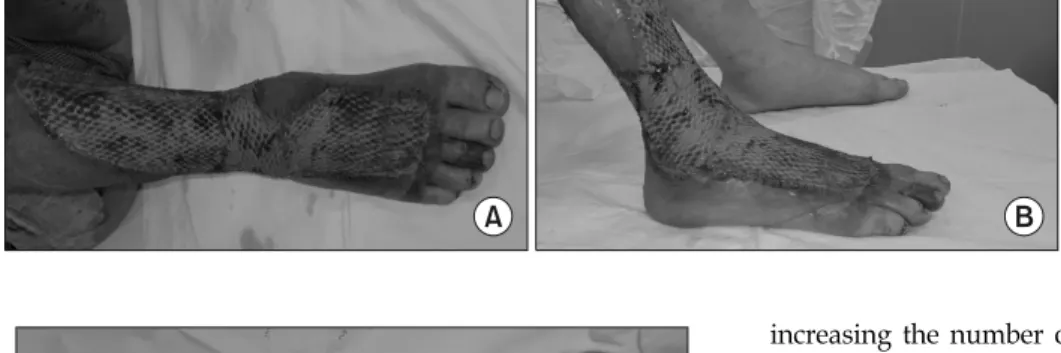
대한화상학회지 Vol. 22, No. 2, 2019Fig. 2. 6 times after NPWT images:
defect site covered by healthy granulation tissue (A) anterior images (B) lateral images.
Fig. 1. On admission images: 3rd
degree burn on right lower leg with eschar formation and focal tendon exposure, (A) anterior images (B) lateral images.weak immunity, so it is necessary to keep them in a state of isolation when a wound occurs. Care should be taken as it is slower to recover than in healthy people and can lead to sepsis if infection occurs. From the perspective of a healthy care staff who has to treat these patients, they are exposed to the risk of infection of blood through nee- dles or syringes. Medical staff should consider and pro- ceed treatment through the safe way to protect them- selves and other patients from this.
We report a case of a 3rd degree burn by electric pad with a surface area of approximately 5% of the body sur- face of a patient who underwent a sensory depression, which is a side effect of antiretroviral drugs used for treatment in patients with AIDS. In this regard, we report the case with literature review, which is safely recovered using negative-pressure wound therapy and split-thick- ness skin graft.
CASE REPORT
A 46-year old male patient who had diagnosed ac- quired immune deficiency syndrome (AIDS) was treated by antiretroviral drugs and undergone nausea and hypo- esthesia of lower extremities caused by side effect of the treatment. The patient developed a burn on the right low- er limb after sleeping on the electrical pad, but was self-disinfected at home. The wound was not recovered and worsened, and the patient was admitted to the out-
patient clinic of department of infectious disease which was visited regularly. There was no specific medical his- tory except AIDS. At the time of admission, the wounds were found to be covered with focal eschar formation and marginal induration in a wide range of about 5% of the body surface area of the right lower limb. Some of ten- dons were exposed and there was depression of tactile and pain sensation (Fig. 1). Preferentially, patient was re- verse isolated and checked overall status. He didn’t have fever and general condition was well. Overall laboratory blood examination was done. Specifically, Procalcitonin rate was reported 20.380 ng/mL and C-reactive protein rate was reported 190.89 mg/L. We treated the wound and intravenous antibiotic treatment using Cefepime with close consultation between the Department of Infectious Disease and Plastic Surgery considering medical con- dition of the patient. When the patient was judged to be undergoing surgical treatment, we performed the eschar- ectomy and debridement of the wound. Focal necrosis of the muscle layer and subcutaneous layer was observed.
Early negative pressure wound therapy (NPWT) using
the Vacuum Assisted Closure
TMdevice (CuraV.A.C.
ⓇTherapy, CGBIO, South Korea) was performed to mini-
mize the movement and contact of the patient. In order
to prevent infection through the blood of the patient, the
operation was carried out while wearing safety glasses,
special mask and double-gloving. NPWT was done twice
a week for 3 weeks (Fig. 2). 24 days after admission, there
Seok Won Hong, et al:Treatment of Third Degree Burn due to Low-Temperature Contact Burn on AIDS Patient
23
Fig. 3. 5 days after mesh STSG
and NPWT images: skin graft was stable and almost taken state (A) anterior images (B) lateral images.Fig. 4. 8 days after mesh STSG and NPWT images: skin graft
was stable.was no infection sign with healthy granulation tissue and split thickness skin graft using mesh was performed.
Intermediate thickness of skin graft was taken and be widened by using 1:1.5 ratio Mesh plate. Focal tendon ex- posure site was covered with acellular dermal matrix (Matriderm
Ⓡ, Medskin solutions, US) and skin graft.
NPWT was performed on the skin graft site for minimiz- ing the movement and contact of the patient. The pres- sure of NPWT was 75 mmHg. To protect the skin graft from detaching with sponge of NPWT, we cover the skin graft with lubricous perforated material (Mepitel One
Ⓡ, Molnlycke Health Care
Ⓡ, US) (Fig. 3). Five days after the operation, the skin graft was almost taken except focally lost. Eight days after operation, the patient was nearly healed without any complications and discharged (Fig. 4).
DISCUSSION
Unlike the West, which used the convection of warm air using a fireplace for heating in winter, Korea recently preferred to use electric pad in the floor as well as bed due to the cultural influence of heating with the warm Ondol in winter. Because the surface temperature of cur- rent electrical pads is usually limited to 50
oC, in the ab- sence of underlying disease, it is not uncommon to take burns, but occasional cases of severe burn have been ob- served when the senses are diminished or sleeping pills are taken. Recently, one research has been conducted as
increasing the number of cases of severe burn by electric pads and a paper reported that even a healthy person without medical or specific history such as taking sleep- ing pills or drunken state may experience burns due to electric pads
2).
Low-temperature burn can be occurred by various me- dia, but in general, the most frequent cases are caused by contact and hot water in the outpatient department of hospital. There have been various studies on generation and aggravation of burn. According to Brans et al.
3), the contact burn results in a severe burn compared to the scalding burn when the burn is taken at the same time and at the same temperature. This suggests that the low-temperature contact burn may result in a severe burn even with a shorter exposure time.
Generally, it is reported that deep burns can occur when the scalding burn from 44
oC to 6 hours and form 45
oC to 3 hours. While, the low-temperature contact burn can be caused more severe burn even with a shorter ex- posure time at the same temperature
1,3). From the study of Kim et al.
2), the surface temperature was measured in silicone rubber with a thermal conductivity similar to that of human skin at seven state of electric pad (130 W, 1∼7 state temperature controller). As a result, the temperature rise to 45.5
oC after 7 hours, and to 58.1
oC when the blan- ket was additionally covered. This is a temperature at which severe burn can be occurred within one minute.
Antitretroviral therapy which has greatly improved
prognosis of HIV infection is combinations of the drugs
to avoid viral resistance. Adverse reactions are common
with antiretrovirals such as hypersensitivity reactions, liv-
er toxicity, gastrointestinal intolerance and nervous sys-
tem toxicity. Peripheral neuropathy can be occurred as
side effect of antiretroviral therapy
4). In our case, the pa-
tient had undergone the hypoesthesia of both lower leg
due to the therapy. As we mentioned above, prevention
through education is very important in patients with de-
24
대한화상학회지 Vol. 22, No. 2, 2019creased sensation, especially because of the high proba- bility of occurrence of low-temperature contact burn.
Treatment of over third degree burns in AIDS patients has many limitations and risks. Patients with impaired immune status and without proper treatment may experi- ence worsening of wound resulting sepsis and opportun- istic infections. Therefore, it is important to select ad- equate methods of treatment. These methods should be done in extreme sterility. Recovery from simple wound dressing can be a time-consuming and unsuitable choice for AIDS with weak immunity. This can also be a burden to the medical staff with risks of infection.
Health care staff always exposure to the risk of biohaz- ardous transmission in surgery of any infectious patient.
Despite the highest standards of infection control, includ- ing universal safety precautions, there remains a risk of needle-stick injury to the operating room staff. A system- atic review suggested a per-event risk of 23 of 10,000 cas- es of HIV transmission from needle-stick injury
5). In our report, to minimize the procedures and frequency for re- ducing the risk of transmission and maximize the effect of treatment for patient, we performed the negative pres- sure wound therapy. Whenever surgical treatment was performed, all instruments including the walls of the op- erating room, were covered with plastic bags to prevent to transferring the blood of AIDS patient to others through instruments. Also, we take every efforts to mini- mize the potential for needle-stick injury, including the passing of any sharp instrument in a sterile container,
which is transferred as needed from surgeons to the scrub nurse. We strongly recommend “Double-gloving” for all cases of the procedures in operating room to reduce med- ical staff percutaneous blood exposure.
It is considered that the low-temperature contact burn due to the electric pad can be occurred with a higher probability than the healthy person for the person with the sensory depression. By educating and preventing this, it is considered that the incidence of severe burn can be lowered. If these burns occur in AIDS patients despite such education and prevention, as in our report, early surgical treatment, negative pressure wound therapy and recovery through skin graft using mesh are expected to minimize the burden on patients and medical staff and result in good prognosis.
REFERENCES
1) American Burn Association. Scald injury prevention : Educator’s guide. 2008;3
2) Seungsoo Kim, et al. The mechanism of low temperature burn and clinical cases. J Korean Burn Soc 2015;18:74-80.
3) Brans T, Dutrieux R, Hoekstra M, Kreis R, Pont J. Histo- pathological evaluation of scalds and contact burns in the pig model. Burns. 1994;20:48-51.
4) Bernardino R. Adverse drug reactions to antiretroviral medication. Frontiers in Bioscience 14. 2009:1785-1792 5) Marcus JL, Chao CR, Leyden WA, et al. Narrowing the gap
in life expectancy between HIV-infected and HIV-uninfected individuals with access to care. J Acquir Immune Defic Syndr 2016;73:39-46.