Prevention of Venous Thromboembolism in Medical Intensive Care Unit: A Multicenter Observational Study in Korea
Patients admitted to medical intensive care unit (MICU) are at increased risk for venous thromboembolism (VTE); and prophylaxis is recommended. However, the actual range and frequency of VTE prophylaxis administered to MICU patients are not well defined. Patients over 40 yr of age and expected MICU stay of more than 48 hr were eligible for this observational cohort study of 23 MICUs in Korea. Patients already on anticoagulation therapy or those requiring anticoagulation for reasons other than VTE were excluded.
Among 830 patients, VTE prophylaxis was given to 560 (67.5%) patients. Among 560 patients, 323 (38.9%) received pharmacoprophylaxis, 318 (38.4%) received mechanical prophylaxis and 81 (9.8%) received both forms of prophylaxis. About 74% of patients in the pharmacoprophylaxis group received low molecular weight heparin and 53% of the patients in the mechanical prophylaxis group used intermittent pneumatic compression.
Most of the patients (90%) had more than one risk factor for VTE and the most common risk factor was old age, followed by heart and respiratory failure. In this observational cohort study of 23 MICUs in Korea, 67.5% of patients received thromboprophylaxis.
Further studies are needed to clarify the role and efficacy of VTE prophylaxis in Korean critically ill patients.
Keywords: Medical Patients; Intensive Care Units; Thromboprophylaxis; Venous Thromboembolism
Jinwoo Lee,1 Seok Chan Kim,2 Sun Jong Kim,3 Jin Young Oh,4 Hyun Kyung Lee,5 Ho Kee Yum,5 Yang-Ki Kim,6 Sang-Bum Hong,7 Moo Suk Park,8 Sung-Chul Hwang,9 Hyoung Kyu Yoon,2 Hak-Ryul Kim,10 Jae Hwa Cho,11 Sunghoon Park,12 and Chul-Gyu Yoo1
1Division of Pulmonary and Critical Care Medicine, Department of Internal Medicine, Seoul National University College of Medicine, Seoul; 2Department of Pulmonology, The Catholic University of Korea School of Medicine, Seoul; 3Department of Internal Medicine, Konkuk University School of Medicine, Seoul; 4Department of Internal Medicine, University of Dongguk College of Medicine, Dongguk University Ilsan Hospital, Goyang; 5Department of Internal Medicine, Seoul Paik Hospital, Inje University College of Medicine, Seoul; 6Department of Respiratory Medicine and Allergy,
Soonchunhyang University School of Medicine, Seoul; 7Division of Pulmonary and Critical Care Medicine, Department of Internal Medicine, University of Ulsan College of Medicine, Asan Medical Center, Seoul; 8Department of Internal Medicine, Yonsei University College of Medicine, Seoul; 9Department of Pulmonary and Critical Care Medicine, Ajou University School of Medicine, Suwon; 10Department of Internal Medicine, College of Medicine, Wonkwang University, Iksan;
11Department of Internal Medicine, College of Medicine, Inha University, Incheon; 12Department of Internal Medicine, Hallym University College of Medicine, Seoul, Korea
Received: 9 May 2014 Accepted: 3 July 2014 Address for Correspondence:
Chul-Gyu Yoo, MD
Division of Pulmonary and Critical Care Medicine, Department of Internal Medicine, Seoul National University College of Medicine, 101 Daehak-ro, Jongno-gu, Seoul 110-744, Korea Tel: +82.2-2072-7593, Fax: +82.2-762-9662
E-mail: [email protected]
Funding: This study was sponsored by Sanofi-Aventis, Korea Co., Ltd. (2009, DIREG_L_03416).
http://dx.doi.org/10.3346/jkms.2014.29.11.1572 • J Korean Med Sci 2014; 29: 1572-1576
INTRODUCTION
Critically ill patients, including those in medical intensive care unit (MICU), are at in- creased risk for venous thromboembolism (VTE) such as deep vein thrombosis and pulmonary embolism (1). Many patients have multiple thrombosis risk factors such as advanced age, sepsis, heart failure, mechanical ventilation, paralysis and central ve- nous catheters (2).
The true incidence of VTE in critically ill patients is unknown but is estimated to range from 5% to 80% (3, 4). Previous studies have shown regional variations in the incidence of VTE, and thus far, most population–based data on VTE epidemiology were predom- inantly from Caucasian populations (5-7). Incidence of VTE has been rarely reported in Asian populations (8-10) and more so in critically ill Korean patients. Also, a signifi- cant portion of VTE is left undetected in MICU (6, 11) and it contributes significantly to morbidity and mortality associated with critical conditions (3). Given these factors, the core of VTE management is prevention.
Preventative measures largely fall into two groups: pharmacologic prophylaxis, such as low molecular weight heparins (LMWH) and unfractionated heparins (UFH) and mechanical prophylaxis, such as graduated compression stockings (GCS) and inter- mittent pneumatic compression (IPC). Diverse modes of VTE prophylaxis have been reported to be used in 33% to 100% of the critically ill patients (12). However, the actual range and frequency of VTE prophylaxis administered to MICU patients are not well defined. Especially, VTE prophylaxis is predicted to be under-utilized in Asia because of the misconception that its incidence is lower in Asians compared to Caucasians (13).
The objective of this multicenter observational study was to as- sess the actual use of VTE prophylaxis in Korean critically ill MICU patients.
MATERIALS AND METHODS Study design
Consecutive medical patients over 40 yr of age and expected MICU stay of more than 48 hr were eligible for this observation- al cohort study. Patients from MICUs of 23 hospitals in Korea were enrolled between June 2009 and July 2011. Patients already on anticoagulation therapy before admission to MICU or those requiring anticoagulation for other reasons not related to VTE were excluded. Additional exclusion criteria were contraindica- tion to mechanical prophylaxis, recent operation, plans for op- eration within a week, absence of written consent or current participation in other clinical trials.
Data collection
Patient data was collected at enrollment and at day 7 or day dis- charged from the MICU if the patient was discharged before day 7. For each patient, we recorded age, sex, height, weight, admitting diagnosis, VTE risk factors (14), bleeding risk factors and VTE prophylaxis. Thrombocytopenia was defined as plate- let counts below 100,000/μL and renal insufficiency was de- fined as creatinine clearance below 30 mL/min. All diagnostic tests for VTE performed during the study period were recorded.
Statistical analyses
All data analysis was conducted using the Statistical Package for the Social Sciences (SPSS) version 19.0. The chi-square test was used to compare non-continuous parameters and the Mann- Whitney rank-sum test was used to compare continuous data.
Probability of < 0.05 was considered significant.
Ethics statement
The study protocol was reviewed and approved by the institu- tional review board (IRB) of each hospital (Seoul National Uni- versity College of Medicine, IRB No.0906-080-284; Asan Medi- cal Center, IRB No.2009-0203; Hallym University Sacred Heart Hospital, IRB No.2009-S017; Yonsei University College of Medi- cine, IRB No.4-2009-0149; Wonkwang University College of Me- dicine, IRB No.7303-355; Chonnam University College of Medi- cine, IRB No.E-2009-05-045; Seoul Paik Hospital, IRB No.SIT- 2009-082; Pusan Paik Hospital, IRB No.09-058; Sanggye Paik Hospital, IRB No.09-41; Konkuk University School of Medicine, IRB No.KUH1010151; Nowon Eulji Hospital, IRB No.EMCIRB 09-30; Ajou University School of Medicine, IRB No.AJIRB-MED- OBS-09-111; Eijeongbu St. Mary’s Hospital, IRB No.UC09OSME 0063;
Dongguk University Ilsan Hospital, IRB No.2009-1-29; Daejeon Eulji Hospital, IRB No.09-30; Wonju Christian Hospital, IRB No.
CR309010; Pusan National University Hospital, IRB No.2009069;
Ulsan University Hospital, IRB No.09-37; Seoul Paik Hospital, IRB No.SIT-2009-082; Seoul St. Mary’s Hospital, IRB No.KC09- OSME0193; Chonnam National University Hwasun Hospital, IRB No.HCRE 0940-4; Soonchunhyang University School of Medicine, IRB No.2009-51; Inha University College of Medicine, IRB No.2009-862; Kangdong Sacred Heart Hospital, IRB No.09- 46; Yeouido St. Mary’s Hospital, IRB No.SC09OSMI0075). Inform- ed consent was waived by the IRB.
RESULTS
Patient characteristics
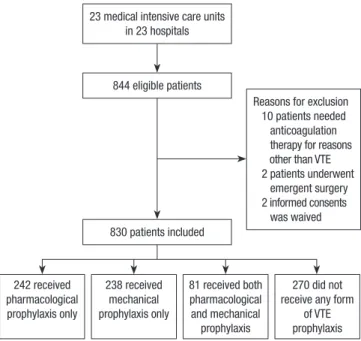
Of the 844 patients enrolled in the study, 14 enrolled patients were excluded from the final analysis for the following reasons:
10 because the patient needed anticoagulation therapy from reasons other than VTE such as atrial fibrillation, acute coro- nary syndrome or renal replacement therapy, 2 because the pa- tient underwent emergent surgery within 7 days of enrollment and 2 because informed consent was waived (Fig. 1).
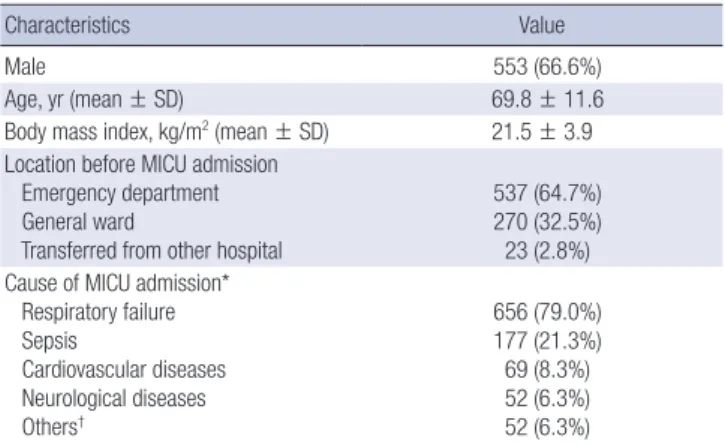
Baseline characteristics of the 830 patients are shown in Ta- ble 1. Patients were admitted to MICU for various reasons but the most common diagnosis on admission was respiratory fail- ure (79%). Table 2 summarizes the risk factors for VTE and blee- ding. Almost all patients (90%) had more than one risk factor for VTE before admission to MICU and 697 (84%) patients ac- quired new risk factors for VTE during their MICU stay. Patients had median of 4 risk factors for VTE (range, 0-8). The most com- mon VTE risk factor was old age (age 65 yr and over) (71.2%) followed by presence of central venous catheters (63%). Bleed- ing risk factors were assessed before and after MICU admission
Reasons for exclusion 10 patients needed anticoagulation therapy for reasons other than VTE 2 patients underwent emergent surgery 2 informed consents was waived
242 received pharmacological prophylaxis only
238 received mechanical prophylaxis only
81 received both pharmacological and mechanical
prophylaxis
270 did not receive any form
of VTE prophylaxis 23 medical intensive care units
in 23 hospitals
844 eligible patients
830 patients included
Fig. 1. Selection of study population and reasons. VTE, venous thromboembolism.
and 374 patients (45%) had more than one risk factor for bleed- ing. The most common risk factor was thrombocytopenia (20.8%) followed by coagulopathy (18.9%).
VTE thromboprophylaxis
Among 830 MICU patients, 560 (67.5%) of the patients received VTE prophylaxis. Patients who received prophylaxis was signifi- cantly older (P < 0.001), had heart or respiratory failure (P = 0.009) and sepsis (P < 0.001) compared with those not on VTE prophy- laxis. Previous history of VTE, presence of malignancy, immo- bilization and estrogen use was not different between the two groups. Patients with recent bleeding were more likely to not receive any prophylaxis (P < 0.001). However, presence of other bleeding risk factors such as history of hemorrhagic stroke, co- agulopathy, thrombocytopenia and renal insufficiency did not differ between patients who received prophylaxis and those who
did not receive any prophylactic treatment for VTE.
Pharmacologic prophylaxis was administered to 323 (38.9%) patients. LMWH were prescribed to a total of 239 patients and 104 patients received unfractionated heparin. In the LMWH group, only one patient was given dalteparin and all the other patients received enoxaparin. Most of the patients (207 patients, 64.1%) were started on pharmacologic VTE prophylaxis on the first day of MICU admission. Sixty patients (18.6%) started pharmacolo- gic prophylaxis on the second day followed by 22 patients (6.8%) on the third day, 15 patients (4.6%) on the fourth day, 8 patients on the fifth day, 5 patients on the sixth day and 6 patients on the seventh day of MICU admission.
Mechanical prophylaxis was administered to 318 (38.3%) pa- tients. Either GCS (n = 165), IPC (n = 169), or both (n = 16) was used. Most of the patients (231 patients, 72.6%) were started on mechanical VTE prophylaxis on the first day of MICU admission and 44 patients (13.8%) started on the second day. One hundred twenty-six patients (39.6%) had bleeding risk factors.
Eighty-one patients (9.8%) received both pharmacologic and mechanical prophylaxis. These patients were more likely to be diagnosed with sepsis (25.9% vs. 13.8%) and treated with me- chanical ventilation (92.6% vs. 49.1%), sedatives (81.5% vs. 36.4%) and central venous catheters (76.5% vs. 54.3%) compared with patients who did not receive any prophylaxis (P < 0.001).
Diagnosis of symptomatic VTE
During ICU stay, 17 patients underwent diagnostic tests for sus- pected VTE and the results were positive in 8 patients (0.9%).
For diagnostic tests, 15 patients underwent chest computed to- mographic angiography, one patient had Doppler ultrasound of the lower extremities and one patient had venography. Among Table 1. Characteristics of the 830 patients
Characteristics Value
Male 553 (66.6%)
Age, yr (mean ± SD) 69.8 ± 11.6
Body mass index, kg/m2 (mean ± SD) 21.5 ± 3.9 Location before MICU admission
Emergency department General ward
Transferred from other hospital
537 (64.7%) 270 (32.5%) 23 (2.8%) Cause of MICU admission*
Respiratory failure Sepsis
Cardiovascular diseases Neurological diseases Others†
656 (79.0%) 177 (21.3%) 69 (8.3%) 52 (6.3%) 52 (6.3%)
*Multiple diagnosis possible; †Other causes were gastrointestinal bleeding, hepatic encephalopathy, diabetic ketoacidosis, acute kidney injury and hypoglycemia.
Table 2. Risk factors for venous thromboembolism (VTE) and risk factors for bleeding in the study population Risk factors
Type of prophylaxis Pharmacologic only
(n = 242) Mechanical only
(n = 238) Both
(n = 81) No prophylaxis
(n = 270) Total
(n = 830) VTE risk factors
Advanced age ( > 65 yr) Heart/respiratory failure Immobilization Sepsis
Active cancer requiring therapy Previous VTE
Estrogens Central venous line Mechanical ventilation Sedation/paralysis
185 (76.4) 124 (51.2) 72 (29.8) 57 (23.6) 31 (12.8) 1 (0.4)
0 153 (63.2) 187 (77.3) 113 (46.7)
181 (76.7) 80 (33.9) 56 (23.7) 66 (28.0) 30 (12.7)
0 0 161 (67.9) 190 (80.2) 125 (52.7)
62 (76.5) 38 (46.9) 17 (21.0) 21 (25.9) 11 (13.6) 1 (1.2) 1 (1.2 ) 62 (76.5) 75 (92.6) 66 (81.5)
163 (60.4) 92 (34.1) 54 (20.0) 37 (13.7) 35 (13.0) 2 (0.7)
0 147 (54.4) 133 (49.3) 98 (36.3)
591 (71.3) 334 (40.3) 199 (24.0) 181 (21.8) 107 (12.9) 4 (0.5) 1 (0.1) 523 (63.0) 585 (70.5) 402 (48.4) Bleeding risk factors
Previous or recent bleeding Hemorrhagic stroke Coagulopathy
Thrombocytopenia ( < 100,000/μL) Renal insufficiency (Ccr < 30 mL/min)
11 (4.5) 6 (2.5) 58 (24.0) 40 (16.5) 35 (14.5)
21 (8.9) 5 (2.1) 32 (13.5) 52 (21.9) 18 (7.6)
8 (9.9) 1 (1.2) 14 (17.3) 11 (13.6) 12 (14.8)
48 (17.8) 2 (0.7) 53 (19.6) 70 (25.9) 36 (13.3)
88 (10.6) 14 (1.7) 157 (18.9) 173 (20.8) 101 (12.2) Data are presented as numbers (percentages). Some patients had more than 1 risk factor. Eighty-one patients (9.8%) received both pharmacologic and mechanical prophylaxis.
VTE, venous thromboembolism; Ccr, creatinine clearance.
the 15 patients with chest computed tomography, 5 were diag- nosed with pulmonary embolism. Deep vein thrombosis was diagnosed in one patient who underwent venography. Left ven- tricular thrombus and iliac vein thrombus was accidentally dis- covered in two patients.
Among 8 patients with confirmed VTE, 4 patients were male and 4 patients were female. All but one patient had risk factors for VTE before and after ICU admission. Three patients had risk factors for bleeding, one with coagulopathy and two patients with both coagulopathy and renal insufficiency. All of the pa- tients were on VTE prophylaxis. Three patients were on both pharmacologic and mechanical prophylaxis, whereas 1 patient was on mechanical prophylaxis only and 4 patients were on che- mical prophylaxis only.
Clinical outcomes
At day 7, 55 patients (6.6%) had died, 548 patients (66%) were still in the MICU and 227 patients (27.3%) were discharged from ICU. Among the non-survivors, 16 patients (29.1%) did not re- ceive any prophylaxis for VTE. The cause of death in all 55 pa- tients was associated with the underlying disease and not VTE.
DISCUSSION
Critically ill patients face an increased risk of VTE and VTE oc- currence is known to be associated with significant morbidity and mortality (15). According to the current guidelines, routine prophylaxis of VTE with LMWH or UFH is recommended to critically ill patients admitted to ICU and mechanical thrombo- prophylaxis is recommended for those who are bleeding or are at high risk for major bleeding (16). However, despite compel- ling evidence suggesting routine thromboprophylaxis for criti- cally ill patients, prophylaxis rates as low as 33% have been re- ported in previous studies (12, 17). Unfortunately, thrombopro- phylaxis rates of critically ill Asian patients are not well studied compared to the Western population. Parikh et al. (18) studied the current VTE prophylaxis methods in Asian patients admit- ted to MICU, but the study only included patients in whom de- cision to give VTE prophylaxis had already been taken. There- fore, actual use of thromboprophylaxis in real practice settings could not be assessed.
The results of this prospective observational study of 830 MI CU patients show that routine thromboprophylaxis in Korean critically ill medical patients are still significantly underused.
Only 67.5% of the patients received any form of thrombopro- phylaxis. Although 45% of our study population had risk factors for bleeding and 3% of the patients had more than one bleeding risk factors, according to the 9th American College of Chest Phy- sicians Consensus Conference on Antithrombotic Therapy guide- lines (16), mechanical prophylaxis measures should have been considered.
Relatively low rate of thromboprophylaxis may be associated with the previous belief that the incidence of VTE is low in Asian population. However, yearly increasing incidence of VTE has been reported in the Korean population (19). The current Kore- an guidelines (20, 21) recommend immediate stratification of thrombotic risk and emphasizes on the primary prevention of VTE. The guidelines also specify that since the majority of pa- tients admitted to the ICU have multiple risk factors for VTE, pharmacological or mechanical prophylaxis should be given.
Also, underestimation of the risk of VTE and fear of bleeding complications have been discussed as a possible explanation for underutilization of prophylactic therapy (22).
Since the main purpose of this study was not to assess VTE prevalence, diagnostic tests were performed only when VTE was clinically suspected. Diagnosis of VTE in critically ill patients are challenging because many patients are on sedatives and mechanical ventilation and therefore they are not able to com- municate their symptoms. Also diagnostic modalities to diag- nose VTE are limited in these subjects. Potential risk of transfer and risks of development of contrast-induced nephrotoxicity cannot be dismissed in many cases. Illustrating this, only 17 pa- tients (2%) in our study underwent diagnostic tests for VTE. In- terestingly, all of the patients diagnosed with VTE in this study were under thromboprophylaxis. Development of VTE is known to be high despite thromboprophylaxis. Ibrahim et al. (23) re- ported that 23.6% of the ventilated MICU patients developed VTE even after 100% employment of prophylaxis.
The study has certain limitations. First, factors influencing the physician’s decision making, regarding thromboprophylax- is methods, were not assessed. Overestimations of bleeding, neg- ligence and lack of consensus guidelines have been suggested as a possible explanation for underutilization of VTE prophy- laxis (24). Second, patients were followed up only until 7 days after MICU admission and thus long-term outcomes could not be assessed. Third, although it might be associated with under- utilization of thromboprophylaxis, complications related to throm- boprophylaxis, such as bleeding events were not recorded.
However, to the best of our knowledge, this is one of the few multicenter studies to report the actual use of VTE prophylaxis in critically ill Asian patients. Also most of the studies are con- ducted in mixed ICU or surgical ICU and studies targeting only patients in MICU are rare. Hopefully, the results of this study will shed some light on the issue of adequate and effective pre- vention of VTE in MICU.
Our data show that 90% of Korean patients admitted to MICU are at risk for VTE and that the recommended VTE prophylaxis is underutilized, since only 67.5% of eligible patients received either chemical or mechanical prophylaxis. Further studies are needed to clarify the role and efficacy of VTE prophylaxis in Ko- rean critically ill patients.
ACKNOWLEDGEMENTS
This study was sponsored by Sanofi-Aventis, Korea Co., Ltd. Data analysis, interpretation and the writing of the manuscript were independent from the sponsor. We thank all the physicians who participated in the study. The active participants were as follows:
Kyoo-Rok Han, Byoung Hoon Lee, Hye-Kyung Park, Soo Jeon Choi, Kwang Won Seo, Won Yeon Lee, Min Soo Han, Hui-Kyung Jeon, and In Jae Oh.
DISCLOSURE
The authors have no conflicts of interest to disclose.
ORCID
Jinwoo Lee http://orcid.org/0000-0003-0958-106X Sang-Bum Hong http://orcid.org/0000-0002-4424-7457 Jae Hwa Cho http://orcid.org/0000-0002-3432-3997 Sunghoon Park http://orcid.org/0000-0001-7004-6985 REFERENCES
1. Davidson BL. Risk assessment and prophylaxis of venous thromboem- bolism in acutely and/or critically ill patients. Haemostasis 2000; 30: 77- 81; discussion 63.
2. Cushman M. Epidemiology and risk factors for venous thrombosis. Se- min Hematol 2007; 44: 62-9.
3. Williams MT, Aravindan N, Wallace MJ, Riedel BJ, Shaw AD. Venous thromboembolism in the intensive care unit. Crit Care Clin 2003; 19:
185-207.
4. Attia J, Ray JG, Cook DJ, Douketis J, Ginsberg JS, Geerts WH. Deep vein thrombosis and its prevention in critically ill adults. Arch Intern Med 2001; 161: 1268-79.
5. Patel R, Cook DJ, Meade MO, Griffith LE, Mehta G, Rocker GM, Mar- shall JC, Hodder R, Martin CM, Heyland DK, et al. Burden of illness in venous thromboembolism in critical care: a multicenter observational study. J Crit Care 2005; 20: 341-7.
6. Hirsch DR, Ingenito EP, Goldhaber SZ. Prevalence of deep venous throm- bosis among patients in medical intensive care. JAMA 1995; 274: 335-7.
7. Marik PE, Andrews L, Maini B. The incidence of deep venous thrombosis in ICU patients. Chest 1997; 111: 661-4.
8. Xu XF, Yang YH, Zhai ZG, Liu S, Zhu GF, Li CS, Wang C. Prevalence and incidence of deep venous thrombosis among patients in medical inten- sive care unit. Zhonghua Liu Xing Bing Xue Za Zhi 2008; 29: 1034-7.
9. Aniwan S, Rojnuckarin P. High incidence of symptomatic venous throm- boembolism in Thai hospitalized medical patients without thrombopro-
phylaxis. Blood Coagul Fibrinolysis 2010; 21: 334-8.
10. Do JG, Kim DH, Sung DH. Incidence of deep vein thrombosis after spi- nal cord injury in Korean patients at acute rehabilitation unit. J Korean Med Sci 2013; 28: 1382-7.
11. Twigg SJ, McCrirrick A, Sanderson PM. A comparison of post mortem findings with post hoc estimated clinical diagnoses of patients who die in a United Kingdom intensive care unit. Intensive Care Med 2001; 27:
706-10.
12. Geerts W, Cook D, Selby R, Etchells E. Venous thromboembolism and its prevention in critical care. J Crit Care 2002; 17: 95-104.
13. Liew NC, Chang YH, Choi G, Chu PH, Gao X, Gibbs H, Ho CO, Ibrahim H, Kim TK, Kritpracha B, et al. Asian venous thromboembolism guide- lines: prevention of venous thromboembolism. Int Angiol 2012; 31: 501- 16.
14. Geerts W, Selby R. Prevention of venous thromboembolism in the ICU.
Chest 2003; 124: 357s-63s.
15. Chan CM, Shorr AF. Economic and outcomes aspects of venous throm- boembolic disease. Crit Care Clin 2012; 28: 113-23, vii.
16. Kahn SR, Lim W, Dunn AS, Cushman M, Dentali F, Akl EA, Cook DJ, Balekian AA, Klein RC, Le H, et al. Prevention of VTE in nonsurgical pa- tients: antithrombotic therapy and prevention of thrombosis, 9th ed: amer- ican college of chest physicians evidence-based clinical practice guide- lines. Chest 2012; 141: e195S-226S.
17. Keane MG, Ingenito EP, Goldhaber SZ. Utilization of venous thrombo- embolism prophylaxis in the medical intensive care unit. Chest 1994; 106:
13-4.
18. Parikh KC, Oh D, Sittipunt C, Kalim H, Ullah S, Aggarwal SK; VOICE Asia Investigators. Venous thromboembolism prophylaxis in medical ICU patients in Asia (VOICE Asia): a multicenter, observational, cross- sectional study. Thromb Res 2012; 129: e152-8.
19. Jang MJ, Bang SM, Oh D. Incidence of venous thromboembolism in Ko- rea: from the Health Insurance Review and Assessment Service database.
J Thromb Haemost 2011; 9: 85-91.
20. Bang SM, Jang MJ, Kim KH, Yhim HY, Kim YK, Nam SH, Hwang HG, Bae SH, Kim SH, Mun YC, et al. Prevention of venous thromboembolism, 2nd edition: korean society of thrombosis and hemostasis evidence-based clin- ical practice guidelines. J Korean Med Sci 2014; 29: 164-71.
21. Bang SM, Jang MJ, Oh D, Kim YK, Kim IH, Yoon SS, Yoon HJ, Kim CS, Park S, Korean Society of Thrombosis and Hemostasis. Korean guide- lines for the prevention of venous thromboembolism. J Korean Med Sci 2010; 25: 1553-9.
22. Ahmad HA, Geissler A, MacLellan DG. Deep venous thrombosis pro- phylaxis: are guidelines being followed? ANZ J Surg 2002; 72: 331-4.
23. Ibrahim EH, Iregui M, Prentice D, Sherman G, Kollef MH, Shannon W.
Deep vein thrombosis during prolonged mechanical ventilation despite prophylaxis. Crit Care Med 2002; 30: 771-4.
24. Bikdeli B, Sharif-Kashani B. Prophylaxis for venous thromboembolism:
a great global divide between expert guidelines and clinical practice? Se- min Thromb Hemost 2012; 38: 144-55.