The Clinical Outcomes of Lower Gastrointestinal Bleeding Are Not Better than Those of Upper Gastrointestinal Bleeding
The incidence of lower gastrointestinal bleeding (LGIB) is increasing; however, predictors of outcomes for patients with LGIB are not as well defined as those for patients with upper gastrointestinal bleeding (UGIB). The aim of this study was to identify the clinical outcomes and the predictors of poor outcomes for patients with LGIB, compared to outcomes for patients with UGIB. We identified patients with LGIB or UGIB who underwent endoscopic procedures between July 2006 and February 2013. Propensity score matching was used to improve comparability between LGIB and UGIB groups. The clinical outcomes and predictors of 30-day rebleeding and mortality rate were analyzed between the two groups.
In total, 601 patients with UGIB (n = 500) or LGIB (n = 101) were included in the study, and 202 patients with UGIB and 101 patients with LGIB were analyzed after 2:1 propensity score matching. The 30-day rebleeding and mortality rates were 9.9% and 4.5% for the UGIB group, and 16.8% and 5.0% for LGIB group, respectively. After logistic regression analysis, the Rockall score (P = 0.013) and C-reactive protein (CRP; P = 0.047) levels were significant predictors of 30-day mortality in patients with LGIB; however, we could not identify any predictors of rebleeding in patients with LGIB. The clinical outcomes for patients with LGIB are not better than clinical outcomes for patients with UGIB. The clinical Rockall score and serum CRP levels may be used to predict 30-day mortality in patients with LGIB.
Keywords: Gastrointestinal Bleeding; Colonoscopy; Hematochezia; Mortality; Prognosis Min Seob Kwak, Jae Myung Cha,
Yong Jae Han, Jin Young Yoon, Jung Won Jeon, Hyun Phil Shin, Kwang Ro Joo, and Joung Il Lee Department of Internal Medicine, Kyung Hee University Hospital at Gangdong, Kyung Hee University School of Medicine, Seoul, Korea Received: 31 March 2016
Accepted: 28 June 2016 Address for Correspondence:
Jae Myung Cha, MD
Department of Internal Medicine, Kyung Hee University Hospital at Gangdong, Kyung Hee University School of Medicine, 892 Dongnam-ro, Gandong-gu, Seoul 05278, Korea E-mail: [email protected]
http://dx.doi.org/10.3346/jkms.2016.31.10.1611 • J Korean Med Sci 2016; 31: 1611-1616
INTRODUCTION
Acute gastrointestinal bleeding is a common cause of hospital admission and life-threatening medical emergency in many countries (1,2). Gastrointestinal bleeding can be classified into upper- or lower-gastrointestinal bleeding (UGIB or LGIB) on the basis of anatomical location (3-6). Risk factors for clinical outcomes for patients with UGIB have been widely investigated (7-10); however, little is known about the risk factors for clinical outcomes in patients with LGIB, despite a rising incidence (6,8).
In a Spanish population-based study (4), patients with LGIB had longer hospital stays and higher mortality rates compared to patients with UGIB. Furthermore, the patients with LGIB showed a significantly increasing trend of hospitalization due to lower-gastrointestinal events in comparison to a decreasing trend of hospitalization due to upper-gastrointestinal events in patients with UGIB. However, the authors of the study analyzed bleeding and perforation together, and therefore the clinical outcomes of LGIB alone remain to be determined. To date, no studies have compared the risk factors of clinical outcomes in patients with LGIB versus UGIB, especially in Asian population.
The aim of this study was to identify the clinical outcomes and
the predictors of poor outcomes for patients with LGIB, com- pared to outcomes for patients with UGIB.
MATERIALS AND METHODS Patients
We retrospectively studied patients with UGIB or LGIB, who underwent upper endoscopy and/or colonoscopy with or with- out intervention between July 2006 and February 2013 at the Kyung Hee University Hospital in Gangdong, Seoul, Korea. Pa- tients were considered eligible for the study if they had upper endoscopy and/or colonoscopy with a history of hematemesis, melena, hematochezia, anal bleeding, occult bleeding, or a combination of these symptoms. Patients who initially visited another hospital for the bleeding episode and were subsequent- ly transferred to our hospital were included as long as no inter- vention had been performed. Data regarding transfers to and from other institutions and readmission were also collected.
Patients with esophagogastric variceal bleeding and obscure gastrointestinal bleeding were excluded from the database. We compared the risk factors of clinical outcomes for patients with LGIB to those for patients with UGIB. The database of eligible Gastroenterology & Hepatology
consecutive patients was reviewed for the following informa- tion: demographic data (age, sex), historical data (smoking, al- cohol, presenting signs or symptoms, comorbidity, relevant medical history, date of endoscopy, and any concomitant in- take of medications on presentation), physical examination findings, and laboratory data. The endoscopic report included the specialty of the endoscopist, identification of the bleeding lesion, methods of endoscopic hemostasis, and timing and out- comes of endoscopic intervention.
Patients with acute gastrointestinal bleeding were managed according to the guidelines of the American College of Gastro- enterology and the American Society for Gastrointestinal En- doscopy (11-13). According to guidelines for UGIB, high-dose proton pump inhibitor (pantoprazole 80 mg bolus followed by 8 mg/hr infusion) was routinely administered to most patients with UGIB. All patients were monitored from the time of hospi- tal admission up to 30 days after the endoscopic procedure for 30-day rebleeding or mortality. The decision of whether to ad- minister antithrombotic drugs was left to the discretion of the attending physician. In general, antithrombotic drugs were re- sumed as soon as possible after the endoscopic procedure for secondary prevention (within 1-3 days for most patients); how- ever, antithrombotic drugs were not used for primary preven- tion. Uncontrolled bleeding despite endoscopic hemostasis was usually considered an indication for angiographic emboli- zation or surgery.
Definition of variables
UGIB was defined as bleeding within the reach of an upper en- doscopy, whereas LGIB was defined as bleeding distal to the reach of colonoscopy (14,15). Endoscopic intervention was con- sidered complete when endoscopic hemostasis at the bleeding site was successful, and active bleeding was stopped during the first endoscopic intervention.
Thirty-day rebleeding was defined by recurrent hemateme- sis, hematochezia, fresh anal bleeding or both, together with ei- ther the development of hemodynamic instability or a decrease in hemoglobin concentration at least 2 g/L following initial suc- cessful treatment and stabilization within 30 days of the initial bleeding episode. Thirty-day mortality was defined as any death occurring within 30 days of the initial bleeding episode. Major comorbidity was defined as liver cirrhosis, chronic renal failure, end-stage renal disease or malignancy, on the basis of a previ- ous study (16). For risk stratification, the Glasgow-Blatchford score (GBS) and the clinical Rockall score were generally used as described previously (17,18). The clinical Rockall score con- sists of pre-endoscopic variables: age, shock, and comorbidity (17). The GBS score includes the following five variables: blood urea levels, hemoglobin levels, systolic blood pressure, and oth- er markers (heart rate, melena, syncope, hepatic disease, and cardiac failure) (18). We used a modified GBS score for patients
with LGIB, substituting hematochezia instead of melena.
Statistical analyses
The primary outcome measures were 30-day rebleeding and mortality rates for patients with LGIB or UGIB. The secondary outcome measures were predictive factors for the 30-day re- bleeding and mortality.
Categorical data are expressed as number (percentage), wher- eas continuous data are expressed as mean ± standard devia- tions. A two-tailed Student’s t-test was used for continuous vari- ables, and a two-tailed χ2 test or a Fisher’s exact test was used for categorical data. Univariate logistic regression analysis was performed to determine independent risk factors of rebleeding or mortality, and odds ratios (ORs) and 95% confidence inter- vals (CIs) were calculated. All P values were two tailed, and a P value < 0.05 was considered statistically significant. Data anal- yses were conducted using SPSS software, version 21.0 (SPSS, Chicago, IL, USA).
Propensity score matching was used to improve the compa- rability between the LGIB and UGIB groups using the following variables: age, sex, major comorbidity, experience of the endos- copist, and ulcerogenic medications (such as nonsteroidal anti- inflammatory drugs [NSAIDs], anti-platelet agent, or anticoag- ulants), which can influence the outcomes of the patients (19).
After estimating propensity scores, participants were matched based on a 2:1 nearest-neighbor algorithm by SPSS-R plugin software. This resulted in 303 matched pairs without significant imbalances (|d| > 0.25) in the covariates utilized.
Ethics statement
This study was conducted according to the Declaration of Hel- sinki and approved by the hospital’s institutional review board (KHNMC IRB-2015-08-044). Informed consent was waived by the board.
RESULTS
Baseline patient characteristics
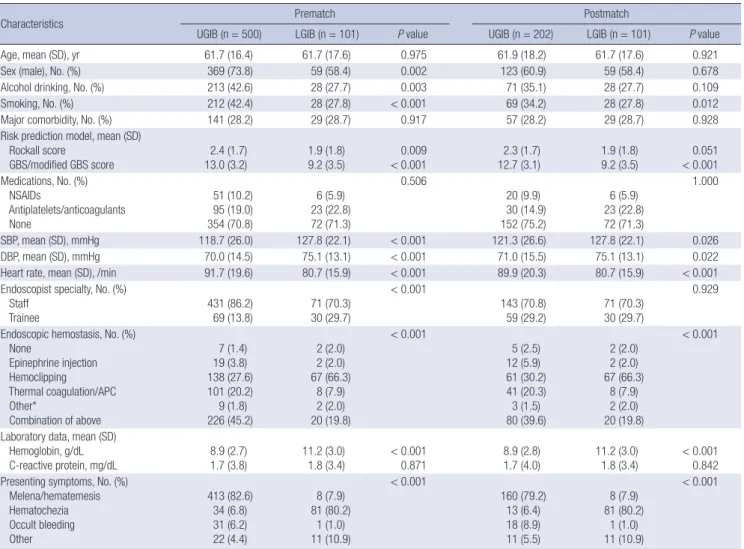
During the study period, a total of 837 patients with UGIB or LGIB were identified, and 236 patients were excluded due to insufficient medical records. Therefore, 601 patients with UGIB (n = 500) or LGIB (n = 101) were finally analyzed. After 2:1 pro- pensity score matching, 202 patients with UGIB and 101 pati- ents with LGIB were identified as matched pairs. The clinical and laboratory characteristics of these matched pairs are sum- marized in Table 1; the pairs are well balanced for the variables, including age, sex, comorbidity, experience of the endoscopist, and ulcerogenic medications. After matching, the modified GBS score was significantly lower in the LGIB group than in the UGIB group (P < 0.001); however, the Rockall score was only marginally lower in the LGIB group than in the UGIB group (P =
0.051). The patients with UGIB had significantly lower systolic/
diastolic blood pressure, higher heart rate and lower hemoglo- bin levels than patients with LGIB.
Clinical outcomes
The mean duration of disease-related hospital stay was compa- rable in both groups (P = 0.123; Table 2). The most common causes of LGIB were postpolypectomy bleeding, diverticular bleeding, malignancy, Dieulafoy’s lesion, and hemorrhoid, while, in UGIB, peptic ulcer, Mallory-Weiss tear, malignancy, Dieula- foy’s lesion, and angiodysplasia were the most common causes in our center.
The 30-day rebleeding and mortality rate were 9.9% and 4.5%
for the UGIB group and 16.8% and 5.0% for the LGIB group, re- spectively (Table 2). Although the 30-day rebleeeding rate was higher in the LGIB group than in the UGIB group, no statistical- ly significant difference was found between the two groups for 30-day rebleeding or mortality rate. Successful endoscopic he-
mostasis was significantly higher in the UGIB group compared with the LGIB group (86.6% compared with 76.2%, P = 0.037).
Hemoclip application was the most frequently used endoscop- Table 1. Clinical and laboratory characteristics of patients with lower or upper gastrointestinal bleeding before and after propensity score matching
Characteristics Prematch Postmatch
UGIB (n = 500) LGIB (n = 101) P value UGIB (n = 202) LGIB (n = 101) P value
Age, mean (SD), yr 61.7 (16.4) 61.7 (17.6) 0.975 61.9 (18.2) 61.7 (17.6) 0.921
Sex (male), No. (%) 369 (73.8) 59 (58.4) 0.002 123 (60.9) 59 (58.4) 0.678
Alcohol drinking, No. (%) 213 (42.6) 28 (27.7) 0.003 71 (35.1) 28 (27.7) 0.109
Smoking, No. (%) 212 (42.4) 28 (27.8) < 0.001 69 (34.2) 28 (27.8) 0.012
Major comorbidity, No. (%) 141 (28.2) 29 (28.7) 0.917 57 (28.2) 29 (28.7) 0.928
Risk prediction model, mean (SD) Rockall score
GBS/modified GBS score 2.4 (1.7)
13.0 (3.2) 1.9 (1.8)
9.2 (3.5) 0.009
< 0.001 2.3 (1.7)
12.7 (3.1) 1.9 (1.8)
9.2 (3.5) 0.051
< 0.001 Medications, No. (%)
NSAIDs
Antiplatelets/anticoagulants None
51 (10.2) 95 (19.0) 354 (70.8)
6 (5.9) 23 (22.8) 72 (71.3)
0.506
20 (9.9) 30 (14.9) 152 (75.2)
6 (5.9) 23 (22.8) 72 (71.3)
1.000
SBP, mean (SD), mmHg 118.7 (26.0) 127.8 (22.1) < 0.001 121.3 (26.6) 127.8 (22.1) 0.026
DBP, mean (SD), mmHg 70.0 (14.5) 75.1 (13.1) < 0.001 71.0 (15.5) 75.1 (13.1) 0.022
Heart rate, mean (SD), /min 91.7 (19.6) 80.7 (15.9) < 0.001 89.9 (20.3) 80.7 (15.9) < 0.001
Endoscopist specialty, No. (%) Staff
Trainee
431 (86.2) 69 (13.8)
71 (70.3) 30 (29.7)
< 0.001
143 (70.8) 59 (29.2)
71 (70.3) 30 (29.7)
0.929
Endoscopic hemostasis, No. (%) None
Epinephrine injection Hemoclipping Thermal coagulation/APC Other*
Combination of above
7 (1.4) 19 (3.8) 138 (27.6) 101 (20.2) 9 (1.8) 226 (45.2)
2 (2.0) 2 (2.0) 67 (66.3)
8 (7.9) 2 (2.0) 20 (19.8)
< 0.001
5 (2.5) 12 (5.9) 61 (30.2) 41 (20.3) 3 (1.5) 80 (39.6)
2 (2.0) 2 (2.0) 67 (66.3)
8 (7.9) 2 (2.0) 20 (19.8)
< 0.001
Laboratory data, mean (SD) Hemoglobin, g/dL
C-reactive protein, mg/dL 8.9 (2.7)
1.7 (3.8) 11.2 (3.0)
1.8 (3.4) < 0.001
0.871 8.9 (2.8)
1.7 (4.0) 11.2 (3.0)
1.8 (3.4) < 0.001 0.842 Presenting symptoms, No. (%)
Melena/hematemesis Hematochezia Occult bleeding Other
413 (82.6) 34 (6.8) 31 (6.2) 22 (4.4)
8 (7.9) 81 (80.2)
1 (1.0) 11 (10.9)
< 0.001
160 (79.2) 13 (6.4) 18 (8.9) 11 (5.5)
8 (7.9) 81 (80.2)
1 (1.0) 11 (10.9)
< 0.001
UGIB, upper gastrointestinal bleeding; LGIB, lower gastrointestinal bleeding; GBS score, Glasgow-Blatchford score; SD, standard deviation; NSAID, nonsteroidal anti-inflamma- tory drug; SBP, systolic blood pressure; DBP, diastolic blood pressure; APC, argon plasma coagulation.
*Other endoscopic hemostasis included band ligation and beriplast injection.
Table 2. Clinical outcomes of patients with upper or lower gastrointestinal bleeding
Variables UGIB LGIB P value
Hospital stay*, mean (SD), day 6.3 (5.0) 5.3 (5.4) 0.123 30-day rebleeding, No. (%) 20 (9.9) 17 (16.8) 0.082
30-day mortality, No. (%) 9 (4.5) 5 (5.0) 0.847
Blood transfusion (yes), No. (%) 154 (76.2) 51 (50.5) < 0.001 Endoscopic hemostasis, No. (%)
Complete bleeding control
Incomplete bleeding control 175 (86.6)
21 (10.4) 77 (76.2) 19 (18.8)
0.037
Daytime endoscopy (yes), No. (%) 168 (83.2) 86 (85.1) 0.659 Emergency endoscopy (< 24 hr), No. (%) 199 (98.5) 97 (96.0) 0.227 Embolization or operation, No. (%) 6 (3.0) 4 (4.0) 0.736 UGIB, upper gastrointestinal bleeding; LGIB, lower gastrointestinal bleeding; SD, Stan- dard deviation.
*Twenty-six patients were excluded from this analysis as they experienced gastroin- testinal bleeding during admission at another department, which affected the duration of hospital stay.
ic hemostasis in patients with LGIB, whereas hemoclipping and a combination of hemostatic methods were used more frequent- ly in patients with UGIB.
Risk factors for 30-day rebleeding and mortality
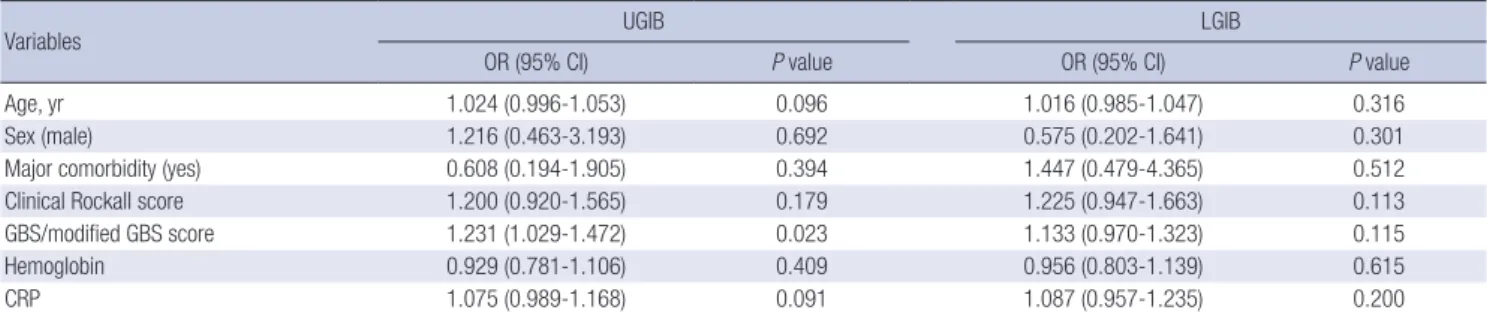
The results of univariate analyses of possible risk factors, includ- ing age, sex, major comorbidity, Rockall score, GBS/modified GBS score, hemoglobin, and C-reactive protein (CRP) levels, for 30-day rebleeding and mortality in patients with UGIB or LGIB are summarized in Table 3 (rebleeding) and Table 4 (mor- tality). For 30-day rebleeding, no risk factors were identified in the LGIB group; and only the GBS score correlated significantly with rebleeding in the UGIB group (OR = 1.231, 95% CI, 1.029- 1.472; P = 0.023; Table 3). For 30-day mortality, the Rockall score (OR = 2.081, 95% CI, 1.170-3.700; P = 0.013) and CRP levels (OR = 1.174, 95% CI, 1.002-1.376; P = 0.047) were identified as risk factors in the LGIB group; however, the Rockall score, GBS score, hemoglobin, and CRP levels were all identified as risk factors in the UGIB group (Table 4).
DISCUSSION
Patients with acute gastrointestinal bleeding have significant medical problems, including morbidity, rebleeding and mor- tality. Previous studies have found that age, sex, comorbid con- ditions, and NSAIDs use were significant predictors of rebleed- ing and mortality for LGIB (20-23), but they have lacked the pow- er to clarify. Compared to outcomes for patients with UGIB, lit-
tle attention had previously been paid to outcomes for patients with LGIB, and risk factors for rebleeding and mortality were unknown. In this study, the duration of hospital stay and 30- day mortality rate of patients with LGIB were similar to those of patients with UGIB. Furthermore, the 30-day rebleeding rate of the LGIB group was higher than that of the UGIB group (16.8%
compared with 9.9%), although statistical significance was not reached (P = 0.082). Therefore, the clinical outcomes for pati- ents with LGIB are no better than the clinical outcomes for pa- tients with UGIB. Our findings may be explained by the lower rate of successful endoscopic hemostasis in patients with LGIB than in patients with UGIB (76.2% compared with 86.6%, P = 0.037). In the management of LGIB successful endoscopic he- mostasis is more difficult because of the low diagnostic rate of the definite source of bleeding (24). More careful risk stratifica- tion is necessary for patients with LGIB as they have poor clini- cal outcomes despite more stable vital signs compared to pa- tients with UGIB; the LGIB group had higher blood pressures, stable heart rates, higher hemoglobin levels, lower clinical Rock- all scores, and lower modified GBS scores.
To date, many risk stratification models for predicting clinical outcomes in patients with UGIB have been suggested (7,9,10, 25); however, only a few studies have investigated patients with LGIB, and the results are inconsistent (6,20,26,27). The accurate identification of high-risk patients during the assessment of pa- tients with LGIB has therefore been difficult. The BLEED classi- fication tool (28), developed and validated in the United States, has been used to predict poor prognosis for patients with LGIB Table 3. Predictable risk factors for 30-day rebleeding in patients with upper or lower gastrointestinal bleeding
Variables UGIB LGIB
OR (95% CI) P value OR (95% CI) P value
Age, yr 1.024 (0.996-1.053) 0.096 1.016 (0.985-1.047) 0.316
Sex (male) 1.216 (0.463-3.193) 0.692 0.575 (0.202-1.641) 0.301
Major comorbidity (yes) 0.608 (0.194-1.905) 0.394 1.447 (0.479-4.365) 0.512
Clinical Rockall score 1.200 (0.920-1.565) 0.179 1.225 (0.947-1.663) 0.113
GBS/modified GBS score 1.231 (1.029-1.472) 0.023 1.133 (0.970-1.323) 0.115
Hemoglobin 0.929 (0.781-1.106) 0.409 0.956 (0.803-1.139) 0.615
CRP 1.075 (0.989-1.168) 0.091 1.087 (0.957-1.235) 0.200
UGIB, upper gastrointestinal bleeding; LGIB, lower gastrointestinal bleeding; OR, odds ratio; CI, confidence interval; GBS score, Glasgow-Blatchford score; CRP, C-reactive protein.
Table 4. Predictable risk factors for 30-day mortality in patients with upper or lower gastrointestinal bleeding
Variables UGIB LGIB
OR (95% CI) P value OR (95% CI) P value
Age, yr 1.020 (0.980-1.061) 0.334 1.060 (0.990-1.135) 0.092
Sex (male) 0.794 (0.207-3.053) 0.738 0.456 (0.073-2.858) 0.402
Major comorbidity (yes) 2.113 (0.547-8.170) 0.278 4.038 (0.638-25.555) 0.138
Clinical Rockall score 1.693 (1.115-2.571) 0.014 2.081 (1.170-3.700) 0.013
GBS/modified GBS score 2.162 (1.426-3.277) < 0.001 1.302 (0.980-1.729) 0.069
Hemoglobin 0.731 (0.536-0.996) 0.047 0.995 (0.735-1.347) 0.975
CRP 1.125 (1.026-1.234) 0.012 1.174 (1.002-1.376) 0.047
UGIB, upper gastrointestinal bleeding; LGIB, lower gastrointestinal bleeding; OR, odd ratio; CI, confidence interval; CRP, C-reactive protein.
or UGIB (28); however, it is too complex to be applied practical- ly in a clinical setting. The Rockall score (17) and the GBS score (18) are used most widely to predict risk, especially of rebleed- ing and mortality, for patients with UGIB (29,30). It has been suggested that the same variables included in both the Rockall and GBS models for UGIB (9,10,17,18) could be included in a risk-prediction model for LGIB (27,28,31). So, it might make sense to apply these scoring systems to the prediction of high- risk patients with LGIB, even though neither system has been evaluated in patients with LGIB. In this study, the clinical Rock- all score predicted mortality, but not rebleeding, in patients with LGIB. This might be because the Rockall score was originally developed to predict mortality in patients with UGIB (17). The modified GBS score failed to predict rebleeding or mortality in patients with LGIB. This study suggests, therefore, that the role of the clinical Rockall score can be extended to predict mortali- ty in patients with LGIB.
An interesting finding was that high CRP levels were associ- ated with high mortality in patients with LGIB in this study. High CRP levels were previously associated with the risk of rebleed- ing and mortality in patients with UGIB (16,32), and the CRP level was similarly associated with the risk of mortality in pa- tients with UGIB or LGIB in our study. So, patients with LGIB and high CRP levels should be subjected to close monitoring.
As CRP is a marker of systemic diseases and represents a severe comorbidity, it may be a surrogate marker of severe comorbidi- ty associated with poor outcomes in patients with LGIB as well as in patients with UGIB.
Our study has several advantages and limitations. This is the first study to compare clinical outcomes and risk factors of re- bleeding and mortality by direct comparison of patients with LGIB to patients with UGIB in an Asian population. This study suggested a possible role for the clinical Rockall score and se- rum CRP levels as risk stratification markers in patients with LGIB, although this should be validated with further studies. In addition, the data collected in this study are of high quality, de- spite the retrospective study design, because only one physi- cian (Y. J. Han) reviewed all medical records and entered infor- mation into the database. All possible and relevant risk factors associated with rebleeding and mortality in patients with UGIB or LGIB were simultaneously assessed in our study. This study suffers from some limitations. First, this is a retrospective, sin- gle-center study, which might limit the generalization of our findings. Second, this study was conducted with a limited num- ber of patients. To overcome this limitation, we performed pro- pensity score matching and minimized the risk of selection bias.
However, we still need further prospective, large scale, multi- center studies. The retrospective nature of our study design also limited the data that could be collected.
In conclusion, the clinical outcomes of patients with LGIB are no better than the clinical outcomes of patients with UGIB.
The clinical Rockall score and serum CRP levels can be used to predict 30-day mortality in patients with LGIB.
AUTHOR CONTRIBUTION
Study concept & design: Kwak MS, Cha JM. Acquisition of data:
Han YJ, Yoon JY. Data analysis and interpretation: Jeon JW, Shin HP, Joo KR, Lee JI. Drafting and revision: Kwak MS, Cha JM. Fi- nal approval: all authors.
ORCID
Min Seob Kwak http://orcid.org/0000-0002-8988-7423 Jae Myung Cha http://orcid.org/0000-0001-9403-230X Yong Jae Han http://orcid.org/0000-0003-0647-578X Jin Young Yoon http://orcid.org/0000-0002-2761-0891 Jung Won Jeon http://orcid.org/0000-0002-5493-5843 Hyun Phil Shin http://orcid.org/0000-0002-6074-6045 Kwang Ro Joo http://orcid.org/0000-0002-7887-9006 Joung Il Lee http://orcid.org/0000-0002-0142-1398 REFERENCES
1. Fallah MA, Prakash C, Edmundowicz S. Acute gastrointestinal bleeding.
Med Clin North Am 2000; 84: 1183-208.
2. Thibault GE, Mulley AG, Barnett GO, Goldstein RL, Reder VA, Sherman EL, Skinner ER. Medical intensive care: indications, interventions, and outcomes. N Engl J Med 1980; 302: 938-42.
3. Mäkelä JT, Kiviniemi H, Laitinen S, Kairaluoma MI. Diagnosis and treat- ment of acute lower gastrointestinal bleeding. Scand J Gastroenterol 1993;
28: 1062-6.
4. Lanas A, García-Rodríguez LA, Polo-Tomás M, Ponce M, Alonso-Abreu I, Perez-Aisa MA, Perez-Gisbert J, Bujanda L, Castro M, Muñoz M, et al. Time trends and impact of upper and lower gastrointestinal bleeding and per- foration in clinical practice. Am J Gastroenterol 2009; 104: 1633-41.
5. Longstreth GF. Epidemiology and outcome of patients hospitalized with acute lower gastrointestinal hemorrhage: a population-based study. Am J Gastroenterol 1997; 92: 419-24.
6. Arroja B, Cremers I, Ramos R, Cardoso C, Rego AC, Caldeira A, Eliseu L, Silva JD, Glória L, Rosa I, et al. Acute lower gastrointestinal bleeding man- agement in Portugal: a multicentric prospective 1-year survey. Eur J Gas- troenterol Hepatol 2011; 23: 317-22.
7. Marmo R, Koch M, Cipolletta L, Bianco MA, Grossi E, Rotondano G; PNED 1 and PNED 2 Investigators. Predicting mortality in patients with in-hos- pital nonvariceal upper GI bleeding: a prospective, multicenter database study. Gastrointest Endosc 2014; 79: 741-749.e1.
8. El-Tawil AM. Trends on gastrointestinal bleeding and mortality: where are we standing? World J Gastroenterol 2012; 18: 1154-8.
9. Blatchford O, Davidson LA, Murray WR, Blatchford M, Pell J. Acute upper gastrointestinal haemorrhage in west of Scotland: case ascertainment study. BMJ 1997; 315: 510-4.
10. Rockall TA, Logan RF, Devlin HB, Northfield TC. Incidence of and mortal- ity from acute upper gastrointestinal haemorrhage in the United King-
dom. Steering Committee and members of the National Audit of Acute Upper Gastrointestinal Haemorrhage. BMJ 1995; 311: 222-6.
11. Laine L, Jensen DM. Management of patients with ulcer bleeding. Am J Gastroenterol 2012; 107: 345-60.
12. Banerjee S, Cash BD, Dominitz JA, Baron TH, Anderson MA, Ben-Men- achem T, Fisher L, Fukami N, Harrison ME, Ikenberry SO, et al. The role of endoscopy in the management of patients with peptic ulcer disease.
Gastrointest Endosc 2010; 71: 663-8.
13. Pasha SF, Shergill A, Acosta RD, Chandrasekhara V, Chathadi KV, Early D, Evans JA, Fisher D, Fonkalsrud L, Hwang JH, et al. The role of endoscopy in the patient with lower GI bleeding. Gastrointest Endosc 2014; 79: 875- 85.
14. Raju GS, Gerson L, Das A, Lewis B; American Gastroenterological Asso- ciation. American Gastroenterological Association (AGA) Institute tech- nical review on obscure gastrointestinal bleeding. Gastroenterology 2007;
133: 1697-717.
15. Ell C, May A. Mid-gastrointestinal bleeding: capsule endoscopy and push- and-pull enteroscopy give rise to a new medical term. Endoscopy 2006;
38: 73-5.
16. Lee HH, Park JM, Lee SW, Kang SH, Lim CH, Cho YK, Lee BI, Lee IS, Kim SW, Choi MG. C-reactive protein as a prognostic indicator for rebleeding in patients with nonvariceal upper gastrointestinal bleeding. Dig Liver Dis 2015; 47: 378-83.
17. Rockall TA, Logan RF, Devlin HB, Northfield TC. Risk assessment after acute upper gastrointestinal haemorrhage. Gut 1996; 38: 316-21.
18. Blatchford O, Murray WR, Blatchford M. A risk score to predict need for treatment for upper-gastrointestinal haemorrhage. Lancet 2000; 356: 1318- 21.
19. Moss AJ, Tuffaha H, Malik A. Lower GI bleeding: a review of current man- agement, controversies and advances. Int J Colorectal Dis 2016; 31: 175- 88.
20. Strate LL, Ayanian JZ, Kotler G, Syngal S. Risk factors for mortality in low- er intestinal bleeding. Clin Gastroenterol Hepatol 2008; 6: 1004-10.
21. Das A, Ben-Menachem T, Cooper GS, Chak A, Sivak MV Jr, Gonet JA, Wong RC. Prediction of outcome in acute lower-gastrointestinal haemorrhage based on an artificial neural network: internal and external validation of a predictive model. Lancet 2003; 362: 1261-6.
22. Hreinsson JP, Gumundsson S, Kalaitzakis E, Björnsson ES. Lower gastro-
intestinal bleeding: incidence, etiology, and outcomes in a population- based setting. Eur J Gastroenterol Hepatol 2013; 25: 37-43.
23. Aoki T, Nagata N, Niikura R, Shimbo T, Tanaka S, Sekine K, Kishida Y, Wata- nabe K, Sakurai T, Yokoi C, et al. Recurrence and mortality among patients hospitalized for acute lower gastrointestinal bleeding. Clin Gastroenterol Hepatol 2015; 13: 488-494.e1.
24. Green BT, Rockey DC, Portwood G, Tarnasky PR, Guarisco S, Branch MS, Leung J, Jowell P. Urgent colonoscopy for evaluation and management of acute lower gastrointestinal hemorrhage: a randomized controlled trial.
Am J Gastroenterol 2005; 100: 2395-402.
25. Sung JJ, Tsoi KK, Ma TK, Yung MY, Lau JY, Chiu PW. Causes of mortality in patients with peptic ulcer bleeding: a prospective cohort study of 10,428 cases. Am J Gastroenterol 2010; 105: 84-9.
26. Ríos A, Montoya MJ, Rodríguez JM, Serrano A, Molina J, Ramírez P, Parril- la P. Severe acute lower gastrointestinal bleeding: risk factors for morbidi- ty and mortality. Langenbecks Arch Surg 2007; 392: 165-71.
27. Velayos FS, Williamson A, Sousa KH, Lung E, Bostrom A, Weber EJ, Os- troff JW, Terdiman JP. Early predictors of severe lower gastrointestinal bleeding and adverse outcomes: a prospective study. Clin Gastroenterol Hepatol 2004; 2: 485-90.
28. Kollef MH, O’Brien JD, Zuckerman GR, Shannon W. BLEED: a classifica- tion tool to predict outcomes in patients with acute upper and lower gas- trointestinal hemorrhage. Crit Care Med 1997; 25: 1125-32.
29. Rockall TA, Logan RF, Devlin HB, Northfield TC; National Audit of Acute Upper Gastrointestinal Haemorrhage. Selection of patients for early dis- charge or outpatient care after acute upper gastrointestinal haemorrhage.
Lancet 1996; 347: 1138-40.
30. Robertson M, Majumdar A, Boyapati R, Chung W, Worland T, Terbah R, Wei J, Lontos S, Angus P, Vaughan R. Risk stratification in acute upper GI bleeding: comparison of the AIMS65 score to the Glasgow-Blatchford and Rockall scoring systems. Gastrointest Endosc 2016; 83: 1151-60.
31. Strate LL, Orav EJ, Syngal S. Early predictors of severity in acute lower in- testinal tract bleeding. Arch Intern Med 2003; 163: 838-43.
32. Koseoglu Z, Ozkan OV, Semerci E, Aslan A, Yetim I, Ucar E, Kuvandik G, Temiz M, Borazan A. The relationship between mortality and inflamma- tion in patients with gastrointestinal bleeding. J Int Med Res 2009; 37: 1508- 14.