Printed in the Republic of Korea https://doi.org/10.5012/jkcs.2019.63.5.352
Synthesis, Characterization and Determination of HOMO-LUMO of the Substituted 1,3,5-Triazine Molecule for the Applications of Organic Electronics
Rajeesh Pakkath, Eeda Koti Reddy†, Sheena Kuriakose, Saritha C, Ayyiliath M Sajith‡, Ranjith Pakkath Karuvalam, and Karickal Raman Haridas*
School of Chemical Sciences, Kannur University, Payyanur Campus, Edat P.O. 670327, Kannur, Kerala, India.
*E-mail: [email protected]
†Division of Chemistry, Department of Science and Humanities, Vignan, Foundation for Science, Technology and Research University-VFSTRU (Vignan’s University), Vadlamudi, Guntur, 522 213, AndraPradesh. India.
‡Post Graduate and Research Department of Chemistry, Kasargod Govt. College, Kannur University, Kasaragod, India.
(Received June 9, 2019; Accepted July 18, 2019)
ABSTRACT. The most important parameter of organic molecules for energy harvesting application focuses mainly on their band gap (HOMO-LUMO). In this report, we synthesized differently substituted 1,3,5-triazine based organic molecule which on future processing can be used in organic electronics like solar cells and OLED’s. The energy gap of the synthesized novel analogue was calculated using cyclic voltammetry, UV-Visible spectroscopy and compared with density functional theory (DFT) studies.
Key words: Electroactive material, Bandgap, Organic solar cell, Cyclic voltammetry, Density functional theory
INTRODUCTION
The use of organic materials for electronic applications has got tremendous attention over the last two decades.
Over the period, there have been considerable improvements in this field, leading to the wide use of organic materials in many existing applications such as xerographic and display technologies.1 Electronic organic materials have even inspired the development of devices with potential appli- cations such as field effect transistors and solar cells. This wide range of applications of small molecules as organic solar cells prompted us to synthesize novel analogues based on triazines and explore their potential in solar cell appli- cations. Thus we anticipate to accomplish better control over the macroscopic properties of these materials and thus be able to tune them sensibly for the desired optoelectronic applications.2 Materials based on arylamines have been extensively studied due to their fascinating physical, pho- tochemical, and electrochemical properties.3,4 These materi- als tend to form uniform amorphous layers and are highly luminescent chromospheres. This class of materials has been widely used as hole-transport layers in organic light emit- ting diodes (OLED).5,6 Arylamine and the triazine-based system are commonly employed for hole transporting mate- rials for OLED applications.7
Current research has had shown that organic materials display wide verity of properties like optical, electrical, pho-
toelectric, and magnetic properties in the solid state. Organic electroactive materials have been the subject of recent thought, including organic semiconductors, organic met- als including superconductors, organic photoconductors, organic solar cells, organic non-linear optical materials, photo- and electrochromic organic materials, resist mate- rials, liquid crystals,8 and others.9,10 Furthermore, organic materials have found some possible applications for use in electronic and optoelectronic devices such as sensors, plastic batteries, solar cells, field-effect transistors and several others. In contrast to inorganic materials, organic material is an independent molecule and categorized by weak inter- molecular interactions.12 Hence, molecular level designs of organic materials can be readily possible. Organic conjugated π-electron systems have the possible photo and electro- active materials. These organic materials are further pro- cessed into thin films and applied in electronic, optoelec- tronic devices.13 Methods like spin coating, vacuum vapor deposition, and electrochemical deposition are some of the techniques used in the preparation of organic thin films.14,15 Organic molecules can be used in optoelectronic devices based on their HOMO and LUMO energy band structure.
For engendering photocurrent in the organic solar cells, the material should have a definite band gap.16 Mainly under illumination of light, an electron may be excited to the lowest unoccupied molecular orbital (LUMO) leaving a hole in highest occupied molecular orbital (HOMO). To generate
the photo-current, these band electron-holes (excitons) should be separated to free the electrons and holes.17 After photo- excitation of an electron from HOMO to LUMO, the elec- tron can be excited to LUMO of the acceptor and be col- lected by own electrode, provided that potential difference between the donor’s ionization potential and acceptor’s electron affinity is larger than the excitons binding energy.
The estimation of energy band diagram is possible through cyclic voltammetry technique. Cyclic voltammetry can measure the oxidation potentials, and then the HOMO and LUMO value can be calculated.18 The present study is focused on the synthesis of triazines derivatives and their electrical property determination.
EXPERIMENTAL
The compound C1, C4, C5 & C6 were synthesized by mixing the compound A1 with respective anilines in methanol/ethanol and heated to 170–200oC for 12–24 h in seal tube (Scheme 1). The compound C3 was prepared by taking compound A1 in methanolic ammonia and heated to 50oC for 4 h. Then followed by the addition of triflu- oro methyl aniline in methanol and heated to 150oC for 12 h. The compound C2 was synthesized from A1 with 4- amino phenol followed by the addition of water (Scheme 1).
The detailed procedure for individual compound syn- thesis is bellowed.
Synthesis of N2,N4,N6-Triphenyl-1,3,5-triazine-2,4, 6-triamine (C1)
Aniline (5 mL) was added to a solution of 2,4,6-tri- chloro-1,3,5-triazine (0.5 g, 0.0027 mol) in methanol (20 mL) at room temperature and heated to 150oC in seal tube
for 24 h. A white precipitate obtained was filtered and dried in vacuum for 4 h to obtain N2,N4,N6-triphenyl-1,3,5-tri- azine-2,4,6-triamine (C1) (0.6 g, 63% yield).White solid;
1H NMR (400 MHz, DMSO-d6): δ 9.24 (s, 3H), 7.81 (d, J
= 8.0 Hz, 6H), 7.29 (t, J = 7.6 Hz, 6H), 7.00 (d, J = 7.2 Hz, 3H); LCMS: m/z calculated for C21H18N6: 354.4; Observed mass: 355.2 (M+H); Anal. Calculated for C21H18N6: C, 71.17;
H, 5.12; N, 23.71; Found: C, 71.18; H, 5.13; N, 23.69.
Synthesis of N2-Phenyl-1,3,5-triazine-2,4,6-triamine (C2) Methanolic ammonia (5 mL) was added to a solution of 2,4,6-trichloro-1,3,5-triazine (1.0 g, 0.0054 mol) in meth- anol (20 mL) and heated to 150oC in seal tube. A white precipitate formed was filtered and dried in vacuum for 4 h to get 6-chloro-1,3,5-triazine-2,4-diamine (0.75 g). The above compound was added to methanol (10 mL) followed by the addition of aniline (2 mL) in a seal tube and heated to 160oC for 24 h to get N2-phenyl-1,3,5-triazine-2,4,6-tri- amine (C2) (0.5 g, 50% yield). White solid; 1H NMR (400 MHz, DMSO-d6): δ 9.702 (s, 4H), 9.22 (s, 1H), 7.82 (d, J
= 8.0 Hz, 2H), 7.28 (t, J = 7.6 Hz, 2H), 7.02 (d, J = 7.2 Hz, 1H);
LCMS: m/z calculated for C9H10N6: 202.2; Observed mass:
203.2 (M+H); Anal. Calculated for C21H18N6: C, 53.46;
H, 4.98; N, 41.56; Found: C, 53.49; H, 4.96; N, 41.57.
Synthesis of 4,6-Bis((4-(trifluoromethyl)phenyl)amino)- 1,3,5-triazin-2-ol (C3)
To a solution of 2,4,6-trichloro-1,3,5-triazine (0.5 g, 0.0027 mol) in ethanol (20 mL), 4-trifluoromethyl aniline (1 mL) was added at room temperature and heated to 100oC in a seal tube for 12 h. A white precipitate formed was fil- tered and dried in vacuum for 4 h to get compound (6- chloro-N,N'-bis-(4-trifluoromethyl-phenyl)-[1,3,5]triazine-
Scheme 1. Synthesis of compounds C1-C6.
2,4-diamine) (0.6 g).This is dissolved in ethanol (10 mL) and water was added water (2 mL) in seal tube. The reaction was further heated to 200oC for 4h to get 4,6-bis((4-(tri- fluoro-methyl)phenyl)amino)-1,3,5-triazin-2-ol (C3) (0.5 g, 44% yield). White solid; 1H NMR (400 MHz, DMSO-d6):
δ 11.5 (br. S, 1H), 9.5 (s, 2H), 8 (d, 4H), 7.5 (d, 4H); LCMS:
m/z calculated for C17H11F6N5O: 415.29 observed mass:
415.15(M+H); Anal. Calculated for C17H11F6N5O: C, 49.15;
H, 2.65; F, 27.44; N, 16.86; O, 3.80.
Synthesis of N2,N4,N6-Tris(4-(trifluoromethyl)phenyl)- 1,3,5-triazine-2,4,6-triamine (C4)
4-Trtifluoromethyl aniline (2 mL) was added to a solu- tion of 2,4,6-trichloro-1,3,5-triazine (0.5 g, 0.0027 mol) in ethanol (20 mL) at room temperature and the reaction mixture was heated to 100oC in seal tube for 24 h. A white precipitate formed was filtered and dried in vacuum for 4 h to get N2,N4,N6-tris(4-(trifluoromethyl)phenyl)-1,3,5- triazine-2,4,6-triamine (C4) (0.5 g, 33% yield).White solid;
1H NMR (300 MHz, DMSO-d6): δ 9.69 (s, 3H), 8.20 (bs, 3H), 7.98 (s, 3H), 7.53 (t J = 7.5 Hz, 3H), 7.36 (d, J = 7.2 Hz, 3H); LCMS: m/z calculated for C24H15F9N6: 558.4; Observed mass: 559.0 (M+H); Anal. Calculated for C24H15F9N6: C, 51.62; H, 2.71; F, 30.62; N, 15.05; Found: C, 51.64; H, 2.70; F, 30.61; N, 15.05.
Synthesis of Triethyl 4,4',4''-((1,3,5-Triazine-2,4,6-triyl) tris(azanediyl))tribenzoate (C5)
4-Methoxy aniline (2 mL) was added to a solution of 2,4,6-trichloro-1,3,5-triazine (0.5 g, 0.0027 mol) in ethanol (10 mL) at room temperature and the reaction mixture was heated to 200°C in seal tube for 24 h. A white precipitate formed was filtered and dried in vacuum for 4 h to get tri- ethyl 4,4',4''-((1,3,5-triazine-2,4,6-triyl)tris(azanediyl)) triben- zoate (C5) (0.5 g, 26% yield).White solid; 1H NMR (400 MHz, DMSO-d6): δ 9.70 (s, 3H), 8.19 (s, 6H), 7.59 (d, J = 8.0 Hz, 3H), 7.41 (t, J = 8.0 Hz, 3H), 4.25 (q, J = 14.0, 7.2 Hz, 6H), 1.24 (t, J = 7.2 Hz, 9H); LCMS: m/z calculated for C30H30N6O6: 570.6; Observed mass: 571.0 (M+H); Anal.
Calculated for C30H30N6O6: C, 63.15; H, 5.30; N, 14.73;
Found: C, 63.14; H, 5.32; N, 14.73.
Synthesis of N2,N4,N6-Tris(4-methoxyphenyl)-1,3,5- triazine-2,4,6-triamine (C6)
To a solution of 2,4,6-trichloro-1,3,5-triazine (0.5 g, 0.0027 mol) in methanol (10 mL), 4-methoxy aniline (2 mL) was added at room temperature and the reaction mixture was heated to 170oC in seal tube for 24 h. The white pre- cipitate formed was filtered and dried in vacuum for 4 h to
get N2,N4,N6-tris(4-methoxyphenyl)-1,3,5-triazine-2,4,6- triamine (C6) (0.4 g, 33% yield).White solid; 1H NMR (400 MHz, DMSO-d6): δ 8.95 (s, 3H), 7.64 (bs, 6H), 6.86 (d, J = 8.8 Hz, 6H), 3.73 (s, 9H); LCMS: m/z calculated for C24H24N6O3: 444.4; Observed mass: 445.2 (M+H); Anal.
Calculated for C24H24N6O3: C, C, 64.85; H, 5.44; N, 18.91;
Found: C, 64.86; H, 5.45; N, 18.90.
UV-Visible Absorption Studies
The energy carried by the UV-Visible radiation corre- sponds to the energy levels of the electronic states of the organic molecules. The lower energy molecular orbital electron is promoted to higher energy molecular orbital at resonance of the molecules by absorbing the quantified energy provided by the electromagnetic radiation. UV-Vis- ible spectrometer can be used to understand and study these transitions of electrons. Eoptical corresponds to the energy of the long wavelength edge of the exciton absorp- tion band. The longest absorption wavelength λ is used to calculate the optical gap energy (Eg). According to the equa- tion, the optical band gap can be calculated by a formula.
Eg= 1242/λ nm
Cyclic Voltammetry Studies
The cyclic voltammetry studies divulge the redox behav- ior of the as-synthesized compounds. The measurements were carried out on a glassy carbon electrode in acetonitrile solutions containing 0.1 M tetrabutylammonium tetraflu- oroborate (TBATFB) as the supporting electrolyte using a three-electrode cell and potentiostat Biologic workstation.
The potentials were measured using Pt wire as a reference electrode, and a Pt spiral wire was used as a counter elec- trode. Each measurement was done with an internal redox standard ferrocene/ferrocenium (FOC) as described in the literature.19,20 The estimations were done with the empir- ical relation ELUMO= [(Ered- E1/2(ferrocene)) + 4.8] eV (Where Ered = Reduction potential and E1/2 = half-wave potential of ferrocene).
HOMO/LOMO Estimation
The corresponding HOMO and LUMO levels were cal- culated using Eox (onset) for the measurements in solution.
The estimations were done with the empirical relation EHOMO = [(Eox- E1/2(ferrocene)) + 4.8] eV. Ferrocene was used as external standard. E1/2(ferrocene) is equal to 0.304 V which can be used in the equation to calculate the EHOMO. From the absorption spectra, we can calculate the band gap (Eg).
The difference will give the LUMO.
Computational Details
Geometrical optimization and excited state calculations were carried out using DFT and TDDFT with the UB3LYP functional21 by the Gaussian 09 program.22 The solvation effect was considered by the polarizable continuum model (PCM)23 with acetonitrile as the solvent. 6-31G (d)24 basis set was used for all the atoms in the calculation.
Thermal Studies
The thermal stability of compounds was analyzed using a PerkinElmer STA-6000 thermogravimetric analyser (TGA) under a nitrogen atmosphere from 40 to 800oC at 10oC min-1 using aluminium pans.
RESULT AND DISCUSSION
The UV/Vis absorption spectra of compounds in ace- tonitrile (ACN) are given in Fig. 1. The optical energy band
gap of compounds was determined from the onset of UV/
Vis spectra and are listed in Table 1. The band gap is rang- ing from 3.8 to 4.8 with the corresponding order C3 > C1
> C2 > C4 > C6 > C5. The compound exhibited a band gap of 4.14 eV when one hydrogen of an amine of triazine is replaced by phenyl (C2). There is an increase in the band gap (4.17 eV) when one hydrogen of each amine of azine is replaced by phenyl (C1).
The band gap is shifted to 4.01 eV, 3.91 eV, and 3.84 eV respectively when the substitution of the phenyl group attached to triazine is changed to trifluoromethane (C4), methoxy (C6) and ester (C5). -CF3 increased the bandgap than -OCH3 and -CO2Et. Similarly, the replacement of hydrogen of two amine groups of triazine molecule by (trifluoromethyl) phenyl (C3) effected an increase in the band gap (4.83 eV). Thus, the change of functional group in the substituted triazine markedly affected the band gap.
The band gap of a material can be tailored by choosing
Figure 1. UV-Visible spectra of synthesized compounds.
Table 1. Optical band gap calculation from UV-Visible spectroscopy
No Samples Molecular Formula Wavelength Max (nm) Band gap (eV) 1242/λ (nm)
1 C1 C21H18N6 298 4.17
2 C2 C9H10N6 300 4.14
3 C3 C17H11F6N5O 257 4.83
4 C4 C24H15F9N6 310 4.01
5 C5 C30H30N6O6 323 3.84
6 C6 C24H24N6O3 318 3.91
suitable functional groups.
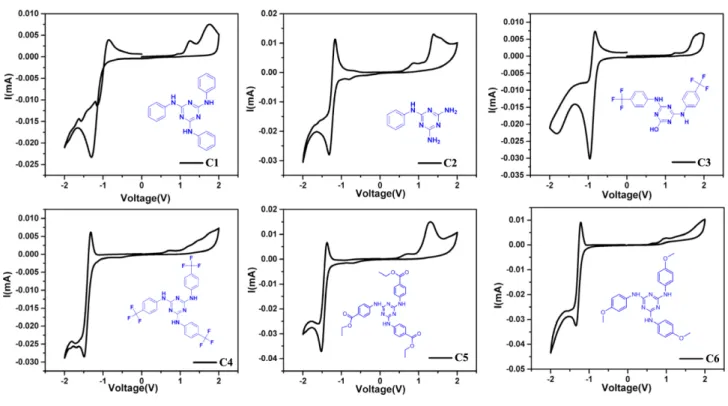
Electrochemical properties of compounds were inves- tigated by cyclic voltammetry (CV). Cyclic voltammo- gram of synthesized compounds are given in Fig. 2. All the compounds underwent quasi-reversible redox behavior.
LUMO, HOMO, and the energy gap (Eg) are calculated from the onset potential of electrochemical reduction and oxidation (Table 2). Since substituents dominate the HOMOs
of compounds, their HOMO energy levels are similar with little variation.
Whereas, a significant difference was observed for LUMOs.
This independent modification of HOMO and LUMO of compounds with different substituents can greatly facil- itate the molecular design of the desired materials. In a comparison of the substitutions, compounds with elec- tron releasing group (C1, C2, C6) shows an increase in Figure 2. Cyclic voltamogaram of synthesized compounds.
Table 2. The HOMO-LUMO values from cyclic voltammetry using UV-Visible spectroscopy Compound Eox volt
(From CV)
EHOMO eV [E ox -E1/2+ 4.8]
Optical Band gap (from absorption studies)
ELUMO
(EHOMO–Optical bandgap)
C1 0.9734 5.4694 4.17 1.2994
C2 0.6828 5.1788 4.14 1.0388
C3 1.1568 5.6528 4.83 0.8228
C4 0.5797 5.0757 4.01 1.0657
C5 0.4965 4.9925 3.84 1.1525
C6 0.5817 5.0777 3.91 1.1677
Table 3. DFT and TD-DFT computed HOMO-LUMO energy levels (in eV) for C1-C6
Compound HOMO (eV) LUMO (eV) HOMO-LUMO energy gap (eV) TD-DFT (eV)
C1 5.699 0.631 5.068 4.491
C2 5.506 0.208 5.299 4.810
C3 6.372 1.376 4.996 4.643
C4 6.293 1.364 4.929 4.322
C5 6.010 1.429 4.581 3.996
C6 5.093 0.288 4.804 4.234
the LUMO, whereas electron withdrawing group results in the decrease of LUMO in the following order C2 > C6 >
C1 > C4 > C3 > C5.
The HOMO-LUMO energy levels are calculated com-
putationally and given in Table 3. The spatial distribution of the HOMO and LUMO is shown in Fig. 3. From the molecular orbitals (MO’s) of C1-C6, the LUMO is mainly distributed on the triazine core, and the HOMO is dis- Figure 3. Spatial distributions of HOMOs and LUMOs of substituted triazine.
tributed over the substituents. The triazine core acts as an acceptor whereas the substituents as a strong donor. This donor-acceptor design of compounds can lead to sepa- rated electron density distribution between the HOMO and LUMO, which is shown in C1, C2, C3, C4, C5, C6.
This separation is responsible for the efficient hole and electrontransporting properties for the materials.
The HOMO-LUMO calculation using the cyclic vol- tammetry (CV) and by the DFT studies are comparable.
The lower LUMOs of compounds endorse to optoelec- tronic devices due to good electron ejection and trans- portation.
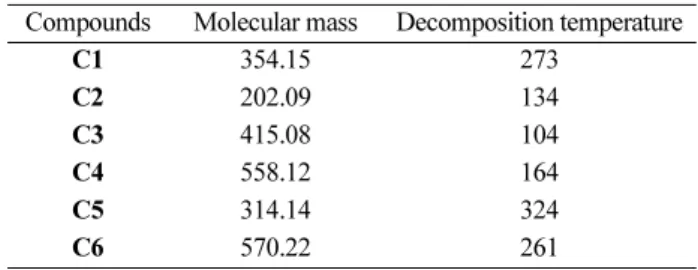
The thermal stability of the compounds are analyzed by thermo gravimetry. The TGA thermogram is given in Fig.
4, and decomposition temperature is listed in Table 4. All compounds show good thermal stability. The thermal sta- bility order of the synthesized compound is C5>C1>C6>
C4>C2>C3. Compound C1, C4, C5 and C6 have more phenyl group substitution than compound C2 and C3.
Thus, the decomposition temperature can also be tuned by changing the substitutions of different groups in the basic structure A1. The thermal properties of compounds are good for optoelectronic devices. The synthesized compounds have good solubility in acetonitrile and chloroform, which prominently increases the processing nature and applica- tions of the triazine-based materials.
CONCLUSION
In summary, a new series of conjugated differently sub- stituted 1,3,5-triazines have been synthesized using a sim- ple synthetic strategy that will greatly inspire the research of the triazine-based electroactive molecule. The results indicate the HOMO-LUMO values of 1,3,5 Triazine is influenced mainly by the substituent on the triazine ring as well as their symmetry. Here, we found that donor and accep- tor can tune the energy level of the molecules. So, a superior material can be designed, and their thermal, electrochem- ical and optical property can be tuned by changing the substituent of 1,3,5-triazine. The synthesized compounds also showed good thermal stability, solubility and can be further processed for use in optoelectronic device appli- cations.
Acknowledgments. The authors are extremely grateful and sincerely acknowledge Dr. Archana Velloth, Postdoc- toral Researcher, Computational Chemistry Lab and Institute for Molecular Science, Okazaki, Aichi, Japan for providing the DFT studies. Publication cost of this paper was sup- ported by the Korean Chemical Society.
Supporting Information. Additional supporting infor- mation is available in the online version of this article.
REFERENCES
1. Forrest, S. R.; Thompson, M. E. Chem. Rev. 2007, 107, 923.
2. Tessler, N.; Preezant, Y.; Rappaport, N.; Roichman, Y.
Adv. Mater. 2009, 21, 2741.
3. Shirota, Y.; Kageyama, H. Chem. Rev. 2007, 107, 953.
4. Shirota, Y. J. Mater. Chem. 2005, 15, 75.
5. Berggren, M.; Nilsson, D.; Robinson, N. D. Nature Mate- rials 2007, 6, 3.
6. Cicoira, F.; Santato, C.; Adv. Funct. Mater. 2007, 17, 3421.
7. Fink, R.; Frenz, C.; Thelakkat, M.; Schmidt, H.-W. Mac- romolecules 1997, 30, 8177.
8. Schmidt-Mende, L.; Fechtenkötter, A.; Mullen, K.; Moons, E.; Friend, R. H.; MacKenzie, J. D. Science 2001, 293, 1119.
9. Witte, G.; Wöll, C. J. Mater. Res. 2004, 19, 1889.
10. Dimitrakopoulos, C. D. Advanced Semiconductor and Organic Nano-Techniques; Elsevier: 2003; pp 191-240.
11. Pron, A.; Gawrys, P.; Zagorska, M.; Djurado, D.; Dema- drille, R. Chem. Soc. Rev. 2010, 39, 2577.
12. Etter, M. C. J. Phys. Chem. 1991, 95, 4601.
13. Shirota, Y. J. Mater. Chem. 2000, 10, 1.
14. Chang, J.-F.; Sun, B.; Breiby, D. W.; Nielsen, M. M.; Sölling, T. I.; Giles, M.; McCulloch, I.; Sirringhaus, H. Chem. Mater.
2004, 16, 4772.
15. Forrest, S. R. Nature 2004, 428, 911.
Figure 4. Thermogram of synthesized compounds.
Table 4. Thermo gravimetric analysis of synthesized compounds Compounds Molecular mass Decomposition temperature
C1 354.15 273
C2 202.09 134
C3 415.08 104
C4 558.12 164
C5 314.14 324
C6 570.22 261
16. Kietzke, T. Adv. OptoElec. 2007.
17. Hoppe, H.; Sariciftci, N. S. J. Mater. Res. 2004, 19, 1924.
18. Al-Ibrahim, M.; Roth, H.-K.; Schroedner, M.; Konkin, A.; Zhokhavets, U.; Gobsch, G.; Scharff, P.; Sensfuss, S.
Organic Electronics 2005, 6, 65.
19. Pommerehne, J.; Vestweber, H.; Guss, W.; Mahrt, R. F.;
Bässler, H.; Porsch, M.; Daub, J. Adv. Mater. 1995, 7, 551.
20. Gagne, R. R.; Koval, C. A.; Lisensky, G. C. Inorg. Chem.
1980, 19, 2854.
21. Becke, A. D. J. Chem. Phys. 1993, 98, 5648.
22. Frisch, M. J.; Trucks, G. W.; Schlegel, H. B.; Scuseria, G.
E.; Robb, M. A.; Cheeseman, J. R.; Scalmani, G.; Barone, V.; Mennucci, B.; Petersson, G. A.; Gaussian 09, Revision D.1; Gaussain Inc.: Wallingford, CT, 2009.
23. Scalmani, G.; Frisch, M. J. J. Chem. Phys. 2010, 132, 114110.
24. Hehre, W. J.; Ditchfield, R.; Pople, J. A. J. Chem. Phys.
1972, 56, 2257.