Journal of the Korean Chemical Society 2014, Vol. 58, No. 1
Printed in the Republic of Korea http://dx.doi.org/10.5012/jkcs.2014.58.1.76
-76-
Petroleum Refinery Effluents Treatment by Advanced Oxidation Process with Methanol
Wen Shoucheng*
Department of Petroleum Engineering, Yangtze University, HuBei Jingzhou, 434023 China.
*E-mail: [email protected]
(Received December 13, 2013; Accepted December 16, 2013)
ABSTRACT. Petroleum refinery effluents are waste originating from industries primarily engaged in refining crude oil. It is a very complex compound of various oily wastes, water, heavy metals and so on. Conventional processes are unable to effectively remove the chemical oxygen demand (COD) of petroleum refinery effluents. Supercritical water oxidation (SCWO) was pro- posed to treat petroleum refinery effluents. In this paper, methanol was used to investigate co-oxidative effect of methanol on petroleum refinery effluents treatment. The results indicated that supercritical water oxidation is an effective process for petro- leum refinery effluents treatment. Adding methanol caused an increase in COD removal. When reaction temperature is 440oC, resi- dence time is 20 min, OE is 0.5 and initial COD is 40000 mg/L, and COD removal increases 8.5%.
Key words: Petroleum refinery effluents, Advanced Oxidation Process, SCWO, COD removal
INTRODUCTION
Petroleum refinery effluents (PRE) are wastes originat- ing from industries primarily engaged in refining crude oil and manufacturing fuels, lubricants and petrochemical intermediates.1 These effluents are a major source of aquatic environmental pollution.2 The effluents are composed of oil and grease along with many other toxic organic com- pounds. Although concerted efforts have been made to replace fossil fuels, crude oil remains an important rawmaterial.
The need to satisfy the ever-increasing global energy demand, which is expected to soar by 44% over the next two decades,3 makes the processing of crude oil and the generation of PRE globally important issues.
The process of refining crude oil consumes large amounts of water. Consequently, significant volumes of wastewa- ter are generated,4 resulting in serious environmental pol- lution. At present, the conventional oily wastewater treatment processes include air floatation, membrane separation, chem- ical coagulation, chemical oxidation, physical adsorption, biodegradation, and so on.5 However, these traditional technologies have often encountered some problems, such as complex procedures, poor performances, and high man- agement requirement.6
SCWO is a deep oxidation technology proposed by Modell7 in 1982, it can completely and thoroughly destroy the structure of organic effluent, and the reaction com- pletes in a very short time. Most hydrocarbons and oxy- genated hydrocarbons are converted to CO2 and H2O.
Nitrogen in the feed is converted to N2 or N2O. Heteroa- toms in the feed such as chlorine, sulfur, or phosphorus are converted to their corresponding mineral acids (HCl, H2SO4, or H3PO4) or salts if pre-neutralized with base. Typical operating conditions are usually well above the critical point in the range of 500–650oC and 250–300 bar, with reactor residence times under one minute for complete destruction. Under these conditions, dioxins, furans, NOx and other noxious by-products that plague incineration- based processes do not form in SCWO.8
After 1982, the researchers began to study nuclear waste, and later SCWO is widely used petrochemicals, paper mills, hospitals, electronics, industrial and domestic wastewa- ter.9−10 Currently, treatment of rocket fuels, industrial waste and physiology garbage11 by SCWO is accomplished in the USA. Polymers12 and dioxins13 treatments by SCWO are implemented in many European countries. Many sci- entific and technological workers14−20 have achieved sat- isfactory results about SCWO in recent years.
It is well known that the oxygenated additive can improve the oxidation efficiency of organic compounds in com- bustion,21,22 and the oxygenated additive can gain similar effects in SCWO. The results are expressed in some stud- ies.23−25 Researchers firmly believe that the oxidation mech- anism of SCWO is similar with combustion.
In the past years, methanol benzene, and phenol26 were investigated as oxygenate additive. Currently, SCWO of petroleum refinery effluents with methanol is not reported.
The function of methanol has not yet well known. This
Petroleum Refinery Effluents Treatment by Advanced Oxidation Process with Methanol 77
2014, Vol. 58, No. 1
paper investigated the oxidation effect of methanol on petroleum refinery effluents under supercritical conditions, which contained reaction products and pathways in the presence of methanol. Accordingly, this paper focused on COD removal of petroleum refinery effluents in the pres- ence of methanol.
EXPERIMENTAL Materials and Methods
SCWO experiments
SCWO of the petroleum refinery effluents was carried out in a 0.6L batch autoclave (Fig. 1). Firstly, water and petroleum refinery effluents were put into the reactor, and then the system was flowed by nitrogen to remove the air within the system; the valves around the reactor were closed when the air was removed entirely. Secondly, a specific amount of required methanol was put into the reactor. Finally, pure O2 was put into the reactor until the predefined pres- sure was reached, and the reaction started. Liquid samples (ca.15 mL) were periodically withdrawn from the reactor and analyzed.
Analytical methods
The COD of collected liquid are measured by potas- sium dichromate method of Chinese Standard 11914-89.
OE is defined as equation 1.
OE = O2,Excess= (1)
RESULTS AND DISCUSSION SCWO of Petroleum Refinery Effluents
Effect of reaction temperature
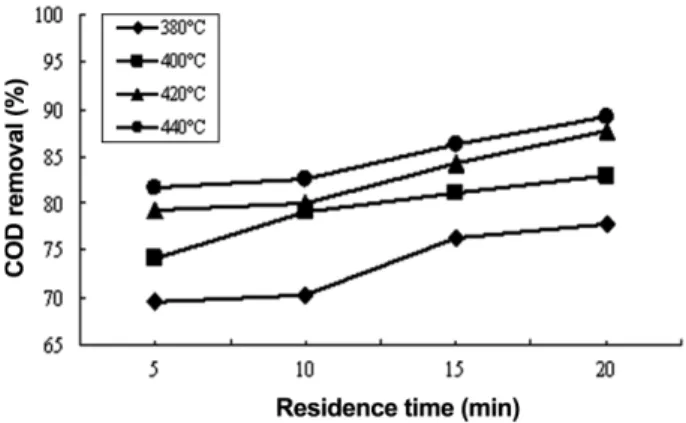
The experimental results are given in Fig. 2. As it is expected, rising temperature made the COD removal greatly
increased. At 440oC, COD removal reached more than 80%
after 5 and 20 min, respectively. Therefore, temperature had a significant impact on the oxidation of petroleum refinery effluents.
According to the thermodynamic and kinetic princi- ples, it is known that rate of all reaction will accelerate as temperature increasing. Eventually, it can accelerate the degradation of oily matter. Therefore, the temperature is higher, COD removal increases faster. When reaction temperature comes to 440oC, COD removal reaches 90.33%.
Effect of residence time
In Fig. 2, it is seen that at first of 5 min, the COD removal reached about 70%. The COD removal reached about 80% after 15 minutes. It is need to be considered from the perspective of the reaction rate. The concentration of the reactant is high at first, so the response rate is slow. As the reaction proceeds, the concentration of the reactants reduced. So the reaction rate starts to react quickly. There- fore, COD removal increased slowly at first of 5 min, and it became quickly afterwards.
Effect of initial COD
It is seen that COD removal increases as initial COD increasing from Fig. 3. When initial COD is 10000 mg/L, the COD removal reaches 69.51%.When initial COD is 40000 mg/L, the COD removal reaches 90.33%. When ini- tial COD is between 30000 mg/L and 40000 mg/L, the upward trend of the COD removal is gentle.
According to the kinetic principles, it is known that COD concentration of petroleum refinery effluents increases, activated molecular generated quickly and the numbers of them are more. Therefore, effective collision presented more active and reaction probability of particles becomes larger. Thereby the oxidation rate speeds up and oxidation O2
( )in–( )O2 stoichiometric
O2 ( )in
--- 100×
Figure 1. Schematic diagram of the experimental setup.
Figure 2. Effect of temperature on SCWO of petroleum refinery effluents.
Journal of the Korean Chemical Society
78 Wen Shoucheng
effect of petroleum refinery effluents promoted.
Effect of OE
Fig. 4 indicates that COD removal increases when OE
increases. When HE is above 0.5, the upward trend of COD removal becomes gentle. When OE is 0.5 and residence time is 20 min, COD removal is 76.11%. When OE is 0.7 and residence time is 20 min, COD removal is 76.76%.
COD removal only increases by 0.65%. Therefore, OE is selected for 0.5.
Co-oxidation of Petroleum Refinery Effluents Effect of methanol
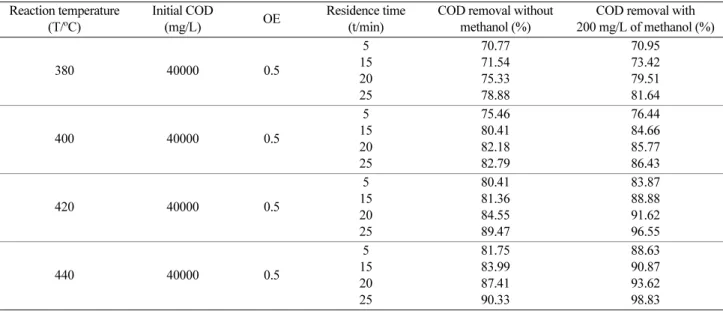
Table 1 showed the COD removal without methanol and adding methanol. It is showed that adding a small amount of methanol can raise the COD removal. The high concentrations of methanol causes an increase in the the COD removal of at 440oC, residence time is 20 min, OE is 0.5 and initial COD is 40000 mg/L. COD removal increases 8.5% with adding 200 mg/L of methanol.
CONCLUSION
SCWO of petroleum refinery effluents co-oxidative effect of methanol on petroleum refinery effluents were investigated.
The results showed that greater than 80% COD removal from petroleum refinery effluents was achieved via SCWO.
The results indicated that supercritical water oxidation is an effective process for petroleum refinery effluents treat- ment. Adding methanol caused an increase in COD removal.
When reaction temperature is 440oC, residence time is 20 min, OE is 0.5 and initial COD is 40000 mg/L, and COD removal increases 8.5%.
Figure 3. Effect of initial COD on SCWO of petroleum of refinery effluents.
Figure 4. Effect of OE on SCWO of petroleum refinery effluents.
Table 1. The COD removal is effected by methanol Reaction temperature
(T/oC)
Initial COD
(mg/L) OE Residence time
(t/min)
COD removal without methanol (%)
COD removal with 200 mg/L of methanol (%)
380 40000 0.5
5 15 20 25
70.77 71.54 75.33 78.88
70.95 73.42 79.51 81.64
400 40000 0.5
5 15 20 25
75.46 80.41 82.18 82.79
76.44 84.66 85.77 86.43
420 40000 0.5
5 15 20 25
80.41 81.36 84.55 89.47
83.87 88.88 91.62 96.55
440 40000 0.5
5 15 20 25
81.75 83.99 87.41 90.33
88.63 90.87 93.62 98.83
Petroleum Refinery Effluents Treatment by Advanced Oxidation Process with Methanol 79
2014, Vol. 58, No. 1
Acknowledgments. The publication cost of this paper was supported by the Korean Chemical Society.
REFERENCES
1. Harry, M. F. Industrial Pollution Handbook; McGraw Hill Inc.: New York, 1995.
2. Wake, H. Estuarine, Coastal Shelf Sci. 2005, 62, 131.
3. Diya’uddeen, B. H.; Daud, W. M. A. W.; Aziz, A. R. A.
Process Saf. Environ. Prot. 2011, 89, 95.
4. Coelho, A.; Castro, A. V.; Dezotti, M.; Sant’Anna, G. L.
Jr. J. Hazard. Mater. 2006, 137, 178.
5. Zhao, H. L.; Li, G. Y. Procedia Environ. Sci. 2011, 10, 158.
6. Gu, D. M.; Wang, Y.; Song, Z. J. Journal of Harbin Uni- versity of Civil Engineering and Architecture 2002, 35, 65.
7. Medoll, M. U.S. Patent 4,338,199, 1982.
8. Marrone, P. A. J. Supercrit. Fluids 2013, 79, 283.
9. Xiang, B. T.; Wang, T.; Shen, Z. Y. Huanjing Kexue Xuebao 2002, 22, 17.
10. Bambang, V.; Jae-Duck, K. J. Environ. Sci. 2007, 19, 513.
11. Takahashi, Y.; Wydeven, T.; Koo, C. Adv. Space Res. 1991, 99, 483.
12. Watanabe, M.; Mochiduki, M.; Sawamoto, S.; Adschiri, T.; Arai, K. J. Supercrit. Fluids 2001, 20, 257.
13. Meng, L. H.; Xu, Y. H.; Huang, Y. D. Environmental Pro- tection of Chemical Industry 2000, 20, 16.
14. García-Jarana, M. B.; Kings, I.; Sánchez-Oneto, J.; Portela,
J. R.; Al-Duri, B. J. Supercrit. Fluids 2013, 80, 23.
15. Zhang, J.; Wang, S. Z.; Guo, Y.; Xu, D. H.; Gong, Y. M.;
Tang, X. Y. J. Environ. Sci. 2013, 25, 1583.
16. Shin, Y. H.; Lee, H.; Veriansyah, B.; Kim, J.; Kim, D. S.;
Lee, H. W.; Youn, Y. S.; Lee, Y. W. J. Supercrit. Fluids 2012, 72, 120.
17. Abelleira, J.; Sánchez-Oneto, J.; Portela, J. R.; de la Ossa, E. J. M. Fuel 2013, 111, 574.
18. Fujii, T.; Hayashi, R.; Kawasaki, S.; Suzuki, A.; Oshima, Y. J. Supercrit. Fluids 2011, 58, 142.
19. Sato, T.; Trung, P. H.; Tomita, T.; Itoh, N. Fuel 2012, 95, 347.
20. Veriansyah, B.; Song, E. S.; Kim, J. D. J. Environ. Sci.
2011, 23, 545.
21. Ploeger, J. M.; Green, W. H.; Tester, J. W. J. Supercrit.
Fluids 2006, 39, 239.
22. Anitescua, G.; Munteanub, V.; Tavlaridesa, L. L. J. Super- crit. Fluids 2005, 33, 139.
23. Savage, P. E.; Yu, J. L.; Stylsdki, N.; Brock, E. E. J.
Supercrit. Fluids 1998, 12, 141.
24. Brock, E. E.; Savage, P. E.; Barker, J. R. Chem. Eng. Sci.
1998, 53, 857.
25. Savage, P. E.; Rovira, J.; Stylski, N.; Martino, C. J. J.
Supercrit. Fluids 2000, 17, 155.
26. Perez, I. V.; Rogak, S.; Branion, R. J. Supercrit. Fluids 2004, 30, 71.