Received: February 8, 2017 Revised: April 7, 2017 Accepted: April 23, 2017
Address for Correspondence: Hassan Rakhshandeh, Pharmacological Research Center of Medicinal Plants, Mashhad University of Medical Sciences, Mashhad, Iran
Tel: +98-51-3882-8566, Fax: +98-51-3882-8567, E-mail: [email protected]
Original Article
pISSN: 2288-6478, eISSN: 2288-6761 https://doi.org/10.6118/jmm.2017.23.2.124 Journal of Menopausal Medicine 2017;23:124-130
J MM
Introduction
Osteoporosis is a leading cause of disability and death among elderly women which imposes huge economic costs on the society.1,2 Estrogens are integral to skeletal homeo- stasis, with ovarian hormone deficiency acting as critical risk factors of osteoporosis. There are strong evidences on bone- related benefits of raloxifene and hormone replacement therapy (HRT).3,4 However, short-term estrogen use can
lead to vaginal bleeding, while long-term use can increase the risk of breast cancer, stroke and cardiovascular disease.5 The main side effects of raloxifene are vein thromboses and pulmonary embolism. As a result, many postmenopausal women favor compounds that contain non-hormonal mate- rials like phytoestrogens as a safer option.6~9 Phytoestrogens are plant substances with a structure and function similar to estradiol, which is responsible for estrogenic effect.10 Phy- toestrogens have been the subject of growing attention for
The Effect of Short-term Treatment with Fennel on Bone Density in Postmenopausal Women: A Randomized
Controlled Trial
Masumeh Ghazanfarpour1, Elham Amini2, Talat Khadivzadeh3, Masoudeh Babakhanian4, Bahareh Nouri5, Hassan Rakhshandeh6, Maliheh Afiat7
1Department of Midwifery and Reproductive Health, Nursing and Midwifery School, Mashhad University of Medical Sciences, Mashhad, Iran, 2Department of Midwifery, School of Nursing and Midwifery, Mashhad University of Medical Sciences, Mashhad, Iran, 3Department of Midwifery, School of Nursing and Midwifery, Mashhad University of Medical Sciences, Mashhad, Iran, 4Abnormal Uterine Bleeding Research Center, Semnan University of Medical Sciences, Semnan, Iran, 5Mashhad University of Medical Sciences, Mashhad, Iran, 6Pharmacological Research Center of Medicinal Plants, Mashhad University of Medical Sciences, Mashhad, Iran, 7Obstetrics and Gynecology, Women's Health Research Center, Department of Obstetrics and Gynecology, Faculty of Medicine, Mashhad University of Medical Sciences, Mashhad, Iran Objectives: The goal of this study is to assess the effect of fennel on bone density.
Methods: This was a double-blind, randomized, placebo-controlled trial, which studied sixty eligible postmenopausal women, who were randomly assigned to fennel and placebo groups. Then, the dual energy X-ray absorptiometry was utilized to measure bone mineral density (BMD) and bone mineral content (BMC) of the spine, femoral neck, intertrochanter, and trochanter at the baseline and after three-month follow-up.
Results: The mean BMD and BMC at lumbar spine (P = 0.14, P = 0.504), total hip femoral (P = 0.427, P = 0.471), trochanter (P = 0.075, P = 0.07), intertrochanter, (P = 0.864, P = 0.932) and femoral neck (P = 0.439, P = 0.641) was not significantly different between the fennel and placebo groups.
Conclusions: The results of this study did not approve the effect of fennel on bone density in post-menopausal women. However, to gain deeper insights, further studies with longer durations and larger sample sizes are recommended. (J Menopausal Med 2017;23:124-130)
Key Words: Bone density · Foeniculum · Postmenopause
Masumeh Ghazanfarpour, et al. Fennel on Bone Density in Postmenopausal Women
their bone-sparing properties.3 Foeniculum vulgare is used to treat liver obstruction, spleen and gall bladder, to allevi- ate digestive problems such as indigestion, colic, nausea, flatulence and bronchodilation, and to enhance memory.11,12 It also includes phenolic compounds such as flavonoids (fla- vonoid glycosides and flavonoid aglycones), phenolic acids, hydroxycinnamic acids, coumarins and tannins.13 The results of in vitro studies have revealed the osteoprotective effect of Foeniculum vulgare extract.14 Another recent in vitro cell culture demonstrated that Foeniculum vulgare Miller seed (FvMs) could potentially prevent bone loss in postmeno- pausal osteoporosis by mitigating osteoclast differentiation and function.15 Nonetheless, to the best of our knowledge, the effect of Foeniculum vulgare on bone mineral content (BMC) and bone mineral density (BMD) has not been exam- ined in human studies.
Materials and Methods
This is part of a study that assessed the effect of fennel on lipid profile and bone density in Iranian postmenopausal women. It is a randomized, double-blind, placebo-controlled clinical trial intended to compare the effectiveness of Foe- niculum vulgare on bone density in menopausal women. The study was conducted in accordance with the principles of Declaration of Helsinki and approved by Ethics Committee of the Mashhad University of Medical Science.
All participants were recruited in the medical center of Imam Reza Hospital in Mashhad, Iran. Inclusion criteria were: 1) postmenopausal status, which was defined as an age of over 40 years with no vaginal bleeding for one year; 2) no regular ingestion of phytoestrogen or soy-based products (which was defined as consumption more than once a week) and 3) a normal mammogram in the last year. Exclusion criteria were: 1) use of any fluoride or bisphosphonates; 2) diseases or medications affecting bone metabolism; 3) cur- rent (or over past 6 months) use of estrogen or calcitonin; 4) history of endometrial or breast cancer; 5) any fracture, and 6) regular physical exercise or allergy to Foeniculum vulgare.
In the next step, informed consent forms were signed by participants along with verbal reassurance that participation was on a voluntary basis and that they could abandon the
trial at any time. In addition, all participants were ensured about the confidentiality of information during and after the study. Sixty participants were randomly assigned to Foe- niculum vulgare or placebo groups at the baseline. All par- ticipants were asked to take soft capsule three times a day - (in the morning, in the midday, and at night). Each 100-mg fennel soft capsule contained 30% fennel (Standardized to 21-27 mg anethole) combined with sunflower oil. Active in- gredients of each capsule were Trans-anthol, Methyl chavi- col, fenchone and stragol. Placebos were in identical shape and size, but filled with sunflower oil. These capsules were provided by Barij Essence Company. The sequence of al- location was based on a random number table. For the pur- pose of allocation concealment, a numbered sealed opaque plastic bottle was used, which contained enough treatment for 30 days. The allocation sequencing and packing was implemented by an employee of Barij Essence Pharmaceuti- cal Company, who was not directly engaged in the study. In this study, participants and research team were blind to the treatment assignment.
Then, dual-energy X-ray absorptiometry (DXA; Hologic QDR-2000 Inc., Bedford, MA, USA) was utilized to measure BMD and BMC of the spine, femoral neck, intertrochanteric, and trochanter at the baseline and after three months.16 The subject screening was performed every 4 weeks to check for any side effect and compliance. To ensure compliance, patients were asked to bring their medication bottle to each visit to count the pills.
Statistical tests
The normal distribution of data was examined using the Kolmogorov-Smirnov test of normality. Paired t-tests (intra group) was used to draw a comparison between the base- line and three-month follow-up, and Student’s t-test (inter groups) was used to compare the two treatment groups, Statistical tests were two-sided, and a P values of less than 0.05 were considered to indicate statistical significance.
Results
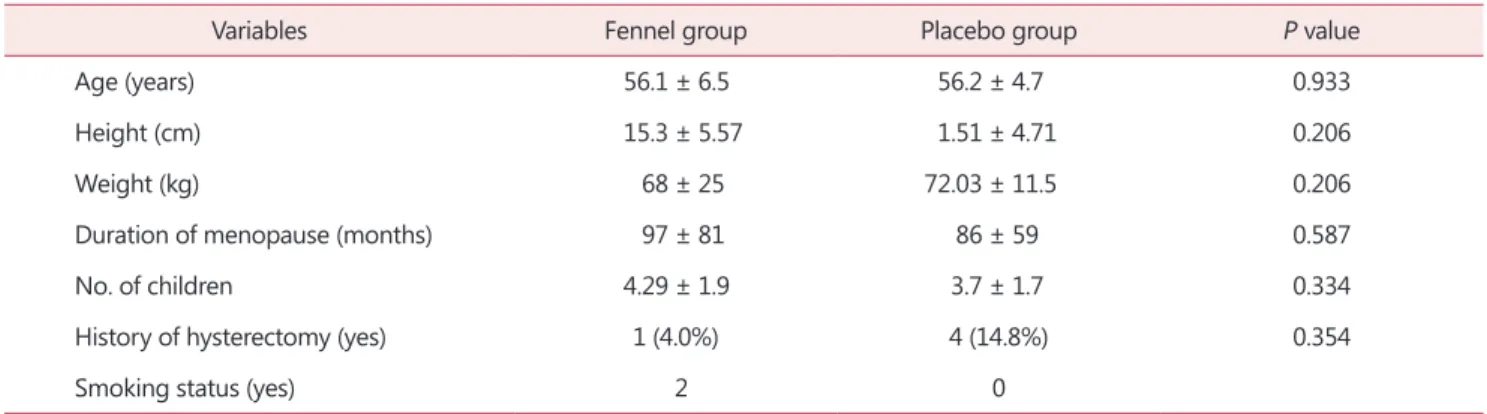
The two groups were similar in variables such as age, history of hysterectomy, body weight, body mass index (BMI)
Journal of Menopausal Medicine 2017;23:124-130
J MM
and duration of menopause at the baseline, as shown in Table 1. Side effects were observed in 6 subjects in the fen- nel group and 3 subjects in the placebo group. In the fennel group, subjects complained of allergic rash (n = 1), weight gain (n = 1), hypertension (n = 1) and vaginal bleeding (n = 2). Only one patient in placebo group complained of stom- achache. The fennel was different from placebo in term of the mean BMD and BMC at lumbar spine (P = 0.14, P = 0.504), total hip femoral (P = 0.427, P = 0.471), trochanter (P = 0.075, P = 0.07), intertrochanter (P = 0.864, P = 0.932) and femoral neck (P = 0.439, P = 0.641) (Table 2). Also, no significant difference was observed in both groups at the baseline and three-month follow-up in terms of mean BMD and BMC at lumbar spine, total hip femoral, trochanter and intertrochanter (the data is not shown in the Table)
Discussion
To the best of our knowledge, this is the first study to as- sess the effects of Foeniculum vulgare on BMC and BMD at the lumbar spine, femoral neck, trochanter, intertrochanter and hip femoral in post-menopausal women. According to results, Foeniculum vulgare did not have any significant positive effect on BMD and BMC over a three-month period.
Despite our efforts, no human study about the effects of Foeniculum vulgare on bone density was found. Neverthe- less, considering that phytoestrogen is an active biological compound in fennel, we referred to studies that evaluated the effect of phytoestrogen on BMC and BMD. Phytoes-
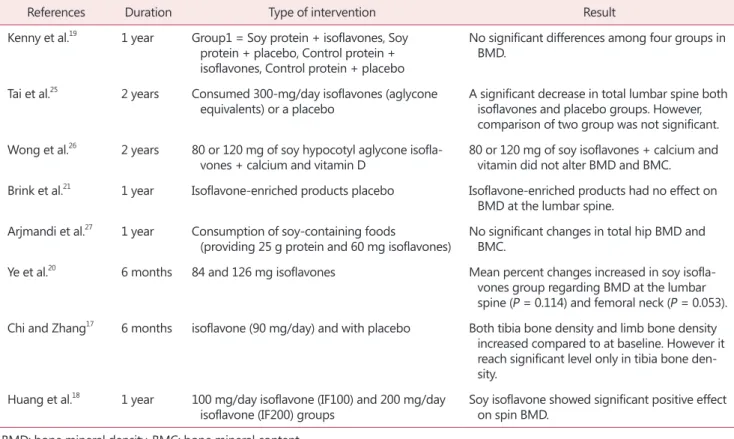
trogens are plant compounds with properties that resemble those of estrogen. There are four main groups of phytoes- trogens: isoflavones, lignans, flavonoids and coumestans.10 Isoflavones are found in soy and red clover extracts; soy isoflavones are mainly composed of genistein and daid- zein, but red clover isoflavones consist of formononetin and biochanin.2 Lignans are commonly found in flaxseed11 and Foeniculum vulgare is considered as a major source of fla- vonoids.13 Although the positive effect of soy isoflavone has been demonstrated in a number of studies17,18 other stud- ies have not reported any beneficial effect (Table 3).18~21 We found three studies assessing the effect of red clover on bone density. The first study was by Atkinson according to which red clover isoflavones enriched with biochanin had a beneficial effect on spine BMD and BMC, but not on hip BMD and BMC over a 24-month follow-up.3 In the second study by Clifton-Bligh, no significant difference was ob- served in BMD loss in the spine, hip and forearm after 24 months of treatment with red clover isoflavones enriched with formononetin.22 The third trial by Thorup showed that 150 mL/day red clover could improve bone status.23
A systematic review of five trials by Abdi revealed an increase in BMD and bone turnover after genistein admin- istration in postmenopausal women. They also found that it was impossible to make conclusive statements about the effect of soy on BMD in postmenopausal women due to het- erogeneity in formulation, phytoestrogen content, and dos- age of supplement.24
The results of an in vitro study showed that Foeniculum vulgare extract in the range of 5 to 50 μg/mL might have
Table 1. Baseline characteristics of subjects in the group
Variables Fennel group Placebo group P value
Age (years) 56.1 ± 6.5 56.2 ± 4.7 0.933
Height (cm) 15.3 ± 5.57 1.51 ± 4.71 0.206
Weight (kg) 68 ± 25 72.03 ± 11.5 0.206
Duration of menopause (months) 97 ± 81 86 ± 59 0.587
No. of children 4.29 ± 1.9 3.7 ± 1.7 0.334
History of hysterectomy (yes) 1 (4.0%) 4 (14.8%) 0.354
Smoking status (yes) 2 0
The data is presented as mean ± standard deviation or number (%)
Journal of Menopausal Medicine 2017;23:124-130 Masumeh Ghazanfarpour, et al. Fennel on Bone Density in Postmenopausal Women
Table 2. Effects of placebo and fennel on BMD and BMC Treatment
(mean ± SD) Placebo
(mean ± SD)
Test
t-value df P value
BMD (g/cm2) Spine (L1–L4)
Baseline 0.820 ± 0.107 0.884 ± 0.120 -2.019 49 0.05
Post-treatment 0.839 ± 0.114 0.885 ± 0.11 -1.47 49 0.14
Change (%) 1.92 0.21 1.12 49 0.26
Total hip
Baseline 0.816 ± 0.089 0.848 ± 0.123 -1.030 49 0.308
Post-treatment 0.834 ± 0.096 0.860 ± 0.132 -0.801 49 0.427
Change (%) 1.87 1.23 0.402 49 0.689
Femoral neck
Baseline 0.67 ± 0.0.1 0.70 ± 0.103 -1.07 49 0.288
Post-treatment 0.683 ± 0.101 0.70 ± 0.104 -0.780 49 0.439
Change (%) 1.79 0.38 0.668 49 0.507
Trochanter
Baseline 0.571 ± 0.061 0.608 ± 0.100 -1.56 49 0.124
Post-treatment 0.573 ± 0.062 0.613 ± 0.08 -1.81 49 0.075
Change (%) 0.37 1.12 -709 49 0.481
Intertrochanter
Baseline 0.982 ± 0.113 1.01 ± 0.149 0.356 51 0.724
Post-treatment 1 ± 0.122 1 ± 0.154 -0.172 51 0.864
Change (%) 1.79 0.11 964 49 0.340
BMC (g) Spine (L1–L4)
Baseline 46.30 ± 8.82 48.1 ± 11.45 -0.635 49 0.528
Post-treatment 46.90 ± 0.839 48.7 ± 10 -0.673 49 0.504
Change (%) 0.86 0.85 -0.5 49 0.960
Total hip
Baseline 25.70 ± 3.11 27.6 ± 4.10 -1.51 49 0.137
Post-treatment 27.80 ± 4.10 28.5 ± 6.72 -0.418 49 0.471
Change (%) 6.2 2.8 0.446 49 0.446
Femoral neck
Baseline 3.06 ± 0.53 3.25 ± 0.54 -1.16 49 0.25
Post-treatment 3.23 ± 0.515 3.30 ± 0.64 -0.469 49 0.641
Change (%) 1.79 0.38 0.668 49 0.507
Trochanter
Baseline 5.30 ± 0.58 5.78 ± 1.30 -1.67 49 0.1
Post-treatment 5.44 ± 0.781 5.99 ± 3.19 -1.85 49 0.07
Change (%) 0.37 1.12 -709 49 0.48
Intertrochanter
Baseline 17.65 ± 2.7 18.5 ± 4.1 -0.084 49 0.381
Post-treatment 19.16 ± 3.90 19.06 ± 5.4 0.086 49 0.932
Change (%) 1.34 0.35 0.43 49 0.43
BMD: bone mineral density, BMC: bone mineral content, df: degree of freedom
Journal of Menopausal Medicine 2017;23:124-130
J MM
a positive effect on cell proliferation and mineralization. In another study on the effects of FvMs on the femurs bone, 32 female mice were randomly assigned to four groups as follows: Group 1 (n = 8) was sham; Group 2 (n = 8) was ovariectomized and treated with water; Group 3 (n = 8) was ovariectomized and treated with low-dose of FvMs 30 mg/
kg, and Group 4 (n = 8) ovariectomized and treated with high dose of FvMs 100 mg/kg. Compared to the control group, the group treated with low and high doses of FvMs demonstrated improved BMD and BMC in the trabecular bone.15 This is inconsistent with the findings of this study.
Limitations of the study
In this study, postmenopausal women were followed only for 12 weeks. Further studies can focus on longer durations and larger sample sizes to explore their beneficial effects.
Conclusion
Foeniculum vulgare did not have any significant effect on BMC and BMD at lumbar spine and total hip in post-meno- pausal women. Further studies with longer durations and larger sample sizes are recommended to validate the results of this study.
Acknowledgement
We thank patients for participating in this study.
Conflict of Interest
The Barij Essence Pharmaceutical Company supported this study by providing soft fennel capsules. However, the design of protocol, analysis, and research implementation were un- dertaken by the author.
Table 3. Effects of soy on bone density
References Duration Type of intervention Result
Kenny et al.19 1 year Group1 = Soy protein + isoflavones, Soy protein + placebo, Control protein + isoflavones, Control protein + placebo
No significant differences among four groups in BMD.
Tai et al.25 2 years Consumed 300-mg/day isoflavones (aglycone
equivalents) or a placebo A significant decrease in total lumbar spine both isoflavones and placebo groups. However, comparison of two group was not significant.
Wong et al.26 2 years 80 or 120 mg of soy hypocotyl aglycone isofla-
vones + calcium and vitamin D 80 or 120 mg of soy isoflavones + calcium and vitamin did not alter BMD and BMC.
Brink et al.21 1 year Isoflavone-enriched products placebo Isoflavone-enriched products had no effect on BMD at the lumbar spine.
Arjmandi et al.27 1 year Consumption of soy-containing foods
(providing 25 g protein and 60 mg isoflavones) No significant changes in total hip BMD and BMC.
Ye et al.20 6 months 84 and 126 mg isoflavones Mean percent changes increased in soy isofla- vones group regarding BMD at the lumbar spine (P = 0.114) and femoral neck (P = 0.053).
Chi and Zhang17 6 months isoflavone (90 mg/day) and with placebo Both tibia bone density and limb bone density increased compared to at baseline. However it reach significant level only in tibia bone den- sity.
Huang et al.18 1 year 100 mg/day isoflavone (IF100) and 200 mg/day
isoflavone (IF200) groups Soy isoflavone showed significant positive effect on spin BMD.
BMD: bone mineral density, BMC: bone mineral content
Journal of Menopausal Medicine 2017;23:124-130 Masumeh Ghazanfarpour, et al. Fennel on Bone Density in Postmenopausal Women
References
1. Prestwood KM, Kenny AM, Kleppinger A, Kulldorff M.
Ultralow-dose micronized 17beta-estradiol and bone den- sity and bone metabolism in older women: a randomized controlled trial. JAMA 2003; 290: 1042-8.
2. Anitha D, Kim KJ, Lim SK, Lee T. Comparison of buckling ratio and finite element analysis of femoral necks in post- menopausal women. J Menopausal Med 2014; 20: 52-6.
3. Atkinson C, Compston JE, Day NE, Dowsett M, Bing- ham SA. The effects of phytoestrogen isoflavones on bone density in women: a double-blind, randomized, placebo- controlled trial. Am J Clin Nutr 2004; 79: 326-33.
4. Boyack M, Lookinland S, Chasson S. Efficacy of raloxifene for treatment of menopause: a systematic review. J Am Acad Nurse Pract 2002; 14: 150-65.
5. Kreijkamp-Kaspers S, Kok L, Grobbee DE, de Haan EH, Aleman A, Lampe JW, et al. Effect of soy protein contain- ing isoflavones on cognitive function, bone mineral density, and plasma lipids in postmenopausal women: a randomized controlled trial. JAMA 2004; 292: 65-74.
6. Colacurci N, Zarcone R, Borrelli A, De Franciscis P, Fortu- nato N, Cirillo M, et al. Effects of soy isoflavones on meno- pausal neurovegetative symptoms. Minerva Ginecol 2004;
56: 407-12.
7. Ghazanfarpour M, Latifnejad Roudsari R, Treglia G, Sade- ghi R. Topical administration of isoflavones for treatment of vaginal symptoms in postmenopausal women: A systematic review of randomised controlled trials. J Obstet Gynaecol 2015; 35: 783-7.
8. Ghazanfarpour M, Sadeghi R, Roudsari RL. The application of soy isoflavones for subjective symptoms and objective signs of vaginal atrophy in menopause: A systematic review of randomised controlled trials. J Obstet Gynaecol 2016; 36:
160-71.
9. Ghazanfarpour M, Sadeghi R, Roudsari RL, Khorsand I, Khadivzadeh T, Muoio B. Red clover for treatment of hot flashes and menopausal symptoms: A systematic review and meta-analysis. J Obstet Gynaecol 2016; 36: 301-11.
10. Balk JL, Whiteside DA, Naus G, DeFerrari E, Roberts JM.
A pilot study of the effects of phytoestrogen supplementa- tion on postmenopausal endometrium. J Soc Gynecol In- vestig 2002; 9: 238-42.
11. Garga C, Khan SA, Ansari SH, Suman A, Garg M. Chemi- cal composition, therapeutic potential and perspectives of Foeniculum vulgare. Pharmacogn Rev 2009; 3: 346-52.
12. Sadrefozalayi S, Farokhi F. Effect of the aqueous extract of Foeniculum vulgare (fennel) on the kidney in experimental PCOS female rats. Avicenna J Phytomed 2014; 4: 110-7.
13. Rahimi R, Ardekani MR. Medicinal properties of Foenicu- lum vulgare Mill. in traditional Iranian medicine and mod- ern phytotherapy. Chin J Integr Med 2013; 19: 73-9.
14. Mahmoudi Z, Soleimani M, Saidi A, Khamisipour G, Aziz- soltani A. Effects of Foeniculum vulgare ethanol extract on osteogenesis in human mecenchymal stem cells. Avicenna J Phytomed 2013; 3: 135-42.
15. Kim TH, Kim HJ, Lee SH, Kim SY. Potent inhibitory effect of Foeniculum vulgare Miller extract on osteoclast differen- tiation and ovariectomy-induced bone loss. Int J Mol Med 2012; 29: 1053-9.
16. Caglayan EK, Engin-Ustun Y, Sari N, Karacavus S, Seckin L, Kara M. Evaluation of bone density measurement in type 2 diabetic postmenopausal women with hypertension and hyperlipidemia. J Menopausal Med 2015; 21: 36-40.
17. Chi XX, Zhang T. The effects of soy isoflavone on bone density in north region of climacteric Chinese women. J Clin Biochem Nutr 2013; 53: 102-7.
18. Huang HY, Yang HP, Yang HT, Yang TC, Shieh MJ, Huang SY. One-year soy isoflavone supplementation prevents early postmenopausal bone loss but without a dose-dependent effect. J Nutr Biochem 2006; 17: 509-17.
19. Kenny AM, Mangano KM, Abourizk RH, Bruno RS, Ana- mani DE, Kleppinger A, et al. Soy proteins and isoflavones affect bone mineral density in older women: a randomized controlled trial. Am J Clin Nutr 2009; 90: 234-42.
20. Ye YB, Tang XY, Verbruggen MA, Su YX. Soy isoflavones attenuate bone loss in early postmenopausal Chinese wom- en : a single-blind randomized, placebo-controlled trial.
Eur J Nutr 2006; 45: 327-34.
21. Brink E, Coxam V, Robins S, Wahala K, Cassidy A, Branca F. Long-term consumption of isoflavone-enriched foods does not affect bone mineral density, bone metabolism, or hormonal status in early postmenopausal women: a ran- domized, double-blind, placebo controlled study. Am J Clin Nutr 2008; 87: 761-70.
22. Clifton-Bligh PB, Nery ML, Clifton-Bligh RJ, Visvalingam S, Fulcher GR, Byth K, et al. Red clover isoflavones en- riched with formononetin lower serum LDL cholesterol-a randomized, double-blind, placebo-controlled study. Eur J Clin Nutr 2015; 69: 134-42.
23. Thorup AC, Lambert MN, Kahr HS, Bjerre M, Jeppesen PB. Intake of novel red clover supplementation for 12 weeks improves bone status in healthy menopausal women. Evid Based Complement Alternat Med 2015; 2015: 689138.
24. Abdi F, Alimoradi Z, Haqi P, Mahdizad F. Effects of phy- toestrogens on bone mineral density during the menopause transition: a systematic review of randomized, controlled trials. Climacteric 2016; 19: 535-45.
Journal of Menopausal Medicine 2017;23:124-130
J MM
25. Tai TY, Tsai KS, Tu ST, Wu JS, Chang CI, Chen CL, et al. The effect of soy isoflavone on bone mineral density in postmenopausal Taiwanese women with bone loss: a 2-year randomized double-blind placebo-controlled study. Osteo- poros Int 2012; 23: 1571-80.
26. Wong WW, Lewis RD, Steinberg FM, Murray MJ, Cramer MA, Amato P, et al. Soy isoflavone supplementation and
bone mineral density in menopausal women: a 2-y multi- center clinical trial. Am J Clin Nutr 2009; 90: 1433-9.
27. Arjmandi BH, Lucas EA, Khalil DA, Devareddy L, Smith BJ, McDonald J, et al. One year soy protein supplementa- tion has positive effects on bone formation markers but not bone density in postmenopausal women. Nutr J 2005; 4: 8.