2007, Vol. 51, No. 4
Printed in the Republic of Korea
높은 온도에서 Urea 와 금속이온과의 반응으로 얻어진 금속 Complexes 의
합성과 분광학적 연구
Akmal S. Gaballa
*, Said M. Teleb
†, and El-Metwally Nour
‡Faculty of Specific Education, Zagazig University, Zagazig, Egypt
†Department of Chemistry, Faculty of Science, Zagazig University, Zagazig, Egypt
‡Department of Chemistry, College of Science, Qatar University, Doha, Qatar (2007. 3. 28 접수)
Synthesis and Spectroscopic Studies of Metal Complexes Formed in the Reaction of Metal Ions with Urea at High Temperature
Akmal S. Gaballa
*, Said M. Teleb
†, and El-Metwally Nour
‡Faculty of Specific Education, Zagazig University, Zagazig, Egypt
†Department of Chemistry, Faculty of Science, Zagazig University, Zagazig, Egypt
‡Department of Chemistry, College of Science, Qatar University, Doha, Qatar (Received March 28, 2007)
요 약. Urea는높은온도(60~80 °C)의수용액상태에서 PtCl2, H2[PtCl6]·6H2O, H2[IrCl6] Ni(CH3CO2)2와반응해서 각각 (1)[PtCl2(Urea)]·2H2O, (2)(NH4)2[PtCl6], (3)(NH4)2[IrCl6]·H2O, (4)[Ni2(OH)2(NCO)2(H2O)2]의 complexes를생성 한다. complexe 1에서 urea는중성 bidentate 리간드로써 Pt(II)와배위한다. complexe 2,3,4에서는높은온도에서반 응하는동안배위 urea분자들이분해되고다양한반응생성물들을얻을수있다. 모든 complexes은각각적당한수득률 로 dark green(1) yellow(2), pale brown (3) faint green(4)의침전물로분리된다. 반응생성물은열분석, IR, 1H and
13C NMR spectra에의해측정되었다. 이 complexes의구성을설명하는일반적인매카니즘이제시되었다.
주제어: 합성, Urea, Platinum, Nickel, Iridium, IR, NMR Spectra, 열분석
ABSTRACT. Urea reacts with PtCl2, H2[PtCl6]·6H2O, H2[IrCl6] and Ni(CH3CO2)2 in aqueous solution at high temperature (60-80 °C) yielding [PtCl2(Urea)]·2H2O (1), (NH4)2[PtCl6] (2), (NH4)2[IrCl6]·H2O (3) and [Ni2(OH)2(NCO)2(H2O)2] (4) complexes, respectively. In complex 1, urea coordinates to Pt(II)as a neutral bidentate ligand via amido nitrogen atoms.
In complexes 2, 3 and 4 it seems that the coordinated urea molecules decompose during the reaction at high temperature and a variety of reaction products are obtained. All complexes were isolated in moderate yields as dark green (1), yellow (2), pale brown (3) and faint green (4) precipitates, respectively. The reaction products were characterized by their micro- analysis, IR, 1H and 13C NMR spectra as well as thermal analysis. General mechanisms describing the formation of these complexes were suggested.
Keywords: Synthesis, Urea, Platinum, Nickel, Iridium, IR, NMR Spectra, Thermal Analysis
INTRODUCTION
From a coordination chemistry prospective, urea could potentially be a neutral ligand for transition metals and coordinates as a monodentate either via
its oxygen1 or nitrogen atoms2 or as a bidentate chelating or bridging ligand depending on the type of metal ion.2-5 Biologically, many hydrolytic enzymes employ two metal ions to facilitate the concen- trated binding of substrate and addition or elimina-
tion of water.6-8 Urease is a nickel-dependent mtalloenzyme that catalyzes the hydrolysis of urea to ammonia and carbon dioxide.4 Urease employs a nonequivalent pair of nickel ions to facilitate the concerted binding of the substrate at one center and nucleophilic attack of water or hydroxide at the other center.9-11
The reactions between various transition metal ions with urea at room temperature have been stud- ied extensively and many metal–urea complexes have been isolated and characterized.12-16 Recently, we have found that reaction of urea with various metal ions at high temperature proceeds with differ- ent mode in which the coordinated urea molecules decompose and a variety of reaction products have been obtained.17-23 The rule played by metal ions in decomposing coordinated urea seems to be depend- ing upon the type of metal ion and the nature of the counter ions involved in the reaction as well as on the reaction temperature.
The present investigation was reported to study the course of the reaction of urea with PtCl2, H2[PtCl6]·6H2O, H2[IrCl6] and Ni(CH3CO2)2·4H2O at ca. 60-80oC. The reaction products were charac- terized by their elemental analyses, infrared, 1H and
13C NMR spectra as well as thermal analysis. The obtained complexes are identified as [PtCl2(Urea)]·2H2O (
1
), (NH4)2[PtCl6] (2
), (NH4)2[IrCl6]·H2O (3
) and [Ni2(OH)2(NCO)2(H2O)2] (4
), respectively.EXPERIMENTAL
All of the chemical used throughout this investi- gation were extra pure grade and used without fur- ther purification.
Infrared spectra of the reactants and the obtained complexes were recorded from KBr discs (4000-400) using a Buck scientific 500-IR spectrophotometer.
Thermal gravimetric analysis (TG) and (DTG) were carried out using a Perkin-Elmer TGA-7 computer- ized thermal analysis system. The rate of heating of samples was kept at 10oC min-1. Sample mass of 0.397 mg was analysed under N2 flow of 30 ml min-1. Microanalyses were performed by the Microanalysis Unit of Cairo University, Egypt using CHNS-932
(LECO) and vario-EL (elmentar Analysensysteme) elemental analyzers.
1H and 13C NMR spectra were recorded on Varian spectrometers Gemini 200, VXR 400 and Unity 500 operating at 200, 400 and 500 MHz for 1H, respec- tively. Solvent signals (1H, 13C) were used as inter- nal references.
[PtCl
2(Urea)]·2H
2O (1)
To a suspension of platinum(II) chloride (0.531 g, 0.01 mol) in 10 ml of distilled water, a solution (10 ml) of urea (0.720 g, 0.06 mol) was added. The mix- ture was stirred at room temperature for about 24 h.
The obtained clear solution was then stirred for about 8 h at ca. 60oC (in a water bath). The result- ing precipitate of [PtCl2(Urea)]·2H2O (
1
) (dark green) was then filtered out, washed several times with hot distilled water and dried at 50oC in an oven for 3 h and then in a desiccator in vacuo. Yield: 0.465 g (64.3%).Anal. found: C, 3.29; H, 2.35; Cl, 18.98; N, 7.84.
Anal. calc. for CH8Cl2N2O3Pt (362.07): C, 3.32;
H, 2.23; Cl, 19.58; N, 7.74.
(NH
4)
2[PtCl
6] (2)
To a solution, (5 ml) of H2[PtCl6]·6H2O (0.518 g, 0.01 mol) in water, a solution (10 ml) of urea (0.360 g, 0.06 mol) was added. The resulting clear yellow solution was stirred for about 8 h at ca. 60oC (in a water bath). The resulting yellow precipitate of compound
2
was filtered off, washed several times with hot distilled water and MeOH and then dried in a desiccator in vacuo. Yield: 0.190 g (42.8%).Anal. found: Cl, 45.94; H, 1.96; N, 6.05.
Anal. calc. for Cl6H8N2Pt (443.87): Cl, 47.92; H, 1.82; N, 6.31.
(NH
4)
2[IrCl
6]·H
2O (3)
To a water solution (10 ml) of H2[IrCl6] (0.814 g, 0.01 mol), a solution (10 ml) of urea (0.720 g, 0.06 mol) was added. The resulting clear solution was stirred for about 8 h at ca. 65oC (in a water bath), there was changing in colour of the reaction mix- ture from dark brown to red. The precipitate of compound (
3
) (pale brown) was then obtained bythe addition of acetone dropwisly with stirring that was filtered off, washed several times with acetone and then dried in a desiccator in vacuo. Yield: 0.103 g (11.2%).
Anal. found: Cl, 45.58; H, 2.50; N, 6.55.
Anal. calc. for Cl6H10IrN2O (459.03): Cl, 46.34; H, 2.20; N, 6.10.
[Ni
2(OH)
2(NCO)
2(H
2O)
2] (4)
To a solution (20 ml) of nickel(II) acetate tetrahy- drate, Ni(CH3CO2)2·4H2O (0.498 g, 0.01 mol) in water, a solution (20 ml) of urea (0.720 g, 0.06 mol) was added. The clear solution was stirred for about 4-6 h at ca. 80oC (in a water bath) resulting in precipita- tion of a faint green compound that was filtered off, washed several times with hot distilled water, dried at 50oC in an oven for 4 h and then in a desiccator in vacuo. Yield: 0.200 g (36.8%).
Anal. found: C, 9.01; H, 2.41; N, 9.84.
Anal. calc. for C2H6N2Ni2O6 (271.47): C, 8.85; H, 2.23; N, 10.32.
RESULTS AND DISCUSSION
Urea reacts with platinum(II) chloride in aque- ous solution at 60oC to form a dark green complex identified as [PtCl2(Urea)]·2H2O (
1
). In this com- plex, urea coordinates to Pt(II) as a bidentate chelat- ing ligand via its nitrogen atoms. The infrared spectrum of the complex shows the characteristic bands of N-coordinated urea. Assignments of the infrared bands in the complex spectra in compari- son with those of free urea were given in Table 1.The formation of N→Pt coordination bond causes significant changes in many of characteristic urea vibrations. The N-H stretching vibrations are shifted to lower values24. On the other hand, the observed stretching vibration of the carbonyl group, n(C=O) in the complex spectrum is shifted to a higher value indicating that oxygen atom is not the donor site, see Table 1. Furthermore the stretching vibration,
ν(N-C) was observed at a lower frequency (1390 cm-1) in comparison with its corresponding value in free urea (1463 cm-1). This is in consistent with the previously known3 for N-coordinated urea. The
deformation (bending and in-pane rocking) motions of NH2 group are observed at 1615 and 1184 cm-1, respectively.The appearance of only one band in the region characteristic for the bending vibration of NH2 at 1615 cm-1 indicate that both NH2 groups are coordinated to Pt(II) ion and urea acts as chelating ligand.25 The geometry associated with complex is likely square planar with two chloro and two nitro- gens constituting the coordination sphere of plati- num(II) ion. This conclusion was also supported by the data obtained from 1H and 13C NMR measure- ments. Table 4. Only one signal is observed in 1H NMR spectrum of [PtCl2(Urea)]·2H2O complex and strongly down field shifted (7.36 ppm) in comparison with its value in free urea (5.64 ppm). Further more the
13C NMR spectra of the complex and free urea show only one signal at approximately the same value. These two observations are consistent with a chelating bidentate nature for urea through the two nitrogen atoms.
Urea seems to interact with hexachloroplatinic or hexachloroiridic acid in a different mode giving
Table 1. Characteristic infrared frequencies(cm-1) and tentative assignments for urea and complex 1, [PtCl2(Urea)]·2H2O Urea [PtCl2(Urea)]·2H2O Assignments**
3458 vs 3346 vs 3256 m
3410 vs 3292 vs 3174 vs
ν(O−H); H2O
ν(N−H); NH2
1677 vs
1620 vs 1716 s
1615 vs ν(C=O)
δb(N−H); NH2
1463 vs 1360 vw
1588 vs
1390 s δb(H2O)
νas(C−N)
1150 s 1184 m δr(NH2)
1068 sh - νs(C−N)
999 w
833 vw - δw(NH2)
787 w - out-of-plane
δ (C=O) def 553 vs
492 vs 535 m δ(NCN)
315 m ν(Pt−N)
*s, strong; m, medium; v, very; w, weak; sh, shoulder.
**υ, stretching; as, asymmetric; s, symmetric; δb, bending; δr, rocking; δw, wagging.
complexes
2
and3
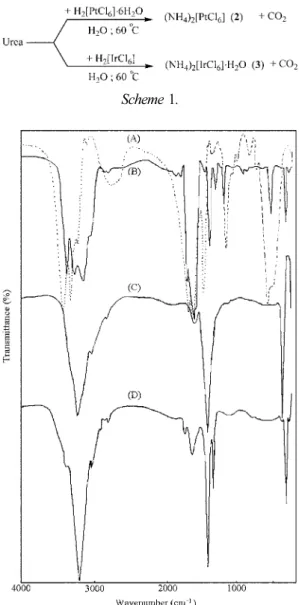
, respectively. The formation of such complexes upon heating of an aqueous mixture of urea with H2[PtCl6]and H2[IrCl6], (see Scheme 1), were clearly identified from their infrared and 1H NMR spectra (Fig. 1, Tables 2, 4). The asymmetric and symmetric stretching motions for N-H were observed at lower frequencies in both complexes, Table 2, in comparison with their values in free urea and in consistent with those known for ammonium ion.3,6-29 Such way of interaction was further sup-ported by observing the stretching motion for M-Cl bond in [PtCl6]2− and [IrCl6]2− moieties at 337 and 306 cm−1, respectively [30]. 1H NMR spectra of the complexes (NH4)2[PtCl6] and (NH4)2[IrCl6]·H2O strongly support this conclusion, there is no signals corre- spond to urea observed but instead a new broad sin- glet signal around 7.3 ppm assigned to NH4+ is observed.
The catalytic decomposition of urea in presence of hexchloroplatinic or hexachloroiridic acids could be explained as follows:
NH2CONH2 + H2O →NH2CO2−+ NH4+
NH2CO2−+ 2H+ → NH4+ + CO2
An aqueous solution of nickel(II) acetate was found to interact with urea at ca. 80oC and a faint green powder precipitate of complex (4) is obtained.
The complex was isolated in a good yield and iden- tified by microanalysis, IR, 13C NMR spectra and thermal analysis. The IR spectrum of the complex
4
is shown in Fig. 2A and its band assignments are given in Table 3. The infrared spectrum shows no bands either due to coordinated urea or acetate ions but instead a group of bands characteristic for coor- dinated isocyanato, coordinated water molecules and bridged hydroxo groups. The complex spec- trum show the presence of bands characteristic for coordinated terminal isocyanato group at 2240 and 2080 cm-1 at higher wavenumbers as expected in comparison with the corresponding bridged isocy- anato ions.3,20,35 The stretching vibration of theFig. 1. IR spectra of (A) urea, (B) Complex 1, (C) Complex
2 and (D) Complex 3.
Scheme 1.
Table 2. Characteristic infrared frequencies(cm-1) and tentative assignments for complexs(NH4)2[PtCl6] (2) and (NH4)2[IrCl6]
·H2O (3)
(NH4)2[PtCl6] (NH4)2[IrCl6]·H2O Assignments**
-3238 vs, br 3042 m
3403 sh 3209 vs 3040 m
ν(O−H); H2O
νas(N−H); NH4+
νs(N−H); NH4+
1590 m 1623 m δas(NH2); NH4+
1401 vs 1403 vs δs(NH2); NH4+
- 1322 s δt(H2O)
337 vs 306 ν(M−Cl)
*s, strong; m, medium; v, very; w, weak; sh, shoulder.
**υ, stretching; as, asymmetric; s, symmetric; δb, bending;
δt, twisting.
hydroxo group was observed as a strong band at 3633 cm-1 and for coordinated water in the 3444- 3381cm-1 region.36-38 Tentative assignments of bands associated with bending motions of NCO−, OH− and H2O ligands were listed in Table 3. Another group
of bands lying at lower wavenumbers 478-393 cm−1 associated with the vibrational motions of Ni-O and Ni-N bonds were also observed [39]. 1H and 13C NMR spectra of the complex [Ni2(OH)2(NCO)2(H2O)2] shows no signals due to free or coordinated urea, but instead a new signal at 124.0 in the 13C NMR spectrum is observed corresponds to NCO ligand.
Based on this data together with the elemental and thermal analysis we identified the obtained product as binuclear nickel(II) complex, [Ni2(OH)2(NCO)2(H2O)2] and the most probable structure associated with this formula is shown in Formula 1.
Formula 1
It is well known that urea coordinates to Ni(II) ions at room temperature forming the [Ni(urea)4]2+
complex ion.2,30-32 At high temperature the follow- ing reaction may take place:
80oC
2[Ni(Urea)4](CH3CO2)2+ 10 H2O→ [Ni2(OH)2 (NCO)2(H2O)2] (
4
) + 4CH3CO2H+6CO2+14NH3The catalytic decomposition of urea and the for- mation of NCO− group in presence of nickel ace- tate salt could be explained as follows:33,34
NH2CONH2 + H2O → NCO− + NH4+
NH4++ H2O → NH3 + H+
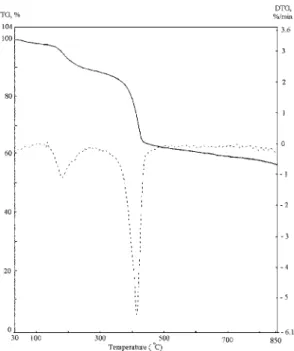
Thermogravimetric (TG) and derivative of ther- mogravimetric analysis (DTG) were carried out for complex
4
under N2 flow, Fig. 3. The obtained ther-Fig. 2. IR spectra of : (A) complex 4 (B) The residue left after the first stage (200oC), [Ni2(OH)2(NCO)2], (C) The final thermal decomposition product, NiO.
Table 3. Characteristic infrared frequencies(cm−1) and tenta- tive assignments for complex 4,[Ni2(OH)2(NCO)2(H2O)2] [Ni2(OH)2(NCO)2(H2O)2] Assignments**
3633 s ν(O−H)
3444 m
3381 w νas(O−H); H2O
νs(O−H); H2O 2240 vs
2080 sh νas(NCO−)
νs(NCO−) 1693 sh
1618 m δs(H2O)
δas(H2O) 1306 w
1155 w 1017 w
δt(H2O)
δb(M−O−H)
δr(H2O)
634 vs δ( NCO−)
478 m ν(Ni−O)
393 m ν(Ni−N)
*s, strong; m, medium; v, very; w, weak; sh, shoulder.
**υ, stretching; as, asymmetric; s, symmetric; δb, bending;
δt, twisting, δr, rocking.
Table 4. Selected 1H and 13C NMR chemical shifts (δ in ppm) of urea and its compounds in dmso-d6
Compound δ (1H) δ (13C)
Urea 5.64 (s, br, NH2) 160.7 (s, CO) [PtCl2(Urea)]·2H2O 7.36 (br, Pt−NH2) 158.2 (s, CO) [Ni2(OH)2(NCO)2(H2O)2] - 124.0 (s, NCO) (NH4)2[PtCl6] 7.31 (br, NH4+) -
(NH4)2[IrCl6]·H2O 7.30 (br, NH4+) -
mal data strongly support the proposed complex formula and indicate that the mode of thermal decomposition occurs in two stages. The first stage lies at a maximum temperature of 175.6oC and is accompanied by a weight loss of 13.4% corre- sponding to the loss of two water molecules in con- sistent with the calculated value of 13.26%. The infra red spectrum obtained for the residue at this stage (at 200oC) clearly show the disappearance of bands due to water molecules and the presence of the characteristic bands due to OH- and NCO- groups, see Fig. 2B. The second stage was observed at 414.0oC and is accompanied by a weight loss of 31% associated with the loss of two HNCO units in good agreement with the calculated values of 31.17%
according to the following reactions:
175.6oC
[Ni2(OH)2(NCO)2(H2O)2]→[Ni2(OH)2(NCO)2]+2H2O
414.0oC
[Ni2(OH)2(NCO)2]→2NiO + 2HNCO
The infrared spectrum for the final residue left after this temperature strongly supports this conclu-
sion see Fig. 2C. The spectrum shows only the characteristic bands associated with NiO.
REFERENCES
1. Wages, H. E.; Taft, K. L.; Lippard, S. J. Inorg. Chem.
1993, 32, 4985.
2. Maslak, P.; Sczepanski, J.L.; Parvez, M. J. Am. Chem.
Soc. 1991, 105,1062.
3. Nakamoto, K. Infrared Spectra of Inorganic and Coor- dination Compounds, Wiley: New York; 1977.
4. Hausinger, R. P. Biochemistry of Nickel, Plenum Press:
New York; 1993.
5. Uozumi, S.; Furutachi, H.; Ohba, M.; kawa, H.; Fen- ton, D. E.; Shindo, K.; Murata, S.; and Kitko D. J.
Inorg. Chem.1998, 37, 6281.
6. Beese, L. B.; Steitz, T. A. EMBO J., 1991, 10, 25.
7. Lebioda, L. L; Stec, B. Biochemistry1991,30, 2817.
8. Lebioda, L. L; Stec, B.; Brewer, J. M.; Tykaraska, E.
Biochemistry1991, 30, 2823.
9. Dixon, N. E.; Riddles, P. W.; Gazzola, C.; Blakeley, R. L.;
Zerner, B.; Can. J. Biochem.1980, 58, 1335.
10. Reedijk, J. and Bouwman, E. Bioinorganic Catalysis, 2nd Edn, Marcel Dekker, Inc.: New York, 1999.
11. Lippard, S.J. Science1995, 268, 996.
12. Barbier, J. P.; Hugel, R. Inorg. Chim. Acta1976, 18(3), 253.
13. Kharitonov, Yu. Ya.; Sulaimankulov, K. S.; Khudaiber- genova, N. B. Z. Neorg. Khim. 1990, 35(8), 2117. (Chem.
Abstr. 1990, 113, 202397).
14.Murzubraimov, B.; Toktomamatov, A. Koord. Khim.
1983, 9(5), 601.
15. Penland, R. B.; Mizushima, S.; Curran, C.; Quagliano, J. V. J. Amer. Chem. Soc. 1957, 79, 1575.
16. Koga, T.; Furutachi, H.; Nakamura, T.; Fukita, N., Ohba, M.; Takahashi K.; Okawa, H. Inorg. Chem.1998,37, 17. Nour, E. M.; Rady, A. H. 989. Synth. React. Inorg. Met-Org.
Chem. 1991, 21, 1153.
18. Nour, E. M.; Al-Thani, M. J. J. Phys. Chem. Solids 1989, 50, 183.
19. Teleb, S. M.; Sadeek, S. A.; Nour, E. M. J. Phys. Chem.
Solids 1993, 54, 85.
20. Nour, E. M.; Rady, A. H. Transition. Met. Chem. 1991, 16, 400.
21. Nour, E. M.; Teleb, S. M.; Al-Khososy, N. A.; Refat, M. S. Synth. React. Inorg. Met-Org. Chem. 1997, 27(4), 22. Refat, M. S.; Teleb, S. M.; Sadeek, S. A. 505. Spectrochim.
Acta2004, A60, 2803.
O-
Fig. 3. Thermogravimeteric (TG) and derivative (DTG) of complex 4.
23. Teleb, S. M.; Nassr, D. E.; Nour, E. M. Bull. Mater. Sci.
2004, 27(6), 483.
24. Svatos, G. F.; Curran C.; Quagliano, J. V. J. Am. Chem.
Soc. 1955, 77, 6159.
25. Pretsch, E.; Bühlmann, P.; Affolter, C. Structure Deter- mination of Organic Compounds, Springer-Verlag, Berlin, 2000; Mizushima, S.; Nakagawa, I.; and Sweeny, D.
M. J. Chem. Phys. 1957, 25, 1006.
26. Walls, A. F. Structural Inorganic Chemistry, 4th Ed.;
Oxford University Press, Ely House: London W1; 1995.
27. Colthup, N. B.; Daly, L. H.; Wiberley, E. Introduction to Infrared and Raman Spectroscopy, Academic Press Inc.; 1964.
28. Bellamy, L. J. The Infrared Spectra of Complex Mol- ecules, Chapman and Hall: London; 1975.
29. Güzler, H.; Germlich, H. IR Spectroscopy: An Intro- duction, Wiely-VCH Verlag GmbH 69469 Weinheim (F.R.G.); 2002.
30. Preetz, W.; Peters, G.; Bublitz, D. Chem. Rev. 1996,
96(3),977.
31. Lopez-Castro, A.; Truter, M. R. J. Chem. Soc., 1963, 1308.
32. Singh, P. P.; Pande, I. M. Can. J. Chem., 1972, 50, 2604.
33. Watson, A. A.; Fairlie, D. P. Inorg. Chem. 1995, 34, 3087.
34. Curtis, N. J.; Dixon, N. E.; Sargeson, A. M. J. Am.
Chem. Soc.1983,105, 5347.
35. Forster, D. and Goodgame, D. M. L. J. Chem. Soc.
1965, 262.
36. Beattie, I. R.; Gilson T. R.; Ozin, G. A. J. Chem. Soc.(A) 1969, 534.
37. Nakagawa, I.; Shimanouchi, T. Spectrochim. Acta 1964, 20, 429.
38. Adms, D. M.; Lock, P. J. J. Chem. Soc.(A) 1971, 2801.
39. Foster, D.; Ross, S. D. Inorganic Infrared and Raman Spectra, MCGraw Hill: London, 1972.
![Table 1. Characteristic infrared frequencies (cm -1 ) and tentative assignments for urea and complex 1, [PtCl 2 (Urea)]·2H 2 O Urea [PtCl 2 (Urea)]·2H 2 O Assignments **](https://thumb-ap.123doks.com/thumbv2/123dokinfo/5300087.154989/3.892.457.758.242.567/table-characteristic-infrared-frequencies-tentative-assignments-complex-assignments.webp)
![Fig . 2. IR spectra of : (A) complex 4 (B) The residue left after the first stage (200 o C), [Ni 2 (OH) 2 (NCO) 2 ], (C) The final thermal decomposition product, NiO.](https://thumb-ap.123doks.com/thumbv2/123dokinfo/5300087.154989/5.892.133.431.211.549/spectra-complex-residue-stage-final-thermal-decomposition-product.webp)