Replacements for Chromate Pigments in Anticorrosion Primers for Aluminum Alloys
Zhangzhang Yin, Wim van Ooij†, and Paula Puomi
Department of Chemical and Materials Engineering, University of Cincinnati, Cincinnati, OH 45210-0012, USA
Aerospace aluminum alloys such as Al alloy 2024-T3 and 7075-T6 are subject to localized corrosion due the existence of intermetallics containing Cu, Mg or Zn. Chromate is currently widely used in the aerospace industry as the corrosion inhibitor for these alloys. However, chromate needs to be replaced due to its strong carcinogenicity. In this study, an extensive pigment screening has been performed to find replacements for chromates. Different categories of inhibitors were evaluated by immersion tests, DC polarization tests and other methods. Phosphates, zinc salts, cerium salts, vanadates and benzotriazole were found to be effective inhibitors for AA7075. Among those inhibitors, zinc phosphate was found to be the most effective in our novel, silane-based, one-step aqueous primer system. The performance of this primer is comparable to that of currently used chromate primers in accelerated corrosion tests, while it is completely chromate-free and its VOC is about 80% less than that of current primers. Studies by SEM/EDS showed that the unique structure of the superprimer accounts for the strong anti-corrosion performance of the zinc phosphate pigment.
The self-assembled stratified double-layer structure of the superprimer is characterized by a less-penetrable hydrophobic layer at the top and a hydrophilic layer accommodating the inhibitors underneath. The top layer functions as the physical barrier against water ingress, while the lower layer functions as a reservoirfor the inhibitor, which is leached out only if the coating is damaged by a scratch or scribe. The presence of a silane in the primer further improves the adhesion and anti-corrosion performance of the primer.
Keywords : corrosion, inhibitor, primer, aluminum alloy, zinc phosphate, silane
†Corresponding author: [email protected]
1. Introduction
Aluminum alloys such as 7075-T6 and 2024-T3 are wide- ly used in aircraft because of their high strength and low weight. The existence of the intermetallics attributes to the superior mechanical properties of the alloys. However, the intermetallics containing Cu, Mg or Zn also cause cor- rosion problems.1),2)
Chromates as the corrosion inhibitor together with sol- vent-based primers are used as protection against corrosion on the aircraft. One typical state-of-the art primer currently used on aircraft, MIL-P-23377, contains 25 wt.-% stron- tium chromate and 340 g/l VOC. Both chromate and high VOC in the primer pose severe environmental issues.
Chromate is known as a strong carcinogen. VOCs are neg- ative to human health and contribute to the global warming.
Regulations have been put on the use of chromate pig- ments and VOC level.
Research on finding the replacements for chromate pig-
ments has been going on for decades. The first proposed alternatives are phosphates. Zinc phosphate, for example, has a level of toxicity 50 times lower than chromate.3) However, some authors4) found the efficiency of phosphate is not conclusive judging from poor protection in accel- erated test but a good performance in outdoor long ex- posure tests and in industrial environments. And the pro- tection mechanism of zinc phosphate is not well esta- blished.4) Molybdate is another alternative with which nu- merous studies have been done. Molybdenum is also in the group VI as Cr and is close to chromium in the periodic table.
Phosphomolybdates and other modified phosphate and molybdates are the newer generation of corrosion inhi- bitors. They contain more than one anodic or cathodic in- hibitive species to achieve synergism or higher solubility.
These pigments do demonstrate improved performance, while little interpretations of mechanism were reported.4) For aircraft aluminum alloys extensive studies have been done on AA2024 while little has been reported on pigments for AA7075. This study presents an extensive
and systematic study of pigments for AA7075. Different categories of inhibitors were evaluated by immersion tests, DC polarization tests and accelerating tests. The coating used in this study was a unique waterborne silane-contain- ing primer (named superprimer) which does not require a chromate conversion coating. The detail of superprimer is discussed elsewhere.5) The protection mechanism of the pigmented superprimer was studied by using SEM/EDS.
2. Experimental
2.1 Materials
The AA7075 panels used in the study were obtained from Stillwater Steel Supply, Stillwater, OK. The primer L2 used was an epoxy-acrylate based primer developed in the same project. The epoxy EPI-REZ WD510 (bisphe- nol A epoxy resin) and the acrylate ECO-CRYL 9790 were obtained from Hexion Chemicals, Columbus, OH. Primer L2 also contained bis-sulfur silane and crosslinker. The bis-sulfur silane, i.e., the bis[3-(triethoxysilyl) propyl]tet- rasulfide and the crosslink A-Link 25 were obtained from GE Silicones, Wilton, CT.
2.2 Sample preparation
Panels were scrubbed using a maroon “Scotch Brite”
pad (approximately 120-grit equivalent), ultrasonically cleaned, rinsed with deionized water and blow-dried.
The ingredients of the primer L2, epoxy, acrylate, silane and crosslinker, were mixed together and high-shear blended. The level of pigment added in the primer was 20 wt.-%. The formulation was applied onto panels by a #28 draw-down bar. The primers coatings were cured at room temperature for 14 days before the tests were done.
2.3 Pigments evaluated
This study investigated over 100 chemicals which cov- ered phosphates, silicates, carbonates, molybdates, vana- dates, modified molybdates, modified phosphates, calcium salts, zinc salts, cerium salts, Lanthanum salts, benzo- triazole, and hydrotalcite-vanadate (HTV).
2.4 Evaluation and characterization methods 2.4.1 Bare panel immersion test
In order to determine the inhibition of the pigments and also to simulate the working conditions of the pigment in the coatings, water solutions containing 1 wt.-% of each pigment and 3.5 wt.-% NaCl were prepared. The solutions were stirred for 12 hours and then filtered to remove the undissolved pigment. Cleaned AA7075 panels were im- mersed in the solution at room temperature and the corro- sion behaviors were observed.
2.4.2 Electrochemical tests
DC polarization test was carried out on those pigments which performed well in the bare panel immersion test.
The electrolytes used in the DC polarization test were pre- pared in the same way as the solutions used in the bare panel immersion test. Cleaned AA7075 panels were im- mersed in the electrolyte for 20 hours before the test. DC polarization testing was done on Gamry® CMS100 Corro- sion Measurement System. Gamry Echem-AnalystTM soft- ware was used to analyze the data. The primer was studied by using electrochemical impedance spectroscopy (EIS).
The experimental set-up for EIS has been described elsewhere.6) The EIS measurements were performed by us- ing 3.5 wt.-% NaCl as the electrolyte.
2.4.3 Salt water immersion test
Saltwater immersion test was used to evaluate the anti- corrosion ability of the pigment and overall quality of the primer. Primer-coated and cross-scribed panels were im- mersed 3.5 wt.-% NaCl solution at room temperature and their performance was monitored over time.
2.4.4 SEM/EDS
The scribe and cross-section of coated panels exposed to 30 days of saltwater immersion test were examined by using a Philips XL 30 environmental scanning electron microscope (ESEM). The elementary composition of the scribe and cross-section were analyzed by using energy dispersive x-ray analysis (EDS). For EDS analysis small specimens of scribed panels were sputter-coated with Au-Pd film and analyzed. The cross-sectional samples were prepared in polished epoxy molds. The operating voltage used in SEM analysis was 25 kV.
3. Results and discussion
3.1 Pigment evaluation results
In the bare panel immersion test, excess amount of chemicals (1 wt-%) were added. Some of the chemicals, e.g., CeCl3, were quite soluble and dissolved completely.
Too soluble chemicals are not suitable for using in the coatings. The purpose of including them in the test was to determine the inhibition of this class of inhibitors on AA7075. In order to simulate the real working condition of the primer the concentration and pH of the solutions were not adjusted to equality.
Among the more than 100 chemicals tested, some cate- gories of corrosion inhibitors were found to be effective on AA7075. Table 1 listed the performance of the typical inhibitors of their categories in the bare panel immersion test for a period of 12 days.
CZPM, zinc phosphate (ZP), silicates, vanadates, zinc
Table 1. Performance of the typical inhibitors in the bare panel immersion test
Pigments pH Corrosion Start Time Corrosion Degree After
12 days Control 6.5 1hr, medium after 2hrs severe
MgMoO4 7.0 1day, slight medium
Na2HPO4 6.5 2days, medium medium
CeCl3 5.0 2days, slight medium
HTV 7.0 20hrs, slight medium
La(OOCCH3)3 6.5 2hrs, very slight slight La(NO3)3 5.0 4day, slight slight
ZnSO4 5.0 4days, slight slight
CeVO4 6.5 2days, slight slight
NaSiO3 9.0 no corrosion within 12days very slight Zn3(PO4)2 6.0 no corrosion within 12days no CZPM* 6.5 no corrosion within 12days No BaCrO4 6.5 no corrosion within 12days no
*CZPM: calcium zinc phosphomolybdate
salts, lanthanum salts, cerium salts, phosphates and mo- lybdates were found to be effective on AA7075. Without any inhibitor present corrosion occurred fast on the AA7075 panel immersed in the 3.5 wt-% NaCl solution.
Corrosion was visible within an hour and developed to medium after 2 hours. In the solution with strong inhibitors like CZPM and ZP, no corrosion was visible after 12 days of immersion. Images of panels immersed for 40 days are shown in Fig. 1.
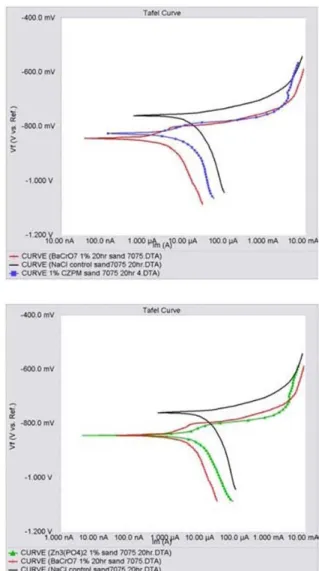
DC polarization testing was carried out on pigments list- ed in Table 1. Fig 2 shows the polarization curves of ZP and CZPM, which demonstrated the strongest inhibition in the immersion test and DC polarization test. Blank and barium chromate were used as control. The cathodic curves of AA7075 in ZP and CZPM solution were de- pressed compared with AA7075 in the blank solution, in- dicating a suppression of the cathodic reduction of oxygen to OH–. Both anodic and cathodic curves in ZP and CZPM were shifted to the left, i.e., towards lower current density, compared to the blank. The shift resulted in a much lower Icorr. Changes were also observed in Ecorr val- ues, with the shift observed in all inhibitor solution to- wards cathodic values.
3.2 Performance of coated panels
ZP and CZPM were incorporated into the superprimer L2 that was developed in the same project. Superprimer L2 is an epoxy-acrylate based primer which contains bis-sulfur silane. Bis-sulfur silane helps inhibit corrosion and improves the adhesion between the coating and substrate. To determine the effect of silane and the pigment superprimer L2 without silane (epoxy + acrylate), L2
Fig. 1. Bare A A7075 panels immersed in inhibitors extractions for 40 days. (a) Blank, (b) CZPM, (c) ZP
Fig. 2. (a) DC polarization curve of ZP compared to blank and chromate, (b) DC polarization curve of CAPM compared to blank and chromate
(epoxy + acrylate + silane), L2 containing 20 wt-% ZP (epoxy + acrylate + silane + ZP) and L2 containing 20 wt-% CZPM (epoxy + acrylate + silane + CZPM) primers
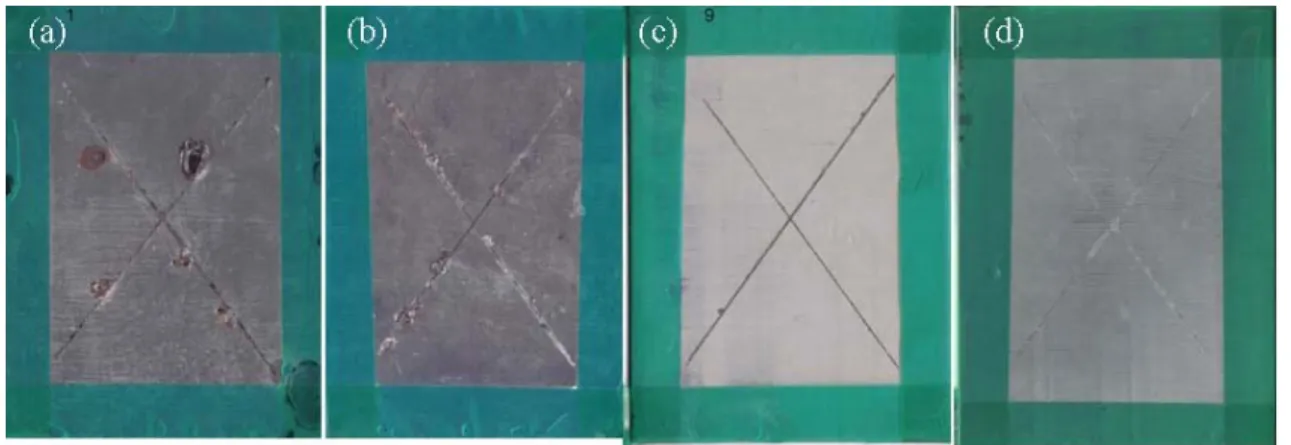
Fig. 3. Coated panels immersed in 3.5% NaCl solution for 40 days. (a) epoxy+acrylate, (b) epoxy+acrylate+silane, (c) epoxy+acrylate+silane+CZPM, (d) epoxy+acrylate+silane+ZP
were prepared and tested in the saltwater immersion test.
Images of the panels immersed for 40 days are shown in Fig. 3. Corrosion and blistering occurred on the coating of epoxy + acrylate (panels a) and the coating of epoxy + acrylate + silane (panels b), and corrosion and blistering on the coating without silane is more severe than those on the coating with silane. Pigmented panels (panel c and d) demonstrated good protection against corrosion.
Adhesion tests showed that silane also improved the ad- hesion between the substrate and superprimer coating. The superprimer containing silane gave results of 5A in the dry condition and 5B in the wet condition in the adhesion test carried out according to ASTM D3359-97 standard.
The classification varies from 5A for no peeling or re- moval to 0A for complete removal. Without silane the results were 4B in the dry condition and 0A in the wet condition.
The 0 ~ 34 days EIS results of L2 pigmented with ZP are shown in Fig. 4. In the period of 34 days, the im- pedance of the coating showed only minimal shift in all
Fig. 4. Impedance spectra for 1-34 days of A A7075 panels coated with superprimer L2 containing ZP
the frequency ranges. This demonstrated that the coating provides good corrosion resistant and good barrier protection.
3.3 Mechanism
Unlike the primers currently used on aircraft, super- primer L2 is a waterborne primer. Zinc phosphate, a hy- drophilic pigment, worked well in L2 and some other wa- terborne superprimers. However, the combination of zinc phosphate and solvent-based primer did form a satisfactory coating partially due to the low solubility of zinc pho- sphate. The solubility constant of zinc phosphate is 9.0x10⁻³³. However, as shown in the bare panel immersion test even the very little dissolved zinc phosphate is enough to protect the metal from corrosion. Therefore the leaching rate of the pigments from the coating becomes a more important factor and it may be the reason why zinc phos- phate does not work well in solvent-based primers. The cross-section of the pigmented superprimer was examined by using SEM/EDS as shown in Fig. 5. From the SEM image a layered structure can be observed in the cross- section. The apparent layers are the upper dark layer (~10μ
Fig. 5. SEM micrograph of the cross-section of the superprimer L2 pigmented with ZP. The substrate is AA7075
Fig. 6. (a) SEM micrographs of the scribe of AA7075 panels coated with ZP pigmented superprimer L2, (b) EDS spectra of a spot in the scribe shown in (a)
m) which contains no pigments and the lower darker layer (~15μm) accommodating all the pigments. It was found that the upper layer is mainly epoxy and the lower layer is acrylate. The level of silane is higher in the lower part of the superprimer.5) The epoxy layer is hydrophobic so less water will be absorbed and less water can penetrate it. On the contrary, water can diffuse into the lower hydro- philic layer fast and quickly to release the pigment in the form of a saturated solution when the coating is broken.
Therefore, the stratified structure of the superprimer pro- vides good barrier protection with a hydrophobic layer on the top and good corrosion protection with a hydrophilic layer facilitating fast transportation of the pigment un- derneath. Abundant silane near the interface enhances the corrosion protection and adhesion.
The scribe of the panel coated with ZP-pigmented L2 was found still shining after 30 days immersion in the salt water. The elementary composition of the scribe was analyzed by using EDS. The SEM image of the scribe is shown in Fig. 6a. Trace of zinc and phosphorus were found on the scribe and in some area the level of them are quite high as shown in Fig 6b.
4. Summary
A wide variety of inhibitors were evaluated in a search for chromate-replacing pigments for AA7075. A few cate- gories of inhibitors such as phosphates, zinc salts, cerium salts, and vanadates were found to be effective and zinc phosphate and CZPM were found to be the strongest among them. As demonstrated in the bare panel immersion test the low solubility of zinc phosphate does not impair its corrosion inhibitive ability. DC polarization tests con- firmed the inhibitive ability of the pigments.
Epoxy-acrylate based superprimer pigmented with zinc phosphate provides strong protection against corrosion for AA7075. A SEM/EDS investigation showed that the unique structure of the superprimer accounts for the strong anti-corrosion performance of the zinc phosphate pig- ment. The self-assembled stratified structure of the super- primer is characterized by a less-penetrable hydrophobic layer at the top and a hydrophilic layer accommodating the inhibitors underneath. This structure provides both strong barrier protection and fast pigment leaching‐out into a scribe, which may be critical for a pigment with very low solubility.
Acknowledgments
The authors gratefully acknowledge the MURI (US Air Force Research Office) projects for funding, Dr. Guy Davis at DACCO SCI, Inc. for corrosion testing and Sumeet for help with SEM/EDS analysis.
References
1. F. Andreatta, H.T., J.H.W. de Wit, Electrochimica Acta, 49, 2851 (2004).
2. M. Shao, Y. Fu., R. Hu, C.Lin, Materials Science and Engineering, A344, 323 (2003).
3. M. Bethencourt, F. J. Botana., M. Marcos, R. M. Osuna, J.M. Sanchez-Amaya, Progress in Organic Coatings, 46, 280 (2003).
4. A. O. S. Leitea, W.S. Araújoa., I. C. P. Margarit, A.
N. Correiaa and P.de Lima-Neto, Journal of Brazil Chemistry Society, 16, 756 (2005).
5. A. Seth, W.J. van Ooij, P. Puomi, Z. Yin, A. Ashirgade, S. Bafna, C. Shivane, Progress in Organic Coatings, 58, 136 (2007).
6. D. Zhu and W.J. van Ooij, Journal of Adhesion Science and Technology, 16, 1235 (2002).