252 Korean Chem. Eng. Res., 56(2), 252-260 (2018)
https://doi.org/10.9713/kcer.2018.56.2.252 PISSN 0304-128X, EISSN 2233-9558
Hydrodynamic and Heat Transfer Studies in Riser System for Waste Heat Recovery using Chalcopyrite
Ashok Kumar Popuri*,**,† and Prabhakar Garimella*
*Department of Chemical Engineering, S.V.U. College of Engineering, S.V. University, Tirupati, 517502, India
**Department of Chemical Engineering, VFSTR University, Vadlamudi, 522202, India (Received 15 June 2017; Received in revised form 21 November 2017; accepted 29 November 2017)
Abstract − Energy, a critical input, is to be efficiently managed via waste heat recovery and energy reuse for the eco- nomic viability of a process industry. In particular, cement manufacture demands a huge quantum of energy, for the nec- essary reactions. Huge amounts of hot effluent gases are generated. Energy recovery from these waste gases is an area that is of contemporary research interest. Now, about 75% of total heat recovery takes place in the riser of the suspen- sion pre-heater system. This article deals with the hydrodynamic and heat transfer aspects of riser typically used in the cement industry. An experimental apparatus was designed and fabricated with provision for the measurement of gas pressure and solid temperatures at different heights of the riser. The system studied was air - chalcopyrite taken in dif- ferent particle sizes. Acceleration length (LA) determined at different parametric levels was fitted to an empirical cor- relation: LA/dt= 4.91902(dp/dt)0.10058(ws/wg)-0.11691(ugμg/dt2gρg)0.28574(ρp/ρg)0.42484. An empirical model was developed for Nusselt number as a function of Reynolds and Prandtl numbers using regression analysis: Nu = 0.40969 (Rep)0.99953 (Pr)0.03569.
Key words: Riser, Acceleration length, Suspension preheater, Chalcopyrite, Gas velocity
1. Introduction
The process industry is an energy intensive activity and its success and economic viability depends heavily on energy management.
This realization prompts consideration of energy recovery and reuse at process conceptualization and design stage itself. Petroleum refin- ing, petrochemicals, cement, power and several others are identified as those consuming large quantity of energy [1]. The cement indus- try, in particular, demands considerable energy inputs for endother- mic reactions like clinker formation [2,3]. During the initial phases, the Indian cement industry employed petroleum-based products as the fuel until the oil crunch of 1973 forced them to look for alterna- tives [4,5]. Coal due to its easy availability has become the source of energy since then [6]. Several technological advancements, mainly aimed at reduction in energy use, have been implemented in the last fifty years [7]. Early kilns of 300-600 tpd capacity gave way to 1200 tpd units and thereafter to 3000 tpd plants [8]. The specific energy consumption decreased in the process, from 6300 kJ/kg clinker in long wet kilns to 4600 units in long dry process [9]. In semi-dry kilns, this has further gone down to 4100 units and finally, with the introduction of suspension pre-heater (SP) system coupled with pre- calcinator, the specific energy requirement is currently ~ 3350 kJ/kg clinker [10,11].
In the modern cement industry, waste heat recovery involves the use of four to five cyclones, placed one above the other and intercon- nected by long vertical gas ducts. Raw cement mix (limestone, clay and bauxite) is introduced into the transporting duct leading to the first stage cyclone (top most) and is preheated in suspended state, by uprising hot gas leaving the second cyclone [12]. This constitutes the first stage of waste heat recovery, hot effluent gas passing on part of its energy to the solids. Preheated suspension enters the first cyclone, where solids are separated from the gas stream. Partially heated par- ticles move down the line, enter the interconnecting gas duct between the second and third stages, facilitating further heating of solids by the hot gas ascending from the third stage. This way, the solids get preheated to the desired temperature by exhaust gases, resulting in high heat recovery from the kiln gas. This arrangement is known as suspension pre-heater system (SP) [13,14].
Blasetti and De Lasa (2001) studied the heat transfer between the gas and solid phases in the riser section of a cyclone suspension pre- heater system, and suggested that the heat-transfer coefficient in the system depended on both the concentration of solid particles and the particle Reynolds number in the riser section [15-17].
Kaczmarzyk and Bandrowski (1980) postulated that the suspended solid particles were free to have other types of motion like rotational motion, in addition to axial motion, thereby causing considerable disturbance in the relatively stable laminar film adjacent to the parti- cle surface. Consequently, there was turbulence over a larger portion of the particle surface than would have otherwise been possible with stationary particles [18,19]. The data collected for vertical pneu- matic transport of granular materials was used to arrive at a correla-
†To whom correspondence should be addressed.
E-mail: [email protected]
This is an Open-Access article distributed under the terms of the Creative Com- mons Attribution Non-Commercial License (http://creativecommons.org/licenses/by- nc/3.0) which permits unrestricted non-commercial use, distribution, and reproduc- tion in any medium, provided the original work is properly cited.
tion - Nusselt number, Nu = 0.00114 b-0.5984 Rep0.8159 (0.00025 < b <
0.05 and 180 < Rep < 1800).
Sharlovskaya (1958) suggested a generalized equation based on the data on heat transfer between solid and fluid. The correlation was simple, in that only the Nusselt number was plotted against the Reyn- olds number [20].
Watanabe et al. (1991) studied experimentally the characteristics of interfacial heat transfer between gas and solid particles in the fast- fluidized bed regime, which is similar to the present heat transfer studies in many respects [21,22]. The heat transfer coefficients were estimated on the basis of temperature profiles obtained experimen- tally. It was stated that the particle hold-up, the velocity and the tem- perature distribution with in a particle influence the magnitude of heat transfer coefficient. The heat transfer coefficient was observed to increase with an increase in the suspension density. The data were found to be valid over a wide range of gas velocity and particle mass flux. Again, the heat transfer coefficient was found to decrease sig- nificantly as the riser height (measured from the bottom) is increased.
It was concluded that the minimum height required for heat transfer to become stable ranged from 0.83 to 1.52 m for circulating fluid- ized bed systems.
2. Experimental Aspects
Studies on hydrodynamic behavior and heat transfer characteris- tics of the riser were carried out using cold (pressure measurement) and hot model (temperature measurement) experimental apparatus.
2-1. Experimental apparatus
Schematic diagram and fabricated experimental apparatus are shown in Figures 1 and 2. The apparatus essentially consists of a ver- tical transport duct, A (diameter: 0.0508 m; height: 2.1082 m); cyclone separator, B (diameter: 0.127 m; cylindrical height: 0.1778 m; coni- cal height: 0.254 m; inlet diameter: 0.0508 m; solid outlet pipe diam- eter: 0.0508 m; gas outlet pipe diameter: 0.0508 m); solid storage tank, C (diameter: 0.127 m; cylindrical height: 0.4064 m; conical height:
0.2794 m); stand pipe, D (height: 0.3048 m: diameter: 0.0254 m);
solid feeding line, E (diameter: 0.03175 m; length: 0.6096 m); bend, F (diameter: 0.0508 m; total flat length: 0.3048 m); orifice meter, G (diameter: 0.019 m); blower, H (2.2 kw, 3.0 hp, 415V, 3 phase induc- tion motor, 2830 RPM, 50Hz, 4.61A, 55 IP, 150 m3/hr, rectangular outlet: 0.0889 m x 0.0762 m); solid collection pot, I (diameter:
0.0508 m; height: 0.3048 m); auxiliary air inlet, J (diameter: 0.0254 m; length: 1.524 m); electric furnace, K (length: 0.381 m; breadth:
0.4064; height: 1.524 m; each coil height: 1.016 m; number of coils:
12); all made up of steel.
A screw conveyor transports the solid from solid storage tank to the bottom of the riser and an auxiliary air flow is also provided, to ensure smooth flow of solid particles, by preventing choking in the transport line. An orifice meter connected across pressure taps (P1 and P2) measures the velocity of entering air. Eighteen pressure taps
(P3 - P20), each installed 0.1016 meters apart, facilitate measurement of static pressures along the height of the riser. Seven valves, each 0.3048 meters apart, are installed on the riser to permit collection of solid samples at various heights. Ten thermocouples, each 0.2032 meters apart, are also installed along the riser to measure air tempera- ture at various heights. All the external metal surfaces are com- pletely covered with half-an- inch thick glass wool layer, wrapped with a quarter-inch rope and finally coated with plaster of paris to prevent heat loss from the riser and to ensure near-adiabatic opera- tion.
2-2. Experimental procedure 2-2-1. Hydrodynamic studies
Chalcopyrite particles of known size are loaded into the storage tank and the rotary valve is adjusted for a specific solid feed rate. Air from the blower is metered and is sent through the bottom of the riser to transport the solids vertically upward. The gas – solid suspension on reaching the top of the riser is separated in the cyclone separator, the solids completing their cycle along the down comer and reach- ing the storage vessel. Provision has been made for the collection of solid samples at various riser heights. The static pressures along the riser height are measured with the help of water manometers after the system reaches steady state. Differential pressure can be found across any section of the riser. The pressure drop across the cyclone is also measured. Experimental data are collected by varying the size of par- ticles, the solid feed rate and the air velocity.
2-2-2. Heat transfer studies
Chalcopyrite of predetermined size is charged into the storage tank and the rotary valve is positioned for a specific solid feed rate.
Air from the blower is preheated to the desired temperature in the electric furnace. As the hot air moves upwards, the solid is fed into the riser, the test section behaving like a direct contact, vertical paral- lel flow heat exchanger. Air velocity is so maintained as to ensure pneumatic transport of the solid particles. Heat transfer takes place between the hot air and the solid. Temperatures of air and also of solid at various riser heights are recorded. At steady state, solid sam- ples are collected from various points into stand-by calorimeters.
Final temperatures attained by the mercury thermometers in the calo- rimeters are recorded to obtain the temperature profile of solid within the riser. In this manner data on variations in air and particle tempera- tures are recorded at different air velocities, different particle sizes and different temperatures of the incoming hot air.
3. Results and Discussion
3-1. Hydrodynamic studies - acceleration (or mixing) length Starting from the introduction of solid into the duct, various forces act upon the particles. Depending upon the mode of injection, the particle can either be at zero or negligible velocity at the bottom of the riser, after which it is accelerated at the expense of the kinetic
energy of the fluid. At a certain riser height, the particle velocity reaches a maximum value, which evidently depends on the system conditions. Once this velocity is reached, the system behaves like a homogeneous (dispersed) gas-solid suspension. This minimum length (or height) required for attaining a steady homogeneous flow, is
termed as “Acceleration Length”, LA or “Entry Length” or “Mixing Length”.
By plotting static pressure distribution against the riser height, an asymptotic trend is observed. A cross plot of riser height against pressure drop per unit length (or height) indicates a plateau, the pres- Fig. 1. Schematic diagram of experimental apparatus.
sure drop per unit length remaining substantially constant with riser height. This particular length (or height) is identified as the riser height, beyond which a homogeneous suspension flow occurs. Val- ues of pressure gradient DP/DL at different riser heights are found as per the equation,
[ΔP/ΔL]i to (i+1) = [DP(i+1) to 0− DPi to 0] / [Li+1to 0− Li to 0] (1) 3-1-1. Effect of gas velocity on acceleration length
Pressure gradients at different riser heights, obtained at different gas velocities, for chalcopyrite-air system, are shown in Fig. 3.
Acceleration lengths evaluated from this data are tabulated as Table 1.
Pressure gradient, which seemed to be inversely related to the riser height initially, continued to show the same trend of decrease with increase in height, but at a lower slope before reaching constancy in the ordinate level for all the three velocities studied. Pressure gradient is higher at higher gas velocities. Accordingly, acceleration length exhibited a direct dependence on the gas superficial velocity, increas- ing with increasing gas velocity, as indicated by the data shown in Table 1. As the gas travels past the solid, some of its kinetic energy is passed on to the solid, helping the particles to pick up speed, i.e., par- ticles are accelerated with a simultaneous drop in the gas velocity.
The higher the gap between gas and particle velocities, the more the length would be, to reach the steady flow rate. So acceleration lengths increase as the gas velocity increases.
3-1-2. Effect of particle size on acceleration length
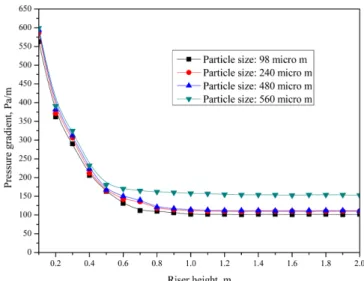
Pressures are measured at different riser heights with different sizes of the solid particles and the resulting plots of pressure gradient vs. riser height are shown as Fig. 4 for the chalcopyrite-air system.
Variation of acceleration length with particle size is given in Table 2.
Fig. 2. Fabricated experimental apparatus.
Fig. 3. Variation of pressure gradient with gas velocity (Particle size:
98 mm; Solid feed rate: 0.012 kg/sec).
Table 1. Variation of acceleration length with gas velocity Gas velocity (ug), m/s Acceleration length (LA), m
6.6 0.83
7.9 0.92
9.9 1.11
14.53 1.42
Fig. 4. Variation of pressure gradient with particle size (Gas velocity:
14.53 m/s; Solid feed rate: 0.0362 kg/sec).
Table 2. Variation of acceleration length with particle size Particle size (dP), μm Acceleration length (LA), m
98 1.03
240 1.11
480 1.19
560 1.23
Pressure decreases as the particles move up, with the smallest par- ticle causing the highest pressure drop. Pressure drop decreases with increasing particle size at all riser heights. Packing density and parti- cle density are the two factors that are responsible for gas pressure drop. While both are significant in case of small particles, the first factor diminishes as particle size is increased. Pressure gradient reached a steady value at a riser height of 0.7 m for all particle sizes.
As far as acceleration length is concerned, higher particle size demands higher acceleration length, indicating the difficulty in accelerating bigger particles to a velocity equal to the gas velocity, overcoming the forces of gravity and drag.
3-1-3. Effect of Solid Feed Rate on Acceleration Length
Solid feed rate is the next variable studied with pressure measure- ment carried out at different riser heights for chalcopyrite-air and the data so collected are plotted as Fig. 5. Acceleration lengths calcu- lated from the experimental data are listed in Table 3.
Increase in solid feed rate apparently increased the pressure drop per unit length, which is reasonable. The gas is forced to carry higher quantities of solids with increased solid feed rate. Further, it is noticed that from the data that, for a set of conditions, the accelerat- ing length decreased with an increase in the solid loading rate. This can be explained by the fact that an enhanced solid flux reduces the void fraction, resulting there by in higher interstitial velocity, enhanc- ing the drag on the particle and reducing the length of riser necessary to attain a stable flow condition.
3-1-4. Effect of material density on acceleration length
The effect of solid density on the pressure gradients at different
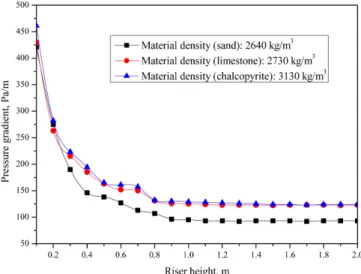
riser heights is examined using three different systems – sand-air, limestone-air and chalcopyrite-air. The results are as shown in Fig. 6 and the corresponding acceleration lengths are listed in Table 4.
All three systems exhibited a uniform trend of lowering of pres- sure gradient exponentially as the riser height increases, reaching a steady horizontal level beyond a riser height of 0.9 m. Further, an increase in the material density enhanced the acceleration length with all other parameters remaining constant. This dependence can be explained by the fact that the higher the particle density, the higher will be the downward pull of gravity on these particles and hence, the higher will be the acceleration length to attain homogeneity over- coming the gravitational force.
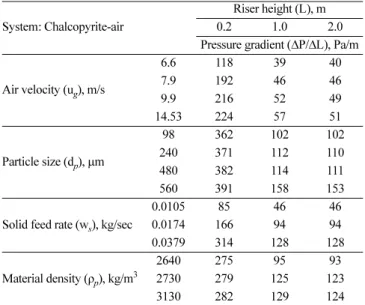
Consolidated data, showing the pressure gradient per unit length against the different parameters considered, at lower, middle and top portion of the riser are as shown in Table 5.
The data clearly supports the hypothesis of acceleration length.
Pressure gradient per unit length decreases in the lower half of the riser and remains steady in the upper half, regardless of levels of other parameters. The decrease in the (ΔP/ΔL) indicates the energy expended in dealing with the heterogeneity, i.e., the energy spent by the fluid to accelerate the solids and to help them attain a uniform velocity. Once this is achieved, the pressure gradient is maintaining a constant level.
3-1-5. Prediction of empirical model for acceleration length A consolidated list of acceleration length obtained from the exper- imental study is provided as Table 6, to understand its dependence on the parameters studied and also to form the basis for development of Fig. 5. Variation of pressure gradient with solid feed rate (Gas veloc-
ity: 10.61 m/s; Particle size: 98 µm).
Table 3. Variation of acceleration length with solid feed rate Solid feed rate (ws), kg/s Acceleration length (LA), m
0.0105 0.86
0.0174 0.79
0.0379 0.75
Fig. 6. Variation of pressure gradient with material density (System:
Sand-Air, Limestone-Air, Chalcopyrite-Air; Gas velocity: 14.67 m/s; Solid feed rate: 0.0329 kg/s; Particle size: 480 µm).
Table 4. Variation of acceleration length with material density Material density (ρp), kg/m3 Acceleration length (LA), m
2640 (sand) 1.09
2730 (limestone) 1.21
3130 (chalcopyrite) 1.52
a suitable correlation.
It is evident from the above table that an increase in the air veloc- ity, increase in the particle size and increase in the particle density enhances the acceleration length, while an increase in solid feed rate decreases the acceleration length. All these factors - gas velocity (ug), particle size (dp), solid loading ratio (lr), and material density (ρp) - need be considered while formulating a correlation for acceleration length (LA). In addition, other physical properties of gas like gas den- sity (ρg), gas viscosity (μg), acceleration due to gravity (g) and tube diameter (dt) will also affect acceleration length, LA.
Considering this, one may write
LA= f(ug, dp, dt, ρp, ρg, μg, g, lr) (2) Let the functional relationship be of the type,
LA= (ug)a1. (dp)a2. (dt)a3. (ρp)a4. (ρg)a5. (μg)a6. (g)a7. (ws)a8. (wg)a9 (3)
Expressing in terms of primary units of mass M, length L and time T and regrouping the variables, one gets
(4)
Through regression analysis of the experimental data, the constant k and exponents b, i, f and d are evaluated and the outcome is
(5)
LA values obtained from experiments and model equation are plot- ted in Fig. 7 and a reasonably good agreement between the two, especially in the trend is observed. A good concurrence in the magni- tudes can also be noticed at most of the data points. Statistical analy- sis between the experimental and calculated (using correlation) values of the acceleration length is also made and a correlation coef- ficient of 0.95 obtained.
LA dt --- k dp
dt ---
⎝ ⎠⎛ ⎞a ws wg ---
⎝ ⎠⎛ ⎞b ugμg
dt2gρg
---
⎝ ⎠
⎛ ⎞c ρp
ρg
---
⎝ ⎠⎛ ⎞d
=
LA dt
--- 4.91902 dp dt ---
⎝ ⎠⎛ ⎞0.10058 ws wg ---
⎝ ⎠⎛ ⎞–0.11691 ugμg
dt2gρg
---
⎝ ⎠
⎛ ⎞0.28574 ρp
ρg
---
⎝ ⎠⎛ ⎞0.42484
= Table 5. Variation of pressure gradient
System: Chalcopyrite-air
Riser height (L), m
0.2 1.0 2.0
Pressure gradient (ΔP/ΔL), Pa/m Air velocity (ug), m/s
6.6 118 39 40
7.9 192 46 46
9.9 216 52 49
14.53 224 57 51
Particle size (dp), μm
98 362 102 102
240 371 112 110
480 382 114 111
560 391 158 153
Solid feed rate (ws), kg/sec
0.0105 85 46 46
0.0174 166 94 94
0.0379 314 128 128
Material density (ρp), kg/m3
2640 275 95 93
2730 279 125 123
3130 282 129 124
Table 6. Values of acceleration length (LA) obtained from experiments System Particle size, dp, μm Particle density,
ρp, kg/m3
Air velocity, ug, m/s
Solid feed rate, ws, kg/s
Air feed rate, wg, kg/s
Acceleration length, LA from experiments
Chalcopyrite-Air 98 3130 6.6 0.012 0.015 0.83
Chalcopyrite-Air 98 3130 7.9 0.012 0.018 0.92
Chalcopyrite-Air 98 3130 9.9 0.012 0.022 1.11
Chalcopyrite-Air 98 3130 14.53 0.036 0.033 1.03
Chalcopyrite-Air 240 3130 14.53 0.036 0.033 1.11
Chalcopyrite-Air 480 3130 14.53 0.036 0.033 1.19
Chalcopyrite-Air 560 3130 14.53 0.036 0.033 1.23
Chalcopyrite-Air 98 3130 10.61 0.010 0.024 0.86
Chalcopyrite-Air 98 3130 10.61 0.017 0.024 0.79
Chalcopyrite-Air 98 3130 10.61 0.037 0.024 0.75
Chalcopyrite-Air 480 3130 14.67 0.032 0.034 1.52
Chalcopyrite-Air 480 3130 14.67 0.032 0.034 1.11
Sand-Air 480 2640 14.67 0.0329 0.035 1.09
Limestone-Air 480 2730 14.67 0.0329 0.035 1.21
Chalcopyrite-Air 480 3130 14.67 0.0329 0.035 1.52
Fig. 7. Acceleration length (LA) obtained from experiments and model equation.
3-2. Heat transfer studies
It is mentioned in the preceding sections that an SP system works on the principle of fluid-to-particle heat transfer. In practice, the flue gas is fed through a series of cyclone separators, interconnected through riser pipes. Literature sources reveal that about 75% of the heat transfer takes place in the riser alone. As such, heat transfer in the riser plays a key role. Again, the rate of heat transfer within the riser may not be uniform all through. There can be faster rate of heat transfer in the lower section of the riser, which can diminish towards the end. It is, therefore, necessary to conduct both analytical and experimental studies on gas-to-solid heat transfer in the riser, particu- larly in the acceleration zone.
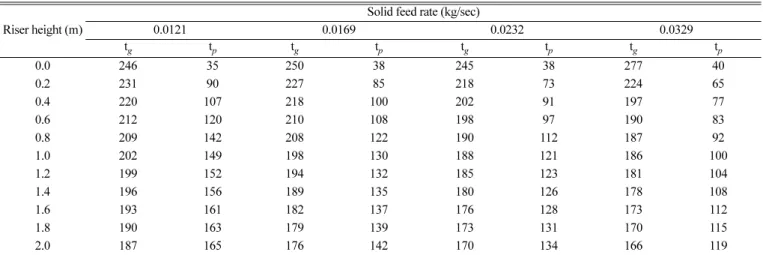
Using the gas and solid temperatures given in Tables 7 and 8, the rate of heat transfer and the heat transfer coefficient are estimated at different air and solid feed rates. This data is used to find the relation among Nu, Rep and Pr. The equations employed are
Rate of heat transfer, (6)
Heat transfer coefficient, (7)
3-3. Correlation of Nusselt number
To fit the experimental data, a correlation of the following type has been developed, which is valid for higher ranges of solid concentra- tion.
(8)
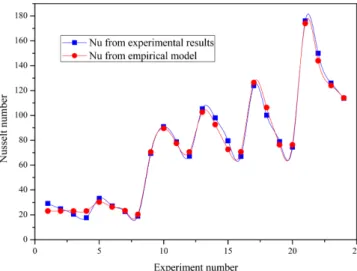
(9)
Through regression analysis of the experimental data, the con- stant a and exponents b and c were evaluated.
(10) Nusselt number values obtained from experiments and model equation are plotted in Fig. 8. The model is perhaps yielding the mean levels of the heat transfer coefficient, failing to indicate the cyclic increase and decrease. Statistical analysis between the experi- mental and calculated (using correlation) values of the Nusselt num- ber yielded a correlation coefficient of 0.96.
q=m· Cp(ΔT)
h q
A(ΔT) ---
=
Nu=aRePbPrc hdt
---k a dPvρ ---μ
⎝ ⎠
⎛ ⎞b CPμ ---k
⎝ ⎠
⎛ ⎞c
=
Nu=0.40969 Re( P)0.99953( )Pr 0.03569
Table 7. Variation of gas and solid temperatures along riser with solid feed rate (Average particle size: 240 µm; Air flow rate: 0.0351 kg/sec) Riser height (m)
Solid feed rate (kg/sec)
0.0111 0.0143 0.0245 0.0346
tg tp tg tp tg tp tg tp
0.0 188 37 188 36 186 38 188 37
0.2 174 79 177 62 172 58 166 52
0.4 169 92 164 73 158 66 156 58
0.6 166 101 158 81 154 72 144 63
0.8 162 114 157 93 147 80 140 70
1.0 159 123 153 99 143 85 134 73
1.2 156 127 148 106 139 92 132 75
1.4 157 129 147 109 138 97 130 77
1.6 152 132 144 114 135 104 128 79
1.8 150 135 143 118 133 109 124 81
2.0 148 138 141 123 131 113 121 83
tg: Gas temperature in °C tp: Solid temperature in °C
Table 8. Variation of gas and solid temperatures along riser with solid feed rate (Average particle size: 240 mm; Air flow rate: 0.0341 kg/sec)
Riser height (m)
Solid feed rate (kg/sec)
0.0121 0.0169 0.0232 0.0329
tg tp tg tp tg tp tg tp
0.0 246 35 250 38 245 38 277 40
0.2 231 90 227 85 218 73 224 65
0.4 220 107 218 100 202 91 197 77
0.6 212 120 210 108 198 97 190 83
0.8 209 142 208 122 190 112 187 92
1.0 202 149 198 130 188 121 186 100
1.2 199 152 194 132 185 123 181 104
1.4 196 156 189 135 180 126 178 108
1.6 193 161 182 137 176 128 173 112
1.8 190 163 179 139 173 131 170 115
2.0 187 165 176 142 170 134 166 119
4. Conclusion
An experimental apparatus, along the lines of a riser used in the cement industry, was fabricated and exhaustive hydrodynamic stud- ies were made by varying fluid velocity, solid feed rate, particle size and density. A mathematical model for the riser hydrodynamics was deduced using linear regression and the model equation was able to predict the acceleration (or mixing) length (LA) of the riser. The cor- relation that is suggested for estimation of acceleration length goes as
Instantaneous gas and particle temperature profiles were obtained experimentally. An empirical correlation was developed for Nusselt number as a function of Reynolds and Prandtl numbers using regres- sion analysis which is valid for higher ranges of solid concentration.
.
Nomenclature
A : Heat transfer area [m2] cp : Specific heat [J/kg·°C]
dp : Particle diameter [m]
dt : Tube diameter [m]
g : Acceleration due to gravity [m/s2] h : Heat transfer coefficient [W/m2·°C]
k : Thermal conductivity [W/m·°C]
lr : Solid loading ratio L : Length of pipe [m]
La : Acceleration length [m]
m.
: Mass flow rate [kg/s]
Nu : Nusselt number Pr : Prandtl number
q : Rate of heat transfer [W]
ReP : Particle Reynolds number tg : Air temperature [°C]
tp : Particle temperature [°C]
ug : Air velocity [m/s]
wg : Air flow rate [kg/s]
ws : Solid feed rate [kg/s]
β : Volume fraction of solids [1-ɛ]
ρp : Solid density [kg/m3] ρg : Air density [kg/m3] μg : Air viscosity [kg/m·s]
ΔP/ΔL : Pressure gradient per unit length of pipe [Pa/m]
ΔT : Temperature difference [°C]
References
1. Marek, W., “Analysis of the Effects of Temperature and the Share of Solid and Gas Phases on the Process of Separation in a Cyclone Suspension Preheater,” Sep. Purif. Technol., 168, 114- 123(2016).
2. Yong, C., Faqi, Z. and Yaodong, W., “Experimental Analysis of the Solids Acceleration Region in a Circulating Fluidised Bed Riser,” Indian Chem. Eng., 57(2), 136(2015).
3. Abdulkadir, M., Hernandez-Perez, V., Lowndes, I. S., Azzopardi, B. J. and Dzomeku, S., “Experimental Study of the Hydrody- namic Behavior of Slug Flow in a Vertical Riser,” Chem. Eng.
Sci., 106, 60-75(2014).
4. Huang Weixing and Zhu Jingxu, “An Experimental Investiga- tion on Solid Acceleration Length in the Riser of a Long Circulat- ing Fluidized Bed,” Chinese J. of Chem. Eng., 9(1), 70-76(2001).
5. Xiao, Y. H., Wang, S. D., Yang, S. S., Zhao, K., Zeng, X. and Xu, X., “Solids Acceleration Length in a Cold Dense Transport Bed,” J. Thermal Sci., 21(6), 533-538(2012).
6. Razzak, S. A., Barghi, S. and Zhu, J. X., “Axial Hydrodynamic Studies in a Gas–Liquid–Solid Circulating Fluidized Bed Riser,”
Powder Technol., 199, 77-86(2010).
7. Guangwen Xu, Kosuke Nomura, Nobuyoshi Nakagawa and Kunio Kato, “Hydrodynamic Dependence on Riser Diameter for Dif- ferent Particles in Circulating Fluidized Beds,” Powder Tech- nol., 113(1-2), 80-87(2000).
8. Mitali Das, B., Meikap, C. and Saha, R. K., “A Critical Analysis of the Acceleration Length and Pressure Profile of Single-Particle Systems in a Circulating Fluidized Bed,” Asia-Pac. J. Chem. Eng., 3, 560-571(2008).
9. Li, S., Wu, J. Y., Wang, R. Z. and Huangfu, Y., “Study of Heat and Mass Transfer in Integrated Thermal Management Controller (ITMC) Employed in Waste Heat Recovery Application,” Energy Convers. Manage., 48, 3074-3083(2007).
10. Monazam, E. R. and Shadle, L. J., “Analysis of the Acceleration Region in a Circulating Fluidized Bed Riser Operating above Fast Fluidization Velocities,” J. Ind. Eng. Chem. Res., 47, 8423-8429 (2008).
11. Huang, W. X., Zhu, J. X. and Parssinen, J. H., “Comprehensive Study on the Solids Acceleration Length in a Long CFB Riser,”
J. Chem. Eng. Technol., 29, 1197-1204(2006).
12. Pandey, K. M. and Ray, M., “Experimental Studies on Hydrody- LA
dt
--- 4.91902 dp dt ---
⎝ ⎠⎛ ⎞0.10058 ws wg ---
⎝ ⎠⎛ ⎞–0.11691 ugμg
dt2gρg
---
⎝ ⎠
⎛ ⎞0.28574 ρp
ρg
---
⎝ ⎠⎛ ⎞0.42484
=
Nu=0.40969 Re( P)0.99953( )Pr0.03569
Fig. 8. Comparison of Nusselt number obtained from experiments and empirical model.
namics of a Cyclone Separator Employed in a Circulating Fluidized Bed,” Int. J. Chem. Eng. Appl., 1(2), 123-131(2010).
13. Yang, Y. L., Jin, Y., Yu, Z. Q., Wang, Z. W. and Bai, D. R., “The Particle Velocity Distribution in a Riser of Dilute Circulating Flu- idized Bed,” J. Chem. Ind. Eng., 2, 182-191(1991).
14. Kalita, P., Saha, U. K. and Mahanta, P., “Parametric Study on the Hydrodynamics and Heat Transfer along the Riser of a Pressurized Circulating Fluidized Bed Unit,” Exp. Therm. Fluid Sci., 44, 620- 630(2013).
15. Blasetti, A. and De Lasa, H., “Heat-Transfer Prediction in the Riser of a Novel Fluidized Catalytic Cracking Unit,” Ind. Eng. Chem.
Res., 40, 4623-4632(2001).
16. Bai, D. R., Jin Yong and Yu Zhiqing, “The Particle Acceleration and the Interaction Between Gas and Solids in the Riser of Cir- culating Fluidized Beds,” J. Chem. React. Eng. Technol., 3, 260- 270(1991).
17. Ferschneider, G. and Mège, P., “Dilute Gas-Solid Flow in a Riser,”
Chem. Eng. J., 87(1), 41-48(2002).
18. Kaczmarzyk, G., Bandroski, J., “Gas-Solid Heat Transfer Coef- ficients in Vertical Pneumatic Transport,” Int. Chem. Engg., 20, 98-110(1980).
19. Bai, D. R., Jin, Y. and Yu, Z.Q., “The Length of Particle Accelera- tion Region in Fast Fluidized Beds,” J. Chem. React. Eng. Tech- nol., 6, 34-39(1990).
20. Sharlovskaya, M. S., “Investigation of Heat Transfer in Fluidized Bed by Using the Quasi-Stationary Method (in Russian),” Reports of Siberian Branch of AS SSSR, 7, 62-74(1958).
21. Watanabe, T., Yong, C., Hasatani, M., Yushen, X., and Naruse, I., “Gas to Particle Heat Transfer in Fast Fluidized Bed,” Circu- lating Fluidized Bed Technology III, Oxford Pergamon Press, 283-287(1991).
22. Reddy, B. V. and Nag, P. K., “Effect of Riser Exit Geometry on Bed Hydrodynamics and Heat Transfer in a Circulating Fluid- ized Bed Riser Column,” Int. J. Energy Res., 25(1), 1-8(2001).