Feasibility of a Laparoscopic Approach for Generalized Peritonitis from Perforated Appendicitis in Children
Hye Kyung Chang,
1Seok Joo Han,
1Seung Hoon Choi,
2and Jung-Tak Oh
11Department of Pediatric Surgery, Severance Children’s Hospital, Yonsei University College of Medicine, Seoul;
2Department of Surgery, Gangnam Severance Hospital, Yonsei University College of Medicine, Seoul, Korea.
Received: January 9, 2013 Revised: February 25, 2013 Accepted: March 6, 2013
Corresponding author: Dr. Jung-Tak Oh, Department of Pediatric Surgery, Severance Children’s Hospital, Yonsei University College of Medicine, 50 Yonsei-ro, Seodaemun-gu, Seoul 120-752, Korea.
Tel: 82-2-2228-2124, Fax: 82-2-313-8289 E-mail: [email protected]
∙ The authors have no financial conflicts of interest.
© Copyright:
Yonsei University College of Medicine 2013 This is an Open Access article distributed under the terms of the Creative Commons Attribution Non- Commercial License (http://creativecommons.org/
licenses/by-nc/3.0) which permits unrestricted non- commercial use, distribution, and reproduction in any medium, provided the original work is properly cited.
Purpose: This study evaluated the feasibility of a laparoscopic approach in chil- dren with generalized peritonitis secondary to perforated appendicitis. Materials and Methods: We retrospectively analyzed the medical records of patients who underwent laparoscopic appendectomy with drainage for generalized peritonitis secondary to perforated appendicitis at our hospital between September 2001 and April 2012. Laparoscopic outcomes were compared with outcomes of an open method for perforated appendicitis. Results: Ninety-nine patients underwent lapa- roscopic appendectomy (LA) for generalized peritonitis from perforated appendi- citis, and 87 patients underwent open appendectomy (OA) for perforated appendi- citis. Wound infection was more common in the OA group (12.6%) than in the LA group (4.0%; p=0.032). The incidence of intestinal obstruction during long-term follow-up was significantly higher in the OA group (4.6% vs. 0.0% in the LA group; p=0.046). LA was possible in most patients for whom LA was attempted, with a conversion rate of 10.8%. Conversion to OA was affected by the preopera- tive duration of symptoms and the occurrence of intraoperative complications.
Conclusion: LA is feasible for use in children with generalized peritonitis from perforated appendicitis, with reasonable open conversion and perioperative com- plication rates comparable to those of the OA group.
Key Words: Appendicitis, peritonitis, laparoscopy, children
INTRODUCTION
Acute appendicitis in young children is commonly accompanied by perforation, resulting in a significant increase in morbidity.1 Generalized peritonitis secondary to perforated appendicitis is a challenging disease in children because of its system- ic clinical characteristics and substantially increased morbidity. Although laparo- scopic appendectomy (LA) is commonly performed in children with appendicitis, laparoscopic approaches for treating generalized peritonitis have some difficulties.
These difficulties include a limited view due to severe adhesions from generalized peritonitis and confined space of the small abdominal cavity of children. More- over, the use of LA for complicated appendicitis is controversial because of the high incidence of intra-abdominal abscess.2,3
OA was performed via a right lower transverse or para- median incision. Cotton tapes were used to protect the ab- dominal wall from dirty, contaminated intra-abdominal con- tents. After appendectomy, dirty materials were removed via sponge stick sweeps and thorough irrigation with warm saline was performed until the drainage fluid became clear.
Draining catheters were inserted via another incision into the pelvic cavity or paracolic gutter, depending on the oper- ative findings of peritoneal contamination from the appen- diceal perforation.
Categorical parameters were analyzed using the Pear- son’s chi-squared test or Fisher’s exact test. Continuous pa- rameters were analyzed with an independent t-test or Mann- Whitney’s U test. Multivariate analyses were performed to define the factors related to open conversion from laparos- copy. Statistical analyses were carried out with SPSS ver- sion 18.0 software (SPSS Inc., Chicago, IL, USA). A p-value less than 0.05 indicated statistical significance. The Institu- tional Review Board of our hospital approved this study (4- 2012-0448).
RESULTS
During the study period, 519 patients (73.3%) underwent LA and 189 patients (26.7%) underwent OA at our hospital.
Of these, 186 patients (26.3%) were included in this study because they had perforated appendicitis with generalized peritonitis confirmed by laparoscopy or underwent OA with drainage for perforated appendicitis. LA for generalized peritonitis from perforated appendicitis was performed with- out open conversion in 99 patients. OA for perforated ap- pendicitis was performed in 87 patients, including 12 pa- tients who were converted to the open method.
The clinical characteristics of the two groups are present- ed in Table 1. The mean age at appendectomy was 8.4±3.6 years (8.3±3.3 years in the LA group vs. 8.4±3.9 years in the OA group; p=0.947). The mean duration of symptoms was 3.8±3.4 days (3.4±2.5 days in the LA group vs. 4.3±4.1 days in the OA group; p=0.074).
In most of the LA group, CT [77.8% (77/99)] and ultra- sonography [7.1% (7/99)] were used for diagnosis. Only 15 patients (15.2%) in the LA group underwent surgery after diagnosis by clinical assessment without radiologic evalua- tion. In the OA group, 48.3% (42/87) of the patients were diagnosed by clinical assessment including physical exami- nation and laboratory findings. CT and ultrasonography In this study, we reviewed our experience, which used a
laparoscopic approach for generalized peritonitis secondary to perforated appendicitis in children, to evaluate its feasibil- ity. The results of LA for generalized peritonitis from perfo- rated appendicitis were compared to those of an open ap- proach for perforated appendicitis.
MATERIALS AND METHODS
We retrospectively analyzed the medical records of patients who underwent LA with drainage for generalized peritoni- tis secondary to acute perforated appendicitis at our hospital between September 2001 and April 2012. We also reviewed the medical records of patients who underwent open appen- dectomy (OA) with drainage for perforated appendicitis with localized or generalized peritonitis or periappendiceal abscess at our hospital during the same study period. De- mographics, preoperative duration of symptoms, operative findings, operative time, conversion from laparoscopy to open surgery, length of hospital stay, and intraoperative and postoperative complications were reviewed.
The diagnosis of appendicitis was confirmed by typical presentation on physical examination, laboratory findings, and/or ultrasonography or CT. Generalized peritonitis was defined as purulent fluid collection in the entire peritoneal cavity, confirmed by laparoscopic findings, in the LA group.
In the OA group, patients with appendiceal perforation and localized or generalized peritonitis or periappendiceal ab- scess were included to compare laparoscopic outcomes for generalized peritonitis secondary to perforated appendicitis.
The patients who had other co-morbidity that was not cor- related to appendicitis were excluded. Triple antibiotic ther- apy (ampicillin or cephalosporin, aminoglycoside, and met- ronidazole) was used postoperatively in both groups.
LA was performed using three ports: one supra- or infra- umbilical port for the camera and two working ports in the left lower quadrant of the abdomen and suprapubic area.
After ligation of the appendiceal stump using an endo-loop and removal of the appendix, the entire abdominal cavity was cleaned, including both paracolic gutters, pelvic cavity, perihepatic area, splenic fossa, and intermesenteric space, by thorough and meticulous irrigation with warm saline un- der the direct view of the laparoscope until the irrigation fluid became clear. Two or three draining catheters were in- serted into the pelvic cavity and both paracolic gutters via one suprapubic port site.
amount of irrigation fluid was used in the LA group (4.0±2.6 L in the LA group vs. 1.8±1.0 L in the OA group; p=0.019).
The operative time was longer in the LA group (114.2±34.0 min) than in the OA group (87.0±63.0 min; p<0.001).
Fifty-eight postoperative complications (31.2%) occurred during hospitalization or within the first month after appen- dectomy. Those complications included prolonged ileus or intestinal obstruction, wound infection, intra-abdominal ab- scess, leakage, pleural effusion, voiding difficulty, and drug eruption. Although there were no differences between the two groups in the overall rate of postoperative complications, the rates of wound infection and bowel leakage were higher in the OA group. The incidence of wound infection was higher in OA group even after the exclusion of the converted group in the OA group [4.0% (4/99) in the LA group vs.
14.7% (11/75) in the OA group; p=0.013]. However, initial laparoscopic attempts were converted to an open approach in three of four patients with postoperative leakage. Among the four patients exhibiting postoperative leakage, three patients were performed in 42.5% (37/87) and 9.2% (8/87) of pa-
tients in the OA group, respectively.
Perioperative clinical data are presented in Table 2. Dur- ing surgery, nine patients (4.8%) had complications. Intra- operative complications were more frequent in the OA group than in the LA group [9.2% (8/87) in the OA group vs. 1.0%
(1/99) in the LA group; p=0.013]. However, among the eight patients in the OA group with intraoperative complications, laparoscopic attempts were converted to open procedures in three patients due to these complications (i.e., mesenteric bleeding, serosal tearing with bleeding of the small bowel and cecum, and rupture of the appendiceal stump during laparoscopic ligation). Considering these complications in the patients who underwent open conversion from laparos- copy, there were no significant differences in the rate of in- traoperative complications between the two groups [3.9%
(4/102) in the LA group vs. 6.0% (5/84) in the OA group;
p=0.734]. Other intraoperative complications included se- rosal tearing of the small bowel in both groups. A larger Table 1. Clinical Characteristics of the LA and OA Groups
Overall (n=186) LA group (n=99) OA group (n=87) p value Sex, male : female (%) 97 : 89 (52.2 : 47.8) 55 : 44 (55.6 : 44.4) 41 : 45 (47.7 : 52.3) 0.321
Age at appendectomy with drainage, yrs 8.4±3.6 8.3±3.3 8.4±3.9 0.947
Duration of symptoms, days 3.8±3.4 3.4±2.5 4.3±4.1* 0.074
LA, laparoscopic appendectomy; OA, open appendectomy.
*Three patients in whom the duration of symptoms was unavailable were excluded.
Table 2. Perioperative Clinical Data in the LA and OA Groups
Overall (n=186) LA group (n=99) OA group (n=87) p value
Operative time, minutes 101.5±51.4 114.2±34.0 87.0±63.0 <0.001*
Mean amount of irrigate, liters 3.7±2.5 4.0±2.6 1.8±1.0 0.019*
Intraoperative complications, n (%) 9 (4.8) 1 (1.0) 8 (9.2)§ 0.013†
Postoperative complications during
hospitalization or in 1 month, n (%) 58 (31.2) 27 (27.3) 31 (35.6) 0.219‡
Prolonged ileus/intestinal obstruction, n (%) 21 (11.3) 11 (11.1) 10 (11.5) 0.934‡
Wound infection, n (%) 15 (8.1) 4 (4.0) 11 (12.6) 0.032‡
Intra-abdominal abscess, n (%) 5 (2.7) 3 (3.0) 2 (2.3) >0.999†
Leakage, n (%) 4 (2.2) 0 (0.0) 4 (4.6)|| 0.046†
Length of hospital stay, days 9.8±4.5 10.1±3.5 9.5±5.5 0.377*
Long-term complications after 1 month, n (%) 8 (4.3) 2 (2.0) 6 (6.9) 0.149†
Intestinal obstruction after 1 month 4 (2.2) 0 (0.0) 4 (4.6) 0.046†
Transient abdominal pain 3 (1.6) 2 (2.0) 1 (1.1) >0.999†
Wound dehiscence on drainage site 1 (0.5) 0 (0.0) 1 (1.1) 0.468†
Duration of follow-up, months 62.4±40.7 43.5±34.1 84.0±36.8 <0.001*
LA, laparoscopic appendectomy; OA, open appendectomy.
*Independent t-test.
†Fisher’s exact test.
‡Pearson chi-square test.
§Three patients underwent open conversion from laparoscopy due to intraoperative complications during laparoscopy.
||Three patients underwent open conversion.
went open conversion due to intraoperative complications.
In one patient, a pneumoperitoneum could not be made be- cause of a rigid and distended abdominal wall. In another patient with open conversion, laparoscopic instruments could not approach the retrocecal position of the appendi- ceal base. The cause of open conversion was not specific for three patients, nevertheless, the difficulties of laparo- scopic procedures were noted.
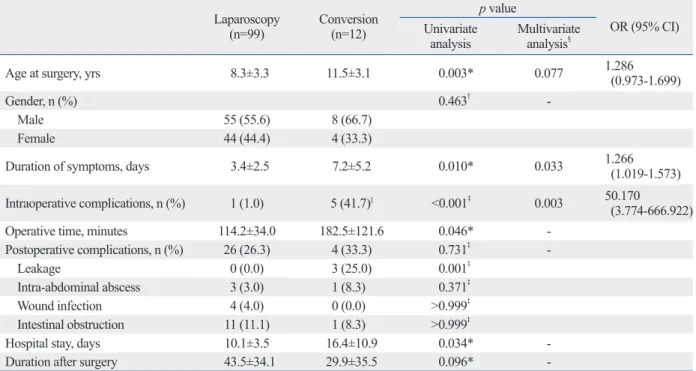
Factors associated with the conversion of laparoscopy to an open method are shown in Table 3. Multivariate analyses revealed that the preoperative duration of symptoms and the occurrence of intraoperative complications were associated with open conversion (p=0.033 for the duration of symptoms and p=0.003 for intraoperative complications). The incidence of postoperative complications did not differ between the laparoscopy and conversion groups, excluding a difference in the incidence of leakage [0.0% (0/99) in the laparoscopy group vs. 25.0% (3/12) in the conversion group; p=0.001].
DISCUSSION
As a surgical treatment modality for appendicitis, LA per- were treated by conservative management with drainage, to-
tal parenteral nutrition, and intravenous antibiotic treatment.
Surgery was repeated in only one patient in whom ligation of the appendiceal stump was impossible due to severe in- flammation during the initial open-converted surgery.
The incidence of long-term complications after the first month of follow-up did not differ between the two groups.
However, the long-term incidence of intestinal obstruction significantly differed between the two groups [0.0% (0/99) in the LA group vs. 4.6% (4/87) in the OA group; p=0.046].
Surgical management was indicated in two of these cases.
The mean duration of follow-up was longer in the OA group (84.0±36.8 months) than in the LA group (43.5±34.1 months;
p<0.001) because the majority of the OA group underwent surgery in the earlier study period.
Laparoscopic attempts were converted to OAs in 12 pa- tients [10.8% (12/111)] with peritonitis. Severe adhesion, the most common cause of open conversion, was noted in four patients [33.3% (4/12)]. Intraoperative complications, in- cluding disruption of the appendiceal stump during laparo- scopic ligation, mesenteric bleeding, or serosal tearing of the small bowel, were other causes of open conversion. Among the 12 open conversions in this study, three patients under-
Table 3. Factors Associated with Conversion of Laparoscopy to an Open Method Laparoscopy
(n=99) Conversion
(n=12)
p value
OR (95% CI) Univariate
analysis Multivariate analysis§
Age at surgery, yrs 8.3±3.3 11.5±3.1 0.003* 0.077 1.286
(0.973-1.699)
Gender, n (%) 0.463† -
Male 55 (55.6) 8 (66.7)
Female 44 (44.4) 4 (33.3)
Duration of symptoms, days 3.4±2.5 7.2±5.2 0.010* 0.033 1.266
(1.019-1.573) Intraoperative complications, n (%) 1 (1.0) 5 (41.7)|| <0.001‡ 0.003 50.170
(3.774-666.922)
Operative time, minutes 114.2±34.0 182.5±121.6 0.046* -
Postoperative complications, n (%) 26 (26.3) 4 (33.3) 0.731‡ -
Leakage 0 (0.0) 3 (25.0) 0.001‡
Intra-abdominal abscess 3 (3.0) 1 (8.3) 0.371‡
Wound infection 4 (4.0) 0 (0.0) >0.999‡
Intestinal obstruction 11 (11.1) 1 (8.3) >0.999‡
Hospital stay, days 10.1±3.5 16.4±10.9 0.034* -
Duration after surgery 43.5±34.1 29.9±35.5 0.096* -
OR, odds ratio; CI, confidence interval.
*Mann-Whitney U test.
†Pearson’s chi-square test.
‡Fisher’s exact test.
§Binary logistic regression.
||Two patients had intraoperative complications after open conversion.
the laparoscopic approach and lead to an initial consideration of open surgery. However, the limited working space was not a problem for appendectomy in most of the children with generalized peritonitis from perforated appendicitis in this study. The open conversion rate of our study (10.8%) is com- parable to those of previous studies reporting 4.1-39.1%.15-18 Considering that our study included severe forms of perfo- rated appendicitis, our results indicate the favorableness of a laparoscopic approach.
Although the conversion rate was low in this cohort with generalized peritonitis, bowel leakage was common among patients who required open conversion. Among the patients with generalized peritonitis from perforated appendicitis, severe adhesions and more advanced inflammatory chang- es around the operative field could be expected in patients in whom laparoscopic attempts failed and who required conversion to open surgery. If patients undergo conversion from laparoscopy to open appendectomy, they then should be managed carefully to prevent postoperative complica- tions such as leakage from bowel anastomoses.
This study had a few limitations. First, it was impossible to compare the use of antibiotics, duration of drainage, or start of oral feeding between the two groups because of the innate limitation of the retrospective design. In addition, the dura- tion of follow-up differed between the LA and OA groups.
The shorter mean duration of follow-up of the LA group may have resulted in underestimation of the incidence of long-term complications. Thus, a longer follow-up period could be required for the LA group to compare the long- term outcomes between the two groups. However, we be- lieve that the mean follow-up period of 43.5 months in the LA group was sufficient for estimating the incidence of postoperative complications.
The other limitation was the difference in disease severity between the LA and OA groups. To evaluate the outcomes of LA for children with generalized peritonitis from perfo- rated appendicitis, we included patients who underwent OA for perforated appendicitis with localized or generalized peritonitis in the control group. In contrast to the easy confir- mation of generalized peritonitis by laparoscopic findings in the LA group, OA may be inappropriate for evaluating the entire abdomen. Therefore, there were inevitable differences in disease severity between the two groups. However, the severity of morbidity in the LA group was equal to or more advanced than that in the OA group. Moreover, the outcomes of laparoscopy for generalized peritonitis were comparable to those of an open approach for perforated appendicitis.
mits easy and rapid localization of the appendix (regardless of its location), excellent control of hemostasis, exploration of the entire abdominal cavity, and complete lavage of the contaminated peritoneal cavity. Considering these advantag- es of laparoscopy, it was believed that the postoperative inci- dence of intra-abdominal abscess could be reduced using a laparoscopic approach for appendicitis.4 However, the inci- dence of intra-abdominal abscess in cases of complicated appendicitis was reported to be increased during laparosco- py compared to that for an open approach.2,3 There is a de- bate regarding the use of LA to treat perforated or complicat- ed appendicitis in children.5-7 In recent reports of complicated appendicitis in children, LA was considered the treatment of choice.8-13 To treat children with complicated appendicitis ac- companied by generalized peritonitis, the severely advanced form of complicated appendicitis, the only one prospective study comparing laparoscopy with an open method reported the superiority of laparoscopic treatment; however, only a small number (n=12) of patients were treated with laparosco- py in this study.14 Therefore, to our best knowledge, the pres- ent study is the largest to examine treatments for generalized peritonitis in children with appendicitis.
In the present study, the outcomes of the LA group were similar to or better than those of the OA group. Intraopera- tive and postoperative complications of the LA group oc- curred at an acceptable frequency. Among them, wound in- fection and long-term intestinal obstruction occurred less frequently in the LA group. We believe that these complica- tions could be reduced by the innate characteristics of lapa- roscopy, that is, a minimal incision, compared to extended laparotomy for the treatment of complicated appendicitis.
Another factor reducing the incidence of long-term intesti- nal obstruction in our study was thorough irrigation under direct vision of the entire abdominal cavity in the LA group, in contrast to sponge stick sweeps and irrigation with a lim- ited view in the OA group. We attempted meticulous irriga- tion using a magnified, laparoscopic view by cleaning the entire abdominal cavity, including both paracolic gutters, pelvic cavity, perihepatic space, splenic fossa, and most of the intermesenteric spaces in most patients of the LA group.
Those careful and meticulous irrigations may have partly contributed to the longer operative time in the LA group.
Our study also found a low rate of conversion from lapa- roscopy to an open approach. Technical limitations can be expected from the small working space and diffuse adhe- sions during laparoscopy in children with peritonitis second- ary to perforated appendicitis, which could limit the use of
proach for children presenting with simple or complicated appen- dicitis. Am J Surg 2006;192:750-5.
8. Menezes M, Das L, Alagtal M, Haroun J, Puri P. Laparoscopic ap- pendectomy is recommended for the treatment of complicated ap- pendicitis in children. Pediatr Surg Int 2008;24:303-5.
9. Taqi E, Al Hadher S, Ryckman J, Su W, Aspirot A, Puligandla P, et al. Outcome of laparoscopic appendectomy for perforated ap- pendicitis in children. J Pediatr Surg 2008;43:893-5.
10. Wang X, Zhang W, Yang X, Shao J, Zhou X, Yuan J. Complicated appendicitis in children: is laparoscopic appendectomy appropri- ate? A comparative study with the open appendectomy--our expe- rience. J Pediatr Surg 2009;44:1924-7.
11. Lee SL, Yaghoubian A, Kaji A. Laparoscopic vs open appendec- tomy in children: outcomes comparison based on age, sex, and perforation status. Arch Surg 2011;146:1118-21.
12. Masoomi H, Mills S, Dolich MO, Ketana N, Carmichael JC, Nguyen NT, et al. Comparison of outcomes of laparoscopic versus open appendectomy in children: data from the Nationwide Inpa- tient Sample (NIS), 2006-2008. World J Surg 2012;36:573-8.
13. Nataraja RM, Teague WJ, Galea J, Moore L, Haddad MJ, Tsang T, et al. Comparison of intraabdominal abscess formation after lapa- roscopic and open appendicectomies in children. J Pediatr Surg 2012;47:317-21.
14. Miyano G, Okazaki T, Kato Y, Marusasa T, Takahashi T, Lane GJ, et al. Open versus laparoscopic treatment for pan-peritonitis sec- ondary to perforated appendicitis in children: a prospective analy- sis. J Laparoendosc Adv Surg Tech A 2010;20:655-7.
15. Liu SI, Siewert B, Raptopoulos V, Hodin RA. Factors associated with conversion to laparotomy in patients undergoing laparoscopic appendectomy. J Am Coll Surg 2002;194:298-305.
16. Mancini GJ, Mancini ML, Nelson HS Jr. Efficacy of laparoscopic appendectomy in appendicitis with peritonitis. Am Surg 2005;71:
17. Pokala N, Sadhasivam S, Kiran RP, Parithivel V. Complicated ap-1-4.
pendicitis--is the laparoscopic approach appropriate? A compara- tive study with the open approach: outcome in a community hos- pital setting. Am Surg 2007;73:737-41.
18. Garg CP, Vaidya BB, Chengalath MM. Efficacy of laparoscopy in complicated appendicitis. Int J Surg 2009;7:250-2.
In this study, the outcomes of the LA group for general- ized peritonitis were comparable or superior to those of the OA group for perforated appendicitis with localized or gen- eralized peritonitis. LA was a safe and useful technique for treating children with generalized peritonitis secondary to perforated appendicitis that decreased the incidence of post- operative wound infections and long-term intestinal obstruc- tion. To reduce the incidence of wound infection and long- term intestinal obstruction, LA should be attempted in all children suspected of having generalized peritonitis from perforated appendicitis.
REFERENCES
1. Morrow SE, Newman KD. Current management of appendicitis.
Semin Pediatr Surg 2007;16:34-40.
2. Horwitz JR, Custer MD, May BH, Mehall JR, Lally KP. Should laparoscopic appendectomy be avoided for complicated appendi- citis in children? J Pediatr Surg 1997;32:1601-3.
3. Krisher SL, Browne A, Dibbins A, Tkacz N, Curci M. Intra-ab- dominal abscess after laparoscopic appendectomy for perforated appendicitis. Arch Surg 2001;136:438-41.
4. el Ghoneimi A, Valla JS, Limonne B, Valla V, Montupet P, Chavr- ier Y, et al. Laparoscopic appendectomy in children: report of 1,379 cases. J Pediatr Surg 1994;29:786-9.
5. Meguerditchian AN, Prasil P, Cloutier R, Leclerc S, Péloquin J, Roy G. Laparoscopic appendectomy in children: a favorable alter- native in simple and complicated appendicitis. J Pediatr Surg 2002;37:695-8.
6. Ikeda H, Ishimaru Y, Takayasu H, Okamura K, Kisaki Y, Fujino J.
Laparoscopic versus open appendectomy in children with uncom- plicated and complicated appendicitis. J Pediatr Surg 2004;39:
1680-5.
7. Partrick DA. Prospective evaluation of a primary laparoscopic ap-