Korean J ournal of S oil S cience and F ertilizer
Article https://doi.org/10.7745/KJSSF.2017.50.5.462
pISSN : 0367-6315 eISSN : 2288-2162
Specification Scheme of Pig Liquid Manure as Organic Agricultural Substances Used for Organic Farming
Il-Hwan Seo, Kyo-Suk Lee, Ja-Hyun Rhie, Se-Won Min, and Doug-Young Chung*
Department of Bio-environmental Chemistry, Collage of Agriculture and Life Science, Chungnam National University, Daejeon 34134, Korea
*Corresponding author: [email protected]
A B S T R A C T Received: August 7, 2017
Revised: November 3, 2017 Accepted: November 6, 2017
A more efficient use of nutrients from organic sources can benefit both farmers and water quality in agriculture.
In this paper we reviewed information related to the regulations and guidelines of a swine liquid fertilizer to propose an establishment scheme for the official standards of swine manure slurry as a liquid fertilizer for organic farming. According to the law of establishment and designation of official standard of fertilizers, the liquid fertilizer made with pig liquid manure belongs to the byproduct fertilizer as of one of organic fertilizer.
However, the official standards for byproduct fertilizers including the liquid fertilizer set by the Rural Development Administration (RDA), especially for a liquid swine manure fertilizer, should be revised to meet the goals of laws pursuing the environmentally sound agriculture, especially for organic farming because the terms and relevant standards need additional specific standards alike the standards such as impurities and parameter for declaration in EU. Therefore, it is suggested that official standards for byproduct fertilizers should be revised with respect to nutrient, salt content as of SAR and Na content instead of NaCl. Also we need to develop the maximum limit of heavy metals in soil to which the liquid fertilizer can be applied, as well as application rate depending on EC of the liquid fertilizer.
Keywords: Liquid swine manure, Organic Agricultural Substances, Organic Farming, Heavy metals
Proposed standard for the quality of a pig slurry manure fertilizer.
Factor Evaluation Unit Remarks
Fertility
Nitrogen (N)
Total
(%) as liquid (to be decided after field test) Soluble
Organic Phosphorus (P) Total
Soluble Potassium (K)
Toxicity
Heavy metal (mg kg-1) Limit value: As (5), Hg (0.2), Cd (0.5), Pb (15), Cr (30), Cu (50), Zn (130), Ni (5)
PAH (s) Not detected
Pathogens No pathogenic microorganism
Homogeneity
pH (1:5) less than 7.3
EC (1:5) (dS m-1) Salinity; less than 4
Na (mg L-1) Soil physical property (to be decided after field test) Cl Crop tolerance (to be decided after field test) Organic matter
(%) Fertility (to be decided after field test) Ignition loss Impurity; less than 0.5
Others - Volatile fatty acid (0.43 g COD g-1 VS)
Ⓒ The Korean Society of Soil Science and Fertilizer. This is an Open Access article distributed under the terms of the Creative Commons Attribution Non- Commercial License (http://creativecommons.org/licenses/by-nc/4.0) which permits unrestricted non-commercial use, distribution, and reproduction in any medium, provided the original work is properly cited.
Introduction
정부는 유기농축산물 인증농장 및 경축순환농법으로 유래한 것만 사용가능토록 되어 있던 가축분뇨 퇴 ․ 액비의 재 활용 확대를 위하여 자연순환농업 등 다양한 사업을 추진하고 있어 퇴비의 경우 일정한 규격을 충족할 경우 유기농업 자재로 사용이 가능하게 되었다 (KOSIS, 2014). 그리고 2007년 환경보전 및 안전농산물 생산과 유기농업 실천농가 의 자재 선택 편의 제공을 위해 유기농업자재 공시 등 인증제도 도입한 후 현재 유기질비료, 부숙유기질비료, 미생물 제 등 약 5천억 원의 시장을 형성하고 있다. 그러나 농촌진흥청고시 비료공정규격설정 및 지정에서는 액비의 품질기 준을 비료성분과 유해성분 중심으로만 지정 ․ 관리하고 있어, 향후 돈분액비를 포함한 가축분뇨 액비의 이용을 확대 하기 위해서는 최소한의 품질관리 기준 설정과 같은 현실적인 방안이 필요하다 (Chung, 2015).
가축분은 긍정적인 면과 부정적인 요소를 동시에 지니고 있다. 발효과정을 거쳐 생산된 퇴비나 발효시킨 가축분뇨 액비를 농경지에 환원하면 유기물 및 양분공급원 역할을 하고 한편 가축분뇨액비는 고형분함량이 낮으나 수용성상태 의 질소와 인, 칼리 등이 쉽게 식물체가 흡수할 수 있어 양분이용 효율이 높다 (Jeon et al., 2012, 2013). 그러나 가축분 뇨액비의 과다 시용은 수질오염의 원인으로 작용하기도 한다 (Ra, 2013). 지금까지 정부의 주요 시책을 보면 친환경 농어업 육성 및 유기식품 등의 관리지원에 관한 법률을 제정하여 가축분뇨의 처리를 위한 자원화 지원, 양질의 퇴 ․ 액 비를 사용토록하기 위한 비료공정규격 개선, 가축분뇨 퇴 ․ 액비 원활한 유통을 위한 제도를 개선하였으나 (MAFRA, 2014; RDA, 2014), 이는 대부분 퇴비에 한정되어 있고, 액비의 경우에는 유기농업자재로 인정되지 않아 시범포 활용 등 제한적으로 활용되고 있다.
따라서 축산분뇨 해결을 위하여 범정부적 대책의 필요성이 대두되어 농림축산식품부와 환경부는 가축분뇨 공동자 원화시설 및 의 가축분뇨 공공처리시설 사업 등을 추진하고 있으나 생산된 액비의 자원 재활용을 위한 대책은 미미한 실정이다 (Lee et al., 2009). 현행 유기농업을 영위하는 과정에서 사용되고 있는 유기농업자재의 현황과 허용기준을 조사하여, 가축분뇨 액비규정을 제정하여 늘어나고 있는 가축분뇨의 재활용을 확대하여 환경오염 방지 및 축산농가 의 가축분뇨 처리에 대한 부담을 경감하기 위하여 방안이 필요하다. 따라서 본 논문은 가축분뇨 액비에 대한 관련법인 친환경농어업법 시행규칙 제2호 다목 제5항이 삭제됨에 따라 1)가축분뇨의 관리 및 이용에 관한 법률, 2)비료관리법, 그리고 3)친환경농어업 육성 및 유기식품 등의 관리 ․ 이용에 관한 법률 등을 종합 비교하여 가축분뇨 중 돈분뇨를 유 기농자재로재활용하기 위한 항생물질 및 유해미생물 함유여부, 유해 중금속의 허용기준 등의 허용기준 설정 방안에 대하여 조사하였다.
Present status of utilization of animal manure as a organic fertilizer 가축분뇨를 이용한 퇴비 및 액비를 이 용한 자연 순환 농업을 촉진하기 위하여 다양한 사업이 진행하고 있음에도 불구하고 농산물 재배 시 가축분뇨 액비의 사용이 매우 제한적이다. 가축분뇨 중 퇴비의 경우에는 정부의 농림축산 부산물의 자원화를 촉진하고 토양 비옥도 증 진 및 토양환경 보전을 통해 지속가능한 친환경 농업 육성을 위하여 정부 및 지방자치단체에서 매년 보조금이 지원되 고 있다 (RDA, 2015, 2016). 또한 일정한 기준을 설정하여 그 기준에 적합하면 유기농업자재로서도 사용이 가능하도 록 돼있으나 돈분을 이용한 액비의 경우 이러한 기준에서 제외돼 있어 자원활성화가 어려운 실정이다 (Ra, 2013).
비료의 품질을 보전하고 원활한 수급과 가격안정을 통하여 농업생산력을 유지하고 증진시키며 농업환경을 보호함 을 목적으로 법률 제13135호로 비료관리법을 제정하였다 (RDA, 2015). 이에 따른 비료관리법은 비료, 보통비료와 부산물비료의 정의, 공정규격, 보증 성분 등에 대한 의미를 정의하고 있다. 현재 친환경농어업유기식품 등의 관리, 지
원에 관한법률 시행규칙 별표3 제2호다목5항에 따르면 (Table 1) 가축분뇨를 원료로 하는 퇴비와 액비(이하 “가축분 뇨 퇴 ․ 액비라 한다)는 유기축산물 ․ 무항생제축산물 인증 농장 및 경축순환농법으로 사육한 농장에서 유래한 것만 사 용할 수 있으며, 완전히 부숙시켜서 사용하되, 과다한 사용, 유실 및 용탈 등으로 인하여 환경오염을 유발하지 아니하 도록 하여야 한다 (MAFRA, 2014). 그러나 가축분뇨 퇴비의 경우 일정 조건을 갖추면 사용가능하다는 조항이 있어 사용이 가능하지만 액비의 경우 이러한 조항에서 제외돼 있다. 따라서 Lee et al. (2016)이 제시한 것처럼, 우리나라 축 산산업의 현황을 파악하여 가축분 액비에 대하여도 사용가능 조건 등을 검토하여 양질의 유기농업자재로서의 요건을 갖춘 액비로서 활용방안이 마련하여야 한다.
Fertilizer management law set by RDA and the types of byproduct fertilizers 농촌진흥청 고시 제2016- 26호에 따르면 비료관리법 제4조제1항 ․ 제2항 ․ 제4항 및 같은 법 시행규칙 제3조에 따라 보통비료 공정규격의 설정 ․
변경 ․ 폐지 또는 부산물비료의 지정 ․ 폐지에 관하여 필요한 사항을 정함을 목적으로 비료 공정규격설정 및 지정을 고 시하였다 (RDA, 2016). 비료 공정규격설정 및 지정 고시에서는 비료의 구분, 보통비료와 부산물비료의 지정, 비료의 성분과 원료 등을 정하고 있다 (RDA, 2016).
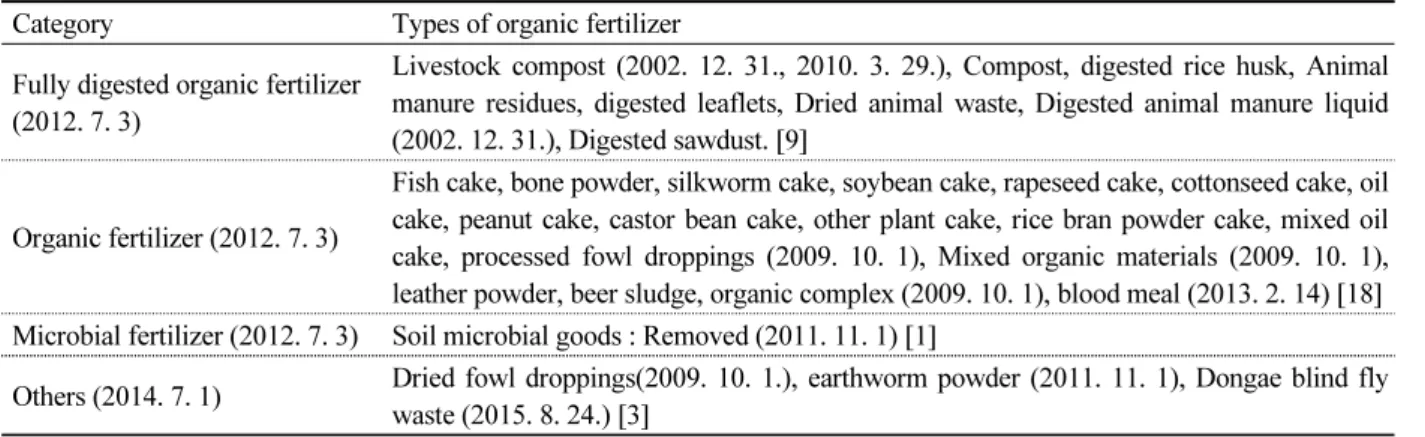
비료공정규격에서는 비료는 성분을 보증하는 보통비료와 유기물 등 부산물을 원료로 하는 부산물비료로 분류한 다. 이 중 유기질비료가 속한 부산물비료는 “농업, 임업, 수산업, 제조업 또는 판매업을 영위하는 과정에서 나온 부산 물, 사람의 분뇨, 음식물류폐기물, 토양미생물제 등을 이용하여 제조한 비료로서 농림축산식품부장관이 지정하는 것 을 말한다.”로 되어 있으며 가축분액비는 부산물비료에 속한다. 부산물비료의 종류는 가축분퇴비, 가축분뇨발효액, 유기질비료, 미생물제 등 31종이 지정되어 있다 (Table 2).
Table 2. Types of organic fertilizer according to Article 4-Section 1, 2, and 4 of the fertilizer management law set by RDA.
Category Types of organic fertilizer
Fully digested organic fertilizer (2012. 7. 3)
Livestock compost (2002. 12. 31., 2010. 3. 29.), Compost, digested rice husk, Animal manure residues, digested leaflets, Dried animal waste, Digested animal manure liquid (2002. 12. 31.), Digested sawdust. [9]
Organic fertilizer (2012. 7. 3)
Fish cake, bone powder, silkworm cake, soybean cake, rapeseed cake, cottonseed cake, oil cake, peanut cake, castor bean cake, other plant cake, rice bran powder cake, mixed oil cake, processed fowl droppings (2009. 10. 1), Mixed organic materials (2009. 10. 1), leather powder, beer sludge, organic complex (2009. 10. 1), blood meal (2013. 2. 14) [18]
Microbial fertilizer (2012. 7. 3) Soil microbial goods : Removed (2011. 11. 1) [1]
Others (2014. 7. 1) Dried fowl droppings(2009. 10. 1.), earthworm powder (2011. 11. 1), Dongae blind fly waste (2015. 8. 24.) [3]
[ ] indicates the number of fertilizers developed.
Table 1. Definition of the composted organic fertilizer by Enforcement rule of Article 2-Act Da-Section 5 related to Environmentally sound organic foods.
Revised
5) Meaning of compost and digested liquid which use only animal manure as source is that materials produced from organically growing livestock farm that do not use any of antibiotics or recycling agriculture, and those should be completely digested. Also they do cause any environmental problem due to excessive uses, loss, and leaching. But the compost and digested liquid produced from the farm besides the farms mentioned above should qualify the following terms and conditions.
Reasons Any of requirement can be needed because the standards for organic materials as fertilizer is deleted from the regulations.
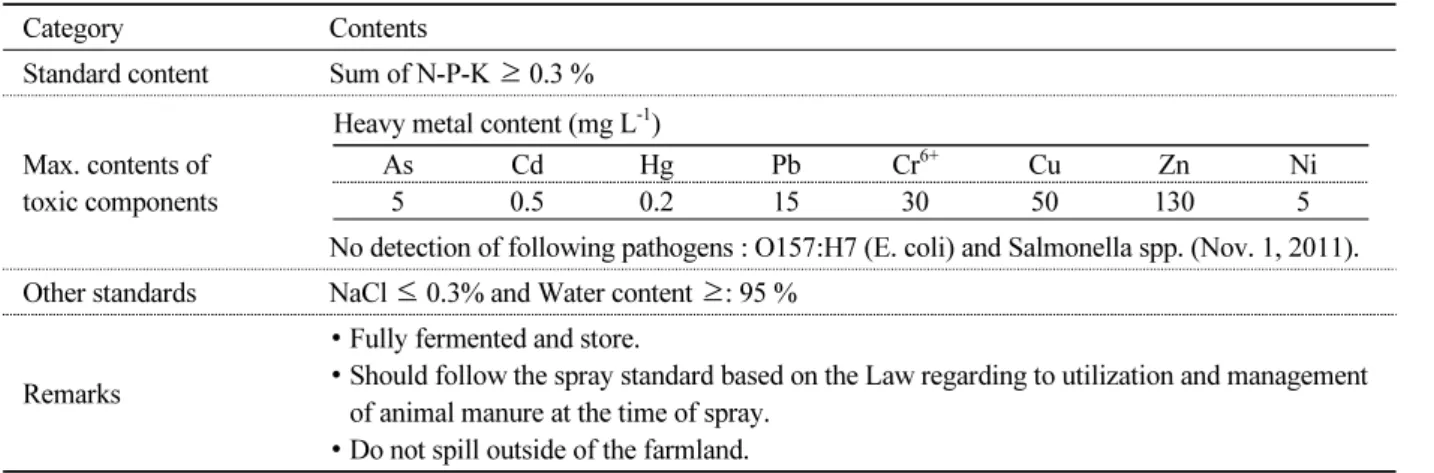
Definition and criteria for the digested liquid fertilizer of animal manure 가축분뇨의 관리 및 이용에 관한 법률에 규정되어 있는 가축분뇨액비의 정의는 가축의 사육과정에서 배출되는 분뇨 및 청소수의 혼합물 또는 기타 가 축분뇨 처리과정 (혐기발효 폐액, 속성발효 액상분뇨)에서 발생되는 물질을 비료로 활용할 목적으로 수집, 저장하고 일정기간 부숙시켜 병원성 미생물, 충란, 잡초종자 사멸, 이분해성 물질 분해 등의 과정을 거친 위생과 경종측면에서 안정화된 액상물질로서 농림축산식품부령으로 정하는 기준에 적합한 것을 말한다 (Table 3). 그리고 가축분뇨의 자 원화 및 이용 촉진에 관한 규칙 제2조 제6호에서 “농림축산식품부령이 정하는 기준”이란 비료관리법 제2조제4호에 따라 고시한 비료공정규격 중 가축분뇨발효비료(액)의 공정규격을 말한다. 다만, 질소전량의 최소함유량은 0.1퍼센 트 이상이어야 한다고 규정하고 있다.
가축분뇨의 관리 및 이용에 관한법률 (이하 가축분뇨법) 제13조의 2에서 “자원화시설의 퇴비화 또는 액비화의 기 준은 대통령령으로 정한다”라고 규정하고 있다 (MAFRA, 2014). 다만, 비료관리법에 따른 퇴비 또는 액비는 같은 법 제2조제4호에 따라 고시한 비료공정규격 중 퇴비 또는 액비의 공정규격에 적합하여야 한다고 규정하고 있다. 가축분 뇨발효액의 공정 규격 중 부산물비료 중 부숙유기질비료의 규격의 함량, 함유할 수 있는 유해성분의 최대량, 그리고 그 밖의 규격으로 구성돼 있다. 한편 이러한 규격 외에 충분한 발효 시까지 저장, 살포할 경우에는 가축분뇨의 관리 및 이용에 관한 법률 시행규칙 제13조 별표 4 액비의 살포기준에 따라 살포하여야 한다 (Table 4). 이때 살포하는 액비는 농경지 밖으로 유출을 금지하고 있다 (RDA, 2014).
Table 3. Legal statute and its relative content about the digested liquid fertilizer.
Legal statute Content
Law regarding to utilization and management of animal manure [Enforcement Mar. 2015.
as law 12516 (Mar. 2014), Partial revision]
Article 2 (Definition)
6. Liquid fertilizer means that substance is the liquid phase of digested animal manure containing nutrients and should be meet the standards set by Ministry of Agriculture, Food and Rural Affairs (MAFRA).
Law regarding to utilization and management of animal manure [Enforcement Jan. 2014 as an ordinance of MAFRA 67, Dec. 2013]
Article 3 (Digested liquid fertilizer)
The standards set by MAFRA based on the Article 2 No. 6 mean an official standard of digested (liquid) animal manure fertilizer based on the article 2-No. 4 on law of management of fertilizer. But the total nitrogen content should be 0.1 % or greater. (Revision Mar. 2013).
Table 4. The official standards of digested liquid fertilizer made with the animal manure as byproduct fertilizers.
Category Contents
Standard content Sum of N-P-K ≥ 0.3 %
Max. contents of toxic components
As Cd Hg Pb Cr6+ Cu Zn Ni
5 0.5 0.2 15 30 50 130 5
Heavy metal content (mg L-1)
No detection of following pathogens : O157:H7 (E. coli) and Salmonella spp. (Nov. 1, 2011).
Other standards NaCl ≤ 0.3% and Water content ≥: 95 %
Remarks
∙ Fully fermented and store.
∙ Should follow the spray standard based on the Law regarding to utilization and management of animal manure at the time of spray.
∙ Do not spill outside of the farmland.
Foreign laws relevant to criteria and ranges of contents 미국과 Federal Research Station of Liebefeld (FAC)에 근거한 유럽국가의 유기질 비료와 관련한 법적기준을 설정하는 기본 조건은 중금속 허용수준 (Heavy metal allowable levels), 물리적 구성요소와 비활성 오염 (Physical composition and inert contamination), 병원성 세균과 식물병원 (Pathogenic bacteriology and phytopathogens), 가능유해물질 (Potentially Toxic Elements, PTE’s), 완숙 도와 식물성장성 (Maturity and plant growth performance)를 근거로 한다 (ANNEXES, 2008; FAC, 1995). 유기액 비기준과 관련하여 2014년 이전의 규정과 유기질비료산업유럽협회 (ECOFI, European Consortium of the Organic- Based Fertilizer Industry) 2014년 이후 제정한 유기액비의 기준을 살펴보면 2014년 이전은 유기탄소 함량은 3% 이 상이었으나 제시안은 5% 이상으로 그리고 제시안에서는 유기태 질소량(Norg)을 2% 이상으로 규정하고 있다 (Table 5). 따라서 국내 기준은 병원성 세균과 식물병원균은 국외 기준과 큰 차이가 없으나 가능유해물질의 경우 축산 현장에 서 사용하고 있는 살충제, 살균제, 그리고 항생물질을 다시 조사하여 독성이나 위해등급을 평가하여 추가 보완하여야 할 것으로 판단한다.
Table 5. Proposals and previous criteria for quality and safety for the liquid type organic fertilizers by ECOFI in 2014.
Category DM† OC‡ Ntot Norg P2O5 K2O Pathogens OP§
--- (%) --- Salmonella spp E. coli PAHs
Previous No min. 3 ≤ 2 ≤ No limit 2 ≤ 2 ≤ None in 25 g
sample
1000 CFU g-1
6 mg kg-1
Proposed No min. 5 ≤ 2 ≤ 2 ≤ 1 ≤ 2 ≤ Same as above
†Dry matter; ‡Organic carbon; §Org. pollutant.
Table 6, 7은 스위스와 독일의 혐기성기성소화과정으로 제조한 액상비료의 품질기준으로 스위스의 액비기준은 최 소품질기준, 중금속 함량 (납 등 7항목), 생체이물질 (Xenobiotic compound), 위생 (최소 부숙 온도 및 기간), 질산태 와 아질산태 외에 2012년에 추가로 기준을 설정한 암모늄태 질소와 최소 질소함량기준 등으로 구성돼 있다 (ACSP, 2001). 독일의 혐기소화액 품질 기준을 살펴보면 (Table 7) 위생, 불순물, 부숙도, 악취, 유기물 함량, 7종의 중금속 함 량 (비소 제외), 보증 계수 (Parameter for declaration)로 7개 항목으로 구분하고 있다 (Wheeler, 1999; Stefanie, 2009).
그리고 영국의 혐기소화액 품질기준 (PAS110:2010)을 살펴보면 병원성미생물, 유해물질 (중금속 7종), 안정도 (휘발 성 지방산, 잠재 생물학적 가스), 물리성 (돌과 유리 조각 등), 비료 기준 (pH, 총질소, 총인, 총칼리, 암모늄태 질소, 수 용성 염소와 나트륨, 건조중, 감열감량, 실질적 유해물질 함량) 등에 대하여 기준을 설정하고 있다 (ANNEX 2, 2004).
Table 6. Quality guidelines for compost and anaerobically digested liquid manure in Swiss.
Criteria Liquid digestate
Minimum quality Fulfilled according to minimum quality (FAC, 1995)
Heavy metal < Osubst limits
Hygiene Complies with minimal quality requirements according to FAC (1995) with temperature protocol Impurities Complies with minimal quality requirements according to FAC (1995)
Decomposition -
NH4+-N
(g kg-1 TS) > 3
N min. > 3
그리고 위생의 경우 국내에서는 대장균속과 살모넬라가 불검출로 규정하고 있으나 유럽의 경우 FAC에서 규정한대 로 특정온도 (55°C와 65°C)에서 부숙 기간 (1주 또는 3주)이나 이와 동등한 위생처리 과정의 준수하였는가에 여부를 대하여 요구하고 있다. 또한 스위스의 경우도 부숙 온도와 부숙 기간에 따른 최소 기준을 정하고 있다 (ECOFI, 2014).
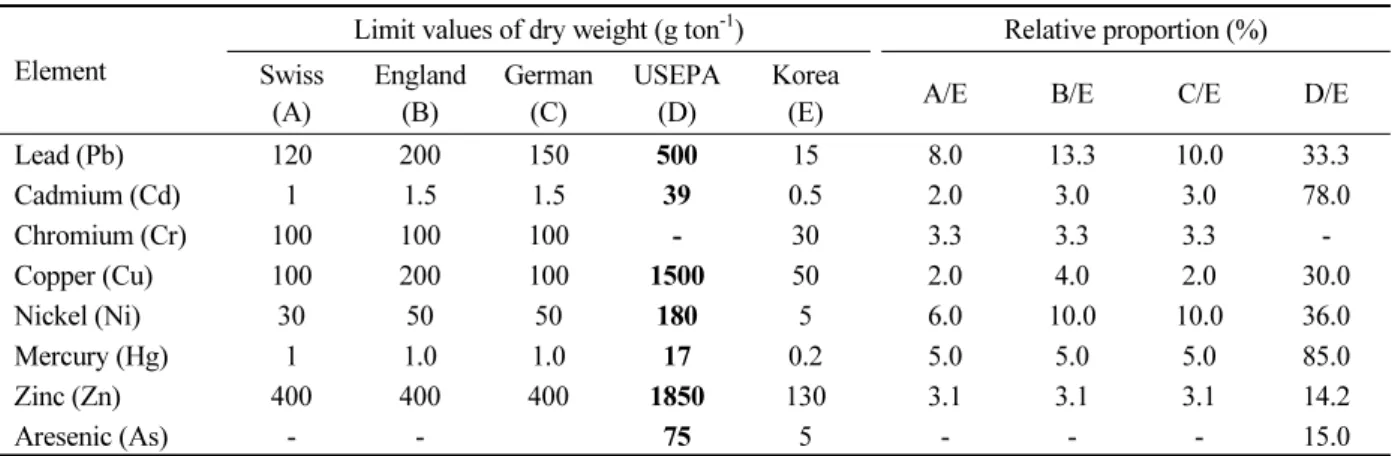
중금속 함량기준을 살펴보면 한국과 미국은 비소를 포함하여 총 8개 항목을 규정하고 있으나 유럽국가의 경우는 비소를 제외한 7개 항목에 대해 기준을 설정하고 있다 (Table 8). 중금속 허용기준치를 비교하여 보면 미국의 기준치 가 가장 높으며 스위스, 독일, 영국의 기준은 유사하다. 이와 같이 유럽의 대부분 국가들의 중금속 허용치 기준은 국내 기준보다 매우 높은 것으로 조사되었다. 이외에 유럽국가 연합은 유럽국가간 거래 등에 적용하기 위한 EU-Eco level 을 정하여 사용하고 있다 (Table 9). 그리고 미국의 기준은 크롬을 제외한 7개 항목 (납, 카드뮴, 구리, 니켈, 수은, 아연, 비소)에 대한 최대치를 정하고 있으며 별도로 주마다 각각의 기준을 설정하여 관리하고 있다 (William, 2000;
Lawrence and Smith, 2002).
Table 7. Quality standard for anaerobically digested liquid fertilizer from biowaste (RAL GZ 245).
Quality Criteria Quality requirements
Hygienic aspects
∙ Proof for successful treatment for sanitization (heating of the input material to 70°C for at least 1 hour or input-output control)
∙ Proof of compliance with the hygienic requirements by temperature profiles (monitoring the process temperature)
∙ Max. of 2 germinable weeds and sprouting plant parts per liter
∙ Salmonella not traceable
Impurities
∙ Max. 0,5 M.% dm selection and weighing of impurities (glass, plastics and metals > 2 mm
∙ With an impurity content > 0,1 M.-% dm: max. area sum of the selected impurities shall not exceed 25 cm2 L-1
Degree of fermentation Organic acids (total) ≤ 4.000 mg L-1
Odour Free from annoying odors
Organic Matter Min. 30 M.-% dm, determined by loss on ignition Heavy metal content
(Pb, Cd, Cr, Cu, Ni, Hg, Zn)
∙ Limit values correspond to the waste and fertilizer legislation
∙ Micronutrient (Cu, Zn) plausible value should not be exceed.
Parameter for declaration
Product type (digestate product liquid or solid), Name of producer, Bulk density (volume weight), Dry matter content, pH-value, Salt content, Plant nutrients (total) (N, P2O5, K2O, MgO, S), Nitrogen soluble (NH4-N; NO3-N), Micro-nutrients (according to fertilizer legislation), Organic matter, Alkaline effective matter (CaO), Benefit value index,
Table 8. Heavy metal concentration limit values for digestate from biodegradable waste management (Osubst Annex 4.5).
Element
Limit values of dry weight (g ton-1) Relative proportion (%) Swiss
(A)
England (B)
German (C)
USEPA (D)
Korea
(E) A/E B/E C/E D/E
Lead (Pb) 120 200 150 500 15 8.0 13.3 10.0 33.3
Cadmium (Cd) 1 1.5 1.5 39 0.5 2.0 3.0 3.0 78.0
Chromium (Cr) 100 100 100 - 30 3.3 3.3 3.3 -
Copper (Cu) 100 200 100 1500 50 2.0 4.0 2.0 30.0
Nickel (Ni) 30 50 50 180 5 6.0 10.0 10.0 36.0
Mercury (Hg) 1 1.0 1.0 17 0.2 5.0 5.0 5.0 85.0
Zinc (Zn) 400 400 400 1850 130 3.1 3.1 3.1 14.2
Aresenic (As) - - 75 5 - - - 15.0
한편 스위스, 영국 독일, 그리고 미국의 중금속 허용기준치를 한국과 비교하여 보면 스위스의 경우 구리가 한국기 준보다 약 2배정도 높았으며 미국의 기준은 카드뮴과 수은이 78배와 85배로 높은 것으로 조사되었다 (BSI, 2010). 그 러나 유럽 국가들은 현행 중금속 기준함량이 높다고 판단되어 현재의 기준보다 낮은 농도의 수준으로 중금속 기준을 수정하려고 준비 중이며 네덜란드의 경우 비소를 규제 항목에 추가하였다 (ECOFI, 2014). 따라서 현재 국내 퇴비나 액비 중금속 기준이 유럽이나 미국 기준보다 높아 액비를 활용도를 높이기 위하여 액비 중금속함량 기준을 검토할 필 요가 있다고 판단된다.
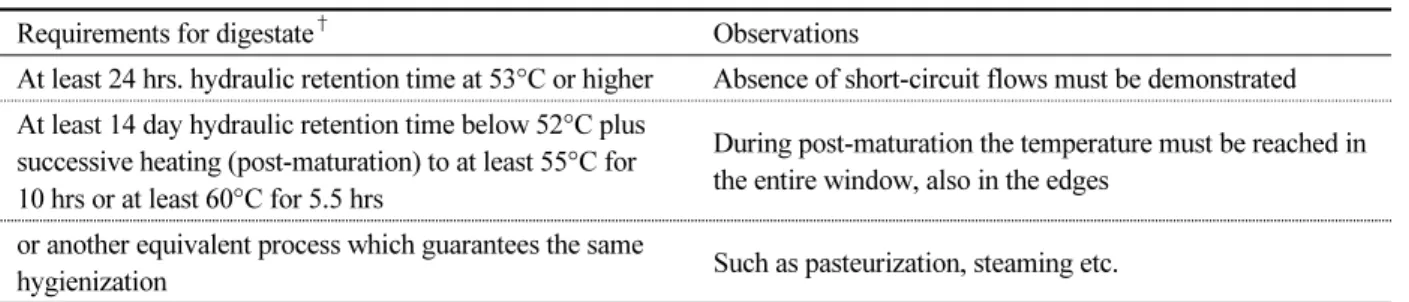
위생과 관련한 내용으로는 액비 준비 과정 중 유해미생물 살균 또는 사멸에 대한 기준으로 덴마크와 스웨덴에서 적 용하고 있는 처리기준과 방법에 준하여 처리시간과 온도에 대하여 규정하고 있다 (Table 10).
Table 10. Hygienization requirements for digestate from biodegradable waste management.
Requirements for digestate† Observations
At least 24 hrs. hydraulic retention time at 53°C or higher Absence of short-circuit flows must be demonstrated At least 14 day hydraulic retention time below 52°C plus
successive heating (post-maturation) to at least 55°C for 10 hrs or at least 60°C for 5.5 hrs
During post-maturation the temperature must be reached in the entire window, also in the edges
or another equivalent process which guarantees the same
hygienization Such as pasteurization, steaming etc.
†The requirement are based on the Danish (Statutory Order. Ministry of Environment & Energy) and Swedish (RVF-Quality Assurance System) guidelines.
그리고 유럽국가 들의 대부분은 토양에 함유된 중금속 함량을 기준하여 퇴비와 액비의 처리 수준을 제한하거나 금 하고 있다. 예로 독일의 경우 토성별 중금속 함량을 기준하고 있으며 네덜란드는 점토와 부식함량으로 그리고 이태리, 스위스, 그리고 캐나다는 단순 토양 내 중금속 함량으로 기준을 설정하고 있다 (Table 11). Canadian Food Inspection Agency (2011)가 제시한 농경지 토양 내 최대 중금속 허용기준과 비교하여 보면 구리와 크롬에 대한 기준은 없으며
Table 9. Programs or countries with proposed new or reduced concentration limits for metals in EU-eco label.
Element EEC
Organic Rule‡
EU-
Eco-Label B-Agr† NL 1§ NL 2¶ CH UK∮
Arsenic - - - 25 15 -
Cadmium 0.7 1.0 1 1 0.7 3 1.5
Chromium 70 50 70 50 50 150 100
Copper 70 100 90 60 25 150 200
Lead 45 100 120 100 65 150 150
Mercury 0.4 1.0 1 0.3 0.2 3 1
Nickel 25 505 20 20 10 50 50
Zinc 200 200 280 200 75 500 400
†Country Codes: B Belgium; NL Netherlands; CH Switzerland; Agr Agriculture.
‡EEC Organic Rule ls #2092/91 Brussels.
§Quality Class A.
¶Class B and EU-Eco-Label.
∮UK Compost Association (CAS2).
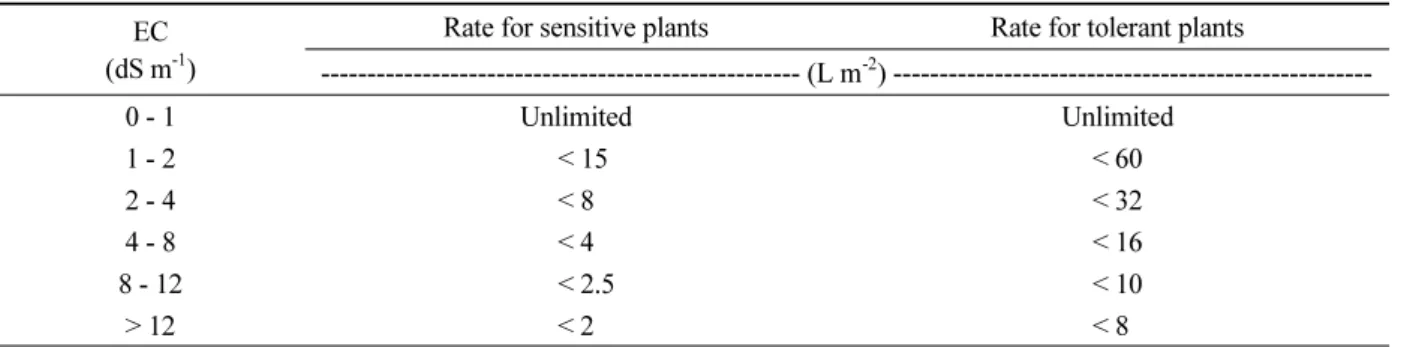
카드뮴과 납의 기준은 독일, 네덜란드, 이태리 등의 국가 기준보다 높으나 니켈은 독일의 점토토양 기준보다 낮은 수 준이다. 한편 캐나다 한편 미국의 경우 액비와 관련한 최대 처리량 기준은 없으나 퇴비의 경우 EC를 기준한 퇴비의 염 류 수준에 따라 민감한 작물과 내염성 작물로 구분하여 표층 5 cm를 기준한 처리 수준 (L m-2)을 제시하고 있다 (Table 12). 예로 퇴비의 EC가 0~1 dS m-1일 경우 토양에 처리하는 수준을 제한하지 않으나 EC 값이 증가할수록 처리량이 감소하여 EC 값이 12 dS m-1일 이상일 경우 민감한 작물은 m2당 2리터 이하로 그리고 내염성 작물의 경우 ㎡당 8리터 이하로 처리 수준을 제한하고 있다 (William, 2000).
Table 11. Absolute soil metal concentrations, based on soil type, over which applications of composts and liquid fertilizer are restricted or forbidden.
Country Soil Type Cd Pb Cr Cu Hg Ni Zn
--- (mg kg-1) ---
Canada† 4 100 ** ** 1 36 370
Germany
Clay 1.5 100 100 60 1 70 200
Silt 1 70 60 40 0.5 50 150
Sand 0.4 40 30 20 0.1 15 60
Holland‡ 0.4 + 7 × 10⁻³
× (T+3H) 50 + T + H 50 + 2T 15 + 0.6
× (T=H)
0.2 + 0.0017
× (2T + H) 10 + T 50 + 1.5 (2T + H)
Italy 1.0 50 50 75 1.0 50 150
Switz 0.03 1.0 - 0.7 - 0.2 0.5
Max. cumulative content§ 4.0 100 - - 1.0 36.0 370
†German Ministry of Environment (1998); Canadian Council of Ministers of Environment (1998).
‡Bavnick (1989) Key: T = Clay%; H = Humus% with 0.1M HNO3 extract after (Häni, 1989); Berset (1993) ** Canada Fertilizers Act covers these elements.
§Maximum Acceptable Cumulative Metal Additions to Soil (kg ha-1) (T-4-93-Standards for Metals in Fertilizers and Supplements, Canadian Food Inspection Agency (2011).
Table 12. Maximum compost application based on salt content†. EC
(dS m-1)
Rate for sensitive plants Rate for tolerant plants
--- (L m-2) ---
0 - 1 Unlimited Unlimited
1 - 2 < 15 < 60
2 - 4 < 8 < 32
4 - 8 < 4 < 16
8 - 12 < 2.5 < 10
> 12 < 2 < 8
Modified after Australia Standards, AS 4454-1999 based on rates mixed into the top 5 cm of soil.
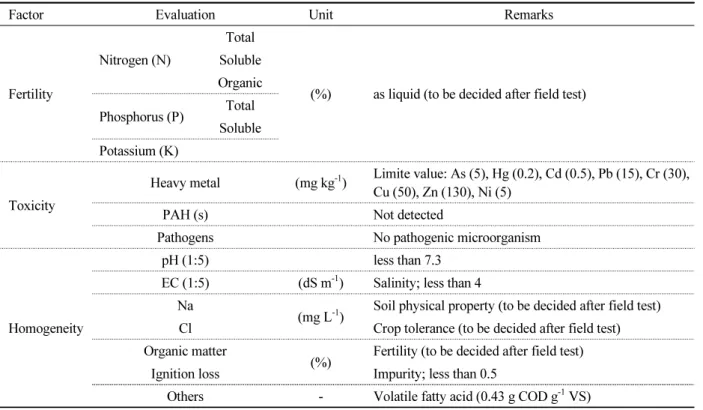
따라서 상기에서 살펴 본 바와 같이 국내 유기농업에 적용할 수 있는 돈분액비의 기준은 Table 13과 같이 정의할 수 있다. 먼저 돈분액비의 기준은 질소, 인, 그리고 칼리를 포함하는 비효, 중금속, 유해물질, 병원생 미생물을 포함하는 독성, 그리고 균질성 pH, EC, Na, Cl, 강열감량. 그리고 기타 조건으로 구분하여 품질과 안정성을 기준한 규격조건을 제시할 수 있다.
Table 13. Proposed standard for the quality of a pig slurry manure fertilizer.
Factor Evaluation Unit Remarks
Fertility
Nitrogen (N)
Total
(%) as liquid (to be decided after field test) Soluble
Organic Phosphorus (P) Total
Soluble Potassium (K)
Toxicity
Heavy metal (mg kg-1) Limite value: As (5), Hg (0.2), Cd (0.5), Pb (15), Cr (30), Cu (50), Zn (130), Ni (5)
PAH (s) Not detected
Pathogens No pathogenic microorganism
Homogeneity
pH (1:5) less than 7.3
EC (1:5) (dS m-1) Salinity; less than 4
Na (mg L-1) Soil physical property (to be decided after field test) Cl Crop tolerance (to be decided after field test) Organic matter
(%) Fertility (to be decided after field test)
Ignition loss Impurity; less than 0.5
Others - Volatile fatty acid (0.43 g COD g-1 VS)
Discussion
가축분뇨 액비는 경종순환의 한 방향으로 토양환경개선과 작물재배에 안전한 영양원으로 사용하기 위하여 가축분 뇨발효액의 공정 규격은 비료의 규격의 함량, 함유할 수 있는 유해성분의 최대량, 그리고 그 밖의 규격으로 구성돼 있 다. 그러나 대부분의 돈분액비는 비료공정 규격을 충족하지 못하므로 비료가치 기준인 N-P-K 전량의 합이 0.3% 이상 과 관련한 기준은 재설정이 필요하다. 또한 위해성 측면에서 국내 액비 기준 중 중금속과 관련한 기준이 유럽이나 미 국 등과 비교해 매우 높은 수준으로 설정돼 있어 액비의 활용도를 높이는데 제한 요건으로 작용할 수 있다. 그러므로 작물생육에 미치는 영향과 토양오염기준과의 상관성을 조사하여 액비의 중금속 수준을 조정하는 방안이 요구된다.
따라서 돈분액비 기준 제시안은 돈분액비의 질소 등과 같은 작물생육에 필요한 물질을 기준한 비효성, 그리고 중금속 이나 항생제와 같은 물질을 기준한 위해성, 대장균이나 살모넬라와 같은 충을 기준한 위생성, 그리고 돈분액비의 활 용도를 높이기 위하여 불순물 함량과 불순물의 크기 등에 대한 기준, 이외에 돈분액비를 처리하는 토양의 특성을 고려 한 pH와 EC, 특히 EC 등 항목별 기준을 설정하는 방안이 필요하다. 특히 돈분액비의 경우 토양의 물리성에 영향을 미 치는 Na가 포함되어 있어 토양 특성을 고려한 액비 기준 SAR 값이 포함되어야 할 것이다. 그리고 캐나다의 경우처럼 퇴비나 액비를 처리 할 때 액비처리량을 결정하는 지침안 등도 별도로 제시되어야 할 것으로 판단하다.
Acknowledgement
This research was conducted with the support of a research grant from Chungnam National University in 2016.
References
ANNEX 2. 2004. Compost : Legislation and standards- Heavy metals and organic compounds from wastes used as organic fertilisers. B4-3040 /2001/325284/MAR/A2.
ANNEXES. 2008. Compost production and use in the EU annexes. http://www.organics-recycling.org.uk/dmdocuments/
080229_EoW_final-report_annex1-7_v1.0.pdf.
British Standards Institution. 2010. Specification for whole digestate, separated liquor and separated fibre derived from the anaerobic digestion of source-segregated biodegradable materials. PAS:2010. BSI.
Canadian Food Inspection Agency. 2011. T-4-93-Standards for Metals in Fertilizers and Supplements. http://www.
inspection.gc.ca/plants/fertilizers/trade-memoranda/t-4-93/eng/1305611387327/1305611547479.
Chung D.Y. 2015. Investigation of standards for a liquid animal manure depending on domestic animal manure management facilities in Korea as project. pp. 25-50.
ECOFI. 2014. ECOFI Responses and Proposals for Quality and Safety Criteria for Organic Fertilizers, Organic Soil Improvers and Organo-Mineral Fertilizers. ECOFI. V8.
FAC. 1995. Compost and sewage sludge: Guidelines and recommendations of the research centre for agricultural chemistry and environmental science with respect to waste fertilisers. EDMZ Art.-Nr. 730.920.d, vergriffen.
Jeon, S.J, S.R. Kim, I.G, Hong, H.J. Kim, D.G. Kim, and M.G. Lee. 2013. A study to draw a plan of liquid fertilizer quality certification standards for livestock manure management. J. Anim. Environ. Sci. 19:183-190.
Jeon, S.J., S.R. Kim, D.G. Kim, K.S. Rho, D.Y. Choi, and M.G. Lee. 2012. Studies on the main level-grading factors for establishment of LFQC (Liquid Fertilizer Quality Certification) system of livestock manure in Korea. J. Anim.
Environ. Sci. 18:111-122.
KOSIS. 2014. National statistics of animal manure. Assessed in http://www.index.go.kr/potal/main/EachDtlPageDetail.
do?idx_cd=1475.
Lawrence, R.C. and B.W. Smith. 2002. Heavy Metal in Fertilizers: Considerations for Setting Regulations. Oregon Department of Agriculture. Salem, Oregon Department.
Lee, D.S., J.B. Lee, M.Y. Lee, R.N. Joo, K.S. Lee, S.W. Min, B.D. Hong, and D.Y. Chung. 2016. Establishment scheme for official standards of liquid swine manure fertilizer. Korean J. Agric. Sci. 43:360-368.
Lee, S.B., J.O. Seung, S.S. Kim, B.S. Kim, B.M. Lee, Y.J. Oh, C.K. Kang, K.J. Choi, and M.K. Hong. 2009. The Listing procedure for environmental friendly organic materials in Korea. Proc. Korean Soc. Org. Agric. Conf.
MAFRA. 2014. Law regarding to utilization and management of animal manure.
Nordberg, A. 2012. Legislation in different European countries regarding implementation of anaerobic digestion.
Swedish Institute of Agricultural Engineering.
Ra, C.S. 2013 Solutions and problems for livestock manure. Assessed in http://www.gsnj.re.kr/symposium2013/
file/symposium2013_hwp_3_01.pdf.
RDA. 2014. Establishment and designation of official standard of fertilizers, Notification No. 2014-6 of RDA.
RDA. 2015. The fertilizer management law. RDA.
RDA. 2016. The official standards of digested liquid fertilizer made with the animal manure as byproduct fertilizers.
Stefanie S. 2009. Quality requirements and quality assurance of digestion residuals in Germany. https://kompost.de/
uploads/media/Quality_Requirements_ of_digestion_residuals _i n_Germany_text_02.pdf .
Wheeler, P. 1999. Standards and regulations for soil improvers and growing media derived from wastes. In: IEA bioenergy workshop, band II. Hygienic and environmental aspects of anaerobic digestion: legislation and experiences in Europe. Deutschen Veterinärmedizinischen Gesellschaft e.v., Giessen, Germany, p. 95-103.
William F. B. 2000. Compost quality standards & guidelines. New York State Association of Recyclers. Woods End Research Laboratory, Inc.