Abnormal Shoot Responses of Pinus densiflora Seedlings to Open-field Experimental Warming and Precipitation Manipulation
Jo, Heejae
*, Chang, Hanna
**, Han, Seung Hyun
**, An, Jiae
**, Yang, A-Ram
***and Son, Yowhan
****†*
Master Student, Dept. of Environmental Science and Ecological Engineering, Graduate school, Korea Univ., Seoul, Korea
**
Ph. D Student, Dept. of Environmental Science and Ecological Engineering, Graduate school, Korea Univ., Seoul, Korea
***
Ph. D Research Fellow, Forest Technology and Management Research Center, National Institute of Forest Science, Pocheon, Korea
****
Professor, Dept. of Environmental Science and Ecological Engineering, Graduate school, Korea Univ., Seoul, Korea
ABSTRACT
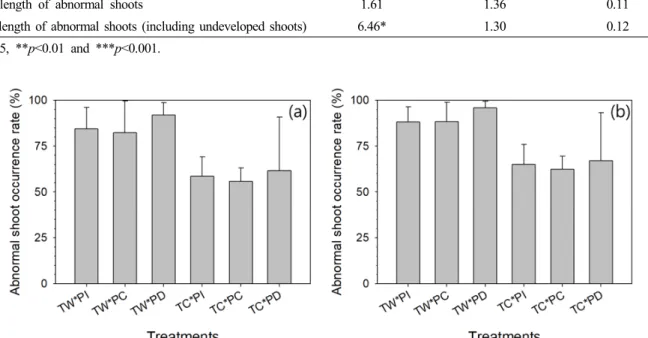
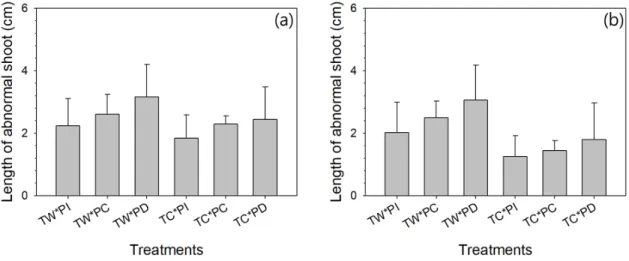
This study was conducted to investigate abnormal shoot responses in Pinus densiflora seedlings to open-field warming and precipitation manipulation. In May 2017, 18 plots (2 temperature levels × 3 precipitation levels × 3 replicates) were constructed and 90 seedlings of 1-year-old P. densiflora were planted in each plot. The temperature in the temperature warming (TW) plots was set to 3°C higher than that in the temperature control (TC) plots, and precipitation was set to decrease (PD) or increase (PI) by 40% compared to the precipitation control (PC) plots. The manipulation experiment started in June, 2017. The abnormal shoot occurrence rates in September and November, 2017; seedling number in each needle length growth stage in September, 2017; and length of abnormal shoots in November, 2017 were measured. Warming significantly increased the occurrence rate and developed the needle length growth stage of abnormal shoots in P. densiflora seedlings, whereas precipitation and interaction effects between the two treatments were not significant. The mean occurrence rates in September and November were 86.17 ± 11.80% and 90.78 ± 7.92% in the TW plots and 58.59 ± 16.13% and 64.80 ± 14.71% in the TC plots, respectively. Thus, the abnormal conditions derived from increased temperature stimulated the occurrence of abnormal shoots. Warming also elongated the needle length of the abnormal shoots, which might affect future photosynthesis. However, there was no significant difference in abnormal shoot length under warming and precipitation manipulation. Thus, warming stimulated the occurrence and needle development of abnormal shoots in P. densiflora seedlings, which could lead to the inhibition of subsequent growth by the use of reserved nutrients and degradation of seedling quality.
Key words: Abnormal shoot, Climate change, Drought, High temperature, Japanese red pine
†