실외 실험적 온난화 및 강수 처리에 따른 소나무와 낙엽송 유묘의 초기 생장 특성
권보람1⋅조민석 1*⋅양아람2⋅장한나3⋅안지애4⋅손요환3
1국립산림과학원 산림기술경영연구소, 2국립산림과학원 국제산림연구과,
3고려대학교 환경생태공학과, 4국립생태원 복원연구실
The Early Growth Performances of Pinus densiflora and Larix kaempferi Seedlings Under Open-field Experimental Warming and Precipitation Manipulation
Boram Kwon1, Min Seok Cho 1*, A-Ram Yang2, Hanna Chang3, Jiae An4 and Yowhan Son3
1Forest Technology and Management Research Center, National Institute of Forest Science, Pocheon 11186, Korea
2Division of Global Forestry, National Institute of Forest Science, Seoul 02455, Korea
3Department of Environmental Science and Ecological Engineering, Korea University, Seoul 02841, Korea
4Division of Restoration Research, National Institute of Ecology, Yeongyang 36531, Korea
요 약: 본 연구는 기후변화와 관련하여 양묘과정에서 온도와 강수 변화에 따른 주요 침엽수의 생존 및 생장 특성 변화를
알아보고자 수행하였다. 소나무와 낙엽송 노지묘(1-0)를 대상으로 대조구 기준 3℃의 온도를 상승시키거나 ±40%의 강수를 조절한 6처리 생육환경[온도 2처리(대조: TC, 증가: TW) × 강수 3처리(대조: PC, 감소: PD, 증가: PI)] 실외 실험구를 조성 하였으며, 생존율, 근원경, 묘고, 물질생산량 및 묘목품질지수 변화를 조사하여 이원분산분석을 수행하였다. 소나무는 온도 와 강수 처리에 따른 생존율 차이가 없었지만, 강수가 증가할수록 묘목품질지수가 낮아지는 경향을 보였다. 낙엽송은 온도 상승과 강수 감소에 따라 고사율이 증가하였으며, 묘목품질지수는 두 요인 간 상호작용을 보이면서 온도대조-강수증가 처 리구에서 가장 낮게 나타났다. 따라서 양묘과정에서 소나무는 강수 증가, 낙엽송은 온도 증가 또는 강수 감소에서 낮은 묘 목 생산량과 품질이 예상되며, 기후변화에 따른 두 수종의 특이적 민감도를 확인할 수 있었다. 향후 지구온난화와 가뭄·폭 우 등의 강수 변화에 의해 수종별 묘목 생존과 품질의 변화가 예상되기 때문에 각 수종의 생육 반응 특성에 따른 적합한 양묘시업 대응 전략이 필요할 것으로 판단된다.
Abstract: This study aimed to investigate the effects of climate change on the survival and growth performance of Pinus densiflora and Larix kaempferi seedlings using open-field experimental warming and precipitation manipulation.
We measured the survival rate, root-collar diameter, and height, and then calculated the seedling quality index (SQI) of 2-year-old seedlings under 6 treatments [2 temperatures (TC: Control; TW: Warming) × 3 precipitation manipulations (PC: Control; PD: Decreased; PI: Increased)] and performed a two-way ANOVA to test for differences.The air temperature of the warming plots was 3°C higher than that of the control plots, while the precipitation manipulation plots received ±40% of the precipitation received by the control plots. Temperature and precipitation treatments did not significantly affect the survival rate of P. densiflora; however, the SQI of P. densifloradecreased with increasing precipitation. In contrast, the mortality rate of L. kaempferi increased with increasing temperature and decreasing precipitation. Furthermore, in L. kaempferi, TC × PI treatment resulted in the lowest SQI with a significant interaction effect observed between the two factors. In summary, low seedling production and quality should be expected in P.
densiflora as precipitation increases and in L. kaempferi as temperature increases or precipitation decreases. These results indicate species-specific sensitivities to climate change of two plant species at the nursery stage. With the occurrence of global warming, the frequencies of drought and heavy rainfall events are increased, and this could affect the survival and seedling quality of tree species. Therefore, it is necessary to improve nursery techniques by establishing new adaptation strategies based on species-specific growth performance responses. 1)
Key words: climate change, nursery, precipitation, seedling growth, seedling survival rate, warming
* Corresponding author E-mail: [email protected] ORCID
Min Seok Cho https://orcid.org/0000-0003-2847-8412
JOURNAL OFKOREANSOCIETY OFFORESTSCIENCE ISSN 2586-6613(Print), ISSN 2586-6621(Online) http://e-journal.kfs21.or.kr https://doi.org/10.14578/jkfs.2020.109.1.31
31
서 론
지구 온난화로 지난 133년간(1880-2013년) 대기 온도 는 평균 약 0.85℃가 상승했으며, 21세기 말 지구의 평균 기온은 현재보다 약 3.7℃ 상승(RCP 8.5 기준) 될 것으로 전 망된다(Intergovernmental Panel on Climate Change, 2014).
기온은 수목의 생리 작용 및 생장 변화를 초래하는 주요 영향 인자로, 기후변화 시나리오에 근거한 온난화는 국 내 침엽수림 분포의 북상에 영향을 미칠 것으로 예측된 다(Ko et al., 2014). 또한 일부 연구에서는 기후변화에 따 른 온도 상승이 식물의 생장기간 연장에 영향을 미쳐 산 림생태계의 탄소 흡수를 증가시킬 것이라 모의하기도 한 다(Saxe et al., 2001).
그러나 지구적 범위에서 온난화는 대기 습도를 포함한 물 순환 패턴에도 영향을 미치면서 가뭄이나 폭우의 빈 번한 발생에 기여하고 있다(Dai, 2011). 특히 여름철에 강 수량이 집중되는 우리나라와 같은 기후에서는 강수량 변 화에 따른 가뭄과 폭우 빈도의 증가가 수목 생장 변화에 더욱 복잡한 영향을 미칠 것으로 예상된다.
최근 국내 양묘장에서는 기후변화에 따른 온도와 강수 변화로 묘목 피해가 발생되고 있으며, 이에 따라 연계된 조림목 품질 저하는 조림 성과에 부정적 영향을 미치고 있다(Cho et al., 2010; Kim et al., 2010a, 2010b; Lee, 2016). 묘목의 품질과 생산성은 온·습도, 수분함량, 광량, 양분 조건 등 여러 환경 인자들에 영향을 받으며(Danby and Hik, 2007; Baribault et al., 2010), 특히 온난화와 함 께 가뭄과 폭우가 빈번히 발생하는 상황에서는 이러한 기상재해가 주요 원인으로 여겨지고 있다(Allen et al., 2010). 이는 온도 변화와 수분 가용 조건이 잎의 기공 개 폐에 직접적인 영향을 미쳐 증산과 광합성 작용 등의 생 리활성을 변화시킴으로써 묘목의 생존과 생장에 직결되 는 인자이기 때문이다(Wu et al., 2011). 따라서 목질부의 발달이나 뿌리 활착이 완전하지 않은 묘목 초기의 양묘 단계에서는 온도가 상승된 조건에서의 토양 수분 변화가 생존과 생장을 결정짓는데 더욱 큰 영향으로 나타날 것 이다(Allen et al., 2010; Adams et al., 2017).
이에 기후변화에 따른 수목의 반응을 파악하고 예측하 며, 산림생태계의 취약성을 평가하기 위해 실외에 기후 변화 환경을 인위적으로 조성하여 모의하는 연구가 수행 되고 있다(Slaney et al., 2007; Gunderson et al., 2012; Xu et al., 2012). 국내·외 선행 연구들은 적외선등(Infrared lamp)을 이용한 온난화 실험 방법이 실제 자연 생태계에 서의 환경 변화와 유사하게 조성되며, 이에 따른 묘목과 생태계 반응을 보다 정확하게 파악할 수 있을 것으로 기 대한다(Kimball et al., 2008; Lee et al., 2012). 적외선등
을 이용한 국내 연구에서도 침엽수와 활엽수 모두 수종 특이적 생리 및 생장 특성을 보였다(Lee et al., 2012;
2013; Cho et al., 2014; Park et al., 2016). 이는 온도 상승 효과와 함께 토양의 수분 변화도 상호 연관되어 작용한 결과로 해석되며, 강수 처리에 관한 실험에서도 강수량 의 강도와 빈도 등에 따른 수분 변화 조건은 수종마다 특 이적 반응으로 나타난다고 보고된다(Dai, 2011; Wu et al., 2011; Chung et al., 2013; George et al., 2017). 그러므 로 이러한 온도와 강수 환경 인자들을 동시에 조절하는 실험적 연구의 수행은 변화하는 미래 기후에 대하여 수 종마다 어떠한 생장 반응이 나타날 것인지에 대한 이해 와 예측을 가능하게 할 것이다.
현재 벌기령에 도달한 우리나라 산림에서는 목재 자원 을 이용하고 다시 경제림을 조성하기 위한 선순환 정책 이 추진되고 있으며, 조림 면적의 확대에 대응하기 위해 서는 안정적인 묘목 생산과 공급이 필요하다(Korea Forest Service, 2018). 특히 온대 중·북부 지역에서는 우수한 목 재 가치를 가진 소나무(Pinus densiflora)와 낙엽송(Larix kaempferi)이 주요 조림 수종으로 권장되어 고품질 묘목 의 안정적 공급이 요구되는 실정이다. 그러나 노지 양묘 및 조림 초기 단계의 묘목은 항시 기상재해의 위협에 노 출되어 있기 때문에, 이들 수종의 생장 특성을 실외 실험 적 처리 환경에서 구명하는 것은 고품질의 묘목 생산과 이와 연계된 우수한 조림 성과를 이루기 위한 측면에서 도 중요하다(Kim et al., 2010a, 2010b).
따라서 본 연구에서는 기후변화에 따른 온도 상승과 함께 문제가 되고 있는 강수량 변화와 관련하여, 대기 온 도와 강수량의 변화 처리가 묘목의 생장 반응에 미치는 영향을 구명하고자 수행되었다. 이를 위해 우리나라 온 대 중·북부 지역의 대표적 조림 수종인 소나무와 낙엽송 노지묘(1-0)를 실외 시험지에 식재하여 온도와 강수 처리 에 따른 생존율과 생장 특성을 조사하였다.
재료 및 방법
1. 공시수종 및 시험지
본 연구는 경기도 포천에 위치한 국립산림과학원 산림 기술경영연구소(N 37° 45’, E 127° 10’) 내 실외 묘포장에 온난화 및 강수 처리 시스템을 조성하여 수행하였다. 이 지역과 인접한 동두천 기상대의 30년(1981-2010) 평균 연 평균기온과 연강수량은 각각 11.2℃와 1,503.0 mm이며, 2017년 연구 기간에는 각각 11.8℃와 989.7 mm이었다(Korea Meteorological Administration, 2019). 시험지에는 국립산림 품종관리센터에서 분양받은 소나무와 낙엽송 종자를 이용 하여 2016년에 산림기술경영연구소에서 생산된 1-0 노지
묘를 산림청 종묘사업실시요령(Korea Forest Service, 2012) 기준으로 2017년 5월에 식재하였다.
2. 온난화 및 강수 처리
온도와 강수 처리 실험은 기후변화 시나리오 RCP (Re- presentative Concentration Pathway) 8.5에 따라 예측한 2060년 기후 환경을 기준으로 설계하였다(Korea Meteoro- logical Administration, 2016). 시험지에는 2개의 온도 처리 구(TC: 온도대조, TW: 온도증가)와 3개의 강수 처리구 (PC: 강수대조, PD: 강수감소, PI: 강수증가)에 따른 영향 을 시험하기 위하여 두 수종 각각의 처리마다 1 m×1 m 묘상을 3반복하여 총 36개의 실험구를 난괴법으로 배치 하였다(Figure 1).
온도 처리는 묘고 끝부분으로부터 70 cm 상부의 중앙 에 설치된 적외선등(Infrared lamp; FTE-1000, Mor Electric Heating Association Inc., USA)으로 상승시켰고, 적외선 표면온도 센서(SI-111, Campbell Scientific Inc., USA), 데 이터로거(CR-1000, Campbell Scientific Inc., USA) 및 계 전기(SDM-CD16AC, Campbell Scientific Inc., USA)를 이 용하여 온도 대조구(TC)와 온도 증가구(TW)의 차이(3℃
기준)가 일정하게 유지되도록 제어하였다. 또한 강수 처 리는 지면으로부터 160 cm 높이에 실험구 면적 대비 40%을 차지하도록 광투과성 패널을 브이(V)자형으로 설 치하여 강수를 차단하는 강수 감소구(PD)를 조성하였고, 차단된 강수는 수조(water tank)에 수집하여 펌프와 스프링 클러로 강수 증가구(PI)에 점적관수 되도록 하였다. 이때 구조물 설비나 실험 장비에 의한 광량 등의 변인들을 통 제하기 위하여 온도 대조구(TC)에는 모형 적외선등을 설 치하였다. 각각의 실험구에는 한 개의 토양 온도 및 수분 센서(CS655, Campbell Scientific Inc., USA)를 설치하여
토양 온도와 수분 함량 변화를 측정하였다.
이와 같이 설계된 시스템에 의하여 상승된 월평균 대 기 및 토양온도는 묘목의 생장이 가장 활발한 7월부터 9 월에 온난화 처리구가 온난화 대조구에 비하여 각각 2.
9℃, 2.1℃ 높게 유지되었다. 또한 이 기간의 월평균 토양 수분 함량은 강수 대조구가 6.4-11.6%로 나타났으며, 이 와 비교하여 강수 감소구는 평균 약 6.6%의 토양수분이 감소되었고 강수 증가구는 약 31.6%의 토양 수분이 증가 되었다(Figure 2).
3. 생존율 및 생장 조사
온도와 강수 처리에 따른 생장 반응을 조사하기 위하 여 처리별로 총 90본의 묘목을 선정하여 2017년 9월 말에 근원경과 묘고를 각각 전자식 캘리퍼스와 스틸테이프를 이용하여 측정하였고, H/D율[H/D ratio = height (cm) / root collar diameter (mm)]을 계산하였다. 생장량을 측정한 묘목 중 무작위로 각 9본을 선정하여 굴취하였고, 잎, 줄기, 뿌 리로 구분하여 65℃의 건조기에서 48시간 동안 건조한 후 건중량을 측정하였다. 묘목의 부위별 물질생산량, 총 물 질생산량 및 T/R률[T/R ratio=aboveground biomass (g) / belowground biomass (g)]을 계산하였다. 또한 최종적으 로 묘목의 품질을 종합 평가할 수 있는 묘목품질지수[SQI;
Seedling Quality Index=seedling biomass (g) / (H/D ratio+T/R ratio)]를 산출하였다(Deans et al., 1989). 모든 조사가 종료 된 11월에 묘목의 생존율을 조사하였다.
4. 통계분석
온도와 강수 처리에 따른 생존율 및 생장 특성을 비교·
분석하기 위해서 온도와 강수에 따른 이원분산분석(two- way analysis of variance)을 실시하여 검정하였으며, Duncan Figure 1. The system design of open-field experimental warming and precipitation manipulation. TC: temperature control, TW:
temperature warming, PD: decreased precipitation, PC: precipitation control, PI: increased precipitation.
사후 검정을 수행하였다. 모든 통계분석은 SAS 9.4(SAS Institute Inc., USA)를 이용하였으며, 유의수준은 p<0.05 로 하였다.
결과 및 고찰
1. 생존율
온도와 강수 처리에 따른 6개 처리구 모두에서 소나무 묘목은 95% 이상의 높은 생존율을 보였지만[Figure 3(a)],
낙엽송 묘목은 소나무보다 상대적으로 낮은 약 31-53%
의 생존율을 나타냈다[Figure 3(b)]. 낙엽송 묘목은 발아 후 유묘 단계에서 목질부 형성이 늦어 소나무보다 묘목 관리의 어려움이 따르며, 종묘사업실시요령(산림청 예규 제657호)에 따른 1-1 노지묘의 득묘율 기준도 낙엽송 (70%)이 소나무(80%)보다 낮게 제시되고 있다(Korea Forest Service, 2012). 본 연구에서는 온도대조-강수대조(TCPC) 처리구의 낙엽송 생존율도 양묘 시업 득묘율 기준보다 낮은 43.2%로 나타났다. 2017년 9-10월의 누적강수량 Figure 2. Monthly mean air (A) and soil (B) temperatures and mean soil water contents (C) under experimental warming and precipitation manipulation in the open-field from July to October, 2017. Vertical bars represent SD of the means. TC: temperature control, TW:
temperature warming, PD: decreased precipitation, PC: precipitation control, PI: increased precipitation.
Figure 3. The effect of experimental warming (T) and precipitation (P) manipulation in the open-field on survival rates of Pinus desiflora (A) and Larix kaempferi (B). Vertical bars represent SD of the means (n=270 for P. densiflora and 192 for L. kaempferi).
Different letters show statistical differences among treatments within species at the 5% levels Duncan’s multiple range test. Asterisks are statistical significances in two-way ANOVA. *P≤0.05, **P≤0.01, ***P≤0.001, NS(not significant)=P>0.05. TC: temperature control, TW: temperature warming, PD: decreased precipitation, PC: precipitation control, PI: increased precipitation.
(43.8 mm)은 9-10월 평년 강수량의 약 19.6%에 불과하였 으며, 이와 같이 생육기 후반에 발생한 가을 가뭄이 묘목 의 고사에 중요한 영향을 미친 것으로 판단된다(Korea Meteorological Administration, 2019).
묘목의 생존율에 대한 온도와 강수의 영향도 두 수종 간 에 다른 경향을 나타냈다. 소나무의 경우 온도와 강수 처리 에 따라 생존율에 유의한 차이가 없었고 두 인자의 상호작 용도 나타나지 않았다(p>0.05). 일반적으로 온도 상승은 토 양수분 감소에도 상호 연관되어 묘목의 생존율 감소에 영향 을 미치지만(Castro et al., 2005; Wu et al., 2011), 국내에서 수행된 실험적 온난화 처리에서도 소나무의 생존율은 본 연구와 같이 온도와 강수 조건 변화에 유의한 차이를 보이 지 않았다(Cho et al., 2014). 낙엽송의 경우 온도증가-강수 감소(TWPD) 처리구에서 가장 낮은 생존율을 보이면서 온 도가 증가하고 강수가 감소할수록 생존율이 감소되는 경향 을 나타냈지만(p<0.05), 온도와 강수 처리에 따른 상호작용 은 확인되지 않았다(p>0.05). 즉, 낙엽송 묘목의 고사 피해 가 발생하는 조건에서도 온도가 증가되지 않는 경우와 강수 가 추가적으로 공급되는 경우에는 상대적으로 묘목의 생존 에 유리한 환경이 조성되었음을 알 수 있다.
이처럼 동일한 온도와 강수 처리의 생육 환경에서 나 타난 두 수종의 생존 차이는 수종별 생리적 특성에 의한 수분 민감도가 주요한 원인인 것으로 판단된다. 묘목의 초기 단계 생존에 있어서는 토양 수분 조건이 매우 중요 하며 일부 식물의 잎은 수분 감소에 대응하여 기공을 폐 쇄하고 고사 직전의 역치 이상으로 잎 수분포텐셜을 유 지한다. 일반적으로 소나무류의 수종들이 이와 같은 등 수성(Isohydric)의 특성을 보인다고 알려져 있다(Tyree and Sperry, 1988; Sala et al., 2010; Choat et al., 2012;
Manzoni et al., 2013). 반면에 건조 기간 동안에도 기공 개폐 조절을 하지 않아 잎 수분퍼텐셜을 높게 유지하며 광합성과 증산 작용으로 계속해서 탄소를 동화하는 특성 을 비등수성(Ansiohydric)이라고 한다. 시베리아의 Larix gmelinii과 Pinus sylvestris의 수분이용효율(WUE; Water Use Efficiency)을 실험한 연구 결과에 따르면, L. gmelinii 은 많은 증산작용을 통해 수분을 잃었지만 P. sylvestris은 상대적으로 높은 수분이용효율로 생산성을 유지했다 (Urban et al., 2017). 이러한 결과로 보아 낙엽송은 소나 무와 비교하여 상대적으로 비등수성의 특성을 보일 것으 로 사료되며, 생육기 후반의 더욱 감소된 수분 조건에서 도 고사에 이를 때까지 기공을 닫지 않고 생리 작용을 유 지하여 생존율이 낮아진 것으로 판단된다.
2. 근원경 및 묘고 생장
소나무의 근원경은 온도 상승에 따른 통계적 차이는 없지만(p>0.05), 강수량 감소에 따라 증가하는 경향을 보
이면서 강수 감소구(TCPD: 4.77 mm, TWPD: 4.90 mm) 에서 최대로 나타났다(p<0.001)(Table 1). 기후변화에 대 한 초기 연구에서는 온난화가 진행될수록 식물의 생장 기간 증가와 그에 따른 동화 작용의 증가를 예측했다 (Bronson et al., 2009). 본 연구에서도 소나무의 묘고는 온도와 강수 각각에 유의적 차이를 보였으며 두 요인의 상호작용에도 영향을 받아(p<0.001), 온난화 처리구가 대 조구보다 높은 묘고 생장을 보였으며 강수 감소구에서 최대값을 보였다. 반면에 낙엽송의 근원경과 묘고는 모 두 온도나 강수에 따른 차이가 나타나지 않았으며, 두 요 인에 의한 상호작용 효과도 없었다(p>0.05). 이러한 생장 차이는 두 수종의 생리 특성의 차이에 기인하며, 등수성 수종인 소나무는 온도와 강수 조건 변화에 따라 고사 피 해를 최소화하기 위해 동화작용을 조절하여 처리구별 생 장 차이가 나타난 것으로 판단된다. 그러나 낙엽송과 같 이 비등수성 수종은 고온의 강수 감소 조건에서도 고사 피해를 받을 때까지 과도한 증산과 동화 작용이 유발되 기 때문에(Williams et al., 2013), 온도와 강수 처리구간 의 생장 차이가 나타나지 않은 것으로 판단된다.
온난화의 영향은 수종에 따라 다르게 나타나며, 동일 수종에서도 온난화 처리에 대한 묘목의 생장 반응은 생 장 단계나 묘령 등에 따라 다양하게 보고되고 있다(Arend et al., 2011). 미국의 Pinus edulis를 대상으로 4.8℃의 기 온을 증가시킨 실외 실험에서는 침엽의 발생이 지연되고 지상부 생장이 감소했다(Adams et al., 2015). 반면에 유 럽 4개국의 진달래과(Ericaceae) 관목 대상의 온난화 실 험에서 따뜻하고 건조한 남부 지역은 온난화의 효과가 없었지만, 북부 지역에서는 1℃의 온도 상승에도 전체 지 상부 바이오매스의 15%가 증가할 만큼 온난화에 더 민감 했다(Penuelas et al., 2004). 이러한 온난화 실험 결과의 차 이는 온도 상승과 동시에 발생한 수분 스트레스가 묘목의 생리 기작에 복합적인 영향을 미쳤기 때문이며, 미래의 상승된 온도 조건에서는 묘목의 생장 저하 및 고사를 초 래하는 가뭄의 정도와 시간이 단축될 것이라는 연구 결과 도 보고되고 있다(Adams et al., 2009; Allen et al., 2015).
한편 소나무의 H/D율은 4.48-5.27 cm·mm-1의 범위에서 온도, 강수 및 두 인자의 상호작용 효과가 나타났고 (p<0.01), 낙엽송의 H/D율은 5.79-6.33 cm·mm-1범위에서 온도와 강수 처리에 따른 통계적 차이를 보이지 않았다 (p>0.05). H/D율은 묘목의 건전도를 평가하고 조림 후 산 지적응성을 판단할 수 있는 기초 자료로서(Bayala et al., 2009), 본 연구의 소나무와 낙엽송 묘목은 모두 종묘사업 실시요령 내 제시된 적정 H/D율(소나무 : 5 cm·mm-1,낙엽 송 : 9 cm·mm-1 이하)의 규격을 만족하는 지상부와 지하 부의 균형적 생장을 보였다(Korea Forest Service, 2012).
3. 물질생산량 및 묘목품질지수
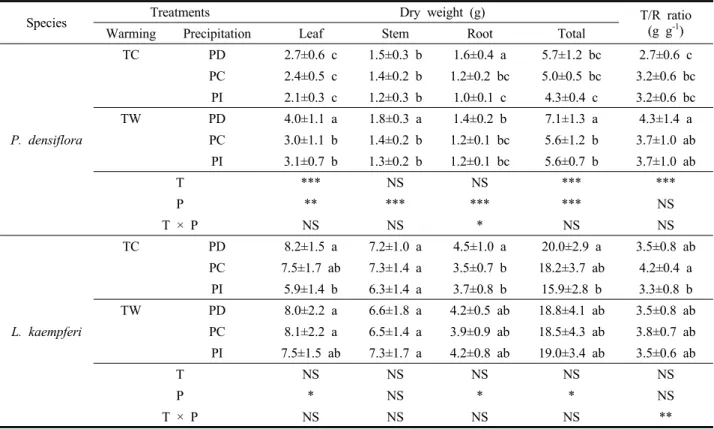
소나무는 강수가 감소할수록 잎, 줄기, 뿌리의 모든 부 위에서 물질생산량이 증가하는 경향을 보였고(p<0.01), 낙엽송은 잎과 뿌리 물질생산량이 강수 감소구에서 높게 나타났다(p<0.05)(Table 2). 그러나 온도 상승에는 소나무 의 잎 물질생산량만이 증가되는 유의한 차이를 보였다 (p<0.001). 결과적으로 소나무와 낙엽송 두 수종 모두 총 물질생산량에 온도와 강수 처리의 상호작용은 없었지만 (p>0.05), 소나무의 경우 온도가 상승되고 강수가 감소할 수록 총 물질생산량이 증가되는 경향을 보였다(p<0.001).
강수 처리 실험에 관한 메타분석 연구 결과에 의하면 물 질생산량은 강수량과 정의 상관관계를 보이는 것으로 보 고되고 있지만(Wu et al., 2011), 본 연구에서는 강수가 감소했을 때 물질생산량이 증가하는 경향을 보였다. 특 히 강수가 감소된 소나무 온도대조-강수감소(TCPD) 처 리구의 뿌리 물질생산량은 강수 증가구와 비교하여 1.6 배 높게 나타났다. 이는 토양수분 부족에 따라 묘목의 생 육활동 유지를 위하여 지하부 생장을 촉진시키며 수분을
원활히 공급하려는 방어 기작의 결과로 판단된다. 초기 의 가뭄 상황에서는 토양 수분의 건조가 표층부터 시작 되기 때문에 근계의 발달은 더욱 지하부로 뻗어가며 (Koike et al., 2003), 강수 감소를 처리한 선행연구에서도 세근 생산량의 증가와 뿌리 길이의 확장 등 지하부 생물 량이 증가했다(Lopez et al., 2009; Han et al., 2018). 그러나 본 연구의 9월 가뭄 현상과 같이 강수 감소가 지속된다면 뿌리의 수분 흡수와 유압 기능이 급격히 저하될 수 있다.
미국 Pinus flexilis 묘목에 강수를 차단한 결과에서도 토양 수분함량이 일정 수준으로 감소했을 때 지상부에 비구조 탄수화물(Non-Structural Carbohydrate)이 축적되며 뿌리보 다 높아진 농도로 체내 수송장애가 발생하였고, 급격하게 생존율이 감소했다고 보고된다(Reinhardt et al., 2015).
강수 감소구와 반대로 강수 증가구에서는 온도 대조구 와 처리구 모두 소나무의 총 물질생산량이 가장 낮게 나 타났다(p<0.001). 이는 과도한 수분이 토양 공극을 포화 시켜 뿌리 세포의 산소 이용 가능성을 감소시킴으로써 소나무의 생장에 부정적인 영향을 미쳤기 때문으로 판단
Species Treatments
Root collar diameter (mm) Height (cm) H/D ratio (cm mm-1) Warming Precipitation
P. densiflora
TC PD 4.77±0.53 ab 22.1±0.6 c 4.69±0.49 bc
PC 4.49±0.72 bc 22.4±0.8 bc 5.11±0.83 a
PI 4.46±0.47 bc 19.8±1.1 d 4.48±0.47 c
TW PD 4.90±0.66 a 23.8±0.7 a 4.93±0.63 ab
PC 4.48±0.57 bc 22.8±0.6 b 5.15±0.61 a
PI 4.34±0.55 c 22.6±0.5 b 5.27±0.62 a
T NS *** ***
P *** *** *
T × P NS *** **
L. kaempferi
TC PD 8.16±1.48 a 47.4±5.6 ab 5.97±1.25 a
PC 7.93±1.47 a 47.2±6.2 ab 6.10±1.10 a
PI 7.82±1.35 a 48.3±7.2 ab 6.33±1.28 a
TW PD 8.44±1.60 a 49.6±6.9 a 6.06±1.22 a
PC 8.04±1.64 a 46.8±7.3 ab 6.04±1.45 a
PI 8.02±1.41 a 45.4±5.1 b 5.79±0.97 a
T NS NS NS
P NS NS NS
T × P NS NS NS
Values are means of 90 seedling±SD. Values with different letters in a column indicate statistical differences among treatments within species at the 5% levels by Duncan’s multiple range test. Asterisks are statistical significances in two-way ANOVA. *P≤0.05,
**P≤0.01, ***P≤0.001 and NS (non-significance)=P>0.05. TC: temperature control, TW: temperature warming, PD: decreased precipitation, PC: precipitation control, PI: increased precipitation.
Table 1. The growth of root collar diameter, height and H/D ratio of Pinus densiflora and Larix kaempferi seedlings under the experimental warming (T) and precipitation (P) manipulation in the open-field.
된다(Bailey-Serres and Voesenek, 2008). 또한 통계적 유 의성은 없지만 낙엽송의 총 물질생산량도 적정 온도 조 건에서 강수를 증가시킨 온도대조-강수증가(TCPI) 처리 구에서 최소로 나타났다. 이는 낙엽송(Larix kaempferi) 2 년생 묘목을 대상으로 한 침수처리 실험에서 잎의 기공 폐쇄가 유도되고 순광합성율이 감소되며, 배수 후에도 생리활성의 회복이 관찰되지 않은 경우와 같은 경향이다 (Terazawa et al., 1992). 반면에 본 연구의 온도 상승 처리 조건에서는 낙엽송의 총 물질생산량이 강수 처리에 관계 없이 균일하게 나타났다. 즉, 낙엽송의 경우 강수 증가 조 건에서의 상승된 온도가 토양수분을 증발시켜 생육에 적 정한 수준의 토양 수분 환경을 조성한 것으로 판단된다.
소나무의 T/R률은 온도 상승으로 높아지는 경향을 보 였지만(p<0.001), 최종적인 묘목품질지수는 강수 처리에 따른 영향만을 받아 두 강수 감소구(TCPD, TWPD) 모두 에서 0.79로 높게 나타났다(p<0.001)(Figure 4). 반면에 낙엽송의 T/R률은 강수가 감소하거나 증가한 경우에 낮 게 나타났으며(p<0.05), 묘목품질지수는 온도 대조구에서 는 강수가 감소할수록 증가했고 온도 증가구에서는 강수
증가에 따라 증가하며 두 처리 인자에 의한 상호작용 효 과가 나타났다(p<0.01).
이와 같은 결과를 종합하면 소나무의 경우 토양의 건 조와 과습 수준에 의해 묘목 품질이 결정되었으며, 낙엽 송의 묘목품질은 온도와 강수 두 요인의 상호작용에 의 해 변화되는 것을 알 수 있다.
결 론
본 연구는 실외 묘포장에 설치한 온도 및 강수 처리 실 험구에서 소나무와 낙엽송 묘목의 생존 및 생장 변화를 측정하여 기후변화에 따른 묘목의 반응을 파악하고자 실 시하였다. 소나무는 온도 및 강수 처리에 따른 생존율의 감소를 보이지 않았지만, 묘목의 생장량과 품질지수는 강 수가 증가할수록 낮아지는 경향을 보였다. 소나무는 온도 와 강수 변화에 따른 생존에 대한 적응성이 높고, 임계 온 도 내의 온도 상승으로 생장이 향상될 수 있을 것으로 예 상된다. 그러나 여름철 집중 호우 등 강수량 증가에 따른 과습한 토양 환경에서는 오히려 묘목의 품질이 저하될
Species Treatments Dry weight (g) T/R ratio
(g g-1)
Warming Precipitation Leaf Stem Root Total
P. densiflora
TC PD 2.7±0.6 c 1.5±0.3 b 1.6±0.4 a 5.7±1.2 bc 2.7±0.6 c
PC 2.4±0.5 c 1.4±0.2 b 1.2±0.2 bc 5.0±0.5 bc 3.2±0.6 bc PI 2.1±0.3 c 1.2±0.3 b 1.0±0.1 c 4.3±0.4 c 3.2±0.6 bc
TW PD 4.0±1.1 a 1.8±0.3 a 1.4±0.2 b 7.1±1.3 a 4.3±1.4 a
PC 3.0±1.1 b 1.4±0.2 b 1.2±0.1 bc 5.6±1.2 b 3.7±1.0 ab PI 3.1±0.7 b 1.3±0.2 b 1.2±0.1 bc 5.6±0.7 b 3.7±1.0 ab
T *** NS NS *** ***
P ** *** *** *** NS
T × P NS NS * NS NS
L. kaempferi
TC PD 8.2±1.5 a 7.2±1.0 a 4.5±1.0 a 20.0±2.9 a 3.5±0.8 ab
PC 7.5±1.7 ab 7.3±1.4 a 3.5±0.7 b 18.2±3.7 ab 4.2±0.4 a PI 5.9±1.4 b 6.3±1.4 a 3.7±0.8 b 15.9±2.8 b 3.3±0.8 b
TW PD 8.0±2.2 a 6.6±1.8 a 4.2±0.5 ab 18.8±4.1 ab 3.5±0.8 ab
PC 8.1±2.2 a 6.5±1.4 a 3.9±0.9 ab 18.5±4.3 ab 3.8±0.7 ab PI 7.5±1.5 ab 7.3±1.7 a 4.2±0.8 ab 19.0±3.4 ab 3.5±0.6 ab
T NS NS NS NS NS
P * NS * * NS
T × P NS NS NS NS **
Values are means of 9 seedling±SD. Values with different letters in a column indicate statistical differences among treatments within species at the 5% levels by Duncan’s multiple range test. Asterisks are statistical significances in two-way ANOVA. *P≤0.05,
**P≤0.01, ***P≤0.001 and NS (non-significance)=P>0.05. TC: temperature control, TW: temperature warming, PD: decreased precipitation, PC: precipitation control, PI: increased precipitation.
Table 2. The dry weight and T/R ratio of Pinus densiflora and Larix kaempferi seedlings under the experimental warming (T) and precipitation (P) manipulation in the open-field.
수 있을 것으로 판단된다. 낙엽송의 경우 온도 및 강수 처 리에 따라 유의한 생존율 차이를 보였고, 온도 상승과 강 수 감소에 의한 최대 건조 조건에서는 생존율이 가장 낮 게 나타났다. 하지만 처리별 낙엽송 묘목의 생장량은 유 사한 수준으로 나타났고, 특히 낙엽송의 묘목품질지수는 온도와 강수 요인에 따른 상호작용이 확인되었다. 수분 민감도가 높은 낙엽송 묘목의 생존에는 온도 상승, 가뭄 등 건조에 대응하는 토양 수분 관리가 매우 중요하게 작 용할 것으로 판단되며, 온난화 조건에서의 인위적인 수분 공급은 낙엽송의 묘목품질 향상에 기여할 것이다. 이와 같이 향후 지구온난화와 가뭄·폭우 등의 강수 변화에 따 라 양묘 과정에서의 묘목 생존과 묘목 품질에 대한 수종 별 영향 차이가 예상된다. 기후변화에 따른 수종별 생육 반응 특성의 구명으로 피음 처리, 생육 및 이식 밀도 조 절, 포지 상 높이 조절, 토양 경운, 관수 등과 같은 수종별 양묘시업 개선 방안이 제시될 수 있을 것으로 판단된다.
감사의 글
본 연구는 산림청(2017058A00-1919-AB01)의 지원에 의하여 이루어진 것입니다.
References
Adams, H.D., Barron-Gafford, G.A., Minor, R.L., Gardea, A.A., Bentley, L.P., Law, D.J., Breshears, D.D., McDowell, N.G.
and Huxman, T.E. 2017. Temperature response surfaces for mortality risk of tree species with future drought.
Environmental Research Letters 12(11): 115014.
Adams, H.D., Collins, A.D., Briggs, S.P., Vennetier, M., Dickman, L.T., Sevanto, S.A., Garcia, N., Forner, H., Powers, H. and McDowell, N.G. 2015. Experimental drought and heat can delay phenological development and reduce foliar and shoot growth in semiarid trees.
Global Change Biology 21(11): 4210-4220.
Adams, H.D., Guardiola-Claramonte, M., Barron-Gafford, G.A., Villegas, J.C., Breshears, D.D., Zou, C.B., Troch, P.A. and Huxman, T.E. 2009. Temperature sensitivity of drought-induced tree mortality portends increased regional die-off under global-change-type drought. Proceedings of the National Academy of Sciences of the United States of America 106(17): 7063-7066.
Allen, C.D., Breshears, D.D. and McDowell, N.G. 2015. On underestimation of global vulnerability to tree mortality and forest die off from hotter drought in the Anthropocene.
Figure 4. The effect of experimental warming (T) and precipitation (P) manipulation in the open-field on seedling quality index (SQI) of Pinus desiflora (A) and Larix kaempferi (B). Vertical bars represent SD of the means (n=9). Different letters show statistical differences among treatments within species at the 5% levels by Duncan’s multiple range test. Asterisks are statistical significances in two-way ANOVA. *P≤0.05, **P≤0.01, ***P≤0.001, NS(not significant)=P>0.05. TC: temperature control, TW: temperature warming, PD: decreased precipitation, PC: precipitation control, PI: increased precipitation.
Ecosphere 6(8): 1-55.
Allen, C.D., Macalady, A.K., Chenchouni, H., Bachelet, D., McDowell, N., Vennetier, M., Kitzberger, T., Rigling, A., Breshears, D.D. and Hogg, E.T. 2010. A global overview of drought and heat-induced tree mortality reveals emerging climate change risks for forests. Forest Ecology and Management 259(4): 660-684.
Arend, M., Kuster, T., Günthardt-Goerg, M.S. and Dobbertin, M. 2011. Provenance-specific growth responses to drought and air warming in three European oak species (Quercus robur, Q. petraea and Q. pubescens). Tree Physiology 31(3): 287-297.
Bailey-Serres, J. and Voesenek, L.A.C.J. 2008. Flooding stress:
acclimations and genetic diversity. Annual Review of Plant Biology 59: 313-339.
Baribault, T.W., Kobe, R.K. and Rothstein, D.E. 2010. Soil calcium, nitrogen, and water are correlated with above- ground net primary production in northern hardwood forests. Forest Ecology and Management 260(5): 723-733.
Bayala, J., Dianda, M., Wilson, J., Ouedraogo, S. and Sanon, K. 2009. Predicting field performance of five irrigated tree species using seedling quality assessment in Burkina Faso, West Africa. New Forests 38(3): 309-322.
Bronson, D.R., Gower, S.T., Tanner, M. and Van Herk, I. 2009.
Effect of ecosystem warming on boreal black spruce bud burst and shoot growth. Global Change Biology 15(6):
1534-1543.
Castro, J., Zamora, R., Hodar, J.A. and Gomez, J.M. 2005.
Alleviation of summer drought boosts establishment success of Pinus sylvestris in a Mediterranean mountain:
an experimental approach. Plant Ecology 181: 191-202.
Cho, M.S., Kim, G.N., Kwon, K.W. and Lee, S.W. 2010. Effect of planting season and vegetation competition on growth performances of containerized seedlings of Pinus densiflora.
Journal of Korean Forest Society 99(3): 359-367 (In Korean with English abstract).
Cho, M.S., Hwang, J., Yang, A., Han, S. and Son, Y. 2014.
Seed germination and seedling survival rate of Pinus densiflora and Abies holophylla in open-field experimental warming using the infrared lamp. Journal of Korean Society of Forest Science 103(2): 203-210 (In Korean with English abstract).
Choat, B., Jansen, S., Brodribb, T.J., Cochard, H., Delzon, S., Bhaskar, R., Bucci, S.J., Feild, T.S., Gleason, S.M. and Hacke, U.G. 2012. Global convergence in the vulnerability of forests to drought. Nature 491(7426): 752.
Chung, H., Muraoka, H., Nakamura, M., Han, S., Muller, O.
and Son, Y. 2013. Experimental warming studies on tree species and forest ecosystems: A literature review. Journal
of Plant Research 126(4): 447-460.
Dai, A. 2011. Drought under global warming: A review. Wiley Interdisciplinary Reviews: Climate Change 2(1): 45-65.
Danby, R.K. and Hik, D.S. 2007. Responses of white spruce (Picea glauca) to experimental warming at a subarctic alpine tree line. Global Change Biology 13(2): 437-451.
Deans, J., Mason, W., Cannell, M., Sharpe, A. and Sheppard, L. 1989. Growing regimes for bare-root stock of Sitka spruce, Douglas-fir and Scots pine. 1. morphology at the end of the nursery phase. Forestry 62: 53-60.
George, J., Grabner, M., Karanitsch-Ackerl, S., Mayer, K., Weißenbacher, L., Schueler, S. and Mäkelä, A. 2017.
Genetic variation, phenotypic stability, and repeatability of drought response in european larch throughout 50 years in a common garden experiment. Tree Physiology 37(1):
33-46.
Gunderson, C.A., Edwards, N.T., Walker, A.V., O'Hara, K.H., Campion, C.M. and Hanson, P.J. 2012. Forest phenology and a warmer climate–growing season extension in relation to climatic provenance. Global Change Biology 18(6):
2008-2025.
Han, S.H., Kim, S., Li, G., Chang, H., Yun, S.J., An, J. and Son, Y. 2018. Effects of warming and precipitation mani- pulation on fine root dynamics of Pinus densiflora Sieb.
et Zucc. seedlings. Forests 9(1): 14.
Intergovernmental Panel on Climate Change. 2014. Climate change 2014: Synthesis report. Intergovernmental Panel on Climate Change, Switzerland.
Kimball, B.A., Conley, M.M., Wang, S., Lin, X., Luo, C., Morgan, J. and Smith, D. 2008. Infrared heater arrays for warming ecosystem field plots. Global Change Biology 14(2): 309-320.
Kim J.J., Kwon, K.W., Kim, P.G., Yoon, T.S., Lee, K.J., Chung, Y.S. and Song, K.S. 2010a. Characteristics of meteorological disasters in Korean nursery industry. Journal of Climate Research 5(1): 42-53 (In Korean with English abstract).
Kim, P.G., Kwon, K.W., Yoon, T.S., Lee, K.J., Song, K.S., Cha, Y.G. and Kim, J.J. 2010b. Damages of seedlings by meteorological disasters in nursery. Journal of Climate Research 5(2): 148-161 (In Korean with English abstract).
Ko, S.Y., Sung, J.H., Chun, J.H., Lee, Y.G. and Shin, M.Y.
2014. Predicting the changes of yearly productive area distribution for Pinus densiflora in Korea based on climate change scenarios. Korean Journal of Agricultural and Forest Meteorology 16(1): 72-82 (In Korean with English abstract).
Koike, T., Kitao, M., Quoreshi, A. and Matsuura, Y. 2003.
Growth characteristics of root-shoot relations of three birch seedlings raised under different water regimes. Roots: The dynamic interface between plants and the earth. Springer
303-310.
Korea Forest Service. 2012. Guidelines for seed and seedling management. Korea Forest Service, Korea (in Korean).
Korea Forest Service. 2018. The 6st National Forest Plan. Korea Forest Service, Korea (in Korean).
Korea Meteorological Administration. 2016. Report of Global Atmosphere Watch 2016. Korea Meteorological Administration, Korea. (in Korean).
Korea Meteorological Administration. 2019. https://www.weather.
go.kr/weather/climate/past_cal.jsp. Climate Information Portal.
(2019.11.30.).
Lee, S.N. 2016. Damages characteristics of nursery industry owing to meteorological disasters in Korea and plan for overcome. (Disseration). Seoul. Konkuk University (In Korean with English abstract).
Lee, S.J., Han, S., Yoon, T.K., Han, S.H., Jung, Y., Yun, S.J.
and Son, Y. 2013. Growth and physiological characteristics of Pinus densiflora seedlings in response to open-field experimental warming using the infrared lamp. Journal of Korean Society of Forest Science 102(4): 522-529. (In Korean with English abstract).
Lee, S.J., Han, S., Yoon, T.K., Chung, H., Noh, N.J., Jo, W., Park, C., Ko, S., Han, S.H. and Son, Y. 2012. Effects of experimental warming on growth of Quercus variabilis seedlings. Journal of Korean Society of Forest Science 101(4): 722-728 (In Korean with English abstract).
López, R., Rodríguez-Calcerrada, J. and Gil, L. 2009. Physio- logical and morphological response to water deficit in seed- lings of five provenances of Pinus canariensis: potential to detect variation in drought-tolerance. Trees 23(3):
509-519.
Manzoni, S., Vico, G., Katul, G., Palmroth, S., Jackson, R.B.
and Porporato, A. 2013. Hydraulic limits on maximum plant transpiration and the emergence of the safety–efficiency trade-off. New Phytologist 198(1): 169-178.
Park, M., Yun, S., Yun, H., Chang, H., Han, S., An, J. and Son, Y. 2016. Effects of open-field artificial warming and precipitation manipulation on physiological characteristics and growth of Pinus densiflora seedlings. Journal of Climate Change Research 7: 9-17 (In Korean with English abstract).
Penuelas, J., Gordon, C., Llorens, L., Nielsen, T., Tietema, A., Beier, C., Bruna, P., Emmett, B., Estiarte, M. and Gorissen, A. 2004. Nonintrusive field experiments show different plant responses to warming and drought among sites, seasons, and species in a north–south European gradient. Ecosystems 7(6): 598-612.
Reinhardt, K., Germino, M.J., Kueppers, L.M. Domec, J. and Mitton, J. 2015. Linking carbon and water relations to drought-induced mortality in Pinus flexilis seedlings. Tree Physiology 35(7): 771-782.
Sala, A., Piper, F. and Hoch, G. 2010. Physiological mechanisms of drought-induced tree mortality are far from being resolved. New Phytology 186: 274-281.
Saxe, H., Cannell, M.G., Johnsen, Ø., Ryan, M.G. and Vourlitis, G. 2001. Tree and forest functioning in response to global warming. New Phytologist 149(3): 369-399.
Slaney, M., Wallin, G., Medhurst, J. and Linder, S. 2007. Impact of elevated carbon dioxide concentration and temperature on bud burst and shoot growth of boreal norway spruce.
Tree Physiology 27(2): 301-312.
Terazawa, K., Maruyama, Y. and Morikawa, Y. 1992.
Photosynthetic and stomatal responses of Larix kaempferi seedlings to short-term waterlogging. Ecological Research 7(2): 193-197.
Tyree, M.T. and Sperry, J.S. 1988. Do woody plants operate near the point of catastrophic xylem dysfunction caused by dynamic water stress?: Answers from a model. Plant Physiology 88(3): 574-580.
Urban, J., Rubtsov, A., Shashkin, A. and Benkova, V. 2017.
Growth, transpiration and water use efficiency of Larix sibirica, Larix gmelinii and Pinus sylvestris forest in Siberia. International Society for Horticultural Science 1222: 124-132.
Williams, A.P., Allen, C.D., Macalady, A.K., Griffin, D., Woodhouse, C.A., Meko, D.M., Swetnam, T.W., Rauscher, S.A., Seager, R. and Grissino-Mayer, H.D. 2013. Tem- perature as a potent driver of regional forest drought stress and tree mortality. Nature Climate Change 3(3): 292.
Wu, Z., Dijkstra, P., Koch, G.W., Peñuelas, J. and Hungate, B.A. 2011. Responses of terrestrial ecosystems to tem- perature and precipitation change: A meta analysis of experimental manipulation. Global Change Biology 17(2):
927-942.
Xu, Z., Hu, T. and Zhang, Y. 2012. Effects of experimental warming on phenology, growth and gas exchange of tree line birch (Betula utilis) saplings, eastern tibetan plateau, China. European Journal of Forest Research 131(3):
811-819.
Manuscript Received : January 22, 2020 First Revision : March 9, 2020 Accepted : March 10, 2020