1. INTRODUCTION
A navigation system provides position information to guided weapon systems, unmanned systems, aircraft, ships, and vehicles; and it is an important element that determines the system performance. Navigation systems are divided into an inertial navigation system and a satellite navigation system. The inertial navigation system estimates position, velocity, and attitude through the integration of the angular velocity and acceleration measured by a gyroscope and an accelerometer, which are inertial sensors. The satellite navigation system, which is represented by the Global Positioning System (GPS) of the United States, estimates position by measuring the arrival times of the radio signals broadcast from satellites and by using the principle of triangulation.
Inertial navigation systems are classified depending on the type and performance of inertial sensors. They are classified into the Gimbal type, where the axis of the inertial sensor is always consistent with the navigation frame, and the Strapdown type, where the axis of the inertial sensor is
Development of MEMS-IMU/GPS Integrated Navigation System
Jeong Won Kim
1†, Chang Woo Nam
1, Jae-Cheul Lee
1, Sung Jin Yoon
2, Jaewook Rhim
21
Hanwha Corporation R&D Center, Daejeon 305-156, Korea
2
Agency for Defense Development, Daejeon 305-600, Korea
ABSTRACT
In the guided missile and unmanned vehicle system, the navigation system is one of the most important components.
Recently, low-cost effective smart projectiles and guided bomb are being developed using MEMS based navigation system which has high-G, low-cost and small size. In this paper, locally developed MEMS based GPS/INS integrated navigation system will be introduced in comparison with the state of the art of MEMS based navigation system. And technical design and development method is described to satisfy the required performance of GPS receiver, MEMS inertial sensor assembly, navigation computer and software.
Keywords: MEMS, GPS/INS integrated navigation system
consistent with the body frame; and can also be classified depending on the principle of the inertial sensor, such as mechanical gyroscope, optical gyroscope, and laser gyroscope. As an inertial navigation system calculates position by the principle of integration, the error of the inertial sensor accumulates, and the error diverges with time. To obtain accurate navigation information, a high- performance inertial sensor should be used. However, it has the disadvantages of increased price, power consumption, and volume, in proportion to the performance.
Recently, guided weapons that improve accuracy while pursuing cost efficiency by adding guidance/navigation/
control functions to free-fall bombs and gun-launched projectiles have been developed. The representative weapon systems include smart projectiles such as Joint Direct Attack Munitions (JDAM), Extended Range Guided Munitions (ERGM), and Excalibur.
The navigation system for these guided weapon systems should satisfy small size, low power, low cost, and high- shock survivability. However, existing mechanical and optical sensors cannot satisfy these conditions. With the recent development of Micro ElectroMechanical System (MEMS) technology, inertial sensors that can satisfy these conditions have been developed (Dowdle & Flueckiger 1996, Barbour 2001, Warnasch & Killen 2002, Brown 2003, Habibi et al. 2008). An MEMS inertial sensor has a number of advantages, but has lower performance than mechanical Received Mar 31, 2014 Revised May 08, 2014 Accepted May 09, 2014
†
Corresponding Author E-mail: [email protected]
Tel: +82-42-828-0533 Fax: +82-42-828-0420
54 JPNT 3(2), 53-62 (2014)
and optical sensors. Thus, it is difficult to independently construct a navigation system, and it is generally developed in the form of a GPS/INS integrated navigation system, through combination with a GPS receiver (Schmidt 1999).
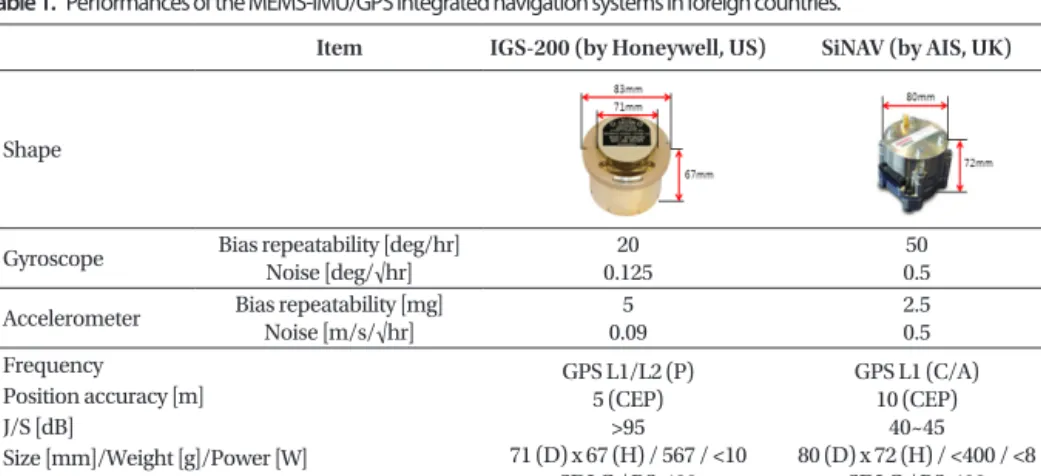
The representative MEMS-based GPS/INS integrated navigation systems include the IGS-200 of Honeywell International, Inc. from the United States and the SiNav of AIS, Inc. from the United Kingdom. Their performances have already been verified by applying them to weapon systems. An MEMS-based navigation system can be used for various applications in addition to guided bombs and smart projectiles. In Korea, the development of a number of guided weapons using MEMS-IMU or navigation system has also been performed, and it is expected to be used in more diverse fields in the future.
This paper introduces the status of the development of an MEMS-based GPS/INS integrated navigation system in Korea. The design method and applied technique of the MEMS-IMU/GPS integrated navigation system are described; and the developed result and its performance are introduced. For the content of this paper, the status of the development of navigation systems in foreign countries is introduced in Section 2; and the design content, development result, and performance of the MEMS-IMU/
GPS integrated navigation system are described in Sections 3 and 4. Lastly, future directions are suggested.
2. STATUS OF MEMS-IMU/GPS
INTEGRATED NAVIGATION SYSTEMS IN FOREIGN COUNTRIES
The representative MEMS-IMU/GPS integrated navigation systems include the IGS-200 of Honeywell International, Inc. from the United States and the SiNav
of AIS, Inc. from the United Kingdom. In addition, there are a number of integrated navigation systems developed based on commercial MEMS sensors. However, most of them have very low performance, and their reliability and environmental resistance are insufficient for weapon systems. In Table 1, the performances of the representative MEMS-IMU/GPS integrated navigation systems were compared. As summarized in Table 1, the MEMS-IMU/GPS integrated navigation systems have a small size; the biases of the gyroscope and the accelerometer are 20~50 deg/hr and 2.5~5 mg, respectively; a position accuracy performance of within 10 m can be provided through integrated navigation with GPS; and the J/S values are higher than that of a general GPS receiver. Especially, the IGS-200 has high electromagnetic wave disturbance resisting performance due to the application of a nulling technique.
3. DESIGN AND DEVELOPMENT OF AN MEMS-IMU/GPS INTEGRATED NAVIGATION SYSTEM
An MEMS-IMU/GPS integrated navigation system was designed so that reliable and accurate navigation information could be provided, by sufficiently reflecting the advantages of an MEMS inertial sensor and by complementing the disadvantages of an MEMS sensor via integrated navigation. Table 2 summarizes the design directions.
As shown in Fig. 1, the MEMS-IMU/GPS integrated navigation system consists of inertial sensor assembly (ISA), signal processing board, navigation computer, GPS receiver, EMI filter board, housing, and vibration isolator. For size minimization, all the electronic components were designed to have a diameter of less than 60 mm by increasing the
Table 1. Performances of the MEMS-IMU/GPS integrated navigation systems in foreign countries.
Item IGS-200 (by Honeywell, US) SiNAV (by AIS, UK)
Shape
Gyroscope Bias repeatability [deg/hr]
Noise [deg/√hr]
20 0.125
50 0.5 Accelerometer Bias repeatability [mg]
Noise [m/s/√hr]
5 0.09
2.5 0.5 Frequency
Position accuracy [m]
J/S [dB]
Size [mm]/Weight [g]/Power [W]
Interface
GPS L1/L2 (P) 5 (CEP)
>95 71 (D) x 67 (H) / 567 / <10
SDLC / RS-422
GPS L1 (C/A) 10 (CEP)
40~45 80 (D) x 72 (H) / <400 / <8
SDLC / RS-422
integration density using multi-layer PCB manufactured by a build-up process, and the major modules were manufactured by ASIC. The efficiency of HW resource usage was increased by the development of an MEMS inertial sensor that has high-grade performance among the grades of MEMS, by the accurate navigation information providing function through deep coupling with GPS, and by the application of single CPU architecture and programmable devices. Also, it was designed to satisfy military environment standards so that the environmental resistance appropriate for weapon systems could be obtained; and the structure was designed so that it could tolerate harsh environments such as gun-launching high impact.
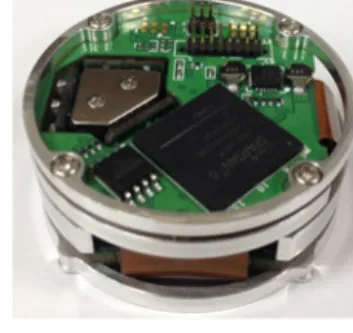
The MEMS ISA consists of an MEMS sensor structure and electronic circuits that control the structure and perform signal processing. The gyroscope of the MEMS is a vibration ring type, and the accelerometer is an electrostatic capacity type. The size of the structure is very small (OxO mm), and the performance was secured by vacuum packaging. The electronic circuits of the gyroscope consist of preamplifier, analog to digital converter (ADC), digital to analog converter (DAC), field-programmable gate array (FPGA), and frequency tuning circuit. The preamplifier is a circuit that
converts the change in electrostatic capacity, which occurs due to the displacement of a sensing structure, into a voltage.
To sense minute changes in electrostatic capacity, a low- noise design was applied. The output of the preamplifier is converted to a digital signal via the differential amplifier and ADC. Then, it is entered into FPGA, and is used as an input signal for the four control loops within FPGA, respectively.
Among the four control circuits, the magnetic resonance control circuit and automatic gain control circuit control the vibration of the driving axis, and the rebalance control circuit and quadrature control circuit control the vibration of the sensing axis. If Coriolis force is applied to the sensing axis due to angular velocity, the rebalance control circuit controls so that the sensing axis can achieve force balance, by applying a force whose magnitude is identical to that of the Coriolis force in the anti-phase. The quadrature control circuit was designed so that it could control the quadrature vibration that occurs at the sensing axis due to frequency offset and external vibration. The electronic circuit of the accelerometer was designed as an analog voltage control structure that can be used in a high acceleration range, through the analysis of existing methods. The electrostatic capacity sensing circuit used a preamplifier with an amplitude modulation charge amplification method, and was designed as a structure that performs feedback control without distinguishing a sensing electrode and a driving electrode. The control circuits excluding the amplifier, ADC, and DAC were designed in a digital method, and the size of the ISA was minimized through implementation using FPGA. Fig. 2 shows the shape of the developed MEMS-ISA.
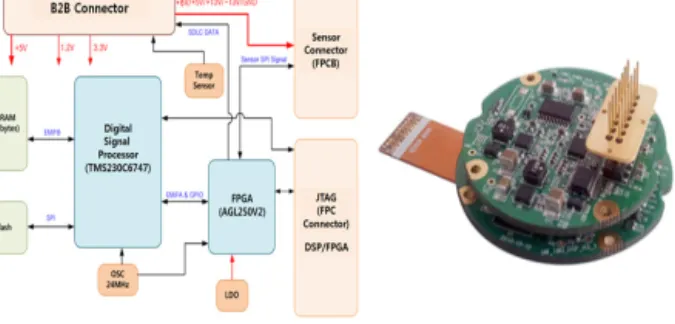
The signal processing board performs the real-time correction of the fixed error and temperature-dependent error included in the sensor signal of the MEMS ISA, and outputs the inertial measurements for navigation operation through coning/sculling compensation. To perform many operations of real numbers at a high speed, the signal processing board was designed based on a digital signal processor (DSP) series processor. For the external Table 2. Design directions of the MEMS-IMU/GPS integrated navigation system.
Item Design direction
Size minimization/
Weight lightening Accuracy
Efficiency
Environmental resistance High-impact survivability
• Device minimization through ASIC of the major modules
• High-integration/high-density HW design
• High-performance MEMS inertial sensor development
• Accuracy improvement through deep coupling with GPS
• HW usage efficiency improvement through the application of single CPU architecture and programmable devices
• Design for satisfying the resistance to harsh environments among the military standards
• Application of the mechanical structure and parts for high-impact resistance
Fig. 1. Structure of the MEMS-IMU/GPS integrated navigation system.
Fig. 2. Shape of the MEMS ISA.
56 JPNT 3(2), 53-62 (2014)
communication interface, an SDLC method was applied, and flexibility was obtained through implementation based on FPGA. Fig. 3 shows the structure and shape of the signal processing board. For size minimization, the diameter of the signal processing board was made to be less than 40 mm.
The GPS receiver was designed to be able to process GPS L1/L2 and GLONASS L1 signals so that it could operate based on multi-band frequencies. For size minimization, the RF part and the correlator (i.e., digital signal processing part) were developed as 1 chip, respectively, through ASIC.
OO-channel satellite signals can be received. The correlator has an extended range correlator (ERC) structure, which has wider tracking range than existing correlators. Also, for high-impact resistance, a clock that is robust to high impact was applied, and the RF part was protected with a can that has a disturbance shielding and mechanical reinforcement
structure, as shown in Fig. 4. After the correlator of the GPS receiver, signal processing is performed by SW, and is operated in the navigation computer.
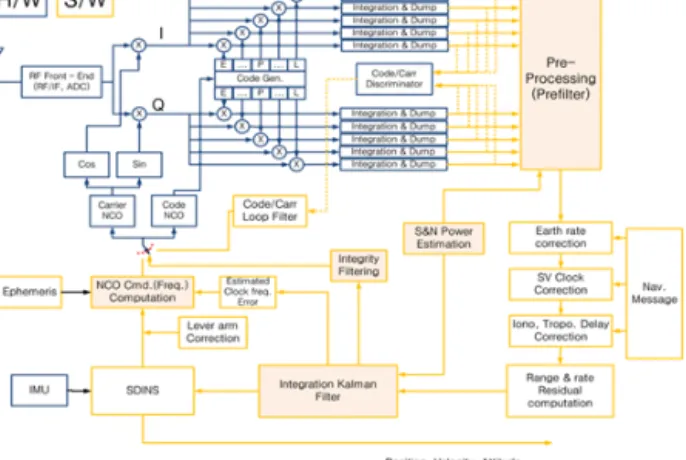
For an existing GPS/INS integrated navigation system, CPU for GPS SW and CPU for integrated navigation SW exist separately. The MEMS-IMU/GPS integrated navigation system was designed as a single CPU based architecture structure, and thus, one CPU operates GPS SW and integrated navigation SW in real time. Single CPU architecture has advantages in terms of size, power consumption, and cost; and is known to be an optimal H/W structure for performing deeply coupled integrated navigation. For deeply coupled integrated navigation, the duplicate signal generator within the GPS receiver, a numerical controlled oscillator (NCO), should be controlled by inertial navigation and the output of the filter at a high refresh rate (1000 Hz), and the output of the correlator should be processed by a pre-processing filter or an integrated filter. If each CPU is used, data need to be exchanged via dual port RAM or serial/parallel communication method, and thus, the performance could deteriorate due to the implementation loss such as transmission delay. To operate GPS SW and integrated navigation SW in single CPU, the navigation computer was designed using high-performance CPU. The CPU is a PowerPC series, and has a small size and a high performance as it was manufactured by a 90 nm process.
It provides various functions such as 400 MHz DDR Memory Controller, USB Dual-Role Controller, Dual Enhanced Three-Speed Ethernet Controllers, Integrated Programmable Interrupt Controller, Power Management Controller, and Serial Peripheral Interface. In addition, it belongs to a product group that is included in the product longevity program of the manufacturer, and thus, the risk of being discontinued is low. The major module other than the CPU part is the external communication interface. All the functions were designed so that easy modification of the functions could be facilitated, through implementation using FPGA. The navigation computer board has a size of Fig. 3. Structure and shape of the MEMS signal processing board.
Fig. 4. Structure and shape of the GPS receiver.
Fig. 5. Structure and shape of the navigation computer.
Jeong Won Kim et al. MEMS-IMU/GPS Navigation System Development 57
or an integrated filter. If each CPU is used, data need to be exchanged via dual port RAM or serial/parallel communication method, and thus, the performance could deteriorate due to the implementation loss such as transmission delay. To operate GPS SW and integrated navigation SW in single CPU, the navigation computer was designed using high-performance CPU. The CPU is a PowerPC series, and has a small size and a high performance as it was manufactured by a 90 nm process. It provides various functions such as 400 MHz DDR Memory Controller, USB Dual-Role Controller, Dual Enhanced Three-Speed Ethernet Controllers, Integrated Programmable Interrupt Controller, Power Management Controller, and Serial Peripheral Interface. In addition, it belongs to a product group that is included in the product longevity program of the manufacturer, and thus, the risk of being discontinued is low. The major module other than the CPU part is the external communication interface. All the functions were designed so that easy modification of the functions could be facilitated, through implementation using FPGA. The navigation computer board has a size of Φ 60 mm. To prevent the cross talk between signals that could occur in the process of size minimization, it was designed based on a signal integrity analysis. A small high-performance navigation computer was developed by the optimal arrangement of parts and by the manufacture of high-integration/high-density build-up PCB. Fig. 5 shows the structure and shape of the navigation computer.
In the case of a navigation system, electromagnetic waves from the asymmetric noise component of power and external interface signals could cause abnormal operation of electronic boards within the navigation system or could affect adjacent devices. To prevent this, it was designed so that all signals could go through the EMI filter board. The EMI filter board was designed to satisfy the military standard (MIL-STD-461E). The filter was designed for rated capacity of the navigation system. A Y-type capacitor structure considering differential mode and an X-type capacitor considering common mode were designed and applied. The signal filter has a C-type low-pass filter structure considering the operating frequency.
Also, a size minimization design was performed through the application of small parts, as shown in Fig. 6.
The housing of the MEMS-IMU/GPS integrated navigation system was designed so that it could tolerate high impact unlike general housing. To minimize the plastic deformation that could occur when high impact is applied, a material with high yield strength was used, and a mechanical rigidity reinforcement design for the weak parts that had been identified through a high impact analysis was applied. In addition, based on the high impact analysis of the internal electronic board components, a mechanical reinforcement design for the electronic boards having the possibility of damage was also reflected.
An MEMS inertial sensor has an inherent characteristic where abnormal operation could occur when vibration is above a certain level. Thus, a vibration isolator should be applied to the navigation system. To satisfy the optimal vibration isolation frequency that had been selected through a frequency response function (FRF) experiment, the vibration isolator was designed using a material and a structure that are not much affected by the changes in temperature. Also, to supplement the high-impact resistance that could be weakened due to the use of a material with low rigidity, a damper was applied. The vibration isolator is combined wrapping the MEMS-ISA, as shown in Fig. 7, and protects the MEMS inertial sensor from external vibration.
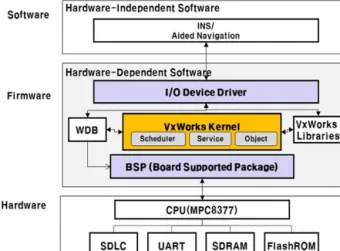
The software of the MEMS-IMU/GPS integrated navigation system was designed based on VxWorks, which is a real-time operating system, and Fig. 8 shows the structure. The integrated navigation algorithm was designed using a deep coupling method, which has superior electromagnetic wave disturbance resisting performance compared to existing weak coupling and strong coupling.
Depending on the method of implementation, there are several kinds of deeply coupled integrated navigation algorithms. Horslund & Hooker (1999) used a method in which range and range-rate residual are used for integrated navigation by estimating them from correlation values using code phase and carrier wave frequency discriminator. Beser et al. (2002) used a method in which pre-processing filtering is performed using a Kalman filter type discriminator. Gustafson et al. (2001) used a method in which a variable gain discriminator depending on S/N is used as a pre-processing filter from ERC based correlator output. Besides, there are several kinds of known deep coupling algorithms, and they have different methods of pre-processing correlator output. In this study, an algorithm that uses ERC based correlator
60 mm. To prevent the cross talk between signals that could occur in the process of size minimization, it was designed based on a signal integrity analysis. A small high- performance navigation computer was developed by the optimal arrangement of parts and by the manufacture of high-integration/high-density build-up PCB. Fig. 5 shows the structure and shape of the navigation computer.
In the case of a navigation system, electromagnetic waves from the asymmetric noise component of power and external interface signals could cause abnormal operation of electronic boards within the navigation system or could affect adjacent devices. To prevent this, it was designed so that all signals could go through the EMI filter board. The EMI filter board was designed to satisfy the military standard (MIL-STD-461E). The filter was designed for rated capacity of the navigation system. A Y-type capacitor structure considering differential mode and an X-type capacitor considering common mode were designed and applied. The signal filter has a C-type low-pass filter structure considering the operating frequency. Also, a size minimization design was performed through the application of small parts, as shown in Fig. 6.
The housing of the MEMS-IMU/GPS integrated navigation system was designed so that it could tolerate high impact unlike general housing. To minimize the plastic deformation that could occur when high impact is applied, a material with high yield strength was used, and a mechanical rigidity reinforcement design for the weak parts that had been identified through a high impact analysis was applied. In addition, based on the high impact analysis of the internal electronic board components, a mechanical reinforcement design for the electronic boards having the possibility of damage was also reflected.
An MEMS inertial sensor has an inherent characteristic
where abnormal operation could occur when vibration is above a certain level. Thus, a vibration isolator should be applied to the navigation system. To satisfy the optimal vibration isolation frequency that had been selected through a frequency response function (FRF) experiment, the vibration isolator was designed using a material and a structure that are not much affected by the changes in temperature. Also, to supplement the high-impact resistance that could be weakened due to the use of a material with low rigidity, a damper was applied. The vibration isolator is combined wrapping the MEMS-ISA, as shown in Fig. 7, and protects the MEMS inertial sensor from external vibration.
The software of the MEMS-IMU/GPS integrated navigation system was designed based on VxWorks, which is a real-time operating system, and Fig. 8 shows the structure.
The integrated navigation algorithm was designed using a deep coupling method, which has superior electromagnetic wave disturbance resisting performance compared to
Fig. 3. S
Fig. 4. S
Fig. 5. S
Fig. 6. S
Structure and
Structure and
Structure and
Shape of the E
shape of the
shape of the
shape of the
EMI filter bo
MEMS sign
GPS receive
navigation c
oard.
nal processing
er.
computer.
g board.
Fig. 6. Shape of the EMI filter board.
Fig. 8. Structure of the integrated navigation real-time SW platform.
Fig. 7. Shape of the combining of the MEMS-ISA and the vibration isolator.
58 JPNT 3(2), 53-62 (2014)
existing weak coupling and strong coupling. Depending on the method of implementation, there are several kinds of deeply coupled integrated navigation algorithms. Horslund
& Hooker (1999) used a method in which range and range- rate residual are used for integrated navigation by estimating them from correlation values using code phase and carrier wave frequency discriminator. Beser et al. (2002) used a method in which pre-processing filtering is performed using a Kalman filter type discriminator. Gustafson et al.
(2001) used a method in which a variable gain discriminator depending on S/N is used as a pre-processing filter from ERC based correlator output. Besides, there are several kinds of known deep coupling algorithms, and they have different methods of pre-processing correlator output. In this study, an algorithm that uses ERC based correlator output and that improves the jamming signal mitigation performance by increasing integration time and using extra correlator output was designed. It was designed as a real- time multitasking structure so that GPS SW and integrated
navigation SW could be operated in single CPU in real time.
Fig. 9 shows the structure of the deeply coupled integrated navigation SW.
As described above, the MEMS-IMU/GPS integrated navigation system is a system where electronic, mechanical, software, and MEMS technologies are integrated. It was designed so that high performance, small size, environmental resistance, and reliability could be secured.
M&S verification for the design content was performed before the manufacture of a the system, and the MEMS- IMU/GPS integrated navigation system was developed and manufactured through verification and debugging processes based on the manufacture of a prototype. Fig. 10 shows the shape of the developed MEMS-IMU/GPS integrated navigation system. The MEMS-ISA and signal processing board that correspond to the lower part of the navigation system can also be used as MEMS-IMU by separate housing, as shown on the left side of Fig. 10.
4. PERFORMANCE OF THE MEMS-IMU/GPS INTEGRATED NAVIGATION SYSTEM
4.1 Inertial Sensor and Navigation Performance
The performance of the MEMS-IMU/GPS integrated navigation system can be divided into inertial sensor performance and navigation performance. The inertial sensor performance is an important element that determines the performance of the navigation system when IMU is independently used or GPS is disconnected. Table 3 summarizes the measurements of the bias and noise of the MEMS gyroscope and accelerometer for a number of the system. The bias repeatability, which is the most important performance, was less than 20 deg/hr and 2 mg, respectively, which showed performance comparable to those of the foreign products.
The evaluation of the navigation performance was conducted through a vehicle test. Fig. 11 shows the vehicle test configuration and the position output trajectory of the integrated navigation system. The position error was Fig. 10. Shape of the MEMS-IMU/GPS integrated navigation system.
Fig. 9. Structure of the integrated navigation SW.
Table 3. MEMS inertial sensor performance results.
Classification Bias repeatability Bias stability Random Walk
Gyroscope
Accelerometer >20 [deg/hr]
>2 [mg] >10 [deg/hr]
>1.5 [mg] >0.2 [deg/√hr]
>0.2 [m/s/√hr]
Table 4. Vehicle test results (Position error (CEP).
Test #1 Test #2 Test #3 Test #4 Test #5