Research Article
Screening of Multiple Abiotic Stress-Induced Genes in Italian Ryegrass leaves
Sang-Hoon Lee
1, Md. Atikur Rahman
2, Kwan-Woo Kim
1, Jin-Wook Lee
1, Hee Chung Ji
2, Gi Jun Choi
2, Yowook Song
2and Ki-Won Lee
2,*1
Animal Genetic Resources Center, National Institute of Animal Science, Rural Development Administration, Namwon 55717, Republic of Korea
2
Grassland & Forages Division, National Institute of Animal Science, Rural Development Administration, Cheonan, 31094, Republic of Korea
ABSTRACT
Cold, salt and heat are the most critical factors that restrict full genetic potential, growth and development of crops globally.
However, clarification of genes expression and regulation is a fundamental approach to understanding the adaptive response of plants under unfavorable environments. In this study, we applied an annealing control primer (ACP) based on the GeneFishing approach to identify differentially expressed genes (DEGs) in Italian ryegrass (cv. Kowinearly) leaves under cold, salt and heat stresses.
Two-week-old seedlings were exposed to cold (4°C), salt (NaCl 200 mM) and heat (42°C) treatments for six hours. A total 8 differentially expressed genes were isolated from ryegrass leaves. These genes were sequenced then identified and validated using the National Center for Biotechnology Information (NCBI) database. We identified several promising genes encoding light harvesting chlorophyll a/b binding protein, alpha-glactosidase b, chromosome 3B, elongation factor 1-alpha, FLbaf106f03,
Lolium multiflorum
plastid, complete genome, translation initiation factor SUI1, and glyceraldehyde-3-phosphate dehydrogenase. These genes were potentially involved in photosynthesis, plant development, protein synthesis and abiotic stress tolerance in plants. However, this study provides new insight regarding molecular information about several genes in response to multiple abiotic stresses. Additionally, these genes may be useful for enhancement of abiotic stress tolerance in fodder crops as well a crop improvement under unfavorable environmental conditions.(Key words : Abiotic stress, Forage, Gene, Italian Ryegrass)
Ⅰ. INTRODUCTION
Abiotic stresses mainly cold, salt, heat, drought and heavy metals are the major limitations of crop productivity which restrict full genetic potential, growth and productivity of crops globally (Tuteja et al., 2011). Cold stress induces several philological constrains through i) generating of reaction oxygen species (ROS), ii) reducing the photochemical efficiency (PSII), and that inhibits photosynthesis in plants (Paredes and Quiles, 2015). Salt stress negatively affects to cells by disturbing the ionic and osmotic equilibrium, whereas, heat stress leads to overproduction of free radicles, induce oxidative stress and subsequent non-reversible damage plant growth (Chalanika et al., 2017). In near future, it is expected that the initiation of heat weave with higher stress intensity
will more severe due to global warming (Wang et al., 2016).
Abiotic stresses induce a series of physiological, biochemical, molecular and morphological changes in crops including forages (Staniak et al., 2015; Rahman et al., 2015, 2016a). In addition, crop performance and yield are the consequence of genotypic expression that is modulated by crop interaction with environment. Thus, screening and functional characterization of genetic resources under abiotic stress would be useful for better understanding the adaptive response of plants to multiple abiotic stresses.
Italian ryegrass (Lolium multiflorum) is the winter forage crop mostly cultivated in Southern Brazil and other South American countries (Pavinato et al., 2014). Recently, it has been extensively cultivated in Korea. Ryegrass is economically most important forage species, considered as excellent source
* Corresponding author : Ki-Won Lee, Grassland & Forages Division, National Institute of Animal Science, Rural Development Administration, Cheonan 31094, Republic of Korea. Tel: +82-41-580-6757, E-mail: [email protected]
of high productivity with high nutritive value (Gerdes et al.
2005). Despite of its many superior properties of ryegrass, some species are known to be sensitive to abiotic stresses, thus limiting its cultivation in certain area (Hulke et al. 2008).
Plants have evolved some strategies to avoid and/or tolerate several abiotic stresses, and molecular breeding approach using suitable candidate genes provides excellent support for forage crop improvement against multiple abiotic stresses (Alam et al., 2010; Singer et al., 2017).
Numerous molecular candidates have been extensively disclosed in several forages legume and grass species including perennial ryegrass (Hulke et al. 2008), alfalfa (Rahman et al., 2015, 2016 a,b), tall fescue (Lou et al., 2017), and Siberian wild rye (Xie et al., 2017), teff grass (Lee et al., 2018) under abiotic stresses. Advanced molecular tools give the new opportunities for understanding of global gene expression in plants. Regulation of gene expression, and functional responses towards abiotic stress tolerance have been demonstrated in forage and turf grass (Kopecký and Studer, 2014), Arabidopsis (Azevedo et al., 2016), and alfalfa (Li et al., 2017). Despite of great progresses in diverse plants, still needs to be elusive in Italian ryegrass (cv. Kowinearly).
Sequence-based several molecular approaches present a better alternative to identify and analyze gene expression. For instance, the serial analysis of gene expression (SAGE) was considered as suitable approach for gene expression profiling (Velculescu et al., 1995), followed by massively parallel signature sequencing (MPSS) (Brenner et al., 2000), suppression subtractive hybridization (SSH) (Sahu and Shaw, 2009), and next-generation sequencing (NGS) technologies (Jain, 2012) which were used to target range of transcript and low abundant genes in plants. In recent years, a GeneFishing approach is being successfully used to identify the differentially expressed genes (DEGs) in plants (Rahman et al., 2016b; Lee et al., 2018). Hence, the benefit of this suitable approach is that it increases the annealing specificity to the template and able to amplify only the genuine gene products.
In this study, we applied annealing control primer (ACP) based gene fishing technique to identify cold, salt and heat-induced DEGs in Italian ryegrass (cv. Kowinearly), subsequently would be target genes to develop abiotic stress tolerant forage crops.
Ⅱ . MATERIALS AND METHODS
1. Plant materials, growth conditions and application of abiotic stresses
Italian ryegrass (Lolium multiflorum cv. Kowinearly) seeds were collected from the Division of Grassland and Forages, National Institute of Animal Science (NIAS). Italian ryegrass seeds were sterilized using 70% ethanol for 2 minutes and washed three times by Mlli-q, followed by the seeds were treated by 30% sodium hypochlorite (NaOCl) solution for 30 min. Finally, surface sterilized seeds were moved to germination medium containing 3% sucrose and half MS (Murashige &
Skoog). The culture room environment was maintained in the room temperature as 25 ±1°C with of 400 µmol m
-2s
-1light and 14 h light/8 h dark period. Two-week old ryegrass seedlings were exposed to cold (4 °C), salt (200 mM NaCl) or heat (42
°C) treatments for 6 h, respectively. The control plants were maintained at 25 ±1°C temperature and/or irrigated by only water. After 6 h of all stress treatments the plants leaves were cut from shoot and leaf transition zone, washed properly using Milli-q water for three times, quickly frozen in liquid N
2for further molecular analyses.
2. Isolation of total RNA and cDNA synthesis
Total RNA was extracted from abiotic stresses treated and non-treated (control) ryegrass leaves using TRIzolreagent (Qiagen, CA, USA). These RNA samples were used for the first stand cDNAs synthesis by reverse transcriptase. The reserve transcription reaction was carried out as described earlier by Lee et al. (2009). After completing of first-strand cDNAs synthesis, samples were diluted at by adding 80 µl of one fold dilution of Milli-q water, and prepared for the GeneFishing
TMapproach.
3. GeneFishing by annealing control primer (ACP)-based approach
DEGs using control primer (ACP)-based approach was carried
out. For this molecular technique, Gene Fishing-kit (Seegene,
Inc., Republic of Korea) was used. Subsequently, synthesis of
the second strand cDNA was performed according to traditional thermal cycler’s protocol and experimental methods of Lee et al.
(2011). Finally, the amplified products were collected and separated by using 1% agarose gel containing RedSafe™
(5µL/100 mL solution; ABC Scientific, USA).
4. Cloning and identification of DEGs
Abiotic stress-induced DEGs were isolated from the gel by using the GENCLEAN II Kit (Q-BIO gene, Carlsbad, CA, USA), and subsequently cloned into a TOPO TA cloning vector (Invitrogen, Carlsbad, CA, USA) based the manufacturer’s protocol. Followed by the sequencing of cloned plasmids were performed using an ABI PRISM 3100 Genetic Analyzer (Applied Biosystems, Foster City, CA, USA). Finally, the sequences of specific genes were validated and confirmed by comparing to corresponding homologs in NCBI database (https://blast.ncbi.nlm.nih.gov/Blast).
Ⅲ. RESULTS AND DISCUSSION
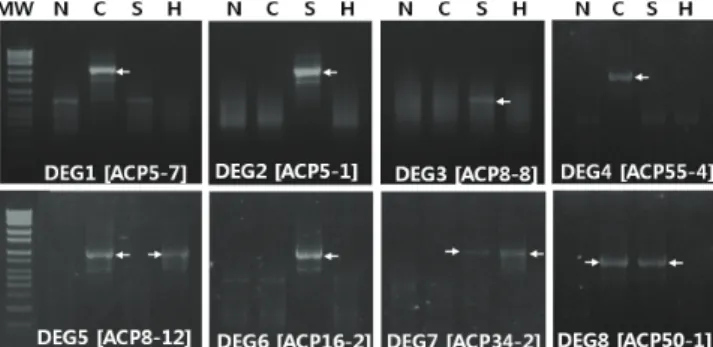
We successfully screened and identified abiotic stress-induced several DEGs including light harvesting chlorophyll a/b binding protein (named as DEG 1), alpha-glactosidase b (DEG 2), chromosome 3B (DEG 3), elongation factor 1-alpha (EF1a;
DEG 4), FLbaf106f03 (DEG 5), Lolium multiflorum plastid, complete genome (DEG 6), translation initiation factor SUI1 (DEG7), nd glyceraldehyde-3-phosphate dehydrogenase (DEG 8) in Italian ryegrass leaves (Figs. 1-3; Table 1). In the following sections, we have clarified the potential role of these identified candidate genes by evaluating previous genomics, abiotic stress responses, and biological importance in plant system.
A light complex is comprised of several subunit proteins which are supercomplex of photosystem, the functional unit of photosynthesis. We have identified cold stress-induced a gene encoding light harvesting chlorophyll a/b binding protein (LHCB;
DEG 1). The LHCB gene is known as key apoprotein of the light-harvesting complex of photosystem II (PSII), this proteins is known to be associated in guard cell signaling. The up-regulation of LSCB in response to cold stress suggests that it is possibly inv LHCB protein gene containing important stress responsive
element, showed similarities among dark, heat, salinity and drought response at developmental stage in barley (Qin et al., 2017). In our study, we identified cold-induced LHCB, therefore we hypothesized that this LHCB gene has pivotal role in photosynthesis and developmental stages in Italian ryegrass leaves.
Salt-induced DEG2 expression is enhanced by salt in Italian ryegrass leaves and identified as alpha-glactosidase b (α-Gal b;
Table 1, Fig. 1). The α-Gals are member of the glycoside hydrolase family, which have pivotal role in leaf elongation during plant development (Chrost et al., 2007). Moreover, it was documented that α-Gal showed tolerance in plants against freezing (Pennycooke et al., 2003). In this study, α-Gal gene was found to be highly induced response to salinity, which indicates α-Gal might be also involved in salt tolerance in Italian ryegrass.
Therefore, this gene would be used as suitable biomarker in abiotic stress response as well as development of abiotic stress tolerant forage crops. DEG3 is identified as encoded chromosome 3B, Choulet et al. (2014), produced a reference sequence of 1 gigabase (gb) chromosome 3B in Triticum aestivum and distributed its structural and functional features. Moreover, they clarified the relationship, gene expression function and chromosome location under15 conditions, also revealed that the several distal regions were enriched wherein some are responded to abiotic stimulus.
However, the gene response in Italian ryegrass to abiotic stress such as NaCl in our study, was supported by this observation.
Fig. 1. Cold, salt, and heat-induced genes in Italian ryegrass leaves. Agarose gel image shows the differentially expressed genes (DEGs) induced by cold (4 °C), salt (NaCl; 200 mM), and heat (42 °C). Arrows on gel image indicate the stress specific DEGs. MW, molecular weight size marker; N, non-treatment; C, cold; S; salt (NaCl); H, heat; ACP, annealing control primer
Cold-induced DEG4 identified as elongation factor 1 alpha
(EF-1 alpha) in ryegrass leaves. LeEF-1 alpha led to enhance
protein synthesis in tomato plants (Pokalsky et al., 1989). In addition, they also found that the increased expression of LeEF-1 alpha mRNA was correlated with higher levels of protein synthesis in developing tissues of tomato. Therefore, up-regulation of EF-1 alpha in our study would be recommend as a candidate for enhancement of protein synthesis in forage leaves, as our main deal with fodder improvement specially for livestock. In this study, we identified some genes in ryegrass leaves, and those specific function still unknown and uncharacterized. For example, the combined cold-heat induced FLbaf106f03 (DEG 5), and a salt-induced Lolium multiflorum plastid, complete genome (DEG6). However, further exploration concerning abiotic stress-induced functional regulation of these genes is needed to develop our understanding.
Salt and heat-induced DEG7 was identified as translation initiation factor Shortened Uppermost Internode1 (SUI1). The member of SUI genes family has significant importance in the development of plant aerial part (Yin et al., 2013). In our
study, we hypothesized that the up-regulation of SUI1gene might be involved in the response of several abiotic stress regulations, as it induced significantly by salt and heat in ryegrass leaves. Moreover, Yin et al. (2013) found that overexpression of SUI1 and SUI2 led to enhance growth of internodes at the stages of vegetative development in rice.
However, these above observations provide the role of SUI1 in abiotic stress response along with plants development.
We also identified the glyceraldehyde-3-phosphatedehydrogenase (GAPDH, DEG8) enzyme in ryegrass leaves; this is a ubiquitous enzyme that plays important role in the glycolysis process. GAPDH is known to be participated in metabolic processes as well as abiotic stress tolerance in plants. Zeng et al. (2016) observed that the expression of several GAPDH genes, which were modulated by abiotic stimuli and associated with enhanced abiotic stress tolerance in wheat. However, the up-regulation of GAPDH in rye grass suggests that it would be potential candidate for conferring stress tolerance in forage crops.
DEG No.
Cold induced
genes Name of (blastx search) Total
score E value Identity Accession 01 Cold Light harvesting chlorophyll a/b binding protein
[Tritivum aestivum] 510 4.00E-141 87% HM362991.1
04 Cold Elongation factor 1-alpha (EF1a)
[Deschampsia antarctica] 1628 0.0 92% HM208299.1
Table 1. Cold-induced DEGs in Italian ryegrass leaves.
DEG
No. Salt induced Name of (blastx search) Total
score E value Identity Accession
02 Salt Alpha-glactosidase b (partial)
[Aegilops tauschii subsp. tauschii] 990 00 95% XM_020300011.1
03 Salt Chromosome 3B
[Tritivum aestivum cv. Arina] 111 3.00E-21 96% HE996635.1
06 Salt Lolium multiflorum plastid,complete genome
[Lolium multiflorum] 2498 0.0 99% JX871942.1
Table 2. Salt–induced DEGs in Italian ryegrass leaves.
DEG No.
Cold-heat and
salt Name of (blastx search) Total
score E value Identity Accession
05 Cold, Heat FLbaf106f03,
[Hordeum vulgare subsp. vulgare] 368 2.00E-98 87% AK251177.1
07 Salt, Heat Translation initiation factor SUI1
[Brachypodium distachyon] 512 1.00E-141 86% XM_003562949.1
08 Cold, Salt Glyceraldehyde-3-phosphate dehydrogenase
[Tritivum aestivum cv. wyuna] 1474 0.0 93% FN429985.1
Table 3. Cold, heat, and salt-induced DEGs in Italian ryegrass leaves.
Ⅳ . CONCLUSION
In this study, several DEGs including light harvesting chlorophyll a/b binding protein, alpha-glactosidase b, chromosome 3B, elongation factor 1-alpha, FLbaf106f03, Lolium multiflorum plastid, complete genome, translation initiation factor SUI1, and glyceraldehyde-3-phosphate dehydrogenase were identified using ACP-based GeneFishing approach. These genes were significantly up-regulated by various abiotic stresses (cold, salt and heat) in Italian ryegrass leaves. These identified genes were involved in photosynthesis, plant development, protein synthesis and abiotic stress tolerance. The identification of these genes in ryegrass leaves would be effective as promising candidates for the fodder crops improvement under multiple abiotic stresses.
Ⅴ . ACKNOWLEDGMENTS
This study was supported by the “Cooperative Research Program for Agriculture Science & Technology Development (Project No. PJ01193504)” and Postdoctoral Fellowship Program of 2018, National Institute of Animal Science, Rural Development Administration, Republic of Korea.
Ⅵ . REFERENCES
Alam, I., Kim, K.H., Sharmin, S.A., Kim, Y.G., and Lee, B.H. 2010. Advances in the molecular breeding of forage crops for abiotic stress tolerance. Journal of Plant Biotechnology.
37:425-441.
Azevedo, H., Azinheiro, S.G., Muñoz-Mérida, A., Castro, P.H., Huettel, B., Aarts, M.G.M. and Assunção, A.G.L. 2016.
Transcriptomic profiling of Arabidopsis gene expression in response to varying micronutrient zinc supply. Genomics Data.
7:256-258.
Brenner, S., Johnson, M., Bridgham, J., Golda, G., Lloyd, D.H., Johnson, D., Luo, S., McCurdy, S., Foy, M., Ewan, M., Roth, R., George, D., Eletr, S., Albrecht, G., Vermaas, E., Williams, S.R., Moon, K., Burcham, T., Pallas, M., DuBridge, R.B., Kirchner, J., Fearon, K., Mao, J.-I. and Corcoran, K. 2000.
Gene expression analysis by massively parallel signature
sequencing (MPSS) on microbead arrays. Nature Biotechnology.
18:630.
Chalanika De Silva, H.C. and Asaeda, T. 2017. Effects of heat stress on growth, photosynthetic pigments, oxidative damage and competitive capacity of three submerged macrophytes. Journal of Plant Interactions. 12:228-236.
Choulet, F., Alberti, A., Theil, S., Glover, N., Barbe, V., Daron, J., Pingault, L., Sourdille, P., Couloux, A., Paux, E., Leroy, P., Mangenot, S., Guilhot, N., Le Gouis, J., Balfourier, F., Alaux, M., Jamilloux, V., Poulain, J., Durand, C., Bellec, A., Gaspin, C., Safar, J., Dolezel, J., Rogers, J., Vandepoele, K., Aury, J.-M., Mayer, K., Berges, H., Quesneville, H., Wincker, P. and Feuillet, C. 2014. Structural and functional partitioning of bread wheat chromosome 3B. Science. 345.
Chrost, B., Kolukisaoglu, U., Schulz, B. and Krupinska, K.
2007. An α-galactosidase with an essential function during leaf development. Planta. 225:311-320.
Gerdes, L., Mattos, H.B.d., Werner, J.C., Colozza, M.T., Cunha, E.A.d., Bueno, M.S., Possenti, R.A. and Schammass, E.A. 2005. Chemical composition and digestibility of forage mass in irrigated aruanagrass pastures or oversown with a mixture of winter forage species. Revista Brasileira de Zootecnia. 34:1098-1108.
Hulke, B.S., Watkins, E., Wyse, D.L. and Ehlke, N.J. 2008.
Freezing tolerance of selected perennial ryegrass (Lolium perenne L.) accessions and its association with field winter hardiness and turf traits. Euphytica. 163:131-141.
Jain, M. 2012. Next-generation sequencing technologies for gene expression profiling in plants. Briefings in Functional Genomics. 11:63-70.
Kopecký, D. and Studer, B. 2014. Emerging technologies advancing forage and turf grass genomics. Biotechnology Advances. 32:190-199.
Lee, K.W., Rahman, M.A., Choi, G.J., Ji, H.C., Hwang, T.Y.
and Lee, S.H. 2018. Identification of differentially expressed abiotic stress-induced genes in teff grass (Eragrostis tef) leaves.
The Journal of Animal and Plant Science. 28:1189-1193.
Lee, K.W., Choi, G. J., Kim, K.Y., Ji, H.C., Zaman, R. and Lee, S.H. 2011. Identification of drought induced differentially expressed genes in barley leaves using annealing control-primer-based Gene Fishing technique. Australian Journal of Crop Science. 5:1364-1369.
Lee, S.H., Lee K.W., Kim, K.Y., Choi, G.J., Yoon, S.Y., Ji,
H.C., Seo, S., Lim, Y.C. and Ahsan, N. 2009. Identification of salt-stress induced differentially expressed genes in barley leaves using the annealing-control-primer-based GeneFishing technique. African Journal of Biotechnology. 8:1326-1331.
Li, Y., Wan, L., Bi, S., Wan, X., Li, Z., Cao, J., Tong, Z., Xu, H., He, F. and Li, X. 2017. Identification of drought-responsive micrornas from roots and leaves of alfalfa by high-throughput sequencing. Genes. 8:119.
Lou, Y., Zhao, P., Wang, D., Amombo, E., Sun, X., Wang, H. and Zhuge, Y. 2017. Germination, physiological responses and gene expression of tall fescue (Festuca arundinacea Schreb.) growing under Pb and Cd. PLOS ONE. 12:e0169495.
Paredes, M. and Quiles, M.J. 2015. The effects of cold stress on photosynthesis in Hibiscus plants. PLOS ONE. 10:e0137472.
Pavinato, P.S., Restelatto, R., Sartor, L.R. and Paris, W.
2014. Production and nutritive value of ryegrass (cv. Barjumbo) under nitrogen fertilization. Revista Ciência Agronômica. 45:230-237.
Pennycooke, J.C., Jones, M.L. and Stushno, V.C. 2003.
Down-regulating α-galactosidase enhances freezing tolerance in transgenic petunia. Plant Physiology. 133:1-9.
Pokalsky, A., Hiatt, W., Ridge, N., Rasmussen, R., Houck, C.
and Shewmaker, C. 1989. Structure and expression of elongation factor 1α in tomato. Nucleic Acids Research. 17:4661-4673.
Qin, D., Dong, J., Xu, F., Ge, S., Xu, Q. and Li, M. 2017.
Genome-wide identification and characterization of light harvesting chlorophyll a/b binding protein genes in barley (Hordeum vulgare L.) Advances in Crop Science and Technology. 301.
Rahman, M.A., Alam, I., Kim, Y.G., Ahn, N.Y., Heo, S.H., Lee, D.G., Liu, G. and Lee, B.H. 2015. Screening for salt-responsive proteins in two contrasting alfalfa cultivars using a comparative proteome approach. Plant Physiology and Biochemistry. 89:112-122.
Rahman, M.A., Kim Y.G., Alam, I., Liu, G., Lee, H., Lee, J.J. and Lee, B.H. 2016a. Proteome analysis of alfalfa roots in response to water deficit stress. Journal of Integrative Agriculture. 15:1275-1285.
Rahman, M.A., Lee, S.H., Kim, K.Y., Park, H.S., Hwang, T.Y., Choi, G.J. and Lee, K.W. 2016b. Arsenic-induced
differentially expressed genes identified in Medicago sativa L.
roots. Journal of The Korean Society of Grassland and Forage Science. 36:243-247.
Sahu, B.B. and Shaw, B.P. 2009. Isolation, identification and expression analysis of salt-induced genes in Suaeda maritima, a natural halophyte,using PCR-based suppression subtractive hybridization. BMC Plant Biology. 9:69-69.
Singer, S.D., Hannoufa, A. and Acharya, S. 2017. Molecular improvement of alfalfa for enhanced productivity and adaptability in a changing environment. Plant, cell & environment. 13090.
Staniak, M. and Kocoń, A. 2015. Forage grasses under drought stress in conditions of Poland. Acta Physiologiae Plantarum. 37:116.
Tuteja, N., Gill, S.S. and Tuteja, R. 2011. Plant responses to abiotic stresses: shedding light on salt, drought, cold and heavy metal stress. Omics and Plant Abiotic Stress Tolerance.
pp. 39-64.
Velculescu, V.E., Zhang, L., Vogelstein, B. and Kinzler, K.W. 1995. Serial analysis of gene expression. Science.
270:484-487.
Wang, D., Heckathorn, S.A., Mainali, K. and Tripathee, R.
2016. Timing effects of heat-stress on plant ecophysiological characteristics and growth. Frontiers in Plant Science. 7.
Xie, W., Zhang, J., Zhao, X., Zhang, Z. and Wang, Y. 2017.
Transcriptome profiling of Elymus sibiricus, an important forage grass in Qinghai-Tibet plateau, reveals novel insights into candidate genes that potentially connected to seed shattering. BMC Plant Biology. 17:78.
Yin, H., Gao, P., Liu, C., Yang, J., Liu, Z. and Luo, D.
2013. SUI-family genes encode phosphatidylserine synthases and regulate stem development in rice. Planta. 237:15-27.
Zeng, L., Deng, R., Guo, Z., Yang, S. and Deng, X. 2016.
Genome-wide identification and characterization of Glyceraldehyde-3-phosphate dehydrogenase genes family in wheat (Triticum aestivum). BMC Genomics. 17:240.
(Received : August 29, 2018 | Revised : September 13, 2018 | Accepted : September 13, 2018)