신경재활치료과학 제7 권 제 3 호
Therapeutic Science for Neurorehabilitation Vol. 7. No. 3. 2018.
https://doi.org/10.22683/tsnr.2018.7.3.023
뇌졸중 환자의 상지 경직 감소와 기능 향상을 위한 국소 진동자극의 효과에 대한 체계적 고찰
원경아*, 박지혁**
*연세대학교 일반대학원 작업치료학과
**연세대학교 보건과학대학 작업치료학과
국문초록
목적 : 본 연구는 국외 학술지를 대상으로 한 체계적 문헌고찰 연구를 통해 경직을 가지고 있는 뇌졸 중 환자를 대상으로 진동자극의 효과를 제시하는 데에 목적이 있다.
연구방법 : 전자 데이터베이스인 NDSL과 RISS를 사용하여 2009년 4월부터 2017년 10월까지의 논 문을 검색하였다. 주요 검색 용어로 ‘Vibration therapy’, ‘Focal vibration ’, ‘Somatosensory’,
‘Upper limb’와 ‘Spasticity after stroke를 사용하였다. 선정기준과 배제기준을 통해 최종적으로 6 개의 논문이 선정하였다.
결과 : 국소 진동자극의 효과를 알아보기 위한 중재방법으로는 진동자극만을 적용한 중재부터 과제 기반 진동자극 중재부터 다양하였다. 중재효과를 알아보기 위해 경직, 상지기능, 일상생활동작 평 가도구가 사용되었다. 국소 진동자극은 뇌졸중 환자의 경직 감소와 상지기능에 긍정적인 영향이 있 는 것으로 나타났으며, 대뇌피질의 활성화에도 유의미한 효과가 있는 것으로 나타났다.
결론 : 본 연구를 통해 치료사들은 국소 진동자극 적용에 필요한 정보 및 근거를 찾을 수 있을 것이다.
하지만 다양한 국소 진동자극의 적용 방법으로 인해 효율적인 진동수, 진폭의 크기 및 진동을 적용 할 위치를 확인하는 데에는 어려움이 있었다. 향후 국내연구에서는 국소 진동자극의 효과를 극대화 할 수 있는 체계적인 중재 프로토콜에 대한 연구가 필요하다.
주제어 : 경직, 국소 진동자극, 뇌졸중, 상지 기능
교신저자 : 박지혁([email protected]) || 접수일: 2018.07.12. || 심사일: 2018.08.06.
|| 게재승인일: 2018.08.14.
Ⅰ. 서 론
뇌졸중 이후 환자에게서 나타나는 경직은 근 긴 장도의 증가, 사지의 비정상적 자세, 근육의 과도한 구축, 힘줄 반사 항진 등의 임상적 문제들을 포함하 는 폭넓은 개념의 용어이다(Noma, Matsumoto, Shimodozono, Etoh, & Kawahira, 2012). 뇌졸중 환자 중 약 20~40%에서 경직이 발생하는데, 이러한 상지 근 긴장도의 병적인 증가는 상지 기능을 제한 시킨다(Noma, Matsumoto, Etoh, Shimodozono,
& Kawahira, 2009). 상지의 기능은 일상생활활동 및 사회 참여 그리고 지역사회로의 복귀에 필요하 며, 이러한 요인들은 전반적인 삶의 질을 결정하는 데 밀접한 관련이 있다(Hatem et al., 2016).
따라서 뇌졸중으로 인한 편마비 환자의 상지 기 능 회복을 위해 근 긴장도 조절은 중요한데, 경직 감 소를 위해 현재 임상에서 사용되고 있는 중재 방법 은 크게 약물 치료와 비약물 치료로 구분될 수 있다. 하지만, 보툴리눔 독소나 페놀과 같은 약물 치료는 근 약화와 근력감소와 같은 부작용을 유발할 수 있 고, 스트레칭이나 온열치료와 같은 비약물 치료는 지속 효과가 짧다는 단점이 있다(Noma et al., 2012).
상지 경직 감소를 위한 효과적인 방법 중 하나는 반복적인 체성 감각자극의 입력을 통해 중추신경계 의 구조와 기능을 변화시킨다는 신경가소성을 바탕 으로 한다(Marconi et al., 2011). Heath, Hore 과 Phillips(1976)는 진동자극의 수용기 중 하나인 근 육방추(muscle spindle)의 Ⅰa 구심성 섬유가 대뇌 피질의 SⅠ 및 MⅠ영역과 직접적으로 연결되어 있 음을 발견하였다. 이러한 직접적인 연결은 진동자 극이 운동피질과 체감각피질을 재구조화하는데 있 어서 해부학적 기초를 제공한다고 보고되었다 (Huerta & Pons, 1990).
진동자극은 뇌졸중 환자의 재활을 위해 인위적으 로 체성감각자극을 제공하는 방식 중 하나이며, 부
작용이 적고 적용하기 위해 특별한 노력이 필요하 지 않는다는 장점이 있다. 진동자극은 적용 방법에 따라 크게 전신 진동자극(whole body vibration)과 국소 진동자극(focal or localized vibration) 두 가 지로 구분된다. 특히 국소 진동자극은 뇌졸중 후 나 타나는 상지 경직의 감소와 기능회복에 효과가 있 음이 보고되었다(Murillo et al., 2014).
따라서 본 연구를 통해 최근 10년간 외국 학술지 에 실린 국소 진동자극을 이용한 뇌졸중 환자의 상 지 경직 감소와 기능 회복과 관련된 연구동향을 알 아보고자 하였다. 이는 국소 진동자극 중재 계획 시, 도움이 될 수 있는 정보 및 근거를 제시해 줄 수 있을 것이다.
Ⅱ. 연구 방법
1. 검색 방법 및 분석 대상
2009년 4월에서 2017년 10월 사이에 국외학술지 에 게재된 논문들을 NDSL과 Riss를 통해 검색하였 다. 주요 검색어로 ‘Vibration therapy’, ‘Focal vi- bration’, ‘Somatosensory’, ‘Upper limb’와
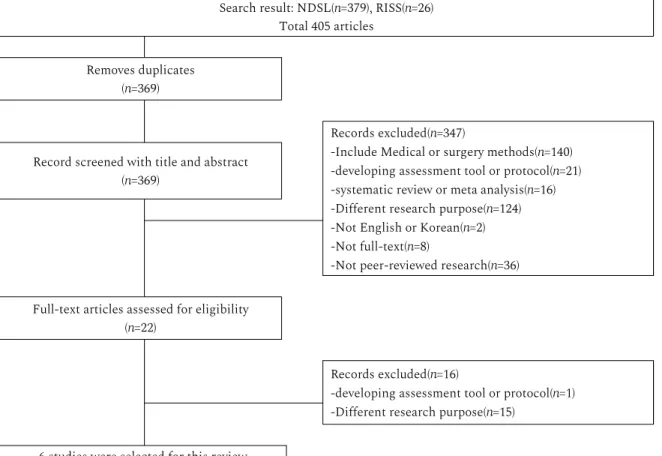
‘Spasticity after stroke’를 사용하였다. 검색 결과 중에서 본 연구의 선정기준과 배제기준에 부합하는 6편의 논문을 최종 선정하여 분석하였다(Figure 1).
1) 선정기준 (1) 실험논문인 연구
(2) 대상자가 경직을 가진 뇌졸중 환자인 연구 (3) 국소 진동자극 효과에 대한 연구
(4) 상지 경직 및 기능과 관련된 연구 (5) 전문을 볼 수 있는 연구
2) 배제기준
(1) 외과적 수술이나 약물이 사용된 연구
(2) 전신 진동자극의 효과에 대한 연구 (3) 영어로 저술되지 않은 연구 (4) 체계적 고찰 또는 메타분석 연구 2. 연구 질적 수준
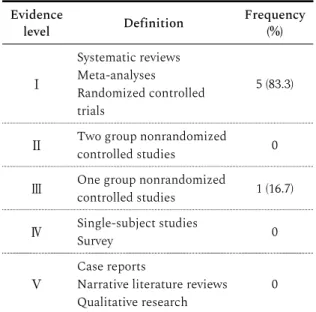
최종적으로 선정된 6편의 연구에 대한 질적 수준 평가를 위해 Arbesman 등(2008)에 의해 개발된 5 단계 분류기준(Table 1)을 사용하였다(Table 2).
3. 근거 제시 방법
국소 진동자극의 효과를 알아보기 위해, 6편의 논문에 대한 결과를 P.I.C.O. 방법으로 제시하였
다. P.I.C.O. 방법은 임상적인 질문에 대한 근거들 을 대상자(Patient), 중재법(Intervention), 대조법 (Comparison). 결과(Outcome)의 틀로 제시한다.
Law와 MacDermid(2008)는 P.I.C.O. 방법을 통 해 찾은 근거들을 체계적으로 제시할 수 있다고 하 였다.
Ⅲ. 연구결과
1. 연구 대상자에 대한 일반적 특성
국소 진동자극의 효과를 알아보기 위해, 6편의 연
Search result: NDSL(n=379), RISS(n=26) Total 405 articles
Removes duplicates (n=369)
Records excluded(n=347)
-Include Medical or surgery methods(n=140) -developing assessment tool or protocol(n=21) -systematic review or meta analysis(n=16) -Different research purpose(n=124) -Not English or Korean(n=2) -Not full-text(n=8)
-Not peer-reviewed research(n=36) Record screened with title and abstract
(n=369)
Full-text articles assessed for eligibility (n=22)
Records excluded(n=16)
-developing assessment tool or protocol(n=1) -Different research purpose(n=15)
6 studies were selected for this review
Figure 1. Flow Diagram of the Literature Selection Precess
구에서 총 181명의 뇌졸중 환자가 모집되었다. 대상 자들의 평균 연령은 54.42세에서 67세, 평균 발병기 간은 5개월에서 100.71개월의 범위를 나타냈다. 6 편의 연구 중 3편의 연구가 아급성기(30-180일), 2
편의 연구는 만성기(>180일) 환자를 대상으로 하였 으며 1편의 연구는 대상자들의 유병기간을 언급하 지 않았다(Table 3).
2. 연구의 특성
1) 대상 연구의 질과 디자인
1편의 연구(Noma et al., 2009)만 근거수준 Ⅲ에 해당하였고, 나머지 5편의 연구(Noma et al., 2012;
Caliandro et al., 2012; Casale et al., 2014;
Author(year) Evidence level
Noma et al.(2009) Ⅲ
Noma et al.(2012) Ⅰ
Caliandro et al.(2012) Ⅰ
Casale et al.(2014) Ⅰ
Costantino et al.(2017) Ⅰ
Calabro et al. (2017) Ⅰ
Table 2. Evidence level of the analyzed studies Evidence
level Definition Frequency
(%)
Ⅰ
Systematic reviews Meta-analyses
Randomized controlled trials
5 (83.3)
Ⅱ Two group nonrandomized
controlled studies 0
Ⅲ One group nonrandomized
controlled studies 1 (16.7)
Ⅳ Single-subject studies
Survey 0
Ⅴ
Case reports
Narrative literature reviews
Qualitative research 0
Table 1. Level of Evidence for Studies
Study Subject(M/F) Age Post-stroke
(months) Stage
Exp Contr Exp Contr Exp Contr
Noma et al.
(2009) 8/6 57.3±19.1 4.93±4.4 Subacute
Noma et al.
(2012) 8/4 8/4
9/3 57.5 61.0
61.5 5.38 4.00
4.13 Subacute Caliandro et al.
(2012) 20/8 14/7 54.42
±12.79 61.85
±15.74 100.71
±82.8 96.4
±66.8 Chronic Casale et al.
(2014) 9/6 9/6 60.60 59.87 - - -
Costantino et al.
(2017) 11/6 10/5 59.0
±15.39 60.47
±16.9 37.78±17.72 Chronic
Calabro et al.
(2017) 5/5 4/6 66±5 67±4 5±2 6±2 Subacute
Table 3. General characteristic of the studies
Costantino et al., 2017; Calabro et al., 2017)는 근 거수준 Ⅰ에 해당하였다.
2) 중재
4편의 연구에서는 진동자극만 단독으로 사용하 였다. 1편은 진동자극과 함께 물리치료를 적용하였 고, 나머지 1편에서는 진동자극과 더불어 로봇 장치 를 이용한 과제 지향적 훈련을 진행하였다. 6편의 연구에서 중재는 1일부터 8주까지 다양한 기간 동 안 적용되었다(Table 4).
3) 진동자극
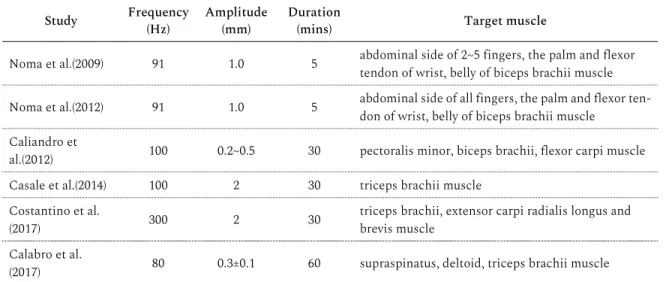
6편 연구 모두에서 진동자극의 강도는 진동수와 진폭을 사용하여 표현하였는데. 진동수(Hz)는 80~100으로, 진폭(mm)은 0.2~2의 범위로 다양하게 적용되었다. 3편의 연구에서는 위팔두갈래근 등 상 지의 굽힘근들을 자극하였고, 다른 3편의 연구에서 는 위팔세갈래근 등 상지의 폄근들을 자극하는 것 으로 나타났다(Table 5). 진동자극의 강도가 불편했 거나 통증이 느껴지는 등의 부작용을 보고한 연구 는 없었다. 진동자극 그룹과 비교하기 위한 대조군 이나 위상치료군에서는 진동자극 그룹과 동일한 강 도로 설정은 하였으나, 실제로는 진동자극이 적용 되지 않도록 진동자극 장치를 위치시켰다. 자극은 하루에 5~30분간 1~2번 적용되었다.
4) 결과 측정 방법
진동자극의 효과를 알아보기 위한 평가도구로, 상지 근긴장도를 위해서는 Modified Ashworth Scale, 근전도 검사를 통한 F wave study가 사용되 었고, 상지 운동기능은 Wolf Motor Function Test, Fugl Meyer Assessment, Jebseb Talyor Hand Function Test, Hand grip strength test 등 이 사용되었다.
분석된 6편의 연구 모두 사전 사후 중재에 대한 평가를 실시하였고, 이 중 후속평가를 실시한 연구
는 3편이었다. 후속평가 기간은 2일에서 4주의 범위 로 나타났다(Table 4).
5) 측정 결과
상지 경직 감소에 대한 효과를 비교한 결과, 6편 중 5편의 연구에서 진동자극 후 경직이 유의미하게 감소된 것으로 나타났다. 상지 기능에 대한 효과는 6편 중 5편의 연구에서만 보고되었는데, 모두 상지 기능의 회복을 보였다. 진동자극 치료를 받은 모든 실험군들은 위상치료나 다른 대조군보다 적어도 한 가지 이상의 평가에서 유의미한 향상을 보였다고 보고되었다(Table 4).
Ⅳ. 고찰
현재 국내에서 전신 진동자극의 효과에 관한 많 은 연구들이 이루어지고 있으나, 국소 진동자극의 효과에 대한 연구는 미흡한 실정이다. 따라서 본 연 구는 국외 학술지에 등재된 6편의 연구를 선정하여 체계적 고찰을 통해 뇌졸중 환자의 경직 감소와 상 지기능 회복에 대한국소 진동자극 치료의 효과를 알아보았다.
뇌졸중 이후 환자에게서 나타나는 경직은 상위운 동신경원(upper motor neuron)의 손상으로 척수 반사가 과하게 나타나는 증상을 말한다. 경직을 감 소시키기 위해 근육 스트레칭, 초음파치료, 온열치 료 등이 효과적인 치료방법으로 제시되었다 (Smania et al., 2010). 최근 들어 뇌졸중 후 신체기 능 회복에 긍정적 효과가 있는 것으로 체성감각자 극의 가치가 높아지고 있다. 체성감각자극 방법 중 진동자극은 알파운동뉴런(α motor neuron)과 연 결되어 있는 근육 방추의 Ⅰa 구심성 섬유와 척수의
Ⅰa 억제성 사이신경세포를 활성화시킨다. 이 구심 성 신경로는 긴장성 진동반사(tonic vibration pathway)를 자극 하여 진동자극을 준 근육에 불수
의적인 수축을 일으키고, 반대쪽 근육을 억제시킨 다고 보고되었다(Noma et al., 2009). 또한 기존의 경직 치료보다 진동자극에 의한 효과가 더 오래 지 속됨이 밝혀졌다(Noma et al, 2012).
국소 진동자극에 대한 연구는 단순히 자극만 제 공한 연구뿐만 아니라 물리치료와 과제 지향적 훈 련을 함께 제공한 연구까지 다양하게 이루어졌다. 본 연구에 선정된 6편의 연구 중 4편의 연구(Noma et al., 2009; Noma et al., 2012; Caliandro et al., 2012; Costantino et al., 2017)는 단순히 국소 진동 자극만을 제공했고, 1편의 연구(Casale et al., 2014) 는 물리치료를 함께 제공했으며, 나머지 1편의 연구 (Calabro et al., 2017)는 과제 지향적 훈련을 병행하 였다. 각 연구에서 실시한 중재 방법은 달랐으나, 국 소 진동자극 치료를 받은 실험군에서 대조군보다 상지경직과 상지기능 중 적어도 한 가지 이상의 영 역에서 유의미한 향상을 보였다.
국소 진동자극의 효과를 측정하기 위한 경직 평가 도구로는 Modified Ashworth Scale(MAS)이 6회, 상지기능 평가도구로는 Fugl Meyer Assessment (FMA)가 2회로 가장 많이 사용되었으나, 각 연구의 중재 프로토콜이 서로 다르기 때문에, 그 결과를 비 교하기 어렵다. 경직 평가에서는 MAS가 공통적으
로 사용되었는데, 6편 중 1편(Caliandro et al., 2012)에서만 유의한 변화가 없는 것으로 나타났다.
이 연구에서는 경직의 변화 없이 상지기능 수준만 유의하게 향상되었는데, 그 이유로 만성기 환자의 경우 힘줄이 구축되고 관절 가동 범위가 감소된 상 태가 안정기에 접어들어 짧은 중재 기간 동안 변화 를 만들어내기 어려웠다고 설명하면서, 국소 진동 자극은 관절의 해부학적 변화가 아직 일어나지 않 은 급성기 또는 아급성기 환자들에게 적용했을 때 더 큰 효과가 있을 것이라고 보고하고 있다.
유병기간을 제시하지 않은 연구 1편을 제외하면, 국소 진동자극은 아급성기 환자에서 만성기 환자까 지 적용되었다. 본 체계적 고찰에는 만성기 환자를 대상으로 한 3편의 연구(Caliandro et al., 2012;
Costantino et al., 2017; Calabro et al ., 2017)가 포 함되었는데, 3편의 연구 모두에서 상지기능에 유의 한 긍정적인 변화를 보였다. 뇌졸중 후 상지기능의 회복이 주로 발병 후 6개월 이내에 이루어진다는 점 에서 국소 진동자극이 만성기 환자를 위한 효과적 인 중재로써 의미를 가질 수 있다.
진동자극을 상지의 굽힘근에 적용한 연구가 3편 (Noma et al., 2009; Noma et al., 2012; Caliandro et al., 2012), 상지의 폄근에 적용한 연구가 3편
Study Frequency
(Hz) Amplitude
(mm) Duration
(mins) Target muscle
Noma et al.(2009) 91 1.0 5 abdominal side of 2~5 fingers, the palm and flexor tendon of wrist, belly of biceps brachii muscle Noma et al.(2012) 91 1.0 5 abdominal side of all fingers, the palm and flexor ten-
don of wrist, belly of biceps brachii muscle Caliandro et
al.(2012) 100 0.2~0.5 30 pectoralis minor, biceps brachii, flexor carpi muscle
Casale et al.(2014) 100 2 30 triceps brachii muscle
Costantino et al.
(2017) 300 2 30 triceps brachii, extensor carpi radialis longus and
brevis muscle Calabro et al.
(2017) 80 0.3±0.1 60 supraspinatus, deltoid, triceps brachii muscle
Table 5. Characteristics of vibration stimulation
(Casale et al., 2014; Costantino et al., 2017;
Calabro et al., 2017)으로 나타났다. 뇌졸중 환자의 경직이 있는 근육에 직접적으로 진동자극을 적용했 을 경우, 처음에는 강한 수축이 나타났으나 몇 분 동 안 진동자극을 지속시키면 경직이 억제됨이 보고되 었다. 그러나 이러한 경직 억제 현상에 대해서는 아 직까지 공식적으로 보고된 연구가 없다(Noma et al., 2009). 경직이 있는 반대쪽의 근육에 진동자극 을 적용했을 경우, 근육방추 Ⅰa 구심성 섬유와 척 수의 Ⅰa 억제성 사이신경세포가 활성화되면서 경 직이 있는 근육에서의 비정상적인 근 수축이 감소 되어 경직이 감소된다고 보고되었다(Desmedt, 1983). 국소 진동자극의 효과를 극대화시킬 수 있는 진동자극 적용 위치에 관한 문제는 명확하게 해결 되어야 한다고 생각된다.
현재 국외에 비해 국소 진동자극의 효과에 대한 연구는 활발하게 이루어지지 못하고 있는 실정이 다. 향후 큰 모집단과 무작위 대조군 연구, 장기간의 추적 연구를 통해 국소 진동자극의 효과를 극대화 시킬 수 있는 진동자극의 주파수(frequency), 진폭 (amplitude), 기간(duration) 및 진동을 적용할 근육 에 대한 논쟁을 명확하게 해결하기 위한 연구가 필 요하다.
Ⅴ. 결론
본 연구는 뇌졸중 후 나타나는 상지경직과 상지 기능 장애에 대한 국소 진동자극의 효과에 대해 알 아보기 위해서 6편의 국외 연구를 선정하여 체계적 고찰을 실시하였다. 이를 통해서 국외 뇌졸중 환자 를 위한 국소 진동자극 치료 방법을 확인하여 국소 진동자극 중재 계획 시, 도움이 될 만한 자료를 마련 하고자 하였다.
국소 진동자극 치료는 아급성기뿐만 아니라 만성 기 환자의 상지경직 및 상지기능에서 긍정적인 효 과를 나타내었다. 하지만 국소 진동자극의 효과를
극대화할 수 있는 진동자극의 주파수(frequency), 진폭(amplitude), 기간(duration) 및 진동을 적용할 근육에 대한 문제를 큰 모집단과 무작위 대조군 연 구를 통해 해결할 필요가 있다. 추후 국소 진동자극 을 활용한 다양한 중재 방법에 대한 연구를 통해 뇌 졸중 환자의 상지경직과 상지기능에 효과적인 중재 프로토콜이 개발되어야 할 것이다.
References
Arbesman, M., Scheer, J., & Lieberman, D. (2008). Using AOTA's critically appraised topic (CAT) and crit- ically appraised paper (CAP) series to link evidence to practice. OT practice, 13(5), 18.
Calabro, R. S., Naro, A., Russo, M., Milardi, D., Leo, A., Filoni, S., ... Bramanti, P. (2017). Is two better than one? Muscle vibration plus robotic rehabilitation to improve upper limb spasticity and function: A pilot randomized controlled trial. PloS one, 12(10), e0185936.
Caliandro, P., Celletti, C., Padua, L., Minciotti, I., Russo, G., Granata, G., ... Camerota, F. (2012). Focal muscle vibration in the treatment of upper limb spasticity: A pilot randomized controlled trial in patients with chronic stroke. Archives of Physical Medicine and Rehabilitation, 93(9), 1656-1661. do- i.org/10.1016/j.apmr.2012.04.002
Casale, R., Damiani, C., Maestri, R., Fundaro, C., Chimento, P., & Foti, C. (2014). Localized 100 Hz vi- bration improves function and reduces upper limb spasticity: A double-blind controlled study. European Journal of Physical and Rehabilitation Medicine, 50(5), 495-504.
Costantino, C., Galuppo, L., & Romiti, D. (2017).
Short-term effect of local muscle vibration treatment versus sham therapy on upper limb in chronic post-stroke patients: A randomized controlled trial.
European Journal of Physical and Rehabilitation Medicine, 53(1), 32-40.
Desmedt, J. E. (1983). Mechanisms of vibration-induced inhibition or potentiation: Tonic vibration reflex and
vibration paradox in man. Advances in Neurology, 39, 671-683.
Hatem, S. M., Saussez, G., della Faille, M., Prist, V., Zhang, X., Dispa, D., & Bleyenheuft, Y. (2016).
Rehabilitation of motor function after stroke: A mul- tiple systematic review focused on techniques to stimulate upper extremity recovery. Frontiers in Human Neuroscience, 10, 442. do- i.org/10.3389/fnhum.2016.00442
Heath, C. J., Hore, J., & Phillips, C. G. (1976). Inputs from low threshold muscle and cutaneous afferents of hand and forearm to areas 3a and 3b of baboon's cerebral cortex. The Journal of Physiology, 257(1), 199-227. doi.org/10.1113/jphysiol.1976.sp011364 Huerta, M. F., & Pons, T. P. (1990). Primary motor cortex
receives input from area 3a in macaques. Brain Research, 537(1-2), 367-371.
Law, M. C., & MacDermid, J. (Eds.). (2008).
Evidence-based rehabilitation: A guide to prac- tice(pp.98-107). Thorofare, NJ: Slack Incorporated.
Marconi, B., Filippi, G. M., Koch, G., Giacobbe, V., Pecchioli, C., Versace, V., ... Caltagirone, C. (2011).
Long-term effects on cortical excitability and motor recovery induced by repeated muscle vibration in chronic stroke patients. Neurorehabilitation and
Neural Repair, 25(1), 48-60. do- i.org/10.1177/1545968310376757
Murillo, N., Valls-Sole, J., Vidal, J., Opisso, E., Medina, J., & Kumru, H. (2014). Focal vibration in neurorehabilitation. European Journal of Physical and Rehabilitation Medicine, 50(2), 231-242.
Noma, T., Matsumoto, S., Etoh, S., Shimodozono, M., &
Kawahira, K. (2009). Anti-spastic effects of the direct application of vibratory stimuli to the spastic mus- cles of hemiplegic limbs in post-stroke patients.
Brain Injury, 23(7-8), 623-631. do- i.org/10.1080/02699050902997896
Noma, T., Matsumoto, S., Shimodozono, M., Etoh, S., &
Kawahira, K. (2012). Anti-spastic effects of the direct application of vibratory stimuli to the spastic mus- cles of hemiplegic limbs in post-stroke patients: A proof-of-principle study. Journal of Rehabilitation Medicine, 44(4), 325-330.
O’Brien, C. F., Seeberger, L. C., & Smith, D. B. (1996).
Spasticity after stroke. Drugs and Aging, 9(5), 332-340.
Smania, N., Picelli, A., Munari, D., Geroin, C., Ianes, P., Waldner, A., & Gandolfi, M. (2010). Rehabilitation procedures in the management of spasticity.
European Journal of Physical and Rehabilitation Medicine, 46(3), 423-38.
Abstract
Effectiveness of Focal Muscle Vibration on Upper Extremity Spasticity and Function for Stroke Patients : A Systematic Review
Won, Kyung-A*, B.H.Sc., O.T., Park, Ji-Hyuk**, Ph.D., O.T.
*Dept. of Occupational Therapy, Graduate School of Yonsei University
**Dept. of Occupational Therapy, College of Health Science, Yonsei University
Objective : This systematic review aimed to investigate the effect of focal muscle vibration in patients with post-stroke spastic hemiplegia.
Methods : We searched literature published between April 2009 and October 2017 using PubMed and RISS databases. The main search terms were Vibration therapy, Focal vi- bration, Somatosensory, Upper limb, and Spasticity after stroke. Based on inclusion/ex- clusion criteria, 6 articles were selected.
Results : Articles on focal muscle vibration intervention ranged from evaluation of applica- tion-only vibration to muscle vibration with task-oriented activity. Intervention effects on upper extremity spasticity and function and activities of daily living were assessed. There were significant effects on upper extremity spasticity, function, and cortical excitability.
Conclusions : This study can provide information on focal muscle vibration for use by clin- ical therapists. However, further studies are needed to identify the optimal stimulation site and frequency/amplitude of application to maximize the effects of focal muscle vibration.
Key Words : Focal muscle vibration, Spasticity, Stroke, Upper extremity function