약용식물 추출물에 의한 면역세포 산화질소 생성 억제 활성 분석
서진숙*·이태훈*·이상민*·이승은**·성낙술**·김지영*†
*경희대학교 생명공학원, **농촌진흥청 국립원예특작과학원 인삼특작부
Inhibitory Effects of Methanolic Extracts of Medicinal Plants on Nitric Oxide Production in Activated Macrophage RAW 264.7 Cells
Jin Suk Seo
*, Tae Hoon Lee
*, Sang Min Lee
*, Seung-Eun Lee
**, Nak Sul Seong
**and Jiyoung Kim
*†*
Graduate School of Biotechnology, Kyung Hee University, Yongin 446-701, Korea.
**
Department of Herbal Crop Research, National Institute of Horticultural & Herbal Science, RDA, Eumsung, Chungbuk 369-873, Korea.
ABSTRACT : A variety of herbs and plants have been traditionally used in oriental folk medicine for the treatment of inflammatory diseases. In our attempt to search for anti-inflammatory agents from natural products, we investigated 64 methanol extracts from 42 medicinal plants belonging to 10 families which were evaluated for inhibitory activities of NO production in lipopolysaccharide (LPS)-stimulated macrophage RAW 264.7 cells. Among them, 16 extracts exhibited inhib- itory activities of NO production (IC
50values ranging from 59.6 to 94.7 ㎍ / ㎖ ). Only the extract from aerial parts of Hosta
lancifolia ( H. lancifolia ) did not exert cytotoxic effects at the concentrations tested. The extract from H. lancifolia decreased the mRNA and protein levels of inducible nitric oxide synthase (iNOS) and pro-inflammatory cytokines in activated mac- rophage RAW 264.7 cells in dose-dependent manner. The results suggest that the extract may contain bioactive compounds that suppress expression of pro-inflammatory cytokines, which may prove beneficial with regard to the development of nat- ural agents for prevention and treatment of inflammatory diseases.
Key Words : Plant Extracts, inducible Nitric Oxide Synthase (iNOS), Nitric Oxide (NO), Inflammation, Hosta lancifolia.
INTRODUCTION
Herbal medicines that have been used in Korea for thousands of years are now being manufactured as drugs containing ingredients of standardized quality and quantity.
Numbers of medicinal herbs have been reported to contain variety of pharmacological activities such as antioxidant, anti-inflammatory, anti-tumor and anti-allergenic activity (Chen et al ., 2007; Jin et al ., 2007; Kumarasamy et al ., 2007; Lee et al ., 2006; Yoo et al. , 2007). Despite the fact that there have been many efforts to screen and develop anti-inflammatory agents, there are still large demands for developing new agents and there are large numbers of medicinal plants grown in Korea yet to be screened.
Nitric Oxide (NO) is synthesized from L-arginine by three types of nitric oxide synthase (NOS) in various cells and
tissues; endothelial NOS (eNOS), neural NOS (nNOS), and inducible NOS (iNOS) (Moncada, 1999; Nathan, 1992). The small amount of NO produced by constitutive eNOS and nNOS plays roles as an important regulator of physical homeostasis but the large amount of NO produced by iNOS in activated macrophages has been implicated in variety of diseases such as arthritis, inflammatory bowel disease, and other types of tissue injury (Bogdan et al ., 2000;
Raghav et al .,2007). Hence, therapeutic inhibition of iNOS would provide new targets for prevention and treatment of inflammatory diseases (Ahn et al ., 2005; Korhonen et al ., 2005; Moncada, 1999; Ricciardolo et al ., 2004).
In this study, 64 methanolic extracts from medicinal plants grown in Korea were screened for their inhibitory effect on NO release in activated macrophage RAW 264.7 cells. Our investigation showed that methanol extract of H. lancifolia
†
Corresponding author: (Phone) +82-31-201-2435 (E-mail) [email protected]
Received 2009 February 17, 2009 / Revised 2009 March 6 / Accepted 2009 June 3
exhibited significant suppression of NO production in activated macrophage RAW 264.7 cells without cytotoxicity at the concentrations tested. This study is designed to the mechanism of action of the plant extracts leading to potential anti-inflammatory effects.
MATERIALS AND METHODS
Materials
3-(4,5-dimethylthiazolyl-2)-2,5-diphenyltetrazoliumbromide (MTT, Sigma, USA), Dulbecco’s modified Eagle’s medium (DMEM, Invitrogen, USA), 10% fetal bovine serum (10%
FBS, Invitrogen, USA), Lipopolysacharide (LPS, Sigma, USA), Griess reagent (Sigma, USA), Dimethyl sulfoxide (DMSO, Sigma, USA), RIPA buffer (Pierce, Rockford, IL, USA), protein assay kit (Bio-Rad Laboratories, USA), Rabbit anti-iNOS (Santa Cruz Biotechnology, USA), X-ray film (FUJI Photo Film Co., Ltd).
Plant extracts of the fruits, seeds, stems, leaves, aerial parts or roots (whichever parts of the plants are used in traditional medicine) of 42 plant species from 10 families were provided by the Biogreen 21 program [20050301034393
& 20070301034045] of Rural Development Administration, Korea. Filtered methanol extracts were air dried using a rotary evaporator and powdered. The dried materials were dissolved in DMSO to the concentration of 100 ㎍ / ㎖ . Cell culture
Murine macrophage RAW 264.7 cells (ATCC) were cultured at 37 ℃ in Dulbecco’s modified Eagles’s medium containing 10% fetal bovine serum, 2 mM glutamate, 100 unit/ ㎖ of penicillin, and 100 ㎍ / ㎖ of streptomycin in a humidified incubator with 5% CO
2. Cells were incubated with 1 ㎍ / ㎖ LPS along with various concentrations of plant extracts for 24 hrs as indicated.
Measurements of NO and cell viability
Nitric oxide was determined by measuring the amount of nitrite, a stable oxidized product, in cell culture supernatants, as previously described (Jin et al ., 2007). To test the effect of the plant extracts on iNOS activity, RAW 264.7 cells (1 × 10
4cells/well) were grown in serum-free medium for 18 hrs and treated with 1 ㎍ / ㎖ LPS (Sigma, USA) in the presence of various concentrations of the plant extracts for 24 hrs. 100 ㎕ of cell culture supernatant was mixed with
100 ㎕ of Griess reagent (Sigma, USA) in a 96-well plate, and absorption was read at 550 ㎚ with a spectrophotometer (Sigma, USA). Nitrite concentrations were determined by comparison with a sodium nitrite standard curve. The cells remaining after the Griess assay were used to determine cell viability by the 3-(4,5-dimethylthiazolyl-2)-2,5-diphenyl- thetazoliumbromide (MTT)-based colorimetric assay (Park et
al ., 2006).
Reverse transcriptase-polymerase chain reaction analysis Total RNA was prepared from RAW 264.7 cells with a Trizol Reagent kit as previously described (Lee et al ., 2007). The following primers were used for PCR amplifi- cation: iNOS, 5'-TCTTCGAAATCCCACCTGAC-3' (forward) and 5'-CCATG ATGGTCACATTCTGC-3' (reverse), TNF- α , 5'-TTGACCTCAGCGCTGAGTTG-3' (forward) and 5'-CCTG TAGCCCACGTCGTAGC-3' (reverse), IL-6, 5'-GAGGATAC CACTCCCAACAG-3' (forward) and 5'-TTCACAGAGGATA CCACTCC-3' (reverse), IL-1 β , 5'-GAAGCTGTGGCAGCTAC CTATGTCT-3' (forward) and 5'-CTCTGCTTG TGAGGTGCT GATGTAC-3' (reverse) (Raghav et al ., 2004). β -actin mRNA levels were measured as an internal control.
Western blot analysis
Raw 264.7 cells were lysed by RIPA buffer containing proteinase inhibitors. Protein concentrations were quantified with a protein assay kit. The proteins (20 ㎍ /lane) were resolved by SDS-polyacrylamide gel electrophoresis, and western blot analysis was performed as described previously (Lee et al ., 2006). Rabbit anti-iNOS was used as primary antibodies and peroxidase conjugated antibody as secondary antibody. The membranes were developed with an enhanced chemiluminescence system from Amersham, and exposed to X-ray film for 30 s.
Statistical analysis
Unless otherwise stated, all experiments were performed with triplicate samples and repeated at least three times.
The data are presented as means ± SD and statistical comparisons between groups were performed using 1-way ANOVA followed by Student’s t-test.
RESULTS AND DISCUSSION
We investigated 64 methanolic extracts of 42 medicinal
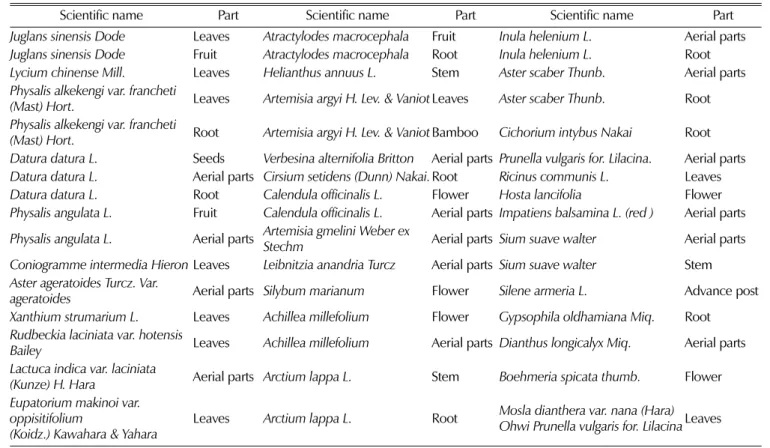
Table 1.
Medicinal plant extracts which do not affect NO production in LPS-activated macrophage RAW264.7 cells.
Scientific name Part Scientific name Part Scientific name Part
Juglans sinensis Dode Leaves Atractylodes macrocephala Fruit Inula helenium L. Aerial parts Juglans sinensis Dode Fruit Atractylodes macrocephala Root Inula helenium L. Root Lycium chinense Mill. Leaves Helianthus annuus L. Stem Aster scaber Thunb. Aerial parts Physalis alkekengi var. francheti
(Mast) Hort. Leaves Artemisia argyi H. Lev. & VaniotLeaves Aster scaber Thunb. Root Physalis alkekengi var. francheti
(Mast) Hort. Root Artemisia argyi H. Lev. & VaniotBamboo Cichorium intybus Nakai Root Datura datura L. Seeds Verbesina alternifolia Britton Aerial parts Prunella vulgaris for. Lilacina. Aerial parts Datura datura L. Aerial parts Cirsium setidens (Dunn) Nakai.Root Ricinus communis L. Leaves Datura datura L. Root Calendula officinalis L. Flower Hosta lancifolia Flower Physalis angulata L. Fruit Calendula officinalis L. Aerial parts Impatiens balsamina L. (red ) Aerial parts Physalis angulata L. Aerial parts Artemisia gmelini Weber ex Stechm Aerial parts Sium suave walter Aerial parts Coniogramme intermedia Hieron Leaves Leibnitzia anandria Turcz Aerial parts Sium suave walter Stem Aster ageratoides Turcz. Var.
ageratoides Aerial parts Silybum marianum Flower Silene armeria L. Advance post Xanthium strumarium L. Leaves Achillea millefolium Flower Gypsophila oldhamiana Miq. Root Rudbeckia laciniata var. hotensis
Bailey Leaves Achillea millefolium Aerial parts Dianthus longicalyx Miq. Aerial parts Lactuca indica var. laciniata
(Kunze) H. Hara Aerial parts Arctium lappa L. Stem Boehmeria spicata thumb. Flower Eupatorium makinoi var.
oppisitifolium
(Koidz.) Kawahara & Yahara Leaves Arctium lappa L. Root Mosla dianthera var. nana (Hara) Ohwi Prunella vulgaris for. LilacinaLeaves
Table 2.
Effects of medicinal plant extracts on NO production and cell viability.
Scientific name Family Plant part Traditional indications/uses
aIC50
(
㎍/
㎖)
bLD50 (
㎍/
㎖)c Impatiens balsamina L. Balsaminaceae Aerial parts Antidote, diuretic, Dysphagia, emetic 59.6 ± 1.7 83.8 ± 3.0 Impatiens balsamina L. Balsaminaceae Root Antidote, diuretic, Dysphagia, emetic 60.5 ± 1.1 82.1 ± 3.8 Inula britannica var. japonica (Thunb.) Franch
& Sav Compositae Flower Diuretic, Expectorant, Stomachic 86.0 ± 1.6 93.2 ± 1.9 Inula britannica var. japonica (Thunb.) Franch
& Sav Compositae Leaves Diuretic, Expectorant, Stomachic 80.9 ± 2.1 91.3 ± 4.5 Inula helenium L. Compositae Leaves Alterative, Bronchitis 78.2 ± 2.6 84.5 ± 6.5 Leibnitzia anandria Turcz Compositae Root Rheumatismus, Detoxication 88.6 ± 3.1 95.5 ± 3.2 Prunella vulgaris for Lilacina Labiatae Root Alterative, Antiseptic, Astringent 92.0 ± 2.0 93.2 ± 4.3 Hibiscus mutabilis Malvaceae Aerial parts Anodyne, Antidote, Cancer, Cough 62.1 ± 0.9 80.4 ± 3.0 Hydrangea macrophylla (Thunb.) Ser Saxifragaceae Leaves Diuretic, Febrifuge, Malaria 67.6 ± 2.5 68.6 ± 4.0 Hyoscyamus niger L. Solanaceae Aerial parts Ache(Tooth), Alcoholism, Anodyne 94.7 ± 6.0 80.8 ± 3.5 Hyoscyamus niger L. Solanaceae Flower Ache(Tooth), Alcoholism, Anodyne 81.4 ± 3.4 87.6 ± 3.5 Physalis alkekengi var. francheti (Mast) Hort. Solanaceae Stem
Absces, Aperient, Detergent, Diabetes, Rheumatism94.5 ± 6.8 96.5 ± 2.5 Physalis angulata L. Solanaceae Root Analgesic, Antidote, Antiseptic, Asthma 73.5 ± 4.4 92.3 ± 4.3 Ledebouriella seseloides (Hoff.) H. Wolff Umbelliferae Root Ache(Head), Anodyne, Arthritis, Ophthalmia 64.7 ± 3.2 77.2 ± 2.2
Boehmeria longispica steud Urticaceae Root Unknown 74.6 ± 4.0 78.5 ± 1.3
Hosta lancifolia
Liliaceae Aerial parts Anodyne, Toothache 68.1 ± 4.0 -d
a
Information summarized from Phytochemical and Ethnobotanical Databases (2006): www.ars-grin.gov
b
IC
50indicates that the concentration at which activity is inhibited by 50%
c
LD
50indicates that the dose at which 50% of test subjects die
d
(
−) indicates no effect of plant extracts on cell viability up to the concentration of 100 ìg/ml
plants belonging to 10 families for inhibitory activity of NO production in LPS-stimulated macrophage RAW 264.7 cells.
The inhibitory activity of 64 extracts from these plants was assessed quantitatively by measuring the level of nitrite, a stable metabolite of NO. Among 64 plant extracts tested, 48 samples did not exhibit the inhibitory activities of nitric oxide production in the activated macrophage cells (Table 1).
Plant extracts from 16 samples exhibited significant inhibition of NO production in the LPS-stimulated macrophage RAW 264.7 cells with IC
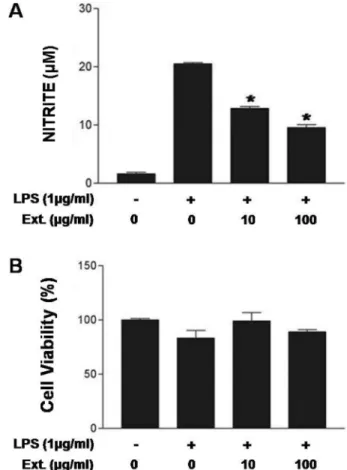
50values in the ranges from 59.6 to 94.7 ㎍ / ㎖ , which are shown in Table 2 with the parts used and medicinal uses. Next we evaluated cytotoxic effect of the extracts and found that only H. lancifolia extract did not exert cytotoxic effects at the concentrations tested, of which LD
50values were in the ranges from 0 to 100 ㎍ / ㎖ (Table 2). The effects of H.
lancifolia extract on NO production and cell viability test are shown in Fig. 1.
We further investigated the effect of the H. lancifolia
extract on the expression of iNOS by PCR analysis. These inhibitory activities were compared well with the known inhibitor of NO production; ammonium pyrrolidinedithio- carbamate (PDTC) with IC
50of 3.5 µ M. High level of NO is produced by iNOS of which expression is induced in LPS-stimulated macrophage RAW 264.7 cells. As shown in Fig. 2, mRNA and protein levels of iNOS are markedly increased by LPS treatment. Co-treatment of macrophage cells with LPS and various concentrations of plant extract from aerial parts of Hosta lancifolia resulted in inhibition of mRNA (Fig. 2A) and protein (Fig. 2B) levels induced by LPS in dose-dependent manner. H. lancifolia extract inhibited iNOS expression in similar fashion as shown in LPS-induced nitric oxide synthesis.
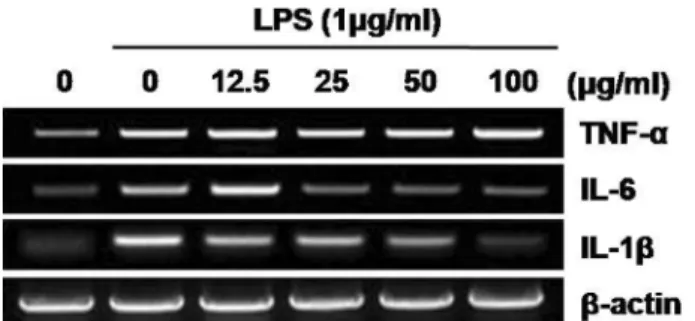
A number of iNOS inhibitors have been known to suppress the production of inflammatory cytokines such as TNF- α , IL-6 and IL-1 β . We tested inhibitory effects of H.
lancifolia extract on LPS-induced pro-inflammatory cytokines mRNA expression levels by RT-PCR analysis. H. lancifolia
extract inhibits IL-6 and IL-1 β mRNA levels in dose- dependent, while H. lancifolia extract only slightly suppresses TNF- α mRNA in 50 ㎍ / ㎖ (Fig. 3), indicating that the H.
lancifolia extract contains some anti-inflammatory compounds.
In this study, we investigated the effects of 64 plant extracts on NO production in LPS-activated macrophage RAW 264.7 cells, and found that Hosta lancifolia exhibited
Fig. 1.
Effects of
H. lancifoliaextract on LPS induced NO production and viability.
A.RAW 264.7 cells were treated with LPS (1
㎍/
㎖) in the presence of various concen
-trations of
H. lancifoliaextract for 24 h.
B.Effect of
H.lancifolia
extract on cell viability. Values represent the means and standard errors and all experiments were carried out in triplicates. * p < 0.05 versus LPS alone.
Fig. 2.
Inhibitory effect of
H. lancifoliaextract on LPS induced
iNOS mRNA and protein level.
A.Levels of iNOS mRNA
were determined by RT-PCR analysis.
B. Levels of iNOS
protein were measured by western blot using polyclonal
antibodies against murine iNOS.
β-actin was used as
internal control.
strong inhibitory activity of iNOS activity without affecting cell viability at the concentrations up to 100 ㎍ / ㎖ . The H.
lancifolia extract similarly inhibited the mRNA and protein levels of iNOS in a dose-dependent manner, indicating that the extract might suppress the expression of iNOS at the transcriptional level. The H. lancifolia extract also exhibited inhibition of inflammatory cytokines such as IL-6 and IL-1 β .
Nitric oxide is generated by immune-activated macro- phages and at inflammatory sites, and performs a pivotal role as neurotransmitter, vasodilator and immune regulator in variety of tissues (Bogdan et al ., 2000, Jin et al ., 2007).
Thus, inhibition of nitric oxide production may constitute an effective therapeutic strategy for prevention of inflammatory reaction and diseases.
It has been reported that several plants related to Hosta lancifolia exhibited various biological activities such as anti- microbial activity (Rojas et al ., 2003), antiprotozoal activity, (Fournet et al ., 2007), anti-HIV-1 activity (Xiao et al ., 2005a; Xiao et al ., 2005b; Xiao et al ., 2006a), and anti- inflammatory activity (Kim et al ., 2004a; Kim et al ., 2004b; Zúñiga et al ., 2005). A number of previous studies revealed the presence of triterpenoids, nortriterpenoids, uleine and demethosyaspidospermine in the extracts of lancifolia - related plants (França et al ., 2000; Xiao et al ., 2006a; Xiao
et al ., 2006b). However, phytochemical information about
Hosta lancifolia has not been elucidated yet. Thus, fractionation and identification of active compounds from these extracts would lead to discovery of a number of natural anti-inflammatory agents that may be potentially useful for prevention and treatment of inflammatory diseases
such as rheumatic arthritis, atherosclerosis and cancer (Park
et al ., 2007, Yin et al ., 2007). In conclusion, our present study reveals that several medicinal plants grown in Korea can be of use as easily accessible sources of natural drugs and possible food supplements.
ACKNOWLEDGEMENTS
This study was supported by a grant given to J. Kim from the Biogreen 21 program [20050401034755].
LITERATURE CITED
Ahn KS, Noh EJ, Zhao HL, Jung SH, Kang SS and Kim YS.
(2005). Inhibition of inducible nitric oxide synthase and cyclooxygenase II by
Platycodon grandiflorumsaponins via suppression of nuclear factor-
κB activation in RAW 264.7 cells.
Life Sciences. 76:2315-2328.
Bogdan C, Röllinghoff M and Diefenbach A. (2000). The role of nitric oxide in innate immunity. Immunological Reviews.
173:17-26.
Chen CY, Peng WH, Tsai KD and Hsu SL. (2007). Luteolin suppresses inflammation-associated gene expression by blocking NF-êB and AP-1 activation pathway in mouse alveolar macrophages. Life Sciences. 81:1602-1614.
Fournet A, Ferreira ME, Rojas de Arias A, Guy I, Guinaudeau H and Heinzen H. (2007). Phytochemical and antiprotozoal activity of
Ocotea lancifolia. Fitoterapia. 78:382- França OO, Brown RT and Santos CA. 384. (2000). Uleine and demethoxyaspidospermine from the bark of
Plumeria lancifolia. Fitoterapia. 71:208-210.
Jin UH, Park SG, Suh SJ, Kim JK, Kim DS, Moon SK, Lee YC, Park WH and Kim CH. (2007). Inhibitory Effect of
Panax notoginsengon Nitric Oxide Synthase, Cyclo-oxygenase- 2 and Neutrophil Functions. Phytotherapy Research. 21:142- Kim Y, Min HY, Park HJ, Lee EJ, Park EJ, Hwang HJ, Jin 148.
C, Lee YS and Lee SK. (2004a) Suppressive effect of inducible nitric oxide synthase (iNOS) expression by the methanol extract of
Actinodaphne lancifolia. Phytotherapy Research. 18:853-856.
Kim Y, Min HY, Park HJ, Lee EJ, Park EJ, Hwang HJ, Jin C, Lee YS and Lee SK. (2004b). Suppressive effects of nitric oxide production and inducible nitric oxide synthase (iNOS) gene expression by
Calystegia soldanellamethanol extract on lipopolysaccharide-activated RAW 264.7 cells. European journal of cancer prevention: the official journal of the European Cancer Prevention Organization (ECP). 13(5):419-424.
Korhonen R, Lahti A, Kankaanranta H and Moilanen E.
(2005). Nitric Oxide Production and Signaling in Inflammation.
Current Drug Targets - Inflammation & Allergy. 4:471-479 Kumarasamy Y, Byres M, Cox PJ, Jaspars M, Nahar L and
Sarkter SD. (2007). Screening Seeds of some Scottish Plants
Fig. 3.
Inhibitory effect of
H. lancifoliaextract on LPS induced pro-inflammatory cytokines mRNA level. Levels of pro- inflammatory cytokines mRNA were determined by RT- PCR analysis. RAW 264.7 cells were treated with LPS (1
㎍
/
㎖) in the presence of various concentrations of
H.lancifolia
extract for 24 h. RT-PCR analysis were carried
out at the temperature of 57
℃.
β-actin was used as
internal control.
for Free Radical Scavenging Activity. Phytotherapy Research.
21:615-621.
Lee HJ, Lee EO, Rhee YH, Ahn KS, Li GX, Jiang C, Lü J and Kim SH. (2006). An oriental herbal cocktail, ka-mi-kae- kyuk-tang, exerts anti-cancer activities by targeting angiogenesis, apoptosis and metastasis. Carcinogenesis. 27:2455-2463.
Lee HJ, Kim YA, Lee JI, Lee BJ and Seo Y. (2007). Screening of Korean marine plants extracts for inhibitory activity on protein tyrosine phosphatase 1B. Journal of Applied Biological Chemistry. 50:74-77
Lee TH, Kwak HB, Kim HH, Lee ZH, Chung DK, Baek NI and Kim J. (2007). Methanol Extracts of
Stewartia koreanaInhibit Cyclooxygenase-2 (COX-2) and Inducible Nitric Oxide Synthase (iNOS) Gene Expression by Blocking NF-êB Transactivation in LPS-activated RAW 264.7 Cells. Molecules and cells. 23:398-404.
Moncada S. (1999). Nitric oxide: discovery and impact on clinical medicine. Journal of the Royal Society of Medicine. 92:164- Nathan C. 169. (1992). Nitric oxide as a secretory product of mammalian cells. The FASEB Journal : official publication of the Federation of American Societies for Experimental Biology.
6:3051–3064.
Park MS, Ban JY, Lee JH, Song KS and Seong YH. (2006).
Methanol extract of
Paeonia Japonicaroot protects cultured rat cortical neurons against oxidative damage induced by hybrogen peroxide. Korean Journal of Medicinal Crop Science. 14:70-76.
Park SK, Kim JJ, Jeon YM and Lee MY. (2007). Suppressive Effects of Korean Indigenous
Acanthopanax divaritacuson the Allergic Inflammation. Journal of Applied Biological Chemistry. 50:155-159.
Raghav SK, Gupta B, Agrawal C, Goswami K and Das HR.
(2006). Anti-inflammatory effect of
Ruta graveolens L.in murine macrophage cells. Journal of Ethnopharmacology.
104:234-239
Raghav SK, Gupta B, Shrivastava A and Das HR. (2007).
Inhibition of lipopolysaccharide-inducible nitric oxide synthase and IL-1
βthrough suppression of NF-
κB activation by 3-(1'-1'- dimethyl-allyl)-6-hydroxy-7-methoxy-coumarin isolated from
Rutagraveolens L