Original Article: Biochemistry/Molecular Biology
Persicaria orientalis and Potentilla fragarioides Extracts Inhibit NF-κB Translocation and Nitric Oxide Production in LPS-stimulated
RAW 264.7 Cells
Jehun Choi · Seung-Eun Lee* · Jeong-Hoon Lee · Geum-Sook Kim · Hyung-Jun Noh · Seung Yu Kim
LPS를 처리한 RAW 264.7 세포에서 털여뀌와 양지꽃 추출물의 NF-κB 활성화 및 Nitric Oxide 생성 저해
최재훈·이승은*·이정훈·김금숙·노형준·김승유
Received: 5 November 2013 / Accepted: 7 January 2014 / Published Online: 30 September 2014
© The Korean Society for Applied Biological Chemistry 2014
Abstract Persicaria orientalis (L.) Spach (Po) and Potentilla fragarioides var. major Maxim (Pf) extracts were analyzed to investigate anti-inflammation through their suppressing effects on free radicals such as reactive oxygen species (ROS). In addition, with regard to Po and Pf, an analysis was conducted of their inhibitory effect on nitric oxide, which is produced in lipopoly- saccharide (LPS)-treated murine macrophage RAW 264.7 cells, and their inhibitory effect on the translocation of the nucleus of nuclear factor-kappa B (NF-κB). The IC
50value of ROS, which was induced by 50 µM 3-morpholinosydnonimine hydrochloride (SIN-1), was found to be 23.35±1.27 µg/mL due to the effect of the Po extract, and 8.46±1.22 µg/mL due to the effect of the Pf extract. In addition, the IC
50value of peroxynitrite treated with the Po extract was 2.19±0.04 µg/mL, whereas that of peroxynitrite treated with the Pf extract was 0.80±0.02 µg/mL. ROS and
peroxynitrite were induced by 50 µM 3-morpholinosydnonimine hydrochloride. There was an increase in the amount of nitric oxide in the RAW 264.7 cells treated with LPS (1 µg/mL), whereas the level of NO was observed to significantly and dose-dependently decrease in the cells treated with Po and Pf. The amount of nitric oxide produced by the group treated with 10 µg/mL of the Pf extract was 11.45±0.57 µM. Furthermore, the Po extracts inhibited the translocation of the nucleus of NF-κB in LPS-treated RAW 264.7 cells. Therefore, it is highly possible that Po and Pf have anti-inflammatory properties.
Keywords inflammation · nuclear factor-kappa B · Persicaria orientalis · Potentilla fragarioides · reactive oxygen species
서 론
현대인은 일상생활을 영위하면서 신체에 위해를 줄 수 있는 여러 물리, 화학적 요인들을 접하게 되는데 이러한 위해 요인 에 의하여 체내 산화스트레스가 증가된다. Superoxide (•O2−), hydroxyl radical (•OH), hydrogen peroxide (H2O2) 같은 활성 산소 (reactive oxygen species, ROS)는 대표적인 산화 스트레 스로 체내 산화, 환원 반응의 불균형을 일으켜 체내 염증반응 이 유도한다(Winrow 등, 1993; Beckman과 Koppenol, 1996).
또한, nuclear factor-kappa B (NF-κB)와 같은 염증 단백질을 활성화시킨다(McCord, 1974; Petrone 등, 1980). 활성화된 NF- κB는 세포 내 핵으로 이동하여 염증성 유전자인 inducible nitric J. Choi · S.-E. Lee · G.-S. Kim · H.-J. Noh · S. Y. Kim
Herbal Crop Utilization Research Team, National Institute of Horticultural
& Herbal Science (NIHHS), RDA, Eumseong 369-873, Republic of Korea J.-H. Lee
Herbal Crop Research Division, National Institute of Horticultural &
Herbal Science (NIHHS), RDA, Eumseong 369-873, Republic of Korea
*Corresponding author (S.-E. Lee: [email protected])
This is an Open Access article distributed under the terms of the Creative Commons Attribution Non-Commercial License (http://creativecommons.
org/licenses/by-nc/3.0/) which permits unrestricted non-commercial use, distribution, and reproduction in any medium, provided the original work is properly cited.
206 J Appl Biol Chem (2014) 57(3), 205−210
oxide synthase (iNOS), cyclooxygenase-2 (COX-2), tumor necrosis factor-alpha (TNF-α)를 발현시킨다(Schreck 등, 1992; Lavrovsky 등, 2000).
Persicaria orientalis (L.) Spach (Po, 털여뀌)는 마디풀과 여 뀌속의 1년생 초본으로 풀의 높이는 1.5−2 m이며 8−9월에 붉 은색 꽃이 피는 식물로서 동남아시아가 원산지다. 동의보감에 는 성질이 약간 차고 맛은 짜며 독(毒)이 없으며 당뇨와 비슷 한 소갈과 다리가 나무처럼 뻣뻣하고 시큰거리며 힘이 없으 면서 열이 나고 붓거나 마르기도 하는 각기를 주로 치료한다 고 효능을 설명하고 있다. 또한, Potentilla fragarioides var.
major Maxim (Pf, 양지꽃)은 장미과 양지꽃속의 숙근성 다년 생 초본이다. 풀의 높이는 30−50 cm이며 노란색 꽃이 4−6월 에 핀다. 식물체 전체 및 뿌리는 상처의 피를 멎게 하거나 설 사, 이질에 쓰고 열을 내리는 약으로 사용한다(Kim, 1989). 하 지만, Po의 환경 생태 연구(Lee 등, 2011)와 Pf에서 분리한 물 질의 항산화능 연구(Choi 등, 1998)는 보고 되었지만 Po와 Pf 의 추출물 혹은 Po와 Pf로부터 분리한 물질을 이용하여 활성 산소 저해 활성 연구 및 세포와 동물 실험으로 염증 단백질 의 발현과 활성을 살펴본 연구가 전무하였다.
이번 연구는 약용식물 Po와 Pf 추출물 에 의한 ROS 저해능 과 마우스 대식세포 (RAW 264.7)에 lipopolysaccharide (LPS)를 처리하여 유도된 염증반응의 저해 활성을 확인하여 항염증 소 재로서의 가능성을 확인하였다.
재료 및 방법
실험 재료 및 추출물. 실험에 사용된 Persicaria orientalis (L.) Spach와 Potentilla fragarioides var. major Maxin 추출물은 농 촌진흥청 식물자원추출물은행에서 분양 받아 사용하였다. Po 와 Pf 추출물은 건조된 뿌리부위를 100% 에탄올, 50oC 조건 으로 가속용매추출장치(ASE 300, Dionex, USA)를 사용하여 농촌진흥청 식물자원추출물은행에서 제조하였다.
실험물질의 제조. 항염증인자에 대한 활성을 평가하기 위해 Po와 Pf 건조한 추출물을 추출시 사용한 용매 ethyl alcohol로 4 mg/mL이 되도록 제조 하여 사용하였다.
Po와 Pf의 Morpholinosydnonimine hydrochloride (SIN-1)에 의해 발생한 ROS의 저해 Po와 Pf의 ROS 저해능은 DCFDA 방법으로 측정하였다(LeBel 등, 1992). 50 mM phosphate buffer pH 7.4를 이용하여 0.125 mM 2',7'-dichlorofluorescin diacetate (DCFDA)와 6 U/mL esterase로 희석한 후 혼합 조제 된 2',7'-Dichlorodihydrofluorescin (DCFH) 용액을 22oC에서 20분간 배양하였다. 그 후 ROS 생성을 위해 3-Morpholino- sydnonimine hydrochloride (SIN-1) 50µM로 추가한 DCFH 용액 190 µL와 추출물 10 µL 합하여 Po와 Pf 추출물의 최종 농도가 10, 20, 40, 80 µg/mL이 되도록 하였다. SIN-1에 의해 생성되는 ROS를 처리 시료가 저해하는 정도를 여기파장 485 nm, 방출파장 530 nm으로 fluorescence microplate reader (Synergy HT, BIO-TEK, USA)로 측정하였다.
Po와 Pf의 SIN-1에 의해 발생한 peroxynitrite의 저해. Po와 Pf의 peroxynitrite 저해능은 dihydrorhodamine 123 (DHR123) 방법으로 측정하였다(Kooy 등, 1994). 검은색 96-well microplate 에 Po와 Pf 추출물을 10 µL 취하고, 90 mM NaCl, 5 mM KCl 및 100 mM diethylenetriaminepenta acetic acid와 10 mM
DHR 123을 함유하는 sodium phosphate 완충액 (pH 7.4)을 가한 후, peroxynitrite를 발생시키는 SIN-1을 50 µM이 되게 처 리하여 시료의 최종농도 0.5, 1, 2, 4 µg/mL이 되게 하였다.
peroxynitrite의 분당 변화량을 여기파장 500 nm 및 방출파장 536 nm로 fluorescence microplate reader (Synergy HT, BIO- TEK)로 측정하였다.
마우스 대식 세포 (RAW 264.7)의 유지. RAW 264.7 (mouse monocyte/macrophage cell line)은 ATCC (American Type Culture Collection)로부터 받았다. 세포는 2 mM L-glutamine, 100 mg/mL streptomycin, 2.5 mg/L amphotericin B, 그리고 보 체 불활성화된 10% fetal bovine serum (FBS)이 함유된 Dulbecco’s Modified Eagle Medium을 이용하여 배양하였다.
또한 세포는 5% CO2와 95% air가 함유된 습한 대기와 같은 조건에서 37oC를 유지하였다. 그리고 10% FBS를 첨가하지 않 은 것을 serum-free medium으로 하였다. 100 mm plastic flasks 에 2일에 한번씩 subculture 하여 세포주를 유지하였다.
Po와 Pf의 RAW 264.7 cell에서 세포 증식에 미치는 영향. 시 험물질의 세포 독성여부를 확인하기 위해, Raw 264.7 세포 증 식에 미치는 각 시험물질의 영향을 MTT assay법을 이용하여 측정하였다. Raw 264.7 세포를 24 well plate에 한 well당 30
×104 개의 세포를 분주하고 16시간 배양하였다. Po와 Pf 추출 물을 5, 10, 20, 40 µg/mL의 농도로 처리하여 18시간동안 배 양 후 MTT assay를 이용하여 세포독성을 측정하였다.
Po와 Pf에 의해 RAW 264.7 cell에서 LPS로 유도된 Nitric Oxide (NO)의 저해. RAW 264.7 세포를 48 well plate에 한 well 당 5×10⁴개가 되도록 분주하고 8시간 배양하였다. Po와 Pf 추출물이 최종농도 2.5, 5, 10 µg/mL 이 되게 처리한 다음 1시간 후 LPS 1 µg/mL로 처리하여 18시간 배양하였다. 배양 후 상층액을 얻어, 세포배양액 중으로 분비한 nitric oxide양을 griess reagent system (Promega, USA)를 이용하여 측정하였다 (Rao, 1997).
Po와 Pf의 nuclear factor kappa-B (NF-κB) 염증 단백질 활 성화 저해. RAW 264.7 세포를 100 mm plastic flasks에 50×
104 개가 되도록 분주하고 16시간 배양하였다. 세포에서 NF- κB의 발현을 확인 하기 위해 Po와 Pf 추출물을 최종농도 5, 10, 20, 40µg/mL이 되도록 처리한 다음 1시간 후 LPS 1 µg/
mL로 처리하여 1시간 배양하였다. 배양 후 세포는 phosphate- buffered saline로 씻은 후, 세포를 세포질 용해액 (10 mM Tris (pH 8.0), 1.5 mM MgCl2, 1 mM DTT, 0.1% NP-40, protease inhibitors) 100µL를 처리하여 15분 동안 얼음에서 방치 후 원 심분리 하여 세포질 단백질이 포함된 상등액을 제거 하고, 이 후 남은 pallet에 세포 핵 용해액 (10 mM Tris (pH 8.0), 50 mM KCl, 100 mM NaCl, protease inhibitor)을 30분 동안 얼 음에서 방치 한 후 원심분리하여 NF-κB 전사을 확인하기 위 한 핵단백질을 얻었다. 얻어진 단백질은 8% (NF-κB) SDS-아크 릴아마이드 겔 상에서 전기영동 한 후 nitrocellulose memebrane 으로 옮겼다. 항체의 비 특이적 결합을 억제시키기 위해 단백 질이 옮겨진 membrane을 5% 탈지 분유액이 포함된 tris- buffered saline and tween 20 (TBST, 50 mM Tris (pH 7.5), 150 mM NaCl, 0.1% Tween-20)으로 30분 동안 실온에서 배양 하였다. 그 후, NF-κB의 specific antibodies를 이용하여 4oC에 서 밤새 반응시켰다. NF-κB 발현 양은 hoserdish peroxidase가 붙어 있는 secondary antibodies로 실온에 30분 반응 후 암실 에서 X-ray film에 현상하여 확인하였다(Habib 등, 1993;
Reddy 등, 2003).
통계학적 분석. 통계학적 분석은 prism5 for windows (GraphPad Software, Inc., USA)를 이용하여 Newman-Keuls Multiple Comparison Test로 분석하였다.
결과 및 고찰
Po와 Pf 추출물의 처리가 RAW 264.7 cell의 세포독성에 미 치는 영향. RAW 264.7 세포에 Pf와 Po 추출물을 18시간 처 리하여 cell viability를 확인한 결과 Pf와 Po 추출물은 RAW 264.7 세포에 세포독성을 나타내지 않았다(Fig. 1).
SIN-1의 처리로 발생한 활성산소 (Reactive oxygen species, ROS)의 Po와 Pf에 의한 제어. 산화 스트레스를 발생시키는 SIN-1 50 mM로 유도된 ROS를 Po와 Po 추출물이 얼마만큼 저해하는지 관찰하였다. ROS는 자유 라디칼에 의해 생성되는 산화 스트레스로 superoxide (•O2−), hydroxyl radical (•OH), hydrogen peroxide (H2O2) 등이 있다. 체내에서 ROS의 증가는 체내 산화, 환원 반응의 불균형을 유도하며 체내 세포 내 NF- κB를 활성화 시키고, NF-κB는 COX-2, iNOS 등의 염증 매개 유전자를 발현시켜 체내 염증반응이 일어난다(Winrow 등, 1993;
Beckman과 Koppenol, 1996). 그러므로, ROS의 제어는 분자염 증 반응의 시초를 제어하는 것으로 의미가 있다.
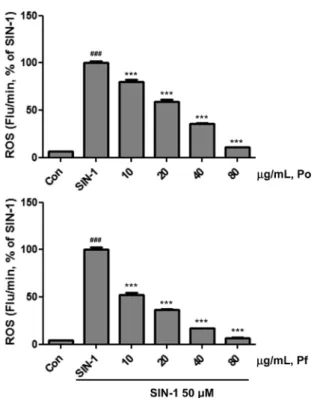
Po와 Pf 추출물은 SIN-1 50 µM로 유도된 ROS를 농도의존 적, 유의적으로 강력하게 제거하는 활성을 나타내었다(Fig. 2).
SIN-1 50µM로 유도된 ROS의 Po와 Pf 추출물에 의한 50%
제거량(IC50)은 23.35±1.27, 8.46±1.22 µg/mL이었다(Table 1).
ROS 저해능이 뛰어난 것으로 알려진 단일물질 penicillamin과 trolox의 SIN-1 50 µM로 유도된 ROS의 IC50 값이 6.98±0.05
와 7.38±0.05 µg/mL와 비교하여 Po와 Pf 추출물의 ROS의 저 해능은 매우 높았다.
SIN-1의 처리로 발생한 peroxynitrite의 Po와 Pf에 의한 제어.
Peroxynitrite는 아질산 이온(NO2)과 ROS 중 하나인 과산화수 소(H2O2)가 결합하여 생성되는 물질로 체내에서 DNA 등을 포 함한 세포 분자에 손상을 주는 자유 라디칼이며, 강력한 산화 스트레스이다(Beckman과 Koppenol, 1996; Szabó 등, 2007).
Peroxynitrite의 제어는 산화 스트레스 및 세포 분자염증의 제 어에 의미가 있어, Po와 Pf 추출물에 의한 peroxynitrite 제어 를 관찰하였다.
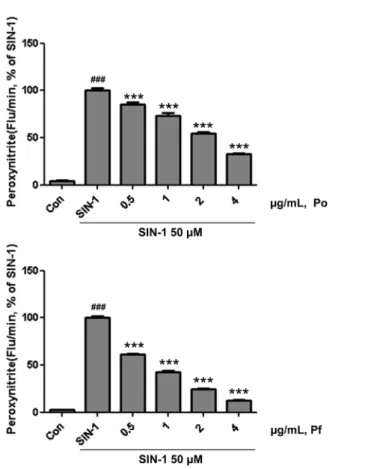
Po와 Pf는 50 µM SIN-1로 생성된 peroxynitrite를 농도의존 적, 유의적으로 제어 하였다(Fig. 3). 또한, Po와 Pf 추출물에 의한 50 µM SIN-1로 유도된 peroxynitrite의 50% 제거량 (IC50)은 Po 2.19±0.04, Pf 0.80±0.02 µg/mL이었다(Table 2).
Po와 Pf 추출물의 peroxynitrite 제어능이 매우 우수한 것을 확 인 하였다. 특히, Peroxynitrite 저해능이 뛰어난 것으로 알려진 Fig. 2 Suppression of ROS level by herbal plant extracts. ROS was measured by fluorescence analysis using DCFDA. Po, Persicaria orientalis (L.) Spach. Pf, Potentilla fragarioides var. major Maxim.
Statistical significance: ###p <0.001 compared to Con, ***p <0.001 compared to SIN-1, respectively.
Table 1 IC50 value of ROS suppression by herbal plant extracts ROS IC50 (µg/mL)
Po 23.35±1.27
Pf 8.46±1.22
Penicillamin 6.98±0.05
Trolox 7.38±0.05
ROS IC50 value was measured by fluorescence analysis using DCFDA induced SIN-1 50 µM. Po, Persicaria orientalis (L.) Spach. Pf, Poten- tilla fragarioides var. major Maxim.
Fig. 1 Viability of herbal plant extracts in RAW 264.7 cells. Cell viability was measured by MTT assay. Con, Control. Po, Persicaria orientalis (L.) Spach. Pf, Potentilla fragarioides var. major Maxim.
208 J Appl Biol Chem (2014) 57(3), 205−210
단일물질 penilcillamin과 trolox의 SIN-1 50 µM로 유도된 peroxynitrite의 IC50 값이 0.67±0.04과 0.55±0.01 µg/mL와 비교 하여, Pf 추출물 IC50 값이 알려진 Peroxynitrite 제어물질들의 IC50값에 근접해 있음을 확인하였다.
RAW 264.7 cell에서 LPS에 의해 생성된 nitric oxide의 Po와 Pf에 의한 저해. RAW 264.7 세포에 LPS 1 µg/mL을 처리하 여 유도한 nitric oxide (NO)를 Po와 Pf 추출물이 억제하는지 관찰 하였다. 세포에 LPS 등의 외부자극이 발생하면 신호전 달과정을 거쳐 NF-κB가 활성화되고 그로 인해 염증성 유전 자인 iNOS가 발현되어 세포 내 분자염증이 나타난다. 발현된 iNOS는 과량의 nitric oxide (NO)가 생성된다(Evans, 1995;
Rao, 1997; Kubes과 McCafferty, 2000). 그러므로, NO의 저해 는 세포 내에 염증반응이 저해되고 있다는 것을 확인 시켜준다.
RAW 264.7 세포에 LPS 1 µg/mL을 처리한 군에서 NO 생성 이 15.47±0.38 µM까지 증가하였으나 Po 추출물 10 µg/mL처리 군에서 NO 생성은 13.34±0.67 µM, Pf 추출물 10 µg/mL 처리 군에서 NO 생성은 11.45±0.57 µM로 농도의존적, 유의적으로 감소하였다(Fig. 4).
RAW 264.7 세포에서 LPS에 의해 유도되는 nuclear factor kappa-B (NF-κB) 활성화 저해. 세포 내 염증을 일으키는 주 요한 원인으로 LPS 등의 외부 자극과 ROS와 peroxynitrite, NO와 같은 산화 스트레스로 인해 증가되는 NF-κB 활성화와 염증반응이 있다. LPS 등의 외부 자극과 산화 스트레스가 체 내 redox imbalance를 유도하여 NF-κB를 활성화 시키고, 활성 화된 NF-κB는 염증관련 유전자들을 발현시킨다. RAW 264.7 세포에 LPS의 자극에 의해 염증반응이 일어나고 있을 때 Po 와 Pf 추출물이 얼마만큼 NF-κB의 활성화를 저해하는지 관찰 하였다.
RAW 264.7 세포에 LPS 1 µg/mL을 처리하여 NF-κB를 유 도하여 Po와 Pf 추출물이 저해하는지를 확인한 결과, LPS 1 µg/mL를 처리한 RAW 264.7 세포에서 Po와 Pf 추출물이 처 리농도 의존적으로 NF-κB의 활성화를 저해한 것을 확인하였 다(Figs. 5 and 6).
Po 와 Pf 추출물의 항염증소재로의 가능성. 산화 스트레스는 분자 염증반응뿐 아니라 동맥경화, 악성빈혈, 치매, 골다공증, 혈관 질환 같은 염증반응에 의해 발생하는 질환들의 주요한 원인이다. 이러한 염증반응은 체내의 redox 환경의 불균형에 의해 발생되며, 이로 인해 염증반응의 주요 전사인자인 NF- Fig. 3 Suppression of peroxynitrite by herbal plant extracts. Peroxynitrite
was measured by fluorescence analysis using DHR123. Po, Persicaria orientalis (L.) Spach. Pf, Potentilla fragarioides var. major Maxim.
Statistical significance: ###p <0.001 compared to Con, ***p <0.001 compared to SIN-1, respectively.
Table 2 IC50 value of peroxynitrite suppression by herbal plant extracts Peroxynitrite IC50 (µg/mL
Po 2.19±0.04
Pf 0.80±0.02
Penicillamin 0.67±0.04
Trolox 0.55±0.01
Peroxynirtire IC50 value induced SIN-1 50µM was measured by fluores- cence analysis using DHR123. Po, Persicaria orientalis (L.) Spach. Pf, Potentilla fragarioides var. major Maxim.
Fig. 4 Suppression of nitric oxide level by herbal plant extracts. Nitric oxide was measured by grease assay. Po, Persicaria orientalis (L.) Spach. Pf, Potentilla fragarioides var. major Maxim. Statistical significance : ###p <0.001 compared to Con, *p <0.05 compared to LPS,
**p <0.01 compared to LPS, respectively.
κB가 활성화되며 이로 인해 COX-2, iNOS, VCAM-1 등의 염 증 유전자가 발현하게 된다(Kim 등, 2002; Chung 등, 2006).
이러한 산화 스트레스로 인한 염증반응 기전은 현대 서구 사 회의 문제로 부각되는 비만이나 나이가 들어가는 노화 등에 서 일어나고 있어 해결을 위해 많은 관심을 기울이고 있다.
본 연구에서는, 산화 스트레스와 염증반응을 저해하는지 살펴 보고자, SIN-1 50 µM이 유도하는 ROS와 peroxynitrite를 Po와 Pf 추출물이 저해하는지 살펴보고, RAW 264.7 세포에 LPS에 의해 활성화되는 NF-κB와 NO를 Po와 Pf 추출물이 저해하는지 검토해 보았다. 그 결과, Po와 Pf 추출물은 ROS와 peroxynitrite 를 저해하였다. 또한, Pf 추출물은 NO를 저해하고, Po 추출물 은 NF-κB의 활성화를 저해하는 것을 관찰하였다.
Po와 Pf 추출물은 SIN-1 50 µM로 유도된 ROS를 농도의존 적, 유의적으로 강력하게 제거하는 활성을 나타내었는데, SIN- 1 50µM로 유도된 ROS의 Po와 Pf 추출물에 의한 50% 저해 능(IC50)은 Po 23.35±1.27, Pf 8.46±1.22 µg/mL이었다. 이 결과 는 66.7 µM 1,2-diphenyl-2-picrylhydrazyl (DPPH)에 의해 생성 된 Radical을 Persicaria hydropiper (Phy) 추출물에 의한 저해 활성을 측정한 결과 Phy의 SC50은 9.5 g/mL, 대조군 di-t-butyl hydroxytoluene의 SC50은 25.4 g/mL으로 Phy의 Radical 저해능 이 우수하였다는 연구(Kim 등, 2007)와 유사한 경향을 나타내 었다. 또한 Potenilla atrosanguinea의 Soxhlet 추출물로 항산화 물질 Trolox와 100 µM DPPH 제거 활성을 비교측정한 Trolox equivalent antioxidant capacity values는 29.82±0.42에서 101.22±0.41 mg의 Trolox/g으로 매우 높은 항산화능을 가진 연 구(Kalia 등, 2008)와 비슷한 경향을 나타내었다.
Po와 Pf 추출물이 RAW 264.7 세포에 LPS 1 µg/mL을 처리 하여 유도한 NO를 억제하는지 관찰 하였다. RAW 264.7 세 포에 LPS 1 µg/mL을 처리한 군에서 NO 생성이 15.47±0.38
µM까지 증가하였으나 Pf 추출물 10 µg/mL 처리군에서 NO 생 성은 11.45±0.57 µM로 농도의존적, 유의적으로 감소하였다. 이 는 Ginko biloba 추출물 200 µg/mL이 RAW 264.7 세포에 LPS 10 ng/mL와 IFN-γ 10U/mL을 처리하여 생성된 NO를 80%까지 농도의존적으로 저해하여 염증을 억제한 연구(Kobuchi 등, 1997)와 동일한 경향이었다. 또한, Cyperus rotundus의 메 탄올 추출물이 RAW 264.7 세포에 LPS 10 ng/mL와 IFN-γ 10 U/mL을 처리하여 생성된 NO와 O2생성물을 농도의존적으로 감소 시켜 Cyperus rotundus 추출물에 의한 염증 저해 기전을 밝힌 연구(Seo 등, 2001)와 동일한 경향이었다.
RAW 264.7 세포에 LPS 1 µg/mL을 처리하여 세포 핵 내로 NF-κB 이동을 유도하였고, Po와 Pf 추출물이 이를 저해하는 지를 확인한 결과, Po 추출물이 처리농도 의존적으로 NF-κB 의 이동을 저해한 것을 확인하였다. 이 결과는 Ginko biloba 추출물 200 µg/mL이 RAW 264.7 세포에 LPS 10 ng/mL와 IFN-γ 10 U/mL을 처리하여 높아진 NF-κB의 활성을 농도의존 적으로 감소 시킨다고한 결과(Kobuchi 등, 1997)와 동일한 경 향이었다.
세포 내 NO의 증가로 NF-κB의 활성화가 일어난다고 알려 져 있으나(Evans, 1995), 그 와는 다른 결과로 NO로 인해 NF- κB의 활성이 감소 된다는 보고(Colasanti과 Persichini, 2000)가 있으며 NO가 NF-κB의 활성과 DNA 바인딩 사이트와의 결합 을 저해한다는 보고(Park 등, 1997)가 있다. 또한, NO는 inhibitor of kappa B alpha를 증가시키고 안정화시켜 NF-κB 활성을 저해하여 그로 인해 발현되는 TNF-α의 발현을 억제 한다(Peng 등, 1995). 이는 Po 처리로 NO가 감소되지는 않으 나 NF-κB의 활성이 감소된 결과를 설명할 수 있을 것으로 사 료된다. 하지만, NO는 대사과정 중 생성되는 염증유전자 nitric oxide synthases (NOS)가 염증 반응을 일으킬 수 있다. NOS 는 eNOS, iNOS, nNOS의 세 종류의 isoform이 있는데 이 중 Fig. 5 Inhibition of NF-κB translocation by Persicaria orientalish. (A)
Western blot analysis was performed to detect NF-κB p65 protein level in nuclear extracts (40µg protein) in RAW 264.7 cell. Con, Control;
LPS, lipopolysaccharide (1µg/mL); Po, Persicaria orientalis (L.) Spach.
(B) Densitometric analysis of NF-κB p65. Statistical significance: *p
<0.05 compared to LPS, **p <0.01 compared to LPS, respectively.
Fig. 6 Inhibition of NF-κB translocation by Potentilla fragarioides. (A) Western blot analysis was performed to detect NF-κB p65 protein level in nuclear extracts (40µg protein) in RAW 264.7 cell. Con, Control;
LPS, lipopolysaccharide (1µg/mL); Pf, Potentilla fragarioides var. major Maxim. (B) Densitometric analysis of NF-κB p65.
210 J Appl Biol Chem (2014) 57(3), 205−210
에서 iNOS가 다양한 염증 모델에서 해로운 작용을 일으키고 피해를 유도한다(Grisham 등, 1999). Pf 추출물은 LPS를 처리 한 RAW 264.7 세포에서 NO의 발생을 억제 하였다. 그러므 로, Pf 추출물은 NO 억제와 더불어 NO로 인하여 생성되는 염증 유전자 iNOS의 발현을 억제 할 수 있을 것이라 사료된다.
ROS, peroxynitirite등 산화스트레스를 저해하고 이로 인해 증가되는 NF-κB를 저해하는 Po 추출물은 TNF-α 등 NF-κB 유래 염증 유전자 발현을 억제하여 염증 반응에 효과가 있을 것으로 사료되며, ROS 등의 산화스트레스 및 NO의 생성을 저해하는 Pf 추출물은 iNOS 등의 NO 유래 염증 유전자를 억 제하여 염증 반응을 제어하는 효과가 있을 것으로 사료된다.
이러한 결과로 Po와 Pf 추출물은 항염증소재로의 가능성이 충 분하다고 사료된다.
초 록
Persicaria orientalis (L.) Spach (Po)와 Potentilla fragarioides var. major Maxim (Pf)의 추출물로 reactive oxygen species (ROS)와 같은 free radical의 억제를 통한 항염증 활성을 살펴 보았다. 또한, Po와 Pf로 LPS를 처리한 murine macrophage RAW 264.7 세포에서 발생한 nitric oxide의 저해와 NF-κB의 핵으로 translocation의 저해를 살펴보았다. 3-morpholinosydnonimine hydrochloride (SIN-1) 50µM에 의해 유도된 ROS의 Po에 의 한 50% 저해값 (IC50)은 23.35±1.27 mg/mL, Pf에 의한 IC50은 8.46±1.22 mg/mL이었다. 또한, SIN-1 50 µM에 의해 유도된 peroxynitrite의 Po에 의한 IC50은 2.19±0.04 mg/mL, Pf에 의한 IC50은 0.80±0.02 mg/mL이었다. LPS 1 mg/mL을 처리한 RAW 264.7 세포에서 Nitric oxide는 증가하였으나 Po와 Pf 추출물 을 처리한 그룹에서 농도의존적, 유의적으로 감소하였다. Po 추출물을 처리한 그룹의 Nitric oxide 생성량은 13.34±0.67 µM, Pf 추출물을 처리한 그룹의 Nitric oxide 생성량은 11.45±0.57 µM이었다. 또한, Po와 Pf 추출물은 LPS를 처리한 RAW 264.7 세포에서 NF-κB의 핵으로의 translocation을 저해하였다. 그러 므로, Po와 Pf는 항염증 소재로서의 가능성이 충분하다고 사 료된다.
Keywords 양지꽃 · 염증 · 털여뀌 · 활성산소 · nuclear factor- kappa B
감사의 글 본 연구는 농촌진흥청 시험연구사업 (과제번호 PJ007437, PJ008700) 의 추출물 시료 제공과 연구비 지원으로 수행된 결과이며 이에 감사 드립니 다. 또한, 2013년도 농촌진흥청 국립원예특작과학원 박사후연수과정지원사 업에 의해 수행되었으며 이에 감사 드립니다.
References
Beckman JS and Koppenol WH (1996) Nitric oxide, superoxide, and peroxynitrite: the good, the bad, and ugly. Am J Physiol 271, C1424–
C37.
Choi YH, Kim MJ, Lee HS, Yun BS, Hu C, and Kwak SS (1998) Antioxidative compounds in aerial parts of Potentilla fragarioides. Kor J Pharmacogn 29, 79–85.
Chung HY, Sung B, Jung KJ, Zou Y, and Yu BP (2006) The molecular inflammatory process in aging. Antioxid Redox Signal 8, 572−81.
Colasanti M and Persichini T (2000) Nitric oxide: an inhibitor of NF-κB/Rel
system in glial cells. Brain Res Bull 52, 155−61.
Evans CH (1995) Nitric oxide: what role does it play in inflammation and tissue destruction? Agents Actions Suppl 47, 107−16.
Grisham MB, Jourd’Heuil D, and Wink DA (1999) I. Physiological chemistry of nitric oxide and its metabolites: implications in inflammation. Am J Physiol 276, G315−G21.
Habib A, Creminon C, Frobert Y, Grassi J, Pradelles P, and Maclouf J (1993) Demonstration of an inducible cyclooxygenase in human endothelial cells using antibodies raised against the carboxyl-terminal region of the cyclooxygenase-2. J Biol Chem 268, 23448−54.
Kalia K, Sharma K, Singh HP, and Singh B (2008) Effects of Extraction Methods on Phenolic Contents and Antioxidant Activity in Aerial Parts of Potentilla atrosanguinea Lodd. and Quantification of Its Phenolic Constituents by RP-HPLC. J Agric Food Chem 56, 10129–34.
Kim HJ, Jung KJ, Yu BP, Cho CG, Choi JS, and Chung HY (2002) Modulation of redox-sensitive transcription factors by calorie restriction during aging. Mech Ageing Dev 123, 1589–95.
Kim JK (1989) Illustrated natural drugs encyclopedia. Namsandang. Korea.
Kim YH, Kim KS, Han CS, Yang HC, Park SH, Ko KI et al. (2007) Inhibitory effects of natural plants of Jeju Island on elastase and MMP-1 expression. J Cosmet Sci 58, 19–33.
Kobuchi H, Therese Droy-lefaix M, Christen Y, and Packer L (1997) Ginkgo biloba extract (EGb 761): inhibitory effect on nitric oxide production in the macrophage cell line RAW 264.7. Biochem Pharmacol 53, 897–903.
Kooy NW, Royall JA, Ischiropoulos H, and Beckman JS (1994) Peroxynitrite-mediated oxidation of dihydrorhodamine 123. Free Radic Biol Med 16, 149–56.
Kubes P and McCafferty DM (2000) Nitric oxide and intestinal inflammation.
Am J Med 109, 150.
Lavrovsky Y, Chatterjee B, Clark R, and Roy A (2000) Role of redox- regulated transcription factors in inflammation, aging and age-related diseases. Exp Gerontol 35, 521–32.
LeBel CP, Ischiropoulos H, and Bondy SC (1992) Evaluation of the probe 2', 7'-dichlorofluorescin as an indicator of reactive oxygen species formation and oxidative stress. Chem Res Toxicol 5, 227–31.
Lee HC, Chekar EK, and Lim DO (2011) The Specific Plant Species and Naturalized Plants in the Area of Naejangsan National Park, Korea. Kor J Environ Ecol 25, 267–83.
McCord JM (1974) Free radicals and inflammation: protection of synovial fluid by superoxide dismutase. Science 185, 529.
Park S, Lin H, and MURPHY S (1997) Nitric oxide regulates nitric oxide synthase-2 gene expression by inhibiting NF-κB binding to DNA.
Biochem J 322, 609–13.
Peng H-B, Libby P, and Liao JK (1995) Induction and stabilization of IκB by nitric oxide mediates inhibition of NF-κB. J Biol Chem 270, 14214–9.
Petrone WF, English DK, Wong K, and McCord JM (1980) Free radicals and inflammation: superoxide-dependent activation of a neutrophil chemotactic factor in plasma. Proc Natl Acad Sci U S A 77, 1159–63.
Rao M (1997) Nitric oxide scavenging by curcuminoids. J Pharm Pharmacol 49, 105–7.
Reddy MC, Subhashini J, Mahipal S, Bhat VB, Srinivas Reddy P, Kiranmai G et al. (2003) C-Phycocyanin, a selective cyclooxygenase-2 inhibitor, induces apoptosis in lipopolysaccharide-stimulated RAW 264.7 macrophages.
Biochem Biophys Res Commun 304, 385–92.
Schreck R, Albermann K, and Baeuerle PA (1992) Nuclear factor κB: an oxidative stress-responsive transcription factor of eukaryotic cells (a review). Free Radic Res Commun 17, 221–37.
Seo WG, Pae HO, Oh GS, Chai KY, Kwon TO, Yun YG et al. (2001) Inhibitory effects of methanol extract of Cyperus rotundus rhizomes on nitric oxide and superoxide productions by murine macrophage cell line, RAW 264.7 cells. J Ethnopharmacol 76, 59–64.
Szabó C, Ischiropoulos H, and Radi R (2007) Peroxynitrite: biochemistry, pathophysiology and development of therapeutics. Nat Rev Drug Discov 6, 662–80.
Winrow V, Winyard P, Morris C, and Blake D (1993) Free radicals in inflammation: second messengers and mediators of tissue destruction. Br Med Bull 49, 506–22.