• 검색 결과가 없습니다.

Exploration of Experienced Science Teachers' Personal Practical Knowledge of Teaching Socioscientific Issues (SSI)

N/A
N/A
Protected

Academic year: 2021

Share "Exploration of Experienced Science Teachers' Personal Practical Knowledge of Teaching Socioscientific Issues (SSI)"

Copied!
13
0
0

로드 중.... (전체 텍스트 보기)

전체 글

(1)

Exploration of Experienced Science Teachers' Personal Practical Knowledge of Teaching Socioscientific Issues (SSI)

Hyunju Lee*∙Hyunsook Chang

1

Abstract: This study explored the accumulated personal practical knowledge of six experienced science teachers in teaching SSI. The guiding research questions were: 1) how did they develop their understanding of SSI and their goals for teaching SSI over many years, and 2) what are the practical issues that the teachers have experienced while addressing SSI in science classrooms. The data source included individual interviews with six science teachers. Each interview lasted 50-70 minutes long and was audio-taped. Data was analyzed based on the methods suggested by Miles and Huberman (1994). Results indicated that, although their motivations for teaching SSI were personal and different, two major categories emerged. One group of teachers was mainly motivated by SSI itself, and the other group was motivated by the teaching aspects that SSI brings. The SSI-oriented group was very sensitive to SSI as it occurs in contemporary society. The teaching-oriented group paid more attention to the educational benefits that addressing SSI could bring to students. Their motivations for teaching SSI influenced how they set up their purposes for teaching, and their purposes for teaching guided them to use appropriate teaching strategies to make their SSI teaching more effective. All of their practical concerns were also connected to their basic motivations for teaching SSI.

Key words: socioscientific issues, SSI, science teachers, practical knowledge, science teaching Ewha Womans University∙

1

Kuksabong Middle School

I. Introduction

The advancement and rapid proliferation of science and technology have given rise to ethical and moral questions and concerns in the contemporary society. These issues are generally called “socioscientific issues(SSI).”In response to various SSI that citizens encounter in their everyday life, science educators and professional organizations have emphasized the inclusion of SSI in science curricula because it can provide students with opportunities to develop functional forms of scientific literacy (Zeidler & Keefer, 2003).

Currently, in the U.S., at least 30 states reflect this idea in their science curriculum by requiring teachers to teach SSI in the science classroom (Lee & Chang, 2007). In South Korea, the Ministry of Education (MOE) also declared such an emphasis in the 7th and the revised version of the 7th National Curriculum. Initial efforts for

dealing with SSI started at the 6th National Curriculum in the mid 1990s (Cho & Choi, 1998).

The 6th National Curriculum explicitly emphasized that science is a human endeavor that is embedded within the social milieu of the society (MOE, 1992), and mentioned the importance of being aware of interrelationships among science, technology, and society (STS).

The 7th and the revised 7th National Curriculum continued this trend by proposing and providing textbooks for a course, which helped students to recognize scientific phenomena in everyday life, understand the impacts of science and technology in society, and practice how to cope with and solve these problems (MOE, 1997).

In spite of this, reform initiatives have not brought about any real change in teacher practices (Davis, 2003; Jenkins, 1992, 2002).

Science teachers still seem to overwhelmingly follow the “antique”view of science (Jenkins, 1992). It is the same in Korea. Lee, Abd-El-

*Corresponding author: Hyunju Lee([email protected])

**Received on 17 March 2010, Accepted on 27 May 2010

***This research was supported by WCU(World Class University) program through the National Research Foundation of Korea

funded by the Ministry of Education, Science and Technology (R32-20109).

(2)

Khalick, and Choi (2006) surveyed Korean science teacher perceptions of teaching SSI, and the results indicated that even though participants positively perceived the need to address SSI in their classrooms, only a minority dealt with such issues sporadically. Many researchers (e.g., Cross & Price, 1996; Lee, et al., 2006; Oulton, Dillon, & Grace, 2004) explored the reasons for not implementing SSI, and the major challenges that teachers reported included their insufficient knowledge of social ramifications, and lack of teaching strategies, limited resources, and inflexibility of curriculum.

One of the effective ways to encourage science teachers to pay more attention to the new conditions of science and to include SSI in their classrooms would be to show them stories of some experienced teachers who have been successfully addressing SSI. Compared to the top-down reform ideas, listening to other teachers' stories and narratives may be more familiar, and teachers may feel empathy with them. Since most of the previous studies on teaching SSI either simply surveyed teachers' perception on teaching SSI or categorized their teaching strategies (e.g. Lee et al., 2006; Sadler et al. 2006), it is hard to hear why certain teachers got involved in teaching SSI, in what ways they approached to SSI, and how their teaching approach was connected with their understanding and philosophy of teaching SSI.

In this study, therefore, the authors explored the personal practical knowledge of six science teachers who have been teaching SSI for several years. Teachers' practical knowledge is often defined as the knowledge that is accumulated over years while teachers have involved in teaching practice (Beijaard & Verloop, 1996;

Cater, 1990; Elbaz, 1981; Johnson, 1992). It is also a particular way of reconstructing their experiences, values, and intentions (Connelly &

Clandinin, 1988). Teachers' practical knowledge broadly includes images of teaching and learning, the roles of teachers and students, and the purposes of and methods for content

instruction (Gess-Newsome et al., 2003). In addition, the teachers' personal practical knowledge has been piled up over many years in different classroom situations, and therefore provides more of a live message through their narratives. The guiding research questions are as follows.

First, how have they developed their understanding of SSI and their goals for teaching SSI over the years?

Second, what are the practical issues that the teachers have experienced while addressing SSI in science classrooms?

Ⅱ. Methods

1. Data Source

The primary data sources were informal, conversation-type interviews with six Korean science teachers who have many years of experience in teaching SSI. All the teachers have been involved in a teacher interest group for more than five years, which was concerned with how to address SSI in the science class. Major criteria for the participants included 1) their enthusiasm for teaching SSI, 2) their actual teaching experience of SSI over years, and 3) their own teaching philosophy and strategies for SSI.

Each interview lasted 50-70 minutes long and was audio-taped. The interview protocol was driven by group discussions among the group members. While reflecting and sharing their experiences of teaching SSI, the teachers raised several issues that they had encountered. These issues included:

What are the purposes of SSI teaching?

Why do we teach SSI?

What are the personal meanings of teaching SSI?

What should we consider when dealing with

SSI in class? (E.g., teacher position in class,

(3)

being balanced, etc.)

What are the difficulties of teaching SSI?

During group discussions, a spectrum of opinions on the issues was recognized and interview protocols were formalized in order to further explore their ideas. Since we had been involved in the group as members from the beginning, these discussions were not disturbed by our presence; rather, during the interviews, the teachers naturally brought up their personal experiences and concerns regarding teaching SSI with detailed examples. Although only one interview was conducted with each teacher, we had a much deeper understanding with each one due to our personal contact over the past five years.

The participating teachers currently teach science in either middle school or high school.

They each vary in teaching experience and college major (chemistry, physics, and earth science), however, they are all very experienced in terms of teaching SSI and developing SSI materials through the teacher interest group.

This teacher interest group has published more than five SSI material books since 1998. They have also addressed various SSI in their science classes.

2. Data Analysis

The overall approach for analyzing the interview data was developed by Miles and Huberman (1994) and is comprised of three

steps: 1) data reduction, 2) data display, and 3) conclusion drawing/verification. We started with data reduction, which “sharpens, sorts, focuses, discards, and organizes data in such a way that final conclusions can be drawn and verified”

(p.11). Some codes used in this stage were taken from related other studies, but other codes were identified from the data. We tried to display the reduced data in an organized, compressed way so that conclusions can be drawn more easily (data display). Two major categories emerged from the participating teachers (i.e., SSI- oriented and teaching-oriented teachers) and we displayed the characteristics of each category in detail (see Figure 1, 2). Finally, we tried to find some regularities, patterns, and possible configurations in order to draw conclusions.

Throughout the research process, the authors kept collaborating and conducting member- checking with individual participants for the purposes of establishing credibility (Lincoln &

Guba, 1985).

Ⅲ. Findings

As Elbaz (1981) has mentioned that “practical knowledge is seen as dynamic, firmly grounded in the individual's inner and outer experiences, and open to change”(p. 67), the science teachers in this study have also developed their personal practical knowledge based on their inner and outer experiences related to science. One prominent thing that emerged from the teachers was that their personal motivations and

Table 1

Demographic information of the participants

Patricia Peggy Nancy Nick Amber Abby

Age/ Gender Mid 40s

/F Early 30s

/F Mid 30s

/F Mid 40s

/M Late 30s

/F Mid 30s

/F

School High S Middle S Middle S Middle S Middle S Middle S

Major Earth S Ed.

(M.S.) Chem Ed.

(M.S.) Phys Ed,

(Ph.D.) Earth S Ed.

(B.S.) Phys Ed.

(M.S.) Chem Ed.

(B.S.)

Teaching Exp. 20years 8years 8years 19years 11years 10years

(4)

initiatives for teaching SSI became the basis of their development of personal practical knowledge. Their motivations and initiatives were firmly grounded and interwoven with their purposes for teaching SSI, their views of SSI, and their other concerns regarding teaching SSI.

1. Initial Motivations of Teachers and Purposes of Teaching SSI

All of the participating teachers started to address SSI with different motivations, but their initial motivations, which they all held in common, were imbued with their personal values and concerns, and past inner or outer experiences. Since they were personally motivated to teach SSI, and not by external forces like curriculum reforms or policies, their motivations and initiatives guided their actions in their teaching practices. In addition, they could develop their own personal practical knowledge as they kept reflecting and internalizing what they experienced in teaching SSI. The fact that they have been actively involved in the teacher interest group for many years is additional proof.

Although their motivations for teaching SSI were personal and individually different, two major categories of motivations emerged. One group of teachers was mainly motivated by SSI itself, and the other was motivated by the teaching aspects that SSI brings. The SSI- oriented group was very sensitive to SSI as it occurs in contemporary society. For them, the political, social, and moral nature embedded in science, to some extent touched their personal values and concerns. This led them to commit themselves to SSI in different forms such as participating social movements and teaching SSI. On the other hand, the teaching-oriented group paid more attention to the educational benefits that addressing SSI brings to students.

They used SSI as a good resource to help students to be more interested in science and to formulate constructive science classrooms. For

both groups of teachers, the purposes of SSI teaching and personal meanings of teaching SSI, represented their initial motivations.

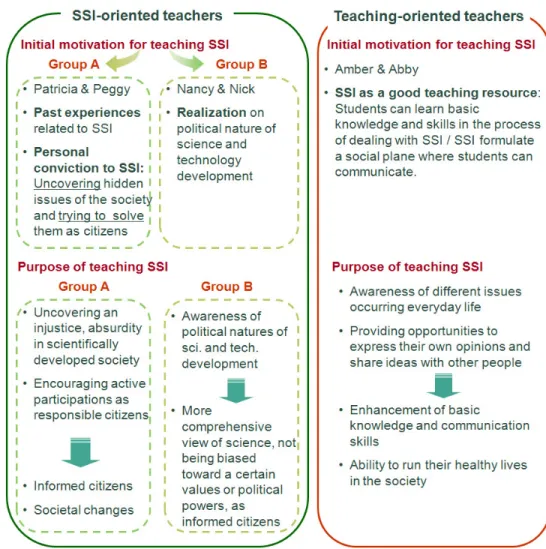
Four teachers (Patricia, Peggy, Nancy, and Nick) belonged to the SSI-oriented group. For them, teaching SSI was one way to share or integrate their personal concerns and convictions with their science teaching. Out of the four teachers, Patricia and Peggy had more direct experiences related to SSI that awakened them.

For instance, Patricia and Peggy had been interested in societal issues since their college years. They used to read sociology books and participate in civic movements for democracy or labor. They were very sensitive to social injustice in society and one of their major personal concerns was how to make society better: “I've often thought that I should use what I learn to solve social problems and to make the situation better. I thought, that's my responsibility”

(Peggy). As science teachers, however, they could not find the bridge between their concerns and science teaching, until they encountered SSI as a resource. “I couldn't find any meaning why I need to teach the conservation of mass. I didn't know what to teach.”(Patricia). Here are excerpts that show how they felt at the time when first recognizing SSI as an important aspect of science teaching:

I attended a lecture provided by the civil organization (called People's Solidarity for Participatory Democracy). It was about alternative energy. While I was listening to his lecture, I felt like, “Oh, this is definitely right!” … The energy issue has a clear direction to go.

We can move from oil energy to an alternative energy system like solar energy. If we make an effort, we can save the earth! (Patricia)

About 10 years ago, I attended a lecture by

chance. It was about ecosystem. It was the first

time that the issue touched me that much. I

even thought, if I failed to become a teacher, it

will be a good idea to join the community,

(5)

caring about ecosystem, and to be with them. I used to meet the people (who I got to know at the lecture) after school, and visit some eco- towns and alternative schools with them…. I often felt my heart was there, but I couldn't quit my job…. When I was informed about STS from a newspaper, and it said this teacher interest group deals with science, human rights, and ethics, I was very excited. I felt like I found something like a bridge! (Peggy)

Their experiences of alternative energy and environmental issues at lectures were enlightening to Patricia and Peggy because the issues matched with their personal concerns and helped them to find the meaning of teaching science: “I was very satisfied with the fact that I found some connections. It (energy and environmental issues) made my science class more meaningful!”(Patricia). For instance, Patricia and Peggy often worked at the Alternative Energy Center during summer vacations and taught elementary kids about the use of solar energy. Meeting the people who worked there and actually seeing how to use solar energy in their lives were very fresh for them. In the case of Patricia, energy issues became a catalyst that helped her to see other issues. She felt that the energy issues could be interwoven with other issues relating to current scientific and technological development such as endangered species and huge constructions.

Patricia and Peggy started to bring different SSI into their classes because teaching SSI to students could be one way to make society better. They regarded students as future informed citizens in a democratic society, who are sensitive to SSI and would take action.

When I talk about pollutions or whatever topics with others, I feel, they also have critical minds on the issues. Nobody says, “I don't really care”or “it's not that important”like that…. But the problem is that they would not go further. I feel, there is a huge gap between knowing and

doing…. I think, my job as a teacher is to help my students to express what they think and actually act…. That's the true, alive knowledge, I believe. Newton's equations are not enough.

Using SSI, I'd like to tell them what society really looks like, how to apply what they learn.

(Peggy)

Peggy had a belief that most people are capable enough to perceive problems in their society. But there is “a huge gap between knowing and doing.”She felt a responsibility to encourage them to more seriously consider the issues and participate. Patricia also had been struggling with “how to change their perception [in order to see the problems in society] and how to encourage them to act”when dealing with SSI.

Nancy and Nick were also motivated to teach SSI, but unlike Patricia and Peggy, they gradually realized the political, social, and moral nature of science and technological development because those issues were not closely connected with their personal concerns. Instead, the more they got involved in the teacher interest group and the more they dealt with SSI, the more they got to see its nature. Once they realized the nature of SSI, they strongly felt a need for teaching SSI in their classrooms.

Those issues (SSI) do not have one correct answer. But whenever I hear TV news, I started doubting, “Is it really a right solution? Did they really count the environment?”I really feel sorry that policy makers do not have a holistic vision about the environment, they approach the issues from the economical or political point of views, they just develop… I feel that we should be aware of this (social, economical, and political nature of science). (Nancy)

I feel, TV news or other mass media are biased. They are for the group with power.

Even though they try to impartially report a

certain event, I think, it is often speaking for the

(6)

power group. For instance, Dr. Hwang case….

When mass media reported his success in stem cell research, nobody doubted his fake.

(Nick)

In the above excerpts, both Nancy and Nick pointed out the political and social nature of SSI.

They were very sensitive to the fact that most of the decisions made about the issues often misled the public. They strongly felt that students should realize this and have more balanced views as citizens.

[Regarding the issues of science and technology development] There is no right answer and nobody knows the answer, but they should know economics is not the only decisive factor for making decisions. Some people say, “we know it may destroy the environment, but we need to develop this to get more economical benefits.”This does not make sense any more. You need to tell what you [as citizens] want for this world. There should be various solutions for the issues.

(Nancy)

Nancy encouraged students to have a more comprehensive view of science, and to not be biased towards certain values or political powers as informed citizens. Nick also emphasized this by often telling students, “You need to understand the issues from different perspectives. For instance, this one has pros and cons. And there are alternatives.”It is critical to become a responsible citizen with a balanced view: “If you are able to do this, policy makers and scientists cannot make irresponsible decisions.”(Nick) Compared to Patricia and Peggy, Nancy and Nick do not necessarily see that the issues needed to be solved in order to make society better; rather, SSI represent the political nature of science.

The other two teachers-Amber and Abby- belonged to the teaching-oriented group. They were also becoming more sensitive to SSI from

being involved in the teacher interest group, but their primary concern was not SSI, but how to make their science classes more interesting and meaningful. For both teachers, the major characteristic of SSI is the controversial aspects of issues that naturally initiate dialogues among students.

I'd like to provide students lots of chances to talk about their opinions, listen to others, and formulate their own thoughts while communicating with each other. Socioscientific issues that we are talking about are good resources for this…. If I talk about alternative energy or other issues in my science classes, my students love it. (Amber)

As you know, many students think science is difficult and boring. If I do something different in class, like experiment, they like it. For instance, if I teach the concept of electrical power, ask them to calculate, and talk about “you need to save energy!” , students just listen. But if I prepare the activity to design an energy effective town like that, they love it. Their discussion is not perfect, but they try to find resources, do something by themselves…. It's different. (Abby)

Amber and Abby considered SSI as a good teaching resource. Students can learn basic knowledge and skills in the process of dealing with SSI. SSI also formulates a social atmosphere where students can communicate and participate. Teaching-oriented teachers like Amber and Abby are often found in other studies. For instance, teachers from Profile A in Sadler et al. (2006), who are covering SSI in their classes with the belief that SSI are important aspects of science education, provided two rationales for teaching SSI. First, “it is the responsibility of science teachers to help prepare students to think critically, weigh scientific evidence, and negotiate complex ethical terrain”

and second, “dealing with controversial science

(7)

topics in the classroom can stimulate interest among students and help them establish relevance for what they are learning”(p. 362).

Compared to the SSI-oriented teachers, they are more concerned about students who live in a society where controversial issues show up almost every day and who are asked to make a decision for their healthy, safe life.

Many students tend to think learning science is not connected to their life. … They learn they should save energy, but in their life, they turn on air conditioners with windows open. Just telling them “save energy”doesn't do anything.

But, if I address some SSI activities, it's

different…. Also, students don't know climate change mitigation projects are going on. They are not personally connected with those issues…. Same as Dr. Hwang's case in stem cell research…. Students need to know those issues happening now. (Abby)

Abby let students be aware of different issues occurring in everyday life, and provided opportunities to be connected with the issues.

She saw some effects: “I cannot say all students are excited about the issue, but at least I can see some changes in their attitudes”(Abby).

Teaching SSI is a way to achieve educational goals for students.

Fig. 1 Teachers' initial motivations and purposes for teaching SSI

(8)

2. Three Major Concerns in Teaching SSI 1) Is SSI science?

Cross and Price (1996) suggested from conversations with science teachers teaching SSI that there was “the tension between science teachers' allegiance to value-free objectivity of science and the more modern view of the problematic nature of the scientific knowledge”

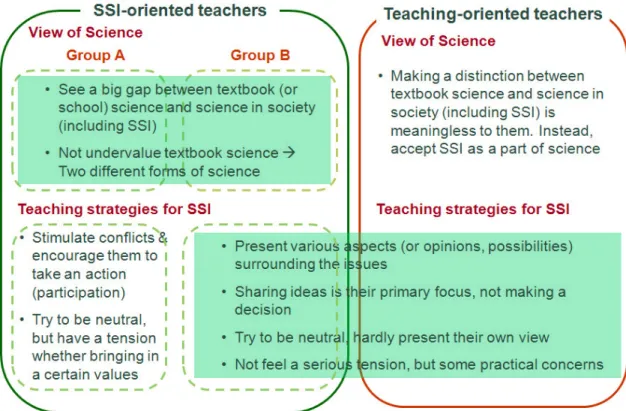
(p. 325). The teachers in this study showed similar tension. SSI-oriented teachers tended to distinguish textbook science (or school science) from science in society (including SSI). Textbook science consists of more scientific facts, theories, and laws, but science in society is a more value- laden entity often associated with politics, economics, militaries, and other human endeavors. In contrast, teaching-oriented teachers did not make a clear distinction between the two because they accepted science in society as a part of school science.

Four teachers in the SSI-oriented group looked at the big gap between textbook science and science in society. It did not mean that the teachers undervalued the textbook science.

Students should know basic scientific knowledge, but it is not enough for students to learn only school science, because real society is quite different. They strongly felt the need for bringing real science into science classrooms and for students to get to know two different aspects of science.

I feel, there are two kinds of science. One is textbook science, and the other is science in the society like SSI, how science and technology relates to society. In school, we talk about science, laws, theories,…. I feel the big gap between two sciences. (Peggy)

Sometimes I feel afraid to deal with SSI because it's too different from textbook science.

Teaching SSI is important, but it's still hard for me to find a good place to address SSI. When I

address SSI, I feel like, my teaching is disconnected. (Nancy)

Some teachers have reported in other studies (e.g., teacher A in Cross & Price (1996); teachers from Profile B & C in Sadler et al. (2006)) that they are often afraid of dealing with SSI due to tension. However, SSI-oriented teachers hardly hesitated to deal with SSI in their classes. Once they judged the need for addressing a certain SSI, regardless of difficulties in finding an appropriate time and place, they tried to actualize it.

When I teach the equilibrium of atmospheric radiation, I definitely need to teach global warming. Once I explain global warming, I also need to talk about energy. It's a natural flow.

These are the issues that we need to solve because they are connected to our students.

(Patricia)

It was natural for Patricia to incorporate textbook science and SSI because in this way she could give them a more complete view of science.

Unlike the SSI-oriented teachers, teaching- oriented teachers believed that making a distinction between textbook science and SSI is meaningless. Instead, they accepted SSI as a part of science: “They are all science. Science is everywhere”(Abby).

I want my students to feel the beauty of science. Science is the process that people communicate each other and finally develop some ideas. If you look at the history of science and how scientific knowledge has developed, you can see this nature of science.

Science is not just solving problems…. In fact, students love to discuss. When I bring up SSI in my class, students are very actively talking about their thoughts. (Amber)

The meaning of the “beauty of science”in the

above excerpt is quite different from the view of

(9)

scientists. Scientists often mentioned it in order to describe the logical, intellectual power of science. However, Amber focused on the sociological aspect of science, such as cooperating and communicating with each other to develop ideas. She focused on the commonality between the two, rather than differentiating between them, and therefore she did not feel any serious tension.

2) Should I remain neutral in class?

Oulton et al. (2004) mentioned common beliefs that teachers frequently brought up in order to support their teaching pedagogy when being asked about teaching controversial issues. One is that a “balanced view on the issue must be presented”and the other is that a “teacher should remain neutral”(p. 415). He added that

“while teachers generally agree that a balanced view should be presented, there is widespread disagreement about whether teachers should remain neutral”(p. 415). All of the participating teachers in this study mentioned that they tried to present a balanced view and be neutral in class for various reasons. However, as Oulton et al. pointed out, they expressed some conflicts in terms of remaining neutral.

Two SSI-oriented teachers, Patricia and Peggy, struggled with whether or not to bring in their own values. For instance, Patricia said:

I try to be neutral in class. However, since I have my own position on the issue, sometimes I feel “I should jump into the discussion.”But it does not take long, it's better not to do. In fact, I am still struggling about my position. … If students are talking about side A too much, I initiate them to think about side B. “What about this (side B)?” … From my experience, students tend to stand in a gray area. In that case, I try to stimulate them to experience conflicts in their minds. (Patricia)

Peggy also had clear feelings on the issues

that she deals with in her class, and her major concern was how to help students change their naive ideas and attitudes. It was not too difficult for her to hide her positions on the issues in class, but she has conflicting feelings on whether or not staying balanced was desirable. She recognized that her students tended to be satisfied with just being aware of the different aspects, and not really experiencing any moral conflicts or exploring further to make their own decisions. Sometimes she felt that students were too oriented towards a certain value, like an economical point of view, without considering other aspects, or that they stood in a gray area:

“I don't want them to be in a gray area”(Peggy).

The other four teachers did not feel a serious tension in taking their position in class. They felt comfortable remaining neutral because their primary focus was to let students hear different aspects of the issues.

First of all, I introduce some aspects of the issues to enlarge their vision for the issue.

Then I give them a chance to think. I don't think making a decision is not that important.

Having a holistic view on the issue is more important. If my students taste different aspects of the issues, I think that's enough. (Nick)

My focus of teaching SSI is to let them have confidence in dealing with the issues. For this, I encourage them to know various aspects of the issues. There is no one right answer.

Personally, I hope they have more environmental-friendly view, rather than economical perspectives, but… (Nancy)

The primary concern of Nick and Nancy was to let students be aware of the political, economical, and sociological aspects of science.

If their students became aware of aspects from

their classes, both teachers would be satisfied

regardless of the position that their students

made. Compared to Nick and Nancy, Amber and

(10)

Abby were more teaching-oriented. They were mainly concerned about whether or not their students had enough opportunities to share their ideas and thoughts.

The most important thing is to make the atmosphere where students can freely talk about their thoughts and discuss. They listen to each other, respect each other…. I try to help them to be involved in this process. [I: Some teachers feel the tension whether they should present their opinions or not. What about you?]

Not really. The process of communicating, collaborating, how they get to the conclusion is more important to me. (Amber)

Amber and Abby did not feel any serious tension over what kinds of values on which they were going to focus, whether or not they needed to lead students towards being more aware of certain values, or whether or not they presented their own views. The major reason they

presented balanced views was to formulate an atmosphere where students could hear various ideas and actively communicate.

3) Are students personally engaged in SSI?

Science teachers tend to expect that students rely on different reasons or logics to formulate their positions and list some evidence to support their decision-Sadler and Zeidler (2005) called this rationalistic informal reasoning-rather than emotions or intuitions. Dewhurst (1992) mentioned that rationality does not provide an appropriate basis because “it is just proofs, which are lacking in areas of moral controversy”

(p. 159). Outlon et al. (2004) also pointed towards a controversy over whether or not “the focus should be on rationality, reasoning and sticking to the facts”(p. 415), and added that “most controversies are not susceptible to solutions based simply on reasoned argument”(p. 416).

Most of the teachers in this study, except for

Fig. 2 Teachers' views of science and their teaching strategies for SSI

(11)

Amber, emphasized personal relations to the issues, rather than focusing on rationalistic decision making. For instance,

I try to give students many chances to express their opinions in their own words. I am not still good at it. But, I think it takes time. Making a good decision is important. But I think, it is also important to feel, “this issue is personally related to me.” (Peggy)

Sometimes I am very upset because my students don't care about the issues. They don't have any opinions, no pros and cons.

They don't see the problems in the issues.

(Abby)

Peggy and Abby pointed out the phenomenon that students are not personally related to the issues. This phenomenon was often reported from previous studies. Sixteen-to-seventeen year-old students in Connell et al.'s (1999) study showed a tendency for being detached from environmental issues and expressed feeling overwhelmed or helpless. Lee and her colleagues (2006) also reported that most of the college students in their study did not take SSI seriously or merely quoted their own values without any further engagement, even though they provided some evidence to support their position. All the teachers in this study have also witnessed this phenomenon and seriously considered how to help students be more personally engaged in the issues and with their values.

Ⅳ. Discussions

This study explored the accumulated personal practical knowledge of six experienced science teachers with teaching SSI. The personal narratives of the teachers indicated that they had thought of different practical issues regarding teaching SSI. Their personal motivations and initiatives for teaching SSI became the foundation of their development of

their personal practical knowledge for SSI.

Although SSI-oriented teachers developed their practical knowledge in a different way from teaching-oriented teachers, both groups of teachers showed clear integrity. Their motivations for teaching SSI influenced how they set up their purposes for teaching SSI. SSI- oriented teachers tended to regard students as future informed citizens in the democratic society, who are sensitive to SSI and will take an action for SSI. On the contrary, teaching- oriented teachers tended to focus on helping the students to handle SSI with basic knowledge and skills and so run their healthy lives as individual beings. For SSI-oriented teachers, teaching SSI was a way to share or integrate their personal concerns and convictions with their science teaching. For teaching-oriented teachers, it was a way to achieve their educational goals for students. Their purposes for teaching SSI guided them to use appropriate teaching strategies to make their SSI teaching more effective. All of their practical concerns were also connected to their basic motivations for teaching SSI. For the views of science and SSI, SSI-oriented teachers tended to differentiate textbook science from science in the society including SSI. On the contrary, teaching-oriented teachers did not make a clear distinction between two because they accepted science in the society as a part of school science. For taking position in class, two SSI-oriented teachers struggled with whether or not to bring in their own values. But the other four teachers felt comfortable remaining neutral because their primary focus was to let students hear different aspects of the issues.

These findings suggest some practical

implications. First, when designing in-service

programs for teaching SSI, teacher educators

should consider how to help science teachers

personally relate to the issues and find meaning

in teaching SSI. Current in-service programs in

Korea that often include STS or SSI tend to

focus on informing teachers about the practical

aspects (e.g., a topic list to deal with, how to

(12)

manage discussions or debates, etc.) and encourage them to implement these aspects.

This study shows that only informing teachers about how to deal with SSI may not be enough to motivate them. Teaching strategies for SSI are subject to change depending on the situation.

However, personal values and concerns, or educational goals of teachers, are deeply rooted within them and play a role as an essential motivating force. When they personally feel the importance and necessity of teaching SSI, they are motivated and continuously develop themselves towards their goals. Another thing to consider is that it usually takes a period of time until teachers develop their own views and teaching philosophies on SSI. Since many teachers still seem to overwhelmingly follow the

“antique”view of science, we cannot simply expect that they would change their view of science and SSI teaching after only a couple of weeks of an in-service program. The participating teachers in this study have worked on teaching SSI over several years, and, as time went on, they started expanding their views of science. Teacher educators should give teachers enough time and chances to reflect on their views of science and SSI teaching until SSI becomes an important part of their science teaching.

Second, even though the participating teachers have several years of teaching experience in SSI, they still reported some tension and concerns. As Oulton et al. (2004) stated, being balanced in class seems to be a general consensus among science teachers dealing with controversial issues. The experienced teachers in this study pointed out the problems that may be caused by a balanced position in teachers. In their experience, the teachers recognized some tendencies in students, such as not being personally related to the issues, making a decision, or listing some evidence to support their decision without any serious consideration of their values, listing evidence, staying in a grey area, advocating certain values without

considering other aspects of issues, and so on.

Some participating teachers, especially Patricia and Peggy, were very frustrated by these tendencies and felt a serious conflict over whether or not being balanced in class is appropriate, and not forcing students to see larger societal values. But many science teachers, unlike the teachers in this study, tend to put too much emphasis on rationalistic decision-making in SSI and ask students to gather more facts. SSI is very complex in nature.

Therefore, simply sticking to the facts is insufficient, because it may cause an over- simplistic presentation of moral dilemmas, as Kibble (1998) has pointed out. Like the participating teachers in this study, teachers should consider more fundamental aspects of teaching SSI.

References

Beijaard, D., & Verloop, N. (1996). Assessing teachers' practical knowledge. Studies in Educational Evaluation, 22, 275-286.

Carter, K. (1990). Teachers' knowledge and learning to teach. In W. R. Houston (Ed.), Handbook of research on teacher education (pp.

291-310). New York: Macmillan.

Cho, H., & Choi, K. (1998). The necessities and current states of science education dealing with socioscientific characteristics of science.

Journal of the Korean Association for Research in Science Education, 18(4), 559-570.

Connell, S., Fien, J., Lee, J., Sykes, H., &

Yencken, D. (1999). 'If it doesn't directly affect you, you don't think about it': A qualitative study of young people's environmental attitudes in two Australian cities. Environmental Education Research, 5(1), 96-113.

Connelly, E. M., & Clandinin, D. J. (1988).

Teachers as curriculum planners: Narratives of experience. New York: Teachers College Press.

Cross, R. T., & Price, R. F. (1996). Science

teachers' social conscience and the role of

controversial issues in the teaching of science.

(13)

Journal of Research in Science Teaching, 33(3), 319-333.

Davis, K. S. (2003). “Change is hard” : What science teachers are telling us about reform and teacher learning of innovative practises. Science Education, 87(1), 3-30.

Dewhurst, D. (1992). The teaching of controversial issues. Journal of Philosophy of Education, 26, 153-163.

Elbaz, F.(1981). The teacher's practical knowledge: Report of a case study. Curriculum Inquiry, 11(1), 43-71.

Gess-Newsome, J., Southerland, S. A., Johnston, A. & Woodbury, S. (2003). Educational reform, personal practical theories, and dissatisfaction: The anatomy of change in college science teaching. American Educational Research Journal, 40(3), 731-767.

Jenkins, E. W. (1992). School science education: Toward a reconstruction. Journal of Curriculum Studies, 24(3), 229-46.

Jenkins, E. W. (2002). Linking school science education with action. In W.M. Roth and J.

Desautels (Eds.), Science education as/for sociopolitical action (pp.17-34). New York: Peter Lang.

Johnston, S. (1992). Images: A way of understanding the practical knowledge of student teachers. Teaching and Teacher Education, 8, 123-136.

Kibble, D. (1998). Moral education dilemmas for the teacher. Curriculum Journal, 9, 51-61.

Lee, H., & Chang, H. (2007). The comparison of state-level U.S. science curricula with science teachers' perception regarding teaching socioscientiifc issues(SSI). The Journal of Curriculum & Evaluation, 10(1), 189-209.

Lee, H., Abd-El-Khalick, F., & Choi, K.

(2006). Korean science teachers' perceptions of the introduction of socioscientific issues into the science curriculum. Canadian Journal of Science, Mathematics, and Technology Education, 6(2), 97-117.

Lincoln, Y. & Guba, E. (1985). Naturalistic inquiry. Thousand Oaks, CA:Sage.

Miles, M. B., & Huberman, A. M. (1994).

Qualitative data analysis: An expanded sourcebook (2nd ed.). Thousand Oaks, CA:Sage.

Ministry of Education. (1992). The 6th Korea National Curriculum Standard. Seoul:Daehan Printing and Publishing Co.

Ministry of Education. (1997). The 7th Korea National Curriculum Standard. Seoul:Daehan Printing and Publishing Co.

Oulton, C., Dillon, J., & Grace, M. M. (2004).

Reconceptualizing the teaching of controversial issues. International Journal of Science Education, 26(4), 411-423.

Sadler, T. D., & Zeidler, D. L. (2005). Patterns of informal reasoning in the context of socioscientific decision making. Journal of Research in Science Teaching, 42(1), 112 138.

Sadler, T. D., Amirshokoohi, A., Kazempour, M., & Allspaw, K. M. (2006). Socioscience and ethics in science classrooms: Teacher perspectives and strategies. Journal of Research in Science Teaching, 43(4), 353-376.

Zeidler, D. L., & Keefer, M. (2003). The role of moral reasoning and the status of socioscientific issues in science education. In D.

L. Zeidler (Ed.), The role of moral reasoning in

socioscientific issues and discourse in science

education (pp. 7-40). Dordrecht, The

Netherlands: Kluwer Academic Publishers.

수치

Abby let students be aware of different issues occurring in everyday life, and provided opportunities to be connected with the issues.
Abby were more teaching-oriented. They were mainly concerned about whether or not their students had enough opportunities to share their ideas and thoughts

참조

관련 문서

Secondary beginning teachers' views of scientific inquiry: with the view of Hands-on, Minds-on, and Hearts-on. Introducing teaching STEAM as a practical

Secondary beginning teachers' views of scientific inquiry: with the view of Hands-on, Minds-on, and Hearts-on.. Introducing teaching STEAM as a practical

Secondary beginning teachers' views of scientific inquiry: with the view of Hands-on, Minds-on, and Hearts-on.. Introducing teaching STEAM as a practical

But such emotional depletion, depersonalization, and lowering of personal sense of achievements experienced due to unfair process of promotional reviews

Therefore, the purpose of this study is to study on the special education teachers’ state of first aid education completion, knowledge level and abilities

Furthermore, if desirable teachers' images and teaching methods that American, English cultures have like as this study showed are added to English education

Secondary beginning teachers' views of scientific inquiry: with the view of Hands-on, Minds-on, and Hearts-on.. Introducing teaching STEAM as a practical

Secondary beginning teachers' views of scientific inquiry: with the view of Hands-on, Minds-on, and Hearts-on. Introducing teaching STEAM as a practical