배액절감형 양액공급 방법이 파프리카(Capsicum annuum ‘Coletti’) 생육과 수량에 미치는 영향
안철근1*·황연현1·안재욱1·윤혜숙1·장영호1·손길만1·황승재2·김광수3·이한철4
1경상남도농업기술원 수출농식품연구과, 2경상대학교 원예학과,
3서울시립대학교 환경원예학과, 4국립원예특작과학원 시설원예시험장
Effect of Irrigation Methods for Reducing Drainage on Growth and Yield of Paprika (Capsicum annuum ‘Coletti’)
in Rockwool and Cocopeat Culture
Chul Geon An1*, Yeon Hyeon Hwang1, Jae Uk An1, Hae Suk Yoon1, Young Ho Chang1, Gil Man Shon1, Seung Jae Hwang2, Kang Soo Kim3, and Han Cheol Rhee4
1Gyeongnam Agriculture Research & Extension Services, Jinju 660-985, Korea
2Department of Horticulture, Gyeongsang National University, Jinju 660-701, Korea
3Department of Environmental Horticulture, The University of Seoul, Seoul 130-743, Korea
4Protected Horticulture Research Station, National Institute of Horticultural and Herbal Science, Busan 618-800, Korea
Abstract. This study was carried out to investigate the effect of irrigation methods for reducing a drain- age on the growth and yield in rockwool (Grodan co.) and cocopeat (chip : dust = 50 : 50 included fiber) cul- ture. The nutrient solution was irrigated by 100 J · cm−2-100 mL, 50 J · cm−2-45 mL, 50 J · cm−2-40 mL, 50 J · cm−2-35 mL (100~50 J · cm−2-100~35 mL, Nutrient solution 100~35 mL was irrigated per plant when the accumulated radiation was 100~50 J · cm−2). The drain rates per plant of 100-100, 50-45, 50-40, 50-35 were 26.3%, 8.8%, 6% 4.4% and 23.1%, 7.5%, 5% 3.4% in rockwool and cocopeat slabs. The water con- tents and EC of 100-100 and 50-45 were managed by the 55~70%, 3.0~5.0 dS · m−1 which were good con- dition for paprika culture in rockwool and cocopeat slabs, while those of 50-40 and 50-35 were managed by beyond 50%, 4.5~9.5 dS · m−1. The plant height, number of branches and leaf size of 100-100 and 50-45 were similarly increased while those of 50-40 and 50-35 were decreased. The fruit size and weight of 50-40 and 50-35 were small and light, while those of 100-100 and 50-45 were similarly big and heavy. The mar- ketable fruits of 100-100 and 50-45 treatments were similarly more by 9.7~9.8 in rockwool and 8.8~8.9 in cocopeat, while the unmarketable fruits, the small and blossom end rot fruits were increased in 50-40 and 50-35 treatments. The yield of 100-100 and 50-45 treatments were similarly high.
Key words : accumulated radiation, blossom end rot, root zone EC, water content
서 론
국내의 파프리카 수경재배는 고형배지경을 이용한 비순환식의 개방형 방식으로 대부분 재배되고 있는데, 이러한 고형배지 재배에서는 공급 양액의 30%의 배액
이 유지되도록 해야 배지 내 염류집적과 pH 변동을 최소화시킬 수 있고 생산성도 높일 수 있다(Smith, 1988; Schon과 Compton, 1997). 그러나 비순환식 수 경재배에서 배액되는 양액은 환경오염을 야기할 뿐만 아니라, 양액비료의 소비량을 증가시키므로 미래 지향 적 친환경 농업의 정착을 위해서는 점차 양액을 재활 용하는 순환식 시스템으로 발전되어야 하지만 아직까 지는 안정적인 순환식 수경재배 시스템이 정착되지 못
*Corresponding author: [email protected]
*Received July 29, 2012; Revised August 5, 2012;
*Accepted August 10, 2012
해 지하수 오염이 점차 현실화되고 있는 실증이다 (Kim 등, 2001; Choi 등, 2001). 네덜란드 등 선진 국에서는 95% 이상이 수경재배에서 순환식 시스템을 이용하고 있으며 양액관리, 양액소독 등 순환식 시스템 에서 야기되는 문제점을 줄이기 위한 많은 연구가 이 루어지고 있다(Choi 등, 2001). 우리나라에서도 배액을 회수하여 재사용할 수 있는 순환식 수경재배 시스템을 실용화하기 위한 재배시스템, 양액관리, 양액소독 등에 관한 많은 연구가 필요하다(Kim 등, 2001). 순환식 수경재배에서는 병원균 오염염려 등으로 폐양액을 소 독하는 과정이 반드시 필요한데, 네덜란드에 비해 청고 병, 역병 등 근권부 병발생이 많은 국내환경에서는 면 적확대가 잘 되지 않고 있는 실정이다. 네덜란드에서는 2000년부터 모든 수경재배 농가가 순환식 수경재배 시 스템을 채택하도록 규정하고 있으나(Ammerlaan,
1993), 국내에서는 아직 법적인 규제는 없다. 국내 수
경재배 면적은 이미 1,200ha를 넘어섰고 여기에서 발 생하는 폐양액은 공급량의 30%인 연간 3,000,000m3 정도이며, 이렇게 버려지는 비료염이 약 7,000톤에 달 하고 있다. 국내에서도 대규모 재배단지에서는 순환식 재배방식을 도입하여 적용하려 하고 있지만, 우리나라 의 재배규모는 대부분 소규모로 순환식 재배방식을 도 입하여 적용하기에는 배액을 모으는 설비와 소독을 위 한 시설에 대한 비용을 감당할 수 없는 실정이다. 따 라서 비순환식 수경재배를 하면서 배액량을 최소한으 로 제한하고 근권환경과 생육상태를 유지할 수 있는 양액공급 기술 개발의 필요성이 커지고 있는 것이다.
폐양액의 발생을 줄이기 위해서는 우선 공급량을 제한 하여야 하는데, 이러한 경우 근권부에 함수율이 낮아지 고 EC가 높아져 생육이 위축되고 소과나 배꼽썩음과 가 많아져 품질이 떨어지게 된다. 양액 공급량을 줄이 면서 이러한 문제를 해소할 수 있는 새로운 양액공급 방법을 제시하고자 본 연구를 수행하였다.
재료 및 방법
파프리카 노란색 품종인 ‘Coletti’(Enza zaden, The Netherlands)를 2011년 1월 24일에 240공 암면플러그 에 파종하여 2011년 2월 20일에 양액(EC 2.0dS · m−1, pH 5.5)으로 포수시킨 암면블럭(10cm × 10cm × 6.5cm) 에 U자로 이식(An 등, 2002)하였다. 육묘기간 중 파
프리카 그로단표준액(EC 2.0~3.0dS · m−1, pH 5.5)을 양액으로 조성하여 매일 오전에 공급하였다. 본엽이 10매 내외로 전개되었을 때인 2011년 3월 7일에 경남 농업기술원 유리온실에서 암면배지(Grodan, 120cm × 12cm × 6.5cm)를 양액(EC 3.0dS · m−1, pH 5.5)으로 충분히 포수한 뒤 슬래브 당 4주씩 180 × 30cm 간격 으로 2조로 정식하였다. 재배 중에는 급액 EC를 2.8~3.0dS · m−1, 그리고 pH를 5.5~5.8의 범위를 유지 하도록 공급하였다. 배액절감을 위한 양액공급 처리내 용은 누적일사량이 100J · cm−2에 도달했을 때 주당 1 회 공급량을 100mL로 하여 30% 정도의 배액이 발 생되도록 하는 관행(대조구, 100J · cm−2-100mL) 방법 과 공급횟수를 2배로 하기 위해 일사량이 50J · cm−2 에 도달했을 때 주당 1회 공급량을 45mL(목표 배액 20% 이하), 40mL(목표 배액 10% 이하), 35mL(목표 배액 5% 이하)로 조절하여 적은 량으로 자주 공급하 는 처리구를 두었다.
파프리카 가지의 유인은 2본으로 하였고 기타 작물관 리와 환경관리는 관행에 준하였다. 함수율과 EC는 암면 용 함수율측정기(WCM-H, Grodan Co., Denmark)를 이용하여 매일 13시경에 처리 당 10곳을 측정하여 평 균값으로 산정하였다. 수확은 과실이 90% 이상 착색 된 것을 기준으로 2011년 5월 20일부터 2011년 7월 30일까지 하였고, 100g 이상의 모양이 정상적이고 병 충해 흔적이 없는 과실을 상품으로 분류하였고, 100g 미만의 소과, 배꼽썩음과, 병과 등을 비상품으로 구분 하여 수량조사를 하였다. 조사주수는 반복 당 10주로 하였고, 기타 조사는 농촌진흥청 시험연구조사기준 (RDA, 1997)에 준하였다. 시험구 배치는 난괴법 3반 복으로 하였고, 통계분석은 SAS 프로그램을 이용하여 분석하였다.
결과 및 고찰
양액공급 방법별 전 생육기간의 주당 일일 공급량은 100J · cm−2-100mL(100-100) 처리가 809.3mL이었고, 50J · cm−2-45mL(50-45) 처리는 743.5mL로 100-100 처리에 비해 91.9%, 50J · cm−2-40mL(50-40) 처리는 656.3mL로 81.1%, 그리고 50J · cm−2-35mL(50-35) 처리는 591mL로 73%의 양액이 공급되어 처리별 목 표 공급량을 크게 벗어나지 않았다. 주당 일일 배액량
과 배액율은 Rockwool 배지에서는 100-100 처리가 241.0mL 26.3%, 50-45 처리가 65.5mL 8.8%, 50-40 처리가 39.2mL 6.0%, 그리고 50-35 처리가 26.2mL 4.4%였고, Cocopeat 배지에서는 100-100 처리가 187.1mL 23.1%, 50-45 처리가 55.9mL 7.5%, 50-40 처리가 32.6mL 5.0%, 그리고 50-35 처리가 20.2mL 3.4%였다. 공급량에 대한 배액률은 기존 공급방법인 누적광량 100J · cm−2당 1회 공급하는 처리에 비해 2 배로 자주 공급하는 방식인 50J · cm−2당 1회 양액을 공급했을 때에는 배액량이 줄어들면서 배액율은 감소 하였다. 배지별로는 Rockwool보다 Cocopeat 배지에서 배액량이 적었고 배액율도 낮았다(Table 1).
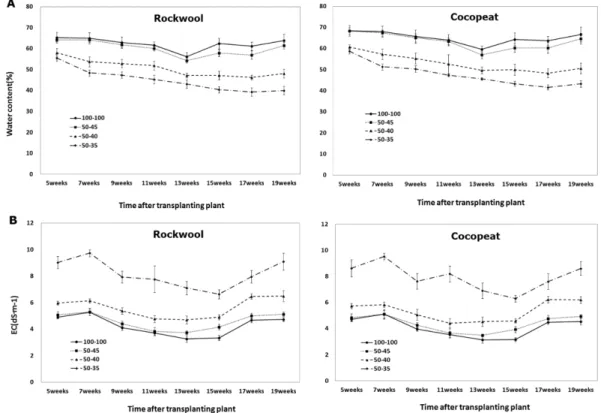
처리별 함수율과 슬래브 EC의 경시적 변화는 Fig.
1에서 나타낸 바와 같다. 생육기간 동안의 함수율은 100-100 처리가 가장 높게 유지되었고, 50J · cm−2에 양액공급하는 처리에서는 1회 양액공급량이 많아질수 록 높게 유지되었다. 처리별 함수율은 100-100 처리와 50-45 처리가 Rockwool에서 55~65%, Cocopeat는
60~70% 정도로 생육에 적당한 수준의 함수율을 유지하
였지만, 50-40과 50-35 처리에서는 양액공급량이 줄어 들수록 대부분 적정 수준 이하로 낮아졌고, Cocopeat 보다는 Rockwool 배지에서 변화의 폭이 컸다. 슬래브 EC는 100-100 처리와 50-45 처리가 3.0~5.0dS · m−1 의 파프리카 생육 적정 범위에서 비슷하게 유지되었지 만, 50-45 처리가 다소 높았다. 50-40 처리는 4.5~
6.5dS · m−1, 50-35 처리는 6.5~9.5dS · m−1로 파프리카 적정 생육 EC 범위보다 높게 유지되었으며 배지간에 는 Rockwool이 Cocopeat 배지보다 높았다.
50-45 처리는 기존 양액공급 방식인 100-100 처리보
다 공급량을 10% 정도 줄인 처리인데도 일일 배액량이 Rockwool의 경우 241mL에서 65.5mL로 175.5mL,
72.8% 감소하였고, Cocopeat에서도 187mL에서
55.9mL로 131.1mL, 70.1% 감소하였다. 하지만 슬래 브내 함수율과 EC는 적정 근권조건인 55~65% 함수 율, 3.0~5.0dS · m−1 EC의 범위에 있었다. 이와같이 급액횟수를 늘리고 1회 당 급액량을 줄이면 근권의 적 정 수분상태가 유지되고 배액량이 감소하여 배액으로 낭비되는 양을 줄일 수 있는데(Benoit, 1992; Shimaji, 1990, Smith, 1988), 이러한 급액방법에 의해 하루 동안의 급액량을 동일하게 하더라도 1일 급액횟수나 1 회당 급액량을 어떻게 설정하느냐에 따라 수분흡수량 을 조절할 수 있다(Kim 등, 2001; Li 등, 2001;
Roh와 Lee, 2001).
양액공급 방법별 생육은 100-100의 기존 양액공급 방식에 비교해서 50-45 처리는 거의 비슷한 수준이었 지만, 50-40과 50-35 처리는 생육이 위축되는 경향을 보였다. 초장과 분지수는 100-100과 50-45 처리가 초 장이 길고 분지수가 증가하였으며, 공급량이 감소할수 록 초장이 짧고 분지수는 감소하였다. 경경과 주경장은 양액공급방법과 배지종류에 따른 차이가 없었다. 잎 크 Table 1. Comparison of the irrigation and drain amount per plant affected by irrigation methods in the rockwool and coco-
peat culture.
Substrates Irrigation methods (J · cm−2-mL)z
Irrigation amount per day (mL · plant−1)
Drain amount per day (mL · plant−1)
Drain rate (%)
Rockwool 100-100 809.3 241.0 26.3
50-45 743.5 065.5 08.8
50-40 656.3 039.2 06.0
50-35 591.0 026.2 04.4
Cocopeat 100-100 809.3 187.1 23.1
50-45 743.5 055.9 07.5
50-40 656.3 032.6 05.0
50-35 591.0 020.2 03.4
Significancey
Rockwool (A) ** ** **
Cocopeat (B) ** ** **
A × B ns * *
zIrrigation amount (mL) per accumulation radiation (J · cm−2) a plant.
yns, *, ** Nonsignificant or significant at p = 0.05, 0.001, respectively.
기는 100-100과 50-45 처리가 컸고, 양액공급량이 감 소할수록 작았다(Table 2).
양액공급량을 줄이면 함수율이 낮아지고 근권의 EC
가 높아져 양분흡수의 균형이 깨지고 뿌리에 스트레스 를 받고, 심하면 광합성이 저하되고 생육이 억제된다 (Aljibury와 May, 1970; Martin 등, 1970; Xu 등, Fig. 1. Change of the water content (A) and EC (B) in the substrates affected by irrigation methods in the rockwool and
cocopeat culture.
Table 2. Effects of irrigation methods on the growth of paprika (Capsicum annuum ‘Coletti’) in the rockwool and cocopeat culture.
Substrates Irrigation methods (J · cm−2-mL)z
Plant height (cm)
No. of branches per plant
Stem diameter (cm)
Main stem length (cm)
Leaf size (cm) Length Width
Rockwool 100-100 181.3 21.2 1.85 34.5 23.1 15.5
50-45 183.0 21.3 1.86 34.4 22.9 15.5
50-40 173.9 20.9 1.84 34.1 22.1 15.1
50-35 164.3 20.3 1.85 34.2 21.5 14.3
Cocopeat 100-100 201.1 21.6 1.90 34.7 25.6 16.4
50-45 199.8 21.8 1.89 34.6 25.4 16.5
50-40 183.6 21.1 1.88 34.4 24.7 16.2
50-35 177.2 20.5 1.87 34.4 24.4 16.1
Significancey
Rockwool (A) * ns ns ns * *
Cocopeat (B) * ns ns ns ns ns
A × B * ns ns ns * ns
zIrrigation amount (mL) per accumulation radiation (J · cm−2) a plant.
yns, *, ** Nonsignificant or significant at p = 0.05, 0.001, respectively.
1997). 작물의 스트레스를 줄이고 영양생장을 촉진하기 위해서는 1회 공급량을 줄이면서 1일 공급횟수를 늘리 는 방법이 효과적이다(Beniot, 1992; Lee 등, 1998).
100-100과 50-45 처리는 함수율, EC 등 근권환경이 안정적으로 유지하였기 때문에 생육이 비슷하였고, 50- 40과 50-35 처리는 낮은 함수율과 높은 EC로 생육이 생식생장으로 전환되었을 것으로 생각되었다.
배지종류별로는 Cocopeat가 Rockwool 배지보다 초 장이 길고 잎이 컸는데, 배지의 보수력이 Cocopeat가 Rockwool보다 높기 때문에(An 등, 2009) 함수율이 높아지고 EC가 낮아져 영양생장이 촉진된 것으로 판 단되었다.
양액공급 방법별 과실특성에서 과실크기는 100-100 과 50-45 처리가 가장 컸고 공급량이 줄어들수록 크 기가 감소하였다. 평균과중 역시 100-100 처리와 50- 45 처리는 비슷하였지만, 50-40과 50-35 처리는 양액 공급량이 줄어들수록 감소하였다. 당도 증진을 위해 수 분공급을 제한하거나(Kuriyama, 1996; Li 등, 2001), 고농도 EC 공급으로 효과를 거두지만 이로 인해 과중 의 감소가 불가피한데, 급액량 감소는 근권의 양수분 균형을 깨뜨려서 생육이 억제되고 건물중이 감소해 과 실생장이 저해되는 것(Hayata 등, 1998)으로 판단하였 다. 배지종류별로는 Cocopeat가 Rockwool 배지에 비해 과실크기가 증가했는데, Cocopeat의 경우 Rockwool보 다 높은 보수력을 바탕으로 근권이 안정됨으로써 뿌리
의 활력과 초세가 강해지고 엽면적이 증가하여 과실의 충실도가 높아졌기(Ito와 Kawai, 1994; Ootake 등,
1994) 때문으로 추정하였다. 과육두께와 심실수 등은
양액공급 방법과 배지종류별로 차이를 보이지 않았다 (Table 3).
근권의 함수율을 떨어뜨리거나, 고농도의 양액을 공급 하면 과실 당도가 증가되는데(Adams, 1991; Shinohara 등, 1995; Tadesse 등, 1999), 본 연구에서는 양액공 급방법과 배지종류에 따라 근권 함수율과 EC의 분포 수준이 그다지 심하지 않았기 때문에 당도의 차이가 없었던 것으로 생각되었다. 경도는 100-100 처리가 가 장 높았고, 50J · cm−2 당 1회 양액을 공급하는 처리 들 중에서는 공급량이 많을수록 경도가 높았다. 색도는 밝기정도를 나타내는 L은 처리간에 차이가 없었지만, 빨간색의 a와 노란색의 b는 양액공급량이 줄어들수록 증가하는 경향이었다(Table 4).
양액공급 방법별 상품과수는 100-100 처리와 50-45 처리가 비슷한 수준으로 가장 많았고 양액공급량이 줄 어들수록 감소하는 경향이었다. 상품율은 Rockwool에 서는 100-100 처리가 92.3%로 가장 높았고, 50-45 처리는 89.9%, 50-35 처리는 71.8%로 가장 낮았다.
그러나 Cocopeat에서는 50-45 처리에서 92.6%로 가 장 높았고 100-100 처리는 90.8%, 50-35는 75.8%로 가장 낮았다. 50-40, 50-35 처리는 적정 수준을 벗어 나 근권 함수율이 장기간 낮게 유지됨으로써 뿌리에 Table 3. Effects of irrigation methods on the fruit size, weight, pericarp thickness and locules of paprika (Capsicum annuum
‘Coletti’) in the rockwool and cocopeat culture.
Substrates Irrigation methods (J · cm−2-mL)z
Fruit size (cm) Mean fruit weight (g)
Pericarp thickness (mm)
No. of locules Length Width
Rockwool 100-100 8.5 9.3 186.5 7.0 3.8
50-45 8.4 9.1 185.5 7.1 3.8
50-40 8.2 9.0 177.3 7.0 3.9
50-35 8.3 8.6 175.0 6.9 3.8
Cocopeat 100-100 8.8 9.2 189.0 7.1 3.9
50-45 8.6 9.0 190.8 7.0 3.8
50-40 8.4 8.7 182.6 7.2 3.9
50-35 8.5 8.6 173.0 7.0 3.9
Significancey
Rockwool (A) ns ns * ns ns
Cocopeat (B) ns * * ns ns
A × B ns ns ns ns ns
zIrrigation amount (mL) per accumulation radiation (J · cm−2) a plant.
yns, *, ** Nonsignificant or significant at p = 0.05, 0.001, respectively.
스트레스가 발생하고 양분의 흡수가 저해되어 초세가 약해지고 엽면적이 감소되어 과실 품질이 낮아 상품성 이 떨어졌거나(Aljibury와 May, 1970; Martin 등,
1970), 수분스트레스를 통해 낙과가 촉진되었기(Doyle
등, 1994; Rao 등, 1976) 때문으로 추정하였다.
비상품과수는 양액공급량이 적었던 50-35 처리에서
소과와 배꼽썩음과의 발생이 많았고, 100-100과 50-45 처리는 비슷한 수준이었다. 양액공급량이 적었던 50-40 과 50-35 처리에서 소과와 배꼽썩음과 발생이 많았던 것은 근권의 함수율과 EC의 변화폭이 커 근권 생육이 억제되고 광합성율이 낮아 과실이 작고(Ito와 Kawai, 1994; Ootake 등, 1994), 근권의 낮은 수분함량에 의 Table 4. Effects of irrigation methods on the soluble solids, fruit hardness and hunter value of paprika (Capsicum annuum
‘Coletti’) in the rockwool and cocopeat culture.
Substrates Irrigation methods (J · cm−2-mL)z
Soluble solids (o Brix)
Fruit hardness (g · 5 mm−1)y
Hunter valuex
L a b
Rockwool 100-100 5.8 1,983 53.9 6.9 49.7
50-45 6.1 1,943 54.2 7.2 49.9
50-40 6.3 1,873 54.3 8.2 52.0
50-35 6.7 1,780 54.6 9.3 51.9
Cocopeat 100-100 6.0 1,963 54.1 7.6 50.6
50-45 5.9 1,954 53.6 7.1 51.4
50-40 6.6 1,837 54.8 9.3 52.2
50-35 6.6 1,767 54.3 9.8 53.3
Significancew
Rockwool (A) ns * ns * ns
Cocopeat (B) ns ns ns * *
A × B ns ns ns ns ns
zIrrigation amount (mL) per accumulation radiation (J · cm−2) a plant.
yRheometer probe φ5 mm.
xL, lightness; a, redness (+ red, − green); and b, yellowness (+ yellow, − blue).
wns, *, ** Nonsignificant or significant at p = 0.05, 0.001, respectively.
Table 5. Effects of irrigation methods on the yield of paprika (Capsicum annuum ‘Coletti’) in the rockwool and cocopeat cul- ture.
Substrate
Irrigation methods (J · cm−2-mL)z
Marketable fruits (%)
No. of harvested fruits per plant
Yield (kg · 10a−1) Marketable Unmarketabley
Total Small BER Others Total
Rockwool 100-100 92.3 9.7 0.2 0.5 0.1 0.8 10.5 6,095
50-45 89.9 9.8 0.3 0.7 0.1 1.1 10.9 6,126
50-40 80.0 8.4 0.3 1.7 0.1 2.1 10.5 5,019
50-35 71.8 7.9 0.5 2.5 0.1 3.1 11.0 4,659
Cocopeat 100-100 90.8 8.9 0.2 0.6 0.1 0.9 9.8 5,669
50-45 92.6 8.8 0.1 0.5 0.1 0.7 9.5 5,658
50-40 85.3 8.7 0.1 1.3 0.1 1.5 10.2 5,354
50-35 75.8 7.5 0.3 2.0 0.1 2.4 9.9 4,373
Significancex
Rockwool (A) * ** ns * ns * ns *
Cocopeat (B) * * ns * ns * ns *
A × B ns ns ns ns ns ns ns ns
zIrrigation amount (mL) per accumulation radiation (J · cm−2) a plant.
ySmall, < 100 g;BER, blossom end rot; Others, diseased and bent fruits.
xns, *, ** Nonsignificant or significant at p = 0.05, 0.001, respectively.
해 Ca의 흡수가 제한되어 배꼽썩음과의 발생이 증가되 었던 것(Bar-Tal과 Pressman, 1996)으로 판단된다.
수량은 100-100, 50-45 처리에서 근권의 함수율과 EC가 적정 생육조건의 수준으로 유지됨으로써 생육이 안정되고 과실의 품질을 유지하는데 유리했기 때문에 수량이 높아졌을 것으로 판단하였다. 양액공급량이 가 장 적었던 50-35 처리는 배지에 상관없이 낮은 수량 성을 보였다.
적 요
파프리카 수경재배의 배액량을 감소시키기 위한 양 액공급 방법이 파프리카 생육과 수량에 미치는 영향을 검토코자 Rockwool과 Cocopeat 배지를 사용하여 누 적광량 당 주당 1회 양액공급량을 100-100(100J · cm−2- 100mL irrigation per plant, 30% drainage), 50-45, 50-40, 50-35로 조절하여 공급하였다.
주당 일일 배액량과 배액율은 Rockwool 배지에서 는 100-100 처리가 241.0mL 26.3%, 50-45 처리가 65.5mL 8.8%, 50-40 처리가 39.2mL 6.0%, 그리고 50-35 처리가 26.2mL 4.4%였고, Cocopeat 배지에서 는 100-100 처리가 187.1mL 23.1%, 50-45 처리가 55.9mL 7.5%, 50-40 처리가 32.6mL 5.0%, 그리고 50-35 처리가 20.2mL 3.4%였다.
처리별 함수율은 100-100 처리와 50-45 처리가 Rockwool에서 55~65%, 그리고 Cocopeat는 60~70%
정도로 생육에 적당한 수준의 함수율을 유지하였지만, 50-40과 50-35 처리에서는 양액공급량이 줄어들수록 대부분 적정 수준 이하로 낮아졌고, Cocopeat보다는 Rockwool 배지에서 변화의 폭이 컸다. 슬래브 EC는 100-100 처리와 50-45 처리가 3.0~5.0dS · m−1의 파프 리카 생육 적정 범위에서 비슷하게 유지되었다. 50-40 처리는 4.5~6.5dS · m−1, 50-35 처리는 6.5~9.5dS · m−1 로 파프리카 적정 생육 EC 범위보다 높은 수준을 유 지하였으며 배지간에는 Rockwool이 Cocopeat 배지보 다 높았다.
초장과 분지수는 100-100 처리와 50-45 처리가 초 장이 길고 분지수가 증가하였으며, 공급량이 감소할수 록 초장이 짧고 분지수가 감소하였다. 잎 크기는 100- 100 처리와 50-45 처리가 컸고, 양액공급량이 감소할 수록 작았다.
과실크기와 평균과중은 100-100 처리와 50-45 처리 가 가장 크고 무거웠으며, 양액공급량이 줄어들수록 감 소하였다. 상품율과 상품과수는 100-100과 50-45 처리 에서 높고 많았으며, 50-35처리가 가장 낮고 적었다.
비상품과수는 양액공급량이 적었던 50-35 처리에서 소 과와 배꼽썩음과의 발생이 많았고, 100-100과 50-45 처리는 비슷한 수준이었다. 수량은 100-100, 50-45 처 리에서 높았고, 양액공급량이 줄어들수록 감소하였다 주제어 : 근권 EC, 누적일사량, 배꼽썩음과, 함수율
사 사
본 논문은 2012년 농촌진흥청에서 지원한 농업 현 장 실용화 기술 개발 과제(과제번호: PJ0073002012) 의 연구비로 수행되었음.
인 용 문 헌
1. Adams, P. 1991. Effects of increasing the salinity of the nutrient solution with major nutrients or sodium chloride on the yield, quality and composition of toma- toes grown in rockwool. J. Horatio. Sci. 66:210-207.
2. Aljibury, F.K. and D. May. 1970. Irrigation schedules and production of processing tomatoes on the San Joaquin Valley Westside Calif. Agar. 24(8):10-11.
3. Ammerlaan, J.C.J. 1993. Environment-conscious pro- duction system in Dutch glasshouse horticulture. Paper at ISHS International Symposium on New Cultivation System in Greenhouse. Caqliari. Italy.
4. An, C.G., D.S. Kang, C.W. Rho, and B.R. Jeong. 2002.
Effects of transplanting method of seedlings on the growth and yield of paprika. Kor. J. Hort. Sci. Tech- nol. 20:15-18.
5. An, C.G., Y.H. Hwang, G.M. Shon, C.S. Lim, J.L. Cho, and B.R. Jeong. 2009. Effects of Irrigation amount in rockwool and cocopeat substrates on growth and fruit- ing of sweet pepper during fruiting period. Kor. J.
Hort. Sci. Technol. 27(2):233-238.
6. Bar-Tal, A. and E. Pressman. 1996. Root restriction and potassium and calcium solution concentrations affect dry matter production, calcium uptake and blos- som end rot in greenhouse tomato. J. Amer. Soc. Hort.
Sci. 121:649-55.
7. Benoit, F. 1992. Practical guide for simple soilless cul- ture techniques. Europ. Vegetable R & D Centre, Bel- gium. p. 28-37.
8. Choi, K.Y., M.J. Kang, Y.B. Lee, S.O. Yoo, and J.H.
Bae. 2001. Development of optimum nutrient solution for sweet pepper substrate culture in closed system. J.
Kor. Soc. Hort. Sci. 42(5):513-518.
9. Doyle, A.S., W.L. Dickens, and J.R. Stansell. 1994.
Irrigation regimes affect yield and water use by bell pepper. J. Amer. Soc. Hort. Sci. 119:936-939.
10. Kim. H.J., J.H. Kim, Y.H. Woo, W.S. Kim, and Y.I.
Nam. 2001. Nutrient and water uptake of tomato plants by growth stage in closed perlite culture. J. Kor.
Soc. Hort. Sci. 42:254-258.
11. Kuriyama, T. 1996. Influence of quantitative control of nutrient solution on yield and Brix of fruit juice in ash ball culture of tomato. Res. Bull. Kyushu Branch of the Japan. Soc. Hort. Sci. 4:85-86.
12. Hayata, Y., T. Tabe, S. Kondo, and K. Inoue. 1998.
The effects of water stress on the growth, sugar and nitrogen content of cherry tomato fruit. J. Japan. Soc.
Hort. Sci. 65:759-766.
13. Ito, H. and S. Kawai. 1994. Effects of watering con- trol on the fruit qualities of tomato and cherry tomato.
Res. Bull. Aichi Agric. Res. Center 26:191-199.
14. Lee, E.H., B.Y. Lee, Y.B. Lee, Y.S. Kwon, and J.W.
Lee. 1998. Nitrate content and activities of nitrate reductase and glutamine synthease as affected by ionic strength, nitrate concentration, ratio of nitrate to ammonium in nutrient solution for culture of leaf let- tuce and water dropwort. J. Kor. Soc. Hort. Sci.
39:161-165.
15. Li, X.R., H.N. Cao, K.C. Yoo, and I.S. Kim. 2001.
Effect of limited supplying frequency and amount of nutrient solutions on the yield and fruit quality of tomato grown in ash ball. J. Kor. Soc. Hort. Sci. 42:
501-505.
16. Martin, P.E., J.C. Lingle, R.M. Hagan, and W.J.
Flocker. 1970. Irrigation of tomatoes in a single har-
vest program. Calif. Agr. 6:13-14.
17. Ootake, Y., Y. Ban, Y. Tanaka, and G. Hayashi. 1994.
Changes of chemical constituents in tomato fruit in relation to soil moisture. Res. Bull. Aichi Agric. Cen- ter 26:209-212.
18. Rao, K.P. and D.W. Rains. 1976. NO3− absorption by barley. 2. Influence of NRA. Plant Physiol. 57:59-62.
19. Roh, M.Y. and Y.B. Lee. 2001. Amount of water absorption, net CO2 assimilation rate, growth, and yield of cucumber plants as affected by irrigation con- trol method in substrate culture. J. Kor. Soc. Hort. Sci.
42:38-42.
20. Rural Development Administration (RDA). 1997. The- ory and application to cultivation of crop physiology.
pp. 304-330.
21. Schon, M.K. and M.P. Compton. 1997. Comparison of cucumbers grown in rockwool or perlite at two leach- ing fractions. Hort Technology 7:30-33.
22. Shimaji, H. 1990. Control equipments on soilless cul- ture. Agriculture and Hort. 65:104-110.
23. Shinohara, Y., K. Akiba, T. Maruo, and T. Ito. 1995.
Effect of water stress on the fruit yield, quality and physiological condition of tomato plants using gravel culture. Acta Hortic. 396:211-218.
24. Smith, D.L. 1988. Rockwool in horticulture. pp. 24-72.
Grower Books, London.
25. Tadesse, T., M.A. Nichols, and K.J. Fisher. 1999.
Nutrient conductivity effects on sweet pepper plants grown using a nutrient film technique. 2. Blossom-end rot and fruit mineral status. J. New Zealand Crop Hort.
Sci. 27:239-247.
26. Xu, H.L., L. Gauthier, and A. Gosselin. 1997. Green- house tomato photosynthetic accumulation to water deficit and response to salt accumulation in the sub- strate. J. Japan. Soc, Hort. Sci. 65:777-784.