• 검색 결과가 없습니다.

Design of a Bimorph Piezoelectric Energy Harvester for Railway Monitoring

N/A
N/A
Protected

Academic year: 2021

Share "Design of a Bimorph Piezoelectric Energy Harvester for Railway Monitoring"

Copied!
8
0
0

로드 중.... (전체 텍스트 보기)

전체 글

(1)

Design of a Bimorph Piezoelectric Energy Harvester for Railway Monitoring

Jingcheng Li*, Shinae Jang*

and Jiong Tang**

Abstract Wireless sensor network is one of prospective methods for railway monitoring due to the long-term operation and low-maintenance performances. How to supply power to the wireless sensor nodes has drawn much attention recently. In railway monitoring, the idea of converting ambient vibration energy from vibration of railway track induced by passing trains to electric energy has made it a potential way for powering the wireless sensor nodes. In this paper, a bimorph cantilever piezoelectric energy harvester was designed based on a single degree-of-freedom model. Experimental test was also performed to validate the design. The first natural frequency of the bimorph piezoelectric energy harvester was decreased from 117.1 Hz to 65.2 Hz by adding 4 gram tip mass to the free end of the 8.6 gram energy harvester. In addition, the power generation of the piezoelectric energy harvester with 4 gram tip mass at resonant frequency was increased from 0.14 mW to 0.74 mW from 2.06 m/s

2

base excitation compared to stand-alone piezoelectric energy harvester without tip mass.

Keywords: Piezoelectric, Energy Harvesting, Railway, Structural Health Monitoring

[Received: November 1, 2012, Revised: November 23, 2012, Accepted: November 26, 2012] *Civil and Environmental Engineering Department, University of Connecticut, Storrs, CT 06269, U.S., **Mechanical Engineering Department, University of Connecticut, Storrs, CT 06269, U.S. ✝ Corresponding Author, Email: [email protected]

ⓒ 2012, Korean Society for Nondestructive Testing

1. Introduction

Wireless smart sensors have drawn significant attention in general structural health monitoring realm in recent years due to its wireless, low cost, and versatility. Especially, wireless sensor network with self-powered ability have been of increasingly interests for the rails with high demand in railway monitoring under natural and manmade disasters. In general, energy generated from ambient environment such as solar power, wind energy, vibration energy, etc., can be stored in energy storage devices to provide power for the wireless sensors. By powering these wireless sensors from ambient energy, the performance of the sensor networks will be improved and the maintenance costs will be reduced [1]. In railway monitoring, the vibration energy from railway track induced by passing train is a large amount energy which can be used for powering wireless sensors.

Electromagnetic, electrostatic and piezoelectric are the most commonly used energy harvesting mechanisms for converting vibration energy to electric energy [2]. The comparison of these three mechanisms for microsystem has been summarized by Beeby et al. [3]. While each type of these three mechanisms has its benefits for certain applications, it appears that piezoelectric energy harvesters are capable for generating electric power from vibration energy for wireless sensor nodes since recent studies show wireless sensors used for railway monitoring requiring as low as a few mW [4].

As the development of piezoelectric energy

harvesting, a cantilever beam with piezoelectric

material attached to the top and bottom surfaces

becomes an attractive structure for harvesting

energy from ambient excitation. Glynne-Jones et

al. [5] investigated the power output of a

generator fabricated by piezoelectric materials

attached to the top and bottom of a 0.1 mm

(2)

stainless steel beam, a maximum power of 3.3 µW was generated under a frequency of 80.1 Hz with optimal resistive load of 333 kΩ.

Similar study has been performed in the work of duToit et al. [6] for validating the mathematical model. However, a maximum power of 586 µW was measured with 2.5 m/s 2 base acceleration at resonant frequency. Similar results can also be found in Erturk and Inman’s work [7]. In addition, a bimorph piezoelectric cantilever beam generator with proof mass on the free end was developed by Roundy et al. [8, 9]. Proof mass on the free end significantly increase the power output of the piezoelectric cantilever beam. A maximum power output of nearly 80 µW with a power density of 70 µW/cm 3 was produced with a 250 kΩ load resistor, at 2.5 m/s 2 input acceleration and resonant frequency of 120 Hz. After optimal design, the power density could be improved to be 250 µW/cm 3 from a vibration source of 2.5 m/s 2 at 120 Hz. On the other hand, in railway monitoring, the first resonant frequency of a cantilever beam structure can be easily tuned to be close to the excitation frequency from the passing train, which means that the cantilever beam structure can be excited around resonant frequency at most of time to get the maximum power output. In addition, the first resonant frequency of the cantilever beam structure can be further reduced by the addition of a tip mass. Those reasons above make the cantilever piezoelectric energy harvester one of potential solutions to long-term, low maintenance power supply for distributed wireless sensor nodes.

In order to design an efficient cantilever piezoelectric energy harvester from the excitation of railway track induced by passing train, the characteristics of the railway track vibration should be considered regarding to the dominant vibration frequency. The main mechanisms of railway vibration arise from dynamic forces at wheel/rail, and rail/ground interfaces. The wheel/

rail interface refers to rail vibration under moving wheel, and wheel/rail unevenness, while the rail/ground interface refers to the ground- borne vibration [10,11]. Many factors influence the vibration of railway track including train speed, length of rail car, rail and wheel roughness and material properties of the foundation et al.. An experimental test was carried out by Chatterjee et al. [12] for determining the track responses during the passage of trains at variable speeds. A dominant rail vibration frequency less than 5 Hz can be found in each train speed which was contributed by the passage of all axles and bogies. On the other hand, a dominant rail vibration frequency range between 20 Hz and 80 Hz can also be found which was caused by the wheel and rail roughness at variable train speeds. Similar results were also presented by Degrande et al. [13]. To date, most energy harvesters employed to harvest energy from vibrations or vibration structures are operated in resonance at single excitation frequency. However, in railway monitoring, the dominant rail excitation frequency is a range rather than a single excitation frequency which requires the energy harvester can be worked in a broad frequency range. In order to design such an energy harvester, the first step will be designing an energy harvester whose resonant frequency will be within the rail excitation frequency range, and the second step is to broaden the working frequency.

In this paper, a cantilever bimorph

piezoelectric energy harvester with tip mass

whose resonant frequency is between 20 Hz and

80 Hz is designed based on a single degree-

of-freedom model for simplicity. The feasibility

of the single degree-of-freedom model is

validated from experimental tests. In addition,

the effect of the tip mass of the piezoelectric

energy harvester is investigated on natural

frequency modification to maximize power

(3)

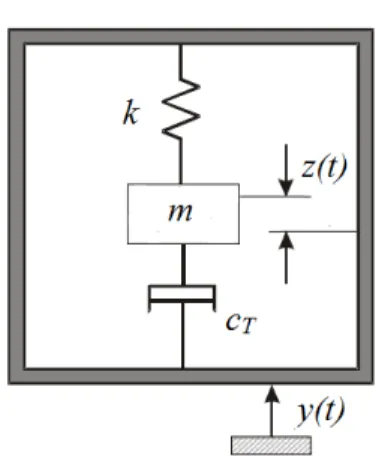
Fig. 1 Single degree-of-freedom model

(a) Piezoelectric without tip mass

(b) Piezoelectric with tip mass

Fig. 2 Schematic of a bimorph piezoelectric energy harvester with and without tip mass in series connection

generation. Based on the theoretical and experimental results, further work in widening the working frequency of the harvester will be performed in future.

2. Mathematical Model

A simple single degree-of-freedom (lumped parameter) model is used in this paper for simplicity (The limitations of the single degree- of-freedom model have been discussed by Erturk and Inman [14]). Fig. 1 shows the schematic of such a system where m is the system mass, k is the spring of stiffness, and c T is the total damping coefficient. The system is being excited by an external sinusoidal vibration y(t) = Ysin(ω t) (where Y is the amplitude of the acceleration and ω is the vibration frequency), resulting in the mass moves as z(t). The equation of motion of the system is described in Eq. (1).

( )

T

( ) ( ) ( )

mz t && + c z t & + kz t = − && my t (1)

Since energy is extracted from relative movement between the mass and the base, the maximum power is generated when the excitation frequency matches the natural frequency of the system ω

n

= k m / . And total damping ratio (ζ t = k/2mω n ) prevents the power goes to infinity when the generator vibrates at resonant frequency.

Fig. 2 shows the schematic of a bimorph piezoelectric energy harvester with and without tip mass in series connection. It can convert the vibration energy to electric energy.

Based on Challa’s work [15], the open voltage V 0 generated from the system depends on the stress σ developed in the structure and the material properties of the piezoelectric patch, as shown in Eq. (2):

31 0

p n

V d t σ ε

= − (2)

where t p is the thickness of the piezoelectric layer, -d 31 is the piezoelectric strain constant, and ε is the dielectric constant of the piezoelectric material, and σ n is the piezoelectric stress at resonant frequency:

2 2

3

n

4

t n

EYh σ L

= ζ ω (3)

where E is the effective modulus of the beam, h is the distance of the piezoelectric layer from the neutral axis, L is the length of the beam.

n

k

eff

/ m

eff

ω = , k eff = 3EI/L 3 , m eff = 33m b /140+m t ,

m b is the total mass of the beam, and mt is the

tip mass. The damping ratio can be obtained by

(4)

Property Symbol Values Property Symbol Values

Length (mm) L 50.8 Brass modulus (GPa) E

s

105

Width (mm) b 31.8 Piezo modulus (GPa) E

p

66

Brass thickness (mm) t

s

0.14 Tip mass (kg) M

t

0.002(each)

Piezo thickness (mm) t

p

0.26(each) Piezo dielectric constant (F/m)

33

ε

S

1500ε

0

Brass density (kg/m

3

) ρs 9000 Piezo strain constant (pm/V) d

31

-190 Piezo density (kg/m

3

) ρ

p

7800

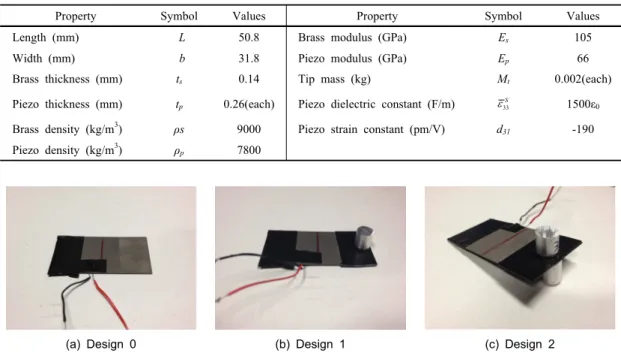
Table 1 Geometry and material properties of the piezoelectric energy harvester

(a) Design 0 (b) Design 1 (c) Design 2

Fig. 3 Piezoelectric energy harvester prototype a) design 0 without tip mass b) design 1 with one tip mass c) design 2 with two tip mass

performing a flick test, through which an amplitude decay plot is obtained and the corresponding damping is determined by:

1 2

1 2

In a ζ a

= π (4)

The power generated from the piezoelectric energy harvester can be calculated such that:

2 0

( )

2

Lp p

s Lp

P V R

R R

= + (5)

where R s is the internal resistance and R Lp is the applied load resistance. As can be seen from Eq. (5), the maximum power can be reached when the applied load resistance equals to the internal resistance. Therefore, a theoretical model to design an energy harvester for wireless sensors has been derived.

3. Experimental Setup

To design an appropriate energy harvester prototype for railway monitoring, an experimental

set up has been prepared with piezoelectric material and tip masses. The bimorph piezoelectric harvester used in this study was from Piezo System, Inc.(T226-A4-503X) [16], which consisted of two equal size PZT-5A piezoelectric elements bracketing a brass substructure layer, and the piezoelectric elements were connected in series. The material used in this paper is similar to those used by duToit et al. [6] and Erturk and Inman [7]. The geometry and material properties of the piezoelectric energy harvester are presented in Table 1.

Three piezoelectric energy harvesters have

been designed based on the theoretical model

described in Section 2: design 0, 1, and 2 (see

Fig. 3). Design 0 has no tip mass at the free

end, while Design 1 has one tip mass, and

Design 2 has two. The tip mass was made of

aluminum with 2 gram for each. Based on the

mathematical model, the first natural frequency

of the design 0 was 120.3 Hz which was out of

the dominant rail vibration frequency range. Two

prototypes of piezoelectric energy harvesters with

(5)

Fig. 4 Experimental setup for the validation of the mathematical model

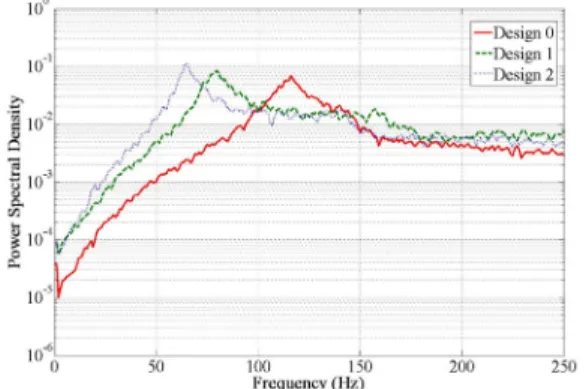
Fig. 5 Power spectral density of the piezoelectric energy harvester

tip mass were designed. The natural frequency of design 1 and design 2 was 85.3 Hz and 69.7 Hz, respectively, where only design 2 was within the railway dominant vibration frequency.

The experimental setup is shown in Fig. 4.

One end of the bimorph piezoelectric energy harvester was free, while the other end was clamped and excited from the base by a shaker connected to a function generator via a power amplifier. The generated voltage from the energy harvester was measured by connecting it to a data acquisition system. In addition, an acceler- ometer was attached on the clamped end of the piezoelectric energy harvester to measure the base acceleration. The load resistors were shunted between the piezoelectric elements. Experimental tests will be performed to validate the feasibility of the mathematical model. The natural frequencies and energy outputs of the three piezoelectric harvesters will be compared between the mathematical and experimental results.

4. Results and Discussions

Using the experimental setup described in section 3, several results have been found.

Firstly, as shown in Fig. 5, the first natural frequencies of the three piezoelectric bimorph energy harvesters, Design 0, 1 and 2, were 117.1 Hz, 80.3 Hz, and 65.2 Hz, respectively, while those were predicted by the mathematical model to be 120.3 Hz, 85.3 Hz and 69.7 Hz, respectively. Given those material properties by

the producer, the results for the first natural frequency agreed very well. In addition, as the weight of tip mass increased, the first natural frequency of the energy harvester decreased. By adding 4 gram tip mass to the free end of the piezoelectric energy harvester, the natural frequency decreased from 117.1 Hz to 65.2 Hz from the experimental data. Because the excitation frequency of railway track by passing train is low, the first natural frequency could be further reduced by heavier tip mass. Nonetheless, at this stage, design 2 matches the objective of this study which designing an energy harvester whose resonant frequency is within the dominant rail vibration frequency range.

Secondly, the effect of tip mass in

increasing the maximum energy output with the

optimal load resistance at resonant frequency

was investigated. Thirteen different resistances 1,

3.3, 4.8, 6.7, 9.9, 11.8, 14.9, 19.4, 26.5, 50.5,

67.9, 98.6, and 118 kΩ were used. The base

excitation was measured to be 0.21g (2.06 m/s 2 )

and was held constant during these tests by

monitoring the base acceleration. The damping

ratio of the prototypes was measured to be

0.018. The power and voltage responses of the

three piezoelectric energy harvesters at different

load resistances are shown in Fig. 6 and 7,

respectively. From Fig. 6, generally, the power

increases as the resistance increases before it

(6)

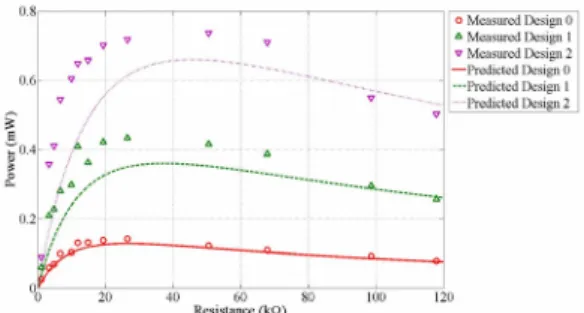
Fig. 6 Comparison of predicted and measured power output versus resistance under 0.21g base excitation at resonant frequency

Fig. 7 Comparison of predicted and measured voltage output versus resistance under 0.21g base excitation at resonant frequency

reaches the optimal resistance, then the power decreases when the resistance keeps on increasing. The maximum power generated by design 0, design 1 and design 2 were measured to be 0.14, 0.43 and 0.74 mW, while the predicted results were 0.13, 0.36, and 0.66 mW, respectively, resulting in 7.14%, 16.30% and 10.81% error. In addition, by adding tip mass to the free end, the maximum power generated by design 1 and design 2 increased 176.9% and 407.7% from measured data compared to design 0. Moreover, the mathematical model under- estimated the power generated from the energy harvesters. The optimal resistances predicted by the model were 26.5, 37.3 and 45.6 kΩ for design 0, design 1 and design 2, respectively.

While from the plot, the optimal resistance for design 0 is between 20 and 26.5 kΩ, and between 26.5 kΩ and 50.5 kΩ for design 1 and

design 2 from measured data. Furthermore, the optimal load resistance increases as the tip mass increases from the plot.

In addition, the voltage output versus resistances under the first natural frequency at 0.21g base acceleration for the three harvesters is shown in Fig. 7. From the plot, the voltage of the three generators increase rapidly at beginning, and then increase slowly after the optimal load resistance for both predicted and experimental data. The voltage reaches the maximum at the maximum resistance. Similar to power output, the mathematical model under- estimated the voltage output from the energy harvesters. In general, reasonable agreements have been found between the predicted and measured electrical responses from Fig. 6 and 7.

5. Conclusions

A bimorph piezoelectric energy harvester with tip mass whose resonant frequency is within the dominant rail vibration frequency range was designed. With the tip mass in energy harvester, the natural frequency was decreased and the maximum energy output was increased at the resonant frequency. In addition, a SDOF model was validated to predict the natural frequency and power output of the piezoelectric energy harvester. From the test results, the first natural frequency of the generators decreased from 117.1 Hz to 80.3 Hz and 65.2 Hz by adding 2 gram and 4 gram tip mass to the free end of the cantilever bimorph piezoelectric energy harvester, respectively.

Meanwhile, by adding the 2 gram and 4 gram

tip mass, the maximum energy output at

resonant frequency with optimal resistance under

base excitation of 0.21g increased from

0.14 mW to 0.43 mW and 0.74 mW, respec-

tively. Generally, good agreements have been

found between the experimental and mathematical

data. Further study on designing an efficient

(7)

energy harvester for wireless sensor nodes used in railway monitoring is underway including field tests to obtain the ambient frequency, track deflection and strain information of the railway track by passing train; to broaden the working frequency of the energy harvester based on the dominant rail vibration frequency range; and to validate the feasibility of the design by field tests .

Acknowledgement

This material is based upon work supported by the U.S. Department of Homeland Security under Grant Award Number 2008-ST-061- TS002. The generous supports are gratefully acknowledged. The views and conclusions contained in this document are those of the authors and should not be interpreted as necessarily representing the official policies, either expressed or implied, of the U.S.

Department of Homeland Security.

References

[1] G. Park, T. Rosing, M. D. Todd, C. R.

Farrar and W. Hodgkiss, "Energy harvesting for structural health monitoring sensor networks," Journal of Infrastructure Systems, ASCE, Vol. 14, No. 1, pp. 64-79 (2008)

[2] C. B. Williams and R. B. Yates, "Analysis of a micro-electric generator for micro- systems," Sensors and Actuators, Vol. 52, pp. 8-11 (1996)

[3] S. P. Beeby, M. J. Tudor and N. M.

White, "Energy harvesting vibration sources for microsystems applications,"

Measurement Science and Technology, Vol.

17, pp. 175-195 (2006)

[4] S. Jang, H. Jo, S. Cho, K. Mechitov and J. Rice, "Structure health monitoring of a cable-stayed bridge using smart sensor

technology: deployment and evaluation,"

Smart Structures and Systems, Vol. 6, No.

5-6, pp. 439-459 (2010)

[5] P. Glynne-Jones, S. P. Beeby and N. M.

White, "Towards a piezoelectric vibration powered microgenerator," IEEE Science Measurement and Technology, Vol. 148, No. 2, pp. 68-72 (2001)

[6] N. E. duToit and B. L. Wardle,

"Experimental verification of models for microfabricated piezoelectric vibration energy harvesters," AIAA Journal, Vol. 45, pp. 1126-1137 (2007)

[7] A. Erturk and D. J. Inman, "An experimentally validated bimorph cantilever model for piezoelectric energy harvesting from base excitations," Smart Materials and Structures, Vol. 18, 025009 (2009) [8] S. Roundy, P. K. Wright and J. Rabaey,

"A study of low lever vibration as a power source for wireless sensor nodes,"

Computer Communication, Vol. 26, pp.

1131-1144 (2003)

[9] S. Roundy and P. K. Wright, "A piezoelectric vibration base generator for wireless electronics," Smart Materials and Structures, Vol. 13, pp. 1131-1142 (2004) [10] S. A. Suhairy, "Prediction of Ground

Vibration from Railways," SP Swedish National Testing and Research Institute, SP Report (2000)

[11] Aylesbury Vale Parkway Development Railway Vibration. MM Doc Ref:

229338/46 Rev. A (2007)

[12] P. Chatterjee, G. Degrande, S. Jacobs, J.

Charlier, P. Bouvet and D. Brassenx,

"Experimental results of free field and structural vibrations due to underground railway traffic," 10 th International Congress on Sound and Vibration, Stockholm, Sweden (2003)

[13] G. Gegrande, P. Chatterjee, W. Van de

Velde, P. Hölscher, V. Hopman, A. Wang,

(8)

N. Dadkah and R. Klein, "Vibration due to a test train at variable speeds in a deep bored tunnel embedded in London clay,"

11 th International Congress on Sound and Vibration, St-Petersburg, Russis (2004) [14] A. Erturk and D. J. Inman, "Issues in

mathematical modeling of piezoelectric energy harvester," Smart Material and Structure, Vol. 17, 065016 (2009)

[15] V. R. Challa, M. G. Prasad and F. T. Fisher,

"A coupled piezoelectric-electromagnetic energy harvesting technique for achieving increased power output through damping matching," Smart materials and Structures, Vol. 18, 095029 (2009)

[16] Piezo Systems, Inc. http://www.piezo.com/

prodbm1brass.html

수치

Fig. 1 Single degree-of-freedom model
Table 1 Geometry and material properties of the piezoelectric energy harvester
Fig. 4 Experimental setup for the validation of the  mathematical model
Fig.  6 Comparison of predicted and measured  power output versus resistance under 0.21g  base excitation at resonant frequency

참조

관련 문서

In SCP, a solar collector field is con- nected to a conventional distillation plant to provide thermal energy for the desalination process because fossil fuel is not

– Mandatory consultations on and coordination of energy policies and related measures, including in the sphere of establishing a future energy balance structure,

Insider trading refers to activities of people in positions easy to obtain internal information of a company including shareholders and employees of stock

The change in the internal energy of a closed thermodynamic system is equal to the sum em is equal to the sum of the amount of heat energy supplied to the system and the work.

The change in the internal energy of a closed thermodynamic system is equal to the sum em is equal to the sum of the amount of heat energy supplied to the system and the work.

The purpose of the study is to develop a sensor data collection and monitoring system with database using IoT techrology and to apply the ststem to three

 A series of systems for configuring alarm and control functions by monitoring the states of main engine, generator, and auxiliary equipment, for securing the safety

In this paper, we developed a data management system for shipboard machinery equipment and the monitoring application for the verification of the utility, and we