Impact of Divalent Cations on the Rheology of Cellulose Nanofibrils
Rahmini
1, Soyoung Juhn
2, Hyun-A Seong
3‡, Soo-Jeong Shin
4†Received December 4, 2019; Received in revised form April 17, 2020; Accepted April 20, 2020
ABSTRACT
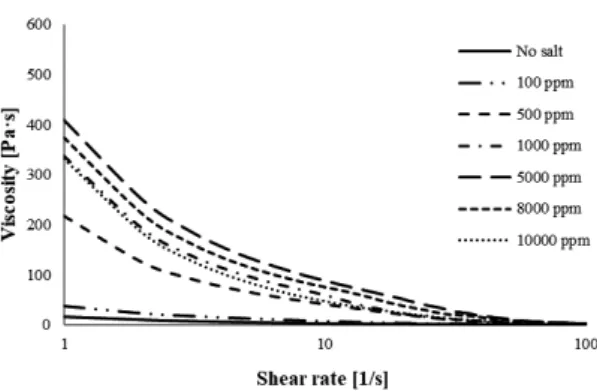
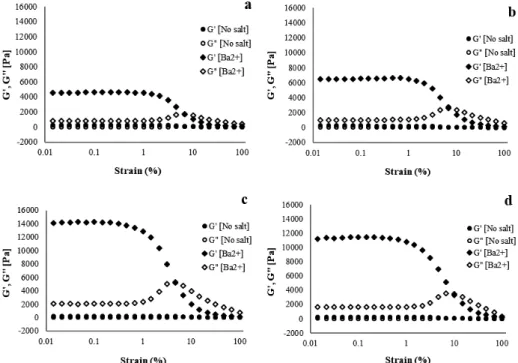
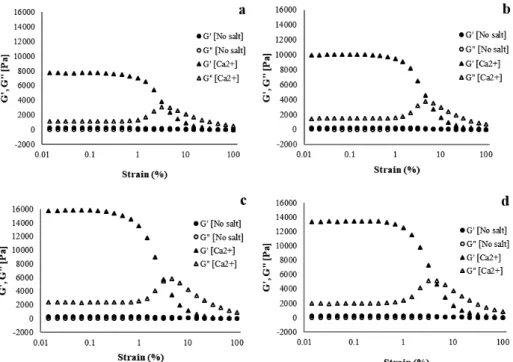
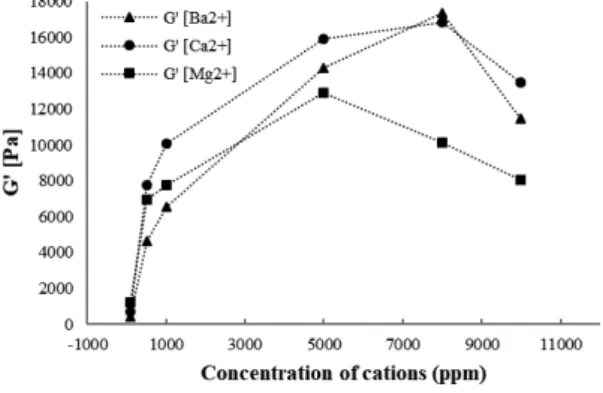
Cellulose nanofibrils (CNFs) hydrogels have been used in various applications due to their ability to form gels via entanglement networks in water. In this study, the rheological properties of CNF gel with various concentrations of divalent cations (Mg
2+, Ca
2+, and Ba
2+) are investigated using a rheometer (MCR 102, Anton Paar, Austria). The addition of divalent cations significantly increased the viscosity, storage modulus, and loss modulus as the concentration of cation increased from 100 to 8,000 ppm that contributed to the formation of stronger gels. This phenomenon indicates that higher cation concentration leads to fibril aggregation and a stiffened network. However, when an excessive amount of cations (10,000 ppm) is added, the CNF starts to coagulate and lose strength. Com- pared to Ca
2+and Ba
2+, Mg
2+has a greater effect on hydrogel strength at 100 ppm, and thus exhibited maximum strength at 5,000 ppm. The maximum strength of Ca
2+occurred at 8,000 ppm, and Ca
2+produced the strongest gel (Mg
2+and Ba
2+were second and third, respectively) between 500 and 1,000 ppm. Ba
2+produced the highest-strength gel with the maximum strength achieved at 8,000 ppm. The impact of divalent ions on the rheo- logical properties of CNF strongly correlated with the kind of cation used and the cation concentration.
Keywords: Cellulose nanofibril, rheology, barium, magnesium, calcium
Printed in Korea http://dx.doi.org/10.7584/JKTAPPI.2020.04.52.2.78
1 Department of Wood and Paper Science, Chungbuk National University, Cheongju, 28644, Republic of Korea, Student 2 Nature Costech Inc., Cheongju, 28578, Republic of Korea, Director for R&D
3 Department of Biochemistry, Chungbuk National University, Cheongju, 28644, Republic of Korea, Professor
4 Department of Wood and Paper Science, Chungbuk National University, Cheongju, 28644, Republic of Korea, Professor
† Corresponding Author: E-mail: [email protected] (Address: Department of Wood and Paper Science, Chungbuk National University, Cheongju, 28644, Republic of Korea)
‡ Co-Corresponding Author: E-mail: [email protected] (Address: Department of Biochemistry, Chungbuk National Uni- versity, Cheongju, 28644, Republic of Korea)