• 검색 결과가 없습니다.

22(3)-317-326-2009] Antimicrobial and antioxidant activity of some Indian medicinal plants for the protection against fish pathogenic bacteria

N/A
N/A
Protected

Academic year: 2021

Share "22(3)-317-326-2009] Antimicrobial and antioxidant activity of some Indian medicinal plants for the protection against fish pathogenic bacteria"

Copied!
10
0
0

로드 중.... (전체 텍스트 보기)

전체 글

(1)

317

Antimicrobial and antioxidant activity of some Indian medicinal plants for the protection against fish pathogenic bacteria

Ramasamy Harikrishnan, Sundaram Jawahar

, Man-Chul Kim, Ju-Sang Kim, Ik-Soo Jang, Chellam Balasundaram

��

and Moon-Soo Heo

Marine Applied Microbes & Aquatic Organism Disease Control Lab, Department of Aquatic Biomedical Sciences & Marine and Environmental Reseach Institute College of Ocean Science, Jeju National University, Jeju 690-756, South Korea

Department of Biotechnology, Bharath College of Science and Management, Thanjavur 613-005, Tamil Nadu, India

��

Department of Animal Science, School of Life Sciences, Bharathidasan University, Tiruchirapalli 620-024, Tamil Nadu, India

This study has shown the screening of anti-bacterial activity of three Indian medicinal plant choloroform : methanol (50:50) solvent leaf extracts (i.e. Azadirachta indica, Ocimum sanctum, and Curcuma longa) with different concentrations (10, 5, 2.5, 1.25, 0.625, 0.312, and 0.156 mg/ml) under in vitro conditions against fish pathogenic bacteria, Aeromonas hydrophila, Streptococcus iniae, Vibrio harveyi, V. anguillarum, and Edwardsiella tarda isolated from olive flounder farms, Jeju Island, South Korea. The anti-microbial activity of the A. indica and O. sanctum extracts yielded the zones of growth inhibition (ZI) was 3 and 1mm against A. hydrophila at concentration of 0.156 mg/ml when compared to that of tetracycline standard (3 mm). At highest concentration (10 mg/ml) of A. indica, O. sanctum, and C. longa, high inhibition was 9, 7, and 6 mm when compared to that of tetracycline (11 mm) against A. hydrophila. The minimum inhibitory concen- tration (MIC) of A. indica, O. sanctum, and C. longa at 0.156 mg/ml that yield 9, 10, and 13 CFU/ml for A.

hydrophila, 16, 22, and 25 CFU/ml for S. iniae and 18, 22, and 23 CFU/ml for E. tarda compared to the tetracycline. At highest concentration (10 mg/ml) of the three extracts was better inhibiting the growth of A.

hydrophila, S. iniae and E. tarda. A. indica, O. sanctum, and C. longa were determined to the potential antioxidant activityon the basis of their scavenging activity of the stable 2,2-diphenyl-1-picrylhydrazyl (DPPH) free radical. A. indica extract was 0.625 mg/ml which indicated that the strong anti-oxidant activity.

However, O. sanctum and C. longa extracts showed weak anti-oxidant activity at this concentration. Hence, in vitro assay among the pathogens, A. hydropila is better inhibitory activity of the extracts. It is evident that the Indian medicinal plants extracts were subjected to its effectiveness against A. hydrophila, S. iniae, and E.tarda at low concentrations. The obtained results in the present study suggested that the Indian plant extracts is a prevention tools for Korean olive flounder aquaculture pathogens and its need further advance investigation.

Key words: Antimicrobial activity, Antioxidant, Fish pathogen, Indian medicinal plants, Olive flounder

The management of fish diseases continues to be a challenging problem except for those diseases that have available vaccines (Anderson, 1992). Antibi- otics and chemicals are partially effective tools for disease management; however, the accumulation of these substances in the environment can lead to the

emergence of drug-resistant strains (Mukherjee et al., 1991). The vaccine was effective prevention tools formed by an oil emulsion in formulation of a metabolizable adjuvant that has given good results in animals vaccinated with parasitic antigens (Lawrence et al., 1997). Similarly, toxic and/or side

Corresponding Author : Moon-Soo Heo, Tel : 064-754-3473 E-mail: [email protected]

13...

(2)

effects of mineral oil adjuvants used in vaccine are well known (Bowden et al., 2003), so new adju- vants based on metabolizable oils have been assayed in recent years in human and animal vacci- nation (Cox and Coulter, 1997). Therefore, the plant-derived drugs remain an important resource, especially in developing countries, to combat seri- ous diseases. Approximately 60 - 80% of the world’

s population still relies on traditional medicines for the treatment of common illnesses (WHO, 2002;

Zhang, 2004). The use of medicinal plants, bacteria, fungi, and algae active principles were treating many bacterial, viral, fungal, and parasitic diseases and to be used in pharmaceutical preparations either as pure compounds or as extracts (Vaidyanathan, 1995). It has become a target for multinational drug companies and research institutes for the discovery of new biologically active compounds and potential drugs (Evans, 1996).

Neem (Azadirachta indica) seed oil has been shown to possess moderate anti-bacterial activity against some strains of human and other pathogenic bacteria (Devakumar and Sukh Dev, 1996). Extract from stem bark is active against Klebsiella, Staphy- lococcus and Serratia species and can enhance the immune response in Balb-c mice (Njiro and Kofi- Tsekpo, 1999). Ocimum sanctum has a vast number of therapeutic applications, such as in cardiopathy, homeopathy, leucoderma, lumbago, hiccups, and skin diseases. The aqueous leaf extract of the plants has anti-bacterial activity (Gupta et al., 2002). The active ingredients of the leaves are responsible for the antibody response and promote nonspecific defence mechanism against A. hydrophila in fish (Logambal and Michael, 2000 ; Venkatalakshmi and Michael, 2001). The curcumin essential oil from the seeds of Curcuma longa has anti-inflam- matory (Anto et al., 1996), anti-microbial (Janssen

et al., 1989), and anti-bacterial (Nakamura et al., 1999) properties. These plants are locally available and cost-effective. Nevertheless, little scientific research was done to investigate of these plants used in aquaculture. In the course of our investiga- tions we found that these plant extracts possess real- ly interesting biological activities. These plant com- pounds are widespread in virtually all plants, often at high level, and include phenols, phenolic acids, flavonoids, tannins, and lignans. It has been recog- nized that plant polyphenols are an important class of defence anti-oxidants. Recently, there has been a growing interest in oxygen-containing free radicals in biological systems and their implied roles in the development of degenerative diseases. It is suggest- ed that their damage to cells leads to pathological changes associated with aging. These radicals may also be a contributory factor in the progressive decline in the function of the immune system (Pike and Chandra, 1995). Preference for natural-foods and food ingredients that are believed to be safer, healthier and less subject to hazards is increasing compared to their synthetic counterparts. However, use of natural anti-oxidants is limited by the lack of knowledge about their molecular composition, the amount of active ingredients in the material source and the availability of relevant toxicity data. More- over, the presence and growth of pathogenic micro- organisms (bacteria, mould, viruses, and fungi) in food and animal may cause its spoilage and result in a reduction in its quality and quantity (Soliman and Badeaa, 2002). This microbial contamination still poses important public health and economic con- cerns for human society. Therefore, the aim of this work was to investigate and to determine the anti- microbial and anti-oxidant activity of A. indica, O.

sanctum, and C. longa solvent leaf extracts.

(3)

Materials and Methods

Plant material

The plant leaves, A. indica, O. sanctum, and C.

longa were identified by the experts of School of Life Sciences, Bharathidasan University, India and each voucher herbarium specimen was kept for future reference. About 500 g of powered material of A. indica, O. sanctum, and C. longa were extract- ed by socked with chloroform : methanol mixed solvent (50 : 50) for one week. The extract was then filtered through sterile muslin cloth. The extract thus obtained was concentrated by using a rotary evaporator (Bibby RE200, Sterilin Ltd., UK) to get a viscous mass. The viscous mass was then kept at room temperature under a ceiling fan to get a dried extract. The extract thus obtained was used for pharmacological screening.

Fish pathogens

The following fish pathogenic micro-organisms were used as test organisms including A. hydrophila (KCTC 2358), S. iniae (KCTC 3657), V. harveyi KCCM 40866), V. anguillarum (KCTC 2711), and E. tarda (KCTC 12267). The micro-organisms kindly provided Prof. Moon-Soo Heo, Department of Aquatic Biomedical Sciences, Jeju National Uni- versity, South Korea who have isolated from the olive flounder farms and were identified species level and maintained under laboratory (Joseph and Carnahan, 1994; Harikrishnan et al., 2003; Kim et al., 2004; Lee et al., 2004; Oh et al., 2005; Baeck et al., 2006). All the strains were maintained in the laboratory on nutrient agar (NA Himedia, India) slopes at 5� C. Aliquots of the stock culture in nutri- ent broth (NB Himedia, India) with 0.85% (w/v) sodium chloride and 20% (v/v) glycerol were stored at -70� C to provide consistent inoculums through-

out the study. The subculture was obtained from NB seed culture for 24 h in a shaker at room tem- perature and then centrifuged at 1000 × g for 10 min at 4� C. The supernatant was discarded, and the bacterial pellet was washed three times with phos- phate-buffered saline (PBS) at pH 7.2 (Harikrishnan et al., 2003). Finally, the pellet was resuspended in PBS to accomplish a concentration of 1.8 × 10

3

, 2.0 × 10

3

, 1.9 × 10

3

, 2.3 × 10

3

, and 2.1 × 10

3

colony-forming units (CFU/ml), which was deter- mined with a Neubauer hemocytometer.

Disc-diffusion assay

Agar disc diffusion method was employed for the determination of anti-microbial activities of the active compounds in NCCLS, 1997. Zones of growth inhibition (ZI) were determined on Mueller- Hinton agar (MHA; Himedia, India) inoculated to yield a confluent lawn that was autoclaved for 15 min, poured in a sterile Petri-dish, and cooled to room temperature (Rasadah and Houghton, 2007).

Each Petri-dish was inoculated with a diluted each pathogen at 0.1 ml (10

7

CFU/ml) onto the MHA sur- face (Bauer et al., 1966) and distributed evenly with a sterile L-shaped glass rod (Alves et al., 2000).

Sterile Whatman number-4 filter paper disks (6 mm

Sigma, USA) were impregnated with the leaf

extracts (A. indica, O. sanctum, and C. longa) sepa-

rately. Sterile ethanol-impregnated disks served as

negative controls (Iwalokun et al., 2001) and tetra-

cycline-impregnated disks at similar concentrations

(Nakamura et al., 1999) served as positive controls

(Babu et al., 2000). Each disk was impregnated with

25 ㎕ of the ethanol (positive control) tetracycline

(negative control) or leaf extract (experiment) at a

concentration of 10, 5, 2.5, 1.25, 0.625, 0.312, and

0.156 mg/ml (Wan et al., 1998). Disks were kept in

the oven at 60� C for 1 h for complete drying of sol-

(4)

vent. The disks were positioned in the center of the MHA surface by pressing slightly. The Petri-dishes were incubated at 28�C for 24 h (Collins et al., 1989).

Minimum inhibitory concentration

The minimum inhibitory concentration (MIC) of the leaf extract against olive flounder fish pathogen- ic bacteria were determined with the agar dilution method (NCCLS, 2000) as followed by Mandal et al. (2002). The MIC of the tetracycline (antibiotics) and leaf extracts were quantified at chosen concen- trations of 10, 5, 2.5, 1.25, 0.625, 0.312, and 0.156 mg/ml by use of the micro-broth dilution method.

Each of the assays used 0.5 ml of leaf extract or tetracycline and 0.5 ml of Mueller-Hinton broth (MHB) give a final density of 1.8 × 10

3

, 2.0 × 10

3

, 1.9 × 10

3

, 2.3 × 10

3

, and 2.1 × 10

3

CFU/ml and these were confirmed by viable counts in each tube.

Tubes were incubated for 24 h at 37� C (Iwalokun et al., 2001). From this, 50 ㎕ was taken out, inoculat- ed into fresh sterile MHA Petri-dishes, and incubat- ed at 28� C aseptically for 24 h.

Chemicals

2,2-diphenyl-1-picrylhydrazyl (DPPH), 2,2’ -azi- nobis-(3-ethylbenzothiazoline-6-sulfonic acid) (ABTS); 6-hydroxy-2,5,7,8-tetramethylchroman-2- carboxylic acid (Trolox) were purchased from Sigma and potassium persulfate (dipotassium per- oxodisulfate) from Merck. All other solvents and chemicals were of analytical grade purity.

DPPH radical-scavenging assay

The electron-donating abilities of the tested extracts were examined on the basis of the method described by Cuendet et al. (1997). The DPPH obviously offers a convenient and accurate method for titrating the oxidizable groups of natural or syn-

thetic anti-oxidants. About 0.5 ml of DPPH 60 M solution in ethanol was thoroughly mixed with an equal volume of test leaf extracts at various concen- trations (10, 5, 2.5, 1.25, 0.625, 0.312, and 0.156 mg/ml) and kept in the dark for 30 min. Absorbance was read at 520 nm using ethanol as blank. 0.5 ml of DPPH solution mixed with 0.5 ml of ethanol was used as control. Inhibition of DPPH radical-scav- enging assay was calculated using the equation: I (%) = 100 × (A

0

- A

s

)/A

0

, where A

0

is the absorbance of the control (containing all reagents except the test compound), and Asis the absorbance of the tested sample. The actual decrease in absorbance induced by the tested sample (change of colour from deep-violet to light yellow) was com- pared to that of the positive control Trolox.

Results

In vitro antimicrobial activity

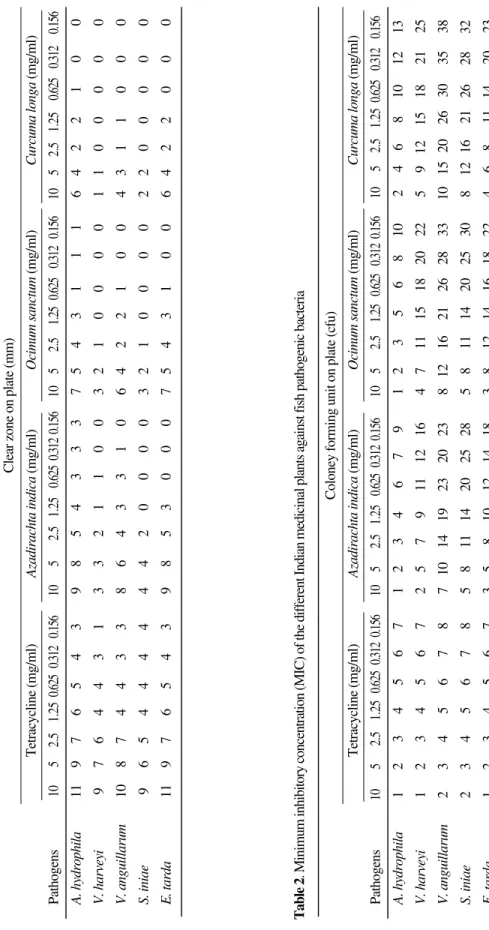
Anti-microbial activities of the chloroform : methanol active principle were determined by the application of agar disc diffusion and MIC tests against a panel of fish pathogenic bacteria (Table 1).

A. indica showed better activity against some fish pathogens. In the present study lowest concentra- tion (0.156 mg/ml) of A. indica and O. sanctum, the ZI was 3 and 1mm against A. hydrophila whereas other pathogen at this concentration did not show any inhibitory activity when compared to positive control (i.e. tetracycline). On the other hand, in highest concentration of 10 mg/ml was found the ZI of 9, 7, and 6 mm on A. indica, O. sanctum, and C.

longa against A. hydrophila (Table 1). In the present study, A. indica extract possessed strong anti-micro- bial activity against A. hydrophila, V. anguillarum, and E. tarda at concentration of 10 mg/ml while O.

sanctum and C. longa of these pathogens were

found low inhibitory activity.

(5)

Minimum inhibitory concentration

The MIC in the present study at lowest concentra- tion (0.156 mg/ml) of A. indica was effective that yielded lowest bacterial colony of A. hydrophila (9 CFU), V. harveyi (16 CFU), and E. tarda (18 CFU) when compared to positive control (i.e. tetracycline).

However, other tested dilutions the MIC of A. indica, O. sanctum, and C. longa were effective against A.

hydrophila, V. harveyi, and E. tarda when compared to the positive control (Table 2). In the present study, A. indica, results from disc diffusion method, fol- lowed by measurements of MIC, A. hydrophila was highest zones of growth inhibition (9 mm) and better MIC of 9 CFU at 0.156 mg/ml.

DPPH assay

The results of DPPH inhibition by different plant leaf extracts are shown in Fig. 1. The DPPH activity was reduced with the addition of all leaf extracts in a concentration-dependent manner. The better DPPH activity was 40% and 85% on O. sanctum and A. indica at 5 mg/ml. On the other hand, A.

indica extract was 10% DPPH radical-scavenger activity at 0.156 mg/ml while C. long and O. sanc- tum was found no activity at this concentration.

Therefore, 0.156 mg/ml can be considered as a full absorbance inhibition of DPPH, because after com- pleting the reaction, the final solution always pos-

sesses some yellowish colour. O. sanctum extract was also a good radical-scavenger activity with the inhibition of 60% at concentration of 10 mg/ml while C. longa extract showed a low radical-scav- enger activity of 40% at 10 mg/ml.

Discussion

In the present study lowest concentration (0.156 mg/ml) of A. indica and O. sanctum yielded the zone of inhibition of 3, and 1mm against A.

hydrophila, while in highest concentration of 10 mg/ml formed the ZI was 9, 7 and 6 mm of A. indi- ca, O. sanctum, and C. longa against A. hydrophila.

There are some reports that the antibacterial proper- ties of herbal extracts are often pathogen-species- specific (Harikrishnan and Balasundaram, 2005). A.

indica contain sevaral active compound such as nimbin, nimbinin, nimbidinin, and nimbidic acid (Mitra et al., 1971). Nimbidin exhibits a significant anti-ulcer effect and completely inhibit the growth of Mycobacterium tuberculosis in vitro. The nim- bolide also showed anti-bacterial activity against S. aureus and S. coagulase (Rojanapo et al., 1985).

C. longa contained many active compounds, such as curcumene, turmerone, and turmerol (Kikuzaki and Nakatani, 1993) and curcuminoids and gin- gerols including curcumin have been reported as anti-microbial, anti-fungal, anti-inflammatory, and anti-oxidant activities (Adams et al., 1998). The turmeric and curcumin have anti-oxidant (Reddy et al., 2005), anti-inflammatory properties (Satoskar et al., 1986). In the present study, A. indica is more effectiveness against A. hydrophila, V. anguillarum, and E. tarda. Therefore, A. indica active principle compounds may be involved in the growth inhibi- tion against fish pathogens. The MIC in the present study at lowest concentration of 0.156 mg/ml on A.

indica is effective that yielded lowest bacterial Fig. 1. DPPH radical-scavenging assay of leaf extracts from

Indian medicinal plants. Ascorbic acid was used as positive

control and the activity express as % of inhibition of DPPH.

(6)

Table 1 . Zones of growth inhibitory (ZI) of the different Indian medicinal plants against fish pathogenic bacteria Clear zone on plate (mm) Tetracycline (mg/ml) Azadirachta indica (mg/ml) Ocimum sanctum (mg/ml) Curcuma longa (mg/ml) Pathogens 10 5 2.5 1.25 0.625 0.312 0.156 10 5 2.5 1.25 0.625 0.312 0.156 10 5 2. 5 1.25 0.625 0.312 0.156 10 5 2.5 1.25 0.625 0.312 0.156 A. hydrophila 1 1 9 7 6 5 4 3 9 8 5 4 3 3 3 7 5 4 3 1 1 1 6 4 2 2 1 0 0 V. harveyi 9 7 6 4 4 3 1 3 3 2 1 1 0 0 3 2 1 0 0 0 0 1 1 0 0 0 0 0 V. anguillarum 1 0 8 7 4 4 3 3 8 6 4 3 3 1 0 6 4 2 2 1 0 0 4 3 1 1 0 0 0 S. iniae 9 6 5 4 4 4 4 4 4 2 0 0 0 0 3 2 1 0 0 0 0 2 2 0 0 0 0 0 E. tarda 1 1 9 7 6 5 4 3 9 8 5 3 0 0 0 7 5 4 3 1 0 0 6 4 2 2 0 0 0 Table 2 . Minimum inhibitory concentration (MIC) of the different Indian medicinal plants against fish pathogenic bacteria Coloney forming unit on plate (cfu) Tetracycline (mg/ml) Azadirachta indica (mg/ml) Ocimum sanctum (mg/ml) Curcuma longa (mg/ml) Pathogens 10 5 2.5 1.25 0.625 0.312 0.156 10 5 2.5 1.25 0.625 0.312 0.156 10 5 2. 5 1.25 0.625 0.312 0.156 10 5 2 .5 1 .2 5 0.625 0.312 0.156 A. hydrophila 1 2 3 4 5 6 7 1 2 3 4 6 7 9 1 2 3 5 6 8 1 0 2 4 6 8 1 0 1 2 1 3 V. harveyi 1 2 3 4 5 6 7 2 5 7 9 1 1 1 2 1 6 4 7 1 1 1 5 1 8 2 0 2 2 5 9 1 2 1 5 1 8 2 1 2 5 V. anguillarum 2 3 4 5 6 7 8 7 10 14 19 23 20 23 8 1 2 1 6 2 1 2 6 28 33 10 15 20 26 30 35 38 S. iniae 2 3 4 5 6 7 8 5 8 1 1 1 4 2 0 2 5 2 8 5 8 1 1 1 4 2 0 25 30 8 12 16 21 26 28 32 E. tarda 1 2 3 4 5 6 7 3 5 8 1 0 1 2 1 4 1 8 3 8 1 2 1 4 1 6 1 8 2 2 4 6 8 1 1 1 4 2 0 2 3

(7)

colony of A. hydrophila, V. anguillarum, and E.

tarda. However, all the other tested dilutions the MIC of A. indica, O. sanctum, and C. longa were effective against the same pathogens.

A. indica and O. sanctum exhibited better anti- bacterial activity against A. hydrophila, with diame- ter zones of inhibition of 3 and 1mm compared to the standard drug tetracycline. Researchers have been interested in biological active compounds iso- lated from these plant species for the elimination of pathogenic micro-organisms because of the resis- tance that they have developed to antibiotics (Hunter and Reeves, 2002). However, very little information is available on such activity against fish pathogens. On the basis of this results and previous studies, the same leaf extracts can be added as a protective agent to wide range of bacteria. Such a result means that A. indica and O. sanctum were capable to exhibit approximately the same anti- microbial activity. Our observations were consid- ered as the first detailed document and possess a strong anti-microbial activity against olive flounder fish pathogens in vitro.

DPPH is the best, easiest and widely used to test- ing preliminary free radical-scavenging activity of a compound or a plant extract (Uddin et al., 2008). In the present study, A. indica extract possess strong anti-oxidant activity. However, O. sanctum and C.

longa extracts was found low radical-scavenging activity. The free radical scavenging property may be one of the assay by which drug is effective as a traditional medicine. The plants tannins and flavonoids are phenolic compounds and may be responsible for anti-oxidant properties (Larson, 1988; Sadhu et al., 2003). A. indica and O. sanctum extracts shown significant free radical scavenging activity while C. longa extracts did not show any activity. It was demonstrated that the infusion of L.

citriodora has a potent superoxide radical-scaveng-

ing activity and a moderate scavenging activity of hydroxyl radical (Valentao et al., 2002). The scav- enging activity of DPPH radical in our screening was 10% shown at the lowest concentration (0.156 mg/ml). This effect is due to the presence of several flavonoids and phenolic acids (Skaltsa and Sham- mas, 1988; Valentao et al., 2002).

In conclusion, the results obtained in the present study are in agreement to a certain degree with the traditional uses of the plants and further investiga- tion in the potential discovery of new natural bioac- tive compounds. A. indica extracts possess strong anti-oxidative activity than O. sanctum and C.

longa. The presence of these anti-oxidants is a desirable feature which may have beneficial health effects on prevention of many diseases. Further studies need to be carried out to define active princi- ple(s) of fractions and to study the relationship between chemical structure and antioxidant activity in vitro and in vivo and the mechanisms by which they may exhibit pharmacological actions.

Acknowledgements

RH is grateful to the Council of Scientific and Industrial Research (CSIR) for the award of Research Associateship which made this work pos- sible. The authors are grateful to the Department of Science and Technology for the facilities made available through FIST program to the department.

RH is grateful for the financial assistance through KOSEF Postdoctoral Fellowship and BK 21 pro- gram of the Ministry of Education, South Korea.

References

Adams, A., Auchinachie, N., Bundy, A., Tatner,

M.F. and Horne, M.Y.: The potency of adju-

vanted vaccines in rainbow trout, Salmo

(8)

gairdneri Richardson, with whole cell bac- terins by oral and intraperitoneal routes. J.

Fish Dis., 6:129-134, 1998.

Alves, T.M.A., Silva, A.F., Brandao, M., Grandi, T.S.M., Smania, E.F.A., Smania Jr A. and Zani, C.L.: Biological screening of Brazilian medicinal plants. The J Memorias do Institu- to Oswaldo Cruz, 95:367-373, 2000.

Anderson, D.P.: Immunostimulants, adjuvants, and vaccine carriers in fish: applications in aqua- culture. Ann. Rev. Fish Dis., 2: 281-301, 1992.

Anto, R.J., George, J., Dinesh-Babu, K.V., Rajasekharan, K.N. and Kuttan, R.: Antimu- tagenic and anticarcinogenic activity of nat- ural and synthetic curcuminoids. Mutation Res., 370:127-131, 1996.

Babu, B., Jisha, V.K., Salitha, C.V., Mohan, S. and Valsa, A.K.: Antibacterial activity of differ- ent plant extracts. Indian J. Microbiol., 42:361-363, 2000.

Baeck, G.W., Kim, J.H., Gomez, D.K. and Park, S.C.: Isolation and characterization of Strep- tococcus sp. from diseased flounder (Par- alichthys olivaceus) in Jeju Island. J. Vet.

Sci., 7:53-58, 2006.

Bauer, A.W., Kirby, M. and Shenis, J.C.: Antibiotic susceptibility testing by a standardized sin- gle disk method. Am. J. Clim. Pathol., 45:493-497, 1966.

Bowden, T.J., Adamson, K., MacLachlan, P., Pert, C.C. and Bricknell, I.: Long-term study of antibody response and injection-site effects of oil adjuvants in Atlantic halibut (Hip- poglossus hippoglossus L.). Fish Shellfish Immunol., 14:363-369, 2003.

Collins, C.H., Lyne, P.M. and Grange, J.M.: Micro- biological methods, 6

th

edition. Butterworth, London, 1989.

Cox, J.C. and Coulter, A.R.: Adjuvantsda classifica- tion and review of their modes of action.

Vaccine, 15:248-256, 1997.

Cuendet, M., Hostettmann, K. and Potterat, O.: Iri- doid glucosides with free radical-scavenging properties from Fagraea blumei. Helvetica Chimica Acta, 80:1144-1152, 1997.

Devakumar, C. and Sukh Dev.: Chemistry, In:

Neem (ed. By N.S. Randhawa, and B.S. Par- mar), pp.77-110, 2

nd

edition, Society of Pesti- cide Science, New Delhi, India, 1996.

Evans, W.C.: Trease and Evans ‘Pharmacognosy’ , 14

th

edition, W.B. Saunders Co. Ltd., Lon- don, 1996.

Gupta, S.K., Prakash, J. and Srivastava, S.: Valida- tion of traditional claim of Tulsi Ocimum sanctum Linn. as a medicinal plant. Indian J.

Exp. Biol., 40:765-773, 2002.

Harikrishnan, R. and Balasundaram, C.: Antimicro- bial activity of medicinal herbs in vitro against fish pathogen, Aeromonas hydrophi- la. Fish Pathol., 40:187-189, 2005.

Harikrishnan, R., Rani, N.M. and Balasundaram, C.: Hematological and biochemical parame- ters in common carp, Cyprinus carpio, fol- lowing herbal treatment for Aeromonas hydrophila infection. Aquaculture, 221:41- 50, 2003.

Hunter, P.A. and Reeves, D.S.: The current status of surveillance of resistance to antimicrobial agents: report on a meeting. J. Antimicrob.

Chemother., 49:17-23, 2002.

Iwalokun, B.A., Gbenle, G.O., Adewole, T.A. and Akinsinde, K.A.: Shigellocidal properties of three Nigerian medicinal plants: Ocimum gratissimum, Terminalia avicennoides, and Momordica balsamina. J. Health Popul.

Nutr., 19:331-335, 2001.

(9)

Janssen, A.M., Scheffer, J.J., Ntezurubanza, L. and Baerheim Svendsen, A.: Antimicrobial aci- tivities of some Ocimum species grown in Rwanda. J. Ethnopharmacol., 26:57-63, 1989.

Joseph, S.W. and Carnahan, A.: The isolation, iden- tification, and systematics of the motile Aeromonas species. Ann. Rev. Fish Dis., 4:315-343, 1994.

Kikuzaki H. and Nakatani, N.: Antioxidant Effects of Ginger Constituents. J. Food Sci., 58:

1407-1410, 1993.

Kim, D.H., Han, H.J., Kim, S.M., Lee, D.C. and Park, S.I.: Bacterial enteritis and the devel- opment of the larval digestive tract in olive flounder, Paralichthys olivaceus (Temminck

& Schlegel). J. Fish Dis., 27:497-505, 2004.

Larson, R.A.: The antioxidants of higher plants.

Phytochemistry, 27:969-978, 1988.

Lawrence, G.W., Saul, A., Giddy, A.J., Kemp, R.

and Pye, D.: Phase I trial in humans of an oil-based adjuvant SEPPIC MONTANIDE ISA 720. Vaccine, 15:176-178, 1997.

Lee, H.K., Son, B.H. and Oh, M.J.: Microbial flora in ascetic cultivated olive flounder (Par- alichthys olivaceus) in Koe-je island in Korea during 2002-2003. Korean J. Micro- biol., 40:133-138, 2004.

Logambal, S.M. and Michael, R.D.: Immunostimu- latory effect of Azadirachtin in Oreochromis mossambicus (Peters). Indian J. Exp. Biol., 38:1092-1096, 2000.

Mandal, S., Mandal, M., Pal, N.K. and Halder, P.K.:

R factor in Proteus vulgaris from ulcerative disease of fish, Channa punctatus. Indian J.

Exp. Biol., 40:614-616, 2002.

Mitra, C.R., Garg, H.S. and Pandey, G.N.: Identifi- cation of nimbidic acid and nimbidinin from

Azadirachta indica. Photochemistry, 10:857- 860, 1971.

Mukherjee, D., Guha, D., Kumar, V. and Chakraborty, S.: lmpairment of steroidgene- sis and reproduction in sexually mature Cyprinus carpio by phenol and sulfide under laboratory conditions. Aquat. Toxicol., 21:29-40, 1991.

Nakamura, C.V., Ueda-Nakamura, T., Bando, E., Melo,A.F.N., Cortez, D.A.G. and Dias Filho, B.P.: Antibacterial activity of Ocimum gratissimum L essential oil. J Memorias do Instituto Oswaldo Cruz, 94:675-678, 1999.

National Committee for Clinical Laboratory Stan- dards.: Methods for dilution antimicrobial susceptibilitytests for bacteria that grow aer- obically. 3rd ed. Approved Standard. Docu- ment M7-A4. Natl. Committee Clin. Lab.

Stand., Wayne, PA, 1997.

National Committee for Clinical Laboratory Stan- dards.:Performance standards for antimicro- bial susceptibility testing: tenth information- al supplement M100-S10. NCCLS, Wayne, PA, 2000.

Njiro, S. M. and Kofi-Tsekpo, M.V.: Effect of an aqueous extract of Azadirachta indica on the immune response in mice. Onderstepoort. J.

Vet. Res., 66:59-62, 1999.

Oh, M.J., Kim, W.S., Kitamura, S.I., Lee, H.,Son, B.W., Jung, T.S. and Jung, S.J.: Change of pathogenicity in olive flounder Paralichthys olivaceus by co-infection of Vibrio harveyi, Edwardsiella tarda and marine birnavirus.

Aquaculture, 257:156-160, 2005.

Pike, J. and Chandra, R.K.: Effect of vitamin and trace element supplementation on immune indices in healthy elderly. Int. J. Vitam. Nutr.

Res., 65:117-120, 1995.

(10)

Rasadah, M.A. and Houghton, P.J.: Antimicrobial activity of some species of Bignoniaceae.

ASEAN Review of Biodiversity and Envi- ronmental Conservation (ARBEC), article III. Available: www.arbec.com.my/

pdf/may-3.pdf, 2007.

Reddy, R.C., Vatsaala, P.G., Keshamouni, V.G., Padmanaban, G. and Rangarajan, P.N.: Cur- cumin for malaria therapy. Biochem. Bio- phys. Res. Commun., 326:472-474, 2005.

Rojanapo, W., Suwanno, S., Somaree, R., Glin- sukon, T. and Thebtaranonth, Y.: Carcino- genicity of an oxidation product of p- phenylenediamine J. Sci. Thailand, 11:177- 188, 1985.

Sadhu, S.K., Okuyama, E., Fujumoto, H. and Ishibashi, M.: Seperartion of leucas, aspara amedicinal plant of Bangladesh, guided by prostaglandin inhibitory and anti oxidant activities. Chem. Pharm. Bull., 51:595-598, 2003.

Satoskar, R.R., Shah, S.J. and Shenoy, S.G.: Evalu- ation if anti-inflammatory properties of cur- cumin (diferuloylmethane) in patients with postoperative inflammation. Int. J. Clim.

Pharmacol. Ther. Toxicol., 24:651-654, 1986.

Skaltsa, H. and Shammas, G.: Flavonoids from Lip- pia citriodora. Planta Med., 54:465, 1988.

Soliman, K.M. and Badeaa, R.I.: Effect of oil extracted from some medicinal plants on dif- ferent mycotoxigenic fungi. Food Chem.

Toxicol., 40:1669-1675, 2002.

Uddin, S.N., Ali, M.E. and Yesmin, M.N.: Antioxi- dant and Antibacterial Activities of Senna tora Roxb. Am. J. Plant Physiol., 3:96-100,

2008.

Vaidyanathan, P.S.V.: Indian Medicinal plants Arya Vaidya Sala, Kottaail, Orient Longman Ltd, Chennai, 1995.

Valentao, P., Fernandes, E., Carvalho, F., Andrade, P.B., Seabra, R.M. and de Lourdes Basto, M.: Studies on the antioxidant activity of Lippia citriodora infusion: scavenging effect on superoxide radical, hydroxyl radical and hypochlorous acid. Biol. Pharm. Bull., 25:1324-327, 2002.

Venkatalakshmi, S. and Michael, R.D.: Immunos- timulation by leaf extract of Ocimum sanc- tum Linn. in Oreochromis mossambicus (Peters). J. Aquacultu. Tropics, 16:1-10, 2001.

Wan, J., Wilcock, A. and Coventry, M.J.: The effect of essential oils of basil on the growth of Aeromonas hydrophila and Pseudomonas fluorescens. J. Appl. Microbiol., 84:152-158, 1998.

World Health Organization.:Traditional Medicine Strategy 2002-2005. Geneva: World Health Organization, 2002.

Zhang, X.: Traditional medicine: its importance and protection (ed. By S. Twarog, and P.

Kapoor) In: Protecting and Promoting Tradi- tional Knowledge: Systems, National Expe- riences and International Dimensions. Part 1.

The Role of Traditional Knowledge in Healthcare and Agriculture. New York:

United Nations, pp.3-6, 2004.

Manuscript Received : August 5, 2009

Revised : December 18, 2009

Accepted : December 24, 2009

수치

Table 1. Zones of growth inhibitory (ZI) of the different Indian medicinal plants against fish pathogenic bacteria  Clear zone on plate (mm) Tetracycline (mg/ml)Azadirachta indica(mg/ml)Ocimum sanctum(mg/ml)Curcuma longa(mg/ml) Pathogens1052.51.250.6250.31

참조

관련 문서

This study aims to show the basic data for the effective counselling activity of the student-counselling volunteers(hereinafter, cited as volunteers ) through

Thus, this study has researched the literature study of the current statistic data and study article and field survey in some farm households, analysis

The objective of this study is to understand the effects of walking activity using fairy tales on the peer competence and emotional intelligence of

Puspose: Puspose: Puspose: Puspose: This study is to identify relations between activity of daily living, social support and loneliness of facilities for

Fresh samples were immediately tested for antioxidant activity, and antioxidant activity was compared according to gestational age and measured the difference

This study researched the possibility of using natural products for hair growth agents and hair loss prevention materials based on the test for the antioxidant and

According to the result of comparative study on nutrient components and antioxidant activity in Abelmoschus esculentus depending on drying methods amino

TABLE 1.ANTI PROLI FERATI VE EFFECT OF EEAD I N C6CELLS ---7.. Caspase-3/-7 activity