• 검색 결과가 없습니다.

Hematological manifestations in dogs progressing to the iron deficiency anemia by repeated phlebotomy

N/A
N/A
Protected

Academic year: 2021

Share "Hematological manifestations in dogs progressing to the iron deficiency anemia by repeated phlebotomy"

Copied!
7
0
0

로드 중.... (전체 텍스트 보기)

전체 글

(1)

387

Hematological manifestations in dogs progressing to the iron deficiency anemia by repeated phlebotomy

Young-Wook Kwon, Doo Kim, Son-Il Pak*

School of Veterinary Medicine and Institute of Veterinary Science, Kangwon National University, Chuncheon 200-701, Korea

(Accepted: November 8, 2006)

Abstract : Progressing to the iron deficiency anemia was experimentally induced in 4 clinically healthy dogs by repeated phlebotomy to characterize hematologic features, serum iron values, and RBC indices.

Abnormal RBC morphologies were also evaluated semiquantitatively on Wright’s-stained blood films.

Hematologic abnormalities in early stage of anemia included decreased both hematocrit and hemoglobin, and reticulocytosis, with no changes in mean corpuscular volume (MCV) and mean corpuscular hemog- lobin concentration (MCHC) were represented. In intermediate stage, decreased serum iron concentration with microcytosis and hypochromia were prominent. In late stage, red cell distribution width and Mentzer’s index were out of reference ranges in the majority of dogs. In this study microcytic anemia was appeared at the hemoglobin range of 5.1-7.2 g/dl. On most sampling days, platelet counts and white blood cells were within the reference ranges, with some minor variations. Iron deficiency was not necessarily associated with microcytic anemia. Judging from the sequential changes of both MCV and MCHC, 3 patterns of anemia were sequentially observed: initially normocytic normochromic, intermediate normocytic hypochromic or normocytic normochormic, and finally microcytic hypochromic. The most frequent morphologic abnormalities were target cells. Occasional elliptocyte, acanthocyte, stomatocyte, kinzocyte, dacrocyte and schistocyte were also noted on the blood films.

Key words : anemia, dog, iron deficiency, phlebotomy, RBC morphology

Introduction

With the exception of young growing animals, iron deficiency anemia (IDA) in dogs usually results from persistent blood loss or dietary deficiency of iron.

Chronic blood loss leading to iron depletion is common in dogs with gastrointestinal bleeding caused by gastric ulcers, neoplasia, or endoparasites, and in those with heavy flea infestation. The laboratory findings of IDA include decreased mean corpuscular volume (MCV), erythrocyte hypochromia, decreased mean corpuscular hemoglobin concentration (MCHC), increased red cell distribution width (RDW), thrombocytosis, and reticu- locytosis during early iron deficiency except in the horse [15]. Other abnormalities include decreased serum iron level, hypoferremia, decreased transferrin saturation, normal or increased total iron binding capacity (TIBC) [16, 32], minimal or absent stainable

iron in the bone marrow of most species, and RBC size and shape changes on blood smears [14]. However, some of these observations vary depending on the clinical stages of iron depletion and the cause of iron deficiency; RBC morphologic changes typically occur in more advanced stages of iron depletion and reticulocytosis may not occur if the iron deficiency is caused by decreased intake [8]. IDAs with involvement of many laboratory findings have been described [10, 31], resulting in difficulties for clinicians to confirm suspected cases of iron deficiency in various clinical stages. In addition, erythroid regenerative response in clinical cases may be affected by many confounding factors such as concurrent parasitemia, neoplasia, or inflammation [31]. In practical point of views, the most important problem in diagnosing IDA is that the sensitivity of any single test is low except marrow examination [13].

*Corresponding author: Son-Il Pak

School of Veterinary Medicine and Institute of Veterinary Science, Kangwon National University, Chuncheon 200-701, Korea

[Tel: +82-33-250-8672, Fax: +82-33-244-2367, E-mail: [email protected]]

(2)

So far, studies that attempts to characterize hematolo- gical values and RBC abnormalities over time in IDA have limited in the veterinary medical literatures, especially in dogs [7, 32]. Therefore, the primary purpose of this study was to characterize hematologic features of IDA and morphologic abnormalities of RBC experimentally induced by repeated phlebotomy, and thus to give clinicians insights into making a diagnosis of IDA.

Materials and Methods

Animals and phlebotomy

Four clinically healthy adult mixed-breed dogs (3 males and 1 female), with an age range of 3 to 5 years, weighing 5-10 kg were included in the study. The dogs were housed at the animal hospital and handled in a

manner similar to that of hospitalized dogs. Judging from the routine physical check-up and hematological or biochemical analysis, all dogs had no history of excess blood loss and were clinically healthy at the beginning of the study and no drug had been adminis- tered to any of the dogs for 2 weeks prior to and during the study. Diet and water were provided ad libitum . Approximately 10% of total blood volume was withdrawn from the jugular vein of each dog on every 2 days intervals after the first withdrawal for 37 days.

Blood samples were obtained from each dog between 09:00 and 12:00 h after being seated for 10 min. Two ml of blood were transferred to ethylenediamine tetraa- cetic acid tube and were analyzed within 2 h after collection. Blood for iron analyses was collected in clot tubes. Serum was removed from the cells and frozen at

20

o

C until analysis.

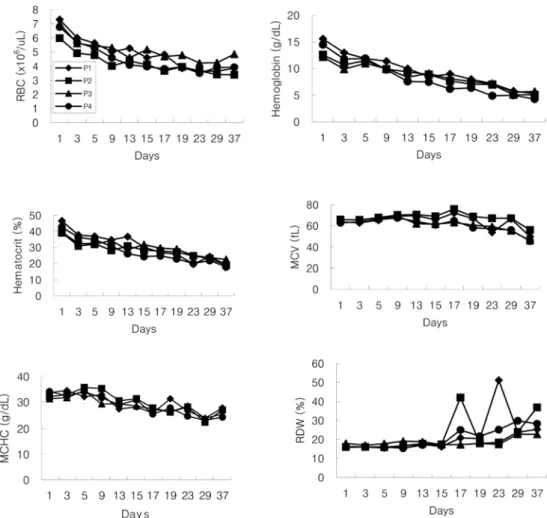
Fig. 1. Sequential changes of erythrocyte parameters in 4 phlebotomy dogs (P1 to P4).

(3)

Evaluation of erythrocyte shape changes

Wright’s stained blood smears were evaluated using a light microscope quantitatively for the degree of erythrocyte shape changes (poikilocytosis) by counting and characterizing the number and type of abnormal RBC in a total of 1,000 RBC at 1000x magnification.

The areas of the smear examined were limited to monolayer in which RBC did not overlap. Erythrocyte shape changes were categorized as previously described [19, 27]. No attempt was made to differentiate kerato- cytes from acanthocytes since a clear distinction was not apparent. Reticulocyte was counted using new methylene blue-stained blood films. The absolute reticulocyte count was calculated by multiplying the percentage of reticulocytes in 1,000 erythrocytes by the RBC count. The corrected reticulocyte count percentage to a normal hematocrit (HCT) of 45% and reticulocyte production index considering expected maturation time of reticulocyte were also computed [22].

Hematology and serum iron

The laboratory was kept blinded as to which identification numbers belonged to which individual dogs. The complete blood cell counts (CBCs) were determined with an automated hematology analyzer (Hemacyte; CDC, USA). The instrument was operated with manufacturer’s reagents and protocols for calib- ration and maintenance. The following parameters were measured in each dog; RBC count, HCT, hemoglobin, MCV, MCHC, and RDW, platelet count, and mean platelet volume (MPV). Mentzer’s index was calculated in each case by dividing MCV by the RBC count [21].

Serum iron was measured using a serum chemistry analyzer (Ektachem; Johnson & Johnson, USA).

Results

The sequential changes of RBC parameters in four phlebotomy dogs during 37 days were shown in Fig.

1. HCT decreased rapidly in all dogs 3 days after phlebotomy and gradually decreased (17-24%) until phlebotomy stopped on day 37. Hemoglobin decreased rapidly during the early phlebotomy period and gradually decreased by the end of study (4.3-5.7 g/dl). Changes in RBC count paralleled changes both in HCT and hemoglobin concentration in all dogs. In 3 of 4 dogs, MCV values were within reference range until 19 days of phlebotomy, and dog no. 2 showed a slightly low MCV (56 fl) until phlebomoty stopped. Since 9 days after phlebotomy 3 of 4 dogs showed hypochromia and MCHC decreased below the reference range on appro- ximately day 17 in all dogs (Fig. 2). Before the phlebo- tomy, hematologic values for all dogs were within reference ranges, except for a slightly low platelet count (174

×

10

3

/

µ

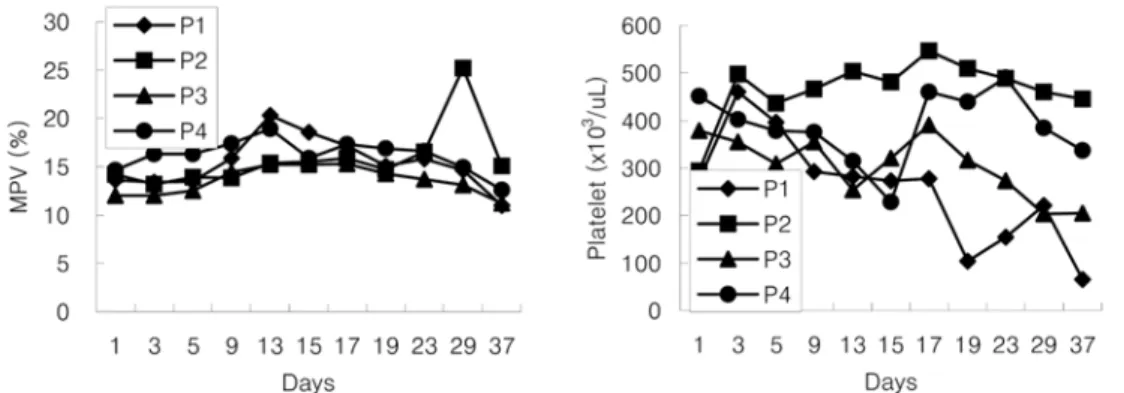
l ) in dog no. 1 (Fig. 3). On most sampling days, platelet counts were within the reference range in 3 of 4 dogs; dog no. 1 showed thrombocyto- penia on days 19, 23 and 37.

Fig. 3. Sequential changes of platelet parameters in 4 phlebotomy dogs (P1 to P4).

Fig. 2. Changes of mean corpuscular volume and mean

corpuscular hemoglobin concentration after phlebotomy in

4 dogs.

(4)

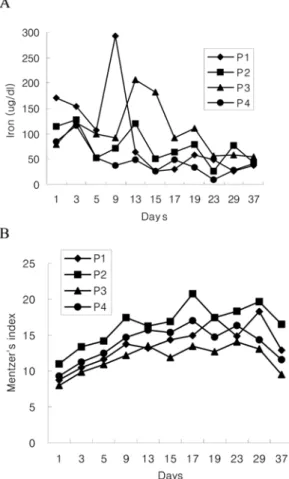
Reticulocytosis occurred in 3 of 4 dogs as early as 5 days after phlebotomy and persisted throughout the blood removal period (Fig. 4). Dog no. 1 showed a reticulocytosis 9 days after phlebotomy. Serum iron concentration decreased rapidly on day 17 in 3 of 4 dogs and dog no. 4 in the very early phelobotomy period.

The iron values were remained low level (10-37

µ

g/

dl) during the remainder of the phlebotomy period (Fig.

5). Three of 4 dogs showed a Mentzer’s index of greater than 13.5 in 9 days after phlebotomy. The RDW should

a high normal during the 15 days after phlebotomy, and slightly increased since then.

With apparently increased erythrocyte hypochromia, the majority of abnormal RBCs were target cells and occasional stomatocytes, dacrocytes, elliptocytes, knizocytes and schistocytes. Morphologic changes became apparent since day 29 and were most prominent on day 37.

Discussion

Potential causes of microcytic anemia include chronic iron deficiency, anemia of inflammatory disease, hepatic failure due to hepatic disease or portosystemic shunts in dogs and cats, pyridoxine deficiency, copper deficiency especially in pigs, hereditary elliptocytosis in dogs, dyserythropoiesis of English springer spaniels [17], and drug or chemical toxicities [15]. Of these conditions, iron deficiency is the most common cause of microcytic Fig. 4. Reticulocyte percentage and production index in 4

phlebotomy dogs (P1 to P4). Reticulocyte response was not calculated for the first 2 consecutive days after phlebotomy.

Fig. 5. Iron concentration (A) and Mentzer’s index (B) in

4 phlebotomy dogs (P1 to P4).

(5)

hypochromic anemia. But in some breeds of dog RBCs are normally microcytes [3, 12].

In an attempt to allow differentiation of causes of microcytosis, a number of calculations such as RDW [5], Mentzer’s index [21] and the discriminant function [11] have been developed. These calculations have been based on the fact that some anemia is associated with a uniform decrease in RBC size, whereas IDA is associated with a significant RBC size variation due to the concurrence of iron-deficient erythropoiesis and erythropoietin-induced marrow stimulation [4, 28]. The RDW, defined as the SD of the RBC volume divided by the MCV multiplied by 100 is a measure of RBC size variation (anisocytosis). Anisocytosis along with poikilocytosis have long been recognized as morphologic hallmarks of some anemias. A classification of anemias based on the RDW and MCV has been proposed and is of particular interest to clinician in that it allows for discrimination of IDA and other types of anemias [5].

A study from humans [24] reported that RDW with greater than 20 was seen exclusively in iron deficiency.

In the present study, anisocytosis was prominent in 17 days after phlebotomy with some minor variations and persisted throughout the study. Since 29 days of study, all dogs had high RDW, ranging 22.8-36.9%. This was further evidenced by prominent reticulocytosis (> 120

×
10

3

/

µ

l) observed at this time point.

IDA can be confirmed by the absence of stainable iron in the marrow [23] and in practice, is often deter- mined by measuring serum iron values with below the normal reference range and observing micorcytic hypo- chromic anemia on CBC profile [25]. With respect to the relationship between serum iron level and MCV and MCHC, this study showed that serum iron levels were below the reference range since day 17, but MCHC and MCV showed a downward trend after day 17 and 29, respectively. This result indicates that there may be a specific time period that low serum iron level does not significantly affect MCV because of bone marrow’s active response. Thus, from the clinical point of view, patients with low serum iron level do not necessarily develop the microcytic anemia.

In this study, however, normal MCV and normal to decreased MCHC was observed at day 11 (dog no. 1) and day 9 (dog no. 4) when serum iron values were below reference range. This may indicate that iron deficiency does not necessarily associate with microcytic anemia.

Although IDA is usually classified as one of the nonre-

generative anemia, clinicians may cautious for selecting treatment options. In this study, for example, reticulo- cytosis was observed in all dogs at day 19 and 29 when iron deficiency was already occurred. This finding suggests that IDA may not be a nonregenerative anemia until microcytic hypochromic finding is apparent, and at this time point not all patients require iron- supplement therapy. Since IDA is a curable condition and has many causes including inadequate iron intake, malabsorption, intravascular hemolysis, intestinal neop- lasm [20] ulcerative colitis, and intestinal parasitism [9], knowledge of the etiology is necessary for proper management of a case of hypochromic micorcytic anemia.

Mentzer proposed an index for discriminating IDA and thalassemia trait in human medicine [11]: a value of greater than 13.5 for IDA and a value of less than 12.5 for thalassemia trait. Based on this criteria, albeit this index has not been fully established in animals, 3 of 4 dogs showed a suspected IDA in 9 days after phlebotomy. In addition, the time point on day 17 when the Mentzer’s indices for all dogs showed above 13.5 is coincident with the time when serum iron level showed below the reference range.

On day 37 when phlebotomy stopped, the indices showed a decreased pattern. This can be attributed by greater decrease in MCV than RBC count, due to severe hypoferremia associated with on-going progress to the chronic stage. Further studies on Mentzer’s index are required for clinical use in animal populations.

Based on the MCV and MCHC, three patterns of

anemia were observed: initially normocytic normoch-

romic for a maximum 15 days after phlebotomy, inter-

mediate normocytic hypochromic or normocytic normo-

chormic for another 8-29 days, and finally microcytic

hypochromic. The anemic process is that initially the

HCT and RBC indices remain normal due to compen-

satory mechanism, but serum ferritin concentration

begins to decrease. In the marrow, as the deficiency

becomes more severe, decreased hemoglobin synthesis

leads to retention of a viable nucleus beyond the

normal number of cell divisions. Thus, the developing

RBCs continue to divide to increase the hemoglobin

concentration in each red cell. The additional divisions

result in the formation of microcytic hypochromic

erythrocytes. In this study microcytic anemia was

appeared at the hemoglobin range of 5.1-7.2 g/dl. If

significant reticulocytosis is present, the macrocytosis

(6)

of the reticulocytes can mask the presence of microcy- tosis. In this study dog no. 1 and no. 4 were shown mixed patterns of MCHC for 12 days, with normo- chromic and hypochromic.

Thrombocytosis is frequently associated with IDA in humans [1, 18]. This phenomenon may be due to stimulation of platelet production by erythropoietin, which is present in high levels in patients with IDA [2] or probably a reactive increase secondary to chronic low-grade consumption of platelets at the bleeding site and increased production in bone marrow [8]. However, platelet response was rarely included in animal studies [7, 10, 31, 32]. It is noteworthy that in this study platelet counts were within the reference range on most sampling days, with occasional thrombocytopenia in a dog. This finding is in consistent with the study by Burkhard et al . [7], reporting that thrombocytosis con- sistently occurred in the rats fed with iron-deficient diet but was rarely seen in phlebotomy rats. Therefore, the degree of IDA did not appear to predict the presence or absence of thrombocytosis. Evaluation of the number and type of abnormal RBC is of importance in the evaluation of hematologic disorders in dogs. In IDA, a variety of RBC morphologic abnormalities on stained blood smears have been reported; hypochromic cells with a greater than normal area of central pallor, anisocytosis, elliptocytes [29], target cells, dacrocytes [22], or poikilocytosis [6, 15, 26, 27, 30].

Conclusion

Many features of IDA in this study were consistent with those of other studies, including decreased serum iron and hemoglobin concentration, microcytosis, hypo- chromia, anisocytosis and poikilocytosis. Serum iron con- centration may not decline in early stage of iron deficiency. Further studies on the development of more clinically-oriented guidelines for the diagnosis of IDA are required, by performing minimal diagnostic tests.

Acknowledgement

This Study was partially supported by the Institute of Veterinary Science, Kangwon National University.

References

1. Alexander MB . Iron deficiency anemia, thrombocytosis,

and cerebrovascular accident. South Med J 1983, 76 , 662-663.

2. Beguin Y . Erythropoietin and platelet production.

Haematologica 1999, 84 , 541-547.

3. Berger M , Brass LF . Severe thrombocytopenia in iron deficiency anemia. Am J Hematol 1987, 24 , 425-428.

4. Bergin JJ . Evaluation of anemia. Getting the most out of the MCV, RDW, and other tests. Postgrad Med 1985, 77 , 253-254, 256, 261-269.

5. Bessman JD , Gilmer PR Jr , Gardner FH . Improved classification of anemias by MCV and RDW. Am J Clin Pathol 1983, 80 , 322-326.

6. Bull BS , Kuhn IN . The production of schistocytes by fibrin strands (a scanning electron microscope study).

Blood 1970, 35 , 104-111.

7. Burkhard MJ , Brown DE , McGrath JP , Meador VP , Mayle DA , Keaton MJ , Hoffman WP , Zimmer- mann JL , Abbott DL , Sun SC . Evaluation of the erythroid regenerative response in two different models of experimentally induced iron deficiency anemia. Vet Clin Pathol 2001, 30 , 76-85.

8. Cotter SM . Hematology. pp. 24-25, Teton NewMedia, Jackson Hole, 2001.

9. Curtis SK . Seizures associated with anemia due to parasitism. Vet Med Small Anim Clin 1977, 72 , 907- 10. 908. Duval D , Mahaffey E . Predicted mean corpuscular volume as an indicator of bone marrow iron in anemic dogs. Vet Clin Pathol 1996, 25 , 95-98.

11. England JM , Fraser PM . Differentiation of iron deficiency from thalassaemia trait by routine blood- count. Lancet 1973, 1 , 449-452.

12. Gookin JL , Bunch SE , Rush LJ , Grindem CB . Evaluation of microcytosis in 18 Shibas. J Am Vet Med Assoc 1998, 212 , 1258-1259.

13. Green R . Disorders of inadequate iron. Hosp Pract (Off Ed) 1991, 26 Suppl 3 , 25-29.

14. Guyatt GH , Oxman AD , Ali M , Willan A , Mcilroy W , Patterson C . Laboratory diagnosis of iron- deficiency anemia: an overview. J Gen Intern Med 1992, 7 , 145-153.

15. Harvey JW , Asquith RL , Sussman WA , Kivipelto J . Serum ferritin, serum iron, and erythrocyte values in foals. Am J Vet Res 1987, 48 , 1348-1352.

16. Harvey JW , French TW , Meyer DJ . Chronic iron deficiency anemia in dogs. J Am Anim Hosp Assoc 1982, 18 , 946-960.

17. Holland CT , Canfield PJ , Watson ADJ , Allan GS .

(7)

Dyserythropoiesis, polymyopathy, and cardiac disease in three related English springer spaniels. J Vet Intern Med 1991, 5 , 151-159.

18. Kasper CK , Whissell DY , Wallerstein RO . Clinical aspects of iron deficiency. JAMA 1965, 191 , 359-363.

19. Lessin LS , Klug PP , Jensen WN . Clinical implications of red cell shape. Adv Intern Med 1976, 21 , 451-500.

20. Madewell BR , Feldman BF . Characterization of anemias associated with neoplasia in small animals. J Am Vet Med Assoc 1980, 176 , 419-425.

21. Mentzer WC Jr . Differentiation of iron deficiency from thalassaemia trait. Lancet 1973, 1 , 882.

22. Morin DE , Garry FB , Weiser MG . Hematologic responses in llamas with experimentally-induced iron deficiency anemia. Vet Clin Pathol 1993, 22 , 81-86.

23. Nelson RW , Couto CG . Small Animal Internal Medicine. 2nd ed. pp. 444-448, Mosby, St. Louis, 1998.

24. Novak RW . Red blood cell distribution width in pediatric microcytic anemias. Pediatrics 1987, 80, 251- 25. 254. Perlman MK , Schwab JG , Nachman JB , Rubin CM . Thrombocytopenia in children with severe iron

deficiency. J Pediatr Hematol Oncol 2002, 24 , 380-384.

26. Rebar AH , Hahn FF , Halliwell WH , DeNicola DB , Benjamin SA . Microangiopathic hemolytic anemia associated with radiation-induced hemangiosarcomas.

Vet Pathol 1980, 17 , 443-454.

27. Rebar AH , Lewis HB , DeNicola DB , Halliwell WH , Boon GD . Red cell fragmentation in the dog: an editorial review. Vet Pathol 1981, 18 , 415-426.

28. Steinberg MH , Dreiling BJ . Microcytosis. Its signifi- cance and evaluation. JAMA 1983, 249 , 85-87.

29. Stockham SL , Scott MA . Fundamentals of Veterinary Clinical Pathology. pp. 108-109, Iowa State Press, Ames, 2002.

30. Weed RI , Reed CF . Membrane alterations leading to red cell destruction. Am J Med 1966, 41 , 681-698.

31. Weiser G , O’Grady M . Erythrocyte volume distribution analysis and hematologic changes in dogs with iron deficiency anemia. Vet Pathol 1983, 20 , 230-241.

32. Weiser MG , Kociba GJ . Sequential changes in

erythrocyte volume distribution and microcytosis

associated with iron deficiency in kittens. Vet Pathol

1983, 20 , 1-12.

수치

Fig. 1.  Sequential changes of erythrocyte parameters in 4 phlebotomy dogs (P1 to P4).
Fig. 2.  Changes of mean corpuscular volume and mean corpuscular hemoglobin concentration after phlebotomy in 4 dogs.
Fig. 5.  Iron concentration (A) and Mentzer’s index (B) in 4 phlebotomy dogs (P1 to P4).

참조

관련 문서

Mean arterial plasma concentration-time profiles of 4-hydroxytamoxifen after an oral administration of tamoxifen (10 mg/kg) to rats in the presence or absence

4. In the case of the outermost orientation angle of 0 °, the maximum / mean load increases slightly with the increase of the number of interfaces, but in the FEM, the maximum

Correlation of automated red cell count (aRBC) and mean of manual red cell counts (mRBC).. Correlation of estimated red cell count (eRBC) and mean of manual red

In the late nineteenth century, although the proportion of ether was increased and that of chloroform decreased due to the raised awareness of the high

& Balakrishnan, 2013), the ratio of the current MI’s mean latency to minimum observed mean latency of any MI in the connection’s history; and (iii) sending ratio, the

23 23 23 Standard 23 Standard Standard deviation, Standard deviation, deviation, mean deviation, mean mean mean for for for for the the the the power power

For gas phase reactions, as the pressure drop increases, the concentration decreases, resulting in a decreased rate of reaction hence a lower conversion when compared to resulting

• The mean of linear combination of random variables equals the linear combination of the means because the mean is a linear statistic.. • The variance is not