한국지반공학회논문집 제32권 4호 2016년 4월 pp. 15 ~ 27 JOURNAL OF THE KOREAN GEOTECHNICAL SOCIETY
Vol.32, No.4, April 2016 pp. 15 ~ 27
ISSN 1229-2427 (Print) ISSN 2288-646X (Online) http://dx.doi.org/10.7843/kgs.2016.32.4.15
선행강우를 고려한 산사태 유발 강우기준(ID curve) 분석
Rainfall Threshold (ID curve) for Landslide Initiation and Prediction Considering Antecedent Rainfall
홍 문 현1 Hong, Moon-Hyun 김 정 환2 Kim, Jung-Hwan 정 경 자3 Jung, Gyung-Ja 정 상 섬4 Jeong, Sang-Seom
Abstract
This study was conducted to suggest a landslide triggering rainfall threshold (ID curve) for landslide prediction by considering the effect of antecedent rainfall. 202 rainfall data including domestic landslide and rainfall records were used in this study. In order to consider the effect of antecedent rainfall, rainfall data were analyzed by changing Inter Event Time Definition (IETD) and IETD based ID curve were presented by regression analysis. Compared to the findings of the previous studies, the presented ID curve has a tendency to predict the landslides occurring at a relatively low rainfall intensity. It is shown that the proposed ID curve is appropriate and realistic for predicting landslides through the validation of proposed ID curve using records of landslides in 2014. Based on this analysis, it is found that the longer IETD, the greater the effect of antecedent rainfall, and the steeper the gradient of ID curve. It is also found that the rainfall threshold (intensity) is higher for the short period rainfall and lower for the long period rainfall.
요 지
본 연구에서는 국내 산사태 발생을 예측하기 위하여 선행강우의 영향을 고려한 산사태 유발 강우기준(Intensity- Duration, ID curve)을 제안하였다. 1999년부터 2013년까지 국내에서 유발된 202개의 산사태에 대하여, 기상청 강우자 료를 바탕으로 산사태 발생 시점 이전의 시강우량 데이터를 수집하고 분석하였다. 선행강우의 영향을 고려하기 위해 강우사상간 시간(Inter event time definition, IETD)을 6, 12, 24, 48, 72, 96시간으로 구분하고, 회귀분석을 통해 강우기 준을 제안하였다. 국외의 산사태 유발강우기준과 제안된 유발강우기준을 비교하였으며, 선행강우에 대한 산사태 유발 강우기준의 변화를 분석하였다. 그 결과, 국내의 경우 비교적 낮은 강우강도에서 산사태가 유발되는 것으로 나타났으 며, IETD가 증가할수록 산사태 유발강우기준의 기울기가 증가하는 경향이 나타났다. 따라서 단기간의 강우에 대해서 는 산사태 유발강우기준(강우강도)이 높아지고, 장기간의 강우에 대해서는 낮아지는 것을 알 수 있었다. 2014년도에 국내에서 발생한 산사태 재해이력을 이용하여 검토한 결과, 본 연구에서 제안된 ID curve가 산사태 유발을 비교적 잘 예측할 수 있는 것으로 나타났다.
1정회원, 연세대학교 토목환경공공학과 박사과정 (Member, Graduate Student, Dept. of Civil and Environmental Engrg., Yonsei Univ.) 2정회원, 연세대학교 토목환경공학과 박사 후 연구원 (Member, Post-doctoral Fellow, Dept. of Civil and Environmental Engrg., Yonsei Univ.) 3정회원, 한국도로공사 도로교통기술원 책임연구원 (Member, Chief Researcher, HTTI, Korea Highway Corporation)
4정회원, 연세대학교 토목환경공학과 교수 (Member, Prof., Dept. of Civil and Environmental Engrg., Yonsei Univ., Tel: +82-2-2123-2807, Fax: +82-2-2123-8378, [email protected], Corresponding author, 교신저자)
*본 논문에 대한 토의를 원하는 회원은 2016년 10월 31일까지 그 내용을 학회로 보내주시기 바랍니다. 저자의 검토 내용과 함께 논문집에 게재하여 드립니다.
Copyright © 2016 by the Korean Geotechnical Society
This is an Open-Access article distributed under the terms of the Creative Commons Attribution Non-Commercial License (http://creativecommons.org/licenses/by-nc/3.0) which permits unrestricted non-commercial use, distribution, and reproduction in any medium, provided the original work is properly cited.
Keywords : Rainfall threshold, Rainfall intensity, Rainfall duration, Antecedent rainfall, ID curve, Inter event time definition (IETD)
1. 서 론
최근 기후변화로 인해 국내에서도 국지성 호우가 빈 번하게 발생하고, 특히 도심지에서 발생한 산사태에 의 해 인명 및 재산피해가 발생하고 있으며, 강우강도, 주 기 및 기간 또한 변화하고 있다. 이에 따라 산사태 발생 은 증가하고 있는 추세이며(Borga et al., 2002; Lee et al., 2009; Liao et al., 2011; Kim et al., 2012; Jeong et al., 2014), 국내에서도 국지성 집중호우의 증가로 산사 태 발생 및 규모가 증가하고 있다(Associated ministries of South Korean government, 2013; Song et al., 2013).
국내의 강우는 하절기인 6월∼9월에 집중적으로 발생 되며, 산사태 기록으로부터 집중호우가 주로 발생하는 이 기간에 산사태가 집중되는 것으로 나타났다(Yun et al., 2010). 국내에서는 강우량에 따라 산사태를 예・경보 하고 있으나(Korea Forest Service, 2010), 약 60%의 재 해가 산림청 산사태 주의보 기준에 못 미치는 강우에서 발생하였다(Kim et al., 2013). 우리나라는 국토의 약 70%가 산림으로 이루어져 경사가 급한 지역이 많고 응 집력이 낮은 풍화토의 비중이 높아 산사태에 취약하기 때문에 국내 지형, 지질 및 기후 특성에 맞는 산사태 유 발 강우기준 설정이 필요하다.
산사태는 대부분 강우침투에 의해 발생하며, 강우침 투에 의한 산사태 발생은 선행강우, 누적강우 및 시간강 우와 밀접한 관련이 있다(Campbell, 1975; Wilson, 1989;
Guzzetti et al., 2007; Jeong et al., 2014). 강우가 발생하 면 지반으로 물이 침투하여 습윤대를 형성하고 습윤대 가 일정 깊이에 도달하면 지반의 강도를 증가시키는 모 관흡수력을 감소시켜 함수비 및 불포화 투수계수가 증 가하며 강우 침투속도가 빨라지게 되어 사면의 불안정 성이 증가하게 된다(Ng and Shi, 2998; Fourie et al., 1999; Cho and Lee, 2000; Jeong et al., 2009). 강우침투 에 의한 산사태는 산사태 발생 당시의 강우조건도 중요 하지만, 그 이전에 발생한 선행강우에 큰 영향을 받는 다(Tan et al., 1987; Chatteriea, 1989; Wei et al., 1991;
Rahardjo et al., 2001; Yune et al., 2010; Kim et al., 2013). 선행강우는 산사태 발생 당시의 지반의 모관흡
수력 초기상태 및 강도를 결정하고, 지속적인 강우로 인 하여 산사태가 발생한다(Kim et al., 2013). 산사태에 대 한 선행강우의 영향은 투수계수가 낮은 지반의 경우 더 크게 나타나며, 강우 패턴에 따라 사면의 안전율이 달라 진다(Rahimi et al., 2011; Kim et al., 2013). 국내에서는 강우의 재현기간별 최대강우강도와 강우지속시간의 관 계를 나타낸 확률강우강도(Intensity-duration-frequency, IDF) 곡선을 설계 시 주로 사용하고 있으나(Lee et al., 2009), 선행강우를 고려할 수 없는 한계가 있다.
산사태 발생의 가장 큰 원인인 강우에 대한 기준은 국내외로 많은 연구가 진행되었으며, 크게 물리적 방법 에 의한 강우기준과 통계적 방법에 의한 강우기준으로 구분할 수 있다(Corominas, 2000; Crosta and Frattini, 2001; Aleotti, 2004; Wieczorek and glade, 2005). 물리 적 방법에 의한 강우기준은 강우에 의한 산사태 발생의 물리적 원리를 규명하여 결정한 기준으로, 얕은 파괴로 인한 산사태 예측에 용이하고 해당 지역의 지질 정보를 고려한 예측이 가능하다. 하지만, 물리적 강우기준은 깊 은 파괴에 의한 산사태 예측에 불리하며, 자세한 지질 정보를 얻는데 한계가 있다. 통계적 방법에 의한 강우기 준은 강우가 산사태 발생에 가장 중요한 요소라는 것을 전제로 다수의 데이터를 분석하여 강우강도, 지속시간 등의 기준을 정한 것이다. 통계적 방법에 의한 강우기준 은 실제 발생한 산사태의 강우 데이터를 이용하며, 다양 한 연구자들에 의해 제안되었다(Kim and Jung, 2000;
Park et al., 1993; Korea forest service, 1993; Caine, 1980;
Dahal and Hasegawa, 2008; Guzzetti et al., 2007; Ikeya, 1989; Saitoa et al., 2010).
최근 국내에서도 Oh and Park(2013; 2014), Jang(2014), Yune et al.(2010)에 의해 산사태 유발 강우기준이 제안 되었으며, 선행강우의 중요성을 강조하였지만 선행강우 에 따른 강우기준의 변화를 고려하지 못하는 한계가 있 다. 이에 본 연구에서는 기존 방법의 문제점을 극복하기 위해 Adams and Fabian(2001)가 제안한 강우사상간 시 간(Inter event time definition, IETD)를 도입하여 선행강 우를 정의하고, 통계적 기법을 이용하여 강우사상간 시 간에 따른 강우기준을 제안하고자 한다.
2. 이론적 배경
2.1 통계적 방법에 의한 산사태 유발 강우기준
통계적 방법에 의한 산사태 유발 강우기준은 과거 발 생한 산사태의 시간강우 데이터로부터 결정되며, 총 강 우량에 의한 강우기준, 강우강도 기준, 강우지속시간 기 준 및 강우강도-지속시간(Intensity-Duration, ID) 기준이 있다. 총 강우량에 의한 강우기준은 산사태 발생 시의 총 누적 강우량과 연평균 강우량을 비교하는 기준으로, Guidicini and Iwasa(1977)에 의하면, 총 누적강우량이 연평균 강우량의 8∼12%가 되면 선행강우에 따라 산사 태 발생 가능성이 있으며 12%를 초과하면 선행강우와 관계없이 산사태가 발생할 가능성이 있다고 보고되었 으며, Govi and Sorzana(1980)는 연평균 강우량이 많은 지역의 경우 산사태를 발생시키는 총 누적강우량 또한 많다고 보고했다. 즉, 산사태 유발 강우기준은 특정 지 역의 기후특성을 대표하는 연평균강수량의 영향을 받 는다. 강우강도 기준은 산사태 발생 시 강우강도와 총 누적강우량의 관계로 산사태 유발 강우기준을 결정한 것으로, Onodera et al.(1974)이 고안하여 다양한 연구자 들에 의해 제안되었다(Govi and Sorzana, 1980; Tatizana et al., 1987; Jibson, 1989; Hong et al., 2005). 강우지속 시간 기준은 산사태 발생을 일으킨 강우의 지속시간과 총 누적강우량의 관계로부터 산사태 유발 강우기준을 결정한 것이다(Caine, 1980; Innes, 1983; Wilson et al., 1992; Kanji et al., 2003; Aleotti, 2004; Giannecchini, 2005).
강우강도-지속시간 기준(Intensity-duration threshold, ID curve)은 가장 일반적이고 널리 사용되는 방법으로, 강우강도와 지속시간을 동시에 고려할 수 있는 방법이 다. ID curve는 해당 지역의 지형, 지질 및 기후 특성에 따라 서로 다르게 제안되며, Eq. (1)과 같이 강우강도(I) 와 강우지속시간(D)의 관계로 나타낼 수 있다.
× (1)
여기서, 는 강우강도, 는 강우지속시간, , , 는 보정계수이며, 일반적으로 c를 0으로 가정하여 Eq. (2) 와 같이 단순한 거듭제곱 함수로 표현한다. 또한, 지역 적 기후특성에 따른 차이를 보정하기 위해 강우강도를 연평균강수량(Mean Annual Precipitation, MAP)으로 나
누어 일반화시키면 Eq. (3)과 같이 나타낼 수 있다.
× (2)
× (3)
Jibson(1989)은 인도네시아, 푸에르토리코, 브라질, 중 국, 홍콩, 일본, 켈리포니아 지역의 기준들을 통합하여 전 세계를 대상으로 한 기준을 제안하였으며, Cannon and Ellen(1985)은 San Francisco Bay 지역의 ID curve 를 연평균강수량에 따라 구분하여 제안하였다. Oh and Park(2013)은 국내 강원도 지역을 대상으로 강우 지속 기간을 단기, 중기, 장기로 구분하여 산사태 유발강우기 준을 제안하였으며, 전국을 경기도, 경상도, 강원도, 전 라도, 충청도로 구분하여 지역별 산사태 유발강우기준 을 제안하였다(Oh and Park, 2014). Jang(2014)은 2006 년부터 2013년까지 국내에서 발생한 산사태 자료를 이 용하여 강우기준을 제안하였으며, 이 외에도 국내외 많 은 연구자들에 의해 다양한 지역의 ID curve가 제안되 었다.
2.2 강우사상 간 시간(IETD)을 이용한 선행강우, 유효 누적강우, 강우지속시간 정의
일반적으로 강우사상을 구별하기 위해 무강우시간 또는 강우사상간 시간(IETD)을 활용하며, 만약 강우가 발생하지 않는 기간이 짧다면 인접한 강우사상은 하나 의 강우사상으로 합칠 수 있고, 길다면 독립된 강우사상 으로 구분된다(Restrepo-Rosada and Eagleson, 1982). 즉, 두 개의 강우사상 사이의 무강우시간이 IETD보다 짧으 면 두 개의 강우사상은 하나의 강우사상으로 결정되며 반대로 두 개의 강우사상 사이의 무강우시간이 IETD보 다 길면 이 두 개의 강우사상은 하나의 강우사상으로 결정된다(Adams and Fabian, 2000). 이는 Fig. 1과 같이 나타낼 수 있으며, Event i, j는 서로 다른 강우사상, b는 무강우시간을 의미한다. 본 연구에서는 IETD가 산사태 발생에 대하여 선행강우의 영향이 지속되는 시간을 의 미한다.
Chung et al.(2010)은 Fig. 2와 같이 강우 유출특성을 고려한 방법으로 1973년부터 2008년까지의 총 36년간 의 강우자료를 분석하여, 강우가 우기에 집중되는 국내 강우패턴에 적합한 IETD는 평균 2∼4일이라고 보고했
Fig. 1. Separation of rainfall according to the IETD (Adams and Fabian, 2001)
Fig. 2. IETD calculation method considering the leakage charac- teristics (Chung et al., 2010)
Fig. 3. Wetting band depth with varying elapsed times after antecedent rainfall (Kim et al., 2013)
Fig. 4. Definition of Effective cumulative rainfall and Rainfall duration with IETD
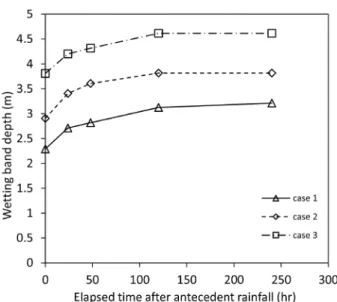
다. Kim et al. (2013)은 선행강우가 산사태에 미치는 영 향을 고려하기 위하여 무강우시간(0∼240 시간)과 산사 태 유발 강우량(10∼30mm/hr)을 변수로 침투해석을 수 행하였다. 침투해석을 통해 산사태의 주요 원인인 습윤 대 깊이와 무강우시간의 관계를 분석한 결과, 선행강우 이후 약 48시간이 경과하면 습윤대의 깊이가 거의 증가 하지 않으며(Fig. 3 참조), 이는 강우침투에 의해 감소한 모관흡수력이 무강우시간 동안 다시 회복하여 일정한 값으로 수렴하기 때문이라고 보고했다(Kim et al., 2013).
본 연구에서는 선행강우의 영향 고려하기 위해 IETD를 6시간에서 96시간(6, 12, 24, 48, 72, 96)으로 구분하여 산사태 유발 강우기준을 제안 및 분석하고, IETD에 따 른 ID curve의 보정계수 , 를 산정하여 최종적으로는 선행강우를 고려한 산사태 유발 강우기준을 제안하고 자 한다. IETD에 따라 선행강우(Antecedent rainfall), 유 효누적강우(Effective cumulative rainfall), 강우지속시간 (Rainfall duration)은 Fig. 4와 같이 정의되고, 강우강도 는 유효연속강우와 강우지속시간을 이용하여 Eq. (4)와 같이 구할 수 있다.
(4)
여기서, 는 강우강도, 은 유효누적강우, 는 강우 지속시간이다.
3. 선행강우를 고려한 산사태 유발 강우기준(ID curve) 제안
3.1 산사태 유발 강우데이터 분석
본 연구에서는 산림청과 기상청으로부터 수집한 1999 년에서 2013년까지의 국내 산사태 발생이력 및 유발 강 우데이터 202개를 분석하여 산사태 유발 강우기준을 제 안하는데 이용하였다. IETD(6, 12, 24, 48, 74, 96시간) 에 따른 강우강도 및 강우지속시간의 통계적 특성은
Table 1. Statistical properties of rainfall intensity and rainfall duration IETD
(hr)
Minimum Maximum Range Average Standard deviation
Intensity
(mm/hr) Duration
(hr) Intensity
(mm/hr) Duration
(hr) Intensity
(mm/hr) Duration
(hr) Intensity
(mm/hr) Duration
(hr) Intensity
(mm/hr) Duration (hr)
6 1.14 3 65.75 114 64.61 111 9.12 27.49 7.50 18.50
12 1.14 3 65.75 114 64.61 111 8.02 36.24 6.72 24.93
24 0.95 3 26.74 177 25.99 174 6.36 54.47 5.15 39.70
48 0.71 4 25.42 457 24.71 453 4.04 101.29 3.76 84.70
72 0.63 6 25.42 654 24.79 648 2.80 163.47 2.59 137.67
96 0.48 11 19.82 909 19.33 898 2.31 219.38 1.89 195.41
(a) Monthly (b) Regional
Fig. 5. The number of monthly and regional landslides
Table 2. ID curve equations
IETD (hr) Equation Range (hr) R-square
6 × 0.5088 12 × 0.5955 24 × 0.7227 48 × 0.7765 72 × 0.7025 96 × 0.7515
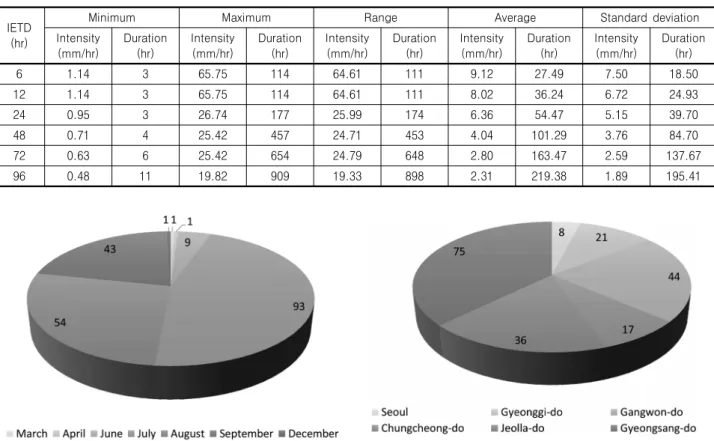
Table 1과 같다. 강우강도는 IETD가 증가할수록 감소하 고 최솟값과 최댓값의 차이가 감소하여 해당 범위가 작 아지며, 표준편차가 감소하므로 IETD가 증가할수록 강 우강도의 산포도가 작다. 강우지속시간은 IETD가 증가 할수록 증가하고 최솟값과 최댓값의 차이가 증가하여 해당 범위가 증가하였으며, 표준편차는 증가하므로 IETD 가 증가할수록 강우지속시간의 산포도는 크게 나타났 다. 산사태는 Fig. 5와 같이 7월에 93건으로 가장 많이 발생하였으며, 대부분이 7∼9월에 집중된 것으로 나타 났고, 산지가 많은 강원도와 경상도에서 많이 발생한 것 으로 나타났다.
3.2 선행강우를 고려한 ID curve 제안 및 분석
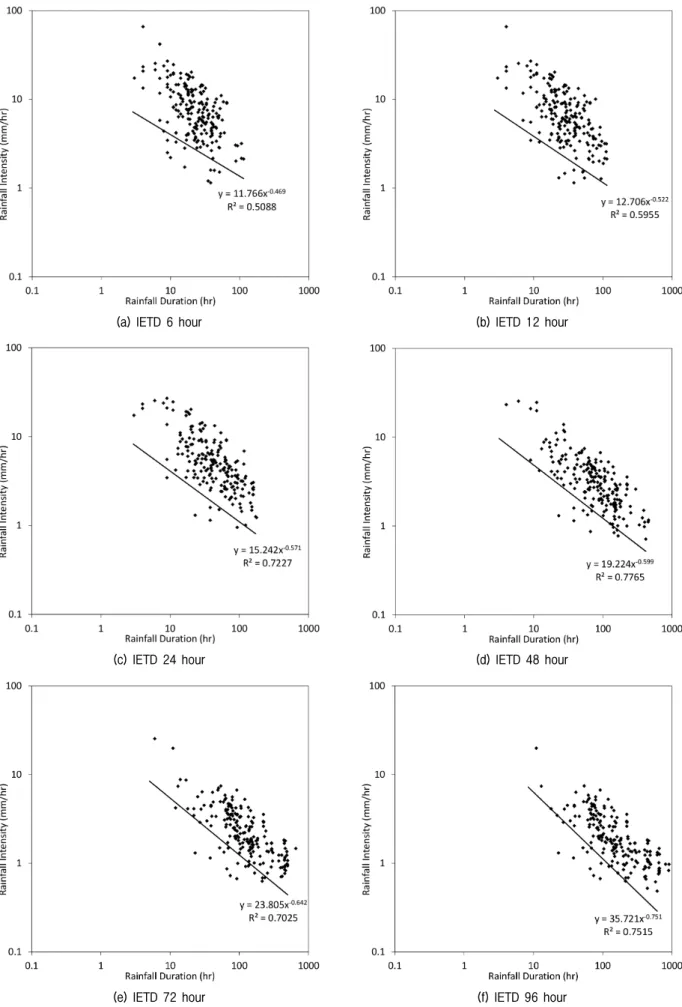
선행강우를 고려하기 위해 IETD 6, 12, 24, 48, 72, 96시간에 따라 각각 유효누적강우와 강우지속시간을 결 정하여 강우강도를 산정하고, 강우강도-강우지속시간 기 준(ID curve)을 구하였다. 강우강도(I)-강우지속시간(D) 관계식은 일정 강우지속시간을 갖는 데이터 중 최소 강 우강도를 갖는 값들의 회귀분석을 통해 Eq. (2)와 같이
거듭제곱 형태로 나타내어 구하였다. 최솟값을 이용한 강우기준은 산사태 발생을 예측하기위해 일반적으로 사용되는 방법으로 평균값 혹은 최댓값을 이용한 강우 기준과 비교했을 때, 과다예측 가능성이 높지만 산사태 예측률이 높기 때문에 산사태 유발강우기준으로 적합 하다고 판단된다. IETD에 따른 ID curve는 Fig. 6과 같 고, 강우강도(I)와 강우지속시간(D)의 관계식은 Table 2 와 같이 정리하였다.
앞서 언급한 바와 같이 IETD는 산사태 발생에 대하 여 선행강우의 영향이 지속되는 시간으로, IETD가 증 가할수록 선행강우의 영향이 크다는 것을 의미한다. Fig.
(a) IETD 6 hour (b) IETD 12 hour
(c) IETD 24 hour (d) IETD 48 hour
(e) IETD 72 hour (f) IETD 96 hour
Fig. 6. Obtained rainfall threshold using regression analysis
Fig. 7. Proposed ID curve with various IETDs
(a) value (b) value
Fig. 8. Relationship between IETD and fitting parameters using regression analysis
Table 3. Fitting parameters of ID curve equations
IETD
6 11.766 0.469
12 12.706 0.522
24 15.242 0.571
48 19.224 0.599
72 23.805 0.642
96 35.721 0.751
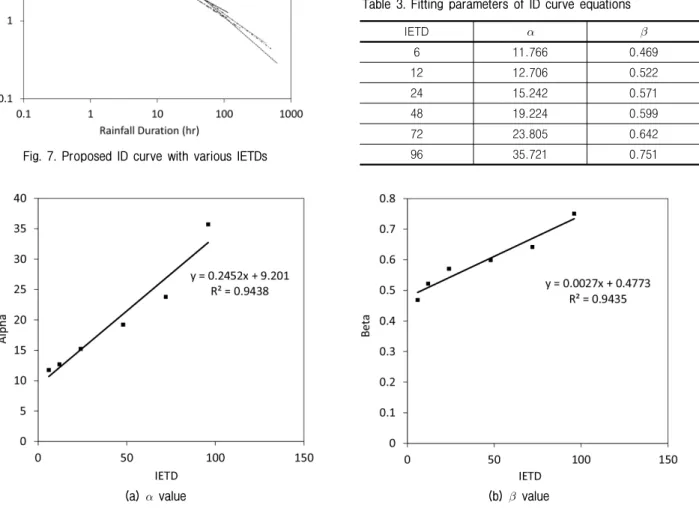
7은 앞서 제안된 ID curve를 도시한 것으로, IETD가 증 가할수록 ID curve의 기울기가 증가하는 것으로 나타났 다. 강우지속시간이 짧은 경우에는 선행강우의 영향이 큰 IETD 96시간 기준에서 강우강도가 크게 나타났으 며, 강우지속시간이 긴 경우에는 IETD 96시간 기준에 서 강우강도가 작게 나타났다. 이는 선행강우의 영향 을 크게 보았을 때, 강우지속시간이 짧고 선행강우가 거의 없는 단기강우의 경우에는 비교적 큰 강우강도에 서 산사태가 발생할 가능성이 높고, 강우지속시간이 길고 선행강우가 많은 장기강우의 경우에는 비교적 작 은 강우강도에서도 산사태가 발생할 가능성이 있음을 의미한다.
ID curve는 보정계수 가 증가할수록 상향이동하며,
가 증가할수록 기울기가 커진다. Table 3과 같이 앞서 제안된 강우강도(I)와 강우지속시간(D)의 관계식에서 보정계수 , 를 IETD에 따라 정리하였으며, Fig. 8과 같이 IETD와 보정계수 , 의 관계를 그래프에 도시하 였다. 회귀분석을 통해 IETD와 보정계수 사이의 관계 는 Eq. (5)와 같이 나타낼 수 있고, Eq. (5)를 Eq. (2)에 대입하면, IETD에 따른 강우강도(I)와 강우지속시간(D) 의 관계를 Eq. (6)과 같이 나타낼 수 있다.
(5a)
(5b)
× (6)
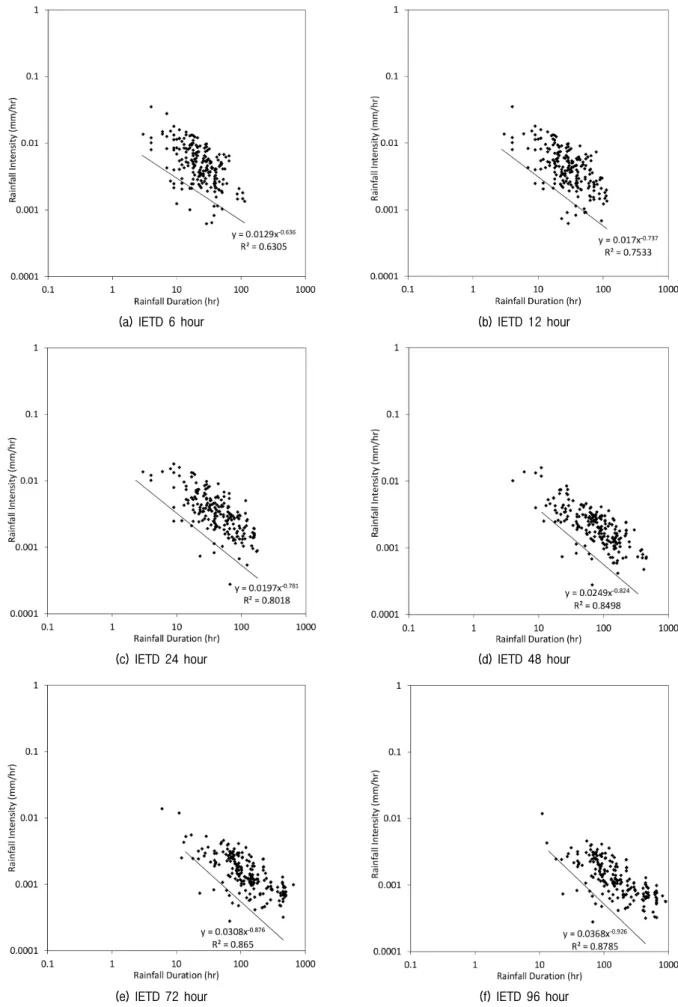
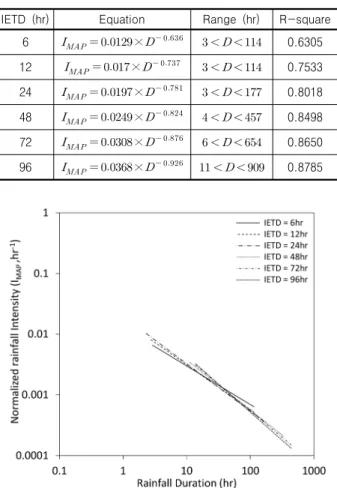
같은 방법으로 연평균강수량으로 일반화된 ID curve 는 Fig. 9와 같고, 일반화된 강우강도(IMAP)와 강우지속 시간(D)의 관계식은 Table 4와 같이 정리하였다. 제안 된 ID curve를 모두 도시하면 Fig. 10과 같고, 앞선 결과
(a) IETD 6 hour (b) IETD 12 hour
(c) IETD 24 hour (d) IETD 48 hour
(e) IETD 72 hour (f) IETD 96 hour
Fig. 9. Obtained rainfall threshold using regression analysis (normalized)
Table 4. Normalized ID curve equations
IETD (hr) Equation Range (hr) R-square
6 × 0.6305 12 × 0.7533 24 × 0.8018 48 × 0.8498 72 × 0.8650 96 × 0.8785
Fig. 10. Proposed ID curve according to various IETDs (normalized)
(a) value (b) value
Fig. 11. Relationship between IETD and fitting parameters using regression analysis (normalized)
Table 5. Fitting parameters of ID curve equations (normalized)
IETD
6 0.0129 0.636
12 0.0170 0.737
24 0.0197 0.781
48 0.0249 0.824
72 0.0308 0.876
96 0.0368 0.926
와 마찬가지로 IETD가 증가할수록 기울기가 증가하는 것으로 나타났다. Table 5는 일반화된 강우강도(IMAP)와 강우지속시간(D)의 관계식에서 보정계수 , 를 IETD 에 따라 정리한 것이고, Fig. 11은 IETD와 보정계수 ,
의 관계를 그래프에 도시한 것이다. 회귀분석을 통해 산정된 관계식은 Eq. (7)과 같고, Eq. (7)을 Eq. (3)에 대 입하면, IETD에 따른 일반화된 강우강도(IMAP)와 강우 지속시간(D)의 관계는 Eq. (8)과 같이 나타낼 수 있다.
(7a)
(7b)
× (8)
4. 비교분석 및 고찰
4.1 국내외 ID curve와 비교
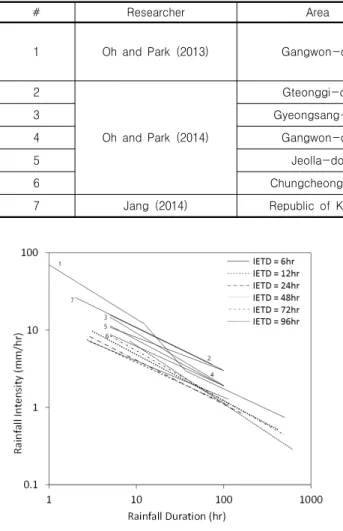
본 절에서는 제안된 ID curve를 기존에 국내에서 제 안된 강우기준과 비교하기 위하여 Fig. 12와 같이 국내 연구자들이 제안한 산사태 유발강우기준(Table 6 참조) 과 함께 그래프에 도시하였다. Oh and Park(2013)은 강
Fig. 12. Comparative analysis of ID curve with existing studies (national)
Table 6. Various ID curve proposed by existing research (national)
# Researcher Area Equation Range
1 Oh and Park (2013) Gangwon-do
× ,
× ,
×
,
,
2
Oh and Park (2014)
Gteonggi-do × -
3 Gyeongsang-do × -
4 Gangwon-do × -
5 Jeolla-do × -
6 Chungcheong-do × -
7 Jang (2014) Republic of Korea × -
Fig. 13. Comparative analysis of ID curve with existing studies (international)
Fig. 14. Comparative analysis of ID curve with existing studies (normalized)
원도 지역의 산사태 발생이력과 강우자료를 바탕으로 강우지속시간에 따라 변화하는 강우기준을 제안하였으 며, 2014년도에는 전국을 5개 권역으로 구분하여 각각 의 강우기준을 제안하였다. Jang(2014)은 2006년부터 2013년까지 국내에서 발생한 산사태 자료를 이용하여 강우기준을 제안하였다. 비교 결과, 기존의 강우기준과 달리 본 연구에서 제안된 ID curve는 IETD가 증가함에 따라 기울기가 증가하여 선행강우를 고려할 수 있는 것 으로 판단된다.
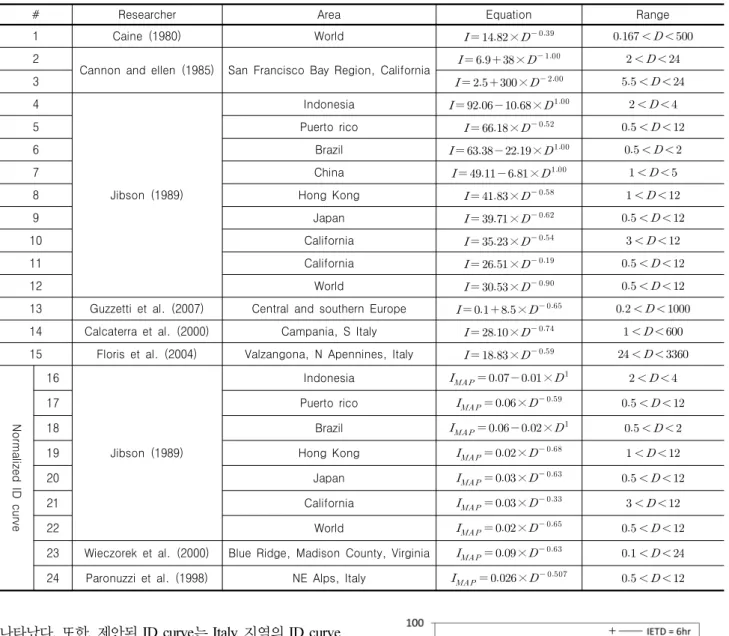
또한, 국외의 ID curve와 비교하기 위해 Fig. 13, 14와 같이 국외 연구자들이 제안한 다양한 산사태 유발 강우 기준들(Table 7 참조)과 함께 그래프에 도시하였다. 비 교 결과, 지형, 지질 및 기후 특성에 따라 다른 지역의 ID curve와 제안된 ID curve는 차이를 보였으며, 제안된 ID curve는 비교적 낮은 강우강도에서 산사태가 유발된 다고 예측하고 있다. 이는 국내 산림이 경사가 급하고 응집력이 낮은 풍화토 비중이 높아 낮은 강우강도에서
도 산사태에 취약하기 때문으로 판단된다. 또한, 국내의 경우 강우지속시간이 매우 짧은 단기강우보다 비교적 긴 강우지속시간에 의한 산사태가 다수 발생한 것으로
Table 7. Various ID curve proposed by existing research (international)
# Researcher Area Equation Range
1 Caine (1980) World ×
2 Cannon and ellen (1985) San Francisco Bay Region, California ×
3 ×
4
Jibson (1989)
Indonesia ×
5 Puerto rico ×
6 Brazil ×
7 China ×
8 Hong Kong ×
9 Japan ×
10 California ×
11 California ×
12 World ×
13 Guzzetti et al. (2007) Central and southern Europe ×
14 Calcaterra et al. (2000) Campania, S Italy ×
15 Floris et al. (2004) Valzangona, N Apennines, Italy ×
Normalized ID curve
16
Jibson (1989)
Indonesia ×
17 Puerto rico ×
18 Brazil ×
19 Hong Kong ×
20 Japan ×
21 California ×
22 World ×
23 Wieczorek et al. (2000) Blue Ridge, Madison County, Virginia ×
24 Paronuzzi et al. (1998) NE Alps, Italy ×
Fig. 15. Validation of proposed ID curve
나타났다. 또한, 제안된 ID curve는 Italy 지역의 ID curve 와 유사한 경향을 보였으며, 일반화된 경우 Hong Kong 지역과 유사한 것으로 나타났다.
4.2 산사태발생 예측에 대한 유효성 검토
Fig. 15와 같이 국립재난안전연구원으로부터 얻은 2014 년도에 발생한 5개 산사태 재해이력을 이용하여 본 연 구에서 제안된 ID curve가 산사태 유발을 예측할 수 있 는지 검토하였다. IETD를 6시간에서 96시간까지 변화 시키면서 분석하였으며, 검토 결과, 2014년도에 발생한 5개 산사태 당시의 강우가 ID curve를 초과하여 제안된 ID curve가 산사태 유발을 잘 예측할 수 있는 것으로
판단된다. 5. 결 론
본 연구에서는 강우강도, 강우기간을 이용하여 강우
와 산사태 발생관계를 정의할 수 있는 산사태 유발강우 기준을 제시하였다. 1999년부터 2013년까지 국내에서 발생한 202개의 산사태에 대하여, 기상청 강우자료를 바탕으로 산사태 발생 시점 이전의 시강우량 데이터를 이용하여 산사태 유발강우기준을 설정하고 분석하였다.
특히 2014년도에 국내 산사태 재해이력을 이용하여 검 토한 결과, 본 연구에서 제안된 ID curve가 산사태 유발 을 비교적 적절히 예측함을 알 수 있었다. 본 연구결과, 다음과 같은 결론을 얻을 수 있었다.
(1) 객관적이고 합리적인 유발강우기준을 제시하기 위 하여 통계적 기법인 회귀분석을 이용하여 강우강도 및 강우기간을 분석하고, 선행강우의 영향을 고려 하기 위하여 IETD를 6, 12, 24, 48, 72, 96시간으로 구분하여 각각의 IETD별 산사태 유발강우기준을 제안하였다.
(2) IETD는 산사태 발생에 대하여 선행강우의 영향이 지 속되는 시간으로 해석할 수 있으며, 분석결과 IETD 가 증가할수록 선행강우의 영향이 커지므로 ID curve 의 기울기가 증가하는 것으로 나타났다.
(3) 제안된 ID curve를 국외의 ID curve와 비교한 결과, 지형, 지질 및 기후 특성에 따라 다른 지역의 ID curve와 제안된 ID curve는 차이를 보였으며, 제안 된 ID curve는 비교적 낮은 강우강도에서 산사태가 유발되었다.
(4) 지역별 기후특성(연평균강수량, MAP)으로 일반화된 ID curve 또한 제안되었으며, 국외의 연구결과와 비교 한 결과, 앞선 결과와 마찬가지로 제안된 ID curve가 비교적 낮은 강우강도에서 산사태가 유발되었다.
(5) 제안된 ID curve는 Italy 지역의 ID curve와 유사한 경향을 보였으며, 일반화된 경우 Hong Kong 지역 과 유사한 것으로 나타났다.
감사의 글
본 연구는 2015년도 정부(미래창조과학부)의 재원으 로 한국연구재단(No. 2011-0030040)의 지원을 받아 수 행되었으며, 이에 깊은 감사를 드립니다.
참고문헌 (References)
1. Adams, B. J. and Papa, F. (2001), “Urban Stormwater Management
Planning with Analytical Probabilistic Models”, Canadian Journal of Civil Engineering, 28(3), pp.545.
2. Aleotti, P. (2004), “A Warning System for Rainfall-induced Shallow Failures”, Engineering Geology, 73(3), pp.247-265.
3. Associated ministries of South Korean government (2013), Abnormal Climate Report. Korean government, 11-1360000-000705-11.
4. Borga, M., Dalla Fontana, G., and Cazorzi, F. (2002), “Analysis of Topographic and Climatic Control on Rainfall-triggered Shallow Landsliding Using a Quasi-dynamic Wetness Index”, Journal of Hydrology, 268(1), pp.56-71.
5. Caine, N. (1980), “The Rainfall Intensity-duration Control of Shallow Landslides and Debris Flows”, Geogr Ann A 62, 23-27.
6. Campbell, R. H. (1975), Soil slips, debris flows, and rainstorms in the Santa Monica Mountains and vicinity, southern California (No. 851). US Govt. Print. Off.
7. Cannon, SH. and Ellen, SD. (1985), “Rainfall Conditions for Abundant Debris Avalanches, San Francisco Bay Region, California”, Calif Geol 38, pp. 267-272.
8. Chatterjea, K. (1989), Observations on the fluvial and slope processes in Singapore and their impact on the urban environment. Doctoral dissertation, Department of Geography, Faculty of Arts & Social Sciences, National University of Singapore.
9. Cho, S. E. and Lee, S. R. (2000), “Slope Stability Analysis of Unsaturated Soil Slopes due to Rainfall Infiltration”, Journal of the Korean Geotechnical Society, 16(1), pp.51-64.
10. Chung, J. H., Lee, J. S., and Park, S. H. (2010), “Analysis on a Minimum Period Without Rainfall in Mountainous Catchment”, Conference of Korea Water Resource Association. pp.1630.
11. Corominas, J. (2000), Landslides and climate. Keynote lecture. In:
Proc. 8th Int. Symp. on Landslides (Bromhead E, Dixon N, IbsenML, eds), vol. 4. Cardiff: A.A. Balkema, pp.1-33.
12. Crosta, GB. and Frattini, P. (2001), Rainfall thresholds for triggering soil slips and debris flow. In: Proc. 2nd EGS Plinius Conf. on Mediterranean Storms (Mugnai A, Guzzetti F, Roth G, eds). Siena, pp.463-487.
13. Dahal, R. K. and Hasegawa, S. (2008), “Representative Rainfall Thresholds for Landslides in the Nepal Himalaya”, Geomorphology, 100(3), pp.429-443.
14. Fourie, A. B., Rowe, D., and Blight, G. E. (1999), “The Effect of Infiltration on the Stability of the Slopes of a Dry Ash Dump”, Geotechnique, 49(1), pp.1-13.
15. Giannecchini, R. (2005), Rainfall triggering soil slips in the southern Apuane Alps (Tuscany, Italy). Adv Geosci 2, pp.21-24.
16. Govi, M. and Sorzana, PF. (1980), “Landslide susceptibility as function of critical rainfall amount in Piedmont basin (Northwestern Italy)”, Studia Geomorphologica Carpatho-Balcanica, 14, pp.43-60.
17. Guidicini, G. and Iwasa, O. Y. (1977), “Tentative Correlation between Rainfall and Landslides in a Humid Tropical Environment”, Bulletin of the International Association of Engineering Geology- Bulletin de l’Association Internationale de Géologie de l’Ingénieur, 16(1), pp.13-20.
18. Guzzetti, F., Peruccacci, S., Rossi, M., and Stark, C. P. (2007),
“Rainfall thresholds for the initiation of landslides in central and southern Europe”, Meteorology and atmospheric physics, 98(3-4), pp.239-267.
19. Hong, Y., Hiura, H., Shino, K., Sassa, K., Suemine, A., Fukuoka, H., and Wang, G. (2005), “The Influence of Intense Rainfall on
the Activity of Large-scale Crystalline Schist Landslides in Shikoku Island, Japan”, Landslides 2(2), pp.97-105.
20. Ikeya, H. (1989), “Debris Flow and its Countermeasures in Japan”, Bulletin of the International Association of Engineering Geology- Bulletin de l'Association Internationale de Géologie de l'Ingénieur, 40(1), pp.15-33.
21. Innes, JL. (1983), Debris flows, Prog Phys Geog 7, pp.469-501.
22. Jang, C. B. (2014), A Study on Behavior Characteristics and Scale of Debris Flow in Korea, M.S. Thesis, Kangwon National University.
23. Jeong, S. S., Choi, J. Y., and Lee, J. H. (2009), “Stability Analysis of Unsaturated Weathered Soil Slopes Considering Rainfall Duration”, Journal of the Korean Society of Civil Engineers, 29(1C), pp.1-9.
24. Jeong, S. S., Kim, J. H., Kim, Y. M., and Bae, D. H. (2014), Susceptibility assessment of landslides under extreme-rainfall events using hydro-geotechnical model; a case study of Umyeonsan (Mt.), Korea. Natural Hazards and Earth System Sciences Discussions, 2(8), pp.5575-5601.
25. Jibson, RW. (1989), Debris flow in southern Porto Rico. Geological Society of America, special paper 236, pp.29-55.
26. Kanji, MA., Massad, F., Cruz, PT. (2003), “Debris Flows in Areas of Residual Soils: Occurrence and Characteristics”, Int. Workshop on Occurrence and Mechanisms of Flows in Natural Slopes and Earthfills. Iw-Flows2003, Sorrento: Associacione Geotecnica Italiana 2, pp.1-11.
27. Kim, J. H., Jeong, S. S., Kim, Y. M., and Lee, K. W. (2013),
“Proposal of Design Method for Landslides Considering Antecedent Rainfall and In-situ Matric Suction”, Journal of the Korean Geotechnical Society, 29(12), pp.11-24.
28. Kim, J. H., Jeong, S. S., and Regueiro, R. A. (2012), “Instability of Partially Saturated Soil Slopes due to Alteration of Rainfall Pattern”, Engineering Geology, 147, pp.28-36.
29. Korea Forest Service (2010), Countermeasure for forest disaster in the summer season, Korea Forest Service Report, pp.21.
30. Lee, S. R., Oh, T. K., Kim, Y. K., and Kim, H. C. (2009), “Influence of Rainfall Intensity and Saturated Permeability on Slope Stability during Rainfall Infiltration”, Journal of the Korean Geotechnical Society, 25(1), pp.65-76.
31. Liao, Z., Hong, Y., Kirschbaum, D., Adler, R. F., Gourley, J. J., and Wooten, R. (2011), Evaluation of TRIGRS (transient rainfall infiltration and grid-based regional slope-stability analysis)’s predictive skill for hurricane-triggered landslides: a case study in Macon County, North Carolina. Natural hazards, 58(1), pp.325-339.
32. Ng, C. W. W. and Shi, Q. (1998), “A Numerical Investigation of the Stability of Unsaturated Soil Slopes Subjected to Transient Seepage”, Computers and geotechnics, 22(1), pp.1-28.
33. Oh, J. and Park, H. J. (2013), “Establishment of Landslide Rainfall Threshold for Risk Assessment in Gangwon Area”, Journal of Korean Society of Hazard Mitigation, 13(3), pp.43-51.
34. Oh, J. and Park, H. J. (2014), “Analysis of Landslide Triggering Rainfall Threshold for Prediction of Landslide Occurrence”, Journal
of Korean Society of Hazard Mitigation, 14(2), pp.115-129 35. Onodera, T., Yoshinaka, R., and Kazama, H. (1974), Slope failures
caused by heavy rainfall in Japan. In: Proc. 2nd Int. Congress of the Int Ass Eng Geol, vol. 11. San Paulo 11, pp.1-10.
36. Paronuzzi, P., Coccolo, A., and Garlatti, G. (1998), Eventi meteorici critici e debris flows nei bacini montani del Friuli. L’Acqua, Sezione I=Memorie, pp.39-50.
37. Rahardjo, H., Li, X. W., Toll, D. G., and Leong, E. C. (2001),
“The Effect of Antecedent Rainfall on Slope Stability”, Geotechnical
& Geological Engineering, 19(3-4), pp.371-399.
38. Rahimi, A., Rahardjo, H., and Leong, E. C. (2010), “Effect of Antecedent Rainfall Patterns on Rainfall-induced Slope Failure”, Journal of Geotechnical and Geoenvironmental Engineering, 137(5), pp.483-491.
39. Restrepo-Posada, P. J. and Eagleson, P. S. (1982), Identification of Independent Rainstorms, Journal of Hydrology, 55(1), pp.303-319.
40. Song, Y. K., Kim, Y. U., and Kim, D. W. (2013), “Recommendation of ID Criterion for Steep-Slope Failure Estimation Considering Rainfall Infiltration Mechanism”, Journal of the Korean Geotechnical Society, 29(5), pp.65-74.
41. Tan, S. B., Tan, S. L., Lim, T. L., and Yang, K. S. (1987), Landslide problems and their control in Singapore. In Proceedings of the 9th Southeast Asian Geotechnical Conference, Bangkok, Thailand, 1, pp.25-36.
42. Tatizana, C., Ogura, M., Rocha, M., and Cerri, LES. (1987), Analise de correlacao entre chuvas e escorregamentos, Serra do Mar, Municipio de Cubatao. Proc. 5th Congress Brasiler, Geol Eng San Paolo, pp.225-236.
43. Wei, J., Heng, Y. S., Chow, W. C., and Chong, M. K. (1991), Landslide at Bukit Batok sports complex. In Proceedings of the 9th Asian Regional/Geotechnical Conference.
44. Wieczorek, G. F. and Glade, T. (2005), Climatic factors influencing occurrence of debris flows, In Debris-flow hazards and related phenomena, pp.325-362. Springer Berlin Heidelberg.
45. Wilson, R. C. (1989), Rainstorms, pore pressures, and debris flows:
a theoretical framework. Landslides in a semi-arid environment, 2nd edn. Publications of the Inland Geological Society, California, pp.101-117.
46. Wilson, RC., Torikai, JD., Ellen, SD. (1992), Development of rainfall thresholds for debris flows in the Honolulu District, Oahu. US Geological Survey Open-File Report, 45, pp.92-521.
47. Yune, C. Y., Jun, K. J., Kim, K. S., Kim, G. H., and Lee, S. W.
(2010), “Analysis of slope hazard-triggering rainfall characteristics in Gangwon province by database construction”, Journal of the Korean Geotechnical Society, 26(10), pp.27-38.
Received : January 22nd, 2016 Revised : March 8th, 2016 Accepted : April 14th, 2016